- Forecast Value (2036): 30.5 Bn
- CAGR (2036): 5.6%
Performance Silicones Market Forecast and Outlook By Fact.MR
The performance silicones market stood at USD 16.8 billion in 2025 and is on track to reach USD 17.7 billion in 2026, expanding to USD 30.5 billion by 2036 at a CAGR of 5.6%. Elastomers is forecast to lead product type at 31.9% share in 2026. Automotive and Mobility holds the largest end use industry position at 24.1%, with Thermal Management leading applications at 21.8% in 2026. The underlying growth story is not complex: every major technology trend of the current decade creates either heat, electrical load, miniaturization pressure, or biocompatibility requirements, and silicone chemistry is disproportionately equipped to handle all four. That is why this market is simultaneously widening into new applications and deepening into more technically demanding versions of existing ones.
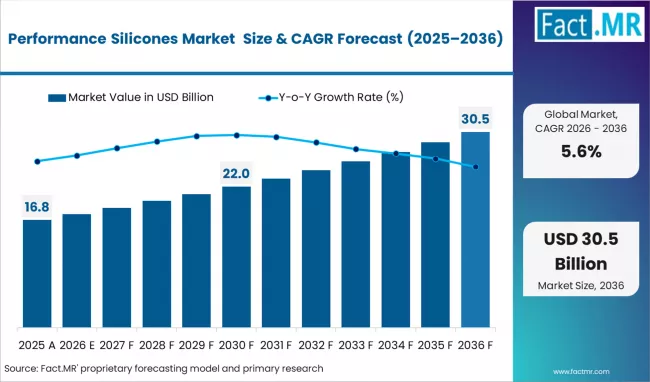
Performance Silicones Market Market Value Analysis | Source: Fact.MR
Key Drivers
- Electrification Tailwind: EV batteries, power electronics, and vehicle sensors are driving expanded demand for thermal management and protective silicone systems.
- Reliability Demand: Electronics, healthcare, and industrial users consistently favor silicones where long-term stability matters more than low upfront material cost.
- Application Breadth: The same chemistry platform can serve elastomers, fluids, gels, coatings, and specialty additives across multiple performance-critical industries.
Key Segments Analyzed in the Report
- Product Type: Elastomers, Fluids, Resins, Gels, Emulsions, And Others
- End Use Industry: Automotive And Mobility, Construction, Electronics, Healthcare, Personal Care, And Others
- Application: Thermal Management, Sealants And Adhesives, Release Coatings, Medical Components, Personal Care Formulation, And Others
- Region: North America, Latin America, Europe, Asia Pacific, And Middle East & Africa
Analyst Opinion
Shambhu Nath Jha, Principal Consultant, Fact.MR says performance silicones keep winning where failure costs more than the material price. As devices become hotter, denser, smaller, and more regulated, silicones shift from optional formulation aid to critical reliability material. The more stringent the operating environment, the less the conversation is about price and the more it is about whether the material can be trusted over a decade of use.
Performance Silicones Market Definition
The performance silicones market covers specialty silicone materials engineered for high-value functional uses, including thermal management, sealing, protection, release, biocompatible components, and advanced formulation roles across industrial and consumer applications.
Performance Silicones Market Inclusions
- Revenue from specialty silicone elastomers, fluids, resins, gels, emulsions, and related high-performance silicone materials.
- Applications spanning mobility, electronics, healthcare, construction, personal care, and other performance-critical markets.
- Demand across North America, Latin America, Europe, Asia Pacific, and the Middle East & Africa.
Performance Silicones Market Exclusions
- Low-value commodity filler systems where silicone functionality is not the primary source of value.
- General inorganic silicon materials that are not silicone-based polymers or formulations.
- Finished consumer product revenue beyond the silicone material content under study.
Performance Silicones Market Research Methodology
This study evaluates the performance silicones market across product type, end use industry, application, and region, using 2025 as the base year and 2026 to 2036 as the forecast period. Market value is expressed in USD billion. Evidence inputs include first-party product portfolios, annual reports, and end-market positioning from Dow, WACKER, Shin-Etsu Chemical, Momentive, and Elkem, combined with adoption signals from automotive, electronics, and healthcare applications. Triangulation aligns specialty silicone penetration, application-value density, end-use production trends, and premium pricing to derive segment and regional estimates.
Key Drivers, Restraints, and Trends in Performance Silicones Market
Drivers
Performance silicones are expanding because many advanced systems now operate under higher heat loads, tighter space constraints, and longer service-life expectations. That favors materials that can insulate, seal, cushion, coat, or manage heat without degrading rapidly. Silicones have become deeply embedded in these roles because few alternatives offer the same balance of flexibility, temperature stability, and electrical performance.
Restraints
The market still faces price sensitivity and qualification drag. Silicones often outperform cheaper alternatives, but not every application can justify the premium. High-spec uses in healthcare, electronics, and mobility require lengthy validation cycles that slow substitution and make supplier switching costly.
Trends
Product development is moving toward application-specific silicone systems over broad generic grades. Thermal interface materials for EVs, advanced encapsulants for electronics, and cleaner silicone ingredients for beauty and healthcare are all growing. Sustainability is entering the discussion through lower-carbon silicones and more circular manufacturing strategies.
Segmental Analysis
Performance Silicones Market Analysis by Product Type
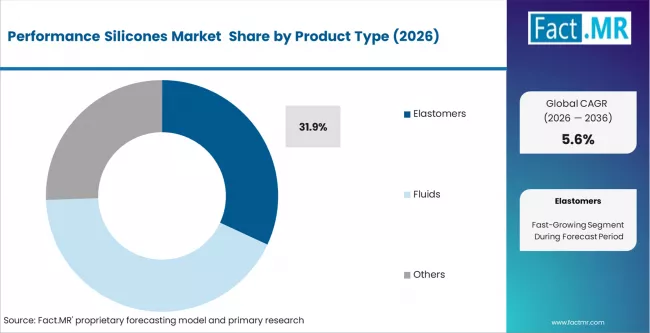
Performance Silicones Market Analysis By Product Type | Source: Fact.MR
The Elastomers segment is expected to lead the product type category with a 31.9% share in 2026. Elastomers lead because they carry silicone value into the widest set of performance uses, from medical tubing and gaskets to EV protection components and industrial sealing systems. Their combination of flexibility, thermal resilience, and durability makes them one of the most commercially entrenched silicone formats.
Performance Silicones Market Analysis by End Use Industry
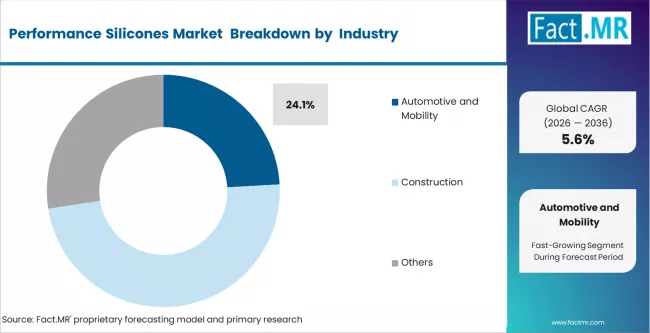
Performance Silicones Market Analysis By End Use Industry | Source: Fact.MR
The Automotive and Mobility segment is expected to lead the end use industry category with a 24.1% share in 2026. Automotive and mobility lead because modern vehicles consume silicones across sealing, thermal management, potting, electronic protection, lighting, and interior durability applications. Electrified platforms increase that relevance by adding battery and power-electronics needs that reward silicone chemistry.
Competitive Aligners for Market Players
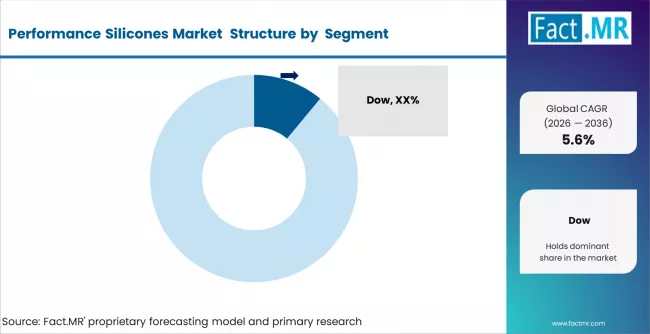
Performance Silicones Market Analysis By Company | Source: Fact.MR
Performance silicones are a specification-driven market, which means competitive advantage is built over years, not quarters. A supplier earns its place in a customer's qualified materials list through a sustained track record of consistency, technical support, and problem-solving in real production conditions. That is why the major players in this market, Dow, WACKER, Shin-Etsu, Momentive, and Elkem, have held their positions through multiple technology cycles. Their moat is not patents or price. It is accumulated application knowledge and the trust that comes from never being the material that caused a line shutdown.
The thermal management application is reshaping competitive dynamics in a meaningful way. EV battery pack designs require thermal interface materials that perform predictably across thousands of charge cycles at elevated temperatures, and the qualification requirements are far more stringent than for conventional automotive sealing or gasket applications. Suppliers that have invested in EV-specific thermal silicone product lines and have secured early battery-pack qualifications are in a structurally stronger position than those relying on adapted versions of existing products.
For smaller and mid-tier silicone producers, the competitive path is through specialization rather than breadth. Trying to match the full-range catalog of a Shin-Etsu or Dow is not a viable strategy. What is viable is owning a narrow application segment deeply enough that customers cannot afford to switch. Medical-grade silicones, advanced release coatings for lithography, or ultra-pure silicone fluids for semiconductor processing are examples of niches where deep technical know-how and regulatory history create durable, high-margin positions that scale does not automatically disrupt.
Key Players in Performance Silicones Market
- Dow
- WACKER
- Shin-Etsu Chemical
- Momentive
- Elkem
- KCC Silicone
- Evonik
- Siltech
- BRB International
- Innospec
Strategic Outlook by Fact.MR on Performance Silicones Market
Fact.MR expects performance silicones to remain one of the more resilient specialty-material categories because they sit inside long-duration technology and reliability trends across multiple end markets. Growth should be strongest where electrification, electronics density, medical safety, and demanding industrial service environments continue to rise. The companies best positioned are those that are deepening application expertise in growth verticals today, because the qualification cycles are long and the window to get on the list is not always open.
Bibliography
- Momentive. (n.d.). Automotive and mobility.
- Momentive. (n.d.). Healthcare and pharmaceuticals.
- Momentive. (n.d.). Silicones for automotive electronics.
- Wacker Chemie AG. (2024). Wacker Chemie AG annual report 2024.
- Dow. (n.d.). Fascinating silicones.
- Elkem. (2025). Elkem to showcase battery material solutions and silicone recycling pilot plant at International Battery Seminar 2025.
- Shin-Etsu Chemical Co., Ltd. (2025). Sustainability report 2025
Segmentation
Scope of the Report
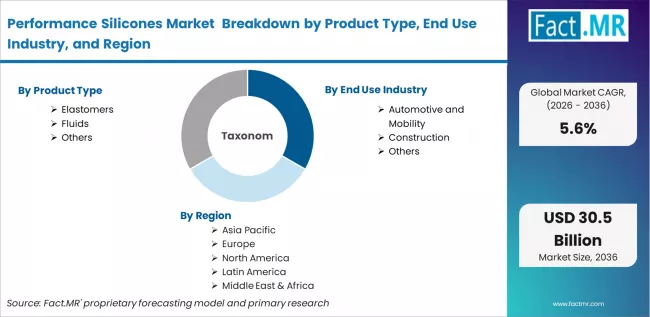
Performance Silicones Market Breakdown By Product Type, End Use Industry, And Region | Source: Fact.MR
| Metric | Value |
|---|---|
| Market Value | USD 16.8 billion in 2025 to USD 30.5 billion by 2036 |
| CAGR | 5.6% from 2026 to 2036 |
| Base Year | 2025 |
| Forecast Period | 2026 to 2036 |
| Product Type Segmentation | Elastomers, Fluids, Resins, Gels, Emulsions, Others |
| End Use Industry Segmentation | Automotive and Mobility, Construction, Electronics, Healthcare, Personal Care, Others |
| Application Segmentation | Thermal Management, Sealants and Adhesives, Release Coatings, Medical Components, Personal Care Formulation, Others |
| Regional Coverage | North America, Latin America, Europe, Asia Pacific, and Middle East & Africa |
Source: Fact.MR analysis. Updated Mar 16, 2026
Frequently Asked Questions
What is the projected size of the Performance Silicones Market by 2036?
What is the CAGR of the Performance Silicones Market from 2026 to 2036?
Which product type segment leads the Performance Silicones Market?
Which end use industry segment dominates the Performance Silicones Market?
Which application segment leads the Performance Silicones Market?
Who are the key companies in the Performance Silicones Market?
What is driving demand in the Performance Silicones Market?
Who worked on this report


Preview the report firsthand - request a free sample
Free SampleGet the brochure for pricing and purchase details
Download PDF