- Forecast Value (2036): 32.5 Bn
- CAGR (2036): 30.9%
What is the pet longevity and geriatric pet care services market forecast to be worth by 2036?
USD 2.2 billion in 2026 to USD 32.5 billion by 2036, at 30.9% CAGR.
- The pet longevity and geriatric pet care services market surpassed a valuation of USD 1.7 billion in 2025.
- Demand is set to increase from USD 2.2 billion in 2026 to USD 32.5 billion by 2036.
- The market is forecast to record 30.9% CAGR during 2026 to 2036 as senior-pet care plans and end-of-life services become routine parts of companion animal care.
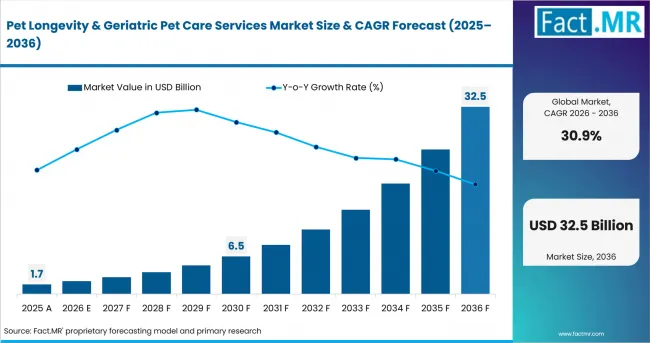
Pet Longevity & Geriatric Pet Care Services Market Value Analysis | Source: Fact.MR
What are the defining numbers behind pet longevity and geriatric pet care services growth?
USD 30.3 billion absolute opportunity by 2036, led by Japan and the United States.
- Demand Drivers in the Market
- Pet owners need structured care as senior dogs and cats develop age-related conditions.
- Veterinary clinics need new service lines around healthspan, mobility and chronic care.
- Insurers need preventive care models that reduce late-stage treatment costs.
- Longevity drug candidates create demand for screening, counseling and monitoring services.
- Key Segments Analyzed
- By Service Type: Senior-Pet Care Plans are expected to hold 35.0% share in 2026 because recurring monitoring creates the core service base.
- By Pet Type: Senior Dogs lead because longevity drug innovation and mobility care first focus on dogs. The share is projected at 46.0% in 2026.
- By Customer Type: Pet Owners and Families are likely to account for 48.0% share in 2026 because they directly fund care decisions.
- By Delivery Model: Subscription Geriatric Care Plans lead as owners seek predictable care. The model is projected to hold 38.0% share in 2026.
- By End Use: Chronic Disease and Quality-of-Life Support is expected to hold 37.0% share in 2026 because aging pets need repeated monitoring.
- By Geography: Japan is projected to record 34.3% CAGR through 2036 as aging pets and insurance-led preventive care support senior-pet services.
- Analyst Opinion at Fact.MR
- Shambhu Nath Jha, Senior Analyst at Fact.MR, states, “Pet longevity is becoming a structured care-services market rather than only a biotech opportunity. Owners want senior pets to stay comfortable, mobile and closely monitored for longer. Providers that combine geriatric veterinary care, diagnostics and compassionate end-of-life support will gain stronger access to premium pet health spending.”
- Strategic Implications
- Veterinary clinics should create senior-pet plans before longevity drugs enter routine practice.
- Pet insurers need preventive and geriatric care models that support earlier intervention.
- Diagnostic providers should connect genetic and chronic-disease markers with care plans.
- Mobile veterinary providers can grow through palliative and end-of-life support for senior pets.
Pet longevity services form the core of this market. These services include veterinary longevity clinics, senior-pet care plans, anti-aging drug support and end-of-life care. Loyal stated in 2026 that FDA accepted the Target Animal Safety section of its Expanded Conditional Approval application for LOY-002, its senior dog lifespan-extension drug candidate. [1] This creates a new service layer around screening and owner counseling for aging companion animals.
Loyal also stated in 2025 that LOY-002 received FDA acceptance for reasonable expectation of efficacy. [2] This supports demand for veterinary education, owner counseling and care-continuity services as longevity therapeutics move closer to commercial use.
Japan is projected to record 34.3% CAGR from 2026 to 2036 as aging pets and insurance-led preventive care support senior-pet services. The United States is likely to post 33.1% CAGR as pet-as-family spending and longevity drug support services expand. South Korea is expected to register 31.8% CAGR because companion animal humanization and senior pet care demand are rising. Germany is forecast to advance at 30.9% CAGR by 2036 as Europe’s senior-pet base supports geriatric care plans. The United Kingdom is set to record 30.2% CAGR as insured pets and palliative care services expand.
How does the pet longevity and geriatric pet care services market break down by segment?
Senior-Pet Care Plans lead at 35.0%; Senior Dogs lead at 46.0%.
Which service type dominates?
Senior-Pet Care Plans hold 35.0% share in 2026.
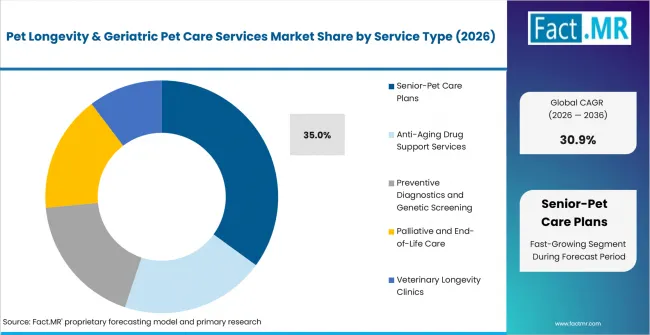
Pet Longevity & Geriatric Pet Care Services Market Analysis By Service Type | Source: Fact.MR
Senior-Pet Care Plans are expected to hold 35.0% share in 2026 because recurring monitoring creates the core service base. The work includes wellness exams, pain review, lab checks, dental monitoring and mobility planning. AVMA states that older pets may develop age-related problems and that good care can help them live happy and active lives. [3] These plans lead because owners need repeated support rather than single-visit treatment.
Which pet type dominates?
Senior Dogs lead because longevity drug innovation and mobility care first focus on dogs.
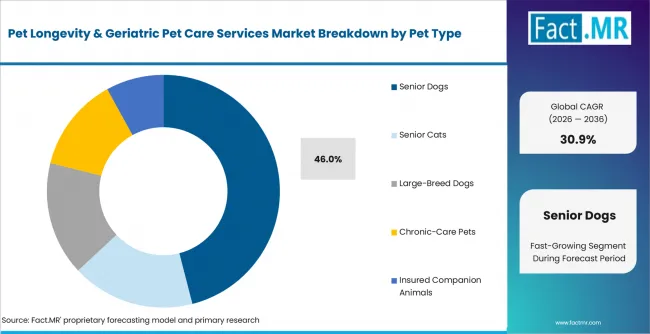
Pet Longevity & Geriatric Pet Care Services Market Analysis By Pet Type | Source: Fact.MR
Senior Dogs lead because canine longevity drug development and geriatric mobility care are becoming visible purchase triggers. The pet type is projected to capture 46.0% share in 2026 as owners seek support for arthritis and chronic conditions. Dog-focused services can scale through clinics, diagnostics and insurer programs.
Which customer type dominates?
Pet Owners and Families hold 48.0% share in 2026.
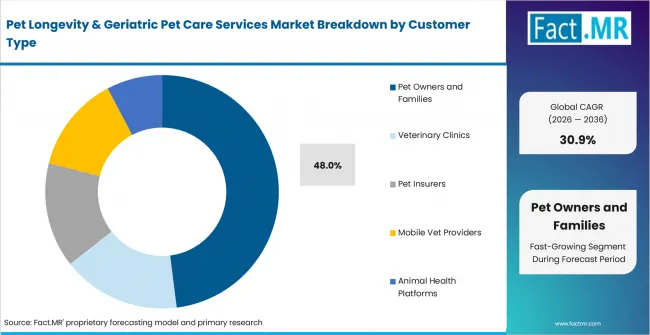
Pet Longevity & Geriatric Pet Care Services Market Analysis By Customer Type | Source: Fact.MR
Pet Owners and Families are likely to account for 48.0% share in 2026 because senior-pet decisions are usually funded at household level. APPA stated that 95 million U.S. households owned pets in 2025. [4] Owners increasingly treat pets as family members and seek higher-quality care during aging. This customer group leads because service demand begins with owner willingness to pay for comfort, mobility and healthspan.
Which delivery model dominates?
Subscription Geriatric Care Plans lead because owners seek predictable care.
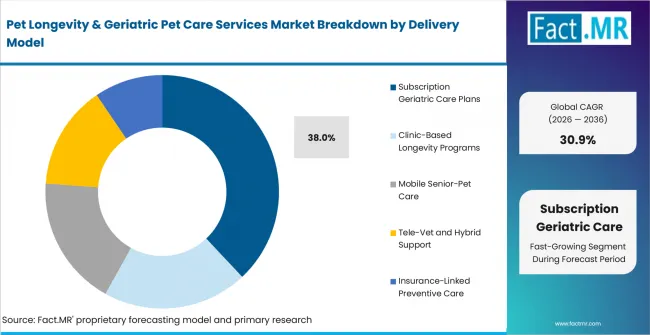
Pet Longevity & Geriatric Pet Care Services Market Analysis By Delivery Model | Source: Fact.MR
Subscription Geriatric Care Plans lead because aging pets need scheduled monitoring and regular follow-up. The model is projected to hold 38.0% share in 2026 as clinics package exams and care navigation. Subscription plans also help owners manage costs across chronic disease and mobility support.
Which end use dominates?
Chronic Disease and Quality-of-Life Support holds 37.0% share in 2026.
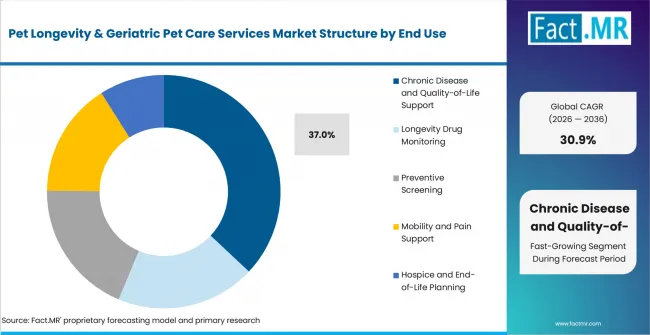
Pet Longevity & Geriatric Pet Care Services Market Analysis By End Use | Source: Fact.MR
Chronic Disease and Quality-of-Life Support leads because older pets often need ongoing help with pain, organ health, cognition and mobility. The end use is expected to hold 37.0% share in 2026 as care shifts toward comfort and functional ability. Service providers support this end use through checkups and owner education.
What is accelerating pet longevity and geriatric pet care demand, and what is holding it back?
Longevity drug progress, senior-pet demographics and pet-as-family spending drive demand; affordability restrains adoption.
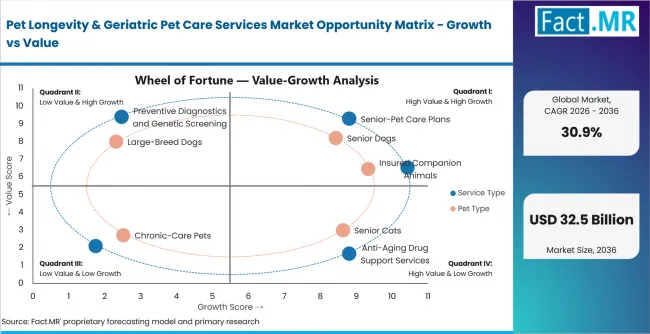
Pet Longevity & Geriatric Pet Care Services Market Opportunity Matrix Growth Vs Value | Source: Fact.MR
Longevity drug progress is the main driver. Loyal stated in 2025 that LOY-002, its senior dog longevity program, received formal FDA acceptance for reasonable expectation of efficacy and owners a clearer signal that canine longevity support may become a clinical service category.
The main restraint is affordability. Senior-pet care can include diagnostics and end-of-life services. Owners without insurance may delay care. Providers must package services in clear plans and show quality-of-life benefits before adoption can scale across middle-income households.
Where do the biggest pet longevity and geriatric pet care opportunities sit?
Senior care plans, longevity drug support and palliative care.
- Senior Care Plans: Clinics can package exams, diagnostics and chronic care into recurring programs.
- Longevity Drug Support: Providers can prepare screening and monitoring pathways for future canine longevity therapies.
- Palliative Care: Mobile and clinic-based teams can support comfort-focused care and end-of-life planning.
Which countries are scaling pet longevity and geriatric pet care services fastest?
Japan 34.3%, United States 33.1%, South Korea 31.8%, Germany 30.9%, United Kingdom 30.2%.
Based on regional analysis, the pet longevity and geriatric pet care services market is segmented into East Asia, North America, Western Europe, Asia Pacific, Latin America, and Middle East and Africa.
.webp "Top Country Growth Comparison Pet Longevity & Geriatric Pet Care Services Market Cagr (2026 2036)")
Top Country Growth Comparison Pet Longevity & Geriatric Pet Care Services Market Cagr (2026 2036) | Source: Fact.MR
| Country | CAGR |
|---|---|
| Japan | 34.3% |
| United States | 33.1% |
| South Korea | 31.8% |
| Germany | 30.9% |
| United Kingdom | 30.2% |
Source: Fact.MR analysis. Updated Jun 22, 2026
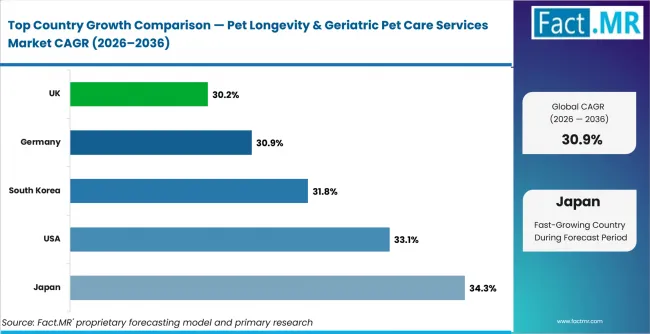
Pet Longevity & Geriatric Pet Care Services Market Cagr Analysis By Country | Source: Fact.MR
What is powering Japan’s lead?
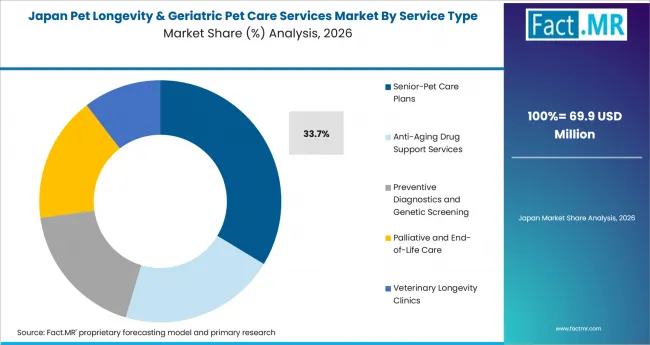
Pet Longevity & Geriatric Pet Care Services Market Japan Market Share Analysis By Service Type | Source: Fact.MR
Japan is projected to record 34.3% CAGR through 2036 as aging pets and insurance-led preventive care support senior-pet services. Japanese owners often invest in long-term care for aging dogs and cats. Senior-pet clinics and hospice services can gain as older animals need repeated support. Demand will favor providers that combine insurance and owner education for aging companion animals.
How is the United States scaling pet longevity services?
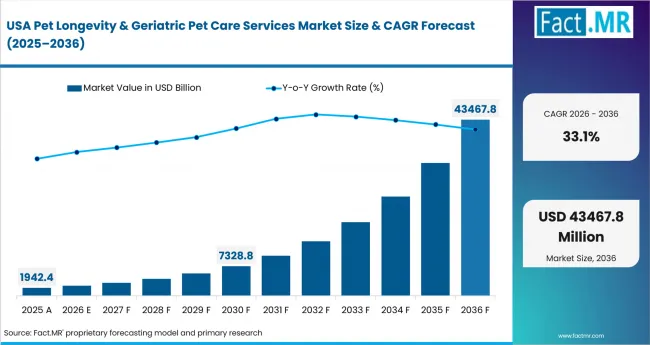
Pet Longevity & Geriatric Pet Care Services Market Country Value Analysis | Source: Fact.MR
The United States is likely to gain strong demand as pet-as-family spending and longevity drug support services expand. The country is expected to post 33.1% CAGR through 2036. Loyal’s canine longevity work gives the market a clear innovation catalyst. Veterinary clinics can build senior wellness plans and owner counseling around aging.
What underpins South Korea’s growth?
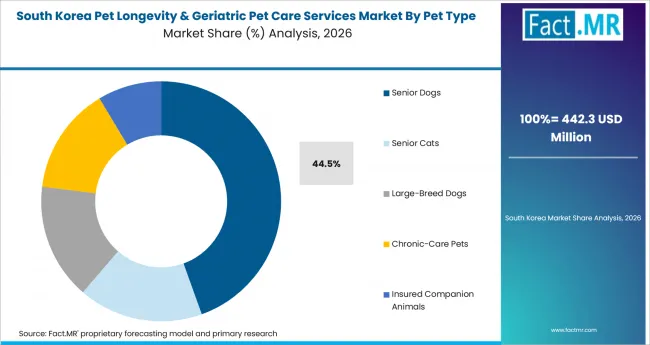
Pet Longevity & Geriatric Pet Care Services Market South Korea Market Share Analysis By Pet Type | Source: Fact.MR
South Korea is expected to register 31.8% CAGR through 2036 because companion animal humanization and senior pet care demand are rising. Pet owners are increasingly using clinics, insurance and wellness services for dogs and cats. Aging pets create demand for chronic disease care, mobility support and home-based end-of-life services. Service providers can gain by building geriatric care packages and digital follow-up.
What supports Germany’s outlook?
Germany is forecast to advance at 30.9% CAGR through 2036 as Europe’s senior-pet base supports geriatric care plans. German owners need structured support for chronic disease, mobility and preventive diagnostics. Veterinary groups can grow through recurring senior-pet plans and palliative care. Demand will favor clinically governed services that help owners make quality-of-life decisions. Insured care and premium veterinary networks will support adoption.
How is the United Kingdom scaling geriatric pet care demand?
The United Kingdom is set to record 30.2% CAGR through 2036 as insured pets and palliative care services expand. Senior dogs and cats need more frequent monitoring for pain, dental disease and chronic conditions. At-home services can help pets that are stressed by travel or have mobility problems. Pet insurers can support preventive care and early intervention. Demand will favor providers that combine clinic visits and compassionate end-of-life planning for aging companion animals.
Who leads the pet longevity and geriatric pet care services landscape?
Loyal and Gallant lead through longevity therapeutics and regenerative pet health.
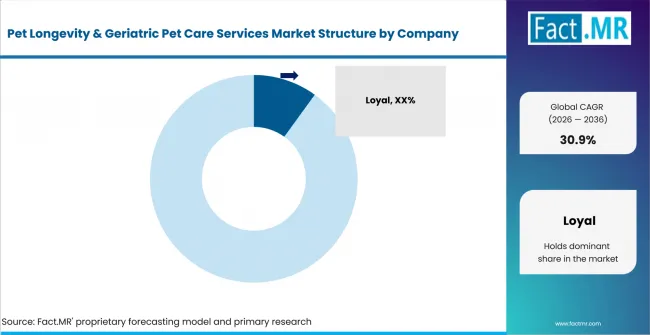
Pet Longevity & Geriatric Pet Care Services Market Analysis By Company | Source: Fact.MR
Pet longevity and geriatric pet care services are used by owners, veterinary clinics and insurers that need structured support for aging companion animals. Loyal is developing canine longevity drugs and preparing the clinical path for senior dog lifespan-extension support. Embark Veterinary provides genetic and age-related testing that can help owners and veterinarians understand life stage and risk. Gallant supports regenerative medicine through ready-to-use stem cell therapies for pets.
Anicom supports Japan’s pet health ecosystem through insurance and pet-health innovation. Competition through 2036 will depend on clinical trust, care-plan design and owner affordability.
Providers that combine diagnostics with recurring senior care will be better placed. Longevity biotech firms can create new veterinary support needs. Mobile and telehealth platforms can support senior pets with mobility limits. Insurers can encourage early monitoring and preventive care through plan design.
Which companies are the key players?
Loyal, Embark Veterinary, Gallant, and Anicom.
- Loyal
- Embark Veterinary
- Gallant
- Anicom Holdings, Inc. / Anicom Insurance
Bibliography
- [1] McKenzie, B. (2026, January 13). One step closer to a dog longevity drug: What LOY-002’s safety milestone means to a practicing vet. Loyal Animal Health.
- [2] Halioua, C. (2025, February 26). Not just for big dogs! Our senior dog program receives preliminary FDA efficacy acceptance (RXE). Loyal Animal Health.
- [3] American Veterinary Medical Association. (n.d.). Caring for senior cats and dogs.
- [4] American Pet Products Association. (2026, March 26). U.S. pet industry reaches $158 billion in 2025, poised for continued growth in 2026.
This Report Addresses
- Strategic intelligence on pet longevity and geriatric pet care services across service type, pet type and customer type.
- Segment analysis covering Senior-Pet Care Plans, Senior Dogs, Pet Owners and Families, Subscription Geriatric Care Plans and Chronic Disease Support.
- Regional outlook covering Japan, United States, South Korea, Germany and United Kingdom.
- Competitive analysis of Loyal, Embark Veterinary, Gallant, and Anicom.
- Service assessment covering veterinary longevity clinics, preventive diagnostics, anti-aging drug support and end-of-life care.
- Pet-type assessment covering senior dogs, senior cats, large-breed dogs and chronic-care pets.
- Primary interviews, provider checks, official source review and senior-pet care validation support the forecast.
What does the pet longevity and geriatric pet care services market cover?
Specialized services that support longer, healthier lives for senior dogs and cats.
The pet longevity and geriatric pet care services market covers veterinary and wellness services focused on aging companion animals. It includes longevity clinics and palliative services. The market differs from broad veterinary services because the focus is healthspan and age-related care continuity.
What is included in the scope?
Geriatric veterinary care and end-of-life services.
The scope includes senior-pet checkups and pain management. It covers veterinary longevity drug support and follow-up testing. It includes preventive diagnostics and mobility support. It also includes palliative care and at-home end-of-life services for dogs and cats.
What is excluded from the scope?
Routine veterinary care without senior-pet or longevity focus.
The scope excludes general veterinary visits with no geriatric or longevity component. It excludes pet food and retail products unless delivered through a care service. It excludes drug manufacturing and biotechnology research unless clinical support services are included. It also excludes broad pet insurance unless the service supports senior-pet care planning or preventive care.
How was the analysis built?
100+ sources, 45+ company portfolios, 25+ countries, 20+ interviews.
- Primary Research: Primary research includes interviews with veterinary clinic operators and pet insurance leaders. It includes input from longevity biotech teams and mobile palliative care providers.
- Desk Research: Desk research reviews FDA-linked canine longevity milestones and senior-pet population sources. It covers official provider pages and pet health service disclosures.
- Market-Sizing and Forecasting: Forecasting uses senior dog and cat populations and veterinary service intensity. Longevity drug support and palliative care demand support the market assessment.
- Data Validation and Update Cycle: Forecasts are validated through provider checks and veterinary service review. Pet ownership updates and animal health innovation milestones help confirm market direction.
Segmentation
What is the report’s scope and coverage?
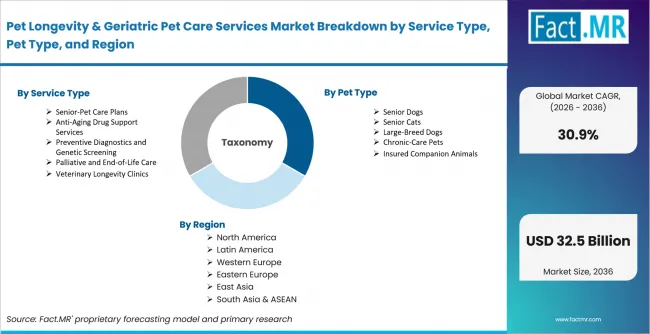
Pet Longevity & Geriatric Pet Care Services Market Breakdown By Service Type, Pet Type, And Region | Source: Fact.MR
| Attribute | Details |
|---|---|
| Quantitative Units | USD Billion in services in 2026 to USD Billion by 2036 |
| Market Definition | Veterinary longevity clinics, senior-pet care plans and end-of-life services for aging companion animals |
| Service Type | Veterinary Longevity Clinics, Senior-Pet Care Plans, Anti-Aging Drug Support Services, Preventive Diagnostics and Genetic Screening, Palliative and End-of-Life Care |
| Pet Type | Senior Dogs, Senior Cats, Large-Breed Dogs, Chronic-Care Pets, Insured Companion Animals |
| Customer Type | Pet Owners and Families, Veterinary Clinics, Pet Insurers, Mobile Vet Providers, Animal Health Platforms |
| Delivery Model | Subscription Geriatric Care Plans, Clinic-Based Longevity Programs, Mobile Senior-Pet Care, Tele-Vet and Hybrid Support, Insurance-Linked Preventive Care |
| End Use | Chronic Disease and Quality-of-Life Support, Longevity Drug Monitoring, Preventive Screening, Mobility and Pain Support, Hospice and End-of-Life Planning |
| Regions Covered | East Asia, North America, Western Europe, Asia Pacific, Latin America, Middle East and Africa |
| Countries Covered | Japan, United States, South Korea, Germany, United Kingdom |
| Key Companies Profiled | Loyal, Embark Veterinary, Gallant, and Anicom |
| Forecast Period | 2026 to 2036 |
| Approach | Hybrid top-down and bottom-up approach using senior-pet populations, pet ownership, service adoption, insurance participation, longevity therapy readiness and provider validation |
Source: Fact.MR analysis. Updated Jun 22, 2026
How is the market segmented?
-
By Service Type:
- Veterinary Longevity Clinics
- Senior-Pet Care Plans
- Anti-Aging Drug Support Services
- Preventive Diagnostics and Genetic Screening
- Palliative and End-of-Life Care
-
By Pet Type:
- Senior Dogs
- Senior Cats
- Large-Breed Dogs
- Chronic-Care Pets
- Insured Companion Animals
-
By Customer Type:
- Pet Owners and Families
- Veterinary Clinics
- Pet Insurers
- Mobile Vet Providers
- Animal Health Platforms
-
By Delivery Model:
- Subscription Geriatric Care Plans
- Clinic-Based Longevity Programs
- Mobile Senior-Pet Care
- Tele-Vet and Hybrid Support
- Insurance-Linked Preventive Care
-
By End Use:
- Chronic Disease and Quality-of-Life Support
- Longevity Drug Monitoring
- Preventive Screening
- Mobility and Pain Support
- Hospice and End-of-Life Planning
-
Region:
- North America
- United States
- Canada
- Europe
- Germany
- United Kingdom
- France
- Italy
- Spain
- Asia Pacific
- Japan
- South Korea
- Australia
- Singapore
- China
- Latin America
- Brazil
- Mexico
- Chile
- Middle East & Africa
- GCC Countries
- South Africa
- Israel
- North America
Frequently Asked Questions
Which service type leads the Pet Longevity & Geriatric Pet Care Services Market?
Which country expands faster in the Pet Longevity & Geriatric Pet Care Services Market?
How does the United States perform in the Pet Longevity & Geriatric Pet Care Services Market?
How does South Korea perform in the Pet Longevity & Geriatric Pet Care Services Market?
How does Germany perform in the Pet Longevity & Geriatric Pet Care Services Market?
How does the United Kingdom perform in the Pet Longevity & Geriatric Pet Care Services Market?
What is the primary driver in the Pet Longevity & Geriatric Pet Care Services Market?
What is the main restraint in the Pet Longevity & Geriatric Pet Care Services Market?
Why are senior dogs important in this market?
Who worked on this report


Preview the report firsthand - request a free sample
Free SampleGet the brochure for pricing and purchase details
Download PDF