- Market Value (2025): USD 336.2 Mn
- Estimated Value (2026): USD 384.0 Mn
- Forecast Value (2036): USD 1451.3 Mn
- CAGR (2026-2036): 14.2%
What is the Photoactive Antimicrobial Packaging Additives Market forecast to be worth by 2036?
USD 384.0 million in 2026 to USD 1451.3 million by 2036 at a 14.2% CAGR.
- The Photoactive Antimicrobial Packaging Additives Market reached USD 336.2 million in 2025.
- Demand is projected to increase from USD 384.0 million in 2026 to USD 1451.3 million by 2036.
- As per Fact.MR analysis, the market is forecast to record 14.2% CAGR from 2026 to 2036 as film converters and food packers test light-activated microbial control for perishable foods.
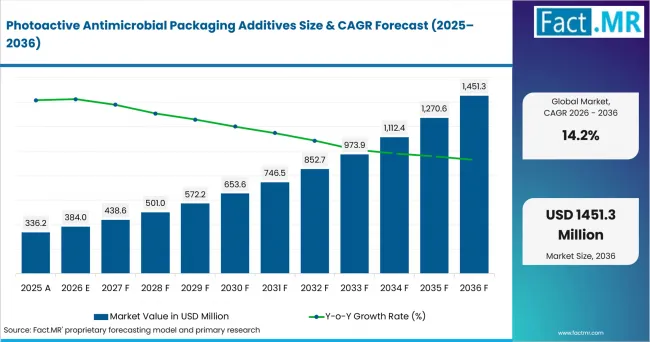
Photoactive Antimicrobial Packaging Additives Value Analysis | Source: Fact.MR
What are the defining numbers behind Photoactive Antimicrobial Packaging Additives Market growth?
USD 1,067.3 million absolute opportunity is expected between 2026 and 2036.
- Demand Drivers in the Market
- Meat and seafood companies use packaging to control microbes. Coatings and film additives add protection during cold storage.
- Packaging companies need materials that work during film making, coating, and sealing without affecting clarity or strength of the materials. They prefer additives that fit existing production methods.
- Food brands need packaging that meets food safety process and waste regulations. They also monitor microbe control and recycling in the choice of suppliers.
- Key Segments Analyzed
- By Active Platform: Photocatalytic oxide is expected to hold a 33.0% share in 2026 because it uses light to protect the package surface.
- By Activation: Visible light accounts for 39.0% share in 2026 as packages get more exposure to sunlight and retail lighting than UV light.
- By Packaging: Film captures39.0% share in 2026 since it covers more surface area and is widely used for fresh food and ready meals.
- By Food Use: Fresh produce leads with 34.0% share in 2026 because moisture and handling increase the risk of microbes.
- Analyst Opinion at Fact.MR
- Shambhu Nath Jha, Principal Consultant at Fact.MR, states, “Photoactive additives need light for food packaging process. Buyers choose additives that control microbes and meet the food-safety rules. Suppliers need the correct guidelines on light usage and production.”
- Strategic Implications
- Film makers can test clarity, sealing, and additive movement before using the material in food packaging.
- Food brands can choose additives based on spoilage risk and package type. The additive needs to control microbes under actual packaging conditions.
- Packaging companies need to keep recycling in mind when selecting materials. The Packaging and Packaging Waste Regulation came into force, with rules for recycling, less packaging and material reuse, the European Commission reported in February 2025. [1]
Denmark is expected to grow at 17.6% CAGR through 2036, followed by the USA at 15.1% and Japan at 14.5%. Germany follows at 13.8%, while the UK stands at 11.8%.
How does the Photoactive Antimicrobial Packaging Additives Market break down by segment?
Visible light and Film are projected to lead at 39.0% share each in 2026; Fresh produce leads Food Use at 34.0%.
Which Active Platform dominates?
Photocatalytic oxide is expected to hold 33.0% share in 2026.
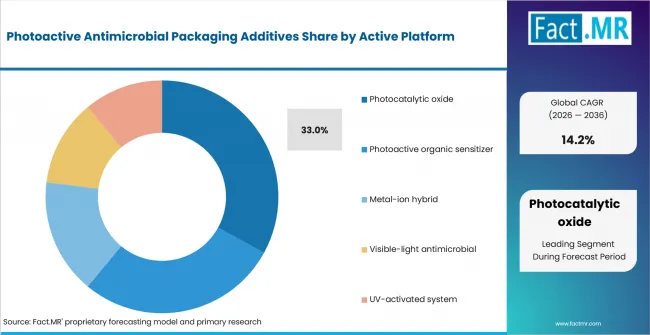
Photoactive Antimicrobial Packaging Additives Analysis By Active Platform | Source: Fact.MR
Photocatalytic oxides leading this segment because they use light to protect food packaging. Other options work with different light and mixing conditions. Buyers compare suppliers based on production performance and food safety. The packaging additive market also includes antimicrobial and other additives.
What leads the Activation segment?
Visible light accounts for 39.0% share in 2026.
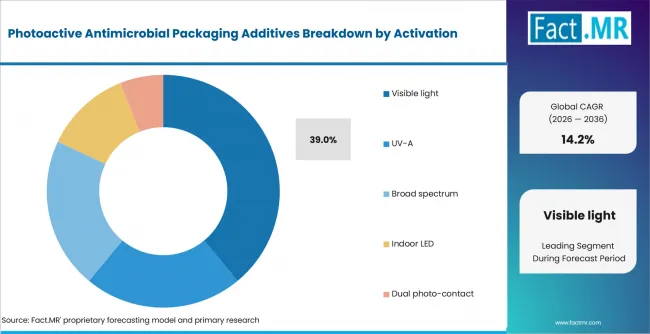
Photoactive Antimicrobial Packaging Additives Analysis By Activation | Source: Fact.MR
Visible light is expected to lead as food packages stay under indoor light for long periods. UV-A and broad-spectrum systems need different light conditions. Indoor LED and dual photo-contact systems are used for specific needs. Similar systems are also used in active and modified atmospheric packaging.
How does Packaging shape demand?
Film leads with 39.0% share in 2026.
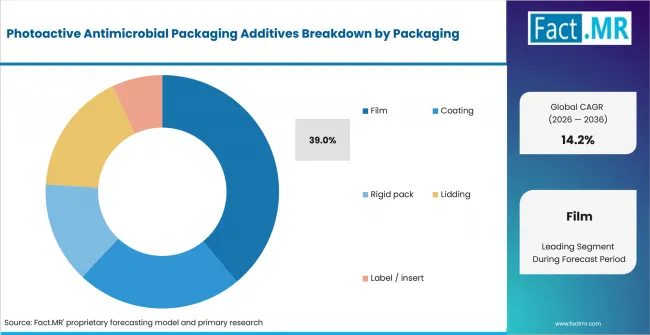
Photoactive Antimicrobial Packaging Additives Analysis By Packaging | Source: Fact.MR
Film is expected to lead because it keeps a large surface close to the food. Coatings add the same function to packaging materials, while rigid packs and lids use it in specific areas. Packaging companies also use anti-blocking agents to make films easier to handle.
What supports Fresh produce within Food Use?
Fresh produce is expected to hold 34.0% share in 2026.
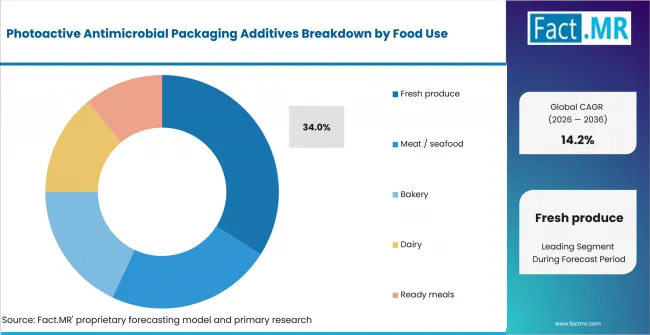
Photoactive Antimicrobial Packaging Additives Analysis By Food Use | Source: Fact.MR
Fresh produce is leading since exposure to moisture and handling can reduce the shelf life. Bakery and dairy products need different packaging and meat and seafood need cold storage in controlled conditions. Destatis reported in February 2026 that Germany harvested 4.5 million tonnes of vegetables in 2025.
What is accelerating Photoactive Antimicrobial Packaging Additives Market adoption, and what is holding it back?
Food safety and longer shelf life increase adoption, while approval costs and safety rules slow growth.
Drivers Impact Analysis
| DRIVER | (~) % IMPACT ON CAGR | GEOGRAPHIC RELEVANCE | IMPACT TIMELINE |
|---|---|---|---|
| Need for microbial control in perishable food | +1.7% | Global | Short term (<= 2 years) |
| Visible-light activation in retail environments | +1.3% | North America, Europe, East Asia | Medium term (2-4 years) |
| Converter demand for additive-based functionality | +1.0% | Global | Medium term (2-4 years) |
| Pressure to reduce spoilage and product loss | +0.8% | Global | Long term (>= 4 years) |
Opportunity Impact Analysis
| OPPORTUNITY | (~) % IMPACT ON CAGR | GEOGRAPHIC RELEVANCE | IMPACT TIMELINE |
|---|---|---|---|
| Low-haze active films for clear food packs | +1.1% | North America, Europe | Short term (<= 2 years) |
| LED-responsive additives for retail exposure | +0.9% | Europe, East Asia | Medium term (2-4 years) |
| Coatings for targeted active surfaces | +0.7% | Global | Medium term (2-4 years) |
Restraints Impact Analysis
| RESTRAINT | (~) % IMPACT ON CAGR | GEOGRAPHIC RELEVANCE | IMPACT TIMELINE |
|---|---|---|---|
| Food-contact authorization and migration testing | -0.9% | Global | Short term (<= 2 years) |
| Variable light exposure in real packages | -0.7% | Global | Medium term (2-4 years) |
| Added formulation and validation cost | -0.6% | North America, Europe, East Asia | Medium term (2-4 years) |
Which countries are scaling the Photoactive Antimicrobial Packaging Additives Market through 2036?
The displayed country range spans 5.8 percentage points from Denmark at 17.6% to the UK at 11.8%.
- Denmark remains 2.5 percentage points above the USA, supported by concentrated food manufacturing and close attention to package results.
- The USA remains 0.6 percentage point above Japan, reflecting its broad packaged-food base and large conversion network.
- Japan remains 0.7 percentage point above Germany, linked to its large food-processing base and detailed package approval practices.
- Germany remains 2.0 percentage points above the UK, shaped by food processing activity and packaging rules needs.
Comparable CAGRs can still produce different entry conditions. Food-contact rules, package recovery systems and the mix of packaged foods vary by country.
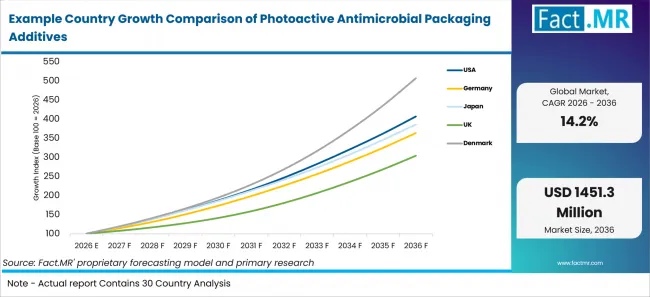
Example Country Growth Comparison Of Photoactive Antimicrobial Packaging Additives | Source: Fact.MR
| Country | CAGR (2026-2036) |
|---|---|
| Denmark | 17.6% |
| USA | 15.1% |
| Japan | 14.5% |
| Germany | 13.8% |
| United Kingdom | 11.8% |
What supports USA adoption?
15.1% CAGR, supported by packaged food and food safety needs.
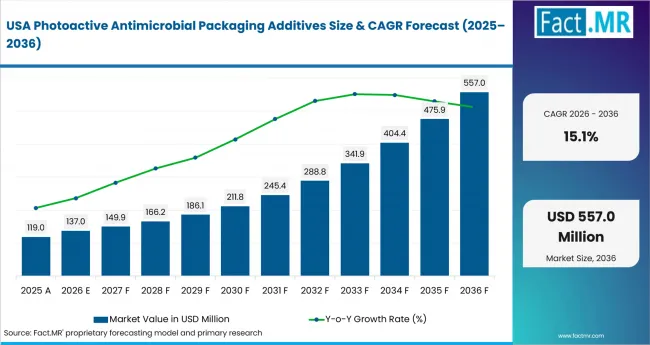
Photoactive Antimicrobial Packaging Additives Country Value Analysis | Source: Fact.MR
In the United States, food packaging companies use films and coatings on retail and foodservice products. New additives have to be compatible with these materials. In March 2026, the Centres for Disease Control and Prevention reported that four major pathogens cause approximately 1.9 million foodborne illnesses in the United States each year.
What supports Germany adoption?
13.8% CAGR, supported by food production and packaging rules.
Germany has a large food processing industry and strict food packaging regulations . Destatis reported in January 2026 that Germany produced 1.7 million tonnes of ready meals in 2024.
What supports Japan adoption?
14.5% CAGR, supported by food production and packaging checks.
Japan has strict standards on processed food quality and packaging. The U.S. Department of Agriculture Foreign Agricultural Service reported in April 2025 that Japan produced USD 174 billion worth of processed food in 2024.
What supports United Kingdom adoption?
11.8% CAGR, supported by food production and packaging needs.
Films and lids for chilled and prepared foods are supplied by UK packaging companies. In July 2026 the Office for National Statistics said that in 2025 food manufacturing accounted for 22.9% of the product sales of UK manufacturers. Photoactive additives can control microbes without affecting sealing, package clarity, or recycling.
What supports Denmark adoption?
17.6% CAGR, supported by food production and food safety.
Denmark’s food industry needs safe packaging for local sales and exports. Statistics Denmark notes that turnover in food, beverage and tobacco manufacturing was DKK 236.4 billion in 2025 in May 2026.
Who leads the Photoactive Antimicrobial Packaging Additives Market?
Avient offers antimicrobial additives under the name Cesa™ WithStand™ and offers a low-haze version for clear plastics. These additives control microbes while keeping the packaging clear and stable during production.
SylvitaTech and L&G Holding also supply antimicrobial systems. Buyers check if these systems work under the required light and with films, coatings, or rigid packaging.
NICHEM Solutions, Tosaf and NuviaChem provide antimicrobial and other packaging additives. Buyers check their effect on clarity, sealing, package strength, and food safety.
Buyers also consider light needs, food-contact rules, production, and recycling. The report separates photoactive antimicrobial suppliers from other packaging additive suppliers.
Which companies are the key providers?
Key companies include Avient, SylvitaTech, L&G Holding, NICHEM Solutions, Tosaf, and NuviaChem.
- Avient
- SylvitaTech
- L&G Holding
- NICHEM Solutions
- Tosaf
- NuviaChem
Bibliography
- European Commission. (2026, February 18). Commission presents action plan to strengthen the competitiveness and resilience of the chemicals industry.
- Avient Corporation. (2025, February 3). Cesa™ WithStand™ SX Low Haze antimicrobial additives now available for clear plastic applications.
- Statistics Denmark. (2026, May 13). Væksten i dansk industri fortsatte i 2025 [Growth in Danish industry continued in 2025].
- Office for National Statistics. (2026, July 24). UK manufacturers’ sales by product: 2025.
- U.S. Department of Agriculture, Foreign Agricultural Service. (2025, April 1). Japan: Food Processing Ingredients Annual (Report No. JA2025-0014).
- Statistisches Bundesamt (Destatis). (2026, January 14). Produktion von Fertiggerichten binnen fünf Jahren mengenmäßig um 25,6 % gestiegen [Production of ready meals increased by 25.6% in volume within five years].
- Interagency Food Safety Analytics Collaboration. (2026, March 30). Annual reports on foodborne illness source attribution estimates. Centers for Disease Control and Prevention.
- Statistisches Bundesamt (Destatis). (2026, February 26). Gemüseernte erreicht 2025 neuen Höchststand [Vegetable harvest reached a new record high in 2025].
- Directorate-General for Environment. (2025, February 11). New rules enter into force for a more sustainable and competitive packaging economy. European Commission.
- Zeballos, E., & Sinclair, W. (2026, June 11). Total U.S. food spending reached $2.51 trillion in 2025. U.S. Department of Agriculture, Economic Research Service.
This Report Answers
- The report explains use across active platform, activation, package format and food application.
- Segment analysis identifies the leading 2026 subsegments and the reasons behind their positions.
- Country analysis compares growth with current food, packaging and rule evidence.
- Competitive analysis separates direct antimicrobial polymer activity from broader packaging-additive participation.
- Application analysis examines light exposure, food-contact approval, optical results and recycling needs.
What does the Photoactive Antimicrobial Packaging Additives Market cover?
The market covers additives that give packaging an antimicrobial function after defined light exposure. They may be incorporated into polymers, masterbatches, coatings or functional layers used in food packaging.
The scope overlaps with packaging coatings and other functional barrier technologies used in food packs.
What is included in the scope?
The scope includes photocatalytic oxides, organic sensitizers, metal-ion hybrids and other visible-light or UV-activated systems used in film, coating, rigid packs, lidding or labels and inserts.
Adjacent formats include antimicrobial closures, flexible films and other active packaging structures.
What is excluded from the scope?
The scope excludes preservatives added directly to food, stand-alone UV sterilization equipment, cleaning products and passive barrier additives. It also excludes standard UV stabilizers and antibacterial films without a photoactivation mechanism.
How Was the Analysis Built?
The analysis draws on 120+ sources, 35+ company portfolios, 25+ countries, and more than 20 industry interviews.
- Primary Research: Primary research includes discussions with manufacturers, service providers, technology developers, distributors, end users, and subject-matter experts. These conversations examine purchasing priorities, product adoption, operational challenges, approval requirements, competitive positioning, and the factors that influence wider market acceptance.
- Desk Research: Desk research covers government statistics, regulatory publications, company filings, trade data, technical studies, industry associations, standards, public policy, and other authoritative sources. Every source used in the analysis is documented in the bibliography.
- Market Sizing and Forecasting: Market estimates combine historical performance, demand indicators, pricing and volume trends, segment shares, company participation, country-level growth, adoption patterns, investment activity, and barriers to market expansion.
- Data Validation and Update Cycle: Findings are validated by comparing primary interviews with public data, company activity, regulatory changes, trade patterns, and industry developments. Regular updates review new product launches, capacity changes, partnerships, approvals, and shifts in commercial adoption.
What is the report’s scope and coverage?
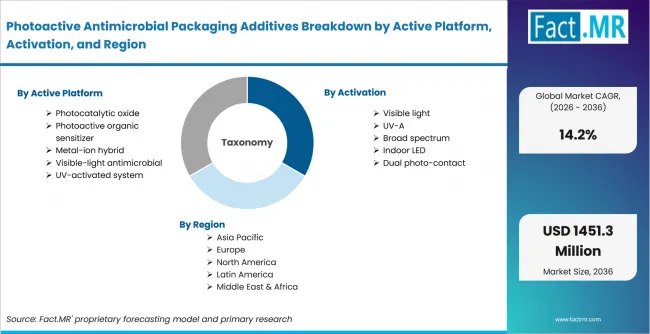
Photoactive Antimicrobial Packaging Additives Breakdown By Active Platform, Activation, And Region | Source: Fact.MR
| Attribute | Details |
|---|---|
| Quantitative Units | USD million |
| Market Definition | Additives incorporated into or applied to food packaging to provide antimicrobial activity after exposure to visible light, UV-A or another defined photoactivation condition. |
| Active Platform | Photocatalytic oxide; Photoactive organic sensitizer; Metal-ion hybrid; Visible-light antimicrobial; UV-activated system |
| Activation | Visible light; UV-A; Broad spectrum; Indoor LED; Dual photo-contact |
| Packaging | Film; Coating; Rigid pack; Lidding; Label / insert |
| Food Use | Fresh produce; Meat / seafood; Bakery; Dairy; Ready meals |
| Regions Covered | North America; Latin America; Western Europe; Eastern Europe; East Asia; South Asia & Pacific; Middle East & Africa |
| Countries Covered | USA; Germany; Japan; United Kingdom; Denmark |
| Key Companies Profiled | Avient; SylvitaTech; L&G Holding; NICHEM Solutions; Tosaf; NuviaChem |
| Forecast Period | 2026 to 2036 |
| Approach | Hybrid top-down and bottom-up approach using packaging conversion activity, food-use exposure, additive platform review, country evidence and provider portfolio validation. |
How is the market segmented?
-
By Active Platform:
- Photocatalytic oxide
- Photoactive organic sensitizer
- Metal-ion hybrid
- Visible-light antimicrobial
- UV-activated system
-
By Activation:
- Visible light
- UV-A
- Broad spectrum
- Indoor LED
- Dual photo-contact
-
By Packaging:
- Film
- Coating
- Rigid pack
- Lidding
- Label / insert
-
By Food Use:
- Fresh produce
- Meat / seafood
- Bakery
- Dairy
- Ready meals
-
By Region:
- North America
- Latin America
- Western Europe
- Eastern Europe
- East Asia
- South Asia & Pacific
- Middle East & Africa