- Market Value (2025): USD 790.9 Mn
- Estimated Value (2026): USD 870.0 Mn
- Forecast Value (2036): USD 2257.0 Mn
- CAGR (2026-2036): 10.0%
What is the Plant-Based Emollients Market forecast to be worth by 2036?
USD 870.0 million in 2026 to USD 2,257.0 million by 2036 at a 10.0% CAGR.
- The plant-based emollients market reached USD 790.9 million in 2025.
- Demand is projected to increase from USD 870.0 million in 2026 to USD 2,257.0 million by 2036.
- The market is forecast to record 10.0% CAGR from 2026 to 2036 as formulators replace selected petroleum-derived softeners with plant esters, bio-based oils, and functional blends.
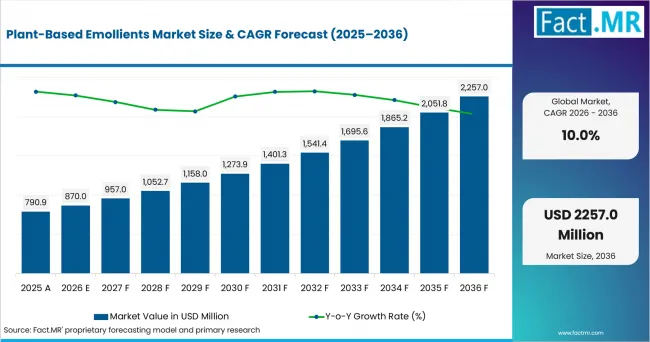
Plant Based Emollients Market Value Analysis | Source: Fact.MR
What are the defining numbers behind Plant-Based Emollients Market growth?
An absolute opportunity of USD 1,387.0 million is expected between 2026 and 2036.
- Demand Drivers in the Market
- Personal care formulators need renewable-origin emollients that improve glide and after-feel while preserving the base feel of creams, lotions, sunscreens, or hair products.
- Industrial-fluid developers need lubricity and thermal-stability inputs that reduce reliance on mineral-oil chemistry where biodegradability and low residue shape the buyer brief.
- U.S. Census Bureau data published through the Federal Reserve Bank of St. Louis showed seasonally adjusted U.S. health and personal care store sales of USD 40.372 billion in May 2026.
- USDA NASS reported 2025 U.S. soybean production at 4.26 billion bushels in January 2026, documenting the scale of domestic soybean output.
- Key Segments Analyzed
- By Product: Plant esters are expected to hold 36.0% share in 2026 because esterification turns vegetable fatty acids into ingredients with controlled sensory feel.
- By Function: Lubricity is projected to account for 38.0% share in 2026 since plant-derived esters can reduce friction in skin care and selected industrial fluids.
- By Application: Personal care is anticipated to represent 35.0% share in 2026 due to use in skin care, sun care, and hair care products.
- By Form: Liquid is estimated to capture 47.0% share in 2026 owing to easier dosing, blending, and cold-process compatibility across formulation lines.
- Analyst Opinion at Fact.MR
- Shambhu Nath Jha, Principal Consultant at Fact.MR, states, “Plant-based emollients are drawing attention because they solve formulation performance and labeling problems at the same time. Demand is expected to move toward suppliers that can prove renewable origin and sensory performance at the same time. The most capable portfolios combine ester chemistry, oil sourcing, stability testing, and application support in one commercial package.”
- Strategic Implications
- Ingredient suppliers should document feedstock origin, natural-origin content, and sensory performance so product-development teams can defend plant-based claims during formula approval.
- Personal care brands should test plant esters against silicone and mineral-oil benchmarks because replacement decisions depend on skin feel and absorption in the final product.
- Industrial-fluid formulators should validate lubricity, oxidation control, and thermal behavior before switching to bio-based oils in high-duty applications.
- Distributors should keep liquid and concentrate grades close to formulation centers because short sample cycles influence supplier selection in personal care and specialty applications.
The USA is projected to post 11.0% CAGR through 2036, supported by personal care retail scale and oilseed availability. Germany is estimated to advance at 10.5% as specialty chemistry capacity supports local formulation work. Japan is forecast to record 9.8% as e-commerce and premium skin care channels sustain ingredient rotation. France is anticipated to reach 9.4% due to beauty exports and origin-controlled positioning. Brazil is projected to register 9.0% as oilseed scale and beauty exports keep local sourcing relevant.
How does the Plant-Based Emollients Market break down by segment?
Plant esters lead Product at 36.0%; Liquid leads Form at 47.0%.
Which Product segment dominates?
Plant esters are expected to hold 36.0% share in 2026.
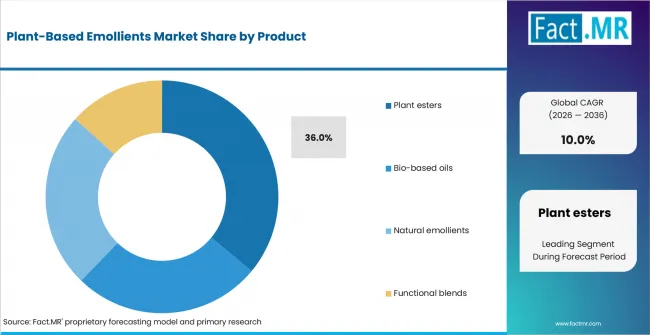
Plant Based Emollients Market Analysis By Product | Source: Fact.MR
Plant esters lead because they give formulators a controlled way to tune spreadability, slip, and dry-down. They also fit renewable-origin claims when vegetable fatty acids are converted into predictable ester grades. BASF expanded its natural-based personal care portfolio in April 2025 with Verdessence Maize, Lamesoft OP Plus, and Dehyton PK45 GA/RA.
What leads the Function segment?
Lubricity is projected to account for 38.0% share in 2026.
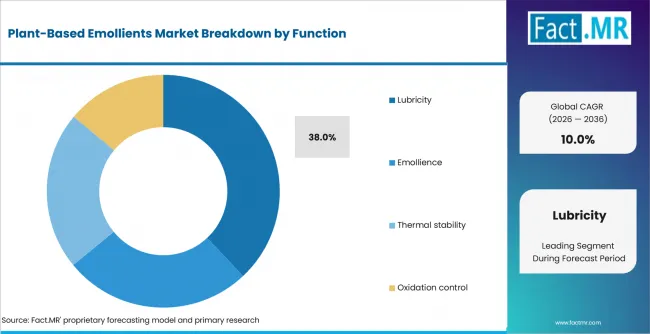
Plant Based Emollients Market Analysis By Function | Source: Fact.MR
Lubricity leads because emollients are bought for performance where skin, hair, packaging, or moving surfaces contact each other. A plant-derived ester that reduces drag and improves feel can justify a premium when it meets renewable-origin requirements.
How does Application shape demand?
Personal care is anticipated to represent 35.0% share in 2026.
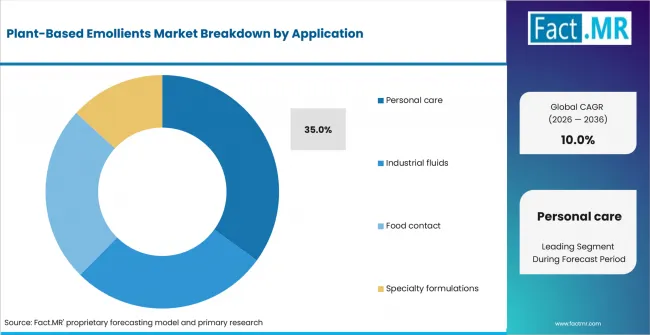
Plant Based Emollients Market Analysis By Application | Source: Fact.MR
Personal care leads because emollients sit inside leave-on and rinse-off products where sensory feel is visible to the consumer. Creams, lotions, balms, hair treatments, and sunscreens all use oil-phase ingredients to change softness and spread. Cosmetics Europe valued Europe’s cosmetics and personal care retail sales at EUR 110 billion in 2025.
What supports the Form segment?
Liquid is estimated to capture 47.0% share in 2026.
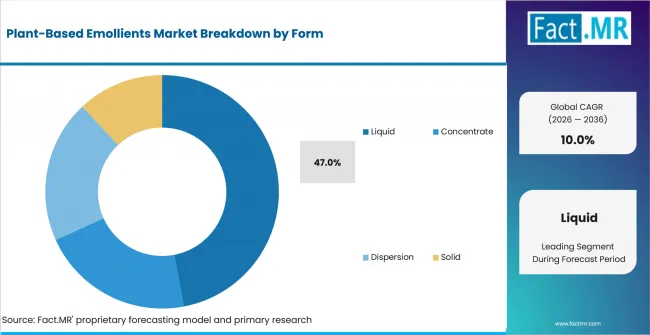
Plant Based Emollients Market Analysis By Form | Source: Fact.MR
Liquid forms lead because they are easier to pump, dose, and blend in existing production lines. They reduce handling friction for contract manufacturers that switch among skin care, hair care, and specialty-fluid batches.
Liquid formats also fit formulation work linked with cosmetic chemicals because oil-phase ingredients need consistent handling across pilot and commercial batches.
What is accelerating Plant-Based Emollients Market adoption, and what is holding it back?
Demand is expected to rise through renewable-origin formulation and liquid-format adoption, while feedstock swings, regulatory documentation, and qualification time shape the pace of adoption.
| DRIVER | (~) % IMPACT ON CAGR | GEOGRAPHIC RELEVANCE | IMPACT TIMELINE |
|---|---|---|---|
| Personal care reformulation toward renewable-origin sensory ingredients | +1.6% | North America, Europe, Japan | Short term (<= 2 years) |
| Plant ester use in lubricity and specialty-fluid applications | +1.1% | USA, Germany, Brazil | Medium term (2-4 years) |
| Liquid format compatibility with existing blending lines | +0.8% | Global | Medium term (2-4 years) |
| Traceable oilseed and bio-based feedstock supply | +0.6% | USA, France, Brazil | Long term (>= 4 years) |
- Personal care reformulation: Brands replace selected silicone, mineral-oil, and synthetic ester functions where plant-based alternatives maintain sensory feel and formula stability.
- Plant ester use: Bio-based oils and esters gain supplier attention when lubricity, low residue, and oxidation control are validated for the intended application.
- Liquid format compatibility: Liquid grades reduce processing friction because manufacturers can dose them into existing tanks with simple pumping and blending steps.
| OPPORTUNITY | (~) % IMPACT ON CAGR | GEOGRAPHIC RELEVANCE | IMPACT TIMELINE |
|---|---|---|---|
| Premium skin care and sun care formulas using plant esters | +1.2% | USA, Germany, France, Japan | Short term (<= 2 years) |
| Food-contact and specialty formulation routes | +0.7% | Europe, Brazil | Medium term (2-4 years) |
| Cleaner label industrial fluids for niche users | +0.5% | USA, Germany | Long term (>= 4 years) |
- Premium skin care and sun care: Plant esters can carry natural-origin stories while preserving the slip and low-tack feel that premium formulas require.
- Food-contact and specialty formulation: Buyers in regulated uses need better documentation, so suppliers with clear dossiers can win repeat qualification work.
- Cleaner label industrial fluids: Bio-based oils are useful where lower petroleum content and lubricity are both part of the user specification.
| RESTRAINT | (~) % IMPACT ON CAGR | GEOGRAPHIC RELEVANCE | IMPACT TIMELINE |
|---|---|---|---|
| Vegetable-oil feedstock price and crop variability | -0.7% | USA, France, Brazil | Short term (<= 2 years) |
| Documentation burden for cosmetics and food-contact uses | -0.5% | Europe, Brazil, Japan | Medium term (2-4 years) |
| Reformulation risk versus incumbent silicone and mineral-oil ingredients | -0.4% | Global | Long term (>= 4 years) |
- Feedstock variability: Oilseed output and competing uses for vegetable oils can alter raw-material costs, especially for esters tied to soybean, rapeseed, sunflower, coconut, or palm derivatives.
- Documentation burden: Formulators need origin, safety, labeling, and regulatory data before a plant-based emollient can move from sample testing into commercial production.
- Reformulation risk: Incumbent ingredients remain hard to replace when they already deliver a known skin feel, process behavior, and stability result at scale.
Which countries are scaling the Plant-Based Emollients Market through 2036?
- The country comparison spans 2.0 percentage points across the forecast period.
- The USA remains 0.5 percentage point above Germany through retail scale and domestic oilseed availability.
- Germany remains 0.7 percentage point above Japan through specialty chemistry capacity and Europe’s cosmetics base.
- Japan remains 0.4 percentage point above France through e-commerce beauty demand and premium formulation standards.
- France remains 0.4 percentage point above Brazil as beauty exports support origin-controlled ingredient use.
- Brazil closes the displayed range through soybean scale and export-oriented beauty positioning.
Comparable CAGRs can create different entry conditions because plant-based emollients depend on feedstock access, regulatory dossiers, formulation culture, and the pace of substitution away from incumbent oil-phase ingredients. Full report coverage includes North America, Latin America, Western Europe, Eastern Europe, East Asia, South Asia & Pacific, Middle East & Africa.
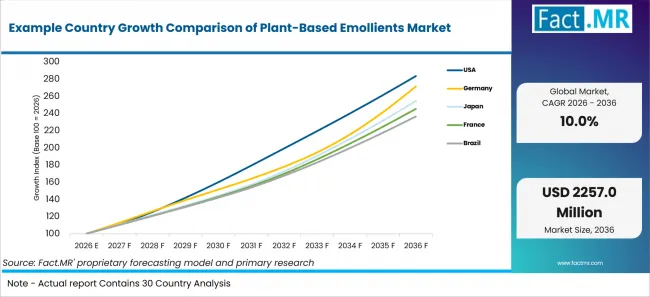
Example Country Growth Comparison Of Plant Based Emollients Market | Source: Fact.MR
| Country | CAGR (2026-2036) |
|---|---|
| USA | 11.0% |
| Germany | 10.5% |
| Japan | 9.8% |
| France | 9.4% |
| Brazil | 9.0% |
What supports USA adoption?
11.0% CAGR, supported by personal care retail scale and oilseed availability.
U.S. formulators operate within a large personal-care retail channel. The Federal Reserve Bank of St. Louis series based on U.S. Census Bureau data listed health and personal care store sales at USD 40.372 billion in May 2026. USDA NASS reported 2025 soybean production at 4.26 billion bushels in January 2026.
What is supporting Germany’s adoption?
10.5% CAGR, supported by specialty emollient capacity and Europe’s cosmetics base.
Germany has specialty chemistry capacity and a large domestic cosmetics market. Cosmetics Europe valued German cosmetics and personal care retail sales at EUR 18.0 billion in 2025. BASF opened a Düsseldorf specialty emollients plant in July 2026 after a mid double-digit million-euro investment. BASF states that the investment expands specialty-emollient production capacity for the European and global cosmetics market.
How does Japan perform?
9.8% CAGR, led by e-commerce beauty demand and premium formulation standards.
Japan’s premium skin care culture places a high value on texture, odor control, and oxidation stability. METI reported on August 26, 2025 that Japan’s cosmetics and pharmaceuticals B2C e-commerce market reached JPY 1.015 trillion in 2024. JNTO reported an estimated 3,597,500 visitor arrivals to Japan in January 2026.
What supports France adoption?
9.4% CAGR, backed by beauty exports and origin-controlled formulation work.
France has a premium beauty base where origin and sensory quality carry commercial weight. Cosmetics Europe valued French cosmetics and personal care retail sales at EUR 14.5 billion in 2025, while European cosmetics exports reached EUR 29.8 billion in 2025.
How is Brazil scaling demand?
9.0% CAGR, supported by soybean scale and export-oriented beauty positioning.
Brazil has a large oilseed base and an export-oriented beauty industry. IBGE reported Brazil’s 2025 soybean production estimate at 166.1 million tonnes on January 15, 2026, in its release of the December estimate. ABIHPEC reported that Brazilian beauty and personal care exports reached USD 1.061 billion in 2025.
Who leads the Plant-Based Emollients Market?
BASF SE is active through specialty emollients for skin care and sun protection. Its July 2026 Düsseldorf plant expands specialty-emollient production capacity for the European and global cosmetics market. BASF also expanded its natural-based personal care ingredient portfolio in April 2025, strengthening its capabilities in renewable and biodegradable formulation ingredients.
Croda International Plc participates through its Beauty businesses; its 2025 Annual Report describes Beauty Care formulation ingredients including emulsifiers and emollients. Evonik Industries AG competes through emollient and specialty-ingredient capabilities, including TEGOSOFT BC MB, highlighted in April 2025 as a natural emollient that is fully based on renewable resources and biodegradable for sun-care and other skin applications.
Clariant AG, The Lubrizol Corporation, and Ashland Inc. add further portfolio depth. Clariant launched Clariant Beauty in April 2025, Lubrizol unveiled Sensomer Cassia 115 polymer in April 2025, and Ashland announced a strategic partnership with IMCD in March 2026 for the exclusive U.S. distribution of its personal-care and home-care ingredients.
Which companies are the active providers?
Key companies include BASF SE; Croda International Plc; Evonik Industries AG; Clariant AG; The Lubrizol Corporation; and Ashland Inc.
- BASF SE
- Croda International Plc
- Evonik Industries AG
- Clariant AG
- The Lubrizol Corporation
- Ashland Inc.
What is the report’s scope and coverage?
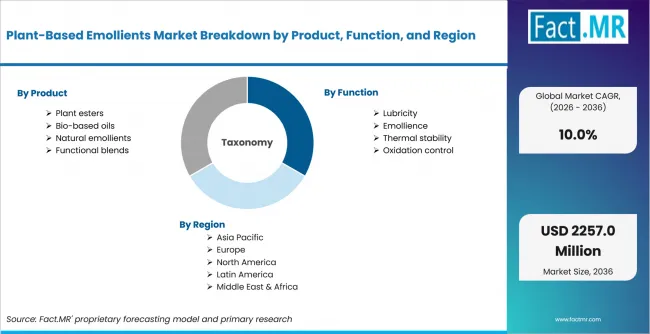
Plant Based Emollients Market Breakdown By Product, Function, And Region | Source: Fact.MR
| Attribute | Details |
|---|---|
| Quantitative Units | USD million |
| Market Definition | Plant-based emollients are renewable-origin oil-phase ingredients used to soften, lubricate, moisturize, condition, or reduce friction in personal care, industrial fluids, food-contact, and specialty formulations. |
| Product | Plant esters; Bio-based oils; Natural emollients; Functional blends |
| Function | Lubricity; Emollience; Thermal stability; Oxidation control |
| Application | Personal care; Industrial fluids; Food contact; Specialty formulations |
| Form | Liquid; Concentrate; Dispersion; Solid |
| Regions Covered | North America; Latin America; Western Europe; Eastern Europe; East Asia; South Asia & Pacific; Middle East & Africa |
| Countries Covered | USA; Germany; Japan; France; Brazil |
| Key Companies Profiled | BASF SE; Croda International Plc; Evonik Industries AG; Clariant AG; The Lubrizol Corporation; Ashland Inc. |
| Forecast Period | 2026 to 2036 |
| Approach | Hybrid top-down and bottom-up approach using application demand, feedstock availability, segment share, country adoption, company portfolios, and regulatory evidence. |
Bibliography
- Associação Brasileira da Indústria de Higiene Pessoal, Perfumaria e Cosméticos. (2026, January 19). Setor de Beleza e Cuidados Pessoais bate recorde de exportações e ultrapassa US$ 1 bi.
- Agência Nacional de Vigilância Sanitária. (2026, July 3). Anvisa atualiza listas de substâncias para uso em cosméticos.
- Ashland Inc. (2026, March 12). Ashland announces strategic partnership with IMCD for the exclusive distribution of personal and home care ingredients in the United States.
- BASF SE. (2025, April 3). BASF launches natural-based innovations for personal care at in-cosmetics Global 2025.
- BASF SE. (2026, July 16). BASF inaugurates new production plant in Düsseldorf, Germany.
- Clariant AG. (2025, April 7). “Clariant Beauty” launches new solutions for personal care.
- Evonik Industries AG. (2025, April 8). in-cosmetics® global 2025: Evonik meets growing customer demand for high-performance, eco-friendly solutions.
- U.S. Census Bureau. (2026, August 14). Advance monthly sales for retail and food services.
- Brazilian Institute of Geography and Statistics. (2026, January 15). In December, IBGE forecasts harvest of 346.1 million tonnes for 2025, 339.8 million tonnes for 2026. IBGE News Agency.
- Japan National Tourism Organization. (2026, February 18). Number of visitor arrivals to Japan: 3,597,500 in January 2026 [Preliminary figures].
- The Lubrizol Corporation. (2025, April 23). Lubrizol unveils Sensomer™ Cassia 115 polymer: Pioneering sustainable personal care.
- Ministry of Economy, Trade and Industry. (2025, August 26). Results of FY2024 E-Commerce Market Survey compiled.
- U.S. Department of Agriculture, National Agricultural Statistics Service. (2026, January 12). Crop Production 2025 Summary.
- Croda International Plc. (2026, March 16). Annual Report and Accounts 2025.
This Report Answers
- The report explains where plant-based emollients are used by product, function, application, form, and region.
- Segment analysis identifies why plant esters, lubricity, personal care, and liquid forms lead the 2026 structure.
- Country analysis reviews the listed markets and the feedstock, beauty, and regulatory mechanisms affecting adoption.
- Competitive analysis reviews current providers across specialty emollients, natural-based personal care ingredients, and application support.
- Application analysis considers how sensory performance, formulation stability, and traceable renewable origin influence supplier selection.
What does the Plant-Based Emollients Market cover?
The Plant-Based Emollients Market covers renewable-origin ingredients that soften, lubricate, and improve the sensory profile of finished formulations. It includes plant esters, bio-based oils, natural emollients, and functional blends used across personal care and selected specialty applications.
What is included in the scope?
The scope includes commercial emollient ingredients made from renewable plant feedstocks, including esters and bio-based oils sold to formulators.
It covers natural blends and liquid concentrates used in creams, lotions, cleansing oils, sun care, hair care, food-contact coatings, and selected specialty fluids.
What is excluded from the scope?
The scope excludes finished skin care brands, retail beauty products, synthetic silicone emollients outside plant-based positioning, mineral-oil emollients, petroleum waxes, base vegetable oils sold only as commodities, and fragrance oils sold for scent alone. Packaging materials, surfactants, preservatives, and colorants are also outside the scope unless sold as part of a plant-based emollient blend.
How Was the Analysis Built?
The analysis draws on 120+ sources, 35+ company portfolios, 25+ countries, and more than 20 industry interviews.
- Primary Research: Primary research includes discussions with manufacturers, service providers, technology developers, distributors, end users, and subject-matter experts. These conversations examine purchasing priorities, product adoption, operational challenges, approval requirements, competitive positioning, and the factors that influence wider market acceptance.
- Desk Research: Desk research covers government statistics, regulatory publications, company filings, trade data, technical studies, industry associations, standards, public policy, and other authoritative sources. Every source used in the analysis is documented in the bibliography.
- Market Sizing and Forecasting: Market estimates combine historical performance, demand indicators, pricing and volume trends, segment shares, company participation, country-level growth, adoption patterns, investment activity, and barriers to market expansion.
- Data Validation and Update Cycle: Findings are validated by comparing primary interviews with public data, company activity, regulatory changes, trade patterns, and industry developments. Regular updates review new product launches, capacity changes, partnerships, approvals, and shifts in commercial adoption.
How is the market segmented?
-
By Product
- Plant esters
- Bio-based oils
- Natural emollients
- Functional blends
-
By Function
- Lubricity
- Emollience
- Thermal stability
- Oxidation control
-
By Application
- Personal care
- Industrial fluids
- Food contact
- Specialty formulations
-
By Form
- Liquid
- Concentrate
- Dispersion
- Solid
-
By Region
- North America
- Latin America
- Western Europe
- Eastern Europe
- East Asia
- South Asia & Pacific
- Middle East & Africa