- Market Value (2025): USD 5.9 Bn
- Estimated Value (2026): USD 6.4 Bn
- Forecast Value (2036): USD 13.5 Bn
- CAGR (2026-2036): 7.8%
What is the Plug-In Barrier Carton Materials Market forecast to be worth by 2036?
USD 6.4 billion in 2026 to USD 13.5 billion by 2036 at a 7.8% CAGR.
- The Plug-In Barrier Carton Materials Market reached USD 5.9 billion in 2025.
- Demand is forecast to increase from USD 6.4 billion in 2026 to USD 13.5 billion by 2036.
- The market is forecast to record 7.8% CAGR from 2026 to 2036 as carton makers test layer structures for current forming and filling systems.
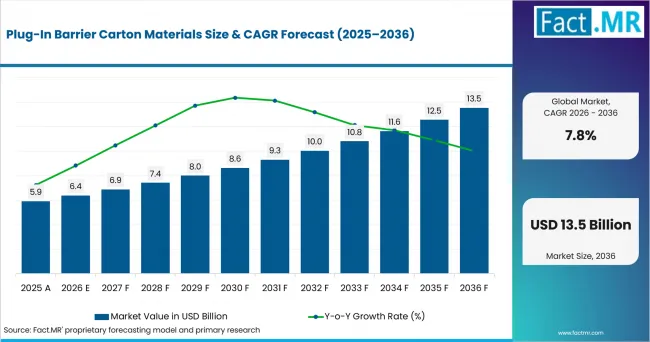
Plug In Barrier Carton Materials Value Analysis | Source: Fact.MR
What are the defining numbers behind Plug-In Barrier Carton Materials Market growth?
The market is likely to create a USD 7.1 billion absolute opportunity from 2026 to 2036.
- Demand Drivers in the Market
- Packaged-food volumes create a broad base for carton use. In June 2026, the USDA Economic Research Service said U.S. food spending reached USD 2.51 trillion in 2025. Fiber-based packs with suitable moisture and oxygen barriers can serve both shelf-stable and chilled foods. Growth in sustainable packaging formats supports the same shift.
- Aseptic drink makers need steady oxygen and light control across long supply periods. Layers are forecast to ease switching when they keep shelf life and fit current fillers.
- Dairy processors need moisture control and steady seals across chilled and ambient formats. Carton designs are forecast to keep product quality while brands raise paper content and review recycling routes.
- Key Segments Analyzed
- By Barrier Architecture: Polymer-coated paperboard is likely to hold 34.0% share in 2026.
- By Pack Format: Aseptic beverage carton is forecast to account for 37.0% share in 2026.
- By Barrier Requirement: Oxygen + light is forecast to represent 33.0% share in 2026.
- By End-use: Dairy / alternatives is likely to capture 36.0% share in 2026.
- Analyst Opinion at Fact.MR
- Fact.MR Principal Consultant Shambhu Nath Jha states, “Barrier results are one part of layer tests. New structures must fit current carton systems and keep shelf-life targets at full line speed. Suppliers that pair board design with coating chemistry and line fit are forecast to secure wider drink and dairy trials.”
- Strategic Implications
- Carton-system suppliers should publish seal windows and line-speed results for each new layer design so pack firms can compare results across current filling and forming lines.
- Design teams should review food-contact coating chemistry along with barrier results. In January 2025, the U.S. Food and Drug Administration confirmed that manufacturers or suppliers had ceased production, supply, or use tied to 35 PFAS food-contact notifications for grease-proofing on paper and board.
- Board makers should pair fiber design with suitable coatings. This approach can raise paper content while keeping the moisture and oxygen control needed by sensitive liquid products.
- Food and drink brands should test layer design for each product so the carton structure matches its shelf life and filling conditions.
China is forecast to record 8.1% CAGR through 2036 driven by drink sales and paper-pack standards. The USA and Japan are each projected at 7.6%, followed by Germany at 7.4% and France at 6.9% as pack recycling needs shape board choice.
How does the Plug-In Barrier Carton Materials Market break down by segment?
Aseptic beverage carton is forecast to lead Pack Format at 37.0% share in 2026; Dairy / alternatives is likely to lead End-use at 36.0% share.
Which Barrier Architecture dominates?
Polymer-coated paperboard is likely to hold 34.0% share in 2026.
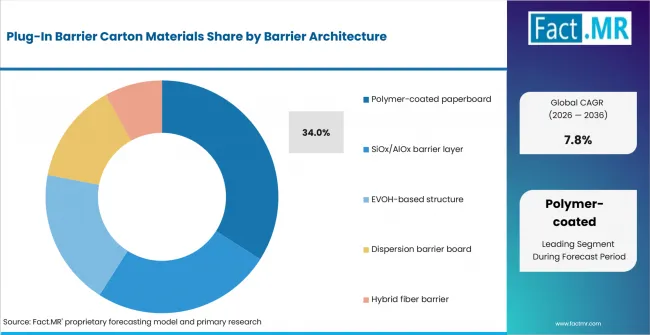
Plug In Barrier Carton Materials Analysis By Barrier Architecture | Source: Fact.MR
Polymer-coated paperboard combines board strength with sealing and moisture control for liquid and dry-food cartons. SiOx/AlOx designs can provide thin, high-barrier layers, while EVOH structures support oxygen control.
Dispersion barrier board is likely to gain use where makers seek more fiber and simpler recycling routes. Hybrid fiber barriers are forecast to serve products that need several control functions while keeping full-scale forming results.
What leads the Pack Format segment?
Aseptic beverage carton is forecast to account for 37.0% share in 2026.
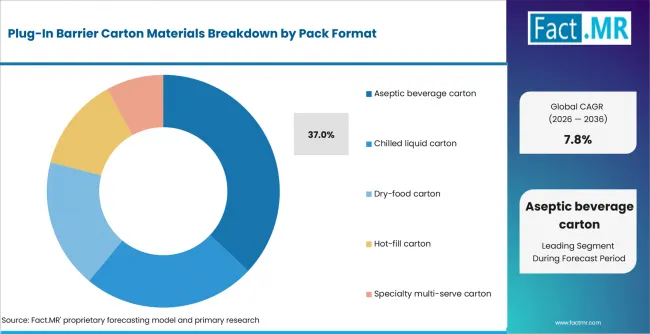
Plug In Barrier Carton Materials Analysis By Pack Format | Source: Fact.MR
Aseptic beverage cartons need broad protection during unrefrigerated distribution. Chilled cartons can use simpler designs because cold storage provides part of the protection. Hot-fill cartons need heat-stable seals and coatings that perform at full line speed. In January 2026, Tetra Pak announced a EUR 60 million pilot plant for paper-based barrier technology in aseptic cartons.
Dry-food cartons are forecast to use grease or moisture barriers based on the product inside. Aroma control remains important for sensitive foods. Specialty multi-serve cartons are expected to place more weight on resealability and line fit because repeated opening changes barrier needs.
How does Barrier Requirement shape demand?
Oxygen + light is forecast to lead with 33.0% share in 2026.
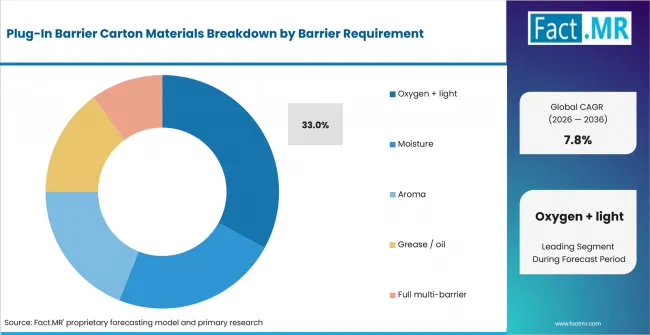
Plug In Barrier Carton Materials Analysis By Barrier Requirement | Source: Fact.MR
Oxygen and light control is expected to remain important for milk and juice because exposure can affect flavour and product quality. Moisture barriers help protect fiber strength and seal performance, while aroma barriers reduce flavour transfer. Grease resistance serves foods in which oils come into direct contact with the board.
Full multi-layer designs are forecast to combine several roles when one carton wall must control oxygen and light along with moisture and aroma. Design teams are likely to compare layer count with recycling and filling-line results before wider use.
What supports Dairy / alternatives within End-use?
Dairy / alternatives is likely to represent 36.0% share in 2026.
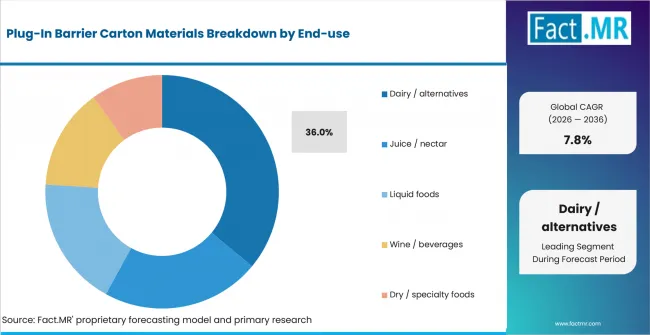
Plug In Barrier Carton Materials Analysis By End Use | Source: Fact.MR
Milk and plant-based drinks use cartons in both chilled and ambient supply chains. Juice and nectar also need oxygen and aroma control. Liquid-food demand extends to soups and cooking products, while wine requires flavour protection. Dry and specialty foods use cartons where moisture or grease resistance helps protect the product.
Carton suppliers serving dairy uses are expected to focus on filling-line fit because product changeovers and seal consistency affect full-scale output. The related liquid packaging cartons field shows how shelf-life needs and carton shape guide board choice across dairy and drinks.
What is accelerating Plug-In Barrier Carton Materials Market adoption, and what is holding it back?
Installed-line fit and paper-rich layer design are forecast to support use across current carton systems. Shelf-life retesting and multi-layer recycling needs are likely to slow switching in demanding food and drink uses.
Drivers Impact Analysis
| DRIVER | (~) % IMPACT ON CAGR | GEOGRAPHIC RELEVANCE | IMPACT TIMELINE |
|---|---|---|---|
| Installed filler fit | +1.4% | Global | Short term (<= 2 years) |
| Paper-rich layer shift | +1.1% | Europe, North America | Medium term (2-4 years) |
| Aseptic carton demand | +0.9% | East Asia, North America | Medium term (2-4 years) |
| Pack-recovery rules | +0.6% | Europe, Japan | Long term (>= 4 years) |
Opportunity Impact Analysis
| OPPORTUNITY | (~) % IMPACT ON CAGR | GEOGRAPHIC RELEVANCE | IMPACT TIMELINE |
|---|---|---|---|
| Paper-based full barrier | +0.9% | Europe | Medium term (2-4 years) |
| Oxide-coated layers | +0.7% | Global | Medium term (2-4 years) |
| Dispersion barrier board | +0.5% | Europe, North America | Long term (>= 4 years) |
Restraints Impact Analysis
| RESTRAINT | (~) % IMPACT ON CAGR | GEOGRAPHIC RELEVANCE | IMPACT TIMELINE |
|---|---|---|---|
| Shelf-life retesting | -0.6% | Global | Short term (<= 2 years) |
| Layer separation | -0.5% | Europe, Japan | Medium term (2-4 years) |
| Filling-line seal limits | -0.4% | Global | Medium term (2-4 years) |
Which countries are scaling the Plug-In Barrier Carton Materials Market through 2036?
- The five profiled markets span 1.2 percentage points in CAGR. The comparison covers the 2026 to 2036 forecast period.
- China remains 0.5 percentage point above the USA as drink demand and coated-paper standards support new carton designs.
- The USA and Japan both record 7.6% CAGR as liquid-food packs and layer tests support new carton designs.
- Germany remains 0.2 percentage point below the USA and Japan. Recycling results continue to receive close regulatory attention.
- France closes the displayed range at 6.9% as pack EPR rules raise the value of fiber-rich structures with clearer recycling routes.
Comparable CAGRs can still create different entry conditions. Filling lines and food output vary by country, and local recycling rules shape board tests. Full report coverage spans North America, Latin America, Europe, East Asia, South Asia & Pacific, and Middle East & Africa.
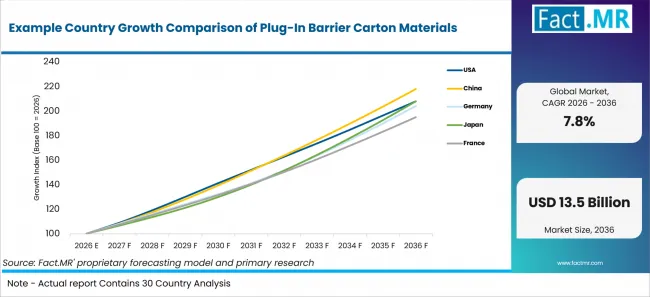
Example Country Growth Comparison Of Plug In Barrier Carton Materials | Source: Fact.MR
| Country | CAGR (2026-2036) |
|---|---|
| China | 8.1% |
| USA | 7.6% |
| Japan | 7.6% |
| Germany | 7.4% |
| France | 6.9% |
What supports USA adoption?
7.6% CAGR, backed by liquid-dairy output and current carton-filling lines.
U.S. dairy output gives carton makers a large base across chilled and ambient liquid products. In March 2026, USDA’s National Agricultural Statistics Service reported that U.S. milk production totaled 18.3 billion pounds in February 2026. Carton layers are expected to gain use where processors need shelf-life control that also fits current filling lines and food-contact rules.
How is China scaling demand?
8.1% CAGR, driven by drink sales and current food-pack paper standards.
China combines large drink volumes with an active paper-pack standards framework. The National Bureau of Statistics reported that retail sales of beverages by enterprises above designated size increased 1.0% in 2025. Carton suppliers are expected to focus on structures that support high-volume forming while controlling oxygen, moisture, and light.
What supports Japan’s growth?
7.6% CAGR, backed by household spending and current liquid-food carton use.
Japan’s consumer market supports packaged drinks and liquid foods across compact retail channels. The Statistics Bureau said in February 2026 that average monthly consumption spending for two-or-more-person households was 314,001 yen in 2025. Design teams are forecast to focus on shelf-life control and recycling fit as cartons become more paper-rich.
How is Germany developing demand?
7.4% CAGR, backed by mature carton use and established pack-recycling systems.
Germany gives close attention to packaging recycling as well as food and drink protection. In January 2026, the German Environment Agency and the Central Agency Packaging Register reported that around 5.5 million tonnes of packaging waste collected by the dual systems were recycled in 2024. Barrier-carton suppliers are expected to pair performance tests with clear recycling routes when they add new layer combinations.
What is supporting France’s adoption?
6.9% CAGR, shaped by pack EPR needs and fiber-based layer choice.
France combines a large packaged-food base with detailed household-pack recycling data. In April 2026, ADEME reported that approximately 4.893 million tonnes of household packaging and graphic papers were sorted for recycling in France in 2024. New barrier layers are expected to gain use when food protection aligns with current sorting and recycling routes.
Who leads the Plug-In Barrier Carton Materials Market?
SIG has a direct fit with the plug-in concept through SIG Terra Alu-free + Full barrier, which can run on existing SIG carton filling lines with only minor adaptations. In May 2025, SIG commercially launched the solution for multi-serve aseptic cartons, with filling speeds of up to 15,000 packs per hour. Beverage producers can therefore adopt the new barrier structure while continuing to use compatible existing SIG filling equipment.
Tetra Pak is advancing paper-based barrier technology for aseptic cartons and has extended the technology to its high-speed A3/Speed filling lines. Elopak provides Pure-Pak carton systems for chilled liquid products alongside board, barrier, and filling-machine options suited to different product requirements. Both companies combine packaging-material development with filling-system capabilities.
Stora Enso supplies liquid-packaging boards for applications including milk, juice, and other sensitive liquid products. The company has also collaborated with Elopak on liquid-carton developments, linking paperboard properties with converting and filling performance.
Competitive differentiation is likely to depend on barrier performance, shelf-life protection, seal integrity, paper content, filling-line compatibility, and recyclability. Integrated carton-system providers may benefit from combining packaging materials with established filling equipment, while material suppliers compete through barrier performance, convertibility, and compatibility with commercial packaging lines.
Which companies are the key providers?
Key companies include SIG; Tetra Pak; Elopak; and Stora Enso.
- SIG
- Tetra Pak
- Elopak
- Stora Enso
Bibliography
- SIG. (2025, May 20). SIG launches world’s-first alu layer-free full barrier solution for multi-serve aseptic cartons, further reducing carbon footprint by up to 61%.
- Tetra Pak. (2026, January 26). Tetra Pak invests €60 million in owned pilot plant to advance its paper-based barrier technology development.
- Elopak. (2025, May 19). Elopak launches Natural White Board, delivering up to 14% lower GHG emissions.
- Zeballos, E., & Sinclair, W. (2026, June 11). Total U.S. food spending reached $2.51 trillion in 2025. U.S. Department of Agriculture, Economic Research Service.
- U.S. Food and Drug Administration. (2025, January 3). FDA determines authorization for 35 food contact notifications related to PFAS are no longer effective.
- U.S. Department of Agriculture, National Agricultural Statistics Service. (2026, March 20). Milk production.
- National Bureau of Statistics of China. (2026, January 20). Total retail sales of consumer goods in December 2025.
- Statistics Bureau of Japan. (2026, February 6). 2025 yearly average.
- German Environment Agency, & Central Agency Packaging Register. (2026, January 27). Facts against myths: Packaging waste recycling in Germany is working.
- Van de Voorde, J., & Parisot, F. (2026, March). Emballages ménagers et papiers graphiques : données 2024 [Household packaging and graphic papers: Data 2024]. ADEME.
This Report Answers
- The report explains where plug-in barrier carton materials are used across Barrier Architecture and Pack Format. It also covers Barrier Requirement and End-use together with regional demand.
- Segment analysis identifies the leading subsegments and the operational reasons carton makers prioritize particular board structures, filling formats, barrier functions, and end-use applications.
- Country analysis examines China, the USA, Japan, Germany, and France together with the food, beverage, recycling, and packaging conditions supporting barrier-carton demand.
- Competitive analysis reviews current providers across integrated carton systems, paper-based barrier technology, liquid-packaging board, and filling-line-compatible material solutions.
- Application analysis assesses how oxygen and light control influence material selection. It also considers moisture protection, aroma control, seal performance, filling-line compatibility, shelf life, and recycling fit.
What does the Plug-In Barrier Carton Materials Market cover?
The market covers paperboard carton structures that use functional barriers against oxygen, light, moisture, aroma, or grease. It includes aseptic, chilled, hot-fill, and dry-food carton designs. Related paper packaging materials provide the wider fiber base used by carton firms.
The assessment covers polymer-coated board, oxide-coated structures, EVOH layers, dispersion barriers, and hybrid fiber designs. It reviews how these materials perform on filling lines and meet shelf-life needs. The wider paper-based and fiber-based packaging field provides context for structures with more fiber.
What is included in the scope?
The scope includes layers used in liquid-food cartons and food-contact paperboard when the layer forms part of the primary carton wall. It covers dairy, juice, nectar, wine, soups, and specialty foods in direct food packs. Related sustainable food packaging helps frame the protection needs across these carton formats.
The scope includes carton structures that use polymer films, oxide layers, EVOH, dispersion coatings, or combined fiber barriers. It also covers layer changes that work with current forming and filling systems. Related folding-carton packaging shows the wider role of paperboard in direct food and beverage packs.
What is excluded from the scope?
The excluded set covers general board cartons that use only standard print or surface finishes. Flexible pouches, bottles, metal cans, glass packs, and transport corrugated cases remain outside the core revenue boundary.
Filling machinery remains outside reported market revenue, although equipment fit can influence adoption. General coatings are included only when they provide a defined barrier or sealing role within a carton. Waterproof coatings for paper and paperboard provide added context for moisture-focused technologies.
How Was the Analysis Built?
The analysis draws on 120+ sources, 35+ company portfolios, 25+ countries, and more than 20 industry interviews.
- Primary Research: Primary research includes discussions with manufacturers, service providers, technology developers, distributors, end users, and subject-matter experts. These conversations examine purchasing priorities, product adoption, operational challenges, approval requirements, competitive positioning, and the factors that influence wider market acceptance.
- Desk Research: Desk research covers government statistics, regulatory publications, company filings, trade data, technical studies, industry associations, standards, public policy, and other authoritative sources. Every source used in the analysis is documented in the bibliography.
- Market Sizing and Forecasting: Market estimates combine historical performance, demand indicators, pricing and volume trends, segment shares, company participation, country-level growth, adoption patterns, investment activity, and barriers to market expansion.
- Data Validation and Update Cycle: Findings are validated by comparing primary interviews with public data, company activity, regulatory changes, trade patterns, and industry developments. Regular updates review new product launches, capacity changes, partnerships, approvals, and shifts in commercial adoption.
What is the report’s scope and coverage?
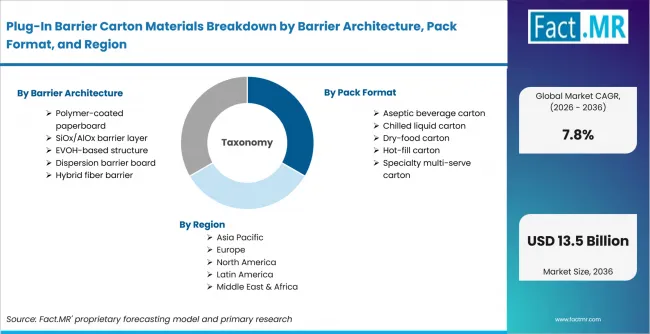
Plug In Barrier Carton Materials Breakdown By Barrier Architecture, Pack Format, And Region | Source: Fact.MR
| Attribute | Details |
| Quantitative Units | USD billion |
| Market Definition | Paperboard carton layers that control oxygen, light, moisture, aroma, grease, or combined exposure while working with carton forming and filling. |
| Barrier Architecture | Polymer-coated paperboard; SiOx/AlOx barrier layer; EVOH-based structure; Dispersion barrier board; Hybrid fiber barrier |
| Pack Format | Aseptic beverage carton; Chilled liquid carton; Dry-food carton; Hot-fill carton; Specialty multi-serve carton |
| Barrier Requirement | Oxygen + light; Moisture; Aroma; Grease / oil; Full multi-barrier |
| End-use | Dairy / alternatives; Juice / nectar; Liquid foods; Wine / beverages; Dry / specialty foods |
| Regions Covered | North America; Latin America; Western Europe; Eastern Europe; East Asia; South Asia & Pacific; Middle East & Africa |
| Countries Covered | China; USA; Japan; Germany; France |
| Key Companies Profiled | SIG; Tetra Pak; Elopak; Stora Enso |
| Forecast Period | 2026 to 2036 |
| Approach | Top-down and bottom-up review using carton use, pack mix, country data, filling-line fit, and provider portfolios. |
How is the market segmented?
-
By Barrier Architecture:
- Polymer-coated paperboard
- SiOx/AlOx barrier layer
- EVOH-based structure
- Dispersion barrier board
- Hybrid fiber barrier
-
By Pack Format:
- Aseptic beverage carton
- Chilled liquid carton
- Dry-food carton
- Hot-fill carton
- Specialty multi-serve carton
-
By Barrier Requirement:
- Oxygen + light
- Moisture
- Aroma
- Grease / oil
- Full multi-barrier
-
By End-use:
- Dairy / alternatives
- Juice / nectar
- Liquid foods
- Wine / beverages
- Dry / specialty foods
-
By Region:
- North America
- Latin America
- Western Europe
- Eastern Europe
- East Asia
- South Asia & Pacific
- Middle East & Africa