- Market Value (2025): USD 2.5 Bn
- Estimated Value (2026): USD 2.9 Bn
- Forecast Value (2036): USD 11.8 Bn
- CAGR (2026-2036): 15.0%
What is the High-Barrier Compostable Laminates Market forecast to be worth by 2036?
USD 2.9 billion in 2026 to USD 11.8 billion by 2036 at a 15.0% CAGR.
- The High-Barrier Compostable Laminates Market reached USD 2.5 billion in 2025.
- Demand is projected to increase from USD 2.9 billion in 2026 to USD 11.8 billion by 2036.
- The market is forecast to record 15.0% CAGR from 2026 to 2036, supported by food brands qualifying compostable structures for sachets, pouches and lidding.
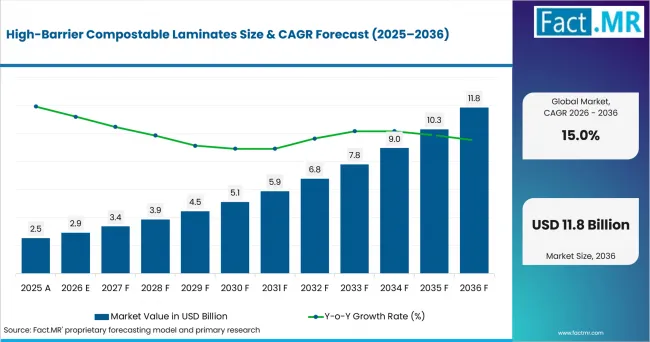
High Barrier Compostable Laminates Value Analysis | Source: Fact.MR
What are the defining numbers behind High-Barrier Compostable Laminates Market growth?
An absolute opportunity of USD 8.9 billion is expected between 2026 and 2036.
- Demand Drivers in the Market
- Food brands need barrier laminates that protect flavor and texture while giving the pack a documented compostable route after use.
- Coffee and tea packers are expected to prioritize aroma control because small packs lose value quickly when barrier performance is weak.
- Converters need materials that run on installed pouch, sachet and lidding equipment so qualification avoids full line replacement.
- European Bioplastics reported in December 2025 that packaging represented 41.3% of global bioplastics capacity in 2025.
- Retail and foodservice accounts are expected to ask for clearer disposal proof as compostable and recyclable pack claims follow different recovery routes.
- Key Segments Analyzed
- By Laminate Platform: PLA-based laminates are projected to hold 36.0% share in 2026 due to film availability and converter familiarity.
- By Barrier Level: High oxygen barrier structures are expected to account for 31.0% share in 2026, supported by coffee and dry-food protection needs.
- By Pack Format: Single-serve sachets are anticipated to capture 29.0% share in 2026 because small packs face weak recovery after use.
- By End-of-Life: Industrial compostable formats are estimated to represent 33.0% share in 2026, led by clearer acceptance in organized composting systems.
- Analyst Opinion at Fact.MR
- Shambhu Nath Jha, Principal Consultant at Fact.MR, states, “The commercial test is shifting from compostable wording toward verified pack performance. Brands are expected to approve suppliers that combine barrier data, sealing behavior and disposal documentation. Film makers with line-trial evidence gain advantage when food accounts compare new laminates against conventional structures.”
- Strategic Implications
- Material suppliers should document oxygen, moisture and aroma-barrier results for every laminate structure sold into food contact packs.
- Converters should qualify films on pouch, sachet and lidding assets before offering long-run supply programs to food brands.
- Certification teams should map industrial and home compostability claims separately because BPI launched its Home Compostability Certification program in 2025, with BPI Commercial Compostability Certification required as a prerequisite.
- Brand owners should test high-value packs first, especially sachets and premium snacks where recovery through recycling is difficult.
China is forecast to record 15.5% CAGR through 2036, led by online food retail and converter scale. The USA is projected to post 15.0% CAGR through food spending depth. Japan is anticipated to hold 15.0% CAGR as food-price pressure raises shelf-life attention. Germany is estimated to reach 14.8% CAGR through ready-meal output. France is expected to advance at 14.3% CAGR because agro-food scale supports pack redesign.
How does the High-Barrier Compostable Laminates Market break down by segment?
PLA-based leads Laminate Platform at 36.0%; industrial compostable leads End-of-Life at 33.0%.
Which Laminate Platform dominates?
PLA-based holds 36.0% share in 2026.
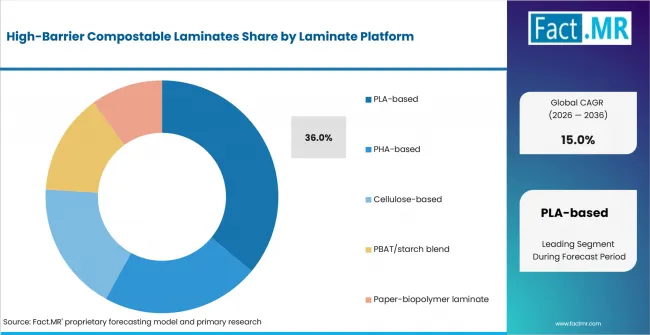
High Barrier Compostable Laminates Analysis By Laminate Platform | Source: Fact.MR
PLA-based laminates are expected to hold 36.0% share in 2026 due to film availability and easier converter qualification. PHA-based options remain relevant where home compostability is central. Cellulose-based laminates support transparent and metallized pack structures. NatureWorks introduced Ingeo Extend 4950D in March 2025 for BOPLA films, including up to 7x transverse-direction stretch.
What leads the Barrier Level segment?
High oxygen barrier holds 31.0% share in 2026.
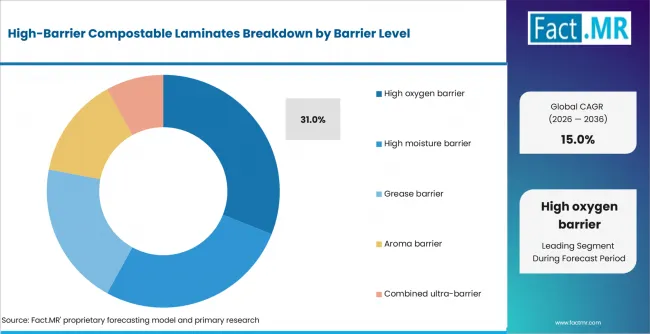
High Barrier Compostable Laminates Analysis By Barrier Level | Source: Fact.MR
High oxygen barrier laminates are projected to account for 31.0% share in 2026, supported by coffee, snacks and powdered foods. Moisture-barrier structures address dry foods and seasoning sachets. Grease-barrier versions serve bakery packs where oil staining affects appearance. Aroma-barrier versions suit coffee and tea packs where odor retention shapes repeat purchase.
How does Pack Format shape demand?
Single-serve sachets hold 29.0% share in 2026.
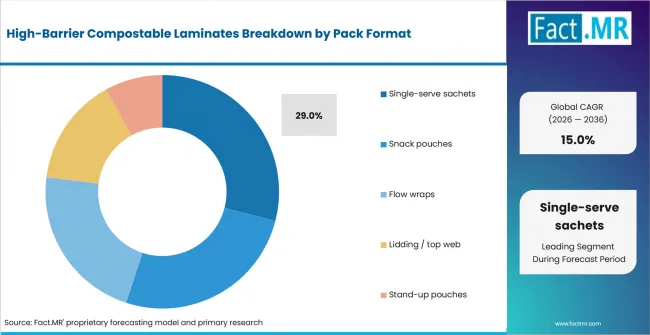
High Barrier Compostable Laminates Analysis By Pack Format | Source: Fact.MR
Single-serve sachets are anticipated to capture 29.0% share in 2026 because tiny flexible packs are difficult to recover after use. Snack pouches and flow wraps remain used where printability and sealing speed are required. Lidding and top-web formats help trays reduce conventional plastic lids. Liquid sachets remain a trial area where leak resistance and sealing control are difficult.
What supports End-of-Life selection?
Industrial compostable holds 33.0% share in 2026.
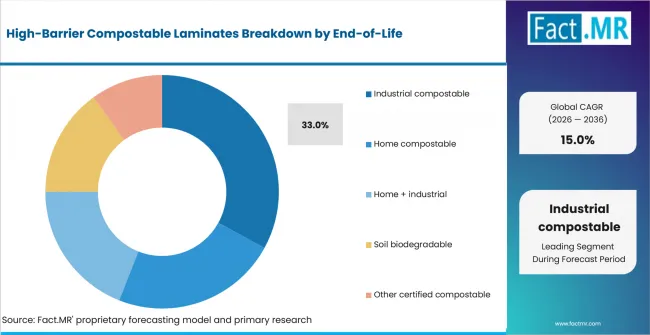
High Barrier Compostable Laminates Analysis By End Of Life | Source: Fact.MR
Industrial compostable laminates are estimated to represent 33.0% share in 2026, led by clearer testing routes and acceptance in organized organics systems. Home compostable structures draw attention for consumer-facing packs. Dual-route certification remains useful when brands sell across foodservice and retail channels.
What is accelerating High-Barrier Compostable Laminates Market adoption, and what is holding it back?
Food-contact barrier needs drive it; composting access and certification cost restrain it.
Drivers Impact Analysis
| DRIVER | (~) % IMPACT ON CAGR | GEOGRAPHIC RELEVANCE | IMPACT TIMELINE |
|---|---|---|---|
| Shift from mixed plastic laminates to certified compostable structures | +2.0% | Europe, North America, East Asia | Medium term (2-4 years) |
| Small-format packaging recovery gaps in sachets and wrappers | +1.7% | Global | Short term (<= 2 years) |
| Food-contact barrier qualification across oxygen and moisture control | +1.3% | North America, Europe, Japan | Medium term (2-4 years) |
| Biopolymer grade development for films and coatings | +1.0% | USA, China, Germany, Japan | Long term (>= 4 years) |
Source: Fact.MR analysis. Updated Sep 17, 2026
Opportunity Impact Analysis
| OPPORTUNITY | (~) % IMPACT ON CAGR | GEOGRAPHIC RELEVANCE | IMPACT TIMELINE |
|---|---|---|---|
| Home compostable barrier laminates for premium dry foods | +1.5% | USA, Japan, France | Medium term (2-4 years) |
| Compostable liquid and condiment sachets | +1.2% | USA, China, East Asia | Short term (<= 2 years) |
| Paper-biopolymer laminate upgrades for lidding and top web | +0.9% | Europe, North America | Long term (>= 4 years) |
Source: Fact.MR analysis. Updated Sep 17, 2026
Restraints Impact Analysis
| RESTRAINT | (~) % IMPACT ON CAGR | GEOGRAPHIC RELEVANCE | IMPACT TIMELINE |
|---|---|---|---|
| Uneven access to accepting composting facilities | -0.9% | USA, France, Japan | Short term (<= 2 years) |
| Higher qualification cost for multilayer compostable structures | -0.6% | Global | Medium term (2-4 years) |
| Confusion between recyclable and compostable claims | -0.4% | Europe, North America | Medium term (2-4 years) |
Source: Fact.MR analysis. Updated Sep 17, 2026
Which countries are scaling the High-Barrier Compostable Laminates Market through 2036?
- The country comparison spans 1.2 percentage points across the forecast period.
- China remains 0.5 percentage point above the USA through online food retail and local film conversion depth.
- The USA remains level with Japan at 15.0% CAGR through foodservice scale.
- Japan remains 0.2 percentage point above Germany as convenience retail and food-contact review support pack trials.
- Germany remains 0.5 percentage point above France through ready-meal output and packaging-rule pressure.
- France closes the displayed range through agro-food production scale and EPR-led packaging redesign.
Comparable CAGRs create different entry conditions because composting access, converter capacity and packaging rules vary by country. Full report coverage includes North America, Latin America, Western Europe, Eastern Europe, East Asia, South Asia & Pacific, Middle East & Africa.
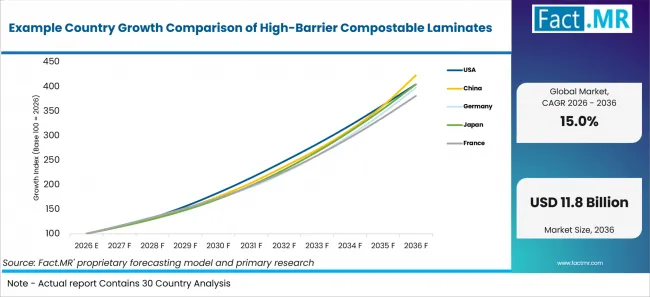
Example Country Growth Comparison Of High Barrier Compostable Laminates | Source: Fact.MR
| Country | CAGR (2026-2036) |
|---|---|
| China | 15.5% |
| USA | 15.0% |
| Japan | 15.0% |
| Germany | 14.8% |
| France | 14.3% |
Source: Fact.MR analysis. Updated Sep 17, 2026
What supports China adoption?
15.5% CAGR, supported by online food retail and local converting scale.
China is forecast to record 15.5% CAGR through 2036 as e-commerce food packs lift small-format barrier needs. The National Bureau of Statistics of China reported in January 2026 that online retail sales of physical goods reached 13,092.3 billion yuan in 2025. That scale supports compostable sachet and pouch trials.
How is the USA scaling demand?
15.0% CAGR, driven by food spending depth and organics diversion.
The USA is projected to post 15.0% CAGR through 2036 as foodservice and retail brands test compostable structures. USDA ERS reported in June 2026 that total U.S. food spending reached USD 2.51 trillion in 2025. Large food-contact volume supports broad material qualification.
What supports Japan growth?
15.0% CAGR, backed by food-price pressure and food-contact compliance.
Japan is anticipated to hold 15.0% CAGR through 2036 as food brands protect shelf life in small packs. The Statistics Bureau of Japan reported in January 2026 that Japan’s food CPI reached 125.8 in 2025. Higher food value keeps oxygen and moisture control central.
What is supporting Germany adoption?
14.8% CAGR, supported by ready-meal output and packaging rules.
Germany is estimated to reach 14.8% CAGR through 2036 as convenience meals require high-integrity lidding and pouch films. Destatis reported in January 2026 that Germany produced 1.7 million tonnes of ready meals in 2024. Converters are expected to link laminates with barrier proof.
How does France perform?
14.3% CAGR, shaped by agro-food scale and EPR pressure.
France is expected to advance at 14.3% CAGR through 2036 as food manufacturers review flexible packaging under EPR systems. Agreste reported in December 2025 that French food and beverage industries commercialized EUR 162 billion of products in 2024. That base supports dry-food, bakery and snack trials.
Who leads the High-Barrier Compostable Laminates Market?
NatureWorks and BASF provide relevant compostable materials for flexible packaging, while TIPA and Futamura Chemical provide compostable laminate and film solutions.
NatureWorks remains directly relevant through Ingeo PLA used in films and flexible packaging. BASF adds ecovio grades for extrusion coating and film lamination. Both companies give converters resin and coating routes for compostable high-barrier structures.
TotalEnergies Corbion is relevant upstream through Luminy PLA grades used in packaging applications. TIPA is active in high-barrier compostable metallized laminates, while Futamura Chemical supplies NatureFlex cellulose films. Novamont contributes through MATER-BI compostable bioplastics. Competition is expected to be shaped by barrier proof, seal behavior and certification depth.
Which companies are profiled in the market?
Companies profiled include NatureWorks, TotalEnergies Corbion, BASF, Novamont, TIPA and Futamura Chemical.
- NatureWorks
- TotalEnergies Corbion
- BASF
- Novamont
- TIPA
- Futamura Chemical
Bibliography
- Directorate-General for Environment. (2026, August 11). New EU packaging rules start to apply, including restrictions on PFAS in food-contact packaging. European Commission.
- European Bioplastics. (2025, December 2). EUBP presents the results of the 2025 market data report.
- National Bureau of Statistics of China. (2026, January 20). Total retail sales of consumer goods in December 2025.
- NatureWorks. (2025, March 18). Ingeo™ Extend: An exceptional solution offering unprecedented manufacturing efficiency and faster biodegradability of BOPLA films.
- Renaud, A. (2025, December 17). Productions commercialisées des industries agroalimentaires 2024 : léger recul des ventes mais un niveau toujours élevé. Agreste.
- Statistics Bureau of Japan. (2026, January 23). Japan 2025.
- Statistisches Bundesamt. (2026, January 14). Produktion von Fertiggerichten binnen fünf Jahren mengenmäßig um 25,6 % gestiegen.
- TotalEnergies Corbion. (2025, September 2). TotalEnergies Corbion and Multi Trade Group partner to drive PLA bioplastics adoption in the Middle East.
- U.S. Environmental Protection Agency. (2026, March 22). Tools for preventing and diverting wasted food.
- Zeballos, E., & Sinclair, W. (2026, June 11). Total U.S. food spending reached $2.51 trillion in 2025. U.S. Department of Agriculture, Economic Research Service.
- BASF. (2026, April 29). New ecovio® portfolio for flexible packaging: Multiple barrier options combined with organic or paper recycling.
This Report Answers
- The report explains where high-barrier compostable laminates are used across laminate platform and barrier level.
- Segment analysis identifies PLA-based laminates and high oxygen barrier structures as the main data-led reference points.
- Pack-format analysis covers sachets, snack pouches, flow wraps, lidding or top-web formats and stand-up pouches.
- End-of-life assessment separates industrial compostable, home compostable, dual certification, soil biodegradable and other certified compostable routes.
- Country analysis examines China, the USA, Japan, Germany and France across policy, food-pack and converter conditions.
- Competitive analysis reviews NatureWorks, TotalEnergies Corbion, BASF, Novamont, TIPA and Futamura Chemical.
What does the Dry Fungi Mycoproteins Market cover?
PLA-based, PHA-based, cellulose-based and PBAT-starch laminate systems used for protective flexible packaging.
The High-Barrier Compostable Laminates Market covers flexible packaging structures that combine barrier performance with a certified compostable end-of-life route. These materials are used where oxygen, moisture, grease or aroma protection is needed in sachets, pouches, flow wraps, lidding and stand-up pouches.
The assessment differs from broad biodegradable packaging because it focuses on laminated structures with high-barrier function. Simple compostable bags, rigid molded items and single-layer films are outside the scope unless they are sold as part of a qualified barrier laminate structure.
What is included in the scope?
High-barrier compostable laminate structures used in food-contact and flexible consumer packaging.
The scope includes PLA-based, PHA-based, cellulose-based, PBAT/starch blend and paper-biopolymer laminate platforms used for oxygen, moisture, grease and aroma control. It covers sachets, snack pouches, flow wraps, lidding formats and stand-up pouches used in food, coffee, tea and personal care. Adjacent compostable laminate packaging materials and bioplastics for packaging are considered when the product is a barrier laminate with compostability documentation. Related bio barrier coatings are included when the coating layer forms part of the laminate.
What is excluded from the scope?
Rigid compostable containers and non-barrier single-layer films are outside the scope.
The scope excludes rigid trays, molded fiber bowls, cutlery, carrier bags, mulch films and resin pellets sold without a laminate application. Conventional recyclable mono-material pouches are excluded unless a compostable barrier laminate is part of the finished structure. Compostable heat-seal coatings are excluded when they are sold only as coating systems and are separate from a laminated high-barrier pack.
How Was the Analysis Built?
The analysis draws on 120+ sources, 35+ company portfolios, 25+ countries, and more than 20 industry interviews.
- Primary Research: Primary research includes discussions with converters, film producers, packaging engineers, certification specialists, food brands and distributors. These conversations examine pack approval, sealing behavior, barrier needs, product adoption and commercial acceptance.
- Desk Research: Desk research covers government statistics, regulatory publications, company pages, industry associations, standards and public policy sources. Every source used in the analysis is documented in the bibliography.
- Market Sizing and Forecasting: Market estimates combine historical performance, demand indicators, segment shares, country-level growth, adoption patterns, investment activity and barriers to market expansion.
- Data Validation and Update Cycle: Findings are validated by comparing primary interviews with public data, company activity, regulatory changes and trade patterns. Update reviews track product launches, capacity changes, partnerships and commercial adoption.
Segmentation
What is the report’s scope and coverage?
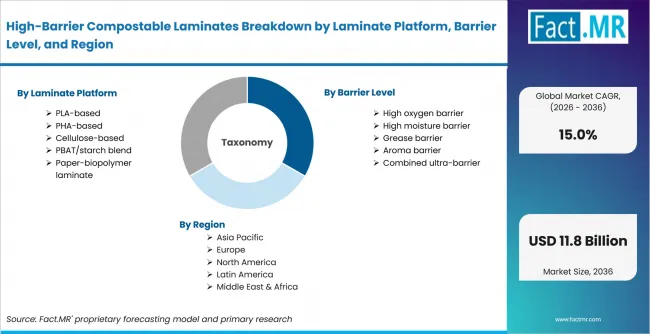
High Barrier Compostable Laminates Breakdown By Laminate Platform, Barrier Level, And Region | Source: Fact.MR
| Attribute | Details |
|---|---|
| Quantitative Units | USD billion |
| Market Definition | Laminated flexible packaging structures that combine certified compostable materials with oxygen, moisture, grease or aroma barrier performance. |
| Laminate Platform | PLA-based; PHA-based; Cellulose-based; PBAT/starch blend; Paper-biopolymer laminate |
| Barrier Level | High oxygen barrier; High moisture barrier; Grease barrier; Aroma barrier; Combined ultra-barrier |
| Pack Format | Single-serve sachets; Snack pouches; Flow wraps; Lidding / top web; Stand-up pouches |
| End-of-Life | Industrial compostable; Home compostable; Home + industrial; Soil biodegradable; Other certified compostable |
| Regions Covered | North America; Latin America; Western Europe; Eastern Europe; East Asia; South Asia & Pacific; Middle East & Africa |
| Countries Covered | China; USA; Japan; Germany; France |
| Key Companies Profiled | NatureWorks; TotalEnergies Corbion; BASF; Novamont; TIPA; Futamura Chemical |
| Forecast Period | 2026 to 2036 |
| Approach | Hybrid top-down and bottom-up approach using food-packaging demand indicators, laminate platform mix, barrier performance needs, certification routes, country adoption and provider portfolio review. |
Source: Fact.MR analysis. Updated Sep 17, 2026
How is the market segmented?
-
By Laminate Platform
- PLA-based
- PHA-based
- Cellulose-based
- PBAT/starch blend
- Paper-biopolymer laminate
-
By Barrier Level
- High oxygen barrier
- High moisture barrier
- Grease barrier
- Aroma barrier
- Combined ultra-barrier
-
By Pack Format
- Single-serve sachets
- Snack pouches
- Flow wraps
- Lidding / top web
- Stand-up pouches
-
By End-of-Life
- Industrial compostable
- Home compostable
- Home + industrial
- Soil biodegradable
- Other certified compostable
-
By Region
- North America
- Latin America
- Western Europe
- Eastern Europe
- East Asia
- South Asia & Pacific
- Middle East & Africa
Frequently Asked Questions
How big is the high-barrier compostable laminates market in 2026?
What is the CAGR of the high-barrier compostable laminates market from 2026 to 2036?
Which laminate platform leads the high-barrier compostable laminates market?
Which end-of-life route leads the high-barrier compostable laminates market?
Which companies are profiled in the high-barrier compostable laminates market?
Who worked on this report


Preview the report firsthand - request a free sample
Free SampleGet the brochure for pricing and purchase details
Download PDF