The Poly Pallets Market is analyzed across its key product, application and end-use segments, with the study covering market dynamics, regional trends and demand outlook, forecast 2026 to 2036.
By Fact.MR Industrial Goods DeskFact-checked under the Fact.MR editorial processUpdated
11 min read
Poly Pallets Market Forecast and Outlook 2026 to 2036
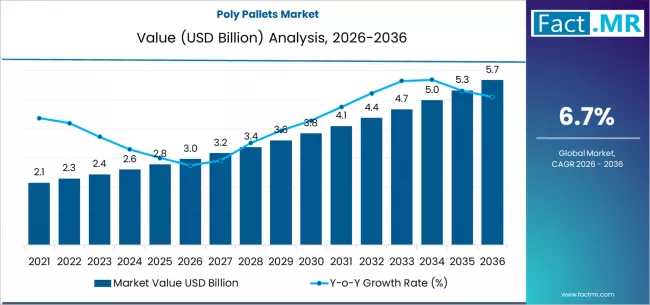
The global poly pallets market is projected ttotal USD 2.96 billion in 2026, and to USD 5.68 billion by 2036, progressing at a 6.7% CAGR. This sustained growth is driven by the foundational shift in logistics and supply chain management toward durable, hygienic, and standardized unit load platforms.
Poly Pallets Market Market Value Analysis | Source: Fact.MR
Summary of Poly Pallets Market
Market Snapshot
Global poly pallets market revenue stood at USD 2.96 billion in 2026 and is forecast treach USD 5.68 billion by 2036.
At a 6.7% CAGR from 2026 t2036, this market is set texpand ~1.92x in value, adding USD 2.72 billion in absolute opportunity.
Growth is being driven by the shift inlogisticsand supply chain management toward durable, hygienic, and standardized unit load platforms.
Poly pallets offer advantages over traditional wood pallets, including moisture resistance, consistent dimensions, superior cleanliness, and longer lifecycle performance.
Increasing automation in warehousing and stringent hygiene regulations in food and pharmaceutical industries are reinforcing adoption.
Demand and Growth Drivers
Increasing demand for durable and hygienic material handling platforms
Rising adoption of automated warehousing andlogisticssystems
Growing emphasis on reusable and recyclablelogisticsassets
Expansion of food, pharmaceutical, and retail distribution infrastructure
Need for solutions that provide:
Moisture and pest resistance
Consistent dimensions for automation compatibility
Improved hygiene and sanitation performance
oLonger lifecycle and lower total ownership cost
Product and Segment View
Food, pharma & retaillogisticshold 39.9% of end-use share in 2026,emergingas the leading segment.
Rackable& nestable pallets hold 42.8% of pallet type share in 2026, positioning them as the dominant segment.
HDPE & PP account for 55.0% of material share in 2026, reflecting primary material adoption.
Structural foam & injection moulding hold 55.6% of technology share in 2026,indicatingleading technology adoption.
Key product categories include:
Food, pharma & retail logistics
oIndustrial warehousing
FMCG logistics
Export logistics
oCold-chain logistics
oAutomated storage systems
Geography and Competitive Outlook
Growth is supported across North America, Europe, Asia Pacific, Latin America, Middle East & Africa.
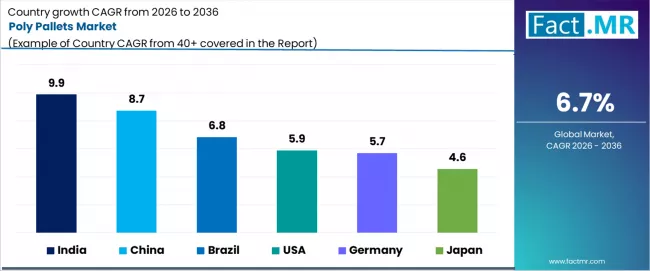
Key growth markets and CAGR: India 9.9%, China 8.7%, USA 5.9%, Brazil 6.8%, Germany 5.7%, Japan 4.6%
Market expansion is closely tied to:
Increasing warehouse automation
Rising demand for hygieniclogisticssolutions
Adoption of reusable and recyclable pallet systems
Key companies active in this market include: ORBIS Corporation, Rehrig Pacific Company, Schoeller Allibert, QingdaoHuading,NilkamalLimited, Mitsubishi Logistics.
Poly Pallets Market — At a Glance
Attribute
Details
Market Value 2026
USD 2.96 billion
Market Value 2036
USD 5.68 billion
Absolute Dollar Opportunity 2026–2036
USD 2.72 billion
Total Growth 2026–2036
91.89%
CAGR 2026–2036
6.7%
Growth Multiple
~1.92x
Key Demand Theme
Increasing adoption of durable, hygienic, and reusablelogisticsplatforms
Leading Segment by End-Use (2026)
Food, Pharma & Retail Logistics
Segment Share (2026)
39.9%
Leading Segment by Pallet Type (2026)
Rackable& Nestable Pallets
Segment Share (2026)
42.8%
Leading Segment by Material (2026)
HDPE & PP
Segment Share (2026)
55.0%
Leading Segment by Technology (2026)
Structural Foam & Injection Moulding
Segment Share (2026)
55.6%
Key Growth Regions
North America, Europe, Asia Pacific, Latin America, Middle East & Africa
Country CAGRs
India 9.9%, China 8.7%, USA 5.9%, Brazil 6.8%, Germany 5.7%, Japan 4.6%
Top Companies
ORBIS Corporation, Rehrig Pacific Company, Schoeller Allibert, QingdaoHuading,NilkamalLimited, Mitsubishi Logistics
North America, Europe, Asia Pacific, Latin America, Middle East & Africa
Polyethylene and polypropylene pallets offer critical advantages over traditional wood, including consistent dimensions, superior cleanliness, resistance tmoisture and pests, and a longer lifecycle, making them essential for modern, high-throughput distribution networks. The economic rationale extends beyond the purchase price ttotal cost of ownership. The durability of poly pallets eliminates costs associated with broken board repairs, nail-related product damage, and fumigation for international shipping. Their compatibility with automated material handling systems in food, pharmaceutical, and retail distribution centers reduces downtime and improves operational efficiency. The market's evolution is therefore tied tthe broader trends of supply chain automation, stringent hygiene regulation, and the pursuit of logistical efficiency and sustainability through asset longevity and recyclability.
North America, Latin America, Western Europe, Eastern Europe, East Asia, South Asia & Pacific, Middle East & Africa
Macro-Level Industry Catalysts
Industry Development
Impact
Circular Economy & Waste Reduction Mandates
Drives adoption over single-use wood, as poly pallets are recyclable and support long-term reuse and pooling models, reducing solid waste.
Accelerated Warehouse Automation
Creates non-negotiable demand for dimensionally precise, consistent, and robust pallets that interact reliably with robots, conveyors, and AS/RS.
Global Hygiene & Food Safety Standards (IFS, BRCGS)
Mandates use of cleanable, non-porous platforms in food and pharma supply chains, where wood is often prohibited.
Total Cost of Ownership Analysis in Logistics
Shifts procurement focus from upfront price to lifecycle cost, where poly pallets' durability and low maintenance offer a superior ROI for closed-loop systems.
Supply Chain Localization & Regionalized Pooling
Increases demand for standardized, asset-trackable pallets suitable for multi-party sharing within specific trade corridors (e.g., Intra-EU).
Segmental Analysis
By Technology, Which Process is Pivotal for Creating Strong, Lightweight Structures?
Structural foam and injection moulding technology commands a leading 55.6% share. This process involves injecting a molten polymer mixed with a blowing agent into a mould, creating a part with a solid outer skin and a foamed inner core.
This results in pallets that are exceptionally strong and rigid for their weight, capable of supporting heavy racked loads while remaining easy to handle. The technology is fundamental to achieving the strength-to-weight ratio required for high-performance logistics, making it the dominant manufacturing method for premium and heavy-duty poly pallets.
By End-Use, Which Sector has the Most Stringent Requirements driving Adoption?
The food, pharma, and retail logistics segment constitutes the primary end-use at 39.9%. This sector operates under the strictest hygiene protocols and requires absolute reliability in fast-paced, automated distribution environments.
Poly pallets are essential as they can be easily washed and sanitized, will not harbor pests or mold, and provide consistent performance in automated sortation systems. The high cost of contamination or system downtime in these industries justifies the investment in poly pallets, making this segment the key driver for quality and innovation.
By Material, Which Polymer Combination Delivers Optimal Performance for Most Applications?
High-density polyethylene and polypropylene collectively hold a dominant 55.0% share. HDPE is prized for its excellent impact resistance at low temperatures and high stiffness, ideal for heavy loads. PP offers good chemical resistance and a higher heat deflection temperature.
The combination, sometimes used in co-injection or within a product portfolio, allows manufacturers to cater to the vast majority of logistical needs, from frozen food storage to general manufacturing, establishing these polymers as the industry standard.
What are the Principal Drivers, Constraints, and Evolving Dynamics of the Poly Pallets Market?
Attribute
Impact
Driver
Intensifying sustainability mandates and hygiene regulations in global food and pharmaceutical supply chains, phasing out non-compliant wood pallets.
Restraint
Significantly higher initial purchase cost compared to wood pallets, creating a barrier for price-sensitive industries and one-way export applications.
Opportunity
Massive growth in pallet pooling and rental services, which rely on durable, trackable poly assets and create a service-based revenue model for manufacturers.
Trend
Integration of RFID tags and IoT sensors into moulded pallets for real-time supply chain visibility, condition monitoring, and automated inventory management.
Analysis of the Poly Pallets Market by Key Countries
Poly Pallets Market Cagr Analysis By Country | Source: Fact.MR
Country
CAGR 2026 to 2036
USA
5.9%
Germany
5.7%
China
8.7%
India
9.9%
Brazil
6.8%
Japan
4.6%
How do a Mature Logistics Sector and Retail Giants Shape Demand for Poly Pallets in USA?
The sophisticated, automated distribution networks of major retailers and the stringent requirements of its pharmaceutical sector drive the USA’s 5.9% CAGR. The demand driver is the need for hygienic, automation-compatible pallets in food, pharma & retail logistics. The market is characterized by a strong presence of pooling companies and major manufacturers like ORBIS and Rehrig Pacific.
Adoption is fueled by the total cost of ownership analysis conducted by large logistics operators, who value the reliability and cleanliness of poly pallets in their massive, technology-driven fulfillment centers.
What Characterizes Germany's Role in Intra-EU Closed-Loop Systems?
Germany's 5.7% CAGR reflects its central role in intra-EU supply chains, where efficiency and standardization are paramount. The market is driven by pallet pooling systems that require durable, standardized assets for cross-border reuse.
German manufacturing and logistics firms prioritize high-quality, rackable & nestable pallets that maximize trailer space on return trips. The emphasis is on structural foam pallets from European leaders like Schoeller Allibert that can withstand years of rigorous use in closed-loop rental systems, aligning with the EU's circular economy objectives.
What Underpins China's Massive Domestic Manufacturing and Export Logistics?
China's 8.7% CAGR is fueled by its dual role as the world's manufacturing hub and a rapidly modernizing domestic logistics market. The primary demand driver is internal logistics modernization for manufacturing & exports, requiring millions of durable pallets.
Massive industry capacity for plastic processing supports high-volume moulding of cost-competitive pallets. While export applications often use wood, domestic supply chains for food, beverage, and electronics are rapidly upgrading to poly pallets to improve efficiency and hygiene, creating immense volume growth.
Why is India's Industrial and Export Growth the Primary Catalyst?
India's leading 9.9% CAGR is propelled by the rapid expansion of its formal manufacturing sector and rising export volumes. The demand driver is the need for heavy-duty pallets that can withstand challenging supply chain conditions and multiple reuse cycles. Price sensitivity fosters innovation in using recycled PP and efficient manufacturing.
Domestic plastics giants like Nilkamal are key players, leveraging scale to produce affordable, durable pallets that meet the growing needs of India's automotive, chemical, and FMCG industries for both domestic and export logistics.
How is Brazil's Agribusiness and Retail Sector Influencing Market Development?
Brazil's 6.8% CAGR is closely tied to the needs of its large warehousing & FMCG sector and agribusiness exports. The demand driver focuses on lightweight pallets that reduce shipping weight and cost-efficient moulding to balance performance with budget. Adoption is growing in sectors where product contamination or moisture damage is a concern.
The market evolution is gradual, focusing on specific applications within controlled supply chains rather than a wholesale replacement of wood, with growth linked to the expansion of modern retail and cold chain infrastructure.
What defines Japan's Focus on Precision, Hygiene, and Space Optimization?
Japan's 4.6% CAGR represents a mature market where space, precision, and cleanliness are paramount, especially in food & beverage and precision logistics. The demand driver is the need for ultra-clean, perfectly dimensioned pallets that integrate with highly automated warehouses and compact storage systems.
Japanese users, supported by specialists like Mitsubishi Logistics, prioritize advanced reinforced pallet designs that offer extreme durability with minimal weight, and pallets designed for specific automated handling equipment, reflecting a focus on total system integration over unit cost.
Competitive Landscape of the Poly Pallets Market
The competitive arena is segmented between global leaders in returnable packaging and regional plastics manufacturing champions. Integrated players like ORBIS and Schoeller Allibert compete through comprehensive pallet pooling service offerings, extensive product lines for specific industries, and advanced molding technology.
Strategic moves include significant capacity expansion in growth regions like Asia, acquisitions of smaller pooling operators to gain market share, and deep partnerships with large retail or automotive clients to design custom pallet solutions.
Competition is intensifying around business model innovation, with a shift from selling pallets to offering Pallet-as-a-Service subscriptions that include tracking, repair, and recycling. Success increasingly depends on localization of manufacturing near key customer hubs to reduce logistics costs and the ability to incorporate higher levels of post-consumer recycled content into products to meet corporate sustainability targets.
Key Players in the Poly Pallets Market
ORBIS Corporation
Rehrig Pacific Company
Schoeller Allibert
Qingdao Huading
Nilkamal Limited
Mitsubishi Logistics
References
European Federation of Wooden Pallet & Packaging Manufacturers (FEFPEB). (2024). Life Cycle Assessment of Packaging Materials: Wood vs. Plastic Pallets.
Grocer Manufacturers Association (GMA). (2025). Guidelines for Pallet Management in Grocery Distribution.
International Organization for Standardization (ISO). (2024). ISO 18613: Pallets for materials handling - Polymeric pallets.
Journal of Cleaner Production. (2025). Economic and Environmental Evaluation of Pallet Pooling Systems.
U.S. Food and Drug Administration (FDA). (2024). Guidance for Industry: Sanitary Transportation of Human and Animal Food.
World Bank. (2024). Logistics Performance Index (LPI) Report: The Role of Standardized Unit Loads.
Lifecycle cost analysis vs. wood and other materials; load capacity and durability testing under dynamic conditions; study of pallet design impact on warehouse automation system efficiency; analysis of pallet pooling economics and reverse logistics; review of recycling infrastructure and end-of-life pathways for polyolefin pallets.
Market by Segments
End-Use :
Food, Pharma & Retail Logistics
Intra-EU Supply Chains
Manufacturing & Exports
Warehousing & FMCG
Food & Beverage
Precision Logistics
Pallet Type :
Rackable & Nestable Pallets
Hygienic Pallets
Heavy-Duty Pallets
Lightweight Pallets
Others
Material :
HDPE & PP
HDPE
Recycled PP
PP
Others
Technology :
Structural Foam & Injection Moulding
Reinforced Pallet Design
High-Volume Moulding
Cost-Efficient Moulding
Others
Region :
North America
USA
Canada
Latin America
Brazil
Mexico
Argentina
Rest of Latin America
Western Europe
Germany
France
Italy
Spain
UK
BENELUX
Rest of Western Europe
Eastern Europe
Russia
Poland
Czech Republic
Rest of Eastern Europe
East Asia
China
Japan
South Korea
Rest of East Asia
South Asia & Pacific
India
ASEAN
Australia
Rest of South Asia & Pacific
MEA
GCC Countries
South Africa
Turkiye
Rest of MEA
Frequently Asked Questions
How big is the poly pallets market in 2026?
The global poly pallets market is estimated to be valued at USD 3.0 billion in 2026.
What will be the size of poly pallets market in 2036?
The market size for the poly pallets market is projected to reach USD 5.7 billion by 2036.
How much will be the poly pallets market growth between 2026 and 2036?
The poly pallets market is expected to grow at a 6.7% CAGR between 2026 and 2036.
What are the key product types in the poly pallets market?
The key product types in poly pallets market are food, pharma & retail logistics, intra-eu supply chains, manufacturing & exports, warehousing & fmcg, food & beverage and precision logistics.
Which pallet type segment to contribute significant share in the poly pallets market in 2026?
In terms of pallet type, rackable & nestable pallets segment to command 42.8% share in the poly pallets market in 2026.