Poly Drums Market
Poly Drums Market Size and Share Forecast Outlook 2026 to 2036
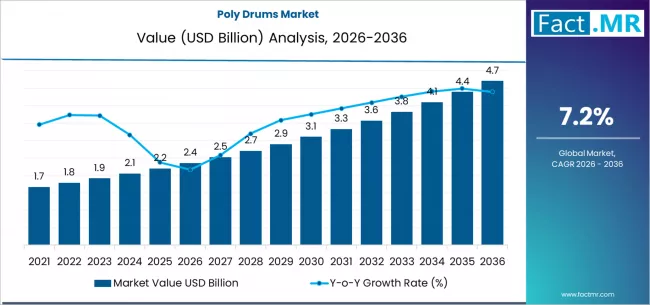
Poly drums market is projected to grow from USD 2.4 billion in 2026 to USD 4.7 billion by 2036, at a CAGR of 7.2%. Chemicals & food ingredients will dominate with a 39.9% market share, while open-head & tight-head drums will lead the drum type segment with a 41.6% share.
Poly Drums Market Forecast and Outlook 2026 to 2036
The global poly drums market is projected to total USD 2.36 billion in 2026, and to USD 4.71 billion by 2036, progressing at a 7.2% CAGR. This steady growth is anchored in the material's critical role as the primary intermediate bulk container for a vast spectrum of industrial sectors.
Key Takeaways from the Poly Drums Market
- Market Value for 2026: USD 2.36 Billion
- Market Value for 2036: USD 4.71 Billion
- Forecast CAGR 2026 to 2036: 7.2%
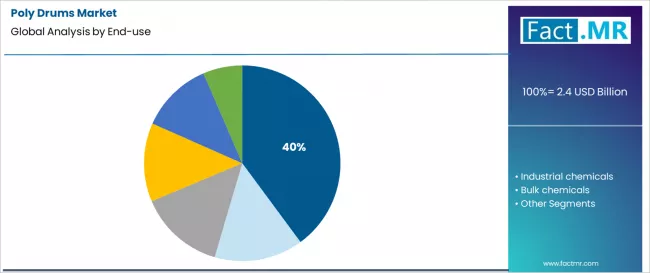
- Leading End-Use Segment (2026): Chemicals & Food Ingredients (39.9%)
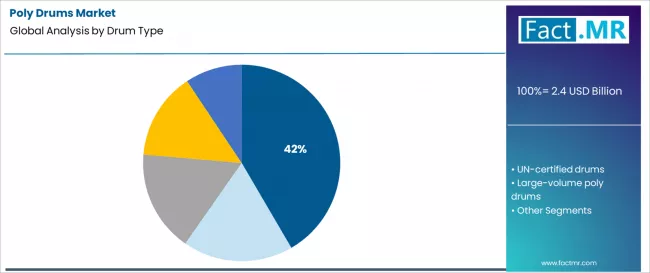
- Leading Drum Type (2026): Open-Head & Tight-Head Drums (41.6%)
- Leading Material Segment (2026): HDPE (41.0%)
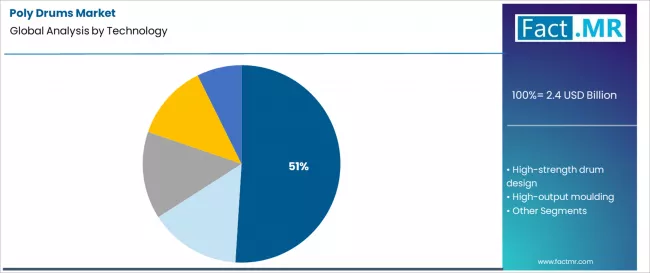
- Leading Technology Segment (2026): Blow Moulding & Multilayer Extrusion (51.0%)
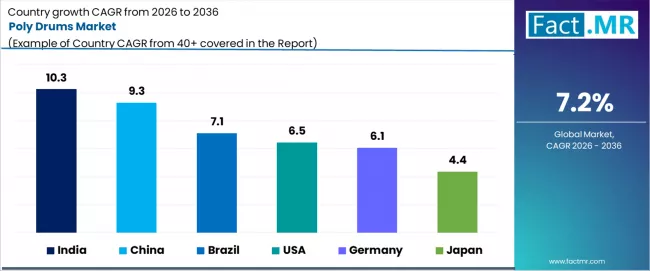
- Key Growth Countries: India (10.3% CAGR), China (9.3% CAGR), USA (6.5% CAGR), Brazil (7.1% CAGR), Germany (6.1% CAGR), Japan (4.4% CAGR)
- Key Players: Mauser Packaging Solutions, Schütz GmbH & Co. KGaA, Time Technoplast Ltd., Mitsubishi Logistics Packaging, Greif, Inc.

High-density polyethylene drums offer an unmatched combination of chemical resistance, durability, and weight efficiency compared to traditional steel or fibre alternatives, securing their position as the default solution for the safe transport and storage of liquids, semi-solids, and powders.
The market’s evolution is less about displacing other formats and more about continuous innovation within the HDPE paradigm itself. Advancements focus on enhancing performance metrics: increasing top-load strength for higher warehouse stacking, integrating barrier layers for sensitive ingredients, and improving design for total cost-in-use, including cleaning and reusability.
Regulatory compliance, particularly UN certification for the transport of dangerous goods, acts as a fundamental market gatekeeper, ensuring that drum design and manufacturing adhere to globally recognized safety and performance protocols, thereby sustaining demand for certified, quality-assured products.
Poly Drums Market
| Metric | Value |
|---|---|
| Market Value (2026) | USD 2.36 Billion |
| Market Forecast Value (2036) | USD 4.71 Billion |
| Forecast CAGR 2026 to 2036 | 7.2% |
Category
| Category | Segments |
|---|---|
| End-Use | Chemicals & Food Ingredients, Industrial Chemicals, Bulk Chemicals, Agrochemicals & Pharma, Chemicals & Lubricants, Specialty Chemicals |
| Drum Type | Open-Head & Tight-Head Drums, UN-Certified Drums, Large-Volume Poly Drums, Stackable Drums, Others |
| Material | HDPE, PP, LDPE, LLDPE, Others |
| Technology | Blow Moulding & Multilayer Extrusion, High-Strength Drum Design, High-Output Moulding, Cost-Efficient Moulding, Others |
| Region | North America, Latin America, Western Europe, Eastern Europe, East Asia, South Asia & Pacific, Middle East & Africa |
How is Supply Chain Resilience Reshaping the Fundamentals of Drum Sourcing and Design?
The industrial packaging landscape is being redefined by a focus on supply chain robustness, material science, and circularity. Geopolitical shifts and logistics volatility have increased the premium on localized or regionalized drum production to ensure container availability.
Material innovation is targeting the development of HDPE grades incorporating higher levels of post-consumer recycled content without compromising UN certification performance, driven by brand owner sustainability commitments.
The economics of drum reconditioning and reuse are gaining prominence as a closed-loop strategy to reduce virgin plastic consumption and total cost of ownership, making drum durability and design-for-cleaning critical competitive factors beyond the first use.
Segmental Analysis
By Technology, Which Manufacturing Process is Synonymous with High-Volume, High-Quality Production?

Blow moulding combined with multilayer extrusion commands a leading 51.0% share. This technology is the industry backbone, enabling the seamless, single-piece production of robust drum bodies. Multilayer co-extrusion allows for the integration of different polymer layers within the drum wall-such as a virgin HDPE outer layer for strength, a recycled-content middle layer, and a pure, FDA-approved inner layer for product compatibility. This capability is essential for creating drums that meet stringent hygiene standards for food and pharma while incorporating sustainable materials, all within a high-speed, automated manufacturing process.
By End-Use, Which Sector Represents the Largest and Most Diverse Volume Demand?

The chemicals and food ingredients segment constitutes the primary end-use at 39.9%. This broad category encompasses everything from industrial acids and alkalis to food-grade oils, syrups, and additives. The universal need across these sub-segments is for a chemically inert, contamination-free, and reliably sealed container. Poly drums meet this need across the value spectrum, from basic intermediate chemicals to high-value food products, driving consistent, high-volume demand and necessitating a wide array of drum specifications, liners, and closure systems.
By Drum Type, Which Design Dichotomy Addresses the Fundamental Trade-off Between Access and Security?

Open-head and tight-head drums collectively hold a dominant 41.6% share. This represents the core design choice for users: open-head drums offer easy access for filling and dispensing viscous or solid products, while tight-head drums provide superior seal integrity for liquids and hazardous materials.
The combined dominance of these two types highlights the market's need to serve fundamentally different emptying and handling processes, with selection dictated by the product's physical characteristics and the safety requirements of its supply chain.
What are the Principal Drivers, Constraints, and Evolving Dynamics of the Poly Drums Market?
Growth is principally driven by the expansion of the global chemical manufacturing and processing industry, which generates continuous demand for reliable intermediate bulk containers. A significant constraint is the volatility in HDPE resin prices, which directly impacts production costs and creates pricing instability for drum manufacturers and their customers.
Opportunity lies in the systematic development of a circular economy for industrial packaging, where drum producers establish or partner with dedicated reconditioning networks to capture and refurbish used drums, creating a new revenue stream and locking in customer loyalty. The key trend is the integration of smart technologies, such as RFID tags or QR codes molded into the drum, enabling track-and-trace, contents verification, and lifecycle management, thereby adding digital value to the physical asset.
Analysis of the Poly Drums Market by Key Countries

| Country | CAGR 2026 to 2036 |
|---|---|
| USA | 6.5% |
| Germany | 6.1% |
| China | 9.3% |
| India | 10.3% |
| Brazil | 7.1% |
| Japan | 4.4% |
How do a Mature Industrial Base and Stringent Logistics Shape the US Market?
The USA's 6.5% CAGR reflects steady demand from its vast chemicals & food ingredients sector and a well-established logistics network optimized for drum handling. Regulatory compliance with DOT and UN standards is a baseline.
Advanced manufacturing and a strong drum reconditioning sector, creating a circular flow, characterize the industry capacity. Demand is split between new drums for sensitive products like specialty chemicals and a robust market for reconditioned units for less demanding applications, with major players like Greif operating across both segments.
What Characterizes Germany's High-Value, Specification-Driven Demand?
Germany's 6.1% CAGR is defined by the needs of its high-value specialty chemicals and pharmaceutical industries. The demand driver is for ultra-clean, highly specified drums, often with custom linings or certification beyond standard UN marks.
The presence of leading engineering-focused manufacturers like Mauser Packaging and Schütz underpins this industry capacity. The market emphasizes precision, quality, and the ability to supply complex, multi-layer barrier drums that protect high-margin products throughout stringent European supply chains.
What underpins China's Unparalleled Scale in Industrial Chemical Production?
China's 9.3% CAGR is fueled by its position as the world's primary manufacturer of industrial chemicals. The sheer volume of production creates immense demand for large-volume poly drums and UN-certified drums for export.
Massive domestic industry capacity for HDPE resin and high-output moulding allows local manufacturers to produce at a scale and cost that supports both domestic consumption and global export of filled chemical products, making it the volume engine of the global market.
Why is India's Bulk Chemical and Agrochemical Sector the Primary Growth Engine?
India's leading 10.3% CAGR is directly tied to the expansion of its bulk chemicals and agrochemicals industries. The demand driver is the need for cost-effective, durable containers for domestic distribution and export. This fuels investment in high-output moulding capabilities.
The market is highly competitive on price, favoring large domestic producers like Time Technoplast that can achieve economies of scale. Growth is further supported by increasing formalization and safety standards in chemical handling, which drives the shift from informal packaging to certified drum usage.
How is Brazil's Agribusiness and Pharma Sector Influencing Specific Drum Demand?
Brazil's 7.1% CAGR is closely linked to the strength of its agrochemicals & pharma sectors. The demand driver combines the need for robust containers for crop protection products with higher-specification drums for active pharmaceutical ingredients.
The focus is on stackable drums for efficient warehousing and cost-efficient moulding to maintain competitiveness in global commodity markets. Strategic trade patterns as a major agricultural exporter necessitate reliable packaging that meets international shipping regulations.
What defines Japan's Mature, High-Specification Market for Specialty Products?
Japan's 4.4% CAGR represents a sophisticated, replacement-driven market focused on high-purity and performance-critical applications in chemicals & lubricants. Demand drivers include the needs of the electronics and automotive industries for contamination-free packaging.
Japanese users prioritize exceptional drum cleanliness, precise dimensional tolerances for automated handling, and advanced barrier properties. Suppliers like Mitsubishi Logistics Packaging focus on high-value, technically advanced solutions and integrated packaging logistics services rather than competing on volume or cost alone.
Competitive Landscape of the Poly Drums Market
The competitive environment is consolidated among global industrial packaging leaders with integrated supply chains. Companies like Greif and Mauser compete through extensive global manufacturing footprints, broad product portfolios spanning all drum types and sizes, and established reconditioning networks that create a circular service offering.
Competition centers on operational excellence in high-volume blow moulding, the development of proprietary resin blends or layer structures for enhanced performance, and the ability to provide consistent quality on a global scale to multinational chemical clients. Strategic moves include vertical integration into HDPE recycling to secure sustainable feedstock, digitalization of drum asset tracking, and acquisitions to bolster regional presence or gain access to specific technology, such as advanced aseptic drum designs for the pharmaceutical sector.
Key Players in the Poly Drums Market
- Mauser Packaging Solutions
- Schütz GmbH & Co. KGaA
- Time Technoplast Ltd.
- Mitsubishi Logistics Packaging
- Greif, Inc.
Scope of Report
| Items | Metrics |
|---|---|
| Quantitative Units | USD Billion |
| Technology | Blow Moulding & Multilayer Extrusion, High-Strength Drum Design, High-Output Moulding, Cost-Efficient Moulding, Others |
| Drum Type | Open-Head & Tight-Head Drums, UN-Certified Drums, Large-Volume Poly Drums, Stackable Drums, Others |
| End-Use | Chemicals & Food Ingredients, Industrial Chemicals, Bulk Chemicals, Agrochemicals & Pharma, Chemicals & Lubricants, Specialty Chemicals |
| Material | HDPE, PP, LDPE, LLDPE, Others |
| Key Countries | India, China, USA, Brazil, Germany, Japan |
| Key Companies | Mauser Packaging, Schütz, Time Technoplast, Mitsubishi Logistics Packaging, Greif |
| Additional Analysis | Comparative analysis of top-load strength and chemical resistance across drum designs; total cost of ownership modeling for single-trip vs. reconditioned drums; study of UN certification testing and compliance logistics; impact of drum design on filling line efficiency and warehouse space utilization; analysis of the reconditioning process economics and quality standards. |
Market by Segments
-
End-Use :
- Chemicals & Food Ingredients
- Industrial Chemicals
- Bulk Chemicals
- Agrochemicals & Pharma
- Chemicals & Lubricants
- Specialty Chemicals
-
Drum Type :
- Open-Head & Tight-Head Drums
- UN-Certified Drums
- Large-Volume Poly Drums
- Stackable Drums
- Others
-
Material :
- HDPE
- PP
- LDPE
- LLDPE
- Others
-
Technology :
- Blow Moulding & Multilayer Extrusion
- High-Strength Drum Design
- High-Output Moulding
- Cost-Efficient Moulding
- Others
-
Region :
- North America
- USA
- Canada
- Latin America
- Brazil
- Mexico
- Argentina
- Rest of Latin America
- Western Europe
- Germany
- France
- Italy
- Spain
- UK
- BENELUX
- Rest of Western Europe
- Eastern Europe
- Russia
- Poland
- Czech Republic
- Rest of Eastern Europe
- East Asia
- China
- Japan
- South Korea
- Rest of East Asia
- South Asia & Pacific
- India
- ASEAN
- Australia
- Rest of South Asia & Pacific
- MEA
- GCC Countries
- South Africa
- Turkiye
- Rest of MEA
- North America
References
- European Chemicals Agency (ECHA). (2024). Guidance on the Packaging and Labelling of Dangerous Substances and Mixtures.
- Food and Agriculture Organization (FAO) & World Health Organization (WHO). (2024). Code of Practice for the Packaging and Transport of Food.
- International Organization for Standardization (ISO). (2025). ISO 15750: Packaging - Drum series.
- National Fire Protection Association (NFPA). (2025). NFPA 30: Flammable and Combustible Liquids Code.
- UN Economic Commission for Europe (UNECE). (2024). UN Model Regulations: Recommendations on the Transport of Dangerous Goods.
- World Packaging Organisation (WPO). (2024). Guidelines for the Design and Testing of Industrial Bulk Packaging.
Table of Content
- Executive Summary
- Global Market Outlook
- Demand to side Trends
- Supply to side Trends
- Technology Roadmap Analysis
- Analysis and Recommendations
- Market Overview
- Market Coverage / Taxonomy
- Market Definition / Scope / Limitations
- Market Background
- Market Dynamics
- Drivers
- Restraints
- Opportunity
- Trends
- Scenario Forecast
- Demand in Optimistic Scenario
- Demand in Likely Scenario
- Demand in Conservative Scenario
- Opportunity Map Analysis
- Product Life Cycle Analysis
- Supply Chain Analysis
- Investment Feasibility Matrix
- Value Chain Analysis
- PESTLE and Porter’s Analysis
- Regulatory Landscape
- Regional Parent Market Outlook
- Production and Consumption Statistics
- Import and Export Statistics
- Market Dynamics
- Global Market Analysis 2021 to 2025 and Forecast, 2026 to 2036
- Historical Market Size Value (USD Million) Analysis, 2021 to 2025
- Current and Future Market Size Value (USD Million) Projections, 2026 to 2036
- Y to o to Y Growth Trend Analysis
- Absolute $ Opportunity Analysis
- Global Market Pricing Analysis 2021 to 2025 and Forecast 2026 to 2036
- Global Market Analysis 2021 to 2025 and Forecast 2026 to 2036, By End-use
- Introduction / Key Findings
- Historical Market Size Value (USD Million) Analysis By End-use, 2021 to 2025
- Current and Future Market Size Value (USD Million) Analysis and Forecast By End-use, 2026 to 2036
- Chemicals & food ingredients
- Industrial chemicals
- Bulk chemicals
- Agrochemicals & pharma
- Chemicals & lubricants
- Specialty chemicals
- Chemicals & food ingredients
- Y to o to Y Growth Trend Analysis By End-use, 2021 to 2025
- Absolute $ Opportunity Analysis By End-use, 2026 to 2036
- Global Market Analysis 2021 to 2025 and Forecast 2026 to 2036, By Drum Type
- Introduction / Key Findings
- Historical Market Size Value (USD Million) Analysis By Drum Type, 2021 to 2025
- Current and Future Market Size Value (USD Million) Analysis and Forecast By Drum Type, 2026 to 2036
- Open-head & tight-head drums
- UN-certified drums
- Large-volume poly drums
- Stackable drums
- Others
- Open-head & tight-head drums
- Y to o to Y Growth Trend Analysis By Drum Type, 2021 to 2025
- Absolute $ Opportunity Analysis By Drum Type, 2026 to 2036
- Global Market Analysis 2021 to 2025 and Forecast 2026 to 2036, By Material
- Introduction / Key Findings
- Historical Market Size Value (USD Million) Analysis By Material, 2021 to 2025
- Current and Future Market Size Value (USD Million) Analysis and Forecast By Material, 2026 to 2036
- HDPE
- PP
- LDPE
- LLDPE
- Others
- HDPE
- Y to o to Y Growth Trend Analysis By Material, 2021 to 2025
- Absolute $ Opportunity Analysis By Material, 2026 to 2036
- Global Market Analysis 2021 to 2025 and Forecast 2026 to 2036, By Technology
- Introduction / Key Findings
- Historical Market Size Value (USD Million) Analysis By Technology, 2021 to 2025
- Current and Future Market Size Value (USD Million) Analysis and Forecast By Technology, 2026 to 2036
- Blow moulding & multilayer extrusion
- High-strength drum design
- High-output moulding
- Cost-efficient moulding
- Others
- Blow moulding & multilayer extrusion
- Y to o to Y Growth Trend Analysis By Technology, 2021 to 2025
- Absolute $ Opportunity Analysis By Technology, 2026 to 2036
- Global Market Analysis 2021 to 2025 and Forecast 2026 to 2036, By Region
- Introduction
- Historical Market Size Value (USD Million) Analysis By Region, 2021 to 2025
- Current Market Size Value (USD Million) Analysis and Forecast By Region, 2026 to 2036
- North America
- Latin America
- Western Europe
- Eastern Europe
- East Asia
- South Asia and Pacific
- Middle East & Africa
- Market Attractiveness Analysis By Region
- North America Market Analysis 2021 to 2025 and Forecast 2026 to 2036, By Country
- Historical Market Size Value (USD Million) Trend Analysis By Market Taxonomy, 2021 to 2025
- Market Size Value (USD Million) Forecast By Market Taxonomy, 2026 to 2036
- By Country
- USA
- Canada
- Mexico
- By End-use
- By Drum Type
- By Material
- By Technology
- By Country
- Market Attractiveness Analysis
- By Country
- By End-use
- By Drum Type
- By Material
- By Technology
- Key Takeaways
- Latin America Market Analysis 2021 to 2025 and Forecast 2026 to 2036, By Country
- Historical Market Size Value (USD Million) Trend Analysis By Market Taxonomy, 2021 to 2025
- Market Size Value (USD Million) Forecast By Market Taxonomy, 2026 to 2036
- By Country
- Brazil
- Chile
- Rest of Latin America
- By End-use
- By Drum Type
- By Material
- By Technology
- By Country
- Market Attractiveness Analysis
- By Country
- By End-use
- By Drum Type
- By Material
- By Technology
- Key Takeaways
- Western Europe Market Analysis 2021 to 2025 and Forecast 2026 to 2036, By Country
- Historical Market Size Value (USD Million) Trend Analysis By Market Taxonomy, 2021 to 2025
- Market Size Value (USD Million) Forecast By Market Taxonomy, 2026 to 2036
- By Country
- Germany
- UK
- Italy
- Spain
- France
- Nordic
- BENELUX
- Rest of Western Europe
- By End-use
- By Drum Type
- By Material
- By Technology
- By Country
- Market Attractiveness Analysis
- By Country
- By End-use
- By Drum Type
- By Material
- By Technology
- Key Takeaways
- Eastern Europe Market Analysis 2021 to 2025 and Forecast 2026 to 2036, By Country
- Historical Market Size Value (USD Million) Trend Analysis By Market Taxonomy, 2021 to 2025
- Market Size Value (USD Million) Forecast By Market Taxonomy, 2026 to 2036
- By Country
- Russia
- Poland
- Hungary
- Balkan & Baltic
- Rest of Eastern Europe
- By End-use
- By Drum Type
- By Material
- By Technology
- By Country
- Market Attractiveness Analysis
- By Country
- By End-use
- By Drum Type
- By Material
- By Technology
- Key Takeaways
- East Asia Market Analysis 2021 to 2025 and Forecast 2026 to 2036, By Country
- Historical Market Size Value (USD Million) Trend Analysis By Market Taxonomy, 2021 to 2025
- Market Size Value (USD Million) Forecast By Market Taxonomy, 2026 to 2036
- By Country
- China
- Japan
- South Korea
- By End-use
- By Drum Type
- By Material
- By Technology
- By Country
- Market Attractiveness Analysis
- By Country
- By End-use
- By Drum Type
- By Material
- By Technology
- Key Takeaways
- South Asia and Pacific Market Analysis 2021 to 2025 and Forecast 2026 to 2036, By Country
- Historical Market Size Value (USD Million) Trend Analysis By Market Taxonomy, 2021 to 2025
- Market Size Value (USD Million) Forecast By Market Taxonomy, 2026 to 2036
- By Country
- India
- ASEAN
- Australia & New Zealand
- Rest of South Asia and Pacific
- By End-use
- By Drum Type
- By Material
- By Technology
- By Country
- Market Attractiveness Analysis
- By Country
- By End-use
- By Drum Type
- By Material
- By Technology
- Key Takeaways
- Middle East & Africa Market Analysis 2021 to 2025 and Forecast 2026 to 2036, By Country
- Historical Market Size Value (USD Million) Trend Analysis By Market Taxonomy, 2021 to 2025
- Market Size Value (USD Million) Forecast By Market Taxonomy, 2026 to 2036
- By Country
- Kingdom of Saudi Arabia
- Other GCC Countries
- Turkiye
- South Africa
- Other African Union
- Rest of Middle East & Africa
- By End-use
- By Drum Type
- By Material
- By Technology
- By Country
- Market Attractiveness Analysis
- By Country
- By End-use
- By Drum Type
- By Material
- By Technology
- Key Takeaways
- Key Countries Market Analysis
- USA
- Pricing Analysis
- Market Share Analysis, 2025
- By End-use
- By Drum Type
- By Material
- By Technology
- Canada
- Pricing Analysis
- Market Share Analysis, 2025
- By End-use
- By Drum Type
- By Material
- By Technology
- Mexico
- Pricing Analysis
- Market Share Analysis, 2025
- By End-use
- By Drum Type
- By Material
- By Technology
- Brazil
- Pricing Analysis
- Market Share Analysis, 2025
- By End-use
- By Drum Type
- By Material
- By Technology
- Chile
- Pricing Analysis
- Market Share Analysis, 2025
- By End-use
- By Drum Type
- By Material
- By Technology
- Germany
- Pricing Analysis
- Market Share Analysis, 2025
- By End-use
- By Drum Type
- By Material
- By Technology
- UK
- Pricing Analysis
- Market Share Analysis, 2025
- By End-use
- By Drum Type
- By Material
- By Technology
- Italy
- Pricing Analysis
- Market Share Analysis, 2025
- By End-use
- By Drum Type
- By Material
- By Technology
- Spain
- Pricing Analysis
- Market Share Analysis, 2025
- By End-use
- By Drum Type
- By Material
- By Technology
- France
- Pricing Analysis
- Market Share Analysis, 2025
- By End-use
- By Drum Type
- By Material
- By Technology
- India
- Pricing Analysis
- Market Share Analysis, 2025
- By End-use
- By Drum Type
- By Material
- By Technology
- ASEAN
- Pricing Analysis
- Market Share Analysis, 2025
- By End-use
- By Drum Type
- By Material
- By Technology
- Australia & New Zealand
- Pricing Analysis
- Market Share Analysis, 2025
- By End-use
- By Drum Type
- By Material
- By Technology
- China
- Pricing Analysis
- Market Share Analysis, 2025
- By End-use
- By Drum Type
- By Material
- By Technology
- Japan
- Pricing Analysis
- Market Share Analysis, 2025
- By End-use
- By Drum Type
- By Material
- By Technology
- South Korea
- Pricing Analysis
- Market Share Analysis, 2025
- By End-use
- By Drum Type
- By Material
- By Technology
- Russia
- Pricing Analysis
- Market Share Analysis, 2025
- By End-use
- By Drum Type
- By Material
- By Technology
- Poland
- Pricing Analysis
- Market Share Analysis, 2025
- By End-use
- By Drum Type
- By Material
- By Technology
- Hungary
- Pricing Analysis
- Market Share Analysis, 2025
- By End-use
- By Drum Type
- By Material
- By Technology
- Kingdom of Saudi Arabia
- Pricing Analysis
- Market Share Analysis, 2025
- By End-use
- By Drum Type
- By Material
- By Technology
- Turkiye
- Pricing Analysis
- Market Share Analysis, 2025
- By End-use
- By Drum Type
- By Material
- By Technology
- South Africa
- Pricing Analysis
- Market Share Analysis, 2025
- By End-use
- By Drum Type
- By Material
- By Technology
- USA
- Market Structure Analysis
- Competition Dashboard
- Competition Benchmarking
- Market Share Analysis of Top Players
- By Regional
- By End-use
- By Drum Type
- By Material
- By Technology
- Competition Analysis
- Competition Deep Dive
- Mauser Packaging Solutions
- Overview
- Product Portfolio
- Profitability by Market Segments (Product/Age /Sales Channel/Region)
- Sales Footprint
- Strategy Overview
- Marketing Strategy
- Product Strategy
- Channel Strategy
- Schütz GmbH & Co. KGaA
- Time Technoplast Ltd.
- Mitsubishi Logistics Packaging
- Greif, Inc.
- Mauser Packaging Solutions
- Competition Deep Dive
- Assumptions & Acronyms Used
- Research Methodology
List Of Table
- Table 1: Global Market Value (USD Million) Forecast by Region, 2021 to 2036
- Table 2: Global Market Value (USD Million) Forecast by End-use, 2021 to 2036
- Table 3: Global Market Value (USD Million) Forecast by Drum Type, 2021 to 2036
- Table 4: Global Market Value (USD Million) Forecast by Material, 2021 to 2036
- Table 5: Global Market Value (USD Million) Forecast by Technology, 2021 to 2036
- Table 6: North America Market Value (USD Million) Forecast by Country, 2021 to 2036
- Table 7: North America Market Value (USD Million) Forecast by End-use, 2021 to 2036
- Table 8: North America Market Value (USD Million) Forecast by Drum Type, 2021 to 2036
- Table 9: North America Market Value (USD Million) Forecast by Material, 2021 to 2036
- Table 10: North America Market Value (USD Million) Forecast by Technology, 2021 to 2036
- Table 11: Latin America Market Value (USD Million) Forecast by Country, 2021 to 2036
- Table 12: Latin America Market Value (USD Million) Forecast by End-use, 2021 to 2036
- Table 13: Latin America Market Value (USD Million) Forecast by Drum Type, 2021 to 2036
- Table 14: Latin America Market Value (USD Million) Forecast by Material, 2021 to 2036
- Table 15: Latin America Market Value (USD Million) Forecast by Technology, 2021 to 2036
- Table 16: Western Europe Market Value (USD Million) Forecast by Country, 2021 to 2036
- Table 17: Western Europe Market Value (USD Million) Forecast by End-use, 2021 to 2036
- Table 18: Western Europe Market Value (USD Million) Forecast by Drum Type, 2021 to 2036
- Table 19: Western Europe Market Value (USD Million) Forecast by Material, 2021 to 2036
- Table 20: Western Europe Market Value (USD Million) Forecast by Technology, 2021 to 2036
- Table 21: Eastern Europe Market Value (USD Million) Forecast by Country, 2021 to 2036
- Table 22: Eastern Europe Market Value (USD Million) Forecast by End-use, 2021 to 2036
- Table 23: Eastern Europe Market Value (USD Million) Forecast by Drum Type, 2021 to 2036
- Table 24: Eastern Europe Market Value (USD Million) Forecast by Material, 2021 to 2036
- Table 25: Eastern Europe Market Value (USD Million) Forecast by Technology, 2021 to 2036
- Table 26: East Asia Market Value (USD Million) Forecast by Country, 2021 to 2036
- Table 27: East Asia Market Value (USD Million) Forecast by End-use, 2021 to 2036
- Table 28: East Asia Market Value (USD Million) Forecast by Drum Type, 2021 to 2036
- Table 29: East Asia Market Value (USD Million) Forecast by Material, 2021 to 2036
- Table 30: East Asia Market Value (USD Million) Forecast by Technology, 2021 to 2036
- Table 31: South Asia and Pacific Market Value (USD Million) Forecast by Country, 2021 to 2036
- Table 32: South Asia and Pacific Market Value (USD Million) Forecast by End-use, 2021 to 2036
- Table 33: South Asia and Pacific Market Value (USD Million) Forecast by Drum Type, 2021 to 2036
- Table 34: South Asia and Pacific Market Value (USD Million) Forecast by Material, 2021 to 2036
- Table 35: South Asia and Pacific Market Value (USD Million) Forecast by Technology, 2021 to 2036
- Table 36: Middle East & Africa Market Value (USD Million) Forecast by Country, 2021 to 2036
- Table 37: Middle East & Africa Market Value (USD Million) Forecast by End-use, 2021 to 2036
- Table 38: Middle East & Africa Market Value (USD Million) Forecast by Drum Type, 2021 to 2036
- Table 39: Middle East & Africa Market Value (USD Million) Forecast by Material, 2021 to 2036
- Table 40: Middle East & Africa Market Value (USD Million) Forecast by Technology, 2021 to 2036
List Of Figures
- Figure 1: Global Market Pricing Analysis
- Figure 2: Global Market Value (USD Million) Forecast 2021 to 2036
- Figure 3: Global Market Value Share and BPS Analysis by End-use, 2026 and 2036
- Figure 4: Global Market Y to o to Y Growth Comparison by End-use, 2026 to 2036
- Figure 5: Global Market Attractiveness Analysis by End-use
- Figure 6: Global Market Value Share and BPS Analysis by Drum Type, 2026 and 2036
- Figure 7: Global Market Y to o to Y Growth Comparison by Drum Type, 2026 to 2036
- Figure 8: Global Market Attractiveness Analysis by Drum Type
- Figure 9: Global Market Value Share and BPS Analysis by Material, 2026 and 2036
- Figure 10: Global Market Y to o to Y Growth Comparison by Material, 2026 to 2036
- Figure 11: Global Market Attractiveness Analysis by Material
- Figure 12: Global Market Value Share and BPS Analysis by Technology, 2026 and 2036
- Figure 13: Global Market Y to o to Y Growth Comparison by Technology, 2026 to 2036
- Figure 14: Global Market Attractiveness Analysis by Technology
- Figure 15: Global Market Value (USD Million) Share and BPS Analysis by Region, 2026 and 2036
- Figure 16: Global Market Y to o to Y Growth Comparison by Region, 2026 to 2036
- Figure 17: Global Market Attractiveness Analysis by Region
- Figure 18: North America Market Incremental Dollar Opportunity, 2026 to 2036
- Figure 19: Latin America Market Incremental Dollar Opportunity, 2026 to 2036
- Figure 20: Western Europe Market Incremental Dollar Opportunity, 2026 to 2036
- Figure 21: Eastern Europe Market Incremental Dollar Opportunity, 2026 to 2036
- Figure 22: East Asia Market Incremental Dollar Opportunity, 2026 to 2036
- Figure 23: South Asia and Pacific Market Incremental Dollar Opportunity, 2026 to 2036
- Figure 24: Middle East & Africa Market Incremental Dollar Opportunity, 2026 to 2036
- Figure 25: North America Market Value Share and BPS Analysis by Country, 2026 and 2036
- Figure 26: North America Market Value Share and BPS Analysis by End-use, 2026 and 2036
- Figure 27: North America Market Y to o to Y Growth Comparison by End-use, 2026 to 2036
- Figure 28: North America Market Attractiveness Analysis by End-use
- Figure 29: North America Market Value Share and BPS Analysis by Drum Type, 2026 and 2036
- Figure 30: North America Market Y to o to Y Growth Comparison by Drum Type, 2026 to 2036
- Figure 31: North America Market Attractiveness Analysis by Drum Type
- Figure 32: North America Market Value Share and BPS Analysis by Material, 2026 and 2036
- Figure 33: North America Market Y to o to Y Growth Comparison by Material, 2026 to 2036
- Figure 34: North America Market Attractiveness Analysis by Material
- Figure 35: North America Market Value Share and BPS Analysis by Technology, 2026 and 2036
- Figure 36: North America Market Y to o to Y Growth Comparison by Technology, 2026 to 2036
- Figure 37: North America Market Attractiveness Analysis by Technology
- Figure 38: Latin America Market Value Share and BPS Analysis by Country, 2026 and 2036
- Figure 39: Latin America Market Value Share and BPS Analysis by End-use, 2026 and 2036
- Figure 40: Latin America Market Y to o to Y Growth Comparison by End-use, 2026 to 2036
- Figure 41: Latin America Market Attractiveness Analysis by End-use
- Figure 42: Latin America Market Value Share and BPS Analysis by Drum Type, 2026 and 2036
- Figure 43: Latin America Market Y to o to Y Growth Comparison by Drum Type, 2026 to 2036
- Figure 44: Latin America Market Attractiveness Analysis by Drum Type
- Figure 45: Latin America Market Value Share and BPS Analysis by Material, 2026 and 2036
- Figure 46: Latin America Market Y to o to Y Growth Comparison by Material, 2026 to 2036
- Figure 47: Latin America Market Attractiveness Analysis by Material
- Figure 48: Latin America Market Value Share and BPS Analysis by Technology, 2026 and 2036
- Figure 49: Latin America Market Y to o to Y Growth Comparison by Technology, 2026 to 2036
- Figure 50: Latin America Market Attractiveness Analysis by Technology
- Figure 51: Western Europe Market Value Share and BPS Analysis by Country, 2026 and 2036
- Figure 52: Western Europe Market Value Share and BPS Analysis by End-use, 2026 and 2036
- Figure 53: Western Europe Market Y to o to Y Growth Comparison by End-use, 2026 to 2036
- Figure 54: Western Europe Market Attractiveness Analysis by End-use
- Figure 55: Western Europe Market Value Share and BPS Analysis by Drum Type, 2026 and 2036
- Figure 56: Western Europe Market Y to o to Y Growth Comparison by Drum Type, 2026 to 2036
- Figure 57: Western Europe Market Attractiveness Analysis by Drum Type
- Figure 58: Western Europe Market Value Share and BPS Analysis by Material, 2026 and 2036
- Figure 59: Western Europe Market Y to o to Y Growth Comparison by Material, 2026 to 2036
- Figure 60: Western Europe Market Attractiveness Analysis by Material
- Figure 61: Western Europe Market Value Share and BPS Analysis by Technology, 2026 and 2036
- Figure 62: Western Europe Market Y to o to Y Growth Comparison by Technology, 2026 to 2036
- Figure 63: Western Europe Market Attractiveness Analysis by Technology
- Figure 64: Eastern Europe Market Value Share and BPS Analysis by Country, 2026 and 2036
- Figure 65: Eastern Europe Market Value Share and BPS Analysis by End-use, 2026 and 2036
- Figure 66: Eastern Europe Market Y to o to Y Growth Comparison by End-use, 2026 to 2036
- Figure 67: Eastern Europe Market Attractiveness Analysis by End-use
- Figure 68: Eastern Europe Market Value Share and BPS Analysis by Drum Type, 2026 and 2036
- Figure 69: Eastern Europe Market Y to o to Y Growth Comparison by Drum Type, 2026 to 2036
- Figure 70: Eastern Europe Market Attractiveness Analysis by Drum Type
- Figure 71: Eastern Europe Market Value Share and BPS Analysis by Material, 2026 and 2036
- Figure 72: Eastern Europe Market Y to o to Y Growth Comparison by Material, 2026 to 2036
- Figure 73: Eastern Europe Market Attractiveness Analysis by Material
- Figure 74: Eastern Europe Market Value Share and BPS Analysis by Technology, 2026 and 2036
- Figure 75: Eastern Europe Market Y to o to Y Growth Comparison by Technology, 2026 to 2036
- Figure 76: Eastern Europe Market Attractiveness Analysis by Technology
- Figure 77: East Asia Market Value Share and BPS Analysis by Country, 2026 and 2036
- Figure 78: East Asia Market Value Share and BPS Analysis by End-use, 2026 and 2036
- Figure 79: East Asia Market Y to o to Y Growth Comparison by End-use, 2026 to 2036
- Figure 80: East Asia Market Attractiveness Analysis by End-use
- Figure 81: East Asia Market Value Share and BPS Analysis by Drum Type, 2026 and 2036
- Figure 82: East Asia Market Y to o to Y Growth Comparison by Drum Type, 2026 to 2036
- Figure 83: East Asia Market Attractiveness Analysis by Drum Type
- Figure 84: East Asia Market Value Share and BPS Analysis by Material, 2026 and 2036
- Figure 85: East Asia Market Y to o to Y Growth Comparison by Material, 2026 to 2036
- Figure 86: East Asia Market Attractiveness Analysis by Material
- Figure 87: East Asia Market Value Share and BPS Analysis by Technology, 2026 and 2036
- Figure 88: East Asia Market Y to o to Y Growth Comparison by Technology, 2026 to 2036
- Figure 89: East Asia Market Attractiveness Analysis by Technology
- Figure 90: South Asia and Pacific Market Value Share and BPS Analysis by Country, 2026 and 2036
- Figure 91: South Asia and Pacific Market Value Share and BPS Analysis by End-use, 2026 and 2036
- Figure 92: South Asia and Pacific Market Y to o to Y Growth Comparison by End-use, 2026 to 2036
- Figure 93: South Asia and Pacific Market Attractiveness Analysis by End-use
- Figure 94: South Asia and Pacific Market Value Share and BPS Analysis by Drum Type, 2026 and 2036
- Figure 95: South Asia and Pacific Market Y to o to Y Growth Comparison by Drum Type, 2026 to 2036
- Figure 96: South Asia and Pacific Market Attractiveness Analysis by Drum Type
- Figure 97: South Asia and Pacific Market Value Share and BPS Analysis by Material, 2026 and 2036
- Figure 98: South Asia and Pacific Market Y to o to Y Growth Comparison by Material, 2026 to 2036
- Figure 99: South Asia and Pacific Market Attractiveness Analysis by Material
- Figure 100: South Asia and Pacific Market Value Share and BPS Analysis by Technology, 2026 and 2036
- Figure 101: South Asia and Pacific Market Y to o to Y Growth Comparison by Technology, 2026 to 2036
- Figure 102: South Asia and Pacific Market Attractiveness Analysis by Technology
- Figure 103: Middle East & Africa Market Value Share and BPS Analysis by Country, 2026 and 2036
- Figure 104: Middle East & Africa Market Value Share and BPS Analysis by End-use, 2026 and 2036
- Figure 105: Middle East & Africa Market Y to o to Y Growth Comparison by End-use, 2026 to 2036
- Figure 106: Middle East & Africa Market Attractiveness Analysis by End-use
- Figure 107: Middle East & Africa Market Value Share and BPS Analysis by Drum Type, 2026 and 2036
- Figure 108: Middle East & Africa Market Y to o to Y Growth Comparison by Drum Type, 2026 to 2036
- Figure 109: Middle East & Africa Market Attractiveness Analysis by Drum Type
- Figure 110: Middle East & Africa Market Value Share and BPS Analysis by Material, 2026 and 2036
- Figure 111: Middle East & Africa Market Y to o to Y Growth Comparison by Material, 2026 to 2036
- Figure 112: Middle East & Africa Market Attractiveness Analysis by Material
- Figure 113: Middle East & Africa Market Value Share and BPS Analysis by Technology, 2026 and 2036
- Figure 114: Middle East & Africa Market Y to o to Y Growth Comparison by Technology, 2026 to 2036
- Figure 115: Middle East & Africa Market Attractiveness Analysis by Technology
- Figure 116: Global Market - Tier Structure Analysis
- Figure 117: Global Market - Company Share Analysis
- FAQs -
How big is the poly drums market in 2026?
The global poly drums market is estimated to be valued at USD 2.4 billion in 2026.
What will be the size of poly drums market in 2036?
The market size for the poly drums market is projected to reach USD 4.7 billion by 2036.
How much will be the poly drums market growth between 2026 and 2036?
The poly drums market is expected to grow at a 7.2% CAGR between 2026 and 2036.
What are the key product types in the poly drums market?
The key product types in poly drums market are chemicals & food ingredients, industrial chemicals, bulk chemicals, agrochemicals & pharma, chemicals & lubricants and specialty chemicals.
Which drum type segment to contribute significant share in the poly drums market in 2026?
In terms of drum type, open-head & tight-head drums segment to command 41.6% share in the poly drums market in 2026.