- Base Value(2025): 150 Mn
- Forecast Value (2036): 420 Mn
- CAGR (2036): 9.5%
What is the polymer slope binders market forecast to be worth by 2036?
USD 170 million in 2026 to USD 420 million by 2036, at 9.5% CAGR.
- The Polymer Slope Binders Market was valued at USD 150 million in 2025.
- The market is estimated at USD 170 million in 2026 and is projected to reach USD 420 million by 2036.
- The market is forecast to expand at 9.5% CAGR from 2026 to 2036 as demand increases for erosion control and slope stabilization across mining, infrastructure and construction projects.
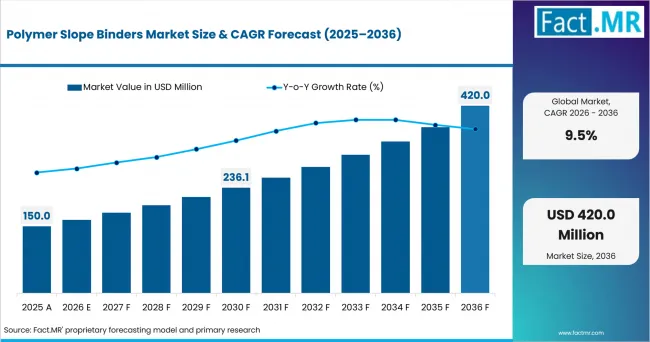
Polymer Slope Binders Market Market Value Analysis | Source: Fact.MR
What are the defining numbers behind polymer slope binder growth?
USD 250 million absolute opportunity by 2036 led by Australia and the United States.
- Demand Drivers in the Market
- Infrastructure projects require effective erosion control solutions.
- Mine rehabilitation programs are increasing demand for slope stabilization.
- Environmental regulations are supporting soil protection measures.
- Contractors seek products that reduce maintenance requirements.
- Key Segments Analyzed
- By Polymer Type: Acrylic Polymers are expected to hold 32.0% share in 2026 because they provide strong soil binding and weather resistance.
- By Application: Mine Benches are projected to account for 29.0% share in 2026 due to extensive slope management requirements.
- By Performance: Erosion Control is expected to hold 31.0% share in 2026 because soil protection remains the primary application.
- By End User: Mining is projected to account for 35.0% share in 2026 due to rehabilitation and operational stabilization requirements.
- By Geography: Australia is projected to record 10.4% CAGR through 2036.
- Analyst Opinion at Fact.MR
- Shambhu Nath Jha, Senior Analyst at Fact.MR, states, “Polymer slope binders are becoming an important component of environmental management programs. Operators increasingly prioritize products that improve slope performance while supporting long-term site rehabilitation objectives.”
- Strategic Implications
- Focus on mining regions with large rehabilitation requirements.
- Expand solutions for highway and infrastructure slope protection.
- Develop products with improved vegetation compatibility.
- Strengthen technical support for site-specific stabilization projects.
Polymer slope binders create a protective layer that binds soil particles and improves surface stability. These products help reduce erosion, dust generation and runoff while supporting vegetation growth on treated slopes.
Australia is expected to register 10.4% CAGR through 2036 due to mining activity and infrastructure expansion. The United States remains a major market and is projected to record 10.0% CAGR through 2036, supported by highway rehabilitation and slope protection projects. Canada is forecast to advance at 9.7% CAGR due to resource development activity. Chile is expected to grow at 9.4% CAGR because of mining investments. South Africa is projected to expand at 9.1% CAGR through 2036 as environmental management requirements increase.
How does the polymer slope binders market break down by segment?
Acrylic Polymers lead at 32.0%; Mining leads at 35.0%.
Which polymer type dominates?
Acrylic Polymers hold 32.0% share in 2026.
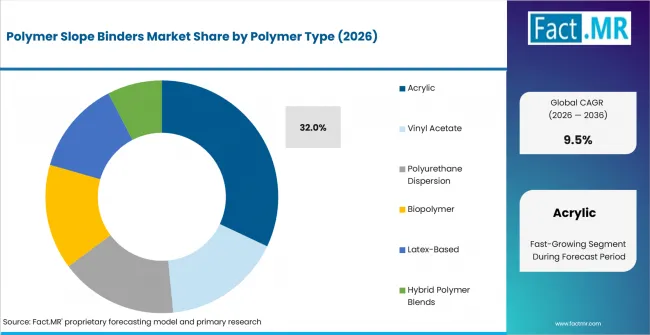
Polymer Slope Binders Market Analysis By Polymer Type | Source: Fact.MR
Acrylic polymers lead because they provide strong soil binding and good weather resistance. These products form a durable surface layer that helps protect exposed slopes from erosion. Contractors prefer acrylic formulations because they are easy to apply and perform well across different soil conditions. Their ability to reduce soil movement supports widespread adoption. Mining sites, highway projects and infrastructure developments remain major users of acrylic-based binders.
Which application dominates?
Mine Benches account for 29.0% share in 2026.
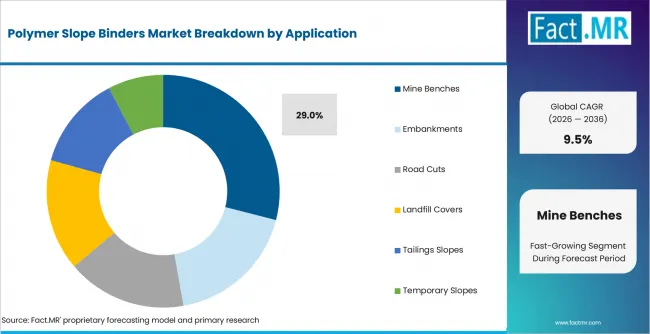
Polymer Slope Binders Market Analysis By Application | Source: Fact.MR
Mine benches account for the largest share because mining operations manage large exposed slope areas. These surfaces are vulnerable to erosion and dust generation. Polymer binders help improve slope stability and reduce maintenance requirements. They also support mine rehabilitation programs and environmental compliance efforts. Growing mining activity continues supporting demand across this segment.
Which performance category dominates?
Erosion Control holds 31.0% share in 2026.
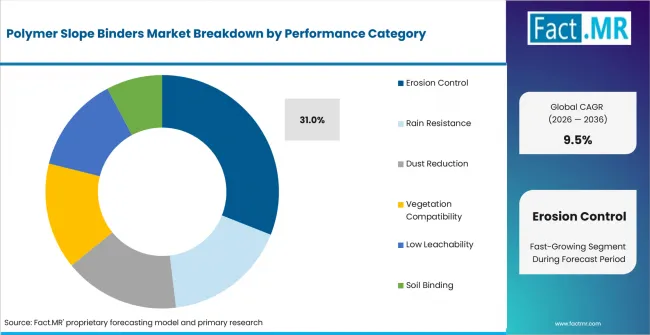
Polymer Slope Binders Market Analysis By Performance Category | Source: Fact.MR
Erosion control leads because preventing soil loss remains the primary objective for most slope stabilization projects. Heavy rainfall and wind exposure can damage untreated surfaces. Polymer binders help maintain slope integrity and reduce sediment runoff. They also improve long-term site management outcomes. Demand continues increasing as infrastructure owners focus on environmental protection.
Which end user dominates?
Mining leads with 35.0% share in 2026.
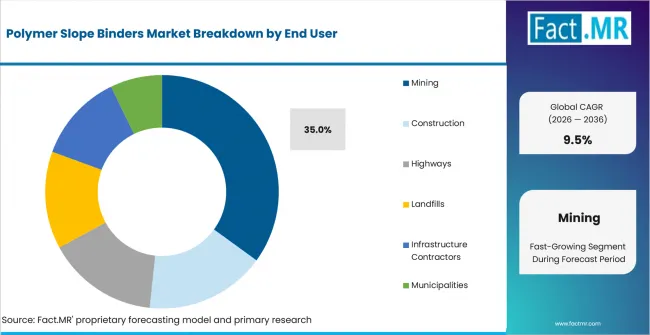
Polymer Slope Binders Market Analysis By End User | Source: Fact.MR
Mining remains the largest end user because mine sites contain extensive slopes, waste areas and rehabilitation zones. These areas require ongoing stabilization and erosion control measures. Operators use polymer binders to improve environmental performance and support closure planning. Surface protection also helps reduce dust emissions and maintenance costs. Large mining projects in Australia, Canada and Chile continue driving demand.
What is accelerating polymer slope binder demand and what is holding it back?
Rehabilitation needs drive demand while treatment costs restrain adoption.
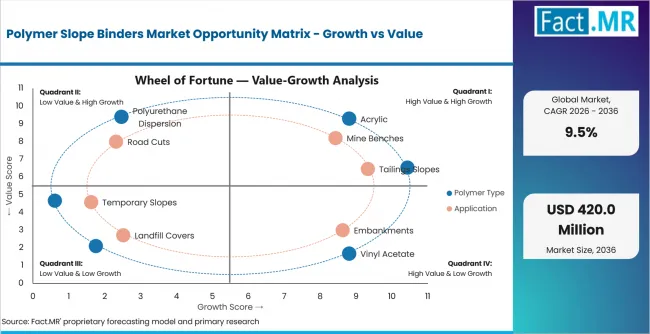
Polymer Slope Binders Market Opportunity Matrix Growth Vs Value | Source: Fact.MR
The main growth driver is increasing investment in erosion control and land rehabilitation. Governments and operators are placing greater focus on environmental performance. Mining companies are adopting slope binders to support rehabilitation targets. Infrastructure agencies are also increasing spending on slope protection programs.
Demand is further supported by stricter regulations covering soil loss and sediment control. The primary restraint is project cost. Large slopes often require significant treatment volumes and specialized application methods. Performance can also vary depending on rainfall intensity and soil composition. This may increase treatment requirements at some locations.
Where do the biggest polymer slope binder opportunities sit?
- Mine Rehabilitation Projects:Mining companies continue expanding land restoration programs that require long-term slope stabilization.
- Highway Embankments:Transportation agencies are investing in erosion control technologies to protect roadside infrastructure.
- Tailings Slopes:Mine operators are increasing focus on tailings management and environmental risk reduction.
- Landfill Covers:Landfill operators require surface protection solutions that improve slope performance and reduce erosion.
Which countries are scaling polymer slope binder adoption fastest?
Australia 10.4%, United States 10.0%, Canada 9.7%, Chile 9.4%, South Africa 9.1%.
Based on regional analysis, the polymer slope binders market is segmented into North America, Western Europe, Asia Pacific, Latin America and Middle East & Africa.
.webp "Top Country Growth Comparison Polymer Slope Binders Market Cagr (2026 2036)")
Top Country Growth Comparison Polymer Slope Binders Market Cagr (2026 2036) | Source: Fact.MR
| Country | CAGR (2026-2036) |
|---|---|
| Australia | 10.4% |
| United States | 10.0% |
| Canada | 9.7% |
| Chile | 9.4% |
| South Africa | 9.1% |
Source: Fact.MR analysis. Updated Jun 25, 2026
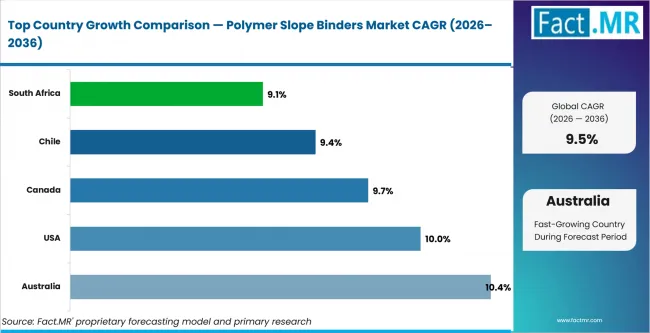
Polymer Slope Binders Market Cagr Analysis By Country | Source: Fact.MR
Why is Australia leading the polymer slope binders market?
10.4% CAGR, supported by mining rehabilitation and infrastructure development
Australia is projected to record 10.4% CAGR through 2036 due to extensive mining activity and increasing focus on land rehabilitation. Large mining operations require slope stabilization across waste dumps and tailings facilities. Mining companies are investing in erosion control technologies that improve environmental performance and support regulatory compliance.
What is driving growth in the United States?
10.0% CAGR, driven by transportation and construction projects
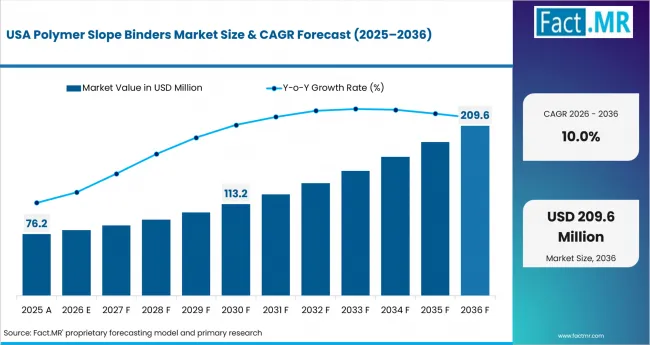
Polymer Slope Binders Market Country Value Analysis | Source: Fact.MR
The United States is expected to post 10.0% CAGR through 2036 as highway agencies and infrastructure contractors increase spending on erosion control measures. Slope protection is becoming an important part of transportation asset management programs. Polymer binders are increasingly used on embankments and construction sites to reduce soil loss and maintenance requirements. Environmental regulations are also supporting wider adoption. Infrastructure modernization programs continue creating growth opportunities across the country.
How is Canada expanding adoption?
9.7% CAGR, led by resource development and environmental management
Canada is forecast to advance at 9.7% CAGR through 2036 due to mining investments and growing emphasis on environmental stewardship. Large resource projects require effective slope stabilization throughout project lifecycles. Operators are adopting polymer binders to improve rehabilitation outcomes and reduce sediment runoff. Demand is also supported by infrastructure projects in remote and environmentally sensitive regions. Mining remains a major source of market growth.
What supports demand in Chile?
9.4% CAGR, driven by copper mining activity
Chile is expected to register 9.4% CAGR by 2036 due to continued investment in copper mining operations. Large mine sites require slope stabilization technologies that support erosion control and environmental compliance. Polymer binders help maintain slope integrity across mine benches and tailings facilities. Operators are increasingly focusing on solutions that improve long-term site performance. Demand remains closely linked to mining activity and land management programs.
Why is South Africa an important market?
9.1% CAGR, backed by mining modernization initiatives
South Africa is projected to grow at 9.1% CAGR through 2036 as mining companies strengthen environmental management practices. Slope stabilization is becoming a more important part of rehabilitation and operational planning. Polymer binders help reduce erosion and improve surface protection across mining sites. Operators are also seeking cost-effective solutions that support compliance with environmental standards. Continued mining activity is expected to support steady demand growth.
Who leads the polymer slope binders landscape?
BASF, Dow, SNF, and Soilworks lead through polymer technology expertise and erosion control capabilities.
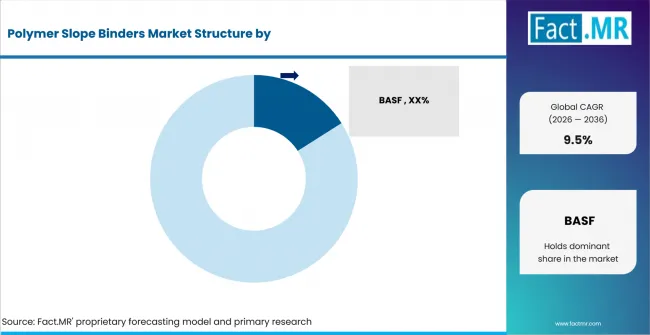
Polymer Slope Binders Market Analysis By Company | Source: Fact.MR
The market is characterized by competition focused on soil binding performance, weather resistance and environmental compatibility. Suppliers continue developing formulations that improve erosion control while supporting vegetation growth and long-term slope stability. Mining remains the largest opportunity for leading participants. Companies are also expanding landfill management and construction applications where erosion control requirements continue increasing. Product durability and environmental performance are becoming important purchasing factors. End users increasingly prefer solutions that reduce maintenance requirements and improve rehabilitation outcomes.
Suppliers that demonstrate strong soil stabilization performance and low environmental impact are expected to strengthen their market position through 2036. Technical support and site-specific application expertise are also becoming important competitive advantages.
Which companies are the key players?
BASF, Dow, SNF, Soilworks, Profile Products
- BASF
- Dow
- SNF
- Soilworks
- Profile Products
- Global Road Technology
Bibliography
- [1] Gautam ZEN UK Ltd. (2025, July 24). Gautam ZEN UK showcases lignin-based biobinder XyloBIND in National Highways trial. Local Council Roads Innovation Group.
- [2] Solmax. (2026). Solmax begins construction of flagship European geosynthetics center in Les Mureaux. Solmax.
- [3] Soilworks. (2026). Slope stabilization and dust control solutions. Soilworks.
- [4] Profile Products. (2026). Erosion control and soil stabilization solutions. Profile Products.
- [5] Global Road Technology. (2026). Polymer soil stabilization and erosion control solutions. Global Road Technology.
This Report Addresses
- Strategic intelligence on polymer slope binders and erosion control technologies.
- Segment analysis covering polymer types, applications, performance categories and end users.
- Regional outlook covering Australia, United States, Canada, Chile and South Africa.
- Competitive assessment of BASF, Dow, SNF and other leading stabilization technology providers.
- Analysis of slope protection, mine rehabilitation and infrastructure development trends.
- Evaluation of soil stabilization requirements across mining, transportation and landfill applications.
- Assessment of environmental compliance requirements related to erosion control and sediment management.
- Primary interviews, supplier benchmarking and industry validation supporting forecast development.
- Analysis of technological developments in polymer-based stabilization products.
- Evaluation of opportunities associated with rehabilitation projects and infrastructure expansion.
What does the polymer slope binders market cover?
Polymer-based products designed for slope stabilization, erosion control and surface protection.
The market covers commercial polymer binders used to stabilize exposed soil surfaces across mining, construction and infrastructure projects. These products create a protective layer that binds soil particles together and reduces the impact of wind and water erosion. Polymer slope binders are commonly applied on embankments, mine benches, road cuts, landfill covers and engineered slopes where long-term surface stability is required. Gautam ZEN UK's lignin-based BioBinder XyloBIND™ was successfully used in the first asphalt surface-course trial on the UK's Strategic Road Network (A590, Cumbria). The renewable polymeric binder partially replaced bitumen, improving durability and reducing carbon emissions while demonstrating the potential of bio-based binding technologies for infrastructure stabilization applications. [1]
What is included in the scope?
Polymer stabilization technologies and erosion control products.
The scope includes acrylic polymers, vinyl acetate polymers, polyurethane dispersions, biopolymers, latex-based products and hybrid polymer blends used for soil binding and slope protection. It covers products applied through spraying, hydroseeding support systems and surface treatment programs designed to improve slope performance. Solmax began construction of its flagship European geosynthetics manufacturing center in Les Mureaux, France, which will consolidate European nonwoven geotextile production into a single advanced facility. The site will support development and manufacturing of geosynthetic materials used for soil reinforcement, slope stabilization, erosion control, and civil infrastructure protection. [2]
What is excluded from the scope?
Mechanical slope reinforcement systems and geotechnical structures.
The scope excludes retaining walls, rock bolts, soil nails, geogrids, geotextiles and other structural reinforcement systems that provide physical slope support. It also excludes concrete stabilization structures, gabions and heavy civil engineering solutions used for permanent slope retention. General earthmoving equipment, excavation services and unrelated construction materials are not included.
How was the analysis built?
100+ sources, 35+ project assessments, 25+ countries and industry interviews.
- Primary Research: Interviews with erosion control specialists, mining operators, infrastructure contractors and environmental consultants.
- Desk Research: Analysis of infrastructure investments, mine rehabilitation programs and slope stabilization requirements.
- Market-Sizing and Forecasting: Estimates based on treated surface area, project spending and polymer consumption trends.
- Data Validation and Update Cycle: Forecasts validated through supplier benchmarking, project analysis and industry interviews.
Segmentation
What is the report's scope and coverage?
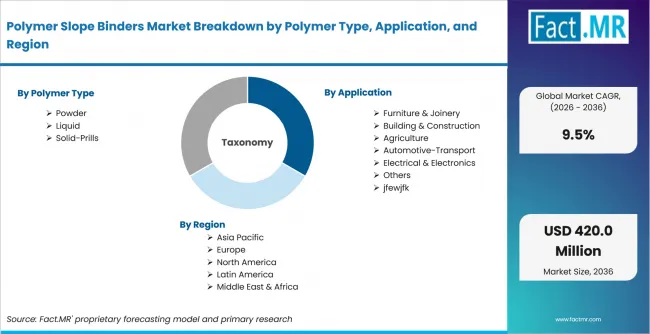
Polymer Slope Binders Market Breakdown By Polymer Type, Application, And Region | Source: Fact.MR
| Attribute | Details |
|---|---|
| Quantitative Units | USD Million in 2026 to USD Million by 2036 at CAGR |
| Market Definition | Covers polymer-based products used for slope stabilization, erosion control and surface protection |
| Polymer Types Covered | Acrylic, Vinyl Acetate, Polyurethane Dispersion, Biopolymer, Latex-Based, Hybrid Polymer Blends |
| Applications Covered | Temporary Slopes, Mine Benches, Embankments, Road Cuts, Landfill Covers, Tailings Slopes |
| Performance Categories Covered | Soil Binding, Erosion Control, Rain Resistance, Dust Reduction, Vegetation Compatibility, Low Leachability |
| End Users Covered | Mining, Construction, Highways, Landfills, Infrastructure Contractors, Municipalities |
| Regions Covered | North America, Western Europe, Asia Pacific, Latin America, Middle East & Africa |
| Key Countries Covered | Australia, United States, Canada, Chile, South Africa |
| Companies Covered | Dow, SNF, Soilworks, Profile Products, Global Road Technology |
| Forecast Period | 2026 to 2036 |
| Research Approach | Hybrid top-down and bottom-up methodology using treated slope area, infrastructure spending, mine rehabilitation activity and erosion control expenditures |
Source: Fact.MR analysis. Updated Jun 25, 2026
How is the market segmented?
-
By Polymer Type
- Acrylic
- Vinyl Acetate
- Polyurethane Dispersion
- Biopolymer
- Latex-Based
- Hybrid Polymer Blends
-
By Application
- Temporary Slopes
- Mine Benches
- Embankments
- Road Cuts
- Landfill Covers
- Tailings Slopes
-
By Performance
- Soil Binding
- Erosion Control
- Rain Resistance
- Dust Reduction
- Vegetation Compatibility
- Low Leachability
-
By End User
- Mining
- Construction
- Highways
- Landfills
- Infrastructure Contractors
- Municipalities
-
By Region
- North America
- United States
- Canada
- Mexico
- Western Europe
- Germany
- United Kingdom
- France
- Italy
- Asia Pacific
- Australia
- China
- India
- Japan
- Latin America
- Chile
- Brazil
- Peru
- Middle East & Africa
- South Africa
- Saudi Arabia
- UAE
- North America
Frequently Asked Questions
Which polymer type leads the market?
Which application accounts for the largest share?
What is driving demand for polymer slope binders?
Which country is growing the fastest?
What is the primary challenge facing the market?
Which end user accounts for the largest share?
Who worked on this report


Preview the report firsthand - request a free sample
Free SampleGet the brochure for pricing and purchase details
Download PDF