- Market Value (2025): USD 264.8 Mn
- Estimated Value (2026): USD 290.0 Mn
- Forecast Value (2036): USD 720.0 Mn
- CAGR (2026-2036): 9.5%
What is the Polyolefin Odor Neutralizers Market forecast to be worth by 2036?
USD 290.0 million in 2026 to USD 720.0 million by 2036, at a 9.5% CAGR.
- The Polyolefin Odor Neutralizers Market valued at USD 264.8 million in 2025 after early qualification work moved through recycled polyolefin applications.
- Demand is projected to increase from USD 290.0 million in 2026 to USD 720.0 million by 2036.
- The market is forecast to record a 9.5% CAGR from 2026 to 2036 driven by rPP applications and Packaging demand.
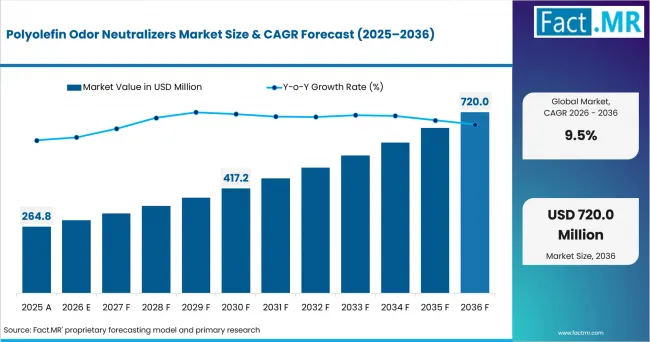
Polyolefin Odor Neutralizers Market Market Value Analysis | Source: Fact.MR
What are the defining numbers behind Polyolefin Odor Neutralizers Market growth?
USD 430.0 million absolute opportunity by 2036, led by rPP and Packaging alongside Zeolite chemistry.
- Demand Drivers in the Market
- Recyclers need odor control that remains effective after storage and repeat processing. Bad smells can limit the use of recycled PE and PP in visible packaging.
- Material producers prefer masterbatch products that work with current extrusion and dosing systems. Large equipment changes make adoption harder.
- Packaging companies need proof that treated recycled PP keeps odor under control during filling and storage.
- Automotive interiors and household products also create demand because smell can affect how finished PE and PP parts are accepted.
- Technical staff need clear records and repeat test results before replacing an approved additive package.
- Key Segments Analyzed
- By Polymer Type: rPP is expected to hold 38% share in 2026 supported by recycled polypropylene trials in packaging and molded goods.
- By Application: Packaging is projected to account for 31% share in 2026 driven by recycled-content qualification and odor checks in finished packs.
- By Chemistry: Zeolite is anticipated to capture 30% share in 2026 due to its use in odor adsorption and process-friendly additive routes.
- By Form: Masterbatch is estimated to represent 30% share in 2026 attributable to dosing control and easier use on existing compounding lines.
- By End User: Recyclers are forecast to account for 35% share in 2026 driven by the need to improve recycled polyolefin acceptance.
- Analyst Opinion at Fact.MR
- Senior Analyst Shambhu Nath Jha at Fact.MR states, “Polyolefin odor neutralizers are moving into a stricter qualification cycle. Adoption is expected to favor providers that prove odor reduction after processing and storage. Additive use must stay easy for rPP and Packaging routes. Technical proof is expected to decide repeat orders more than broad claims.”
- Strategic Implications
- Additive companies should test rPP grades under recycled feedstock variability before extending claims to high-volume customers.
- Recyclers should compare odor reduction after extrusion and storage before committing to repeat orders.
- Compounders should keep Masterbatch and Powder routes separate because dosing behavior changes the final result.
- Distributors should prepare safety files and sample documentation early so technical review does not slow conversions.
Germany is anticipated to advance at a 10.9% CAGR from 2026 to 2036 owing to packaging rules and recycling-focused technical review. Brazil is estimated to record a 10.0% CAGR from 2026 to 2036 attributable to regional packaging production and local trials. The United States is forecast to post a 9.0% CAGR from 2026 to 2036 supported by recycled packaging programs and additive testing.
How does the Polyolefin Odor Neutralizers Market break down by segment?
rPP leads at 38% by Polymer Type segment. Packaging leads at 31% by Application segment in 2026.
How does Polymer Type shape demand?
rPP holds 38% share in 2026.
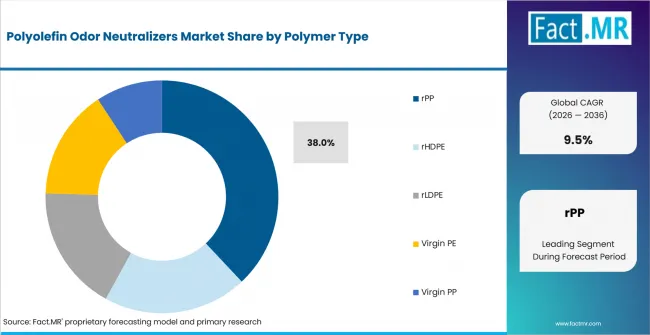
Polyolefin Odor Neutralizers Market Analysis By Polymer Type | Source: Fact.MR
rPP is expected to hold 38% share in 2026 because recycled polypropylene often carries odor variation from prior use and heat history. rHDPE and rLDPE stay in the comparison set when customers need lower odor in recycled packaging films. Virgin PE and Virgin PP are included where odor control is tied to resin handling or sensitive end uses. Application testing usually checks storage odor and melt processing before a customer approves wider use.
Where is Application demand strongest?
Packaging accounts for 31% share in 2026.
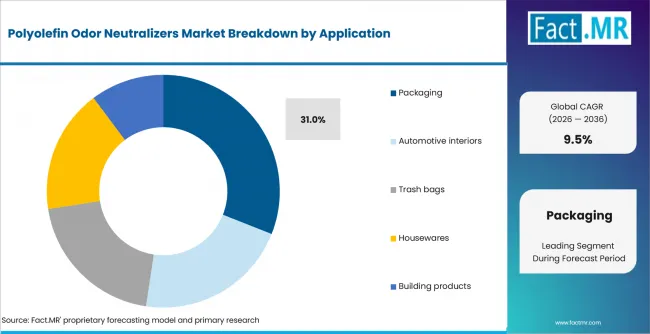
Polyolefin Odor Neutralizers Market Analysis By Application | Source: Fact.MR
Packaging is projected to account for 31% share in 2026 because recycled-content claims need odor control that survives storage and handling. Automotive interiors and Housewares add demand where odor in molded PE/PP parts affects product acceptance. Trash bags and Building products stay in scope when recycled polyolefin use creates odor-control needs. Packaging producers usually approve these additives after line trials show stable results in the finished product.
What supports Chemistry adoption?
Zeolite holds 30% share in 2026.
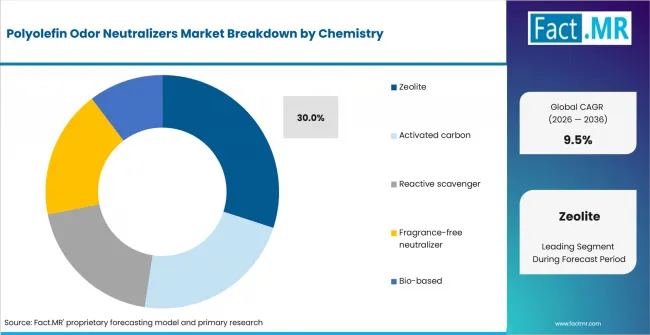
Polyolefin Odor Neutralizers Market Analysis By Chemistry | Source: Fact.MR
Zeolite is anticipated to capture 30% share in 2026 because adsorption routes are easier to explain during technical review. Activated carbon stays relevant where odor sources are more persistent. Reactive scavenger and Fragrance-free neutralizer options serve customers that need different handling or formulation routes. Bio-based chemistry remains part of the comparison set when customers screen additives for material claims and documentation.
Which Form dominates?
Masterbatch leads with 30% share in 2026.
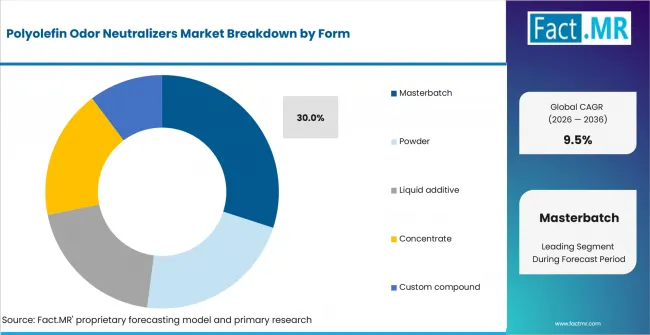
Polyolefin Odor Neutralizers Market Analysis By Form | Source: Fact.MR
Masterbatch is estimated to represent 30% share in 2026 because compounders dose it through familiar pellet-handling routes. Powder and Liquid additive forms stay useful for customers that need flexibility during trials. Concentrate and Custom compound formats serve plants that want odor control built into a narrow processing window. The form decision usually depends on dosing accuracy and how easily the additive fits the existing line.
What leads the End User segment?
Recyclers hold 35% share in 2026.
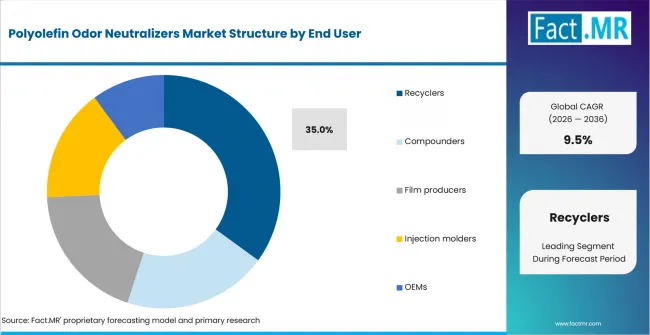
Polyolefin Odor Neutralizers Market Analysis By End User | Source: Fact.MR
Recyclers are forecast to account for 35% share in 2026 because they face the first quality check when recycled PE/PP carries unwanted smell. Compounders and Film producers follow when odor performance must carry through extrusion and film conversion. Injection molders and OEMs use these additives where finished parts need lower odor during storage and handling. Repeat demand depends on material staying stable after commercial-scale processing.
What is accelerating Polyolefin Odor Neutralizers Market adoption, and what is holding it back?
Flake quality control is anticipated to drive adoption, while qualification cost and process fit are expected to restrain the pace.
Drivers Impact Analysis
| DRIVER | (~) % IMPACT ON CAGR | GEOGRAPHIC RELEVANCE | IMPACT TIMELINE |
|---|---|---|---|
| Flake quality control in rPP | +0.8% | China and export processors | Medium term (2-4 years) |
| Label release testing | +0.6% | Europe and North America | Short term (<= 2 years) |
| rPP applications approval programs | +0.5% | Asia Pacific | Medium term (2-4 years) |
| Local support near label converters | +0.4% | Global | Long term (>= 4 years) |
Source: Fact.MR analysis. Updated Jul 16, 2026
- Flake quality control in rPP: Recycled polypropylene often carries odor from prior use and multiple heat steps. Odor neutralizers are expected to help recyclers improve acceptance when output moves into Packaging and visible goods.
- Label release testing: Packaging approval often looks at more than odor. Trials need to show that odor control does not create handling issues during labeling, washing or downstream checks.
- rPP applications approval programs: Recycled-content goals are expected to keep rPP applications under review. Additive companies improve approval prospects when customers repeat odor results during their own process checks.
- Local support near label converters: Technical support close to packaging operations helps shorten trial cycles. Customers are more likely to repeat orders when sample results match plant runs.
Opportunity Impact Analysis
| OPPORTUNITY | (~) % IMPACT ON CAGR | GEOGRAPHIC RELEVANCE | IMPACT TIMELINE |
|---|---|---|---|
| Grades tuned for rPP applications | +0.5% | Global | Medium term (2-4 years) |
| Application labs for Packaging | +0.4% | Asia Pacific and Europe | Short term (<= 2 years) |
| Rule-ready documentation | +0.4% | Europe and United Kingdom | Medium term (2-4 years) |
| Local trials with bottle washers | +0.3% | India and Brazil | Long term (>= 4 years) |
Source: Fact.MR analysis. Updated Jul 16, 2026
- Grades tuned for rPP applications: Product lines tailored to recycled polypropylene are expected to reduce the gap between lab screening and plant approval. The opening is strongest where feedstock quality changes from batch to batch.
- Application labs for Packaging: Local labs help packaging producers test odor and processing fit before commercial use. This gives additive companies a clearer route to qualification without broad claims.
- Rule-ready documentation: Regulatory review around packaging materials is expected to increase the value of clear safety files and composition notes. Documentation becomes part of the sale when customers face internal checks.
- Local trials with bottle washers: Trials near bottle washing and sorting operations help connect odor performance with real recycling conditions. India and Brazil benefit where regional testing keeps support close to processors.
Restraints Impact Analysis
| RESTRAINT | (~) % IMPACT ON CAGR | GEOGRAPHIC RELEVANCE | IMPACT TIMELINE |
|---|---|---|---|
| Qualification cost | -0.4% | Global processors | Medium term (2-4 years) |
| Fit limits in Packaging | -0.3% | Global | Short term (<= 2 years) |
| Documentation burden | -0.3% | Europe and North America | Medium term (2-4 years) |
| Scale-up risk | -0.2% | High-volume plants | Long term (>= 4 years) |
Source: Fact.MR analysis. Updated Jul 16, 2026
- Qualification cost: A change in additive package often triggers repeated tests across odor and processing. Smaller converters often delay approval when repeated trials are hard to recover through pricing.
- Fit limits in Packaging: Packaging grades need odor control that does not affect sealing or color. Any mismatch slows conversion even when lab odor scores look good.
- Documentation burden: Safety files and regulatory notes take time to prepare across regions. Adoption is expected to move slower where customers need separate checks for each application.
- Scale-up risk: Plant trials often expose differences between lab batches and commercial output. High-volume plants are expected to move carefully until treated material delivers the same result across longer runs.
Which countries are scaling Polyolefin Odor Neutralizers Market fastest?
United States 9.0%, Germany 10.9%, Brazil 10.0%.
.webp "Top Country Growth Comparison Polyolefin Odor Neutralizers Market Cagr (2026 2036)")
Top Country Growth Comparison Polyolefin Odor Neutralizers Market Cagr (2026 2036) | Source: Fact.MR
Regional analysis covers North America, Europe, Asia Pacific, Latin America, and the Middle East & Africa.
| COUNTRY | CAGR (2026 to 2036) |
|---|---|
| China | 12.9% |
| India | 11.9% |
| Germany | 10.9% |
| Brazil | 10.0% |
| United States | 9.0% |
| United Kingdom | 8.1% |
| Japan | 7.1% |
Source: Fact.MR analysis. Updated Jul 16, 2026
What underpins Germany growth?
10.9% CAGR, owing to packaging review and technical validation around recycled polyolefin use.
Germany gives additive companies a strict approval environment where recycled content and packaging recyclability must be proven through documentation. In March 2026, the European Commission said the PPWR introduces mandatory recyclability by 2030 and minimum recycled content in plastic packaging. The market is anticipated to advance at a 10.9% CAGR through 2036 due to careful qualification work across Packaging and molded applications.
What is driving Brazil growth through 2036?
10.0% CAGR, driven by packaging production and local trials for recycled PE/PP materials.
Brazil creates demand where packaging producers and recyclers need odor control that fits local material streams. In June 2026, IBGE reported that national industrial production advanced 0.7% in April 2026 compared with March. Regional trials are expected to support a 10.0% CAGR from 2026 to 2036 when treated rPP performs under local sorting and washing conditions.
How is United States scaling demand?
9.0% CAGR, supported by recycled packaging programs and additive testing across polyolefin applications.
Demand in the United States is linked to resin handling and recycling quality in packaging. The market is projected to post a 9.0% CAGR by 2036 as manufacturers continue testing additives to improve the quality of recycled PE and PP.
Who leads the Polyolefin Odor Neutralizers Market?
Ampacet and Avient lead direct polyolefin additive coverage, while Evonik and Tosaf strengthen masterbatch and compounding routes.
Ampacet brings masterbatch expertise and odor-control products for recycled polyolefin applications. Avient adds polymer additive knowledge and support for PE and PP materials that require lower odor after processing and storage. Evonik contributes odor-absorbing technology, while Tosaf provides odor-control masterbatches designed for existing compounding and extrusion lines. These companies compete on odor reduction, dosing accuracy, processing stability, and repeat performance across changing recycled feedstock.
Competition through 2036 is expected to focus on performance after extrusion and storage, clear technical documentation, application fit, and local support during laboratory and plant qualification.
Which companies are the key providers?
Ampacet and Avient are key providers. Evonik and Tosaf are also profiled.
- Ampacet
- Avient
- Evonik
- Tosaf
Bibliography
- Association of Plastic Recyclers. (2025, April 2). APR Design® Guide: Celebrating 30 Years of Impact. Association of Plastic Recyclers.
- Association of Plastic Recyclers. (2026, April 2). APR Publishes First Semi-Annual APR Design® Guide Update. Association of Plastic Recyclers.
- European Commission. (2026, March 29). Commission publishes guidance to support implementation of the Packaging and Packaging Waste Regulation. European Commission.
- European Parliament and Council of the European Union. (2024, December 19). Regulation (EU) 2025/40 on packaging and packaging waste. Official Journal of the European Union.
This Report Addresses
- The report provides strategic intelligence on Polyolefin Odor Neutralizers across Polymer Type, Application, Chemistry, Form, and End User choices that shape odor-control programs in recycled and virgin PE and PP materials.
- Segment analysis covers rPP and Packaging as the share leaders within the 2026 market structure, while Zeolite, Masterbatch, and Recyclers lead their respective categories.
- Regional outlook evaluates US, Germany, France, UK and 30+ countries.
- Competitive analysis profiles Ampacet and Avient alongside Evonik and Tosaf, as an active provider of odor-control additives and masterbatch solutions.
- Chemistry and Form assessment covers Zeolite, Activated Carbon, Reactive Scavenger, Fragrance-Free Neutralizer, and Bio-Based systems across Masterbatch, Powder, Liquid Additive, Concentrate, and Custom Compound formats.
- Use-case assessment covers Packaging and Automotive Interiors alongside Trash Bags, Housewares, and Building Products where odor reduction supports recycled polyolefin acceptance after processing, storage, and finished-product testing.
What does the Polyolefin Odor Neutralizers Market cover?
rPP and Packaging systems lead coverage. Zeolite and Masterbatch routes are reviewed for odor reduction in recycled and virgin PE/PP materials.
The Polyolefin Odor Neutralizers Market covers additives and masterbatches designed to reduce unwanted odor in recycled and virgin polyolefin applications. Coverage includes Polymer Type and Application choices. Chemistry, Form and End User choices are reviewed where odor reduction is the purchased function.
The market differs from broad additive categories because the commercial value comes from odor reduction inside PE/PP materials. General fragrances and unrelated resin additives remain outside the boundary unless sold for a defined polyolefin odor-control role.
What is included in the scope?
Additives and masterbatches used to reduce odors in recycled and virgin PE/PP materials.
The scope includes rPP and rHDPE within Polymer Type coverage. rLDPE and Virgin PE are included for lower-odor recycled packaging films. Virgin PP is also covered where odor control is tied to sensitive handling or end use. Packaging and Automotive interiors are included under Application. Trash bags and Housewares are reviewed when odor control is part of the application need. Building products complete the Application scope. Chemistry coverage includes Zeolite and Activated carbon. Reactive scavenger and Fragrance-free neutralizer are included for different handling routes. Bio-based options complete the chemistry scope. Form coverage includes Masterbatch and Powder. Liquid additive and Concentrate are included for plants that need different dosing routes. Custom compound completes the Form scope. End User coverage includes Recyclers and Compounders. Film producers and Injection molders are included. OEMs complete the commercial view.
What is excluded from the scope?
Commodity resin sold without an odor-reduction function is outside the scope.
The scope excludes general deodorants, fragrance products and unrelated processing additives. Equipment-only recycling systems are outside the boundary unless paired with a defined odor-neutralizing additive or masterbatch. Commodity PE/PP resins are excluded unless sold with a specific odor-control function for a named application.
How was the analysis built?
120+ sources, 40+ company portfolios, 25+ countries, 20+ interviews.
- Primary Research: Primary research includes discussions with additive companies, compounders, recyclers, and packaging producers. It also includes feedback from technical staff involved in odor testing, recycled PE and PP processing, packaging use, and product approval.
- Desk Research: Desk research reviews packaging rules, plastics recycling guidance, chemical-sector publications, company product information, and public industry statistics. These sources help explain how odor-control additives are used in recycled polyolefin materials.
- Market-Sizing and Forecasting: Market sizing reviews current demand and expected growth through the forecast period. Segment performance is assessed by additive type, material, application, and regional use. Country growth is linked to local recycling activity, packaging production, and product testing.
- Data Validation and Update Cycle: The analysis checks company activity, country trends, public sources, and product approval conditions. Regular reviews cover changes in packaging rules, recycling guidance, company developments, and testing requirements that may influence demand.
Segmentation
What is the report’s scope and coverage?
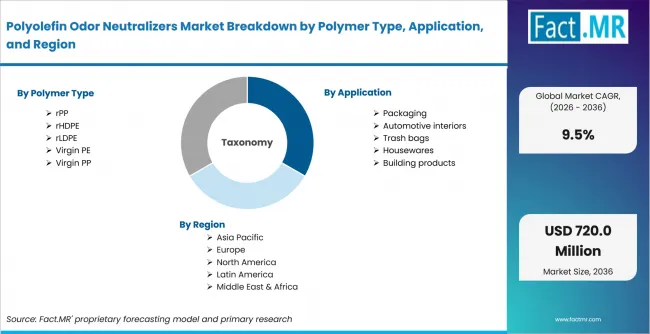
Polyolefin Odor Neutralizers Market Breakdown By Polymer Type, Application, And Region | Source: Fact.MR
| Attribute | Details |
|---|---|
| Quantitative Units | USD million |
| Market Definition | Additives and masterbatches used to reduce odors in recycled and virgin PE/PP materials. |
| Polymer Type | rPP; rHDPE; rLDPE; Virgin PE; Virgin PP |
| Application | Packaging; Automotive interiors; Trash bags; Housewares; Building products |
| Chemistry | Zeolite; Activated carbon; Reactive scavenger; Fragrance-free neutralizer; Bio-based |
| Form | Masterbatch; Powder; Liquid additive; Concentrate; Custom compound |
| End User | Recyclers; Compounders; Film producers; Injection molders; OEMs |
| Regions Covered | North America; Europe; Asia Pacific; Central and South America; Middle East and Africa |
| Countries Covered | Germany; Brazil; United States |
| Key Companies Profiled | Ampacet; Avient; Evonik; Tosaf |
| Forecast Period | 2026 to 2036 |
| Approach | Hybrid top-down and bottom-up approach using segment shares; country growth; company coverage; and technical validation |
Source: Fact.MR analysis. Updated Jul 16, 2026
How is the market segmented?
-
By Polymer Type
- rPP
- rHDPE
- rLDPE
- Virgin PE
- Virgin PP
-
By Application
- Packaging
- Automotive interiors
- Trash bags
- Housewares
- Building products
-
By Chemistry
- Zeolite
- Activated carbon
- Reactive scavenger
- Fragrance-free neutralizer
- Bio-based
-
By Form
- Masterbatch
- Powder
- Liquid additive
- Concentrate
- Custom compound
-
By End User
- Recyclers
- Compounders
- Film producers
- Injection molders
- OEMs
-
By Region
- North America
- United States
- Canada
- Europe
- Germany
- United Kingdom
- France
- Italy
- Spain
- Asia Pacific
- Japan
- South Korea
- Australia
- Central & South America
- Brazil
- Argentina
- Mexico
- Chile
- Middle East & Africa
- UAE
- Saudi Arabia
- South Africa
- North America
Frequently Asked Questions
Which Polymer Type leads the Polyolefin Odor Neutralizers Market?
Which Application leads the Polyolefin Odor Neutralizers Market?
Which Chemistry leads the Polyolefin Odor Neutralizers Market?
Which Form leads the Polyolefin Odor Neutralizers Market?
Which End User leads the Polyolefin Odor Neutralizers Market?
How does Germany perform in the Polyolefin Odor Neutralizers Market?
How does Brazil perform in the Polyolefin Odor Neutralizers Market?
How does United States perform in the Polyolefin Odor Neutralizers Market?
What is the primary driver in the Polyolefin Odor Neutralizers Market?
What is the main restraint in the Polyolefin Odor Neutralizers Market?
Who worked on this report


Preview the report firsthand - request a free sample
Free SampleGet the brochure for pricing and purchase details
Download PDF