- Market Value (2025): USD 1.7 Bn
- Estimated Value (2026): USD 2.3 Bn
- Forecast Value (2036): USD 55.0 Bn
- CAGR (2026-2036): 37.4%
What is the post-quantum migration services market forecast to be worth by 2036?
- The post-quantum migration services market crossed a valuation of USD 1.7 billion in 2025. Demand is expected to increase from USD 2.3 billion in 2026 to USD 55.0 billion by 2036.
- The market is forecast to record 37.4% CAGR during 2026 to 2036 as regulated enterprises begin multi-year migration from legacy public-key cryptography to NIST post-quantum standards.
- Post-quantum migration starts with crypto inventory and system planning. NIST finalized the first post-quantum encryption standards in 2024, including FIPS 203, FIPS 204 and FIPS 205. [1]
- This gives banks and government agencies a clear technical base for migration.
- CISA’s 2024 strategy also shows why crypto discovery is an early step. [2] Enterprises first need to find where encryption is used across systems. This makes inventory and migration planning the first service needs.
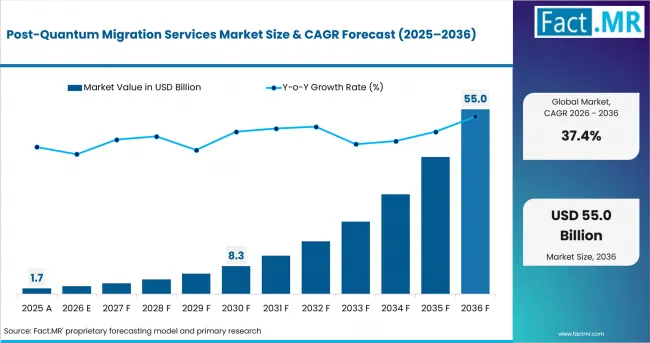
Post Quantum Migration Services Market Value Analysis | Source: Fact.MR
Summary of Post-quantum migration services market
- Demand Drivers in the Market
- Crypto-inventory pressure is rising because enterprises need to locate weak public-key cryptography before remediation.
- Harvest-now-decrypt-later risk pushes banks to protect long-lived financial and identity data.
- Federal migration timelines create service demand across government contractors and technology suppliers.
- Telecom operators need crypto-agility because network protocols and embedded systems require long upgrade cycles.
- Key Segments Analyzed
- By Service Type: Crypto-inventory and discovery audits are expected to hold 39.0% share in 2026 because migration starts with locating vulnerable cryptography.
- By Migration Scope: TLS and PKI lead because certificates and public-key exchange are early migration targets. The segment is projected to capture 35.0% share in 2026.
- By Customer Type: Banks and financial institutions are likely to account for 34.0% share in 2026 because long-lived customer data creates high exposure.
- By Delivery Model: Consulting-led migration is projected to hold 43.0% share in 2026 because enterprises need roadmap design before remediation.
- By End Use: Financial systems are expected to hold 31.0% share in 2026 since transaction security and identity protection are early priorities.
- By Geography: The United States is projected to record 40.1% CAGR through 2036 as federal migration and regulated enterprise activity accelerate.
- Analyst Opinion at Fact.MR
- Shambhu Nath Jha, Senior Analyst at Fact.MR, states, “Post-quantum migration is becoming a board-level security program. We see enterprises asking where cryptography is hidden before they ask which algorithm to deploy. Providers that combine discovery and migration support will gain stronger access to regulated accounts.”
- Strategic Implications
- Banks should prioritize long-lived data before migrating lower-risk systems.
- Telecom operators need device-level migration plans for network equipment and embedded systems.
- Government contractors should prepare crypto inventories before contract requirements tighten.
- Security providers need implementation skills that go beyond cryptographic advisory.
| Metric | Details |
|---|---|
| Industry Size 2026 | USD 2.3 billion |
| Industry Value 2036 | USD 55.0 billion |
| CAGR 2026 to 2036 | 37.4% |
Source: Fact.MR analysis. Updated Jun 19, 2026
The United States is projected to record 40.1% CAGR from 2026 to 2036 as federal migration and regulated enterprise activity accelerate. The United Kingdom is likely to post 38.7% CAGR as financial firms and critical infrastructure operators prepare phased upgrades. Germany is expected to register 37.9% CAGR because banks and industrial groups need crypto-agility planning. Japan is forecast to advance at 36.5% CAGR by 2036 as telecom and technology firms test quantum-safe security. India is set to record 35.2% CAGR as banks and IT service providers build migration capacity.
How does the post-quantum migration services market break down by segment?
Post-Quantum Migration Services Market Analysis by Service Type
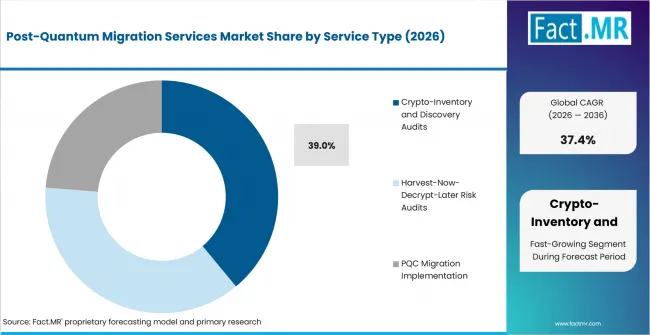
Post Quantum Migration Services Market Analysis By Service Type | Source: Fact.MR
Crypto-Inventory and Discovery Audits are expected to hold 39.0% share in 2026 because migration starts with locating vulnerable cryptography. Enterprises often use RSA and ECC across applications and vendor systems without one central record. Security teams need asset visibility before risk scoring or remediation can begin.
Post-Quantum Migration Services Market Analysis by Migration Scope
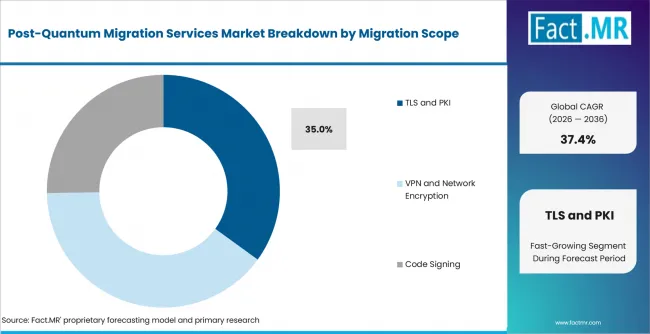
Post Quantum Migration Services Market Analysis By Migration Scope | Source: Fact.MR
TLS and PKI lead because certificates and key exchange sit across public-facing systems and internal communication layers. Security teams usually review certificate authorities and internet-facing services before deeper application remediation. The segment is projected to capture 35.0% share in 2026 as enterprises treat PKI as the first practical migration zone. Early work covers certificate mapping and compatibility testing.
Post-Quantum Migration Services Market Analysis by Customer Type
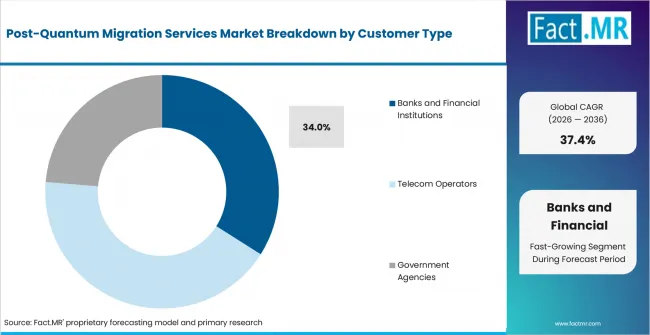
Post Quantum Migration Services Market Analysis By Customer Type | Source: Fact.MR
Banks and Financial Institutions are likely to account for 34.0% share in 2026 because financial records can stay sensitive for many years. Payment data and encrypted archives face harvest-now-decrypt-later exposure. Banks also have mature security budgets and stronger regulatory pressure around cryptographic controls. Migration services help them rank systems before large-scale algorithm changes affect transaction security.
Post-Quantum Migration Services Market Analysis by Delivery Model
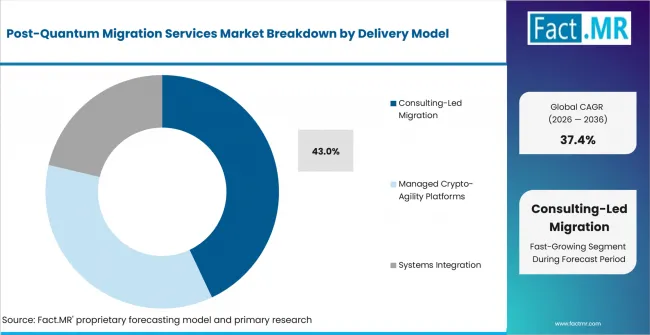
Post Quantum Migration Services Market Analysis By Delivery Model | Source: Fact.MR
Consulting-Led Migration leads because most organizations need a phased roadmap before technical changes begin. Cryptography is spread across software and suppliers, so one tool cannot solve the full migration problem. The delivery model is projected to hold 43.0% share in 2026 as enterprises seek expert planning before remediation. Consulting teams support asset ranking and disruption control.
Post-Quantum Migration Services Market Analysis by End Use
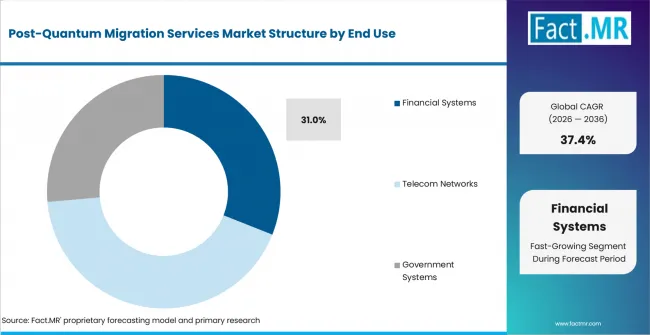
Post Quantum Migration Services Market Analysis By End Use | Source: Fact.MR
Financial Systems lead early demand because transaction security and identity systems face high exposure. Banks must protect data that stays sensitive for long periods. The segment is expected to hold 31.0% share in 2026 as financial institutions prepare quantum-safe protection for long-lived data. Service providers support these programs by reviewing encryption use and system priority before implementation begins.
What is accelerating post-quantum migration services adoption, and what is holding it back?
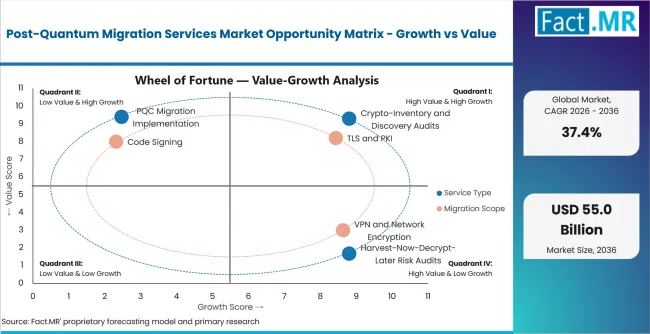
Post Quantum Migration Services Market Opportunity Matrix Growth Vs Value | Source: Fact.MR
The finalization of NIST post-quantum standards is the main driver for migration services. NIST’s 2025 NCCoE work on migration to post-quantum cryptography shows that organizations need cryptographic discovery and inventory tools before they can prioritize replacement of quantum-vulnerable public-key algorithms, which supports movement from planning to implementation [5].
Regulated sectors also face discovery pressure. NSA’s CSfC post-quantum guidance identifies transition changes for classified solutions. [3] This supports demand for crypto-inventory and network security migration services.
Migration complexity can restrain adoption. Large organizations often do not know where cryptography is embedded. Legacy applications and certificates can create hidden dependencies. PQC algorithms also change key sizes and performance profiles. Service providers must test migrations carefully before high-volume deployment.
Opportunities in the Post-Quantum Migration Services Market
- Crypto-Inventory Automation: Providers can help enterprises find vulnerable cryptography at scale.
- Banking Migration Programs: Service firms can support phased migration for payments and identity systems.
- Telecom Network Readiness: Integrators can help operators test PQC across network equipment and certificates.
Which countries are scaling post-quantum migration services demand fastest?
Based on regional analysis, the post-quantum migration services market is segmented into North America, Western Europe, East Asia, South Asia and Pacific, Latin America, and Middle East and Africa.
.webp "Top Country Growth Comparison Post Quantum Migration Services Market Cagr (2026 2036)")
Top Country Growth Comparison Post Quantum Migration Services Market Cagr (2026 2036) | Source: Fact.MR
| Country | CAGR |
|---|---|
| United States | 40.1% |
| United Kingdom | 38.7% |
| Germany | 37.9% |
| Japan | 36.5% |
| India | 35.2% |
Source: Fact.MR analysis. Updated Jun 19, 2026
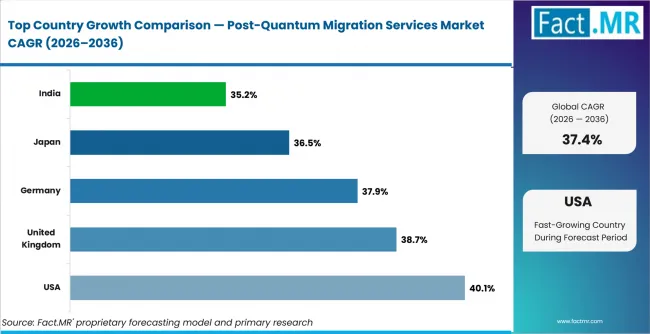
Post Quantum Migration Services Market Cagr Analysis By Country | Source: Fact.MR
North America Post-Quantum Migration Services Market Analysis
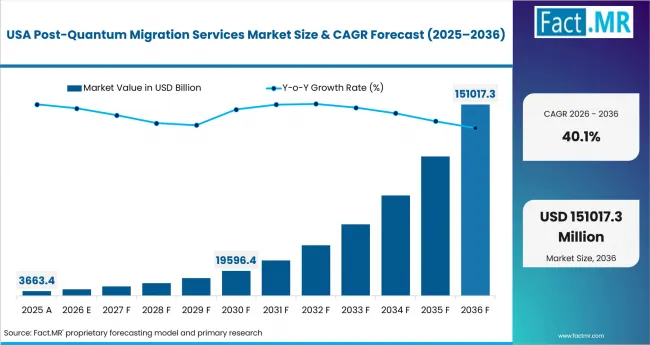
Post Quantum Migration Services Market Country Value Analysis | Source: Fact.MR
North America demand is led by federal migration planning and regulated enterprise security programs. The United States has the strongest early base because standards and enterprise budgets are aligned.
- United States: The United States is projected to record 40.1% CAGR from 2026 to 2036 as federal migration pressure and regulated enterprise activity accelerate. NIST standards give security teams a clear base for PQC transition. Banks and defense suppliers need crypto-inventory and remediation support. Federal contractors will face stronger expectations as agency migration programs mature.
Western Europe Post-Quantum Migration Services Market Analysis
Western Europe demand is tied to financial services security and national cyber guidance. The United Kingdom and Germany lead because large regulated organizations need early crypto-agility programs.
- United Kingdom: Banks and critical infrastructure operators in the United Kingdom are preparing phased PQC upgrades as long-lived customer data faces harvest-now-decrypt-later exposure. Telecom and utility operators must review embedded cryptography across complex networks. The country is likely to post 38.7% CAGR through 2036 as discovery-led migration programs expand. Service demand will start with crypto-inventory and risk ranking before implementation.
- Germany: Germany is expected to register 37.9% CAGR over the forecast period because banks and industrial groups need crypto-agility planning. Manufacturing companies rely on long-life equipment and secure supplier communication that cannot be replaced quickly. Financial firms need certificate and key-management review before wider PQC rollout. Industrial technology providers will require migration support for embedded systems and product security. Providers with German-language documentation and engineering depth can reduce sign-off friction.
East Asia Post-Quantum Migration Services Market Analysis
East Asia demand comes from telecom networks and advanced manufacturing. Japan leads early regional demand because telecom and enterprise security teams are testing quantum-safe migration paths.
- Japan: Japan is forecast to advance at 36.5% CAGR through 2036 as telecom and technology firms test quantum-safe security. SandboxAQ announced a 2024 deployment with SoftBank to identify cryptographic and certificate-based vulnerabilities across networks, endpoints and applications. [4] This supports early demand for discovery-led migration services. Japanese banks and manufacturers will prefer careful pilots before wider rollout.
South Asia Post-Quantum Migration Services Market Analysis
South Asia demand is moving from advisory into service delivery capacity. India has a strong IT services base that can support domestic and global PQC migration programs.
- India: Domestic financial institutions in India need crypto-inventory before upgrading payment and identity systems. Global delivery centers can support PQC migration for international accounts. India is set to record 35.2% CAGR by 2036 as banks and IT service providers build migration capacity. Cost pressure will make standardized discovery and migration templates important. Service providers must train cryptography engineers because remediation is deeper than compliance review. India will favor firms that combine cybersecurity services with application modernization for large banks and outsourced technology programs.
Who leads the post-quantum migration services market landscape?
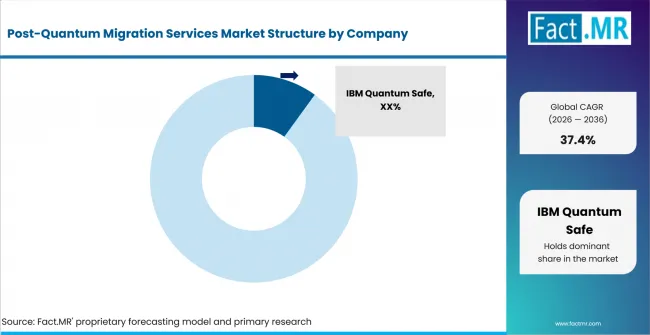
Post Quantum Migration Services Market Analysis By Company | Source: Fact.MR
Post-quantum migration services are used where enterprises need to move from vulnerable cryptography toward NIST-aligned algorithms. IBM supports discovery and remediation workflows. SandboxAQ provides cryptography management capabilities for discovery and migration readiness. PQShield supports quantum-resistant hardware and software implementation needs.
Competition through 2036 will depend on migration depth and enterprise execution. Providers that can locate cryptography and implement changes will be better placed. Banks and telecom operators will prefer partners that can coordinate PKI and application changes across long migration programs.
Which companies are the key players?
- IBM
- SandboxAQ
- PQShield
- Thales
- Entrust
- Accenture
Bibliography
- [1] National Institute of Standards and Technology. (2024, August 13). NIST releases first 3 finalized post-quantum encryption standards.
- [2] Cybersecurity and Infrastructure Security Agency. (2024, September 26). Strategy for migrating to automated post-quantum cryptography discovery and inventory tools.
- [3] National Security Agency. (2025, April 4). CSfC Post Quantum Cryptography Guidance Addendum 1.0 Draft .5.
- [4] SandboxAQ. (2024, April 11). SoftBank Corp. uses SandboxAQ’s AQtive Guard to identify undetected security vulnerabilities in existing IT infrastructure.
- [5] Newhouse, W., Souppaya, M., Barker, W., & Scarfone, K. (2025, September 18). Mappings of Migration to PQC Project Capabilities to NIST Cybersecurity Framework 2.0 and to Security and Privacy Controls for Information Systems and Organizations (NIST CSWP 48, Initial Public Draft). National Institute of Standards and Technology.
This Report Addresses
- Strategic intelligence on post-quantum migration services across service type, migration scope and customer type.
- Forecast mapping from USD 2.3 billion in 2026 to USD 55.0 billion by 2036.
- Segment analysis covering Crypto-Inventory and Discovery Audits, TLS and PKI, Banks and Financial Institutions, Consulting-Led Migration and Financial Systems.
- Regional outlook covering the United States, United Kingdom, Germany, Japan and India.
- Competitive analysis of IBM, SandboxAQ, PQShield, Thales, Entrust and Accenture.
- Service assessment covering discovery audits, risk audits, PQC implementation and managed remediation.
- Migration assessment covering PKI, VPNs, code signing, HSMs and embedded systems.
- Primary interviews, provider checks, official standards review and regulated enterprise validation support the forecast.
What does the post-quantum migration services market cover?
The post-quantum migration services market covers advisory and remediation services that help organizations replace quantum-vulnerable cryptography. It includes crypto-inventory and system migration support. The market differs from post-quantum cryptography technology because the service need is operational migration across applications and suppliers.
Post-Quantum Migration Services Market Inclusions
The scope includes crypto-asset discovery and harvest-now-decrypt-later exposure review. It covers migration planning for NIST post-quantum algorithms and hybrid cryptography. It includes PKI remediation and code-signing migration. Managed crypto-agility services are included when providers track cryptographic assets and support phased remediation.
Post-Quantum Migration Services Market Exclusions
The scope excludes quantum computing hardware and quantum key distribution equipment. It excludes standalone cryptographic libraries unless sold with migration services. It excludes standard cybersecurity audits with no post-quantum scope. General compliance consulting is outside scope unless it supports cryptographic inventory or implementation.
Post-Quantum Migration Services Market Research Methodology
- Primary Research:
- Primary research includes interviews with CISOs and cryptography engineering heads. It includes input from PKI architects and regulated-sector security program owners.
- Desk Research:
- Desk research reviews NIST standards and federal post-quantum migration guidance. It covers official provider pages and cryptography management disclosures.
- Market-Sizing and Forecasting:
- Forecasting uses regulated enterprise migration intensity and cryptographic asset discovery demand. Government migration timelines support the forecast direction.
- Data Validation and Update Cycle:
- Forecasts are validated through provider activity and security architecture feedback. Standards updates and PQC migration guidance help confirm market direction.
Segmentation
What is the report’s scope and coverage?
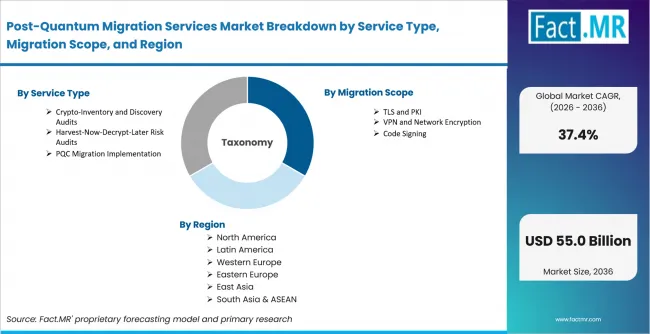
Post Quantum Migration Services Market Breakdown By Service Type, Migration Scope, And Region | Source: Fact.MR
| Attribute | Details |
|---|---|
| Quantitative Units | USD 2.3 billion in 2026 to USD 55.0 billion by 2036 at 37.4% CAGR |
| Market Definition | Services that inventory cryptography, assess quantum risk and migrate enterprise systems to post-quantum standards |
| Service Type | Crypto-Inventory and Discovery Audits, Harvest-Now-Decrypt-Later Risk Audits, PQC Migration Implementation, Crypto-Agility Roadmaps, Managed Remediation Services |
| Migration Scope | TLS and PKI, VPN and Network Encryption, Code Signing, HSM and Key Management, Embedded and IoT Systems |
| Customer Type | Banks and Financial Institutions, Telecom Operators, Government Agencies, Cloud Providers, Healthcare Organizations |
| Delivery Model | Consulting-Led Migration, Managed Crypto-Agility Platforms, Systems Integration, Vendor Tooling, Compliance Retainers |
| End Use | Financial Systems, Telecom Networks, Government Systems, Cloud Infrastructure, Critical Infrastructure |
| Regions Covered | North America, Western Europe, East Asia, South Asia and Pacific, Latin America, Middle East and Africa |
| Countries Covered | United States, United Kingdom, Germany, Japan, India |
| Key Companies Profiled | IBM, SandboxAQ, PQShield, Thales, Entrust and Accenture |
| Forecast Period | 2026 to 2036 |
| Approach | Hybrid top-down and bottom-up approach using regulated enterprise counts, crypto-inventory demand, migration scope, provider activity and standards-driven timing |
Source: Fact.MR analysis. Updated Jun 19, 2026
How is the market segmented?
-
By Service Type:
- Crypto-Inventory and Discovery Audits
- Harvest-Now-Decrypt-Later Risk Audits
- PQC Migration Implementation
- Crypto-Agility Roadmaps
- Managed Remediation Services
-
By Migration Scope:
- TLS and PKI
- VPN and Network Encryption
- Code Signing
- HSM and Key Management
- Embedded and IoT Systems
-
By Customer Type:
- Banks and Financial Institutions
- Telecom Operators
- Government Agencies
- Cloud Providers
- Healthcare Organizations
-
By Delivery Model:
- Consulting-Led Migration
- Managed Crypto-Agility Platforms
- Systems Integration
- Vendor Tooling
- Compliance Retainers
-
By End Use:
- Financial Systems
- Telecom Networks
- Government Systems
- Cloud Infrastructure
- Critical Infrastructure
-
By Region:
- North America
- United States
- Canada
- Europe
- Germany
- United Kingdom
- France
- Italy
- Spain
- Asia Pacific
- China
- Japan
- South Korea
- Taiwan
- Singapore
- Latin America
- Brazil
- Mexico
- Argentina
- Middle East & Africa
- GCC Countries
- South Africa
- Israel
- North America
Frequently Asked Questions
What is the Post-Quantum Migration Services Market size in 2026?
What will the Post-Quantum Migration Services Market be worth by 2036?
What CAGR is projected for the Post-Quantum Migration Services Market?
Which service type leads the Post-Quantum Migration Services Market?
Which country expands faster in the Post-Quantum Migration Services Market?
How does the United Kingdom perform in the Post-Quantum Migration Services Market?
How does Germany perform in the Post-Quantum Migration Services Market?
How does Japan perform in the Post-Quantum Migration Services Market?
How does India perform in the Post-Quantum Migration Services Market?
What is the primary driver in the Post-Quantum Migration Services Market?
What is the main restraint in the Post-Quantum Migration Services Market?
Why are crypto-inventory services important in this market?
Why are banks important in this market?
Who worked on this report


Preview the report firsthand - request a free sample
Free SampleGet the brochure for pricing and purchase details
Download PDF