- Market Value (2025): USD 701.6 Mn
- Estimated Value (2026): USD 790.0 Mn
- Forecast Value (2036): USD 2588.3 Mn
- CAGR (2026-2036): 12.6%
What is the Postbiotic Protein Derivatives Market forecast to be worth by 2036?
USD 790.0 million in 2026 to USD 2,588.3 million by 2036 at a 12.6% CAGR.
- 2025 market value: USD 701.6 million.
- 2026 to 2036 value progression: USD 790.0 million to USD 2,588.3 million.
- 2026 to 2036 CAGR: 12.6%.
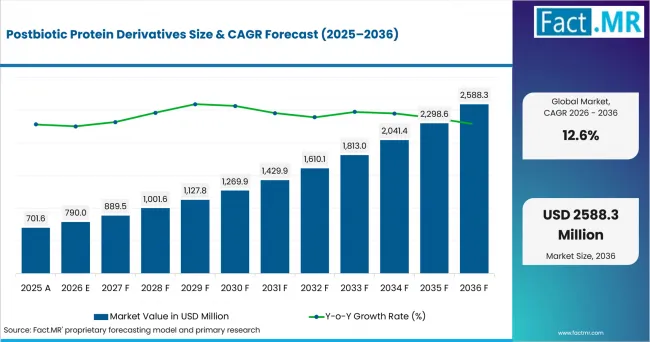
Postbiotic Protein Derivatives Value Analysis | Source: Fact.MR
What are the defining numbers behind Postbiotic Protein Derivatives Market growth?
The market is expected to create an absolute opportunity of USD 1,798.3 million between 2026 and 2036. Bioactive peptides account for 33.0% of Derivative Type in 2026, Dairy proteins account for 29.0% of Protein Substrate, Digestive and gut barrier represents 32.0% of Health Positioning, and Dietary supplements accounts for 36.0% of Application. The mix reflects demand for preparations that can be characterized by protein fraction, delivered at a controlled dose and formulated without maintaining live-cell viability.
- Demand Drivers in the Market
- Formulation stability is widening the set of products in which postbiotic preparations can be used. ADM states that its heat-treated L. gasseri CP2305 can tolerate high-heat and high-water formulation conditions associated with functional foods and gummies. Kerry describes its rice-derived Plenibiotic as stable across processing and shelf life. Removing the need to preserve live-cell counts can therefore make postbiotic ingredients easier to place in bars, beverages, powders and other formats that are difficult for conventional probiotics.
- This advantage matters where formulators already work with protein hydrolysates and want to add microbiome or gut-health positioning without building a live-culture stability program into the finished product.
- Protein-associated mechanisms are giving product developers a more specific research target than undifferentiated fermented biomass. A 2024 Food Research International study examined a surface-layer protein from Lacticaseibacillus paracasei and reported barrier-related effects in an in-vitro model. A 2025 Nutrients study on a dairy-derived postbiotic included casein and beta-lactoglobulin hydrolysate within the preparation, while a 2026 Microorganisms study found that sequentially fermented Lacticaseibacillus preparations affected epithelial-barrier markers and innate immune responses in human enterocyte models. These studies remain preparation-specific, but they support investment in defined protein fractions and reproducible fermentation routes.
- Commercial development also benefits from adjacent manufacturing capability in fermented ingredients, where controlled culture conditions, downstream inactivation and fraction handling can be adapted to postbiotic protein preparations.
- Regulatory systems are encouraging suppliers to document ingredient identity and safety rather than rely on a generic postbiotic label. The U.S. FDA maintains GRAS and new dietary ingredient routes, Japan operates its Foods with Function Claims system, South Korea permits individually recognized functional ingredients, and European as well as UK novel-food systems require authorization where an ingredient falls within novel-food rules. These frameworks increase the commercial value of strain records, manufacturing specifications and evidence tied to the marketed preparation.
- Key Segments Analyzed
- Derivative Type: Bioactive peptides account for 33.0% in 2026 because they give formulators a defined protein-associated fraction that can be characterized alongside the broader postbiotic preparation.
- Protein Substrate: Dairy proteins account for 29.0% in 2026, supported by established fermentation and hydrolysis routes for casein and whey-derived proteins.
- Health Positioning: Digestive and gut barrier represents 32.0% in 2026 because postbiotic research frequently evaluates epithelial integrity, microbial interactions and digestive outcomes.
- Application: Dietary supplements accounts for 36.0% in 2026 because capsules, powders and gummies allow controlled dosing while avoiding many formulation constraints associated with live cultures.
- Analyst Opinion at Fact.MR
- “Protein-linked postbiotic ingredients will be qualified on preparation identity, substantiation and formulation performance rather than on the postbiotic label alone. Suppliers that can specify the microbial source, inactivation route, protein fraction and finished-ingredient evidence give formulators a clearer basis for product development and regulatory review.”
- Shambhu Nath Jha, Principal Consultant, Fact.MR
- Strategic Implications
- Ingredient developers should define the commercial preparation before selecting a health claim. The strict scientific use of postbiotic refers to an inanimate microbial preparation, while substantially purified proteins and peptides sit outside that definition when sold alone. Product specifications should therefore make clear whether the commercial ingredient is an intact inactivated preparation, a protein-enriched fraction, a hydrolysate blend or another derivative within the stated product boundary.
- Formulation teams should match the derivative to the intended delivery system. Functional foods can reward heat and moisture tolerance, while supplement products place more weight on dose standardization and evidence linked to the finished ingredient.
- Country entry also requires separate regulatory planning. A preparation accepted for one food format may still need novel-food review, new dietary ingredient notification or function-claim substantiation elsewhere. Suppliers that build safety, compositional and stability packages at ingredient-development stage can reduce rework when customers expand into multiple markets.
How does the Postbiotic Protein Derivatives Market break down by segment?
The market is segmented by Derivative Type, Protein Substrate, Health Positioning and Application.
Why do Bioactive peptides lead Derivative Type?
Bioactive peptides account for 33.0% of Derivative Type in 2026. Their position reflects the ability to describe a protein-linked fraction more precisely than broad fermentation solids, which helps product developers connect composition with a defined formulation objective.
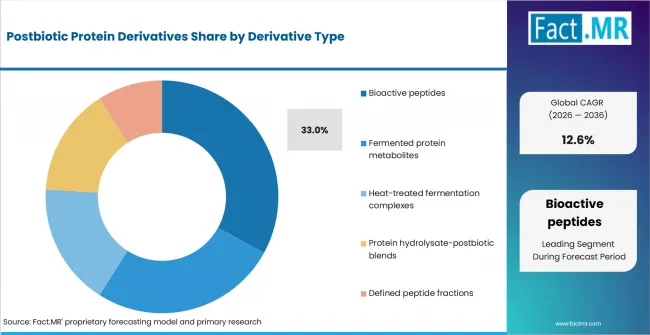
Postbiotic Protein Derivatives Analysis By Derivative Type | Source: Fact.MR
Research illustrates why suppliers are separating protein-related components for study. Xiao and colleagues evaluated a surface-layer protein from Lacticaseibacillus paracasei in a 2024 Food Research International paper, while the 2025 work by Guo and colleagues characterized a dairy postbiotic containing casein and beta-lactoglobulin hydrolysate. These studies are preclinical and preparation-specific, but they show how proteins and smaller peptides can become measurable components within a postbiotic-development program.
The commercial boundary overlaps with protein-derived postbiotics, but product developers still need to distinguish an inanimate microbial preparation from a purified peptide ingredient when applying scientific terminology and making claims.
Why do Dairy proteins lead Protein Substrate?
Dairy proteins account for 29.0% of Protein Substrate in 2026. Milk proteins are already used in fermentation systems where microbial activity and enzymatic hydrolysis can release smaller peptides, giving developers an established substrate for combining protein processing with postbiotic preparation methods.
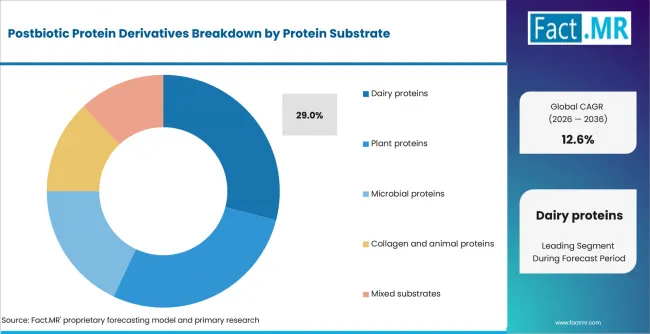
Postbiotic Protein Derivatives Analysis By Protein Substrate | Source: Fact.MR
The 2025 Nutrients study of the Pa JY062 postbiotic reported alpha-s-casein and beta-lactoglobulin hydrolysate in the preparation and observed progressive protein hydrolysis during simulated gastrointestinal digestion. This type of work gives dairy-based development programs a direct route to study how substrate choice changes the composition of the finished postbiotic preparation.
Plant proteins are close behind because they allow non-dairy formulation and can be coupled with fermentation or hydrolysis. Dairy retains the 2026 share advantage because its proteins, processing behavior and fermentation use are already well characterized across nutrition applications.
Why does Digestive and gut barrier lead Health Positioning?
Digestive and gut barrier represents 32.0% of Health Positioning in 2026. The category aligns directly with postbiotic research on epithelial integrity, microbial interaction and local immune signaling, giving formulators a clearer mechanism to investigate than broad wellness claims.
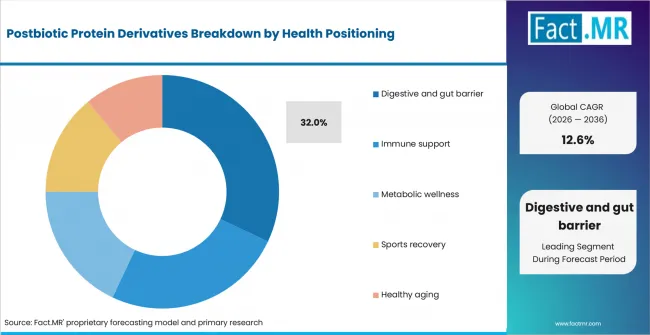
Postbiotic Protein Derivatives Analysis By Health Positioning | Source: Fact.MR
In 2026, Oglio and colleagues reported that a sequentially fermented Lacticaseibacillus postbiotic increased expression of tight-junction and mucus-related markers in a human-enterocyte model. The ISAPP consensus also identifies epithelial-barrier modulation as a plausible mechanism for some postbiotic preparations, while stressing that health benefits must be demonstrated for the specific preparation in the target host.
That evidence requirement shapes buyer behavior. Supplement and functional-food developers are more likely to qualify ingredients with preparation-specific clinical or strong mechanistic support than products relying on a generic gut-health association.
Why do Dietary supplements lead Application?
Dietary supplements accounts for 36.0% of Application in 2026. Supplements allow manufacturers to deliver a defined amount of a postbiotic protein derivative in capsules, powders, sachets or gummies without designing a complete food matrix around the ingredient.
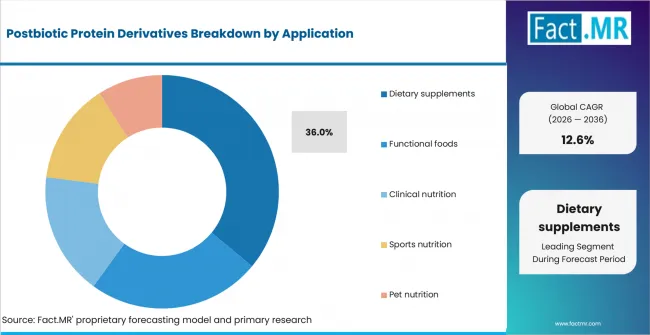
Postbiotic Protein Derivatives Analysis By Application | Source: Fact.MR
The format also fits ingredients whose main commercial value is stability. ADM notes that L. gasseri CP2305 can tolerate high-heat and high-water conditions, while Kerry positions Plenibiotic for multiple stable formats. These characteristics give supplement developers more freedom to use gummies and blended powders instead of relying only on capsules.
The regulatory route remains important for dietary supplements. In the United States, an ingredient that qualifies as a new dietary ingredient requires an FDA notification supported by a safety basis, so preparation identity and manufacturing controls influence commercialization as much as format convenience.
What is accelerating Postbiotic Protein Derivatives Market adoption, and what is holding it back?
Adoption is being accelerated by the combination of formulation stability and more specific ingredient characterization. Inactivated preparations can be used in manufacturing conditions that are difficult for live probiotics, while protein fractions give R&D teams measurable composition targets for digestive, immune and healthy-aging products.
The main restraint is evidentiary and regulatory precision. ISAPP states that purified proteins or peptides alone do not qualify as postbiotics, and it requires a demonstrated health benefit for the specific preparation. Suppliers therefore need to document the microbial source, inactivation process, composition and intended use instead of treating every fermentation-derived peptide as a postbiotic.
Human evidence can also lag mechanistic research. Several current studies use cell models or simulated digestion, so product developers must avoid carrying preclinical findings directly into consumer claims. This raises development cost and can extend the time needed to qualify a new derivative for a regulated health position.
Drivers Impact Analysis
| Factor | (~) % Impact on CAGR | Geographic Relevance | Impact Timeline |
|---|---|---|---|
| Heat and moisture tolerant formulation formats | +1.9% | USA, Europe and East Asia | Near to Long term (2026-2036) |
| Gut-barrier and immune research on defined preparations | +1.6% | Global nutraceutical markets | Near to Long term (2026-2036) |
| Regulatory pathways for documented functional ingredients | +1.2% | USA, Japan, South Korea and Europe | Near to Mid term (2026-2032) |
Opportunity Impact Analysis
| Factor | (~) % Impact on CAGR | Geographic Relevance | Impact Timeline |
|---|---|---|---|
| Defined peptide and protein-fraction characterization | +1.1% | Global | Mid to Long term (2029-2036) |
| Plant and microbial protein substrate development | +0.9% | Europe, USA and East Asia | Near to Long term (2026-2036) |
| Clinical, sports and pet nutrition applications | +0.7% | North America, Europe and Asia | Mid term (2029-2032) |
Restraints Impact Analysis
| Factor | (~) % Impact on CAGR | Geographic Relevance | Impact Timeline |
|---|---|---|---|
| Terminology and claim-boundary uncertainty | -1.0% | Global | Near to Long term (2026-2036) |
| Preparation-specific human substantiation requirements | -0.8% | Regulated health and supplement markets | Near to Long term (2026-2036) |
| Characterization and batch-consistency cost | -0.6% | Specialty ingredient suppliers | Near to Mid term (2026-2032) |
Which countries are scaling the Postbiotic Protein Derivatives Market through 2036?
- USA: FDA safety pathways for microbial-derived food ingredients and new dietary ingredients give suppliers defined routes for documented inactivated preparations used in foods or supplements.
- Japan: The Consumer Affairs Agency operates the Foods with Function Claims system, supporting commercialization of function-positioned foods when businesses submit the required scientific basis and product information.
- Germany: Product entry combines EU novel-food rules with national food-supplement notification, increasing the value of complete compositional, safety and labeling dossiers for novel derivatives.
- South Korea: MFDS allows individually recognized functional ingredients after review of safety and functionality data, creating a route for proprietary postbiotic preparations with ingredient-specific evidence.
- UK: The Food Standards Agency maintains a domestic register and application process for novel foods in Great Britain, giving manufacturers a public reference for authorized ingredients and conditions of use.
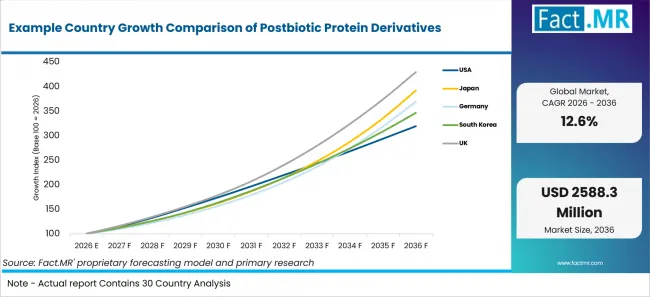
Example Country Growth Comparison Of Postbiotic Protein Derivatives | Source: Fact.MR
Country CAGR (2026-2036)
| Country | CAGR (2026-2036) |
|---|---|
| USA | 12.3% |
| Japan | 14.7% |
| Germany | 14.0% |
| South Korea | 13.2% |
| UK | 15.7% |
What is driving USA's growth through 2036?
The USA is projected to expand at a 12.3% CAGR through 2036. The FDA GRAS inventory includes heat-killed microbial preparations such as Clostridium tyrobutyricum strain ASM#19, for which the agency issued a no-questions letter. This provides a current example of an inactivated microorganism moving through a recognized food-ingredient safety route.
Dietary-supplement use creates a separate pathway. FDA requires manufacturers or distributors to notify the agency when a supplement contains a new dietary ingredient and to provide the basis for concluding that the ingredient is reasonably expected to be safe under labeled conditions of use. For postbiotic protein derivatives, this pushes suppliers toward clear strain identity, manufacturing controls and compositional specifications before customer launch.
What is driving Japan's growth through 2036?
Japan is projected to expand at a 14.7% CAGR through 2036. The Consumer Affairs Agency maintains a searchable Foods with Function Claims database and requires businesses using the system to submit information supporting the claimed function. This gives ingredient suppliers a route to work with brands that need preparation-specific scientific support for functional positioning.
Japan also has a long commercial history with inanimate lactic-acid-bacteria preparations. The ISAPP consensus describes use of these ingredients in Japanese foods and supplements across multiple formats. That history reduces concept novelty for product developers and supports experimentation with heat-treated or protein-linked preparations in everyday food formats.
What is driving Germany's growth through 2036?
Germany is projected to expand at a 14.0% CAGR through 2036. Food supplements must be notified to the Federal Office of Consumer Protection and Food Safety when first placed on the German market, with the product label submitted as part of the notification. This makes label-ready ingredient documentation important for supplement brands using specialized postbiotic derivatives.
EU novel-food authorization adds another layer for ingredients without a history of significant consumption before the applicable cut-off. The European Commission continued updating the Union list in 2026, including changes for pasteurised Akkermansia muciniphila and authorization of an enzymatically produced egg membrane hydrolysate. For German formulators, this active authorization system shapes which microbial and protein-derived ingredients can be commercialized and under what conditions.
What is driving South Korea's growth through 2036?
South Korea is projected to expand at a 13.2% CAGR through 2036. MFDS recognizes both notified functional ingredients and ingredients approved individually after review of safety and functionality data. The ministry published Regulation No. 2026-33 on recognition of functional ingredients and standards for health functional foods in August 2026, keeping the evidence pathway current for proprietary ingredients.
MFDS labeling rules allow only functions recognized in the applicable standards or individually recognized by the ministry to appear as functional information. This gives postbiotic protein-derivative suppliers a commercial incentive to invest in ingredient-specific evidence rather than rely on broad microbiome language that cannot support an approved function claim.
What is driving UK's growth through 2036?
The UK is projected to expand at a 15.7% CAGR through 2036. From April 1, 2025, Great Britain shifted authorized novel foods into an official Food Standards Agency and Food Standards Scotland register that states each ingredient’s status, conditions of use and labeling requirements. The register provides a direct reference for formulation teams assessing whether a derivative can be used in a planned product category.
The Food Standards Agency also maintains an application service for regulated products, including novel foods, where applicants submit product identity and supporting documentation. For postbiotic protein derivatives, the process raises the value of well-defined manufacturing methods and stable composition because authorization applies to a specified ingredient rather than a generic category name.
Who Leads the Postbiotic Protein Derivatives Market?
Key players in the Postbiotic Protein Derivatives Market include Novonesis, Lallemand, IFF, Kerry Group, DSM-Firmenich and ADM. Competition is shaped by preparation characterization, clinical substantiation, fermentation capability, inactivation control, format stability and the ability to support customers through region-specific regulatory review.
Novonesis lists Pylopass as a postbiotic ingredient for gastrointestinal-health supplements. Lallemand distributes IMMUSE, a heat-inactivated Lactococcus lactis preparation positioned for immune support. IFF markets CalceoBiotic as a postbiotic system standardized on calcium and at least 10% protein, giving it a directly measurable protein component within the finished ingredient.
Kerry Group markets the rice-derived Plenibiotic with processing and shelf-life stability claims. DSM-Firmenich maintains a Humiome postbiotic portfolio for human health applications. ADM markets clinically backed postbiotic ingredients and expanded distribution of L. gasseri CP2305 in 2025, emphasizing formulation tolerance in high-heat and high-water products. These portfolios show that supplier differentiation is moving toward named preparations with defined manufacturing and evidence packages.
Which companies are the key providers?
Key providers include Novonesis, Lallemand, IFF, Kerry Group, DSM-Firmenich and ADM.
- Novonesis
- Lallemand
- IFF
- Kerry Group
- DSM-Firmenich
- ADM
Bibliography
- Salminen, S., Collado, M. C., Endo, A., et al. (2021). The International Scientific Association for Probiotics and Prebiotics consensus statement on the definition and scope of postbiotics. Nature Reviews Gastroenterology & Hepatology.
- Oglio, F., Cadavere, A., De Aloe, M., et al. (2026). New Postbiotic Derived from Sequential Fermentation of Two Lacticaseibacillus Strains Exerts Beneficial Effects on Epithelial Gut Barrier and Innate Immunity in Human Enterocytes. Microorganisms.
- Guo, J., Zhao, Y., Guo, W., et al. (2025). Effects of Lactobacillus paracei JY062 Postbiotic on Intestinal Barrier, Immunity, and Gut Microbiota. Nutrients.
- Xiao, L., Zhang, C., Zhang, X., et al. (2024). Effects of Lacticaseibacillus paracasei SNB-derived postbiotic components on intestinal barrier dysfunction and composition of gut microbiota. Food Research International.
- U.S. Food and Drug Administration. (2026). Recently Published GRAS Notices and FDA Letters. FDA.
- U.S. Food and Drug Administration. (2025). New Dietary Ingredient Notification Process. FDA.
- Consumer Affairs Agency, Japan. (2026). Foods with Function Claims Notification Information Search. Government of Japan.
- Consumer Affairs Agency, Japan. (n.d.). Foods with Health Claims. Government of Japan.
- Ministry of Food and Drug Safety. (2026). Regulation on Recognition of Functional Ingredient and of Standard and Specification for Health Functional Foods, No. 2026-33. Republic of Korea.
- Ministry of Food and Drug Safety. (n.d.). Functional Ingredient Recognition. Republic of Korea.
- Ministry of Food and Drug Safety. (n.d.). Health Functional Food Labeling System. Republic of Korea.
- Federal Office of Consumer Protection and Food Safety. (2026). Important Information on Online Notification of Food Supplements. Federal Republic of Germany.
- European Food Safety Authority. (2026). Novel Food Application Procedure. European Union.
- European Commission. (2026). Union List of Novel Foods. European Union.
- Food Standards Agency. (2026). Guidance on Using the Register of Novel Food Authorisations. Government of the United Kingdom.
- Food Standards Agency. (n.d.). Applying for a Regulated Product Authorisation. Government of the United Kingdom.
- Novonesis. (n.d.). Pylopass. Novonesis.
- Lallemand Health Solutions. (2025). Lallemand Health Solutions and Kirin Holdings Announce Distribution Agreement for Scientifically Proven Postbiotic IMMUSE. Lallemand Health Solutions.
- IFF. (n.d.). CalceoBiotic Postbiotic Calcium Support. International Flavors & Fragrances Inc.
- Kerry Group. (n.d.). Digestive Health: Plenibiotic. Kerry Group.
- dsm-firmenich. (n.d.). Humiome Postbiotics. dsm-firmenich.
- ADM. (2025). ADM and Asahi Group Sign Exclusive Distribution Agreement for Innovative Postbiotic Designed to Support Stress, Mood and Sleep. Archer Daniels Midland Company.
This Report Answers
- How do protein-linked fractions change postbiotic ingredient development?
- Why do Bioactive peptides account for 33.0% of Derivative Type in 2026?
- Why do Dairy proteins account for 29.0% of Protein Substrate?
- How does gut-barrier evidence influence ingredient qualification?
- Which regulatory routes matter for food and supplement commercialization?
- What capabilities distinguish suppliers of postbiotic protein derivatives?
What does the Postbiotic Protein Derivatives Market cover?
The market covers commercially sold protein-linked ingredients developed through fermentation, microbial inactivation, hydrolysis or controlled fractionation and positioned for postbiotic-oriented health uses. Revenue includes bioactive peptide preparations, fermented protein metabolites, heat-treated fermentation complexes, protein hydrolysate-postbiotic blends and defined peptide fractions supplied to supplement, food, clinical, sports and pet-nutrition manufacturers.
The commercial boundary focuses on ingredients whose protein or peptide component is part of the product specification or health-positioning logic. It does not treat the entire postbiotic field as protein-derived, and it does not count every generic protein hydrolysate as a postbiotic derivative.
What is included in the scope?
Included products span the stated Derivative Type categories across dairy, plant, microbial, collagen or animal, and mixed Protein Substrates. The scope includes preparations positioned for digestive and gut barrier, immune, metabolic, sports-recovery and healthy-aging use in dietary supplements, functional foods, clinical nutrition, sports nutrition and pet nutrition.
What is excluded from the scope?
Live probiotic cultures sold primarily on viable-cell count, prebiotic fibers, generic fermented foods, standalone amino acids, conventional protein isolates, generic protein hydrolysates without postbiotic positioning, purified metabolites with no relevant protein-linked preparation, pharmaceuticals and finished consumer-product retail margins are excluded. Standalone purified proteins or peptides are outside the strict postbiotic definition when no inanimate microbial preparation remains part of the product.
How Was the Analysis Built?
- Primary Research:Primary research focuses on postbiotic and fermentation ingredient manufacturers, nutraceutical formulators, functional-food developers, clinical-nutrition teams, sports-nutrition brands, pet-nutrition companies, contract manufacturers, analytical laboratories, regulatory specialists and procurement teams sourcing microbiome ingredients.
- Desk Research:Desk research uses peer-reviewed postbiotic studies, scientific consensus statements, government food and supplement regulations, novel-food registers, functional-ingredient approval systems, company technical literature and current ingredient portfolios relevant to postbiotics and protein-linked derivatives.
- Market Sizing and Forecasting:Market sizing evaluates ingredient volumes, dose per finished product, average selling price, application mix, substrate mix, fermentation and inactivation capacity, adoption across supplement and food formats, customer qualification cycles, repeat purchasing and country-level regulatory access.
- Data Validation and Update Cycle:Forecasts are reviewed against new ingredient launches, clinical and mechanistic evidence, changes in postbiotic terminology, novel-food decisions, functional-ingredient approvals, supplier capacity and evidence of adoption in supplements, functional foods, clinical nutrition, sports products and pet nutrition.
What is the report's scope and coverage?
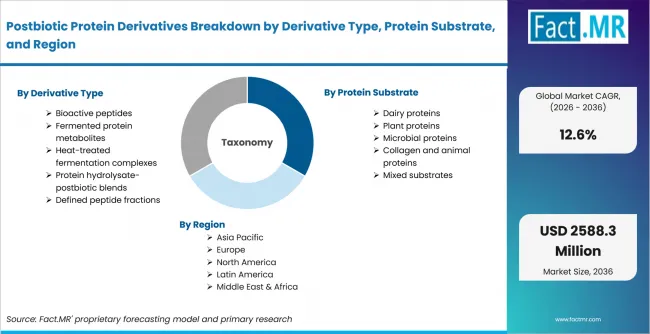
Postbiotic Protein Derivatives Breakdown By Derivative Type, Protein Substrate, And Region | Source: Fact.MR
| Parameter | Details |
|---|---|
| Quantitative Units | USD million, market value and CAGR |
| Market Definition | Protein-linked ingredients developed through fermentation, inactivation, hydrolysis or fractionation for postbiotic-oriented health applications |
| Segments | Derivative Type; Protein Substrate; Health Positioning; Application |
| Regions | Global |
| Countries | USA; Japan; Germany; South Korea; UK |
| Key Companies | Novonesis; Lallemand; IFF; Kerry Group; DSM-Firmenich; ADM |
| Forecast Period | 2026 to 2036 |
| Base Year | 2026 |
| Market Value, 2026 | USD 790.0 million |
| Market Value, 2036 | USD 2,588.3 million |
| CAGR, 2026-2036 | 12.6% |
| Absolute Opportunity | USD 1,798.3 million |
| Approach | Ingredient volume, dosage, application mix, substrate mix, pricing, supplier capacity and regulatory-access assessment |
How is the market segmented?
-
By Derivative Type
- Bioactive peptides
- Fermented protein metabolites
- Heat-treated fermentation complexes
- Protein hydrolysate-postbiotic blends
- Defined peptide fractions
-
By Protein Substrate
- Dairy proteins
- Plant proteins
- Microbial proteins
- Collagen and animal proteins
- Mixed substrates
-
By Health Positioning
- Digestive and gut barrier
- Immune support
- Metabolic wellness
- Sports recovery
- Healthy aging
-
By Application
- Dietary supplements
- Functional foods
- Clinical nutrition
- Sports nutrition
- Pet nutrition