The Poultry Vaccines Market is analyzed across its key product, application and end-use segments, with the study covering market dynamics, regional trends and demand outlook, forecast 2026 to 2036.
By Fact.MR Healthcare DeskFact-checked under the Fact.MR editorial processUpdated
9 min read
Poultry Vaccines Market Forecast and Outlook 2026 to 2036
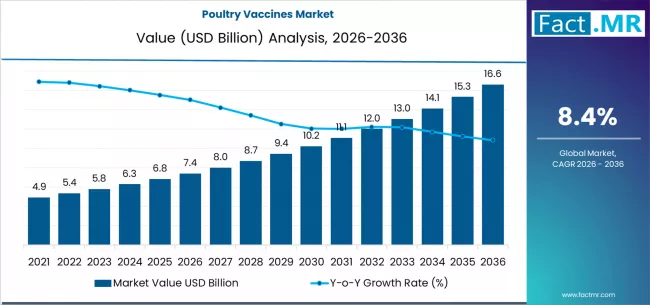
The global poultry vaccines market is projected tgrow from USD 7.40 billion in 2026 tUSD 16.61 billion by 2036, progressing at a CAGR of 8.4%. This sustained expansion is driven by the relentless intensification of global poultry production and the ever-present threat of high-impact avian diseases.
Poultry Vaccines Market Market Value Analysis | Source: Fact.MR
Summary of Poultry Vaccines Market
Market Snapshot
Global poultry vaccines market revenue stood at USD 7.40 billion in 2026 and is forecast treach USD 16.61 billion by 2036.
Ata8.4% CAGR from 2026 t0 2036, this market is set texpand ~2.24x in value, adding USD 9.21 billion in absolute opportunity.
Growth is being driven by the relentless intensification of global poultry production and the ever-present threat of high-impact avian diseases.
The sector iswitnessinga shift from routine disease control toward safeguarding food security and international trade.
Outbreaks of highly pathogenic avian influenza continue tact as a potent catalyst for vaccine adoption and innovation worldwide.
Demand and Growth Drivers
Intensification of global poultry production
Rising threat of high-impact avian diseases
Increasing focus on food security and international trade protection
Outbreaks of highly pathogenic avian influenza
Need for solutions that provide:
Effective disease prevention and control
Improved flock productivity and health
Reduced economic losses from disease outbreaks
Product and Segment View
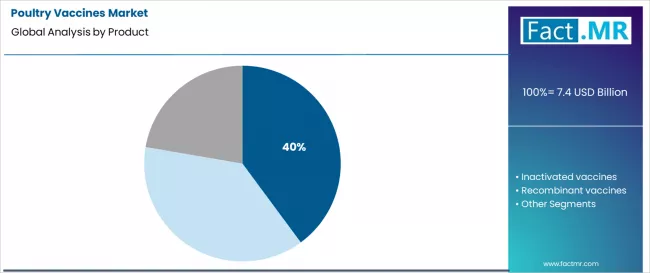
Live attenuated vaccines hold 39.9% of product type share in 2026,emergingas the leading segment.
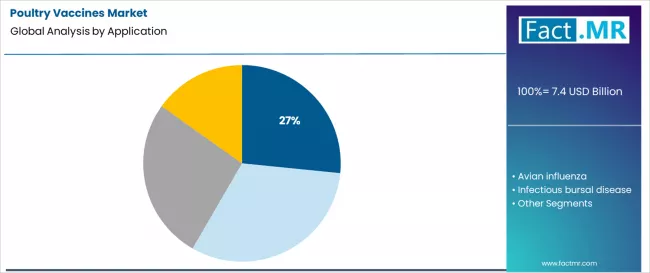
Newcastle disease accounts for 26.6% of disease type share in 2026, positioning it as the dominant segment.
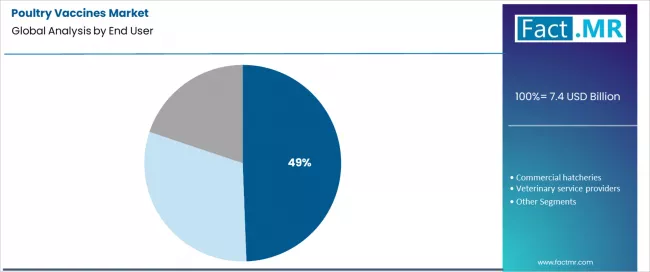
Integrated poultry farmsrepresent49.4% of end-user share in 2026, reflecting primary adoptioncenters.
Geography and Competitive Outlook
Growth is supported globally
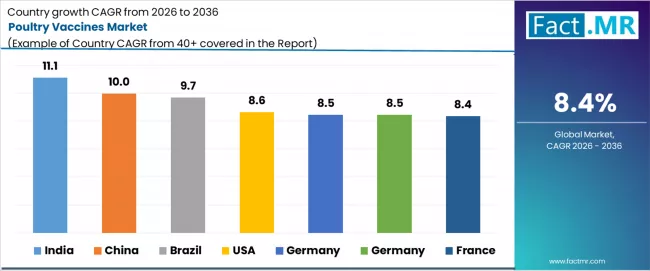
Key growth markets and CAGR: India 11.1%, China 10.0%, Brazil 9.7%, USA 8.6%, Germany 8.5%, UK 8.5%, France 8.4%
Market expansion is closely tied to:
Intensification of poultry production
Rising disease outbreaks
Increasing adoption of vaccination programs
Key companies active in this marketinclude:Zoetis Inc., Boehringer Ingelheim Animal Health, Ceva SantéAnimale, ElancAnimal Health, PhibrAnimal Health Corporation
Poultry Vaccines Market — At a Glance
Attribute
Details
Market Value 2026
USD 7.40 billion
Market Value 2036
USD 16.61 billion
Absolute Dollar Opportunity 2026–2036
USD 9.21 billion
Total Growth 2026–2036
124.46%
CAGR 2026–2036
8.4%
Growth Multiple
~2.24x
Key Demand Theme
Intensification of poultry production and rising disease threats
Leading Segment by Product (2026)
Live Attenuated Vaccines
Segment Share (2026)
39.9%
Leading Segment byApplication(2026)
Newcastle Disease
Segment Share (2026)
26.6%
Leading Segment by End User (2026)
Integrated Poultry Farms
Segment Share (2026)
49.4%
Key Growth Regions
Asia-Pacific, North America, Western Europe
Country CAGRs
India 11.1%, China 10.0%, Brazil 9.7%, USA 8.6%, Germany 8.5%, UK 8.5%, France 8.4%
Integrated Poultry Farms, Commercial Hatcheries, Veterinary Service Providers
Segmentation by Region
North America, Latin America, Western Europe, Eastern Europe, East Asia, South Asia & Pacific, Middle East & Africa
The sector's evolution is marked by a strategic shift from routine disease control toward safeguarding food security and international trade. Outbreaks of highly pathogenic avian influenza continue tact as a potent catalyst for vaccine adoption and innovation worldwide. A dominant trend is the accelerated development and deployment of recombinant vector vaccines. These next-generation products offer advantages such as the ability tdifferentiate infected from vaccinated animals (DIVA strategy) and protection against multiple pathogens with a single dose. The integration of automated in-ovvaccination technology in large-scale hatcheries is becoming standard, enhancing efficacy and enabling the vaccination of billions of chicks annually. This technological progression underscores the industry's move towards precision preventative health.
Category
Category
Segments
Product
Live Attenuated Vaccines, Inactivated Vaccines, Recombinant Vaccines
Integrated Poultry Farms, Commercial Hatcheries, Veterinary Service Providers
Region
North America, Latin America, Western Europe, Eastern Europe, East Asia, South Asia & Pacific, Middle East & Africa
Segmental Analysis
By Product, Which Segment Retains Dominance Due to Cost-Effectiveness and Robust Immunity?
Poultry Vaccines Market Analysis By Product | Source: Fact.MR
Live attenuated vaccines command a leading 39.9% share. Their continued dominance is rooted in their ability to induce strong, long-lasting cellular and humoral immunity at a relatively low cost.
They are the backbone of vaccination programs against ubiquitous diseases like Newcastle Disease and Infectious Bronchitis. Despite the rise of newer technologies, their proven efficacy and ease of mass administration via drinking water or spray ensure their central role in global poultry health.
By Application, Which Disease Represents the Unwavering Core of Global Vaccination Programs?
Poultry Vaccines Market Analysis By Application | Source: Fact.MR
Newcastle Disease constitutes the primary application segment at 26.6%. Its devastating potential for causing near-total flock mortality makes vaccination a universal non-negotiable in commercial production.
The disease's endemic presence in many regions mandates lifelong, multi-dose vaccination schedules, creating consistent, high-volume demand that forms the stable foundation of the entire poultry vaccines market.
By End User, Which Group Exercises Centralized Control Over Vaccine Procurement and Protocols?
Poultry Vaccines Market Analysis By End User | Source: Fact.MR
Integrated poultry farms form the dominant end-user segment at 49.4%. These vertically coordinated operations, which control birds from hatchery to processing, implement standardized, company-wide vaccination protocols to protect their integrated assets.
Their scale allows for bulk procurement, dedicated veterinary oversight, and the adoption of advanced technologies like in-ovo vaccination, making them the most influential buyers.
What are the Principal Drivers, Constraints, and Evolving Dynamics of the Poultry Vaccines Landscape?
Factor
Market Influence
Persistent Threat of Zoonotic and Trade-Disrupting Diseases
Continuous outbreaks of Avian Influenza, a zoonotic and trade-limiting disease, compel mandatory vaccination in an increasing number of countries, directly fueling market growth and R&D investment.
High Logistics and Cold Chain Requirements for Biologicals
Maintaining the efficacy of vaccines requires an unbroken cold chain from manufacturer to farm, adding significant cost and complexity, particularly in emerging markets with underdeveloped infrastructure.
Expansion in Emerging Economies with Growing Meat Consumption
Rising per-capita poultry consumption in Asia, Africa, and Latin America drives the expansion of commercial production, creating a vast new base for routine vaccination programs.
Precision Vaccinology and Tailored Program Design
Moving beyond one-size-fits-all, the trend is toward using diagnostics and farm data to design customized vaccination schedules, optimizing timing, route, and vaccine strain for specific pathogen challenges.
Analysis of the Poultry Vaccines Market by Key Countries
Poultry Vaccines Market Cagr Analysis By Country | Source: Fact.MR
Country
CAGR 2026 to 2036
India
11.1%
China
10.0%
Brazil
9.7%
USA
8.6%
Germany
8.5%
UK
8.5%
France
8.4%
Is the USA's Market Strategy Pivoting Towards Preemptive HPAI Vaccination?
The USA’s 8.6% CAGR is undergoing a potential strategic shift due to unprecedented HPAI losses. While traditionally reliant on culling, serious consideration of preventative vaccination is gaining traction. This would dramatically alter the poultry vaccines landscape, creating massive demand for federally approved DIVA-compliant vaccines and establishing new national biosecurity protocols.
Does Brazil's Status as a Top Global Exporter Dictate a Zero-Tolerance Vaccine Policy?
Brazil’s 9.7% CAGR is inextricably linked to its export dominance. To maintain access to critical markets, the country enforces one of the world's most rigorous and mandatory vaccination regimes, particularly for Newcastle Disease. Growth is fueled by the need to protect its export revenue, making vaccine coverage and efficacy a matter of national economic security.
Can China's Pursuit of Agri-Tech Self-Sufficiency Extend to Vaccine Sovereignty?
China’s 10.0% CAGR is propelled by its drive for self-sufficiency in core agricultural technologies. The poultry vaccines market is characterized by massive domestic production capacity and rapid development of novel vaccines, including for HPAI, reducing reliance on imports and positioning China as a future exporter of affordable vaccines to the Global South.
Will India's Explosive Layer and Broiler Sector Growth Outpace Vaccine Supply Chains?
India’s leading 11.1% CAGR is driven by its rapidly modernizing and expanding poultry sector, now one of the world's largest. The primary challenge for the poultry vaccines market is ensuring cold chain integrity and veterinary outreach can keep pace with the geographical spread and intensification of production, making last-mile delivery a key growth bottleneck.
Are Germany and the UK's Markets Becoming Laboratories for Sustainable Precision Vaccination?
Germany’s and the UK’s 8.5% CAGRs reflect advanced markets focused on sustainability. Research and adoption center on optimizing vaccine protocols to minimize resource use and animal stress. This includes precise application technologies and leveraging immunity from parent flocks to reduce early chick vaccinations, aligning productivity with heightened welfare standards.
Does France's Diverse Poultry Sector Demand Equally Diverse Vaccination Strategies?
France’s 8.4% CAGR must cater to a highly diversified sector ranging from intensive broiler production to label-rouge (free-range) and waterfowl systems. The poultry vaccines market requires a flexible portfolio, with strategies varying from intensive in-ovo programs for standard broilers to tailored schedules for longer-living, outdoor birds facing different disease pressures.
Competitive Landscape of the Poultry Vaccines Market
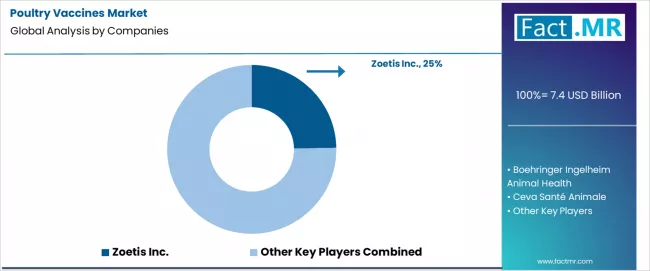
Poultry Vaccines Market Analysis By Company | Source: Fact.MR
The competitive landscape is highly consolidated, dominated by a few multinational animal health corporations with the capital for intensive R&D and global distribution. These leaders compete through extensive vaccine portfolios covering all major diseases and offering combination products for simplified administration. A key battleground is the development of effective, DIVA-compliant vaccines for Avian Influenza, a segment with immense regulatory and commercial stakes.
Competition also focuses on technical service and integration. Leading firms provide more than vaccines; they offer comprehensive vaccination program consulting, hatchery automation equipment, and diagnostic support. Success hinges on forming deep partnerships with integrated poultry producers, embedding their products and protocols into the core of the client's biosecurity operations.
Key Players in the Poultry Vaccines Market
Zoetis Inc.
Boehringer Ingelheim Animal Health
Ceva Santé Animale
Elanco Animal Health
Phibro Animal Health Corporation
Others
Bibliography
Food and Agriculture Organization (FAO). (2025). The State of Food Security and Nutrition: Role of Animal Disease Control. FAO.
International Alliance for Biological Standardization (IABS). (2024). Advances in Poultry Vaccine Technology and Standardization. IABS Proceedings.
World Organisation for Animal Health (WOAH). (2024). Terrestrial Animal Health Code: Chapters on Newcastle Disease and Avian Influenza.
World Veterinary Poultry Association (WVPA). (2025). Global Trends in Poultry Health Management and Vaccination. WVPA Congress Report.
Scope of Report
Items
Metrics
Quantitative Units
USD Billion
Product
Live Attenuated Vaccines, Inactivated Vaccines, Recombinant Vaccines
Efficacy comparison of different vaccine platforms against evolving pathogen strains; economic analysis of vaccination ROI across production systems; impact of maternal immunity on vaccine schedule design; challenges of vaccine delivery in hot/humid climates.
Market by Segments
Product :
Live Attenuated Vaccines
Inactivated Vaccines
Recombinant Vaccines
Application :
Newcastle Disease
Avian Influenza
Infectious Bursal Disease
Others
End User :
Integrated Poultry Farms
Commercial Hatcheries
Veterinary Service Providers
Region :
North America
USA
Canada
Latin America
Brazil
Mexico
Argentina
Rest of Latin America
Western Europe
Germany
France
UK
Italy
Spain
BENELUX
Rest of Western Europe
Eastern Europe
Russia
Poland
Czech Republic
Rest of Eastern Europe
East Asia
China
Japan
South Korea
Rest of East Asia
South Asia & Pacific
India
ASEAN
Australia
Rest of South Asia & Pacific
MEA
GCC Countries
South Africa
Turkiye
Rest of MEA
Frequently Asked Questions
How big is the poultry vaccines market in 2026?
The global poultry vaccines market is estimated to be valued at USD 7.4 billion in 2026.
What will be the size of poultry vaccines market in 2036?
The market size for the poultry vaccines market is projected to reach USD 16.6 billion by 2036.
How much will be the poultry vaccines market growth between 2026 and 2036?
The poultry vaccines market is expected to grow at a 8.4% CAGR between 2026 and 2036.
What are the key product types in the poultry vaccines market?
The key product types in poultry vaccines market are live attenuated vaccines, inactivated vaccines and recombinant vaccines.
Which application segment to contribute significant share in the poultry vaccines market in 2026?
In terms of application, newcastle disease segment to command 26.6% share in the poultry vaccines market in 2026.