- Base Value(2026): 3.0 Bn
- Estimated Value(2026): 3.0 Bn
- Forecast Value (2036): 18.6 Bn
- CAGR (2026 - 2036): 20%
Precision Fermentation Dairy Alternatives Market Forecast and Outlook By Fact.MR
Valuation of the precision fermentation dairy alternatives market stood at USD 2.4 billion in 2025. According to Fact MR, demand for dairy proteins and fats produced through precision fermentation is expected to reach USD 3.0 billion in 2026 and USD 18.6 billion by 2036. A CAGR of 20% is projected for the forecast timeline.
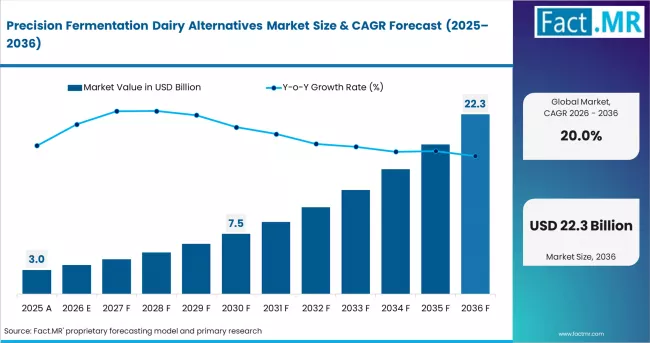
Precision Fermentation Dairy Alternatives Market Market Value Analysis | Source: Fact.MR
Precision Fermentation Dairy Alternatives Market
| Metric | Details |
|---|---|
| Industry Size (2026E) | USD 3.0 billion |
| Industry Value (2036F) | USD 18.6 billion |
| CAGR (2026 to 2036) | 20% |
Source: Fact.MR analysis. Updated Apr 17, 2026
Summary of Precision Fermentation Dairy Alternatives Market
- Market Definition
- The market includes dairy-free ingredients and finished food products produced through microbial fermentation processes that replicate the structural and functional properties of milk proteins and fats. Precision fermentation enables production of bioidentical casein and whey proteins used in cheese, yogurt, ice cream, butter, and beverage formulations requiring emulsification, gel formation, foaming stability, and sensory equivalence to conventional dairy products.
- Demand Drivers
- Increasing demand for animal-free dairy proteins capable of replicating texture, meltability, and emulsification performance of traditional dairy ingredients
- Expansion of biotechnology manufacturing capacity supporting commercial scale production of fermentation-derived casein and whey proteins
- Growing use of fermentation-enabled proteins across cheese alternatives, yogurt formulations, and protein-fortified beverages
- Rising investment in alternative protein development supporting innovation in dairy analog formulation technologies
- Key Segments Analyzed
- Ingredient Type: Casein protein analogs account for approximately 39% share supported by gel formation and structural functionality in cheese analog applications
- Distribution Channel: Business to business represents nearly 46% share driven by supply agreements between ingredient developers and food manufacturers
- Product Type: Milk protein ingredients and cheese alternatives demonstrate consistent adoption across structured dairy alternative product development pipelines
- Geography: Europe demonstrates stable adoption supported by regulatory pathways for novel protein commercialization
- Analyst Opinion at Fact MR
- Shambhu Nath Jha, Principal Consultant, Fact MR, opines, "In this updated edition of the Precision Fermentation Dairy Alternatives Market report, industry participants will observe rapid development of microbial protein production technologies supporting replication of dairy functionality without animal sourcing. Fermentation-derived casein and whey proteins enable formulation of cheese and cultured dairy alternatives with structural and sensory properties comparable to conventional dairy products. Companies that scale fermentation efficiency and maintain regulatory compliance across novel food frameworks are expected to maintain competitive positioning through 2036."
- Strategic Implications Executive Takeaways
- Invest in fermentation process optimization supporting scalable production of bioidentical dairy proteins with consistent purity levels
- Expand partnerships between biotechnology firms and food manufacturers integrating functional dairy proteins into structured formulations
- Strengthen product development capabilities addressing melt behavior, emulsification stability, and sensory equivalence across dairy alternative applications
- Monitor regulatory approval pathways influencing commercialization timelines for fermentation-derived protein ingredients
- Methodology
- Primary interviews conducted with biotechnology firms, food ingredient developers, dairy alternative manufacturers, and commercial formulation specialists
- Desk research based on biotechnology publications, patent filings, regulatory documentation, and protein engineering research datasets
- Market sizing developed using hybrid top-down dairy alternative demand analysis combined with bottom-up assessment of fermentation-derived protein commercialization pipelines
- Data validation performed through cross comparison of commercialization activity, expert consultation, and internal analytical review aligned with Fact MR research standards
A CAGR of 20% indicates transformational expansion with elevated variability linked to scaling efficiency of bio-based protein production and cost curve progression. Growth remains supported by demand for animal-free dairy functionality, while volatility persists due to regulatory approval pathways, input substrate cost exposure, and competition from plant-based protein alternatives.
The United Kingdom leads with a projected CAGR of 21.4%, supported by expansion of biotechnology-based protein production capacity and increasing use in dairy alternative formulations. Germany follows with a CAGR of 20.8%, driven by strong integration of advanced fermentation-derived ingredients across cheese and yogurt substitute categories. The United States records a CAGR of 19.7%, reflecting steady commercialization of bioidentical milk proteins across foodservice and packaged food channels. France shows a CAGR of 19.2%, supported by growing incorporation of animal-free dairy components across specialty food product lines. Japan records the slowest growth at 17.9%, reflecting a relatively mature innovation environment where demand is linked to gradual scaling of production infrastructure. Mature markets generate a significant share of replacement demand as formulation development focuses on protein functionality, texture stability, and sensory equivalence across dairy alternative applications.
Segmental Analysis
Precision Fermentation Dairy Alternatives Market Analysis by Distribution Channel
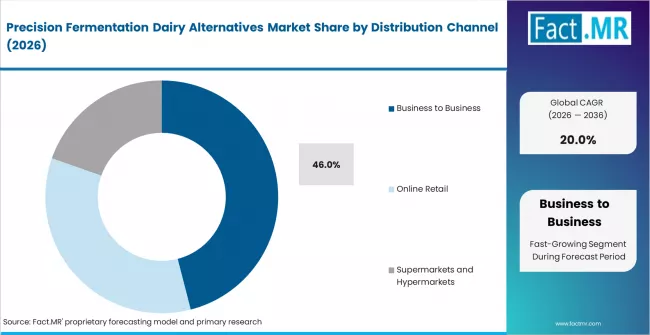
Precision Fermentation Dairy Alternatives Market Analysis By Distribution Channel | Source: Fact.MR
- Market Overview: Based on Fact MR assessment, business to business distribution is projected to account for 46% share of the precision fermentation dairy alternatives market in 2026. Ingredient supply relationships are structured between protein developers and food manufacturers requiring functional dairy protein equivalents across cheese analogs, yogurt alternatives, and protein fortified beverage formulations. Industrial procurement frameworks are aligned with bulk ingredient sourcing models supporting incorporation of animal-free dairy proteins into large scale food production systems. Contract supply agreements define volume consistency requirements across manufacturers developing structured dairy alternative product portfolios requiring standardized protein functionality performance.
- Demand Drivers:
- Ingredient Supply Integration: Food manufacturers procure functional dairy protein equivalents for incorporation into structured formulations requiring emulsification and gel formation performance.
- Production Scale Alignment: Business buyers require consistent protein input characteristics supporting standardized texture development across cheese alternatives and cultured dairy analog products.
- Specification Compliance Requirements: Industrial procurement systems emphasize controlled purity levels and defined protein concentration parameters supporting repeatable batch formulation outcomes.
Precision Fermentation Dairy Alternatives Market Analysis by Ingredient Type
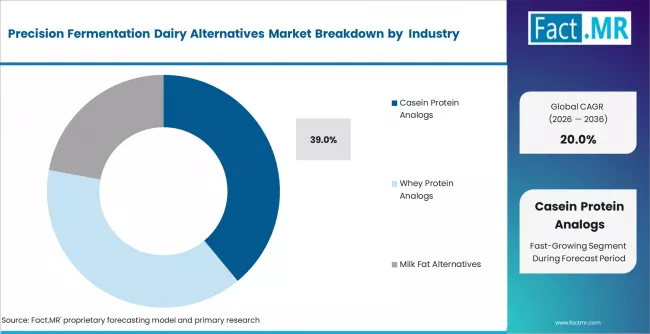
Precision Fermentation Dairy Alternatives Market Analysis By Ingredient Type | Source: Fact.MR
- Market Overview: Casein protein analogs are estimated to hold 39% share of the precision fermentation dairy alternatives market in 2026, supported by structural functionality enabling formation of stable protein networks across cheese analogs and cultured dairy products. Casein proteins demonstrate emulsification capacity and gel forming behavior required for replication of dairy texture attributes across processed food matrices. Functional performance characteristics support incorporation across solid and semi-solid dairy alternative applications requiring melt behavior control, elasticity characteristics, and moisture retention properties aligned with conventional dairy product structure parameters.
- Demand Drivers:
- Protein Network Formation Requirements: Casein analog structures enable formation of stable matrices required across cheese alternatives and cultured dairy formulations.
- Emulsification Performance: Casein functionality supports stabilization of fat and water phases within structured food formulations requiring uniform texture consistency.
- Application Compatibility: Casein protein analogs demonstrate suitability across sliced cheese formats, spreadable dairy alternatives, and fermented dairy style products requiring controlled structural integrity.
Key Dynamics
Precision Fermentation Dairy Alternatives Market Drivers, Restraints, and Opportunities
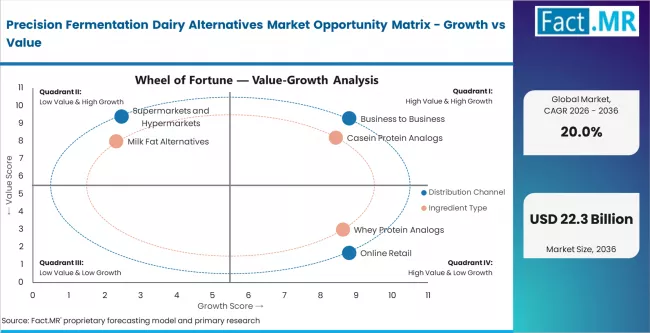
Precision Fermentation Dairy Alternatives Market Opportunity Matrix Growth Vs Value | Source: Fact.MR
Fact MR analysis indicates that the precision fermentation dairy alternatives market developed from biotechnology processes used to produce functional proteins through microbial fermentation. Early dairy alternatives relied primarily on plant-based formulations that replicated texture but differed in protein structure and functionality compared with conventional dairy. The current market valuation reflects the use of engineered microorganisms to produce casein and whey proteins that enable formulation of cheese, milk, and yogurt alternatives with similar functional properties to animal-derived dairy. Demand persists because fermentation-derived proteins allow replication of meltability, emulsification, and foaming characteristics required in dairy product applications.
A structural shift is occurring as plant-based dairy substitutes compete with fermentation-derived dairy proteins designed to improve functional performance in processed foods. Traditional plant-based dairy alternatives remain widely used where ingredient familiarity and established supply chains support large-scale production. Fermentation-derived dairy proteins involve specialized bioprocessing infrastructure, strain engineering, and purification systems that increase production costs relative to plant protein ingredients. These products command higher pricing due to technological complexity and controlled fermentation conditions. Even with gradual commercial scaling, higher per-unit value associated with fermentation-derived dairy ingredients supports strong market value expansion.
- Functional Protein Replication: Manufacturers produce fermentation-derived casein and whey analogs that enable cheese, yogurt, and milk alternatives with comparable texture performance.
- Novel Food Regulatory Pathways: Frameworks such as European Food Safety Authority novel food regulation and U.S. Food and Drug Administration Generally Recognized as Safe (GRAS) pathway influence commercialization timelines.
- North America Biotechnology Scaling: The United States maintains active biotechnology commercialization supporting fermentation-derived dairy ingredient development and pilot-scale production.
Regional Analysis
The precision fermentation dairy alternatives market is assessed across North America, Europe, Asia Pacific, Latin America, and Middle East & Africa, segmented by country-level adoption of animal-free dairy proteins, ingredient commercialization, and specialty food manufacturing capabilities. Regional demand reflects regulatory approvals, food technology investment, and alternative protein product launches. The full report offers market attractiveness analysis.
.webp "Top Country Growth Comparison Precision Fermentation Dairy Alternatives Market Cagr (2026 2036)")
Top Country Growth Comparison Precision Fermentation Dairy Alternatives Market Cagr (2026 2036) | Source: Fact.MR
| Country | CAGR (2026–2036) |
|---|---|
| United Kingdom | 21.4% |
| Germany | 20.8% |
| United States | 19.7% |
| France | 19.2% |
| Japan | 17.9% |
Source: Fact.MR analysis. Updated Apr 17, 2026
Source: Fact MR analysis, based on proprietary forecasting model and primary research
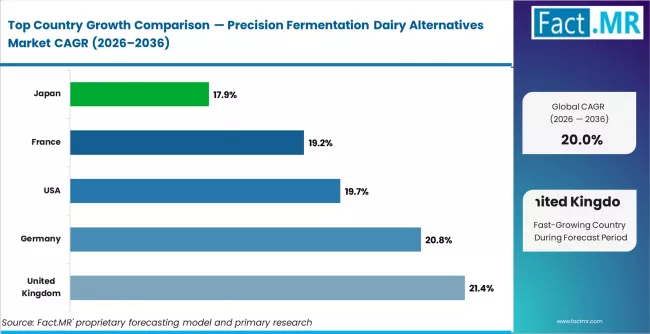
Precision Fermentation Dairy Alternatives Market Cagr Analysis By Country | Source: Fact.MR
Europe
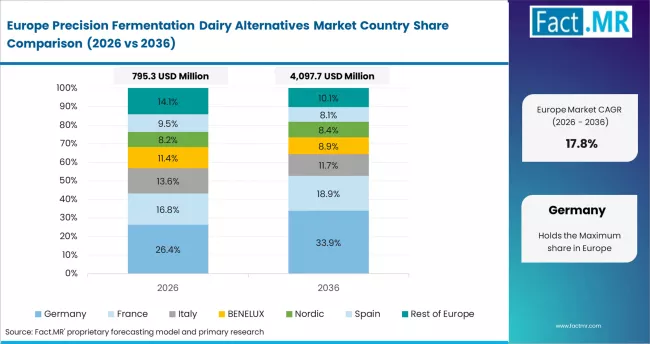
Precision Fermentation Dairy Alternatives Market Europe Country Market Share Analysis, 2026 & 2036 | Source: Fact.MR
Europe functions as the global regulatory laboratory for novel food approval and alternative dairy protein commercialization, supported by structured ingredient authorization pathways and strong food technology research ecosystems. Formo Bio GmbH strengthens dairy protein ingredient development capabilities. Standing Ovation SAS advances casein ingredient innovation. Vivici B.V. expands protein ingredient commercialization.
- United Kingdom: Demand for dairy alternatives produced via precision fermentation in United Kingdom is projected to rise at 21.4% CAGR through 2036. The UK Novel Foods regulatory framework update (Food Standards Agency, 2022) supports approval pathways for new protein ingredients. Vivici B.V. expanded commercialization activities for dairy protein ingredients (March 2023), supporting market growth.
- Germany: Demand for dairy alternatives produced via precision fermentation in Germany is projected to rise at 20.8% CAGR through 2036. EU Novel Food Regulation implementation (European Commission, ongoing) supports commercialization of new protein sources. Formo Bio GmbH expanded protein ingredient production capabilities (February 2023), supporting adoption.
- France: Demand for dairy alternatives produced via precision fermentation in France is projected to rise at 19.2% CAGR through 2036. The France 2030 investment plan (French Government, October 2021) supports food biotechnology development. Standing Ovation SAS expanded casein protein ingredient innovation (January 2023), supporting industry growth.
North America
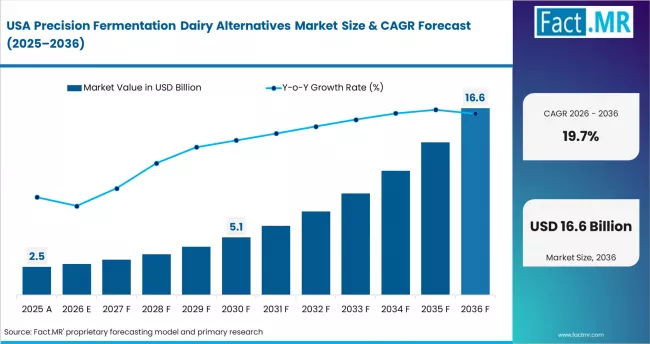
Precision Fermentation Dairy Alternatives Market Country Value Analysis | Source: Fact.MR
North America functions as the alternative protein commercialization and food technology investment hub, supported by structured regulatory engagement and strong venture-backed ingredient development ecosystems. Perfect Day, Inc. maintains leadership in animal-free dairy protein development. Change Foods, Inc. expands dairy protein ingredient innovation. New Culture Inc. supports mozzarella protein ingredient commercialization.
- United States: Demand for dairy alternatives produced via precision fermentation in United States is projected to rise at 19.7% CAGR through 2036. FDA GRAS notification pathway updates (U.S. FDA, ongoing) support commercialization of new protein ingredients. Perfect Day, Inc. expanded commercialization of animal-free dairy proteins (April 2023), supporting market expansion.
Asia Pacific
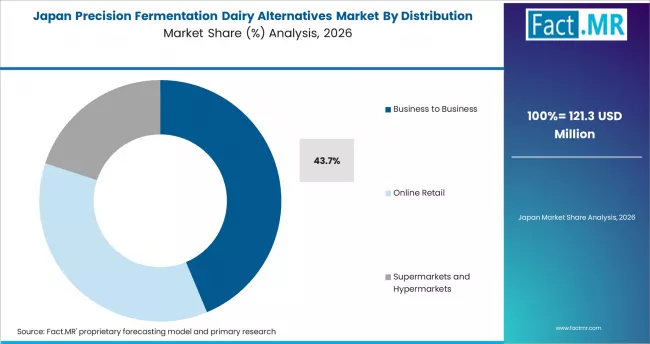
Precision Fermentation Dairy Alternatives Market Japan Market Share Analysis By Distribution Channel | Source: Fact.MR
Asia Pacific serves as the emerging food biotechnology commercialization and alternative protein ingredient adoption market, supported by expanding food innovation investment and specialty product development initiatives. Remilk Ltd. supports dairy protein ingredient commercialization partnerships. Imagindairy Ltd. strengthens protein ingredient development capabilities. Eden Brew Pty Ltd. expands dairy protein ingredient applications.
- Japan: Demand for dairy alternatives produced via precision fermentation in Japan is projected to rise at 17.9% CAGR through 2036. The Food Innovation Strategy (Ministry of Agriculture, Forestry and Fisheries, updated 2021) supports development of novel protein technologies. Eden Brew Pty Ltd. expanded protein ingredient commercialization partnerships (May 2023), supporting market development.
Fact MR's analysis of precision fermentation dairy alternatives market in global regions consists of country-wise assessment that includes United Kingdom, Germany, United States, France, and Japan. Readers can find alternative protein commercialization trends, regulatory developments, ingredient innovation patterns, and competitive positioning across key markets.
Competitive Landscape
Competitive Structure and Buyer Dynamics in the Precision Fermentation Dairy Alternatives Market
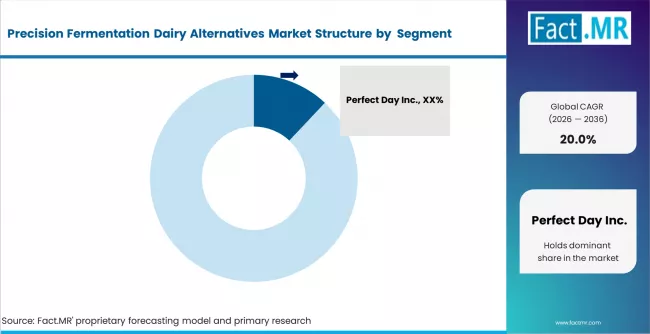
Precision Fermentation Dairy Alternatives Market Analysis By Company | Source: Fact.MR
The competitive structure of the Precision Fermentation Dairy Alternatives Market is moderately fragmented, with biotechnology firms focusing on animal free dairy protein development through microbial production platforms. Companies such as Perfect Day Inc., Remilk Ltd., Formo Bio GmbH, New Culture Inc., Imagindairy Ltd., and Change Foods Inc. maintain notable positions through proprietary microbial strain engineering and protein production processes. Additional participants including Those Vegan Cowboys, Standing Ovation SAS, Vivici BV, and Eden Brew Pty Ltd contribute through specialized protein development and partnership driven commercialization strategies. Competition is primarily influenced by protein functionality, scalability of production, regulatory approval pathways, and compatibility with dairy product formulations.
Several companies maintain structural advantages through proprietary microbial engineering platforms and strong intellectual property portfolios related to animal free protein production. Firms such as Perfect Day Inc. and Remilk Ltd. benefit from early commercialization progress and partnerships with food manufacturers. Formo Bio GmbH and Imagindairy Ltd. maintain advantages through focused research capabilities and fermentation optimization expertise. Food companies typically evaluate multiple protein suppliers to reduce dependency on a single technology provider and manage formulation flexibility. Procurement decisions assess protein performance, scalability potential, and regulatory compliance, moderating supplier pricing leverage within commercial supply agreements.
Key Players of the Precision Fermentation Dairy Alternatives Market
- Perfect Day Inc.
- Formo Bio GmbH
- Remilk Ltd.
- New Culture Inc.
- Imagindairy Ltd.
- Change Foods Inc.
- Those Vegan Cowboys
- Standing Ovation SAS
- Vivici BV
- Eden Brew Pty Ltd
Bibliographies
- [1] European Food Safety Authority (EFSA). (2022). Scientific opinion on animal-free dairy proteins produced by precision fermentation as novel food. EFSA Journal, 20(11), 7604.
- [2] U.S. Food and Drug Administration (FDA). (2022). Overview of the Generally Recognized as Safe (GRAS) evaluation process for new dairy proteins and milk-fat analogs. U.S. FDA.
- [3] Formo Bio. (2023). Casein analogs and functionality in dairy alternatives: Technical report on precision-fermentation casein for cheese and yogurt analogs. Formo Bio GmbH.
- [4] Perfect Day, Inc. (2023). Animal-free dairy proteins in commercial food applications: Performance and sensory evaluation of precision-fermentation whey and casein in ice cream and yogurt formulations. Perfect Day, Inc.
- [5] UK Food Standards Agency (FSA). (2022). Guidance on the UK Novel Foods regulatory framework for precision-fermentation-derived dairy ingredients. Food Standards Agency, UK.
This Report Addresses
- Market size estimation and revenue forecasts for the Precision Fermentation Dairy Alternatives Market from 2026 to 2036, supported by biotechnology protein commercialization benchmarks and adoption trends for fermentation-derived dairy ingredients.
- Growth opportunity mapping across milk protein ingredients, cheese alternatives, yogurt alternatives, ice cream alternatives, and butter and cream alternatives aligned with bioidentical protein functionality requirements in dairy substitute formulations.
- Segment and regional revenue forecasts covering ingredient categories, distribution channels, and key commercialization markets including United Kingdom, Germany, United States, France, and Japan.
- Competition strategy assessment of leading companies such as Perfect Day Inc., Formo Bio GmbH, Remilk Ltd., New Culture Inc., and Imagindairy Ltd, including microbial strain engineering capability benchmarking and fermentation scale optimization positioning.
- Regulatory impact analysis covering European Food Safety Authority novel food authorization pathways, U.S. Food and Drug Administration GRAS framework, and biotechnology-derived ingredient approval standards influencing commercialization timelines.
- Market report delivery in PDF, Excel, PPT, and interactive dashboard formats designed for alternative protein portfolio evaluation, ingredient commercialization tracking, and food technology investment assessment.
- Supply chain vulnerability assessments examining fermentation feedstock cost exposure, bioprocess scale-up constraints, purification efficiency variability, regulatory approval complexity, and substitution pressure from plant-based protein alternatives influencing market expansion trajectory.
Precision Fermentation Dairy Alternatives Market Definition
The Precision Fermentation Dairy Alternatives Market includes dairy free ingredients and food products produced using microbial processes to create proteins and fats that replicate the functional and sensory properties of milk, cheese, yogurt, butter, and other dairy products.
Precision Fermentation Dairy Alternatives Market Inclusions
The report includes global and regional market size estimates, forecast analysis, and segmentation by product type, ingredient category, application, end user group, distribution channel, pricing structure, and commercial adoption patterns.
Precision Fermentation Dairy Alternatives Market Exclusions
The scope excludes plant based dairy alternatives produced without microbial protein production, traditional fermented dairy products, animal derived dairy ingredients, and fermentation technology providers not directly supplying dairy alternative ingredients.
Precision Fermentation Dairy Alternatives Market Research Methodology
- Primary Research: Interviews were conducted with ingredient developers, food manufacturers, biotechnology companies, distributors, and product formulation specialists.
- Desk Research: Public sources included biotechnology publications, company product documentation, regulatory approvals, patent filings, and food ingredient databases.
- Market-Sizing and Forecasting: A hybrid model combining top-down dairy alternative demand assessment and bottom-up analysis of microbial dairy protein commercialization was applied.
- Data Validation and Update Cycle: Estimates were validated through cross source comparison, expert consultation, and periodic monitoring of product launches and regulatory developments.
Segmentation
Report Scope
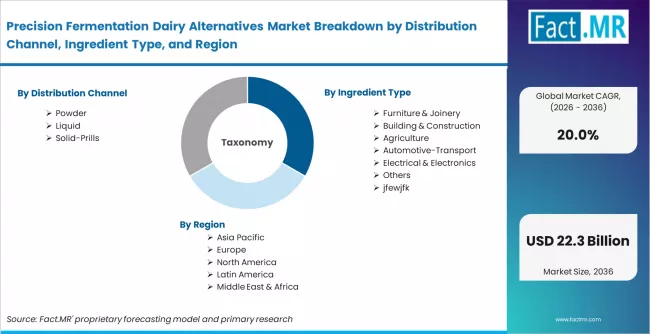
Precision Fermentation Dairy Alternatives Market Breakdown By Distribution Channel, Ingredient Type, And Region | Source: Fact.MR
| Metric | Value |
|---|---|
| Quantitative Units | USD 3.0 billion (2026) to USD 18.6 billion (2036), at a CAGR of 20% |
| Market Definition | The precision fermentation dairy alternatives market includes commercial production and commercialization of dairy-identical proteins and fats created through microbial fermentation processes, used as functional ingredients or finished products replicating conventional milk-based sensory and nutritional characteristics. |
| Product Type Segmentation | Milk protein ingredients, Cheese alternatives, Yogurt alternatives, Ice cream alternatives, Butter and cream alternatives |
| Ingredient Type Segmentation | Casein protein analogs, Whey protein analogs, Milk fat alternatives, Enzyme modified dairy proteins |
| Distribution Channel Segmentation | Business to business, Online retail, Supermarkets and hypermarkets, Specialty vegan stores, Foodservice |
| Regions Covered | North America, Latin America, Europe, East Asia, South Asia, Oceania, Middle East and Africa |
| Countries Covered | United States, Canada, Mexico, Brazil, Argentina, Germany, France, United Kingdom, Netherlands, Denmark, Israel, China, India, Japan, South Korea, Singapore, Australia, New Zealand, and 40+ countries |
| Key Companies Profiled | Perfect Day Inc., Formo Bio GmbH, Remilk Ltd., New Culture Inc., Imagindairy Ltd., Change Foods Inc., Those Vegan Cowboys, Standing Ovation SAS, Vivici BV, Eden Brew Pty Ltd |
| Forecast Period | 2026 to 2036 |
| Approach | Hybrid top-down and bottom-up market estimation based on fermentation-derived protein production capacity analysis, ingredient demand mapping across dairy substitute applications, commercialization pipeline assessment, regulatory approval tracking, and validation through primary interviews with food technology companies, ingredient developers, and commercial food manufacturers. |
Source: Fact.MR analysis. Updated Apr 17, 2026
Precision Fermentation Dairy Alternatives Market Key Segments
-
Product Type:
- Milk Protein Ingredients
- Cheese Alternatives
- Yogurt Alternatives
- Ice Cream Alternatives
- Butter and Cream Alternatives
-
Ingredient Type:
- Casein Protein Analogs
- Whey Protein Analogs
- Milk Fat Alternatives
- Enzyme Modified Dairy Proteins
-
Distribution Channel:
- Business to Business
- Online Retail
- Supermarkets and Hypermarkets
- Specialty Vegan Stores
- Foodservice
-
Region:
- North America
- USA
- Canada
- Mexico
- Europe
- Germany
- UK
- France
- Italy
- Spain
- Nordic Countries
- BENELUX
- Rest of Europe
- Asia Pacific
- China
- Japan
- South Korea
- India
- Australia
- Rest of Asia Pacific
- Latin America
- Brazil
- Argentina
- Rest of Latin America
- Middle East and Africa
- Kingdom of Saudi Arabia
- United Arab Emirates
- South Africa
- Rest of Middle East and Africa
- Other Regions
- Oceania
- Central Asia
- Other Markets
- North America
Frequently Asked Questions
How large is the demand for Dairy Alternatives in the global market in 2026?
What will be the market size of Dairy Alternatives in the global market by 2036?
What is the expected demand growth for Dairy Alternatives in the global market between 2026 and 2036?
Which company is identified as a leading manufacturer in the Dairy Alternatives market?
Which distribution channel is projected to dominate Dairy Alternatives sales by 2026?
Why is business to business distribution important for dairy alternative ingredient adoption?
What is driving demand for Dairy Alternatives in the United Kingdom?
What is the growth outlook for the Dairy Alternatives market in the United Kingdom?
Why is Germany an important market for dairy alternative ingredient solutions?
What is the growth outlook for the Dairy Alternatives market in Germany?
How is demand for Dairy Alternatives evolving in the United States?
What is the growth outlook for the Dairy Alternatives market in the United States?
What is the growth outlook for the Dairy Alternatives market in France?
How is Japan positioned in the Dairy Alternatives market?
What is the growth outlook for the Dairy Alternatives market in Japan?
What are dairy alternative ingredients and what are they mainly used for?
What does the Dairy Alternatives market include in this report?
What applications are included in the scope of the Dairy Alternatives market?
What is excluded from the scope of the Dairy Alternatives market report?
What does market forecast mean in the Dairy Alternatives market report?
How is the Dairy Alternatives market forecast developed in this report?
What does primary validation indicate in the Dairy Alternatives market analysis?
Who worked on this report


Preview the report firsthand - request a free sample
Free SampleGet the brochure for pricing and purchase details
Download PDF