- Base Value(2025): 520 Mn
- Estimated Value(2026): 585 Mn
- Forecast Value (2036): 2480 Mn
- CAGR (2026 - 2036): 15.6%
Zero-Alcohol Fermentation Aroma Bases Market Size, Share and Forecast and Outlook By FACT.MR
In 2025, the zero-alcohol fermentation aroma bases market was valued at USD 520 million. Fact MR analysis indicates demand for zero-alcohol fermentation aroma bases is expected to reach USD 585 million in 2026 and USD 2,480 million by 2036. FMR estimates the market will expand at a CAGR of 15.6% across the forecast period.
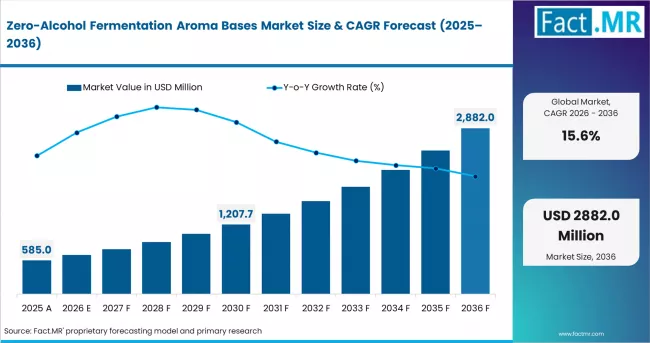
Zero Alcohol Fermentation Aroma Bases Market Market Value Analysis | Source: Fact.MR
Zero-Alcohol Fermentation Aroma Bases Market
| Metric | Details |
|---|---|
| Industry Size (2026E) | USD 585 million |
| Industry Value (2036F) | USD 2,480 million |
| CAGR (2026 to 2036) | 15.6% |
Source: Fact.MR analysis. Updated Apr 24, 2026
Summary of the Zero-Alcohol Fermentation Aroma Bases Market
- Market Definition
- The zero-alcohol fermentation aroma bases market comprises bio-derived aroma compounds produced through controlled fermentation or bioconversion pathways designed to replicate sensory characteristics of alcoholic beverages without ethanol presence. These aroma bases generate esters, aldehydes, organic acids, and volatile compounds that reproduce flavor complexity required in alcohol-free beer, wine alternatives, botanical spirits substitutes, functional beverages, and ready-to-drink mocktails.
- Demand Drivers
- Increasing consumer preference for alcohol-free beverages requiring authentic fermentation-derived flavor complexity.
- Expansion of product portfolios across alcohol-free beer, wine alternatives, and botanical spirits substitutes requiring sensory-equivalent aroma systems.
- Rising investment in fermentation biotechnology enabling controlled biosynthesis of volatile flavor compounds without ethanol retention.
- Growth in functional beverage categories incorporating fermentation-derived flavor systems supporting complex taste layering.
- Increasing regulatory acceptance of zero-alcohol labeling encouraging beverage manufacturers to reformulate traditional products.
- Development of precision fermentation technologies supporting consistent production of ester-rich aroma compounds used in non-alcoholic formulations.
- Key Segments Analyzed
- Technology: Yeast fermentation leads with 38% share due to ability to generate complex ester and aldehyde aroma profiles through controlled metabolic pathways.
- Aroma Type: Fruit ester aromas dominate with 34% share reflecting demand for fruity volatile compounds replicating sensory characteristics of fermented beverages.
- Application: Alcohol-free beer and botanical spirits alternatives represent key application segments requiring fermentation-derived aroma complexity.
- Geography: China and India demonstrate strongest growth supported by expansion of alcohol-free beverage manufacturing, while the United States, Germany, and the United Kingdom reflect scaling adoption across established zero-alcohol product portfolios.
- Analyst Opinion at Fact MR
- Shambhu Nath Jha, Principal Consultant, Fact MR, opines, 'In this updated edition of the Zero-Alcohol Fermentation Aroma Bases Market report, industry participants observe a transition from traditional flavor replication systems toward fermentation-derived aroma architectures capable of delivering layered sensory characteristics without ethanol presence. Market participants are aligning microbial strain optimization strategies with volatility control and aroma persistence targets supporting alcohol-free beverage formulation requirements. Demand expansion reflects increasing reliance on yeast-derived ester systems capable of reproducing fermentation-associated sensory complexity. Competitive positioning is influenced by reproducibility of aroma compound synthesis, regulatory compliance capability, and compatibility with beverage processing conditions through 2036.'
- Strategic Implications/Executive Takeaways
- Invest in microbial strain optimization supporting controlled biosynthesis of ester, aldehyde, and organic acid aroma compounds.
- Expand precision fermentation capability improving yield efficiency and reproducibility of fermentation-derived flavor systems.
- Strengthen collaboration with beverage manufacturers developing alcohol-free product portfolios requiring sensory equivalence to traditional fermented beverages.
- Improve process scalability supporting consistent production of aroma bases across commercial batch fermentation environments.
- Support development of modular aroma systems enabling blending flexibility across beer, wine-style, and botanical beverage formulations.
- Enhance analytical profiling capability ensuring consistency of volatile compound composition across manufacturing cycles.
- Methodology
- Built on primary interviews with flavor houses, fermentation technology developers, beverage formulation specialists, and ingredient procurement teams.
- Benchmarked against alcohol-free beverage product launch trends, fermentation-derived ingredient adoption rates, and regulatory frameworks governing zero-alcohol labeling.
- Applied hybrid market sizing model combining supplier revenue analysis with top down evaluation of alcohol-free beverage formulation demand.
- Validated through triangulation using patent literature, fermentation pathway research publications, supplier technical documentation, and expert consultation.
- Periodically updated to reflect advances in microbial biosynthesis technologies, fermentation process optimization developments, and expansion of alcohol-free beverage product innovation.
A CAGR of 15.6%, with value increasing from USD 585 million to USD 2,480 million, indicates strong growth momentum reflecting structural expansion in alcohol-free beverage formulation and flavor replication technologies. Growth is driven by regulatory acceptance of zero-alcohol labeling and consumer preference shifts, while constrained by fermentation cost structures, sensory accuracy requirements, and competition from synthetic flavor substitutes.
China records the fastest growth at 17.4%, supported by increased development of alcohol-free beverage formulations using fermentation-derived flavor bases. India follows at 16.9%, driven by expanding production of non-alcoholic malt and botanical beverage variants. The United Kingdom shows 16.5% growth, linked to reformulation of premium zero-alcohol spirits and flavored drink concentrates. Germany at 16.2% and the United States at 15.6% represent mature markets where demand is largely replacement-driven as alcohol-free product portfolios expand within established beverage categories. A structural constraint across mature markets is flavor profile replication complexity, which limits rapid substitution of traditional fermentation extracts.
Segmental Analysis
Zero-Alcohol Fermentation Aroma Bases Market Analysis by Technology
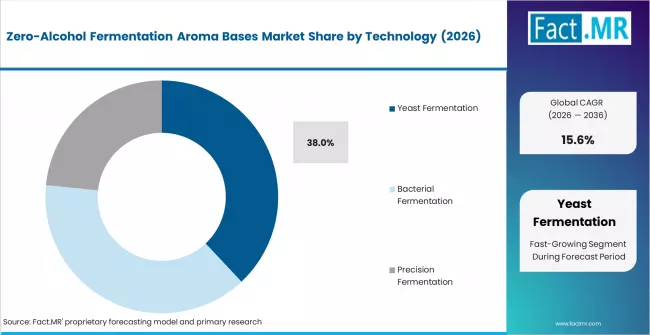
Zero Alcohol Fermentation Aroma Bases Market Analysis By Technology | Source: Fact.MR
- Market Overview: Yeast fermentation is projected to hold 38% share of the zero-alcohol fermentation aroma bases market in 2026. Adoption reflects the ability of yeast metabolic pathways to generate complex aromatic compounds without ethanol accumulation, supporting production of flavor bases suitable for alcohol-free beverage and food formulations. Fermentation process control enables consistent aroma profile replication across industrial production environments.
- Demand Drivers:
- Metabolic Pathway Efficiency: Yeast strains are selected for controlled biosynthesis of volatile aroma compounds including esters, aldehydes, and higher alcohol derivatives used in alcohol-free formulations.
- Process Scalability: Fermentation-based aroma generation enables controlled batch reproducibility and stable compound yield across commercial-scale production systems.
- Regulatory Alignment: Producers prioritize fermentation technologies capable of generating aroma bases compliant with alcohol-free labeling requirements across regulated beverage and food markets.
Zero-Alcohol Fermentation Aroma Bases Market Analysis by Aroma Type
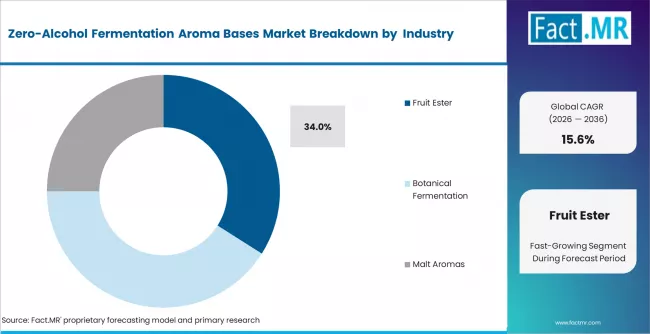
Zero Alcohol Fermentation Aroma Bases Market Analysis By Aroma Type | Source: Fact.MR
- Market Overview: Fruit ester aromas are estimated to account for 34% share in 2026, supported by their role in replicating sensory profiles typically associated with fermented beverages and fruit-based flavor systems without ethanol presence. Ester compounds contribute characteristic fruity notes required in alcohol-free product development.
- Demand Drivers:
- Sensory Profile Replication: Fruit ester compounds provide aromatic signatures associated with fermented beverages, supporting formulation of alcohol-free alternatives maintaining familiar flavor perception.
- Formulation Versatility: Ester aroma bases demonstrate compatibility across beverage, confectionery, and dairy-alternative formulations requiring stable flavor performance under varying processing conditions.
- Product Development Demand: Manufacturers incorporate fruit ester aroma bases to support development of alcohol-free beverages aligned with consumer demand for sensory-equivalent alternatives to traditional fermented products.
Key Dynamics
Zero-Alcohol Fermentation Aroma Bases Market Drivers, Restraints, and Opportunities
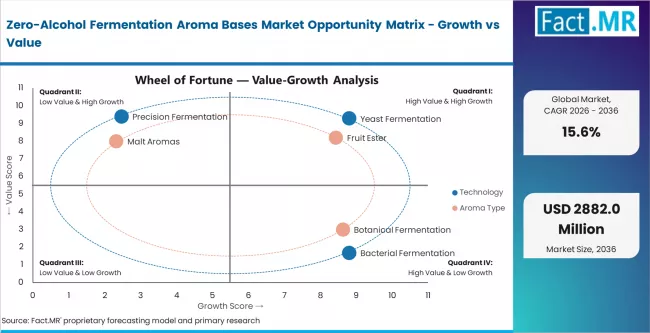
Zero Alcohol Fermentation Aroma Bases Market Opportunity Matrix Growth Vs Value | Source: Fact.MR
Fact MR analysis indicates the market reflects an emerging functional flavor systems segment positioned between traditional fermentation chemistry and modern non-alcoholic beverage formulation. Market size exists because ethanol contributes structure, volatility, and aroma persistence in alcoholic beverages, creating formulation gaps when alcohol is removed. Fermentation-derived aroma bases replicate complexity through organic acids, esters, aldehydes, and higher alcohol analog compounds generated via microbial pathways, enabling beverage manufacturers to maintain sensory depth without ethanol content.
Current dynamics show declining reliance on artificial flavor blends that lack mouthfeel persistence, while fermented aroma bases command higher per-unit pricing due to controlled microbial processing, maturation time, and sensory calibration requirements. Demand expands across alcohol-free beer, wine alternatives, and functional beverages, where fermentation-derived volatile compounds improve flavor layering and perceived authenticity. Higher ingredient costs are balanced by premium product positioning in zero-alcohol beverage categories experiencing strong consumption growth driven by health and lifestyle shifts.
- Alcohol Reduction Policy: Government health strategies encouraging reduced alcohol consumption support demand for aroma bases that replicate ethanol-associated sensory characteristics without regulatory alcohol classification thresholds.
- Europe Innovation Cluster: United Kingdom, Germany, and Spain beverage developers are expanding zero-alcohol beer and wine alternatives using controlled fermentation processes to generate ester-rich aroma matrices.
- Sensory Complexity Engineering: Fermentation-derived aldehydes, esters, and organic acids provide layered aroma persistence that synthetic flavor systems struggle to replicate in low-viscosity beverage bases.
Regional Analysis
The zero-alcohol fermentation aroma bases market is assessed across Asia Pacific, Europe, and North America, segmented by country-level demand for fermentation-derived flavor bases used in alcohol-free beverages, functional drinks, bakery flavor systems, and specialty aroma formulations. Geographic variation reflects alcohol moderation trends, fermentation ingredient innovation, and clean label flavor development. The full report offers market attractiveness analysis.
.webp "Top Country Growth Comparison Zero Alcohol Fermentation Aroma Bases Market Cagr (2026 2036)")
Top Country Growth Comparison Zero Alcohol Fermentation Aroma Bases Market Cagr (2026 2036) | Source: Fact.MR
CAGR Table
| Country | CAGR (2026–2036) |
|---|---|
| China | 17.4% |
| India | 16.9% |
| United Kingdom | 16.5% |
| Germany | 16.2% |
| United States | 15.6% |
Source: Fact.MR analysis. Updated Apr 24, 2026
Source: Fact MR analysis, based on proprietary forecasting model and primary research
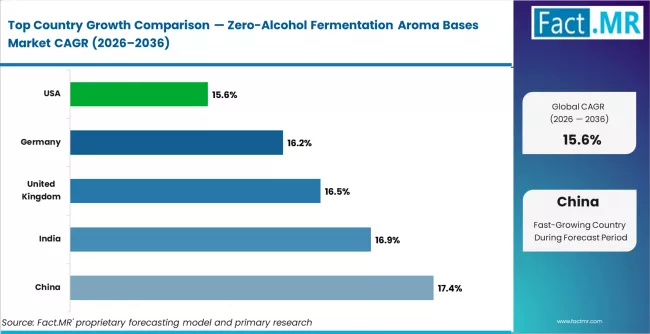
Zero Alcohol Fermentation Aroma Bases Market Cagr Analysis By Country | Source: Fact.MR
Asia Pacific
Asia Pacific functions as the fermentation-derived flavor innovation hub supported by expansion of alcohol-free beverage formulations and microbial aroma compound development. Givaudan SA strengthens fermentation flavor technology capability. Firmenich SA expands bio-based aroma compound production scale. Kerry Group plc supports fermentation-derived flavor system development.
- China: China is projected to record 17.4% CAGR in zero-alcohol fermentation aroma bases through 2036. National Nutrition Plan update (National Health Commission, January 2023) encourages reduced alcohol consumption product development. Givaudan SA expanded fermentation-derived flavor production capability (June 2023).
- India: India is expected to observe 16.9% CAGR in zero-alcohol fermentation aroma bases through 2036. Food processing sector development programme update (Ministry of Food Processing Industries, March 2023) supports specialty flavor ingredient innovation. Kerry Group plc expanded fermentation ingredient application development (July 2023).
Europe
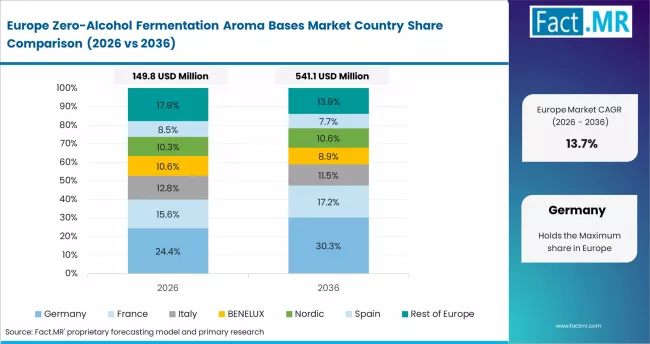
Zero Alcohol Fermentation Aroma Bases Market Europe Country Market Share Analysis, 2026 & 2036 | Source: Fact.MR
Europe operates as the fermentation aroma regulatory laboratory supported by structured food ingredient safety frameworks and increasing demand for alcohol-free beverage formulations. Firmenich SA strengthens microbial aroma compound development capability. Symrise AG expands fermentation-derived flavor portfolio depth. Givaudan SA supports specialty aroma ingredient innovation.
- United Kingdom: The United Kingdom is anticipated to expand at 16.5% CAGR in zero-alcohol fermentation aroma bases through 2036. UK alcohol strategy update (Department of Health and Social Care, February 2023) supports alcohol-free beverage innovation. Symrise AG expanded fermentation-based aroma compound research (May 2023).
- Germany: Germany is forecast to grow at 16.2% CAGR in zero-alcohol fermentation aroma bases through 2036. National reduction strategy for alcohol consumption update (Federal Ministry of Health, January 2023) supports development of non-alcoholic beverage ingredients. Firmenich SA expanded bio-based aroma production capability (April 2023).
North America
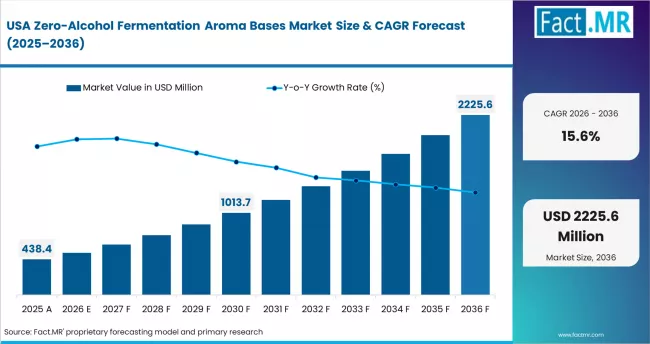
Zero Alcohol Fermentation Aroma Bases Market Country Value Analysis | Source: Fact.MR
North America functions as the commercialization center for fermentation-derived flavor systems supported by strong growth in alcohol-free beverages and clean label formulation demand. Kerry Group plc strengthens fermentation-based flavor technology capability. Givaudan SA expands bio-based aroma molecule development expertise. International Flavors & Fragrances Inc. supports microbial fermentation ingredient innovation.
- United States: The United States is projected to register 15.6% CAGR in zero-alcohol fermentation aroma bases through 2036. FDA flavor ingredient guidance update (October 2023) supports microbial-derived aroma compound usage compliance. International Flavors & Fragrances Inc. expanded fermentation flavor research program (August 2023).
Fact MR's analysis of zero-alcohol fermentation aroma bases market in global regions consists of country-wise assessment that includes China, India, United Kingdom, Germany, and United States. Readers can find fermentation flavor innovation trends, alcohol-free beverage formulation developments, regulatory positioning frameworks, and competitive ingredient technology insights.
Competitive Landscape
What is the Competitive Structure of the Zero-Alcohol Fermentation Aroma Bases Market?
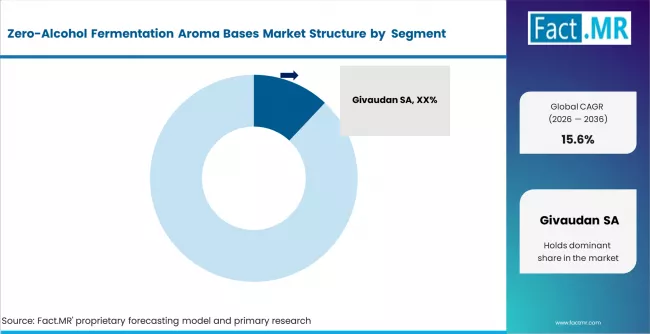
Zero Alcohol Fermentation Aroma Bases Market Analysis By Company | Source: Fact.MR
The Zero-Alcohol Fermentation Aroma Bases Market demonstrates a moderately concentrated competitive structure, supported by global flavor and fragrance companies with advanced fermentation and aroma synthesis capabilities. Leading companies including Givaudan SA, DSM-Firmenich AG, International Flavors & Fragrances Inc., Symrise AG, Kerry Group plc, Takasago International Corporation, Mane SA, and Robertet Group collectively account for nearly 60–70% of global market share, particularly in fermentation-derived aroma systems designed to replicate alcoholic flavor profiles without ethanol content. Competitive positioning is primarily determined by fermentation pathway optimization, aroma compound stability, sensory authenticity, and regulatory compliance for beverage formulations. High technical expertise in microbial biosynthesis and aroma isolation creates entry barriers, limiting participation to companies with established biotechnology and flavor chemistry capabilities.
Structural advantages are observed among companies possessing proprietary microbial strains and integrated flavor formulation platforms that enable scalable production of complex aroma compounds. DSM-Firmenich AG and Givaudan SA benefit from established fermentation infrastructure and long-term relationships with beverage manufacturers developing alcohol-free product portfolios. Buyers typically manage supplier dependency through evaluation of aroma performance consistency across formulations and multi-vendor benchmarking of sensory characteristics. Procurement decisions often consider regulatory documentation, batch reproducibility, and compatibility with beverage processing conditions. Pricing power remains relatively balanced, though suppliers retain moderate leverage where proprietary fermentation processes and validated sensory profiles create switching constraints for beverage companies seeking consistent alcohol-free flavor replication.
Key Players of the Zero-Alcohol Fermentation Aroma Bases Market
- Givaudan SA
- DSM-Firmenich AG
- International Flavors & Fragrances Inc.
- Symrise AG
- Kerry Group plc
- Takasago International Corporation
- Mane SA
- Robertet Group
- EvodiaBio ApS
- Sensient Technologies Corporation
Bibliographies
- [1] National Health Commission (China). (2023, January). National Nutrition Plan update.
- [2] Ministry of Food Processing Industries (India). (2023, March). Food processing sector development programme update.
- [3] Department of Health and Social Care (United Kingdom). (2023, February). UK alcohol strategy update.
- [4] Federal Ministry of Health (Germany). (2023, January). National reduction strategy for alcohol consumption update.
- [5] U.S. Food and Drug Administration. (2023, October). FDA flavor ingredient guidance update.
- [6] Givaudan SA. (2023, June). Fermentation-derived flavor production capability expansion.
- [7] Kerry Group plc. (2023, July). Fermentation ingredient application development expansion.
- [8] Symrise AG. (2023, May). Fermentation-based aroma compound research expansion.
- [9] Firmenich SA. (2023, April). Bio-based aroma production capability expansion.
- [10] International Flavors & Fragrances Inc. (2023, August). Fermentation flavor research program expansion.
This Report Addresses
- Market size estimation and revenue forecasts from 2026 to 2036, supported by validated fermentation capacity benchmarks and demand indicators across alcohol-free beverage formulation systems.
- Growth opportunity mapping across yeast fermentation, bacterial fermentation, precision fermentation, and enzymatic bioconversion technologies aligned with zero-alcohol flavor replication requirements.
- Segment and regional revenue forecasts covering fruit ester, malt, hop, botanical, and wine-style aroma bases across alcohol-free beer, wine alternatives, botanical spirits substitutes, functional beverages, and RTD mocktails.
- Competition strategy assessment including benchmarking of microbial strain engineering capability, aroma compound stability performance, and sensory profile replication consistency across fermentation-derived flavor systems.
- Regulatory impact analysis covering zero-alcohol labeling standards, bio-derived flavor compliance frameworks, and ingredient classification guidelines influencing fermentation aroma adoption in beverage manufacturing.
- Market report delivery in PDF, Excel, PPT, and structured data formats designed for beverage formulators, flavor houses, fermentation technologists, and product innovation teams.
- Supply chain vulnerability assessments identifying concentration risks in microbial strain libraries, fermentation bioreactor capacity, and downstream aroma isolation and purification infrastructure supporting bio-derived flavor compound production.
Zero-Alcohol Fermentation Aroma Bases Market Definition
The zero-alcohol fermentation aroma bases market refers to flavor and fragrance ingredients produced through fermentation processes that generate characteristic aroma compounds without retaining alcohol. These bases replicate sensory notes of fermented products such as beer, wine, dairy, and botanical extracts, enabling formulation of alcohol-free beverages, foods, and fragrances with authentic taste and aroma profiles.
Zero-Alcohol Fermentation Aroma Bases Market Inclusions
The report covers global and regional market size evaluation and forecast outlook across the defined period. It includes segmentation by fermentation pathway such as yeast-derived, bacterial, and enzymatic aroma production. Applications include alcohol-free beverages, functional foods, flavor systems, and fragrance compounds. Pricing structure, supply chain configuration, and trade flow dynamics are also analyzed.
Zero-Alcohol Fermentation Aroma Bases Market Exclusions
The scope excludes conventional alcoholic beverage production, distilled spirits, and finished consumer beverages containing ethanol. Synthetic flavor chemicals not produced through fermentation are not included unless blended with bio-derived aroma bases. Downstream branded drinks, perfumes, and food products are excluded, focusing strictly on intermediate aroma compounds and formulation bases.
Zero-Alcohol Fermentation Aroma Bases Market Research Methodology
- Primary Research: Interviews were conducted with flavor houses, fermentation technology providers, beverage formulators, and ingredient procurement specialists involved in alcohol-free product development.
- Desk Research: Scientific journals, patent publications, regulatory flavor ingredient databases, and company technical documentation were reviewed to identify fermentation-derived aroma compounds and commercial applications.
- Market-Sizing and Forecasting: A hybrid model combining bottom-up supplier revenue evaluation and top-down assessment of alcohol-free beverage and flavor ingredient demand was applied to estimate market size and growth trajectory.
- Data Validation and Update Cycle: Outputs were cross-verified using technical literature, supplier disclosures, and expert consultation. Periodic updates reflect changes in fermentation technology adoption and demand for alcohol-free flavor systems.
Segmentation
Report Scope
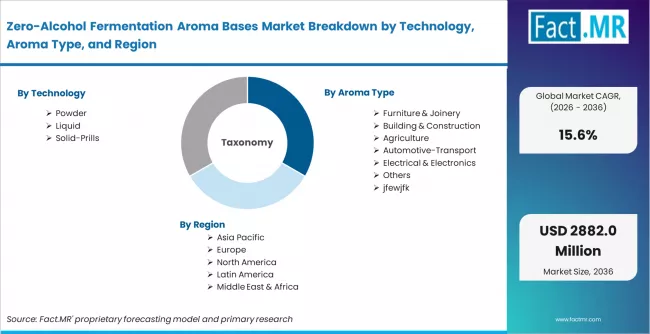
Zero Alcohol Fermentation Aroma Bases Market Breakdown By Technology, Aroma Type, And Region | Source: Fact.MR
| Metric | Value |
|---|---|
| Quantitative Units | USD 585 million (2026) to USD 2,480 million (2036), at a CAGR of 15.6% |
| Market Definition | The zero-alcohol fermentation aroma bases market includes bio-derived aroma compounds produced through fermentation and bioconversion processes to replicate sensory profiles of alcoholic beverages without ethanol content. These aroma systems are used in formulation of alcohol-free beer, wine alternatives, botanical spirits substitutes, and functional beverages requiring authentic flavor complexity and fermentation-derived sensory characteristics. |
| Aroma Type Segmentation | Fruit ester aromas, Botanical fermentation aromas, Malt aromas, Wine-style aromas, Hop aromas |
| Technology Segmentation | Yeast fermentation, Bacterial fermentation, Precision fermentation, Enzymatic bioconversion |
| Application Segmentation | Alcohol-free beer, Alcohol-free wine, Botanical spirits alternatives, Functional beverages, RTD mocktails |
| Regions Covered | North America, Latin America, Europe, East Asia, South Asia, Oceania, Middle East and Africa |
| Countries Covered | United States, Canada, Mexico, Brazil, Argentina, Germany, France, United Kingdom, Italy, Spain, China, India, Japan, South Korea, Indonesia, Australia, and 40+ countries |
| Key Companies Profiled | Givaudan SA, DSM-Firmenich AG, International Flavors & Fragrances Inc., Symrise AG, Kerry Group plc, Takasago International Corporation, Mane SA, Robertet Group, EvodiaBio ApS, Sensient Technologies Corporation |
| Forecast Period | 2026 to 2036 |
| Approach | Hybrid top-down and bottom-up market estimation validated through primary interviews with flavor manufacturers, fermentation technology developers, beverage formulation specialists, and ingredient innovation teams, supported by product pipeline analysis, patent landscape review, and benchmarking of fermentation-derived aroma compound adoption across alcohol-free beverage manufacturing |
Source: Fact.MR analysis. Updated Apr 24, 2026
Zero Alcohol Fermentation Aroma Bases Market Key Segments
-
Aroma Type:
- Fruit Ester Aromas
- Botanical Fermentation Aromas
- Malt Aromas
- Wine Style Aromas
- Hop Aromas
-
Technology:
- Yeast Fermentation
- Bacterial Fermentation
- Precision Fermentation
- Enzymatic Bioconversion
-
Application:
- Alcohol Free Beer
- Alcohol Free Wine
- Botanical Spirits Alternatives
- Functional Beverages
- RTD Mocktails
-
Region:
- North America
- USA
- Canada
- Mexico
- Europe
- Germany
- UK
- France
- Italy
- Spain
- Nordic Countries
- BENELUX
- Rest of Europe
- Asia Pacific
- China
- Japan
- South Korea
- India
- Australia
- Rest of Asia Pacific
- Latin America
- Brazil
- Argentina
- Rest of Latin America
- Middle East and Africa
- Kingdom of Saudi Arabia
- United Arab Emirates
- South Africa
- Rest of Middle East and Africa
- Other Regions
- Oceania
- Central Asia
- Other Markets
- North America
Frequently Asked Questions
How large is the demand for Zero Alcohol Fermentation Aroma Bases in the global market in 2026?
What will be the market size of Zero Alcohol Fermentation Aroma Bases in the global market by 2036?
What is the expected demand growth for Zero Alcohol Fermentation Aroma Bases in the global market between 2026 and 2036?
Which Technology is poised to lead global demand by 2026?
What is Driving Zero Alcohol Fermentation Aroma Base Demand in China?
What is the China Growth Outlook in this Report?
What is Driving Zero Alcohol Fermentation Aroma Base Demand in India?
What is the India Growth Outlook in this Report?
What is Driving Zero Alcohol Fermentation Aroma Base Demand in the United Kingdom?
What is the United Kingdom Growth Outlook in this Report?
What is Driving Zero Alcohol Fermentation Aroma Base Demand in Germany?
What is the Germany Growth Outlook in this Report?
What is Driving Zero Alcohol Fermentation Aroma Base Demand in the United States?
What is the United States Growth Outlook in this Report?
Which Companies are Identified as Leading Participants in the Zero Alcohol Fermentation Aroma Bases Market?
What are Zero Alcohol Fermentation Aroma Bases and What are They Mainly Used For?
What does Zero Alcohol Fermentation Aroma Bases Market Mean in this Report?
What is Included in the Scope of this Zero Alcohol Fermentation Aroma Bases Market Report?
What is Excluded from the Scope of this Report?
What does Market Forecast Mean on this Page?
How is the Zero Alcohol Fermentation Aroma Bases Market Forecast Developed in this Report?
What does Data Validation Approach Mean in this Report?
Who worked on this report


Preview the report firsthand - request a free sample
Free SampleGet the brochure for pricing and purchase details
Download PDF