Prefabricated Rack Pods Market Size, Share, Growth and Forecast (2026 - 2036)
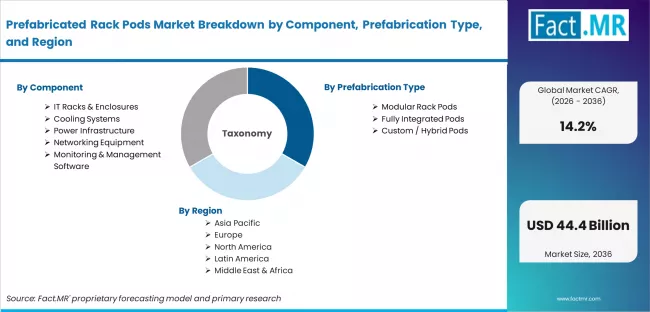
The Prefabricated Rack Pods Market is segmented by Component, Prefabrication Type , Pod Size / Capacity, Deployment Type, Application, Industry Vertical, and Region, with forecasts covering the period from 2026 to 2036.
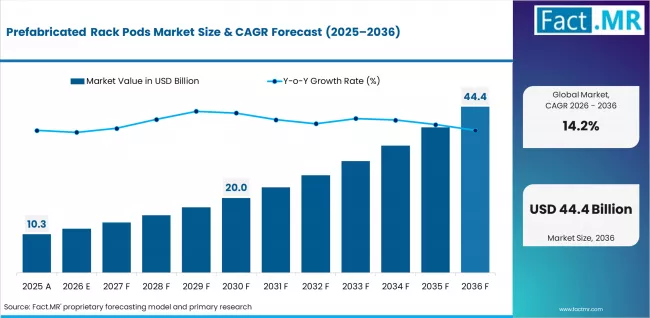
According to Fact.MR estimates, the prefabricated rack pods market stood at USD 10.3 billion in 2025. The market is projected to reach USD 11.9 billion in 2026 and climb to USD 44.4 billion by 2036, progressing at a CAGR of 14.2%. IT racks & enclosures are anticipated to account for nearly 30% share, while data centers (enterprise & colocation) are expected to remain the leading application segment with around 34% share, driven by rapid expansion of hyperscale data centers, increasing cloud adoption, and rising demand for scalable, prefabricated modular infrastructure solutions.
Prefabricated Rack Pods Market Overview, Growth Outlook, and Forecast By Fact.MR
- The Prefabricated Rack Pods market size was valued at USD 10.3 billion in 2025, and it is expected to grow at a CAGR of 14.2% to reach USD 44.4 billion by 2036.
- Expanding at a CAGR of 14.2% during 2026–2036, the market value is projected to grow ~3.8x, creating an absolute opportunity of around USD 32.5 billion in 2036 from 2026.
Summary of the Prefabricated Rack Pods Market
- Demand and Growth Drivers
- The prefabricated rack pods market is expected to grow at a steady rate because there is an increasing requirement for scalable and deployable data center solutions. This is because firms are trying to come up with more effective means of establishing data centers.
- The rising demand to cope with dense computing requirements, artificial intelligence workloads, and cooling systems has resulted in innovative rack pods with cooling and power systems. The growth of cloud computing, 5G, and edge computing data centers in various regions such as India, China, and the USA has fueled the demand for prefabricated and modular rack pods.
- The demand for prefabricated rack pods has been boosted by the adoption of mission-critical applications in several industries like healthcare, BFSI, manufacturing, and government.
- Product and Segment View
- IT racks & enclosures lead the component segment with a 30.9% share in 2026, driven by increasing deployment of high-density computing infrastructure and modular data center expansion.
- Cooling systems follow with a 23.2% share, supported by rising demand for advanced thermal management solutions, especially liquid and in-row cooling for AI and HPC workloads.
- Modular rack pods dominate the prefabrication type segment with a 44.9% share, owing to their flexibility, scalability, and widespread adoption across enterprise and colocation data centers.
- Fully integrated pods account for a 35.1% share, driven by growing preference for plug-and-play, factory-integrated solutions that reduce deployment time and operational complexity.
- Medium-sized pods (5–20 racks) lead the pod size segment with a 44.8% share, supported by their optimal balance between scalability and cost-efficiency across most deployments.
- Small pods (<5 racks) hold a 29.9% share, driven by increasing adoption in edge computing, remote locations, and 5G infrastructure.
- Indoor rack pods dominate the deployment type segment with a 66.9% share, driven by strong demand from enterprise data centers and colocation facilities.
- Outdoor/containerized pods account for a 33.1% share, supported by growing adoption in edge computing and remote deployments requiring rapid and flexible infrastructure.
- Geography and Competitive Outlook
- The exponential rise in data centers, cloud, and edge computing along with implementation of 5G network technology is fueling the growth of Asia Pacific region as the fastest growing market in Prefabricated Rack Pod Market. The countries like China and India will experience a lot of growth owing to heavy investments in hyperscale data centers, smart cities and Artificial intelligence and other forms of digital transformation of industry.
- Europe and North America are already mature markets where there is huge utilization of prefabricated and modular data centers in enterprise IT and colocation applications. These markets have seen extensive adoption of high-density rack pods and efficient cooling infrastructures.
- Leading companies in Prefabricated Rack Pod Market are Schneider Electric SE, Vertiv Group Corp, Huawei Technologies Co. Ltd., Dell Technologies Inc., Hewlett Packard Enterprise (HPE), Eaton Corporation plc, ABB Ltd., Rittal GmbH & Co. KG, Cisco Systems, Inc. and IBM Corporation with emphasis on expansion of modular data center and rack pod products.
- Analyst Opinion
- Shambhu Nath Jha, Principal Consultant at Fact.MR, says “The Prefabricated Rack Pods Market is no longer defined solely by traditional data center deployments. Growth is increasingly driven by edge computing expansion, AI-driven workloads, and the shift toward modular, fully integrated infrastructure that enhances scalability, reduces deployment time, and optimizes operational efficiency across diverse industries.
Prefabricated Rack Pods Market— At a Glance
| Attribute | Details |
|---|---|
| Market Value 2025 | USD 10.3 Billion |
| Market Value 2026 | USD 11.9 Billion |
| Market Value 2036 | USD 44.4 Billion |
| Absolute Dollar Opportunity | USD 32.5 Billion |
| Total Growth | 277.3% |
| CAGR | 14.2% |
| Growth Multiple | 3.8x |
| Key Demand Theme | Rising demand for modular data centers, AI & HPC workloads, edge computing expansion, 5G deployment, and need for scalable, high-density, and energy-efficient IT infrastructure |
| Leading End User | IT & Telecom |
| End User Share | 33.2% |
| Leading Component | IT Racks & Enclosures |
| Component Share | 30.9% |
| Leading Prefabrication Type | Modular Rack Pods |
| Prefabrication Share | 44.9% |
| Leading Pod Size / Capacity | Medium (5–20 racks) |
| Pod Size Share | 44.80% |
| Leading Deployment Type | Indoor Rack Pods |
| Deployment Share | 66.90% |
| Leading Application | Data Centers (Enterprise & Colocation) |
| Application Share | 36.90% |
| Key Growth Regions | Asia-Pacific, North America, Europe |
| Key Companies | Schneider Electric SE, Vertiv Group Corp., Huawei Technologies Co., Ltd., Dell Technologies Inc., Hewlett Packard Enterprise (HPE), Eaton Corporation plc, ABB Ltd., Rittal GmbH & Co. KG, Cisco Systems, Inc., IBM Corporation |
| Segmentation by Component | IT Racks & Enclosures, Cooling Systems, Power Infrastructure, Networking Equipment, Monitoring & Management Software |
| Segmentation by Prefabrication Type | Modular Rack Pods, Fully Integrated Pods, Custom / Hybrid Pods |
| Segmentation by Pod Size / Capacity | Small (<5 racks), Medium (5–20 racks), Large (>20 racks) |
| Segmentation by Deployment Type | Indoor Rack Pods, Outdoor / Containerized Pods |
| Segmentation by Application | Data Centers (Enterprise & Colocation), Edge Computing Sites (5G, IoT, Smart Cities), Disaster Recovery / Backup Infrastructure, High-Performance Computing (HPC), Cloud Service Infrastructure |
| Segmentation by Industry Vertical | IT & Telecom, BFSI, Healthcare, Government & Defense, Manufacturing & Industrial, Retail & E-commerce |
| Segmentation by Region | North America, Latin America, Europe, Asia-Pacific, Middle East & Africa |
Key Growth Drivers, Constraints, and Opportunities
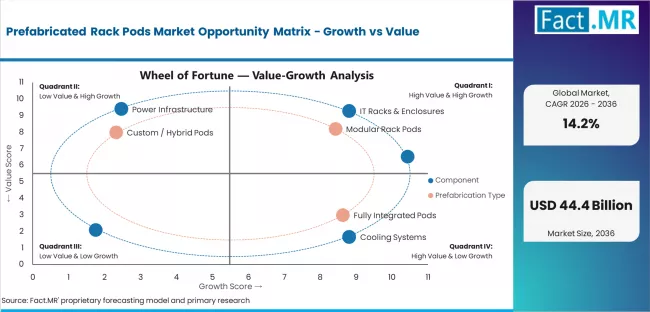
Key Factors Driving Growth
| Growth Driver | Demand Impact | Time Horizon | Key Impact Area | Fact.MR Insight |
|---|---|---|---|---|
| Rapid expansion of data centers, cloud computing, and AI workloads | High | Short–Mid Term | Adoption acceleration | Increasing deployment of hyperscale and high-density computing environments is driving strong demand for scalable, prefabricated rack pod solutions. |
| Rising need for faster deployment, modular infrastructure, and reduced construction timelines | High | Short–Mid Term | Operational efficiency & cost optimization | Enterprises and cloud providers are adopting prefabricated, plug-and-play pods to reduce deployment time, lower CapEx, and improve scalability. |
| Growth of edge computing, 5G networks, and distributed infrastructure | High | Mid Term | Infrastructure decentralization & latency optimization | Increasing demand for low-latency processing is accelerating adoption of compact, containerized rack pods in edge and remote deployments. |
| Advancements in liquid cooling, AI-based monitoring, and integrated pod solutions | Medium-High | Mid–Long Term | Product innovation & performance optimization | Integration of advanced cooling and DCIM technologies is enabling high-density workloads, improving energy efficiency, and enhancing system reliability. |
| Expansion of digital infrastructure and industrial automation in emerging economies | Medium | Short–Mid Term | Regional growth & scalability | Rapid digitalization in Asia-Pacific and Middle East regions is driving demand for modular, scalable, and cost-efficient prefabricated rack pod deployments. |
Key Market Constraints
- The higher upfront cost of modular rack pods, with bundled cooling, power and monitoring solutions, can be a barrier to adoption — especially for small- and medium-sized businesses (SMBs) operating on tight budgets.
- The degree to which retrofit into existing data centre facilities is feasible in terms of compatibility, space and system interoperability can be problematic.
- Changes in the prices of key parts and materials such as cooling systems, power supplies and semiconductors may affect final pricing for solutions and margins of vendors.
- Reliance on data center build cycles and cloud spending as well as telecom infrastructure roll out creates regional demand variability with the result that the market is not experiencing uniform growth around the world.
Key Opportunity Areas
- The adoption of fully integrated, plug and play rack pods with AI based monitoring and DCIM is providing robust oportunidades for advanced intelligent data center infrastructure solutions.
- The pace of digitization and growth of the data center infrastructure in the developing countries like China, India and South East Asia is the major factor driving the demand for scalable and modular rack pod solutions.
- Growing emphasis on energy-efficient designs, liquid cooling, and high-density modular infrastructure is fueling the demand for high-end, next-generation prefabricated rack pod systems.
- The growth of edge computing, hyperscale data centers, AI workloads and 5G networks are expected to drive long term demand for rack pod solutions that are flexible and quick to deploy.
Segment-wise Analysis of the Prefabricated Rack Pods Market
- IT racks & enclosures hold 30.9% of the component segment in 2026, supported by strong demand for high-density computing environments and standardized modular deployments across hyperscale and enterprise data centers.
- Modular rack pods account for 44.9% of the prefabrication type segment in 2026, driven by their flexibility, scalability, and cost-effective deployment across enterprise, colocation, and edge environments.
- Medium-sized pods (5–20 racks) represent 44.8% of the pod size segment in 2026, owing to their optimal balance between capacity, scalability, and cost efficiency, making them suitable for a wide range of applications.
The report presents a detailed study of the Prefabricated Rack Pods Market on the basis of component, prefabrication type, pod size, type of deployment, application, industry vertical, and region. By application, data centers (enterprise & colocation) hold the largest share of 36.9%, owing to robust demand from hyperscale expansion and cloud infrastructure. By industry vertical, the IT & telecom segment is estimated to hold the largest share of 33.2% due to the rapid adoption of cloud computing, 5G networks, and digital transformation initiatives.
Which Component Represents the Dominating Segment in the Prefabricated Rack Pods Market?
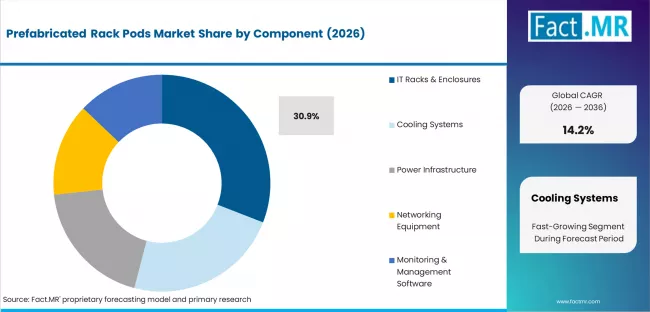
IT racks and enclosures will have the largest share in the component category, capturing 30.9% of the market value by 2026. This increased dominance owes much to the importance of they play in housing high-density computing infrastructure and making it possible to offer standardized, scalable deployments within and between data centers.
Which Prefabrication Type Accounts for the Highest Share in the Market?
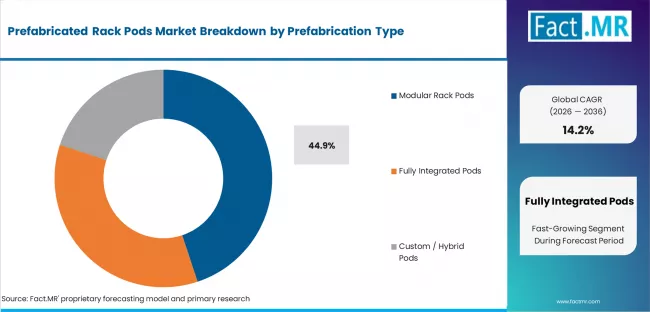
In the prefabrication type segment, the modular rack pods segment is projected to have the largest share of 44.9% in 2026. Their dominance is due to flexibility, ease of deployment, and cost-effective scalability in enterprise, colocation, and edge environments.
Which Pod Size / Capacity Segment Holds the Largest Share?
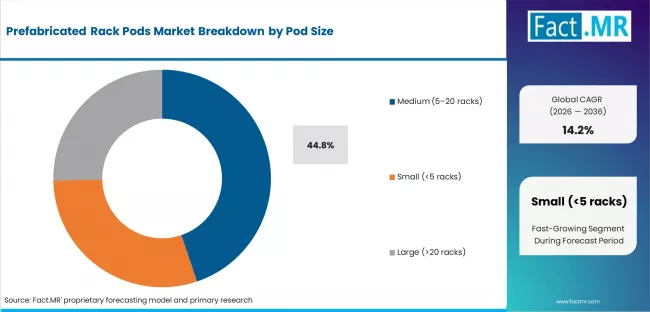
Medium-sized pods (5–20 racks) are the largest segment, catering to 44.8% of the market in 2026. This is because they are the best combination of capacity, scalability and cost effectiveness and they can be used in many different applications.
Which Deployment Type Holds the Largest Share in the Market?
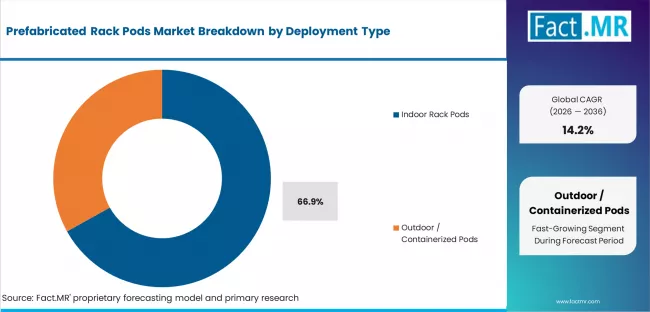
Indoor rack pods have been the leading deployment type segment and is expected to hold 66.9% share by 2026. Their dominance is attributed to their extensive adoption in enterprise and colocation data centers that need controlled environments and a high level of operational reliability.
Which Application Segment Commands the Highest Share in the Market?
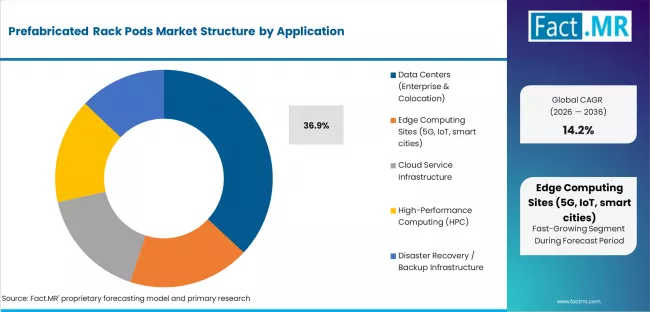
Data centers (enterprise & colocation) hold the largest share, at 36.9% in 2026. Increasing requirements to scale IT in the wake of Cloud Computing, Hyperscale Growth, and Efficiency is the Key Driver.
Which Industry Vertical Emerges as the Leading Segment?
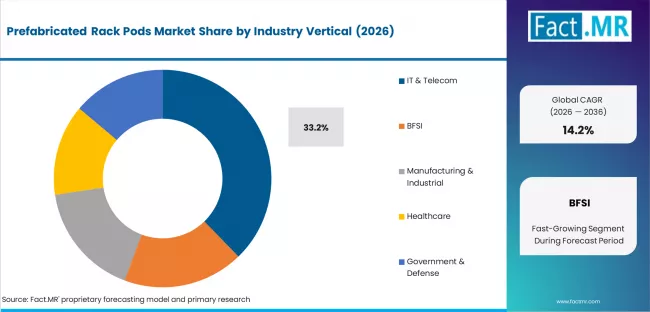
IT & telecom emerges as the leading industry vertical, capturing 33.2% share in 2026. This is fueled by continuous investments in cloud infrastructure, 5G deployment, and digital transformation initiatives globally.
Regional Outlook Across Key Markets
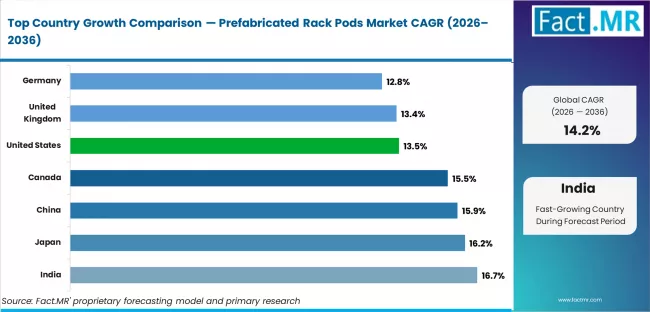
- India is expected to grow at approximately 16.7%, emerging as one of the fastest-growing markets due to rapid expansion of data centers, increasing digitalization, and strong investments in cloud infrastructure, 5G networks, and smart city projects. Government initiatives supporting digital infrastructure and data localization are further driving demand for prefabricated rack pods.
- The United States remains a key market, projected to grow at around 13.5%, supported by the presence of major hyperscale data centers, high cloud adoption, and increasing investments in AI infrastructure and high-density computing environments.
- Asia-Pacific is anticipated to witness the highest growth, with China growing at ~15.9% due to large-scale investments in data centers, 5G deployment, and industrial digitalization. Japan (~16.2%) is also expected to experience strong growth, driven by automation, edge computing, and advanced infrastructure adoption.
- Europe shows steady growth, with Germany (~12.8%) driven by industrial automation and energy-efficient data centers, while the United Kingdom (~13.4%) benefits from increasing investments in digital infrastructure and sustainability initiatives
.webp)
CAGR Table
| Country | CAGR (%) |
|---|---|
| India | 16.7% |
| Japan | 16.2% |
| China | 15.9% |
| Canada | 15.5% |
| United States | 13.5% |
| United Kingdom | 13.4% |
| Germany | 12.8% |
Source: Fact.MR (FMR) analysis, based on proprietary forecasting model and primary research.
North America – The Hyperscale & AI Infrastructure Hub
North America is a mature and technology-rich market where hyperscale data center growth, cloud computing, and increased spending in AI infrastructure are driving demand for Prefabricated Rack Pods. The region focus on high-density, energy-efficient, and modular data center solutions, and the adoption of fully integrated and liquid cooled rack pod is vigorous. Top players including Schneider Electric, Vertiv, Dell Technologies and many more are expanding their modular portfolio.
- U.S.: Expected to grow at ~13.5% CAGR through 2036, driven by hyperscale expansion, AI workloads, and cloud adoption.
- Canada: Growth at ~15.5% CAGR, supported by increasing investments in data centers and telecom infrastructure.
Europe – The Sustainability & Energy-Efficient Infrastructure Market
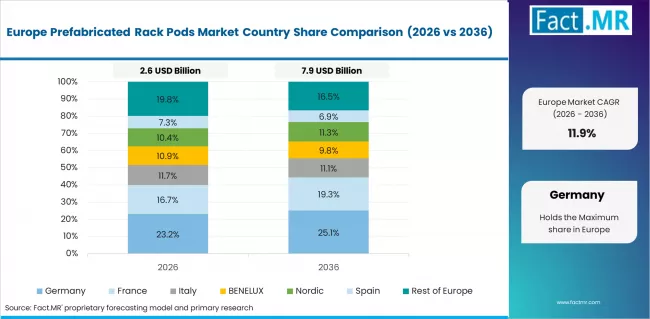
The energy efficiency regulations are stringent in Europe and there is a strong emphasis on green data centers and sustainable infrastructure. The need for modular and energy-efficient and low-carbon solutions is propelling the demand for prefabricated rack pods. A number of regional and global companies are turning their attention to advanced cooling, recyclable products and infrastructure that meets with ESG regulations.
- Germany: Expected to grow at ~12.8% CAGR, supported by industrial digitalization and energy-efficient data center expansion.
- United Kingdom: Growth at ~13.4% CAGR, driven by cloud adoption and sustainability-focused infrastructure upgrades.
Asia-Pacific – The Digital Infrastructure Growth Engine
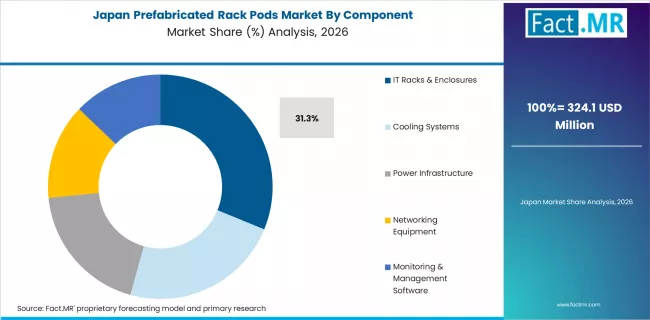
The rapid expansion of data centers, 5G deployment, and digital transformation initiatives drive Asia-Pacific as the fastest-growing market. Countries like China, India, and Japan are witnessing high demand for scalable, modular, and high-density rack pod solutions, especially for edge and cloud solution.
- China: Expected to grow at ~15.9% CAGR, driven by large-scale investments in data centers and telecom networks.
- Japan: Growth at ~16.2% CAGR, supported by advanced technology adoption and edge computing expansion.
- India: Leading growth at ~16.7% CAGR, fueled by cloud growth, smart cities, and rising digital infrastructure investments.
Latin America – The Emerging Data Center Market
Latin America is an emerging market with growing adoption of prefabricated rack pods due to increasing investments in data centers, telecom networks, and enterprise IT infrastructure. Global vendors are expanding their presence through partnerships and regional collaborations.
- Brazil: Expected to witness steady growth through 2036, supported by digital transformation and infrastructure investments.
Middle East & Africa – The Smart City & Connectivity Expansion Zone
Smart city initiatives, rising data center investments, and telecom expansion are some of the factors supporting the growth of the Middle East & Africa region. Governments are concentrating on digitizing their economy rather than diversification of economy, promoting the sales of the modular and quickly deployable rack pod solutions.
- Saudi Arabia (KSA): Growth is expected to remain strong, supported by large-scale smart city projects and digital infrastructure development.
Fact.MR’s analysis of the Prefabricated Rack Pods Market provides a comprehensive regional outlook across North America, Europe, Asia-Pacific, Latin America, and the Middle East & Africa, highlighting country-level trends, infrastructure investments, and technological advancements shaping market growth.
Competitive Benchmarking and Company Positioning
Leading Companies Shaping the Prefabricated Rack Pods Market
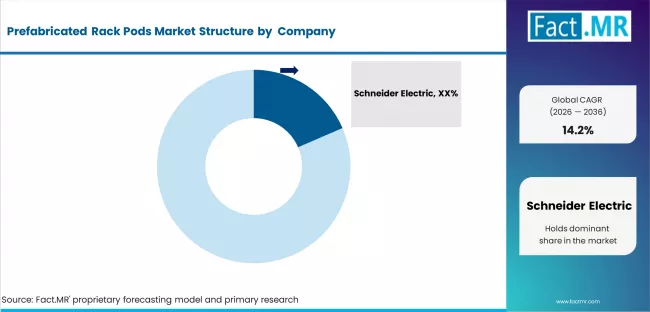
The major manufacturers of Prefabricated Rack Pods Market, such as Schneider Electric SE, Vertiv Group Corp., Huawei Technologies Co., Ltd., Dell Technologies Inc., Hewlett Packard Enterprise (HPE), Eaton Corporation plc, ABB Ltd., and Rittal GmbH & Co. The race is on for speed of deployment, ease of integration, energy efficiency, scalability, and overall TCO.
Strong brand presence, wide distribution network as well as long term relationships with hyperscale, enterprise and telecom customers ensure global data center infrastructure suppliers and IT solution companies can capture the largest market share. Their capacity to provide holistic solutions such as prefabricated modules, power solutions, cooling technologies, and monitoring platforms allow them to enhance consumer retention and simplify large-scale deployments.
Technology-innovative companies and niche providers are investing in high-density rack pod configurations, liquid cooling integration, AI-based monitoring systems, and modular solutions to differentiate themselves. The rising edge computing and AI infrastructure demand increases the competition and demand for innovate compact, energy efficient and fast deployable solutions.
Recent Industry Developments
- Huawei hosts Global Data Center Facility Summit highlighting prefabricated infrastructure (2025)
- Huawei Digital Power showcased next-generation data center solutions at its Global Data Center Facility Summit, including PowerPOD, a prefabricated and containerized power infrastructure system. The solution enables factory pre-integration, faster deployment, and improved energy efficiency, supporting scalable and high-density data center environments. This strengthens Huawei’s position in modular and prefabricated data center infrastructure.
- Vertiv acquires BMarko Structures to expand prefabricated infrastructure capabilities (2026)
- Vertiv announced the acquisition of BMarko Structures, a specialist in modular and prefabricated enclosures. This acquisition enhances Vertiv’s capabilities in delivering prefabricated, factory-built data center infrastructure, including integrated rack, power, and cooling systems. It strengthens Vertiv’s position in scalable and rapidly deployable data center solutions.
- Schneider Electric launches AI-ready prefabricated modular data center solutions (2025)
- Schneider Electric introduced new data center solutions designed for high-density and AI-driven workloads, including prefabricated modular pod architectures under its EcoStruxure platform. These solutions integrate power, cooling, and IT infrastructure, enabling faster deployment, improved efficiency, and scalability in enterprise and hyperscale data centers.
- Vertiv introduces modular liquid cooling infrastructure for high-density compute environments (2026)
- Vertiv launched a new modular liquid cooling infrastructure solution designed to support high-density computing and AI workloads across North America and EMEA. The solution enables prefabricated, scalable deployment of cooling systems integrated with rack infrastructure, improving thermal efficiency and supporting next-generation data center architectures.
- Huawei releases Top 10 Data Center Facility Trends emphasizing modular and prefabricated architecture (2025)
- Huawei Digital Power published its Top 10 Data Center Facility Trends for 2025, highlighting the growing adoption of prefabricated, modular, and high-density data center designs. The report emphasizes containerized deployment, energy efficiency, and intelligent infrastructure as key enablers of next-generation digital infrastructure.
- Huawei accelerates AI data center construction through prefabricated modular solutions (2025)
- Huawei introduced solutions aimed at accelerating AI data center construction using modular and prefabricated infrastructure approaches. These solutions enable rapid deployment, reduced construction timelines, and improved scalability, supporting the growing demand for high-performance computing and AI-driven workloads.
Leading Companies Shaping the Prefabricated Rack Pods Market
- Schneider Electric
- Vertiv
- Huawei
- Dell Technologies
- Hewlett Packard Enterprise
- Eaton
- ABB
- Rittal
- STULZ
- Cannon Technologies
Sources and Research References
- [1] Huawei Digital Power, “Huawei Hosts Global Data Center Facility Summit Showcasing Prefabricated Infrastructure Solutions,” 2025.
- [2] Vertiv Holdings Co., “Vertiv Acquires BMarko Structures to Expand Capacity for Manufactured and Converged Infrastructure Solutions,” 2026.
- [3] Schneider Electric SE, “Schneider Electric Launches New Data Center Solutions to Meet Challenges of High-Density AI and Accelerated Compute Applications,” 2025.
- [4] Vertiv Holdings Co., “Vertiv Introduces New Modular Liquid Cooling Infrastructure Solution to Support High-Density Compute Requirements in North America and EMEA,” 2026.
- [5] Huawei Digital Power, “Powering the Digital Era Forward: Huawei Releases Top Ten Trends of Data Center Facility 2025,” 2025.
- [6] Huawei Technologies Co., Ltd., “Faster AI Data Center Construction with Prefabricated and Modular Solutions,” 2025.
Prefabricated Rack Pods Market Definition
The Prefabricated Rack Pods are modules, which are factory assembled, modular, IT rack-based subsystems combining racks with cooling, power, networking and monitoring for rapid deployment of data center infrastructure. These solutions allow scalable, energy-efficient and space-optimized operations as opposed to the conventional construction. Offered in modular, fully integrated or hybrid pods, they are suitable for indoor and outdoor deployment and small to large capacities. Use Cases include data center, edge computing, HPC, disaster recovery, and cloud infrastructure in industries including IT & telecom, BFSI, healthcare, government, manufacturing, and retail.
Prefabricated Rack Pods Market Inclusions
The report provides an in-depth evaluation of the Prefabricated Rack Pods Market at the global and regional levels, showcasing the market share, key players, and poring over market dynamics along with macroeconomic factors influencing the global market. Component, prefabrication type, pod size, deployment type, application, industry vertical, and geography. The study covers pricing, trends, demand, and adoption for data center, edge computing, cloud, HPC, and disaster recovery. It also features innovations such as modular infrastructure, integrated rack pods, liquid cooling, AI-driven monitoring, and energy-efficient designs; and regional trends that enable scalable, high-density, and fast-racked solutions for data centers serving a broad range of industry sectors.
Prefabricated Rack Pods Market Exclusions
The Prefabricated Rack Pods Market does not include individual IT equipment (servers, storage devices, switches, routers) sold on its own with no integration into prefabricated pods. It excludes conventional, site-built data centers or non-modular solutions. Items such as UPS systems, cooling units, or racks sold individually are not considered components unless they contribute to a complete prefabricated pod solution. Services related to installation, repair, and consulting without ties to hardware are also omitted. Home or small office IT solutions are not in scope, as the research is on commercial, industrial and enterprise scale prefabricated rack pod solutions.
Prefabricated Rack Pods Market Research Methodology
- Primary Research
- Extensive interviews were held with data center operators, cloud providers, telcos, system integrators, OEMs, and enterprise end users within IT and Telecom, BFSI, healthcare, manufacturing, and government to gauge demand, deployment characteristics, pricing, and levels of acceptance for prefabricated rack pod solutions.
- Desk Research
- The market size, trends, and competitive landscape were validated through the analysis of secondary sources such as company annual reports, investor presentations, product catalogs, industry databases, government publications, white papers and data center infrastructure reports.
- Market-Sizing and Forecasting
- Market estimates were derived using a combination of bottom-up analysis (company revenues, product deployments, installed base) and top-down analysis (data center expansion, cloud adoption, AI workloads, and 5G infrastructure growth).
- Data Validation and Update Cycle
- All findings were validated through expert interviews and cross-referenced data sources, with continuous updates based on technological advancements, evolving infrastructure needs, and macroeconomic trends.
Scope of Analysis

Parameter |
Details |
|---|---|
| Quantitative Units | USD 10.3 Billion (2025) to USD 44.4 Billion (2036), at a CAGR of 14.2% |
| Market Definition | The Prefabricated Rack Pods Market comprises modular, factory-built units integrating IT racks, cooling, power infrastructure, networking equipment, and monitoring systems to enable rapid deployment of scalable and energy-efficient data center infrastructure across enterprise, hyperscale, and edge environments. |
| Regions Covered | North America, Europe, Asia-Pacific, Latin America, Middle East & Africa |
| Countries Covered | USA, Canada, UK, Germany, France, China, Japan, India, South Korea, Brazil, Saudi Arabia, UAE, and 20+ countries |
| Key Companies | Schneider Electric SE, Vertiv Group Corp., Huawei Technologies Co., Ltd., Dell Technologies Inc., Hewlett Packard Enterprise (HPE), Eaton Corporation plc, ABB Ltd., Rittal GmbH & Co. KG, Cisco Systems, Inc., and IBM Corporation |
| Forecast Period | 2026 to 2036 |
| Approach | Hybrid demand-side and top-down methodology based on data center expansion, cloud adoption, AI workloads, edge computing growth, telecom infrastructure development, pricing trends, and validation through primary interviews with OEMs, system integrators, data center operators, and enterprise end users across key regions. |
Analysis by Component, Prefabrication Type, Pod Size / Capacity, Deployment Type, Application, Industry Vertical, and Region
-
Prefabricated Rack Pods Market by Component
-
IT Racks & Enclosures
- Open racks
- Enclosed racks
- High-density racks
- Cooling Systems
- In-row cooling
- Rear-door heat exchangers
- Liquid cooling
- Power Infrastructure
- UPS
- PDUs
- Batteries
- Networking Equipment
- Switches
- Routers
- Patch panels
- Monitoring & Management Software
- DCIM (Data Center Infrastructure Management)
- Environmental monitoring
- Remote management
-
-
Prefabricated Rack Pods Market by Prefabrication Type
-
Modular Rack Pods
- Single-rack modules
- Multi-rack scalable pods
- Edge micro-modules
- Fully Integrated Pods
- Pre-tested turnkey systems
- Factory-integrated power + cooling + IT
- Custom / Hybrid Pods
- Client-specific configurations
- Retrofitted modular upgrades
-
-
Prefabricated Rack Pods Market by Pod Size / Capacity
- Small (<5 racks)
- Medium (5–20 racks)
- Large (>20 racks)
-
Prefabricated Rack Pods Market by Deployment Type
-
Indoor Rack Pods
- Raised floor deployments
- Non-raised floor deployments
- Retrofit installations
- Outdoor / Containerized Pods
- ISO container-based pods
- Weatherproof enclosures
- Rugged/harsh environment pods
-
-
Prefabricated Rack Pods Market by Application
- Data Centers (Enterprise & Colocation)
- Edge Computing Sites (5G, IoT, Smart Cities)
- Disaster Recovery / Backup Infrastructure
- High-Performance Computing (HPC)
- Cloud Service Infrastructure
-
Prefabricated Rack Pods Market by Industry Vertical
-
IT & Telecom
- Telecom operators
- Cloud providers
- BFSI
- Banks
- Insurance firms
- Fintech companies
- Healthcare
- Hospitals
- Research labs
- Government & Defense
- Military IT infrastructure
- Smart governance systems
- Manufacturing & Industrial
- Smart factories
- Industrial IoT
- Retail & E-commerce
- Omnichannel platforms
- Warehouse automation systems
-
-
Prefabricated Rack Pods Market by Region
-
North America
- USA
- Canada
- Mexico
- Latin America
- Brazil
- Chile
- Rest of LATAM
- East Asia
- China
- Japan
- South Korea
- Taiwan
- South Asia & Pacific
- India
- Singapore
- Australia
- ASEAN
- Western Europe
- Germany
- France
- U.K.
- Italy
- Spain
- BENELUX
- Nordic
- Rest of W. Europe
- Eastern Europe
- Poland
- Hungary
- Czech Republic
- Balkan & Baltics
- Rest of E. Europe
- Middle East and Africa
- Kingdom of Saudi Arabia
- United Arab Emirates
- South Africa
- Rest of Middle East and Africa
-
- Frequently Asked Questions -
How large is the Prefabricated Rack Pods Market in 2025?
The market is estimated to be valued at USD 10.3 billion in 2025, driven by rapid growth in data centers, cloud computing, and AI infrastructure demand.
What will be the market size by 2036?
The market is projected to reach USD 44.4 billion by 2036, supported by expansion of hyperscale, edge computing, and 5G infrastructure.
What is the expected growth rate of the market?
The market is expected to grow at a CAGR of 14.2% from 2026 to 2036, reflecting strong demand for modular and scalable data center solutions.
Which segment is expected to dominate the market?
Data centers (enterprise & colocation) are expected to dominate with around 36.9% share in 2026, driven by increasing cloud adoption and hyperscale expansion.
Which industry vertical leads the market?
IT & telecom leads the market with approximately 33.2% share in 2026, fueled by growth in cloud infrastructure, 5G deployment, and digital transformation.
Table of Content
- Prefabricated Rack Pods Market - Executive Summary
- Market Overview
- Market Definition and Introduction
- Market Taxonomy/ Research Scope
- Global Prefabricated Rack Pods Market Demand Analysis 2021-2025 and Forecast, 2026–2036
- Historical Market Volume Analysis, 2021-2025
- Current and Future Market Volume Forecast, 2026–2036
- Y-o-Y Growth Trend Analysis
- Global Prefabricated Rack Pods Market - Pricing Analysis
- Product Category and Country-Level Pricing Analysis
- Global Average Pricing Analysis Benchmark
- Factors Influencing Pricing
- Cost Structure Analysis: Elementary Deep Dive
- Competitive Pricing Strategies
- Price Trends and Forecasts
- Historical price trends
- Future price forecasts
- Global Prefabricated Rack Pods Market Demand Analysis 2021-2025 and Forecast, 2026–2036
- Historical Market Value Analysis, 2021-2025
- Current and Future Market Value Forecast, 2026–2036
- Y-o-Y Growth Trend Analysis
- Absolute $ Opportunity Analysis
- Market Background and Foundation Data
- Global Market Outlook and Penetration
- Rapid growth driven by AI, cloud, and data center expansion
- Increasing adoption in hyperscale and edge environments
- Rising share within modular data center market
- Demand Drivers and Consumer Perception
- Preference for fast deployment and scalability
- Reduced CapEx risk and downtime
- Growing trust in prefabricated, plug-and-play systems
- Production and Supply Ecosystem
- Key production regions: North America, Europe, Asia-Pacific
- Expansion of prefabrication facilities by major players
- Integration of rack, cooling, and power systems
- Trade and Supply Chain Dynamics
- Asia-Pacific as major export hub
- Strong demand in U.S. and Europe
- Dependency on steel, electronics, and cooling components
- Investment and Technology Landscape
- High investments in AI and hyperscale data centers
- Growth in liquid cooling and high-density pods
- Focus on energy-efficient and modular solutions
- Start-up Ecosystem and Industry Evolution
- Emerging startups in edge and micro data centers
- Increasing funding in modular infrastructure technologies
- Support from government digital and smart city initiatives.
- Prefabricated Rack Pods Market Opportunity Assessment
- Total Available Market (US$ Bn)
- Serviceable Addressable Market (US$ Bn)
- Serviceable Obtainable Market (US$ Bn)
- Porter’s Five Forces and PESTEL Analysis
- Investment Feasibility Analysis
- Macro-Economic Factors
- Forecast Factors - Relevance & Impact
- Industry Value and Supply Chain Analysis
- List of Key Channel Partners
- Profit Margin & Operating Margin at Each Node of Supply Chain.
- Notes on Value Added at Each Node in the Value Chain
- Factors Influencing Value Chain
- Market Dynamics
- Drivers
- Restraints
- Opportunity Analysis
- Key Regulations & Certifications
- Global Prefabricated Rack Pods Market Analysis 2021-2025 and Forecast 2026–2036, By Component
- Introduction / Key Findings
- Market Size & Volume Analysis by Market Taxonomy, 2021–2036
- IT Racks & Enclosures
- Open racks
- Enclosed racks
- High-density racks
- Cooling Systems
- In-row cooling
- Rear-door heat exchangers
- Liquid cooling
- Power Infrastructure
- UPS
- PDUs
- Batteries
- Networking Equipment
- Switches
- Routers
- Patch panels
- Monitoring & Management Software
- DCIM
- Environmental monitoring
- Remote management
- IT Racks & Enclosures
- Market Attractiveness Analysis by Component
- Global Prefabricated Rack Pods Market Analysis 2021-2025 and Forecast 2026–2036, By Prefabrication Type
- Introduction / Key Findings
- Market Size & Volume Analysis by Market Taxonomy, 2021–2036
- Modular Rack Pods
- Single-rack modules
- Multi-rack scalable pods
- Edge micro-modules
- Fully Integrated Pods
- Pre-tested turnkey systems
- Factory-integrated power + cooling + IT
- Custom / Hybrid Pods
- Client-specific configurations
- Retrofitted modular upgrades
- Modular Rack Pods
- Market Attractiveness Analysis by Prefabrication Type
- Global Prefabricated Rack Pods Market Analysis 2021-2025 and Forecast 2026–2036, By Pod Size / Capacity
- Introduction / Key Findings
- Market Size & Volume Analysis by Market Taxonomy, 2021–2036
- Small (<5 racks)
- Medium (5–20 racks)
- Large (>20 racks)
- Market Attractiveness Analysis by Pod Size / Capacity
- Global Prefabricated Rack Pods Market Analysis 2021-2025 and Forecast 2026–2036, By Deployment Type
- Introduction / Key Findings
- Market Size & Volume Analysis by Market Taxonomy, 2021–2036
- Indoor Rack Pods
- Raised floor deployments
- Non-raised floor deployments
- Retrofit installations
- Outdoor / Containerized Pods
- ISO container-based pods
- Weatherproof enclosures
- Rugged/harsh environment pods
- Indoor Rack Pods
- Market Attractiveness Analysis by Deployment Type
- Global Prefabricated Rack Pods Market Analysis 2021-2025 and Forecast 2026–2036, By Application
- Introduction / Key Findings
- Market Size & Volume Analysis by Market Taxonomy, 2021–2036
- Data Centers (Enterprise & Colocation)
- Edge Computing Sites (5G, IoT, smart cities)
- Disaster Recovery / Backup Infrastructure
- High-Performance Computing (HPC)
- Cloud Service Infrastructure
- Market Attractiveness Analysis by Application
- Global Prefabricated Rack Pods Market Analysis 2021-2025 and Forecast 2026–2036, By Industry Vertical
- Introduction / Key Findings
- Market Size & Volume Analysis by Market Taxonomy, 2021–2036
- IT & Telecom
- Telecom operators
- Cloud providers
- BFSI
- Banks
- Insurance firms
- Fintech companies
- Healthcare
- Hospitals
- Research labs
- Government & Defense
- Military IT infrastructure
- Smart governance systems
- Manufacturing & Industrial
- Smart factories
- Industrial IoT
- Retail & E-commerce
- Omnichannel platforms
- Warehouse automation systems
- IT & Telecom
- Market Attractiveness Analysis by Industry Vertical
- Global Prefabricated Rack Pods Market Analysis and Forecast, by Region
- Introduction / Key Findings
- Market Size & Volume Analysis by Market Taxonomy, 2021–2036
- North America
- Latin America
- Western Europe
- Eastern Europe
- East Asia
- South Asia & Pacific
- Middle East & Africa
- Market Attractiveness Analysis by Region
- North America Prefabricated Rack Pods Market Analysis and Forecast
- Market Size & Volume Analysis by Market Taxonomy, 2021–2036
- By Country
- United States
- Canada
- Mexico
- By Taxonomy
- By Country
- Market Attractiveness Analysis By Country & Taxonomy
- Market Size & Volume Analysis by Market Taxonomy, 2021–2036
- Latin America Prefabricated Rack Pods Market Analysis and Forecast
- Market Size & Volume Analysis by Market Taxonomy, 2021–2036
- By Country
- Brazil
- Chile
- Rest of LATAM
- By Taxonomy
- By Country
- Market Attractiveness Analysis By Country & Taxonomy
- Market Size & Volume Analysis by Market Taxonomy, 2021–2036
- Western Europe Prefabricated Rack Pods Market Analysis and Forecast
- Market Size & Volume Analysis by Market Taxonomy, 2021–2036
- By Country
- Germany
- Italy
- France
- United kingdom
- Spain
- BENELUX
- Nordics
- Rest of Western Europe
- By Taxonomy
- By Country
- Market Attractiveness Analysis By Country & Taxonomy
- Market Size & Volume Analysis by Market Taxonomy, 2021–2036
- Eastern Europe Prefabricated Rack Pods Market Analysis and Forecast
- Market Size & Volume Analysis by Market Taxonomy, 2021–2036
- By Country
- Russia
- Hungary
- Poland
- Balkan & Baltics
- Rest of Eastern Europe
- By Taxonomy
- By Country
- Market Attractiveness Analysis By Country & Taxonomy
- Market Size & Volume Analysis by Market Taxonomy, 2021–2036
- East Asia Prefabricated Rack Pods Market Analysis and Forecast
- Market Size & Volume Analysis by Market Taxonomy, 2021–2036
- By Country
- China
- Japan
- South Korea
- By Taxonomy
- By Country
- Market Attractiveness Analysis By Country & Taxonomy
- Market Size & Volume Analysis by Market Taxonomy, 2021–2036
- South Asia & Pacific Prefabricated Rack Pods Market Analysis and Forecast
- Market Size & Volume Analysis by Market Taxonomy, 2021–2036
- By Country
- India
- ASEAN
- Australia & New Zealand
- Rest of South Asia & Pacific
- By Taxonomy
- By Country
- Market Attractiveness Analysis By Country & Taxonomy
- Market Size & Volume Analysis by Market Taxonomy, 2021–2036
- Middle East & Africa Prefabricated Rack Pods Market Analysis and Forecast
- Market Size & Volume Analysis by Market Taxonomy, 2021–2036
- By Country
- Kingdom of Saudi Arabia
- Other GCC Countries
- Turkiye
- South Africa
- Other African Union
- By Taxonomy
- By Country
- Market Attractiveness Analysis By Country & Taxonomy
- Market Size & Volume Analysis by Market Taxonomy, 2021–2036
- Country-level Prefabricated Rack Pods Market Analysis and Forecast
- Introduction
- Market Value Proportion Analysis, By Key Countries
- Global Vs. Country Growth Comparison
- United States Prefabricated Rack Pods Market Analysis
- Market Size & Volume Analysis by Market Taxonomy, 2021–2036
- By Component
- By Prefabrication Type
- By Pod Size / Capacity
- By Deployment Type
- By Application
- By Industry Vertical
- Market Size & Volume Analysis by Market Taxonomy, 2021–2036
-
- Canada Prefabricated Rack Pods Market Analysis
- Mexico Prefabricated Rack Pods Market Analysis
- Brazil Prefabricated Rack Pods Market Analysis
- Chile Prefabricated Rack Pods Market Analysis
- Germany Prefabricated Rack Pods Market Analysis
- France Prefabricated Rack Pods Market Analysis
- Italy Prefabricated Rack Pods Market Analysis
- Spain Prefabricated Rack Pods Market Analysis
- United Kingdom Prefabricated Rack Pods Market Analysis
- BENELUX Prefabricated Rack Pods Market Analysis
- Nordics Prefabricated Rack Pods Market Analysis
- Poland Prefabricated Rack Pods Market Analysis
- Russia Prefabricated Rack Pods Market Analysis
- Hungary Prefabricated Rack Pods Market Analysis
- Balkan & Baltics Prefabricated Rack Pods Market Analysis
- China Prefabricated Rack Pods Market Analysis
- Japan Prefabricated Rack Pods Market Analysis
- South Korea Prefabricated Rack Pods Market Analysis
- India Prefabricated Rack Pods Market Analysis
- ASEAN Prefabricated Rack Pods Market Analysis
- ANZ Prefabricated Rack Pods Market Analysis
- KSA Prefabricated Rack Pods Market Analysis
- Other GCC Countries Prefabricated Rack Pods Market Analysis
- South Africa Prefabricated Rack Pods Market Analysis
- Turkiye Prefabricated Rack Pods Market Analysis
- Prefabricated Rack Pods Market Structure Analysis
- Market Analysis by Tier of Companies
- Market Share Analysis of Top Players
- Market Space for New Brands and Dollar Opportunity
- Market Presence Analysis
- Regional Footprint of Players
- Product Footprint by Players
- Application Footprint by Players
- Prefabricated Rack Pods Competition Analysis
- Competition Dashboard
- Pricing Analysis by Competition
- Competition Benchmarking
- Competition Deep Dive
- Schneider Electric
- Overview
- Product Portfolio
- Sales Footprint
- Key Developments
- SWOT Analysis
- Strategy Overview
- Key Financials
- Vertiv
- Huawei
- Dell Technologies
- Hewlett Packard Enterprise
- Eaton
- ABB
- Rittal
- STULZ
- Cannon Technologies
- Other Prominent Players
- Schneider Electric
- Primary Insights
- Assumption & Acronyms Used
- Research Methodology & Data Sources
- Introduction
List Of Table
- Table 1: Global Market Value (USD Bn) Forecast by Region, 2021 to 2036
- Table 2: Global Market Volume (Units) Forecast by Region, 2021 to 2036
- Table 3: Global Market Value (USD Bn) Forecast by Component, 2021 to 2036
- Table 4: Global Market Volume (Units) Forecast by Component, 2021 to 2036
- Table 5: Global Market Value (USD Bn) Forecast by Prefabrication Type, 2021 to 2036
- Table 6: Global Market Volume (Units) Forecast by Prefabrication Type, 2021 to 2036
- Table 7: Global Market Value (USD Bn) Forecast by Pod Size / Capacity, 2021 to 2036
- Table 8: Global Market Volume (Units) Forecast by Pod Size / Capacity, 2021 to 2036
- Table 9: Global Market Value (USD Bn) Forecast by Deployment Type, 2021 to 2036
- Table 10: Global Market Volume (Units) Forecast by Deployment Type, 2021 to 2036
- Table 11: Global Market Value (USD Bn) Forecast by Application, 2021 to 2036
- Table 12: Global Market Volume (Units) Forecast by Application, 2021 to 2036
- Table 13: Global Market Value (USD Bn) Forecast by Industry Vertical, 2021 to 2036
- Table 14: Global Market Volume (Units) Forecast by Industry Vertical, 2021 to 2036
- Table 15: North America Market Value (USD Bn) Forecast by Country, 2021 to 2036
- Table 16: North America Market Volume (Units) Forecast by Country, 2021 to 2036
- Table 17: North America Market Value (USD Bn) Forecast by Component, 2021 to 2036
- Table 18: North America Market Volume (Units) Forecast by Component, 2021 to 2036
- Table 19: North America Market Value (USD Bn) Forecast by Prefabrication Type, 2021 to 2036
- Table 20: North America Market Volume (Units) Forecast by Prefabrication Type, 2021 to 2036
- Table 21: North America Market Value (USD Bn) Forecast by Pod Size / Capacity, 2021 to 2036
- Table 22: North America Market Volume (Units) Forecast by Pod Size / Capacity, 2021 to 2036
- Table 23: North America Market Value (USD Bn) Forecast by Deployment Type, 2021 to 2036
- Table 24: North America Market Volume (Units) Forecast by Deployment Type, 2021 to 2036
- Table 25: North America Market Value (USD Bn) Forecast by Application, 2021 to 2036
- Table 26: North America Market Volume (Units) Forecast by Application, 2021 to 2036
- Table 27: North America Market Value (USD Bn) Forecast by Industry Vertical, 2021 to 2036
- Table 28: North America Market Volume (Units) Forecast by Industry Vertical, 2021 to 2036
- Table 29: Latin America Market Value (USD Bn) Forecast by Country, 2021 to 2036
- Table 30: Latin America Market Volume (Units) Forecast by Country, 2021 to 2036
- Table 31: Latin America Market Value (USD Bn) Forecast by Component, 2021 to 2036
- Table 32: Latin America Market Volume (Units) Forecast by Component, 2021 to 2036
- Table 33: Latin America Market Value (USD Bn) Forecast by Prefabrication Type, 2021 to 2036
- Table 34: Latin America Market Volume (Units) Forecast by Prefabrication Type, 2021 to 2036
- Table 35: Latin America Market Value (USD Bn) Forecast by Pod Size / Capacity, 2021 to 2036
- Table 36: Latin America Market Volume (Units) Forecast by Pod Size / Capacity, 2021 to 2036
- Table 37: Latin America Market Value (USD Bn) Forecast by Deployment Type, 2021 to 2036
- Table 38: Latin America Market Volume (Units) Forecast by Deployment Type, 2021 to 2036
- Table 39: Latin America Market Value (USD Bn) Forecast by Application, 2021 to 2036
- Table 40: Latin America Market Volume (Units) Forecast by Application, 2021 to 2036
- Table 41: Latin America Market Value (USD Bn) Forecast by Industry Vertical, 2021 to 2036
- Table 42: Latin America Market Volume (Units) Forecast by Industry Vertical, 2021 to 2036
- Table 43: Western Europe Market Value (USD Bn) Forecast by Country, 2021 to 2036
- Table 44: Western Europe Market Volume (Units) Forecast by Country, 2021 to 2036
- Table 45: Western Europe Market Value (USD Bn) Forecast by Component, 2021 to 2036
- Table 46: Western Europe Market Volume (Units) Forecast by Component, 2021 to 2036
- Table 47: Western Europe Market Value (USD Bn) Forecast by Prefabrication Type, 2021 to 2036
- Table 48: Western Europe Market Volume (Units) Forecast by Prefabrication Type, 2021 to 2036
- Table 49: Western Europe Market Value (USD Bn) Forecast by Pod Size / Capacity, 2021 to 2036
- Table 50: Western Europe Market Volume (Units) Forecast by Pod Size / Capacity, 2021 to 2036
- Table 51: Western Europe Market Value (USD Bn) Forecast by Deployment Type, 2021 to 2036
- Table 52: Western Europe Market Volume (Units) Forecast by Deployment Type, 2021 to 2036
- Table 53: Western Europe Market Value (USD Bn) Forecast by Application, 2021 to 2036
- Table 54: Western Europe Market Volume (Units) Forecast by Application, 2021 to 2036
- Table 55: Western Europe Market Value (USD Bn) Forecast by Industry Vertical, 2021 to 2036
- Table 56: Western Europe Market Volume (Units) Forecast by Industry Vertical, 2021 to 2036
- Table 57: Eastern Europe Market Value (USD Bn) Forecast by Country, 2021 to 2036
- Table 58: Eastern Europe Market Volume (Units) Forecast by Country, 2021 to 2036
- Table 59: Eastern Europe Market Value (USD Bn) Forecast by Component, 2021 to 2036
- Table 60: Eastern Europe Market Volume (Units) Forecast by Component, 2021 to 2036
- Table 61: Eastern Europe Market Value (USD Bn) Forecast by Prefabrication Type, 2021 to 2036
- Table 62: Eastern Europe Market Volume (Units) Forecast by Prefabrication Type, 2021 to 2036
- Table 63: Eastern Europe Market Value (USD Bn) Forecast by Pod Size / Capacity, 2021 to 2036
- Table 64: Eastern Europe Market Volume (Units) Forecast by Pod Size / Capacity, 2021 to 2036
- Table 65: Eastern Europe Market Value (USD Bn) Forecast by Deployment Type, 2021 to 2036
- Table 66: Eastern Europe Market Volume (Units) Forecast by Deployment Type, 2021 to 2036
- Table 67: Eastern Europe Market Value (USD Bn) Forecast by Application, 2021 to 2036
- Table 68: Eastern Europe Market Volume (Units) Forecast by Application, 2021 to 2036
- Table 69: Eastern Europe Market Value (USD Bn) Forecast by Industry Vertical, 2021 to 2036
- Table 70: Eastern Europe Market Volume (Units) Forecast by Industry Vertical, 2021 to 2036
- Table 71: East Asia Market Value (USD Bn) Forecast by Country, 2021 to 2036
- Table 72: East Asia Market Volume (Units) Forecast by Country, 2021 to 2036
- Table 73: East Asia Market Value (USD Bn) Forecast by Component, 2021 to 2036
- Table 74: East Asia Market Volume (Units) Forecast by Component, 2021 to 2036
- Table 75: East Asia Market Value (USD Bn) Forecast by Prefabrication Type, 2021 to 2036
- Table 76: East Asia Market Volume (Units) Forecast by Prefabrication Type, 2021 to 2036
- Table 77: East Asia Market Value (USD Bn) Forecast by Pod Size / Capacity, 2021 to 2036
- Table 78: East Asia Market Volume (Units) Forecast by Pod Size / Capacity, 2021 to 2036
- Table 79: East Asia Market Value (USD Bn) Forecast by Deployment Type, 2021 to 2036
- Table 80: East Asia Market Volume (Units) Forecast by Deployment Type, 2021 to 2036
- Table 81: East Asia Market Value (USD Bn) Forecast by Application, 2021 to 2036
- Table 82: East Asia Market Volume (Units) Forecast by Application, 2021 to 2036
- Table 83: East Asia Market Value (USD Bn) Forecast by Industry Vertical, 2021 to 2036
- Table 84: East Asia Market Volume (Units) Forecast by Industry Vertical, 2021 to 2036
- Table 85: South Asia and Pacific Market Value (USD Bn) Forecast by Country, 2021 to 2036
- Table 86: South Asia and Pacific Market Volume (Units) Forecast by Country, 2021 to 2036
- Table 87: South Asia and Pacific Market Value (USD Bn) Forecast by Component, 2021 to 2036
- Table 88: South Asia and Pacific Market Volume (Units) Forecast by Component, 2021 to 2036
- Table 89: South Asia and Pacific Market Value (USD Bn) Forecast by Prefabrication Type, 2021 to 2036
- Table 90: South Asia and Pacific Market Volume (Units) Forecast by Prefabrication Type, 2021 to 2036
- Table 91: South Asia and Pacific Market Value (USD Bn) Forecast by Pod Size / Capacity, 2021 to 2036
- Table 92: South Asia and Pacific Market Volume (Units) Forecast by Pod Size / Capacity, 2021 to 2036
- Table 93: South Asia and Pacific Market Value (USD Bn) Forecast by Deployment Type, 2021 to 2036
- Table 94: South Asia and Pacific Market Volume (Units) Forecast by Deployment Type, 2021 to 2036
- Table 95: South Asia and Pacific Market Value (USD Bn) Forecast by Application, 2021 to 2036
- Table 96: South Asia and Pacific Market Volume (Units) Forecast by Application, 2021 to 2036
- Table 97: South Asia and Pacific Market Value (USD Bn) Forecast by Industry Vertical, 2021 to 2036
- Table 98: South Asia and Pacific Market Volume (Units) Forecast by Industry Vertical, 2021 to 2036
- Table 99: Middle East & Africa Market Value (USD Bn) Forecast by Country, 2021 to 2036
- Table 100: Middle East & Africa Market Volume (Units) Forecast by Country, 2021 to 2036
- Table 101: Middle East & Africa Market Value (USD Bn) Forecast by Component, 2021 to 2036
- Table 102: Middle East & Africa Market Volume (Units) Forecast by Component, 2021 to 2036
- Table 103: Middle East & Africa Market Value (USD Bn) Forecast by Prefabrication Type, 2021 to 2036
- Table 104: Middle East & Africa Market Volume (Units) Forecast by Prefabrication Type, 2021 to 2036
- Table 105: Middle East & Africa Market Value (USD Bn) Forecast by Pod Size / Capacity, 2021 to 2036
- Table 106: Middle East & Africa Market Volume (Units) Forecast by Pod Size / Capacity, 2021 to 2036
- Table 107: Middle East & Africa Market Value (USD Bn) Forecast by Deployment Type, 2021 to 2036
- Table 108: Middle East & Africa Market Volume (Units) Forecast by Deployment Type, 2021 to 2036
- Table 109: Middle East & Africa Market Value (USD Bn) Forecast by Application, 2021 to 2036
- Table 110: Middle East & Africa Market Volume (Units) Forecast by Application, 2021 to 2036
- Table 111: Middle East & Africa Market Value (USD Bn) Forecast by Industry Vertical, 2021 to 2036
- Table 112: Middle East & Africa Market Volume (Units) Forecast by Industry Vertical, 2021 to 2036
List Of Figures
- Figure 1: Global Market Volume (Units) Forecast 2021–2036
- Figure 2: Global Market Pricing Analysis
- Figure 3: Global Market Value (USD Bn) Forecast 2021–2036
- Figure 4: Global Market Value Share and BPS Analysis by Component, 2026 and 2036
- Figure 5: Global Market Y-o-Y Growth Comparison by Component, 2026 to 2036
- Figure 6: Global Market Attractiveness Analysis by Component
- Figure 7: Global Market Value Share and BPS Analysis by Prefabrication Type, 2026 and 2036
- Figure 8: Global Market Y-o-Y Growth Comparison by Prefabrication Type, 2026 to 2036
- Figure 9: Global Market Attractiveness Analysis by Prefabrication Type
- Figure 10: Global Market Value Share and BPS Analysis by Pod Size / Capacity, 2026 and 2036
- Figure 11: Global Market Y-o-Y Growth Comparison by Pod Size / Capacity, 2026 to 2036
- Figure 12: Global Market Attractiveness Analysis by Pod Size / Capacity
- Figure 13: Global Market Value Share and BPS Analysis by Deployment Type, 2026 and 2036
- Figure 14: Global Market Y-o-Y Growth Comparison by Deployment Type, 2026 to 2036
- Figure 15: Global Market Attractiveness Analysis by Deployment Type
- Figure 16: Global Market Value Share and BPS Analysis by Application, 2026 and 2036
- Figure 17: Global Market Y-o-Y Growth Comparison by Application, 2026 to 2036
- Figure 18: Global Market Attractiveness Analysis by Application
- Figure 19: Global Market Value Share and BPS Analysis by Industry Vertical, 2026 and 2036
- Figure 20: Global Market Y-o-Y Growth Comparison by Industry Vertical, 2026 to 2036
- Figure 21: Global Market Attractiveness Analysis by Industry Vertical
- Figure 22: Global Market Value (USD Bn) Share and BPS Analysis by Region, 2026 and 2036
- Figure 23: Global Market Y-o-Y Growth Comparison by Region, 2026 to 2036
- Figure 24: Global Market Attractiveness Analysis by Region
- Figure 25: North America Market Incremental $ Opportunity, 2026 to 2036
- Figure 26: Latin America Market Incremental $ Opportunity, 2026 to 2036
- Figure 27: Western Europe Market Incremental $ Opportunity, 2026 to 2036
- Figure 28: Eastern Europe Market Incremental $ Opportunity, 2026 to 2036
- Figure 29: East Asia Market Incremental $ Opportunity, 2026 to 2036
- Figure 30: South Asia and Pacific Market Incremental $ Opportunity, 2026 to 2036
- Figure 31: Middle East & Africa Market Incremental $ Opportunity, 2026 to 2036
- Figure 32: North America Market Value Share and BPS Analysis by Country, 2026 and 2036
- Figure 33: North America Market Value Share and BPS Analysis by Component, 2026 and 2036
- Figure 34: North America Market Y-o-Y Growth Comparison by Component, 2026 to 2036
- Figure 35: North America Market Attractiveness Analysis by Component
- Figure 36: North America Market Value Share and BPS Analysis by Prefabrication Type, 2026 and 2036
- Figure 37: North America Market Y-o-Y Growth Comparison by Prefabrication Type, 2026 to 2036
- Figure 38: North America Market Attractiveness Analysis by Prefabrication Type
- Figure 39: North America Market Value Share and BPS Analysis by Pod Size / Capacity, 2026 and 2036
- Figure 40: North America Market Y-o-Y Growth Comparison by Pod Size / Capacity, 2026 to 2036
- Figure 41: North America Market Attractiveness Analysis by Pod Size / Capacity
- Figure 42: North America Market Value Share and BPS Analysis by Deployment Type, 2026 and 2036
- Figure 43: North America Market Y-o-Y Growth Comparison by Deployment Type, 2026 to 2036
- Figure 44: North America Market Attractiveness Analysis by Deployment Type
- Figure 45: North America Market Value Share and BPS Analysis by Application, 2026 and 2036
- Figure 46: North America Market Y-o-Y Growth Comparison by Application, 2026 to 2036
- Figure 47: North America Market Attractiveness Analysis by Application
- Figure 48: North America Market Value Share and BPS Analysis by Industry Vertical, 2026 and 2036
- Figure 49: North America Market Y-o-Y Growth Comparison by Industry Vertical, 2026 to 2036
- Figure 50: North America Market Attractiveness Analysis by Industry Vertical
- Figure 51: Latin America Market Value Share and BPS Analysis by Country, 2026 and 2036
- Figure 52: Latin America Market Value Share and BPS Analysis by Component, 2026 and 2036
- Figure 53: Latin America Market Y-o-Y Growth Comparison by Component, 2026 to 2036
- Figure 54: Latin America Market Attractiveness Analysis by Component
- Figure 55: Latin America Market Value Share and BPS Analysis by Prefabrication Type, 2026 and 2036
- Figure 56: Latin America Market Y-o-Y Growth Comparison by Prefabrication Type, 2026 to 2036
- Figure 57: Latin America Market Attractiveness Analysis by Prefabrication Type
- Figure 58: Latin America Market Value Share and BPS Analysis by Pod Size / Capacity, 2026 and 2036
- Figure 59: Latin America Market Y-o-Y Growth Comparison by Pod Size / Capacity, 2026 to 2036
- Figure 60: Latin America Market Attractiveness Analysis by Pod Size / Capacity
- Figure 61: Latin America Market Value Share and BPS Analysis by Deployment Type, 2026 and 2036
- Figure 62: Latin America Market Y-o-Y Growth Comparison by Deployment Type, 2026 to 2036
- Figure 63: Latin America Market Attractiveness Analysis by Deployment Type
- Figure 64: Latin America Market Value Share and BPS Analysis by Application, 2026 and 2036
- Figure 65: Latin America Market Y-o-Y Growth Comparison by Application, 2026 to 2036
- Figure 66: Latin America Market Attractiveness Analysis by Application
- Figure 67: Latin America Market Value Share and BPS Analysis by Industry Vertical, 2026 and 2036
- Figure 68: Latin America Market Y-o-Y Growth Comparison by Industry Vertical, 2026 to 2036
- Figure 69: Latin America Market Attractiveness Analysis by Industry Vertical
- Figure 70: Western Europe Market Value Share and BPS Analysis by Country, 2026 and 2036
- Figure 71: Western Europe Market Value Share and BPS Analysis by Component, 2026 and 2036
- Figure 72: Western Europe Market Y-o-Y Growth Comparison by Component, 2026 to 2036
- Figure 73: Western Europe Market Attractiveness Analysis by Component
- Figure 74: Western Europe Market Value Share and BPS Analysis by Prefabrication Type, 2026 and 2036
- Figure 75: Western Europe Market Y-o-Y Growth Comparison by Prefabrication Type, 2026 to 2036
- Figure 76: Western Europe Market Attractiveness Analysis by Prefabrication Type
- Figure 77: Western Europe Market Value Share and BPS Analysis by Pod Size / Capacity, 2026 and 2036
- Figure 78: Western Europe Market Y-o-Y Growth Comparison by Pod Size / Capacity, 2026 to 2036
- Figure 79: Western Europe Market Attractiveness Analysis by Pod Size / Capacity
- Figure 80: Western Europe Market Value Share and BPS Analysis by Deployment Type, 2026 and 2036
- Figure 81: Western Europe Market Y-o-Y Growth Comparison by Deployment Type, 2026 to 2036
- Figure 82: Western Europe Market Attractiveness Analysis by Deployment Type
- Figure 83: Western Europe Market Value Share and BPS Analysis by Application, 2026 and 2036
- Figure 84: Western Europe Market Y-o-Y Growth Comparison by Application, 2026 to 2036
- Figure 85: Western Europe Market Attractiveness Analysis by Application
- Figure 86: Western Europe Market Value Share and BPS Analysis by Industry Vertical, 2026 and 2036
- Figure 87: Western Europe Market Y-o-Y Growth Comparison by Industry Vertical, 2026 to 2036
- Figure 88: Western Europe Market Attractiveness Analysis by Industry Vertical
- Figure 89: Eastern Europe Market Value Share and BPS Analysis by Country, 2026 and 2036
- Figure 90: Eastern Europe Market Value Share and BPS Analysis by Component, 2026 and 2036
- Figure 91: Eastern Europe Market Y-o-Y Growth Comparison by Component, 2026 to 2036
- Figure 92: Eastern Europe Market Attractiveness Analysis by Component
- Figure 93: Eastern Europe Market Value Share and BPS Analysis by Prefabrication Type, 2026 and 2036
- Figure 94: Eastern Europe Market Y-o-Y Growth Comparison by Prefabrication Type, 2026 to 2036
- Figure 95: Eastern Europe Market Attractiveness Analysis by Prefabrication Type
- Figure 96: Eastern Europe Market Value Share and BPS Analysis by Pod Size / Capacity, 2026 and 2036
- Figure 97: Eastern Europe Market Y-o-Y Growth Comparison by Pod Size / Capacity, 2026 to 2036
- Figure 98: Eastern Europe Market Attractiveness Analysis by Pod Size / Capacity
- Figure 99: Eastern Europe Market Value Share and BPS Analysis by Deployment Type, 2026 and 2036
- Figure 100: Eastern Europe Market Y-o-Y Growth Comparison by Deployment Type, 2026 to 2036
- Figure 101: Eastern Europe Market Attractiveness Analysis by Deployment Type
- Figure 102: Eastern Europe Market Value Share and BPS Analysis by Application, 2026 and 2036
- Figure 103: Eastern Europe Market Y-o-Y Growth Comparison by Application, 2026 to 2036
- Figure 104: Eastern Europe Market Attractiveness Analysis by Application
- Figure 105: Eastern Europe Market Value Share and BPS Analysis by Industry Vertical, 2026 and 2036
- Figure 106: Eastern Europe Market Y-o-Y Growth Comparison by Industry Vertical, 2026 to 2036
- Figure 107: Eastern Europe Market Attractiveness Analysis by Industry Vertical
- Figure 108: East Asia Market Value Share and BPS Analysis by Country, 2026 and 2036
- Figure 109: East Asia Market Value Share and BPS Analysis by Component, 2026 and 2036
- Figure 110: East Asia Market Y-o-Y Growth Comparison by Component, 2026 to 2036
- Figure 111: East Asia Market Attractiveness Analysis by Component
- Figure 112: East Asia Market Value Share and BPS Analysis by Prefabrication Type, 2026 and 2036
- Figure 113: East Asia Market Y-o-Y Growth Comparison by Prefabrication Type, 2026 to 2036
- Figure 114: East Asia Market Attractiveness Analysis by Prefabrication Type
- Figure 115: East Asia Market Value Share and BPS Analysis by Pod Size / Capacity, 2026 and 2036
- Figure 116: East Asia Market Y-o-Y Growth Comparison by Pod Size / Capacity, 2026 to 2036
- Figure 117: East Asia Market Attractiveness Analysis by Pod Size / Capacity
- Figure 118: East Asia Market Value Share and BPS Analysis by Deployment Type, 2026 and 2036
- Figure 119: East Asia Market Y-o-Y Growth Comparison by Deployment Type, 2026 to 2036
- Figure 120: East Asia Market Attractiveness Analysis by Deployment Type
- Figure 121: East Asia Market Value Share and BPS Analysis by Application, 2026 and 2036
- Figure 122: East Asia Market Y-o-Y Growth Comparison by Application, 2026 to 2036
- Figure 123: East Asia Market Attractiveness Analysis by Application
- Figure 124: East Asia Market Value Share and BPS Analysis by Industry Vertical, 2026 and 2036
- Figure 125: East Asia Market Y-o-Y Growth Comparison by Industry Vertical, 2026 to 2036
- Figure 126: East Asia Market Attractiveness Analysis by Industry Vertical
- Figure 127: South Asia and Pacific Market Value Share and BPS Analysis by Country, 2026 and 2036
- Figure 128: South Asia and Pacific Market Value Share and BPS Analysis by Component, 2026 and 2036
- Figure 129: South Asia and Pacific Market Y-o-Y Growth Comparison by Component, 2026 to 2036
- Figure 130: South Asia and Pacific Market Attractiveness Analysis by Component
- Figure 131: South Asia and Pacific Market Value Share and BPS Analysis by Prefabrication Type, 2026 and 2036
- Figure 132: South Asia and Pacific Market Y-o-Y Growth Comparison by Prefabrication Type, 2026 to 2036
- Figure 133: South Asia and Pacific Market Attractiveness Analysis by Prefabrication Type
- Figure 134: South Asia and Pacific Market Value Share and BPS Analysis by Pod Size / Capacity, 2026 and 2036
- Figure 135: South Asia and Pacific Market Y-o-Y Growth Comparison by Pod Size / Capacity, 2026 to 2036
- Figure 136: South Asia and Pacific Market Attractiveness Analysis by Pod Size / Capacity
- Figure 137: South Asia and Pacific Market Value Share and BPS Analysis by Deployment Type, 2026 and 2036
- Figure 138: South Asia and Pacific Market Y-o-Y Growth Comparison by Deployment Type, 2026 to 2036
- Figure 139: South Asia and Pacific Market Attractiveness Analysis by Deployment Type
- Figure 140: South Asia and Pacific Market Value Share and BPS Analysis by Application, 2026 and 2036
- Figure 141: South Asia and Pacific Market Y-o-Y Growth Comparison by Application, 2026 to 2036
- Figure 142: South Asia and Pacific Market Attractiveness Analysis by Application
- Figure 143: South Asia and Pacific Market Value Share and BPS Analysis by Industry Vertical, 2026 and 2036
- Figure 144: South Asia and Pacific Market Y-o-Y Growth Comparison by Industry Vertical, 2026 to 2036
- Figure 145: South Asia and Pacific Market Attractiveness Analysis by Industry Vertical
- Figure 146: Middle East & Africa Market Value Share and BPS Analysis by Country, 2026 and 2036
- Figure 147: Middle East & Africa Market Value Share and BPS Analysis by Component, 2026 and 2036
- Figure 148: Middle East & Africa Market Y-o-Y Growth Comparison by Component, 2026 to 2036
- Figure 149: Middle East & Africa Market Attractiveness Analysis by Component
- Figure 150: Middle East & Africa Market Value Share and BPS Analysis by Prefabrication Type, 2026 and 2036
- Figure 151: Middle East & Africa Market Y-o-Y Growth Comparison by Prefabrication Type, 2026 to 2036
- Figure 152: Middle East & Africa Market Attractiveness Analysis by Prefabrication Type
- Figure 153: Middle East & Africa Market Value Share and BPS Analysis by Pod Size / Capacity, 2026 and 2036
- Figure 154: Middle East & Africa Market Y-o-Y Growth Comparison by Pod Size / Capacity, 2026 to 2036
- Figure 155: Middle East & Africa Market Attractiveness Analysis by Pod Size / Capacity
- Figure 156: Middle East & Africa Market Value Share and BPS Analysis by Deployment Type, 2026 and 2036
- Figure 157: Middle East & Africa Market Y-o-Y Growth Comparison by Deployment Type, 2026 to 2036
- Figure 158: Middle East & Africa Market Attractiveness Analysis by Deployment Type
- Figure 159: Middle East & Africa Market Value Share and BPS Analysis by Application, 2026 and 2036
- Figure 160: Middle East & Africa Market Y-o-Y Growth Comparison by Application, 2026 to 2036
- Figure 161: Middle East & Africa Market Attractiveness Analysis by Application
- Figure 162: Middle East & Africa Market Value Share and BPS Analysis by Industry Vertical, 2026 and 2036
- Figure 163: Middle East & Africa Market Y-o-Y Growth Comparison by Industry Vertical, 2026 to 2036
- Figure 164: Middle East & Africa Market Attractiveness Analysis by Industry Vertical
- Figure 165: Global Market – Tier Structure Analysis
- Figure 166: Global Market – Company Share Analysis