Rack Fire Suppression Market Size, Share, Growth and Forecast (2026 - 2036)
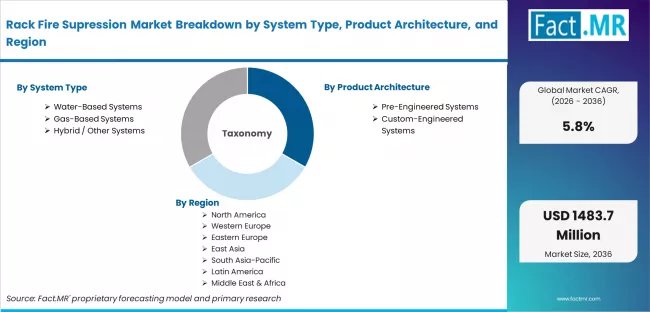
The Rack Fire Suppression Market is segmented by System Type, Product , Suppression Agent, Application, End-Use Industry and Region. Forecast for 2026 to 2036.
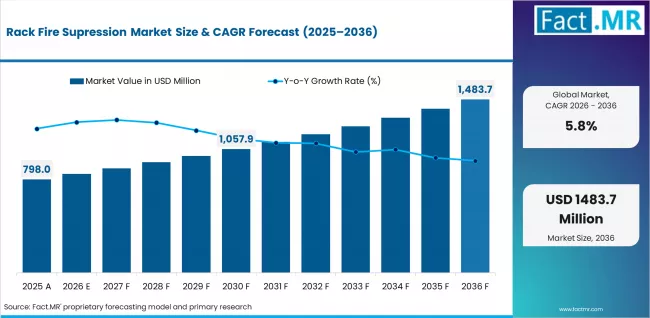
According to Fact.MR estimates, the rack fire suppression market stood at USD 798 million in 2025. The market is projected to reach USD 844.3 million in 2026 and climb to USD 1,483.7 million by 2036, progressing at a CAGR of 5.8%. Water-Based Systems is anticipated to account for nearly 52% share of the system type segment, while Pre-Engineered Systems is expected to remain the leading product architecture with around 61% share, driven by the rapid expansion of data center infrastructure, increasing adoption of warehouse automation and high-density storage systems, and growing demand for advanced, clean-agent and IoT-enabled fire protection solutions across IT, telecom, and industrial sectors.
Rack Fire Suppression Market Overview, Growth Outlook, and Forecast By Fact.MR
Global Rack Fire Suppression Market revenue stood at USD 798 Mn in 2025 and is forecast to reach USD 1,483.7 Mn by 2036. At a 5.8% CAGR from 2026 to 2036, this market is set to expand ~1.8x in value, adding around USD 639 Mn in absolute opportunity.
Summary of Rack Fire Suppression Market
- Demand and Growth Drivers
- Increasing expansion of hyperscale data centers and telecom infrastructure is driving demand for localized fire suppression systems.
- Growing emphasis on business continuity and protection of high-value assets is supporting adoption of advanced fire suppression technologies.
- Rising fire safety regulations and industrial compliance standards are encouraging deployment of automated suppression systems across industries.
- Expansion of warehousing, logistics, and industrial facilities is increasing demand for reliable fire protection solutions.
- Increasing adoption of clean agent systems is improving equipment safety and reducing damage during fire incidents.
- Advancements in detection and suppression technologies are improving system efficiency and response time.
- Product and Segment View
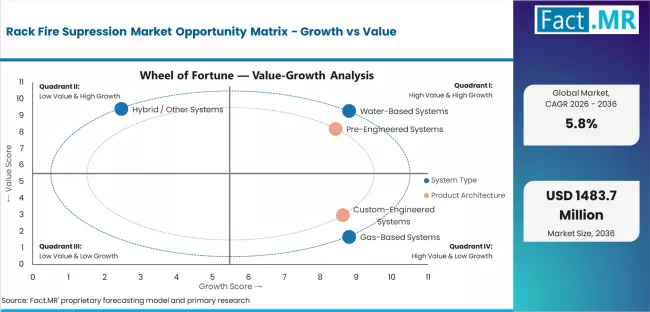
- Water-based systems hold 52% share of system type segment, driven by cost-effectiveness and widespread use across industrial and commercial environments.
- Gas-based systems account for 33% share, supported by increasing adoption of clean agent systems in data centers and telecom facilities.
- Hybrid systems contribute 15% share, reflecting growing integration of multiple suppression technologies.
- Pre-engineered systems dominate with 61% share by product architecture, supported by ease of deployment and standardized configurations.
- Custom-engineered systems account for 39% share, widely used in specialized infrastructure and large-scale installations.
- Clean agents hold 38% share by suppression agent, driven by demand for equipment-safe fire suppression solutions.
- Water-based agents account for 34% share, followed by gas agents at 20% and chemical foam agents at 8%.
- Geography and Competitive Outlook
- North America and Europe represent key markets supported by strong investments in data centers, telecommunications, and industrial infrastructure.
- Asia Pacific is witnessing steady growth driven by industrial expansion and increasing infrastructure investments.
- China and India are emerging as high-growth markets due to expansion of digital infrastructure and manufacturing sectors.
- Market growth is influenced by advancements in intelligent fire detection systems, integration with automated monitoring solutions, and increasing adoption of environmentally safe suppression agents.
- Key companies active in this market include Johnson Controls, Siemens AG, Honeywell International Inc., Minimax Viking, and Fike Corporation.
- Analyst Opinion
- Shambhu Nath Jha, Principal Consultant at Fact.MR, says, “The rack fire suppression market is no longer defined solely by conventional fire protection systems and passive safety mechanisms. Growth is increasingly driven by the rising deployment of high-density data centers and telecom infrastructure, growing emphasis on asset protection and operational continuity, and the shift toward intelligent, automated suppression solutions that enhance response efficiency, minimize equipment damage, and ensure compliance across mission-critical and industrial environments.”
Rack Fire Suppression Market— At a Glance
| Attribute | Details |
|---|---|
| Market Value 2025 | USD 798 Mn |
| Market Value 2036 | USD 1,483.7 Mn |
| Absolute Dollar Opportunity | USD 639 Mn |
| CAGR | 5.8% |
| Growth Multiple | 1.8x |
| Key Demand Theme | Increasing need for fire protection in mission-critical and industrial environments |
| Leading System Type | Water-Based Systems |
| Segment Share | 52% |
| Leading Product Architecture | Pre-Engineered Systems |
| Segment Share | 61% |
| Leading Suppression Agent | Clean Agents |
| Segment Share | 38% |
| Leading Application | Data Centers |
| Segment Share | 42% |
| Leading End-use Industry | IT & Telecom |
| Segment Share | 40% |
| Key Growth Regions | North America, Europe, Asia Pacific |
| Key Companies | Johnson Controls, Siemens, Honeywell, Minimax Viking, Fike |
| Segmentation by System Type | Water-Based Systems, Gas-Based Systems, Hybrid / Other Systems |
| Segmentation by Product Architecture | Pre-Engineered Systems, Custom-Engineered Systems |
| Segmentation by Suppression Agent | Clean Agents, Water-Based Agents, Gas Agents, Chemical Foam Agents |
| Segmentation by Application | Data Centers, Telecommunication Facilities, Warehousing & Logistics, Industrial Facilities, Commercial Infrastructure |
| Segmentation by End-use Industry | IT & Telecom, BFSI, Healthcare, Manufacturing & Industrial, Government & Defense |
| Segmentation by Region | North America, Latin America, Europe, East Asia, South Asia & Pacific, Middle East & Africa |
Is Rack-Level Fire Suppression Worth the ROI in Data Centers?
Rack-level fire suppression ROI is best evaluated as risk mitigation, not cost savings. A typical model uses:
ROI = (Expected Loss Without - Expected Loss With - System Cost) / System Cost.
For hyperscale facilities, downtime costs ($300K–$1M/hour), fire probability (~1%), and equipment loss ($10M+) drive impact. While average-case ROI may appear negative, a single avoided catastrophic event ($50M–$100M loss) can deliver 300%+ ROI. Sensitivity shows ROI improves sharply with higher downtime costs, fire probability, and rack density. Ultimately, these systems act as strategic safeguards against high-impact, low-probability failures.
How Do Regulations and Insurance Drive Rack-Level Fire Suppression Adoption?
Rack-level fire suppression adoption is increasingly compliance-driven. Standards from the National Fire Protection Association including NFPA 13 and NFPA 75 require enhanced protection in high-density storage and data centers. FM Global imposes stricter guidelines, often mandating in-rack or localized suppression for high-risk environments. Insurance providers reinforce this by increasing premiums or limiting coverage for non-compliant facilities, while rewarding compliant systems with better terms. As a result, rack-level suppression is shifting from an optional upgrade to a mandatory, risk-driven investment in modern infrastructure.
Key Growth Drivers, Constraints, and Opportunities
Key Factors Driving Growth
- Fast-growing hyperscale data centers, telecom networks, and high-density industries require fire suppression at the rack level.
- Greater focus on business continuity and asset protection is increasing the deployment of automated and localized fire suppression.
- Growing deployment of clean agent fire suppression systems and advanced intelligent fire suppression systems is expected to boost system performance.
| Growth Driver | Demand Impact | Time Horizon | Key Impact Area | Fact.MR Insight |
|---|---|---|---|---|
| Rapid expansion of data center infrastructure and hyperscale facilities | High | Short-Mid Term | Rack density growth | Increasing deployment of high-density server racks is directly driving demand for localized, rack-level fire suppression solutions |
| Growth of warehouse automation and high-bay storage systems | High | Short-Mid Term | Infrastructure expansion | Rising adoption of AS/RS and e-commerce warehousing is accelerating need for in-rack and targeted fire protection systems |
| Increasing regulatory and insurance compliance requirements | High | Short-Mid Term | Compliance-driven adoption | Stringent NFPA and insurer mandates are pushing facilities toward advanced rack-level suppression to meet safety and coverage standards |
| Advancements in clean agent and IoT-enabled suppression systems | Medium-High | Mid-Long Term | Technology transformation | Smart, clean-agent systems are improving response time and equipment safety, enabling higher adoption in mission-critical environments |
| Rising investments in digital infrastructure across emerging markets | Medium | Short-Mid Term | Regional growth | Expanding data center and industrial infrastructure in Asia-Pacific and other regions is boosting adoption of rack-level fire suppression systems |
Key Market Constraints
- Higher installation and maintenance costs of fire suppression systems may limit their adoption among small-scale facilities.
- Complicated integration process between fire suppression systems and facilities' infrastructure is another limitation to their deployment.
- Different regulations in different regions and environmental considerations related to fire suppression agents may constrain adoption.
Key Opportunity Areas
- Increasing investments in data center infrastructures and the rise of edge data centers and digital ecosystem create demand for fire suppression solutions.
- Greater demand from the retrofit and aftermarket segments to upgrade their fire protection system provides an opportunity for solution providers.
- Technological developments in environmentally friendly suppression agents and IoT-enabled fire suppression systems have enabled the development of advanced fire suppression solutions.
Segment-wise Analysis of the Rack Fire Suppression Market
- By the year 2026, pre-engineered systems account for a 61% market share of the product architecture segment because of the growing use of modular, plug-and-play rack level fire suppression systems that can be easily deployed, scalable, and cost-effective.
- Data centers represent a 42% market share of the application segment by 2026, considering the growing number of hyperscale and colocation facilities, increase in rack density, and requirement of clean agent fire suppression for protecting costly IT infrastructure in such settings.
The segmentation of the rack fire suppression market includes system type, product architecture, suppression agent, application, end-use industry, and region.
Which System Type Dominates the Rack Fire Suppression Market?
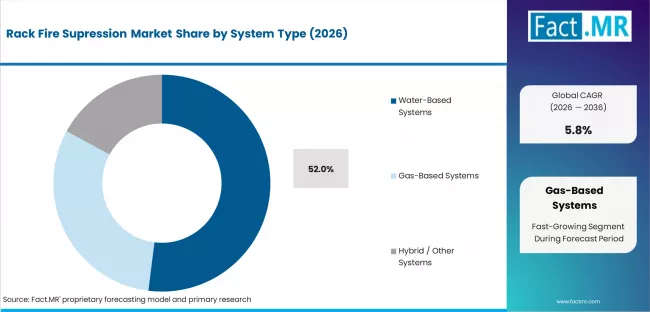
Water-based system technology has the largest segment size with 52% market share in 2026. This is attributed to their cost efficiency and compliance with regulations. Further, these types of system are extensively used in warehouse and industrial rack environments. These systems are suitable for use in areas that require extensive coverage such as high-bay and Automated Storage & Retrieval Systems (AS/RS). On the other hand, gas-based systems will have a 33% share while hybrid/other systems take the remaining 15%. The former's growth will be propelled by its non-damaging characteristics for sensitive equipment. Clean agent innovation notwithstanding, water-based systems remain dominant based on their proven success and scalability.
Which Product Architecture Leads the Rack Fire Suppression Market?
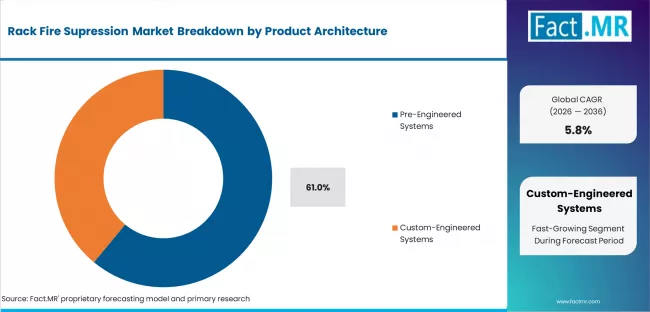
Pre-engineered systems account for 61% of the market in 2026 while custom-engineered systems make up 39%. The growing demand for plug and play fire suppression systems has been responsible for the increasing share held by pre-engineered products. The latter type is favored because it can be installed quickly at low initial costs. In addition, they are more maintainable and therefore suitable for standardized rack applications. However, the increasing trend towards easily scalable and rapidly deployable infrastructure will result in higher share being held by pre-engineered systems.
Which Suppression Agent Segment Holds the Largest Share?
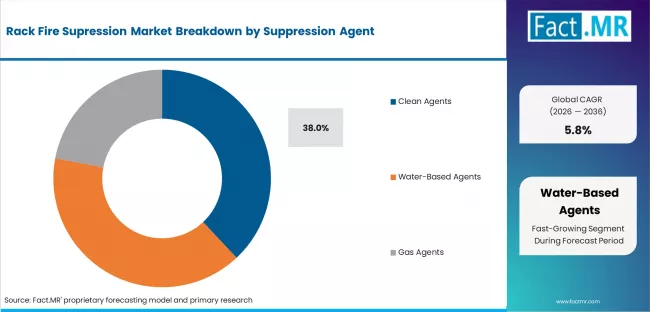
In terms of suppression agent, clean agents represent the most commonly used type with 38% of the market share in 2026. They are preferred because they help to suppress flames without damaging electronic equipment. Water-based products make up 34% while gas-based agents make up 20%. Finally, chemical and foam agents form the remaining 8% of the market. The growing need for equipment safety, continuity of operations and regulatory compliance will drive further adoption of clean agent products.
Which Application Segment Drives the Rack Fire Suppression Market?
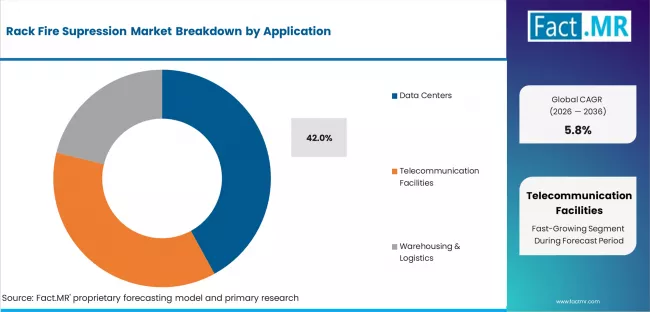
Data centers account for 42% of the market in 2026 owing to the rising number of hyperscale, colocation and edge facilities being created. High density racks and valuable IT infrastructure in these environments makes it necessary to install clean agent fire suppression products. Telecommunication facilities make up 18% followed by warehousing & logistics with 16% share. The latter is propelled by automation and high-bay storage needs. Industrial facilities take 14% of the market share while the remainder of 10% belong to commercial infrastructure.
Which End-Use Industry Accounts for the Largest Share?
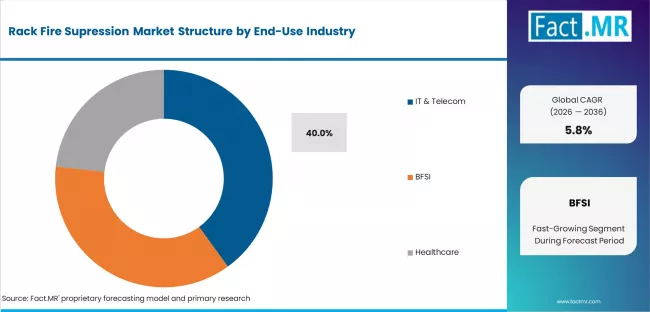
IT & telecommunication dominates the end-use industry segment with 40% market share in 2026. These include data center, cloud computing and telecommunications infrastructures that require advanced rack-level fire suppression. Manufacturing & industrial accounts for 22% followed by BFSI with 14%. Government and defense and healthcare industries each contribute 12% of the market. IT and telecommunications industries dominate in this category due to their reliance on safe rack-level fire suppression technology.
Regional Outlook Across Key Markets
The market analysis covers key global regions, including South Asia and Pacific, Middle East & Africa, North America, Latin America, Western Europe, and Eastern Europe. It is segmented geographically, with specific market dynamics for each region. The full report provides a detailed market attractiveness analysis.
.webp)
CAGR Table
| Country | CAGR (%) |
|---|---|
| Germany | 5.0% |
| Japan | 5.2% |
| U.K. | 5.5% |
| U.S. | 5.8% |
| China | 6.5% |
| India | 7.1% |
| South Korea | 7.4% |
Source: Fact.MR (FMR) analysis, based on proprietary forecasting model and primary research.
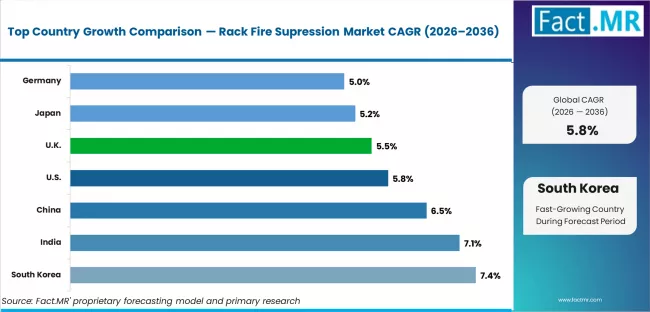
North America – The Compliance-Driven Infrastructure Leader
North America acts as the global compliance and innovation benchmark, driven by stringent fire safety standards and hyperscale data center expansion. Key players such as Honeywell, Johnson Controls, and Carrier Global dominate through integrated fire protection and smart building solutions.
United States
Demand for rack fire suppression systems in the United States is projected to rise at 5.8% CAGR through 2036. Growth is supported by regulatory frameworks such as NFPA updates, including revisions to NFPA 13 (2025), which emphasize enhanced protection in high-density storage. Additionally, hyperscale investments by Amazon Web Services (March 2025) in new data center regions are increasing rack density, driving localized suppression demand [1]. Insurance requirements from FM Global continue to enforce stricter fire protection compliance, further accelerating adoption across both data centers and automated warehouses.
Western Europe – The Regulation-Intensive Safety Market
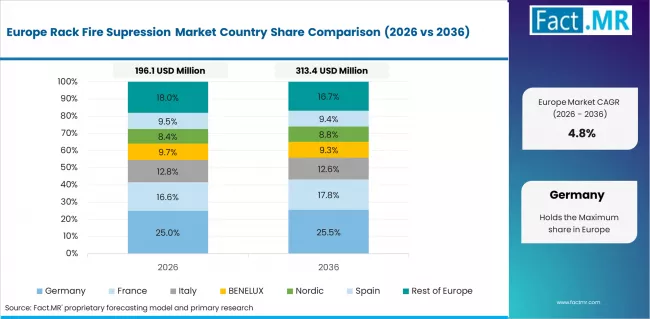
Western Europe functions as the regulatory laboratory, with strong enforcement of fire safety norms and sustainability standards. Companies like Siemens, Bosch, and Schneider Electric lead through integrated building automation and fire safety solutions.
Germany
Demand for rack fire suppression systems in Germany is projected to rise at 5.0% CAGR through 2036. Growth is influenced by strict EN and VdS fire safety standards, with updates by VdS Schadenverhütung (January 2025) reinforcing protection in automated warehouses. Additionally, investments by Deutsche Telekom (April 2025) in data center expansion are increasing demand for clean-agent suppression systems [2]. Germany’s strong industrial base and automation adoption continue to support steady, compliance-driven market growth.
East Asia – The High-Density Digital Expansion Hub
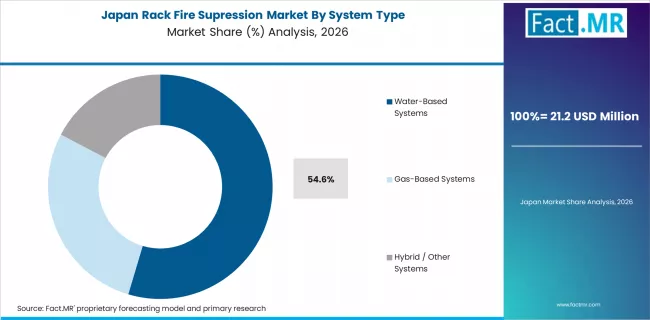
East Asia is the fastest-scaling digital infrastructure hub, characterized by rapid data center expansion and electronics manufacturing. Companies such as Hitachi, Panasonic, and Huawei play key roles in infrastructure and safety systems.
Japan
Demand for rack fire suppression systems in Japan is projected to rise at 5.2% CAGR through 2036. Growth is supported by strict Fire Service Act regulations and updates by Japan’s Fire and Disaster Management Agency (March 2025), emphasizing protection in high-density facilities. Additionally, investments by NTT Communications (April 2025) in data center expansion are increasing adoption of clean-agent suppression systems to protect sensitive IT equipment [3].
South Asia & Pacific – The Emerging Infrastructure Growth Engine
South Asia & Pacific represents the fastest-growing infrastructure market, driven by digitalization and industrial expansion. Regional growth is supported by players like Schneider Electric and ABB expanding their presence.
India
Demand for rack fire suppression systems in India is projected to rise at 7.1% CAGR through 2036. Growth is driven by government initiatives such as the Digital India programme updates (2025) and data center policy incentives across states. Additionally, investments by Adani Enterprises (March 2025) in hyperscale data centers are increasing demand for localized fire protection solutions [4].
Fact.MR analysis indicates that regional growth in the rack fire suppression market is shifting from compliance-led adoption in developed economies to infrastructure-led expansion in emerging regions, with Asia-Pacific and East Asia collectively driving the next phase of high-growth opportunities.
Competitive Benchmarking and Company Positioning
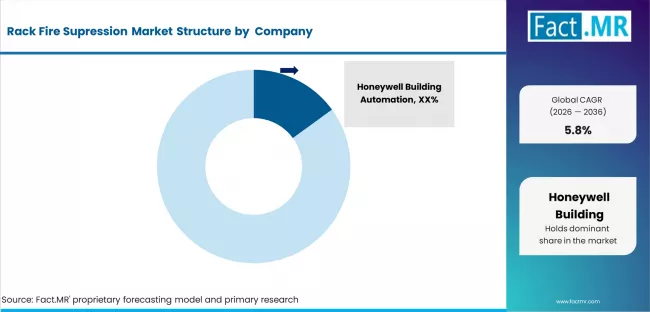
Leading Companies Shaping the Rack Fire Suppression Market
The Rack Fire Suppression Market can be said to be moderately consolidated, dominated by companies such as Illumina, Thermo Fisher, QIAGEN, and Roche, among others that include DNAnexus and Seven Bridges. The competition in the industry does not focus on sequencing per se, but rather on the use of AI for analytics, scalability, and precision. There is an advantage associated with integration owing to complete ecosystems and high levels of customer lock-in. On the other hand, vendors such as BGI and Novogene offer scale-related cost advantages through service provision. Multi-vendor approaches limit the pricing influence of buyers.
Key Players of the Rack Fire Suppression Market
- Honeywell International Inc.
- Johnson Controls
- Siemens Smart Infrastructure
- Schneider Electric
- Carrier
- Emerson
- Delta Electronics
- Vertiv Group Corp
- Eaton Corporation
- Hitachi Vantara, LLC
Recent Industry Developments
- WAGNER Group unveils rack-level fire detection and suppression solutions (June 2025): WAGNER Group introduced its TITANUS RACK·SENS® system designed for server and control cabinets, integrating early smoke detection with localized clean-agent suppression to prevent downtime in data centers and critical environments. [5]
- Johnson Controls launches integrated fire and safety solutions for critical infrastructure (April 2025): Johnson Controls expanded its portfolio with bundled fire prevention and smart building solutions, combining connected suppression systems, AI-enabled monitoring, and integrated safety platforms to enhance resilience in healthcare and commercial facilities. [6]
- Protecfire introduces next-generation fire suppression technology (March 2025): Protecfire showcased its FireSpy Phantom system, designed to meet EN safety standards, highlighting advancements in compact, efficient, and maintenance-free fire suppression solutions for specialized environments. [7]
Sources and Research References
- [1] Amazon Web Services, AWS Announces New Data Center Expansion Initiatives, March 2025
- [2] Deutsche Telekom, Expansion of Data Center Infrastructure in Germany, April 2025
- [3] NTT Communications, Data Center Expansion and Infrastructure Investment Update, April 2025
- [4] Adani Enterprises, Adani Group Expands Hyperscale Data Center Capacity in India, March 2025
- [5] WAGNER Group, Fire Protection Solutions Presented at FeuerTrutz 2025, June 2025
- [6] Johnson Controls, Johnson Controls Launches Industry-Specific Security and Fire Solutions, April 2025
- [7] Protecfire, Latest Developments in Fire Suppression Systems, March 2025
This Report Answers
- How fast is the Rack Fire Suppression Market expected to grow between 2026 and 2036?
- Which system type segment is likely to lead the market by 2026?
- Which application segment is expected to account for the highest demand by 2026?
- What factors are driving demand for rack-level fire suppression solutions globally?
- How is the shift toward clean-agent and IoT-enabled fire suppression systems influencing the market?
- Why is Asia-Pacific emerging as the fastest-growing region for rack fire suppression systems?
- How is the expansion of data centers and warehouse automation supporting market demand?
- Which countries are projected to show the fastest growth through 2036?
- What is driving market expansion in China, India, and South Korea?
- Who are the key companies active in the Rack Fire Suppression Market?
- How does Fact.MR estimate and validate the market forecast for rack fire suppression systems?
Rack Fire Suppression Market Definition
Rack fire suppression is a term used to describe systems that detect and suppress fires in server and storage racks, and other densely populated equipment areas. They employ water, gas or clean agent suppression to rapidly extinguish fires. They are used to safeguard assets and maintain uptime. They are commonly installed in data processing centers, telecommunications facilities, warehouses, industrial sites and other environments where equipment is tightly packed and fire hazards are significant.
Rack Fire Suppression Market Inclusions
This report provides global and regional market estimates and forecasts for rack fire suppression systems through 2036. This report also provides segmentation by type of system, architecture of the product, agent, application, and industry. It also provides insights into installation patterns, technology usage, and system performance. It also offers insights into competition, market drivers, and regional trends in key industries.
Rack Fire Suppression Market Exclusions
The analysis does not cover non-specific building fire protection such as sprinkler systems, portable fire extinguishers, and non-rack specific fire alarm systems. It excludes large industrial fire suppression systems deployed in open spaces and downstream protective equipment not specific to rack protection. The analysis is limited to rack-mounted or enclosed high-density equipment applications.
Rack Fire Suppression Market Research Methodology
- Primary Research
- Interviews with the players in the market such as manufacturers of fire safety systems, operators of data centers, system integrators, and regulators have been performed for collecting primary information on various trends, adoption rates, and technological developments in the industry.
- Desk Research
- In secondary research, company reports, regulatory standards, industry publications, database, and financial statements have been analyzed to corroborate market dynamics and competitive analysis.
- Market-Sizing and Forecasting
- A combination of both top-down and bottom-up approaches has been followed wherein company revenues and industry demand dynamics have been incorporated to determine the market size and its future prospects.
- Data Validation and Update Cycle
- The results have been verified using triangulation techniques by using multiple data points and experts' opinions.
Scope of Report

| Parameter | Details |
|---|---|
| Quantitative Units | USD 798 million in 2025 to USD 1,483.7 million in 2036, at a CAGR of 5.8% |
| Market Definition | The Rack Fire Suppression Market comprises systems designed to detect and suppress fires within storage and server racks, protecting high-density environments such as data centers, warehouses, and industrial facilities from fire risks. |
| Regions Covered | North America, Latin America, Europe, East Asia, South Asia and Pacific, MiddleEastand Africa |
| Countries Covered | USA, Canada, UK, Germany, China, India, 30 plus countries |
| Key Companies | Honeywell International Inc., Johnson Controls, Siemens Smart Infrastructure, Schneider Electric, Carrier, Emerson, Delta Electronics, Vertiv Group Corp, Eaton Corporation, Hitachi Vantara, LLC |
| Forecast Period | 2026 to 2036 |
| Approach | Hybrid demand-side and top-downmethodologybuilt on country-level application demand, product benchmarking, pricing analysis, shipment validation, and primary interviews across manufacturers, distributors, retailers, and end users |
Segment-wise Analysis
-
Rack Fire Suppression Market by System Type
- Water-Based Systems
- Sprinkler-Based Systems
- Water Mist Systems
- Deluge Systems
- Gas-Based Systems
- Clean Agent Systems
- Inert Gas Systems
- CO₂ Systems
- Hybrid / Other Systems
- Foam-Based Systems
- Dry Chemical Systems
- Hybrid Systems
- Condensed Aerosol Systems
- Water-Based Systems
-
Rack Fire Suppression Market by Product Architecture
- Pre-Engineered Systems
- Modular Rack Units
- Plug-and-Play Systems
- Cabinet-Level Systems
- Custom-Engineered Systems
- Facility-Level Rack Integration
- High-Density Rack Solutions
- Zoned Protection Systems
- Pre-Engineered Systems
-
Rack Fire Suppression Market by Suppression Agent
- Clean Agents
- Halocarbon Agents
- Next-Gen Eco Agents
- Water-Based Agents
- Water Mist
- Traditional Water Sprinklers
- Gas Agents
- Inert Gas
- Carbon Dioxide (CO₂)
- Chemical / Foam Agents
- Dry Chemical Powder
- Foam-Based Agents
- Clean Agents
-
Rack Fire Suppression Market by Sequencing Type
- Short-read Sequencing
- Illumina-based pipelines
- High-throughput population genomics
- Long-read Sequencing
- PacBio analysis workflows
- Structural variation analysis
- Very Long-read Sequencing
- Nanopore-based real-time analytics
- Epigenomics & complex genome mapping
- Short-read Sequencing
-
Rack Fire Suppression Market by Application
- Data Centers
- Telecommunication Facilities
- Warehousing & Logistics
- Industrial Facilities
- Commercial Infrastructure
-
Rack Fire Suppression Market by End-Use Industry
- IT & Telecom
- BFSI
- Healthcare
- Manufacturing & Industrial
- Government & Defense
-
Rack Fire Suppression Market by Region
- North America
- USA
- Canada
- Mexico
- Latin America
- Brazil
- Chile
- Rest of LATAM
- East Asia
- China
- Japan
- South Korea
- Western Europe
- Germany
- Italy
- France
- U.K.
- Spain
- BENELUX
- Nordic
- Rest of W. Europe
- Eastern Europe
- Russia
- Hungary
- Poland
- Balkan & Baltics
- Rest of E. Europe
- South Asia & Pacific
- India
- ASEAN
- ANZ
- Rest of SAP
- Middle East and Africa
- Kingdom of Saudi Arabia
- United Arab Emirates
- South Africa
- Rest of Middle East and Africa
- North America
- Frequently Asked Questions -
How large is the demand for Rack Fire Suppression systems in the global market in 2026?
Demand for Rack Fire Suppression systems in the global market is estimated to be valued at USD 844.3 million in 2026.
What will be the market size of Rack Fire Suppression systems in the global market by 2036?
The market size for Rack Fire Suppression systems is projected to reach USD 1,483.7 million by 2036.
What is the expected demand growth for Rack Fire Suppression systems in the global market between 2026 and 2036?
Demand for Rack Fire Suppression systems is expected to grow at a CAGR of 5.8% between 2026 and 2036, driven by increasing fire safety requirements in data centers and industrial storage facilities.
Which system type is expected to dominate the market?
Water-Based Systems are expected to dominate the market, accounting for 52% of the market share in 2026, supported by cost-effectiveness, reliability, and regulatory compliance.
Which country is expected to show the highest growth rate for Rack Fire Suppression systems?
South Korea is projected to show the highest regional CAGR at 7.4%, driven by rapid expansion of data centers and industrial infrastructure.
How significant is the growth outlook for the United States in this market?
The United States is expected to grow at a CAGR of 5.8%, reflecting strong demand from hyperscale data centers and warehouse automation facilities.
Which European market is highlighted in this analysis?
Germany is a key European market, projected to grow at a CAGR of 5.0%, influenced by industrial safety standards and warehouse infrastructure development.
What is the growth outlook for Japan in the Rack Fire Suppression market?
Japan is expected to grow at a CAGR of 5.2%, driven by technological adoption in smart buildings and data center infrastructure.
Which company is identified as a leading player in the Rack Fire Suppression market?
Honeywell International Inc. is recognized as a leading player, offering advanced fire detection and suppression systems for critical infrastructure applications.
Table of Content
- Rack Fire Suppression Market – Executive Summary
- Market Overview
- Market Definition & Introduction
- Market Taxonomy & Research Scope
- Global Rack Fire Suppression Market Demand Analysis 2021-2025 and Forecast, 2026–2036
- Historical Market Volume (Units) Analysis, 2021-2025
- Current and Future Market Volume (Units) Projections, 2026–2036
- Y-o-Y Growth Trend Analysis
- Global Rack Fire Suppression Market - Pricing Analysis
- Product Category and Country-Level Pricing Analysis
- Region Average Pricing Analysis Benchmark
- Price Trends and Forecasts
- Historical price trends
- Future price forecasts
- Factors Influencing Pricing
- Competitive Pricing Strategies
- Cost Structure Analysis
- Global Rack Fire Suppression Market Demand (in Value or Size in US$ Mn) Analysis 2021-2025 and Forecast, 2026–2036
- Historical Market Value (US$ Mn) Analysis, 2021-2025
- Current and Future Market Value (US$ Mn) Projections, 2026–2036
- Y-o-Y Growth Trend Analysis
- Absolute $ Opportunity Analysis
- Market Background and Foundational Data Points
- Installed Base of Rack Infrastructure
- Data Center Capacity Expansion
- Warehouse & Logistics Infrastructure Growth
- Penetration Rate of Rack-Level Fire Suppression
- Regulatory & Compliance Standards
- Fire Incident Rate / Risk Intensity
- Technology Adoption Trends (Clean Agents, IoT Systems)
- End-Use Industry Growth Rates
- Retrofit vs New Installation Ratio
- Regional Infrastructure Investment (CAPEX)
- OEM Production Capacity & Supply Chain Availability
- Trade Scenario, 2025
- Imports and Export Analysis
- By Region
- By Country
- Imports and Export Analysis
- Start-up Ecosystem Analysis, 2021-2025
- Rack Fire Suppression Market Opportunity Assessment
- Total Available Market (US$ Mn)
- Serviceable Addressable Market (US$ Mn)
- Serviceable Obtainable Market (US$ Mn)
- Porter’s Five Forces and PESTEL Analysis
- Investment Feasibility Analysis
- Macro-Economic Factors & Forecast Factors - Relevance & Impact
- Industry Value and Supply Chain Analysis
- List of Key Channel Partners
- Profit Margin & Operating Margin at Each Node of Supply Chain.
- Notes on Value Added at Each Node in the Value Chain
- Factors Influencing Value Chain
- Market Dynamics
- Drivers
- Restraints
- Opportunity Analysis
- Key Regulations & Certifications
- Rack Fire Suppression Market Analysis 2021-2025 and Forecast 2026–2036, By System Type
- Introduction / Key Findings
- Historical Market Size (US$ Mn) & Volume (Units) Trend Analysis By System Type, 2021-2025
- Current and Future Market Size (US$ Mn) & Volume (Units) Analysis and Forecast By System Type, 2026-2036
- Water-Based Systems
- Sprinkler-Based Systems
- Water Mist Systems
- Deluge Systems
- Gas-Based Systems
- Clean Agent Systems
- Inert Gas Systems
- CO₂ Systems
- Hybrid / Other Systems
- Foam-Based Systems
- Dry Chemical Systems
- Hybrid Systems
- Condensed Aerosol Systems
- Water-Based Systems
- Market Attractiveness Analysis By System Type
- Rack Fire Suppression Market Analysis 2021-2025 and Forecast 2026–2036, By Product Architecture
- Introduction / Key Findings
- Historical Market Size (US$ Mn) & Volume (Units) Trend Analysis By Product Architecture, 2021-2025
- Current and Future Market Size (US$ Mn) & Volume (Units) Analysis and Forecast By Product Architecture, 2026-2036
- Pre-Engineered Systems
- Modular Rack Units
- Plug-and-Play Systems
- Cabinet-Level Systems
- Custom-Engineered Systems
- Facility-Level Rack Integration
- High-Density Rack Solutions
- Zoned Protection Systems
- Pre-Engineered Systems
- Market Attractiveness Analysis By Product Architecture
- Rack Fire Suppression Market Analysis 2021-2025 and Forecast 2026–2036, By Suppression Agent
- Introduction / Key Findings
- Historical Market Size (US$ Mn) & Volume (Units) Trend Analysis By Suppression Agent, 2021-2025
- Current and Future Market Size (US$ Mn) & Volume (Units) Analysis and Forecast By Suppression Agent, 2026-2036
- Clean Agents
- Halocarbon Agents
- Next-Gen Eco Agents
- Water-Based Agents
- Water Mist
- Traditional Water Sprinklers
- Gas Agents
- Inert Gas
- Carbon Dioxide (CO₂)
- Chemical / Foam Agents
- Dry Chemical Powder
- Foam-Based Agents
- Clean Agents
- Market Attractiveness Analysis By Suppression Agent
- Rack Fire Suppression Market Analysis 2021-2025 and Forecast 2026–2036, By Application
- Introduction / Key Findings
- Historical Market Size (US$ Mn) & Volume (Units) Trend Analysis By Application, 2021-2025
- Current and Future Market Size (US$ Mn) & Volume (Units) Analysis and Forecast By Application, 2026-2036
- Data Centers
- Telecommunication Facilities
- Warehousing & Logistics
- Industrial Facilities
- Commercial Infrastructure
- Market Attractiveness Analysis By Application
- Rack Fire Suppression Market Analysis 2021-2025 and Forecast 2026–2036, By End-Use Industry
- Introduction / Key Findings
- Historical Market Size (US$ Mn) & Volume (Units) Trend Analysis By End-Use Industry, 2021-2025
- Current and Future Market Size (US$ Mn) & Volume (Units) Analysis and Forecast By End-Use Industry, 2026-2036
- IT & Telecom
- BFSI
- Healthcare
- Manufacturing & Industrial
- Government & Defense
- Market Attractiveness Analysis By End-Use Industry
- Global Rack Fire Suppression Market Analysis and Forecast, by Region
- Introduction / Key Findings
- Historical Market Size (US$ Mn) & Volume (Units) Trend Analysis by Region, 2021-2025
- Current and Future Market Size (US$ Mn) & Volume (Units) Analysis and Forecast by Region, 2026-2036
- North America
- Latin America
- Western Europe
- Eastern Europe
- East Asia
- South Asia & Pacific
- Middle East & Africa
- Market Attractiveness Analysis by Region
- North America Rack Fire Suppression Market Analysis and Forecast
- Introduction / Key Findings
- Pricing Analysis
- Historical Market Size (US$ Mn) & Volume (Units) Trend Analysis by Market Taxonomy, 2021-2025
- Current and Future Market Size (US$ Mn) and Volume (Units) Analysis & Forecast by Market Taxonomy, 2026-2036
- By Country
- United States
- Canada
- Mexico
- By Taxonomy
- Market Attractiveness Analysis By Country & Taxonomy
- Market Trends
- Key Market Participants – Intensity Mapping
- Drivers and Restraints - Impact Analysis
- Latin America Rack Fire Suppression Market Analysis and Forecast
- Introduction / Key Findings
- Pricing Analysis
- Historical Market Size (US$ Mn) & Volume (Units) Trend Analysis by Market Taxonomy, 2021-2025
- Current and Future Market Size (US$ Mn) and Volume (Units) Analysis & Forecast by Market Taxonomy, 2026-2036
- By Country
- Brazil
- Chile
- Rest of LATAM
- By Taxonomy
- Market Attractiveness Analysis By Country & Taxonomy
- Market Trends
- Key Market Participants – Intensity Mapping
- Drivers and Restraints - Impact Analysis
- Western Europe Rack Fire Suppression Market Analysis and Forecast
- Introduction / Key Findings
- Pricing Analysis
- Historical Market Size (US$ Mn) & Volume (Units) Trend Analysis by Market Taxonomy, 2021-2025
- Current and Future Market Size (US$ Mn) and Volume (Units) Analysis & Forecast by Market Taxonomy, 2026-2036
- By Country
- Germany
- Italy
- France
- United Kingdom
- Spain
- BENELUX
- Nordics
- Rest of Western Europe
- By Taxonomy
- Market Attractiveness Analysis By Country & Taxonomy
- Market Trends
- Key Market Participants – Intensity Mapping
- Drivers and Restraints - Impact Analysis
- Eastern Europe Rack Fire Suppression Market Analysis and Forecast
- Introduction / Key Findings
- Pricing Analysis
- Historical Market Size (US$ Mn) & Volume (Units) Trend Analysis by Market Taxonomy, 2021-2025
- Current and Future Market Size (US$ Mn) and Volume (Units) Analysis & Forecast by Market Taxonomy, 2026-2036
- By Country
- Russia
- Hungary
- Poland
- Balkan & Baltics
- Rest of Eastern Europe
- By Taxonomy
- Market Attractiveness Analysis By Country & Taxonomy
- Market Trends
- Key Market Participants – Intensity Mapping
- Drivers and Restraints - Impact Analysis
- East Asia Rack Fire Suppression Market Analysis and Forecast
- Introduction / Key Findings
- Pricing Analysis
- Historical Market Size (US$ Mn) & Volume (Units) Trend Analysis by Market Taxonomy, 2021-2025
- Current and Future Market Size (US$ Mn) and Volume (Units) Analysis & Forecast by Market Taxonomy, 2026-2036
- By Country
- China
- Japan
- South Korea
- By Taxonomy
- Market Attractiveness Analysis By Country & Taxonomy
- Market Trends
- Key Market Participants – Intensity Mapping
- Drivers and Restraints - Impact Analysis
- South Asia & Pacific Rack Fire Suppression Market Analysis and Forecast
- Introduction / Key Findings
- Pricing Analysis
- Historical Market Size (US$ Mn) & Volume (Units) Trend Analysis by Market Taxonomy, 2021-2025
- Current and Future Market Size (US$ Mn) and Volume (Units) Analysis & Forecast by Market Taxonomy, 2026-2036
- By Country
- India
- ASEAN
- Australia & New Zealand
- Rest of South Asia & Pacific
- By Taxonomy
- Market Attractiveness Analysis By Country & Taxonomy
- Market Trends
- Key Market Participants – Intensity Mapping
- Drivers and Restraints - Impact Analysis
- Middle East & Africa Rack Fire Suppression Market Analysis and Forecast
- Introduction / Key Findings
- Pricing Analysis
- Historical Market Size (US$ Mn) & Volume (Units) Trend Analysis by Market Taxonomy, 2021-2025
- Current and Future Market Size (US$ Mn) and Volume (Units) Analysis & Forecast by Market Taxonomy, 2026-2036
- By Country
- Kingdom of Saudi Arabia
- Other GCC Countries
- Turkiye
- South Africa
- Other African Union
- By Taxonomy
- Market Attractiveness Analysis By Country & Taxonomy
- Market Trends
- Key Market Participants – Intensity Mapping
- Drivers and Restraints - Impact Analysis
- Country-level Rack Fire Suppression Market Analysis and Forecast
- Introduction
- Market Value Proportion Analysis, By Key Countries
- Global Vs. Country Growth Comparison
- United States Rack Fire Suppression Market Analysis
- Market Size (US$ Mn) & Volume (Units) Analysis by Market Taxonomy, 2021–2036
- By System Type
- By Product Architecture
- By Suppression Agent
- By Application
- By End-Use Industry
- Same Analysis will be provide for each of the countries mentioned below
- Canada Rack Fire Suppression Market Analysis
- Mexico Rack Fire Suppression Market Analysis
- Brazil Rack Fire Suppression Market Analysis
- Chile Rack Fire Suppression Market Analysis
- Germany Rack Fire Suppression Market Analysis
- France Rack Fire Suppression Market Analysis
- Italy Rack Fire Suppression Market Analysis
- Spain Rack Fire Suppression Market Analysis
- United Kingdom Rack Fire Suppression Market Analysis
- BENELUX Rack Fire Suppression Market Analysis
- Nordics Rack Fire Suppression Market Analysis
- Poland Rack Fire Suppression Market Analysis
- Russia Rack Fire Suppression Market Analysis
- Hungary Rack Fire Suppression Market Analysis
- Balkan & Baltics Rack Fire Suppression Market Analysis
- China Rack Fire Suppression Market Analysis
- Japan Rack Fire Suppression Market Analysis
- South Korea Rack Fire Suppression Market Analysis
- India Rack Fire Suppression Market Analysis
- ASEAN Rack Fire Suppression Market Analysis
- ANZ Rack Fire Suppression Market Analysis
- KSA Rack Fire Suppression Market Analysis
- Other GCC Countries Rack Fire Suppression Market Analysis
- South Africa Rack Fire Suppression Market Analysis
- Turkiye Rack Fire Suppression Market Analysis
- United States Rack Fire Suppression Market Analysis
- Rack Fire Suppression Market Structure Analysis
- Market Analysis by Tier of Companies
- Market Concentration
- Market Share Analysis of Top Players
- Market Space for New Brands and Dollar Opportunity
- Market Presence Analysis
- Regional Footprint of Players
- Product Footprint by Players
- Mobile Optical Pluggable Competition Analysis
- Competition Dashboard
- Pricing Analysis by Competition
- Competition Benchmarking
- Competition Deep Dive
- Honeywell Building Automation
- Overview
- Product Portfolio
- Sales Footprint
- Key Developments
- SWOT Analysis
- Strategy Overview
- Key Financials
- Johnson Controls
- Siemens Smart Infrastructure
- Schneider Electric
- Carrier
- Emerson
- Delta Electronics
- Vertiv Group Corp
- Eaton Corporation
- Hitachi Vantara, LLC
- Other Prominent Players
- Honeywell Building Automation
- Primary insights
- Assumptions & Acronyms Used
- Research Methodology & Data Sources
List Of Table
- Table 1: Global Market Value (USD Mn) Forecast by Region, 2021 to 2036
- Table 2: Global Market Volume (Units) Forecast by Region, 2021 to 2036
- Table 3: Global Market Value (USD Mn) Forecast by System Type, 2021 to 2036
- Table 4: Global Market Volume (Units) Forecast by System Type, 2021 to 2036
- Table 5: Global Market Value (USD Mn) Forecast by Product Architecture, 2021 to 2036
- Table 6: Global Market Volume (Units) Forecast by Product Architecture, 2021 to 2036
- Table 7: Global Market Value (USD Mn) Forecast by Suppression Agent, 2021 to 2036
- Table 8: Global Market Volume (Units) Forecast by Suppression Agent, 2021 to 2036
- Table 9: Global Market Value (USD Mn) Forecast by Application, 2021 to 2036
- Table 10: Global Market Volume (Units) Forecast by Application, 2021 to 2036
- Table 11: Global Market Value (USD Mn) Forecast by End-Use Industry, 2021 to 2036
- Table 12: Global Market Volume (Units) Forecast by End-Use Industry, 2021 to 2036
- Table 13: North America Market Value (USD Mn) Forecast by Country, 2021 to 2036
- Table 14: North America Market Volume (Units) Forecast by Country, 2021 to 2036
- Table 15: North America Market Value (USD Mn) Forecast by System Type, 2021 to 2036
- Table 16: North America Market Volume (Units) Forecast by System Type, 2021 to 2036
- Table 17: North America Market Value (USD Mn) Forecast by Product Architecture, 2021 to 2036
- Table 18: North America Market Volume (Units) Forecast by Product Architecture, 2021 to 2036
- Table 19: North America Market Value (USD Mn) Forecast by Suppression Agent, 2021 to 2036
- Table 20: North America Market Volume (Units) Forecast by Suppression Agent, 2021 to 2036
- Table 21: North America Market Value (USD Mn) Forecast by Application, 2021 to 2036
- Table 22: North America Market Volume (Units) Forecast by Application, 2021 to 2036
- Table 23: North America Market Value (USD Mn) Forecast by End-Use Industry, 2021 to 2036
- Table 24: North America Market Volume (Units) Forecast by End-Use Industry, 2021 to 2036
- Table 25: Latin America Market Value (USD Mn) Forecast by Country, 2021 to 2036
- Table 26: Latin America Market Volume (Units) Forecast by Country, 2021 to 2036
- Table 27: Latin America Market Value (USD Mn) Forecast by System Type, 2021 to 2036
- Table 28: Latin America Market Volume (Units) Forecast by System Type, 2021 to 2036
- Table 29: Latin America Market Value (USD Mn) Forecast by Product Architecture, 2021 to 2036
- Table 30: Latin America Market Volume (Units) Forecast by Product Architecture, 2021 to 2036
- Table 31: Latin America Market Value (USD Mn) Forecast by Suppression Agent, 2021 to 2036
- Table 32: Latin America Market Volume (Units) Forecast by Suppression Agent, 2021 to 2036
- Table 33: Latin America Market Value (USD Mn) Forecast by Application, 2021 to 2036
- Table 34: Latin America Market Volume (Units) Forecast by Application, 2021 to 2036
- Table 35: Latin America Market Value (USD Mn) Forecast by End-Use Industry, 2021 to 2036
- Table 36: Latin America Market Volume (Units) Forecast by End-Use Industry, 2021 to 2036
- Table 37: Western Europe Market Value (USD Mn) Forecast by Country, 2021 to 2036
- Table 38: Western Europe Market Volume (Units) Forecast by Country, 2021 to 2036
- Table 39: Western Europe Market Value (USD Mn) Forecast by System Type, 2021 to 2036
- Table 40: Western Europe Market Volume (Units) Forecast by System Type, 2021 to 2036
- Table 41: Western Europe Market Value (USD Mn) Forecast by Product Architecture, 2021 to 2036
- Table 42: Western Europe Market Volume (Units) Forecast by Product Architecture, 2021 to 2036
- Table 43: Western Europe Market Value (USD Mn) Forecast by Suppression Agent, 2021 to 2036
- Table 44: Western Europe Market Volume (Units) Forecast by Suppression Agent, 2021 to 2036
- Table 45: Western Europe Market Value (USD Mn) Forecast by Application, 2021 to 2036
- Table 46: Western Europe Market Volume (Units) Forecast by Application, 2021 to 2036
- Table 47: Western Europe Market Value (USD Mn) Forecast by End-Use Industry, 2021 to 2036
- Table 48: Western Europe Market Volume (Units) Forecast by End-Use Industry, 2021 to 2036
- Table 49: Eastern Europe Market Value (USD Mn) Forecast by Country, 2021 to 2036
- Table 50: Eastern Europe Market Volume (Units) Forecast by Country, 2021 to 2036
- Table 51: Eastern Europe Market Value (USD Mn) Forecast by System Type, 2021 to 2036
- Table 52: Eastern Europe Market Volume (Units) Forecast by System Type, 2021 to 2036
- Table 53: Eastern Europe Market Value (USD Mn) Forecast by Product Architecture, 2021 to 2036
- Table 54: Eastern Europe Market Volume (Units) Forecast by Product Architecture, 2021 to 2036
- Table 55: Eastern Europe Market Value (USD Mn) Forecast by Suppression Agent, 2021 to 2036
- Table 56: Eastern Europe Market Volume (Units) Forecast by Suppression Agent, 2021 to 2036
- Table 57: Eastern Europe Market Value (USD Mn) Forecast by Application, 2021 to 2036
- Table 58: Eastern Europe Market Volume (Units) Forecast by Application, 2021 to 2036
- Table 59: Eastern Europe Market Value (USD Mn) Forecast by End-Use Industry, 2021 to 2036
- Table 60: Eastern Europe Market Volume (Units) Forecast by End-Use Industry, 2021 to 2036
- Table 61: East Asia Market Value (USD Mn) Forecast by Country, 2021 to 2036
- Table 62: East Asia Market Volume (Units) Forecast by Country, 2021 to 2036
- Table 63: East Asia Market Value (USD Mn) Forecast by System Type, 2021 to 2036
- Table 64: East Asia Market Volume (Units) Forecast by System Type, 2021 to 2036
- Table 65: East Asia Market Value (USD Mn) Forecast by Product Architecture, 2021 to 2036
- Table 66: East Asia Market Volume (Units) Forecast by Product Architecture, 2021 to 2036
- Table 67: East Asia Market Value (USD Mn) Forecast by Suppression Agent, 2021 to 2036
- Table 68: East Asia Market Volume (Units) Forecast by Suppression Agent, 2021 to 2036
- Table 69: East Asia Market Value (USD Mn) Forecast by Application, 2021 to 2036
- Table 70: East Asia Market Volume (Units) Forecast by Application, 2021 to 2036
- Table 71: East Asia Market Value (USD Mn) Forecast by End-Use Industry, 2021 to 2036
- Table 72: East Asia Market Volume (Units) Forecast by End-Use Industry, 2021 to 2036
- Table 73: South Asia and Pacific Market Value (USD Mn) Forecast by Country, 2021 to 2036
- Table 74: South Asia and Pacific Market Volume (Units) Forecast by Country, 2021 to 2036
- Table 75: South Asia and Pacific Market Value (USD Mn) Forecast by System Type, 2021 to 2036
- Table 76: South Asia and Pacific Market Volume (Units) Forecast by System Type, 2021 to 2036
- Table 77: South Asia and Pacific Market Value (USD Mn) Forecast by Product Architecture, 2021 to 2036
- Table 78: South Asia and Pacific Market Volume (Units) Forecast by Product Architecture, 2021 to 2036
- Table 79: South Asia and Pacific Market Value (USD Mn) Forecast by Suppression Agent, 2021 to 2036
- Table 80: South Asia and Pacific Market Volume (Units) Forecast by Suppression Agent, 2021 to 2036
- Table 81: South Asia and Pacific Market Value (USD Mn) Forecast by Application, 2021 to 2036
- Table 82: South Asia and Pacific Market Volume (Units) Forecast by Application, 2021 to 2036
- Table 83: South Asia and Pacific Market Value (USD Mn) Forecast by End-Use Industry, 2021 to 2036
- Table 84: South Asia and Pacific Market Volume (Units) Forecast by End-Use Industry, 2021 to 2036
- Table 85: Middle East & Africa Market Value (USD Mn) Forecast by Country, 2021 to 2036
- Table 86: Middle East & Africa Market Volume (Units) Forecast by Country, 2021 to 2036
- Table 87: Middle East & Africa Market Value (USD Mn) Forecast by System Type, 2021 to 2036
- Table 88: Middle East & Africa Market Volume (Units) Forecast by System Type, 2021 to 2036
- Table 89: Middle East & Africa Market Value (USD Mn) Forecast by Product Architecture, 2021 to 2036
- Table 90: Middle East & Africa Market Volume (Units) Forecast by Product Architecture, 2021 to 2036
- Table 91: Middle East & Africa Market Value (USD Mn) Forecast by Suppression Agent, 2021 to 2036
- Table 92: Middle East & Africa Market Volume (Units) Forecast by Suppression Agent, 2021 to 2036
- Table 93: Middle East & Africa Market Value (USD Mn) Forecast by Application, 2021 to 2036
- Table 94: Middle East & Africa Market Volume (Units) Forecast by Application, 2021 to 2036
- Table 95: Middle East & Africa Market Value (USD Mn) Forecast by End-Use Industry, 2021 to 2036
- Table 96: Middle East & Africa Market Volume (Units) Forecast by End-Use Industry, 2021 to 2036
List Of Figures
- Figure 1: Global Market Volume (Units) Forecast 2021–2036
- Figure 2: Global Market Pricing Analysis
- Figure 3: Global Market Value (USD Mn) Forecast 2021–2036
- Figure 4: Global Market Value Share and BPS Analysis by System Type, 2026 and 2036
- Figure 5: Global Market Y-o-Y Growth Comparison by System Type, 2026 to 2036
- Figure 6: Global Market Attractiveness Analysis by System Type
- Figure 7: Global Market Value Share and BPS Analysis by Product Architecture, 2026 and 2036
- Figure 8: Global Market Y-o-Y Growth Comparison by Product Architecture, 2026 to 2036
- Figure 9: Global Market Attractiveness Analysis by Product Architecture
- Figure 10: Global Market Value Share and BPS Analysis by Suppression Agent, 2026 and 2036
- Figure 11: Global Market Y-o-Y Growth Comparison by Suppression Agent, 2026 to 2036
- Figure 12: Global Market Attractiveness Analysis by Suppression Agent
- Figure 13: Global Market Value Share and BPS Analysis by Application, 2026 and 2036
- Figure 14: Global Market Y-o-Y Growth Comparison by Application, 2026 to 2036
- Figure 15: Global Market Attractiveness Analysis by Application
- Figure 16: Global Market Value Share and BPS Analysis by End-Use Industry, 2026 and 2036
- Figure 17: Global Market Y-o-Y Growth Comparison by End-Use Industry, 2026 to 2036
- Figure 18: Global Market Attractiveness Analysis by End-Use Industry
- Figure 19: Global Market Value (USD Mn) Share and BPS Analysis by Region, 2026 and 2036
- Figure 20: Global Market Y-o-Y Growth Comparison by Region, 2026 to 2036
- Figure 21: Global Market Attractiveness Analysis by Region
- Figure 22: North America Market Incremental $ Opportunity, 2026 to 2036
- Figure 23: Latin America Market Incremental $ Opportunity, 2026 to 2036
- Figure 24: Western Europe Market Incremental $ Opportunity, 2026 to 2036
- Figure 25: Eastern Europe Market Incremental $ Opportunity, 2026 to 2036
- Figure 26: East Asia Market Incremental $ Opportunity, 2026 to 2036
- Figure 27: South Asia and Pacific Market Incremental $ Opportunity, 2026 to 2036
- Figure 28: Middle East & Africa Market Incremental $ Opportunity, 2026 to 2036
- Figure 29: North America Market Value Share and BPS Analysis by Country, 2026 and 2036
- Figure 30: North America Market Value Share and BPS Analysis by System Type, 2026 and 2036
- Figure 31: North America Market Y-o-Y Growth Comparison by System Type, 2026 to 2036
- Figure 32: North America Market Attractiveness Analysis by System Type
- Figure 33: North America Market Value Share and BPS Analysis by Product Architecture, 2026 and 2036
- Figure 34: North America Market Y-o-Y Growth Comparison by Product Architecture, 2026 to 2036
- Figure 35: North America Market Attractiveness Analysis by Product Architecture
- Figure 36: North America Market Value Share and BPS Analysis by Suppression Agent, 2026 and 2036
- Figure 37: North America Market Y-o-Y Growth Comparison by Suppression Agent, 2026 to 2036
- Figure 38: North America Market Attractiveness Analysis by Suppression Agent
- Figure 39: North America Market Value Share and BPS Analysis by Application, 2026 and 2036
- Figure 40: North America Market Y-o-Y Growth Comparison by Application, 2026 to 2036
- Figure 41: North America Market Attractiveness Analysis by Application
- Figure 42: North America Market Value Share and BPS Analysis by End-Use Industry, 2026 and 2036
- Figure 43: North America Market Y-o-Y Growth Comparison by End-Use Industry, 2026 to 2036
- Figure 44: North America Market Attractiveness Analysis by End-Use Industry
- Figure 45: Latin America Market Value Share and BPS Analysis by Country, 2026 and 2036
- Figure 46: Latin America Market Value Share and BPS Analysis by System Type, 2026 and 2036
- Figure 47: Latin America Market Y-o-Y Growth Comparison by System Type, 2026 to 2036
- Figure 48: Latin America Market Attractiveness Analysis by System Type
- Figure 49: Latin America Market Value Share and BPS Analysis by Product Architecture, 2026 and 2036
- Figure 50: Latin America Market Y-o-Y Growth Comparison by Product Architecture, 2026 to 2036
- Figure 51: Latin America Market Attractiveness Analysis by Product Architecture
- Figure 52: Latin America Market Value Share and BPS Analysis by Suppression Agent, 2026 and 2036
- Figure 53: Latin America Market Y-o-Y Growth Comparison by Suppression Agent, 2026 to 2036
- Figure 54: Latin America Market Attractiveness Analysis by Suppression Agent
- Figure 55: Latin America Market Value Share and BPS Analysis by Application, 2026 and 2036
- Figure 56: Latin America Market Y-o-Y Growth Comparison by Application, 2026 to 2036
- Figure 57: Latin America Market Attractiveness Analysis by Application
- Figure 58: Latin America Market Value Share and BPS Analysis by End-Use Industry, 2026 and 2036
- Figure 59: Latin America Market Y-o-Y Growth Comparison by End-Use Industry, 2026 to 2036
- Figure 60: Latin America Market Attractiveness Analysis by End-Use Industry
- Figure 61: Western Europe Market Value Share and BPS Analysis by Country, 2026 and 2036
- Figure 62: Western Europe Market Value Share and BPS Analysis by System Type, 2026 and 2036
- Figure 63: Western Europe Market Y-o-Y Growth Comparison by System Type, 2026 to 2036
- Figure 64: Western Europe Market Attractiveness Analysis by System Type
- Figure 65: Western Europe Market Value Share and BPS Analysis by Product Architecture, 2026 and 2036
- Figure 66: Western Europe Market Y-o-Y Growth Comparison by Product Architecture, 2026 to 2036
- Figure 67: Western Europe Market Attractiveness Analysis by Product Architecture
- Figure 68: Western Europe Market Value Share and BPS Analysis by Suppression Agent, 2026 and 2036
- Figure 69: Western Europe Market Y-o-Y Growth Comparison by Suppression Agent, 2026 to 2036
- Figure 70: Western Europe Market Attractiveness Analysis by Suppression Agent
- Figure 71: Western Europe Market Value Share and BPS Analysis by Application, 2026 and 2036
- Figure 72: Western Europe Market Y-o-Y Growth Comparison by Application, 2026 to 2036
- Figure 73: Western Europe Market Attractiveness Analysis by Application
- Figure 74: Western Europe Market Value Share and BPS Analysis by End-Use Industry, 2026 and 2036
- Figure 75: Western Europe Market Y-o-Y Growth Comparison by End-Use Industry, 2026 to 2036
- Figure 76: Western Europe Market Attractiveness Analysis by End-Use Industry
- Figure 77: Eastern Europe Market Value Share and BPS Analysis by Country, 2026 and 2036
- Figure 78: Eastern Europe Market Value Share and BPS Analysis by System Type, 2026 and 2036
- Figure 79: Eastern Europe Market Y-o-Y Growth Comparison by System Type, 2026 to 2036
- Figure 80: Eastern Europe Market Attractiveness Analysis by System Type
- Figure 81: Eastern Europe Market Value Share and BPS Analysis by Product Architecture, 2026 and 2036
- Figure 82: Eastern Europe Market Y-o-Y Growth Comparison by Product Architecture, 2026 to 2036
- Figure 83: Eastern Europe Market Attractiveness Analysis by Product Architecture
- Figure 84: Eastern Europe Market Value Share and BPS Analysis by Suppression Agent, 2026 and 2036
- Figure 85: Eastern Europe Market Y-o-Y Growth Comparison by Suppression Agent, 2026 to 2036
- Figure 86: Eastern Europe Market Attractiveness Analysis by Suppression Agent
- Figure 87: Eastern Europe Market Value Share and BPS Analysis by Application, 2026 and 2036
- Figure 88: Eastern Europe Market Y-o-Y Growth Comparison by Application, 2026 to 2036
- Figure 89: Eastern Europe Market Attractiveness Analysis by Application
- Figure 90: Eastern Europe Market Value Share and BPS Analysis by End-Use Industry, 2026 and 2036
- Figure 91: Eastern Europe Market Y-o-Y Growth Comparison by End-Use Industry, 2026 to 2036
- Figure 92: Eastern Europe Market Attractiveness Analysis by End-Use Industry
- Figure 93: East Asia Market Value Share and BPS Analysis by Country, 2026 and 2036
- Figure 94: East Asia Market Value Share and BPS Analysis by System Type, 2026 and 2036
- Figure 95: East Asia Market Y-o-Y Growth Comparison by System Type, 2026 to 2036
- Figure 96: East Asia Market Attractiveness Analysis by System Type
- Figure 97: East Asia Market Value Share and BPS Analysis by Product Architecture, 2026 and 2036
- Figure 98: East Asia Market Y-o-Y Growth Comparison by Product Architecture, 2026 to 2036
- Figure 99: East Asia Market Attractiveness Analysis by Product Architecture
- Figure 100: East Asia Market Value Share and BPS Analysis by Suppression Agent, 2026 and 2036
- Figure 101: East Asia Market Y-o-Y Growth Comparison by Suppression Agent, 2026 to 2036
- Figure 102: East Asia Market Attractiveness Analysis by Suppression Agent
- Figure 103: East Asia Market Value Share and BPS Analysis by Application, 2026 and 2036
- Figure 104: East Asia Market Y-o-Y Growth Comparison by Application, 2026 to 2036
- Figure 105: East Asia Market Attractiveness Analysis by Application
- Figure 106: East Asia Market Value Share and BPS Analysis by End-Use Industry, 2026 and 2036
- Figure 107: East Asia Market Y-o-Y Growth Comparison by End-Use Industry, 2026 to 2036
- Figure 108: East Asia Market Attractiveness Analysis by End-Use Industry
- Figure 109: South Asia and Pacific Market Value Share and BPS Analysis by Country, 2026 and 2036
- Figure 110: South Asia and Pacific Market Value Share and BPS Analysis by System Type, 2026 and 2036
- Figure 111: South Asia and Pacific Market Y-o-Y Growth Comparison by System Type, 2026 to 2036
- Figure 112: South Asia and Pacific Market Attractiveness Analysis by System Type
- Figure 113: South Asia and Pacific Market Value Share and BPS Analysis by Product Architecture, 2026 and 2036
- Figure 114: South Asia and Pacific Market Y-o-Y Growth Comparison by Product Architecture, 2026 to 2036
- Figure 115: South Asia and Pacific Market Attractiveness Analysis by Product Architecture
- Figure 116: South Asia and Pacific Market Value Share and BPS Analysis by Suppression Agent, 2026 and 2036
- Figure 117: South Asia and Pacific Market Y-o-Y Growth Comparison by Suppression Agent, 2026 to 2036
- Figure 118: South Asia and Pacific Market Attractiveness Analysis by Suppression Agent
- Figure 119: South Asia and Pacific Market Value Share and BPS Analysis by Application, 2026 and 2036
- Figure 120: South Asia and Pacific Market Y-o-Y Growth Comparison by Application, 2026 to 2036
- Figure 121: South Asia and Pacific Market Attractiveness Analysis by Application
- Figure 122: South Asia and Pacific Market Value Share and BPS Analysis by End-Use Industry, 2026 and 2036
- Figure 123: South Asia and Pacific Market Y-o-Y Growth Comparison by End-Use Industry, 2026 to 2036
- Figure 124: South Asia and Pacific Market Attractiveness Analysis by End-Use Industry
- Figure 125: Middle East & Africa Market Value Share and BPS Analysis by Country, 2026 and 2036
- Figure 126: Middle East & Africa Market Value Share and BPS Analysis by System Type, 2026 and 2036
- Figure 127: Middle East & Africa Market Y-o-Y Growth Comparison by System Type, 2026 to 2036
- Figure 128: Middle East & Africa Market Attractiveness Analysis by System Type
- Figure 129: Middle East & Africa Market Value Share and BPS Analysis by Product Architecture, 2026 and 2036
- Figure 130: Middle East & Africa Market Y-o-Y Growth Comparison by Product Architecture, 2026 to 2036
- Figure 131: Middle East & Africa Market Attractiveness Analysis by Product Architecture
- Figure 132: Middle East & Africa Market Value Share and BPS Analysis by Suppression Agent, 2026 and 2036
- Figure 133: Middle East & Africa Market Y-o-Y Growth Comparison by Suppression Agent, 2026 to 2036
- Figure 134: Middle East & Africa Market Attractiveness Analysis by Suppression Agent
- Figure 135: Middle East & Africa Market Value Share and BPS Analysis by Application, 2026 and 2036
- Figure 136: Middle East & Africa Market Y-o-Y Growth Comparison by Application, 2026 to 2036
- Figure 137: Middle East & Africa Market Attractiveness Analysis by Application
- Figure 138: Middle East & Africa Market Value Share and BPS Analysis by End-Use Industry, 2026 and 2036
- Figure 139: Middle East & Africa Market Y-o-Y Growth Comparison by End-Use Industry, 2026 to 2036
- Figure 140: Middle East & Africa Market Attractiveness Analysis by End-Use Industry
- Figure 141: Global Market – Tier Structure Analysis
- Figure 142: Global Market – Company Share Analysis