- Base Value(2025): 7.3 Bn
- Forecast Value (2036): 14.5 Bn
- CAGR (2036): 6.4%
Pretreatment System Market Forecast and Outlook By Fact.MR
The pretreatment system market was valued at USD 7.3 billion in 2025 and is forecast to reach USD 7.8 billion in 2026 and USD 14.5 billion by 2036, at a CAGR of 6.4%. Reverse Osmosis Systems leads technology at 31.2% share in 2026. Process Water holds the top application position at 29.4%, with Municipal and Utilities leading end use industry demand at 24.8% in 2026. The economic logic of pretreatment is straightforward but easy to underinvest in: it is cheaper to condition water before it enters your asset than to repair or replace the asset after contaminated water has damaged it. The challenge is that the cost of inadequate pretreatment is often paid years after the investment decision, which means capital-constrained facilities systematically underinvest until a failure event makes the real cost visible.
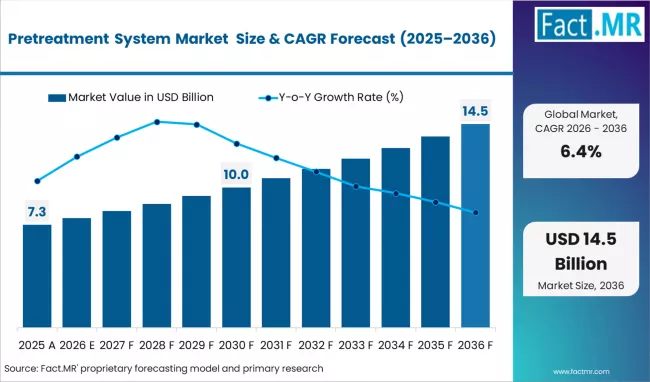
Pretreatment System Market Market Value Analysis | Source: Fact.MR
Key Drivers
- Water Reliability: Industrial facilities need more controlled feedwater and process-water quality to protect assets and operational uptime.
- Compliance Pressure: Pretreatment remains central to industrial wastewater control and municipal sewer protection requirements.
- Industrial Complexity: More demanding water reuse, boiler, and process applications are raising the value of engineered pretreatment systems.
Key Segments Analyzed in the Report
- Technology: Filtration Systems, Reverse Osmosis Systems, Ion Exchange Systems, Clarifiers And Separators, And Others
- Application: Boiler Feedwater, Process Water, Wastewater Pretreatment, Cooling Water, And Others
- End Use Industry: Power Generation, Food And Beverage, Chemicals, Pharmaceuticals, Municipal And Utilities, And Others
- Region: North America, Latin America, Europe, Asia Pacific, And Middle East & Africa
Analyst Opinion
Shambhu Nath Jha, Principal Consultant, Fact.MR says pretreatment systems matter because downstream assets are expensive and unforgiving. Buyers pay for pretreatment when it protects uptime, reduces membrane fouling, keeps boilers stable, and lowers compliance risk before the main treatment step begins. The market grows fastest in industries where the cost of a water-related production interruption is obvious and large, and slower in industries where that cost is still being underestimated.
Pretreatment System Market Definition
The pretreatment system market covers equipment and engineered systems used to condition raw, process, or wastewater before primary treatment, purification, reuse, or discharge handling.
Pretreatment System Market Inclusions
- Revenue from filtration, reverse osmosis, ion exchange, clarifier, separator, and associated pretreatment systems sold for industrial and utility water applications.
- Applications across process water, feedwater conditioning, cooling systems, and wastewater pretreatment environments.
- Demand across North America, Latin America, Europe, Asia Pacific, and the Middle East & Africa.
Pretreatment System Market Exclusions
- Standalone consumable chemicals without associated pretreatment system revenue.
- Main biological treatment plant revenue beyond the pretreatment stage.
- Residential point-of-use water filtration products.
Pretreatment System Market Research Methodology
This study evaluates the pretreatment system market across technology, application, end use industry, and region, using 2025 as the base year and 2026 to 2036 as the forecast period. Market value is expressed in USD billion. Evidence inputs include national pretreatment program requirements, industrial water management needs, and first-party engineering and solution materials from Ecolab Nalco Water, Veolia, and other water technology providers. Triangulation aligns industrial water treatment capex, plant operating requirements, technology mix, and replacement cycles to derive segment and regional estimates.
Key Drivers, Restraints, and Trends in Pretreatment System Market
Drivers
Pretreatment systems grow when water quality becomes a production variable over a utility afterthought. As plants push for higher uptime, tighter process control, and more reuse, upstream conditioning becomes more important. Pretreatment also protects expensive downstream membranes, boilers, and process equipment from avoidable fouling and instability.
Restraints
The market still faces capex discipline and fragmented buyer priorities. Some facilities continue to underinvest in pretreatment until a compliance event or equipment failure makes the need obvious. In addition, pretreatment systems are sold into technically conservative environments where project cycles are long and specification risk is taken seriously.
Trends
The market is moving toward more integrated water pretreatment packages that combine hardware, services, and digital monitoring. Wastewater reuse, feedwater optimization, and industrial effluent control are increasing the need for more engineered approaches over off-the-shelf pretreatment solutions.
Segmental Analysis
Pretreatment System Market Analysis by Technology
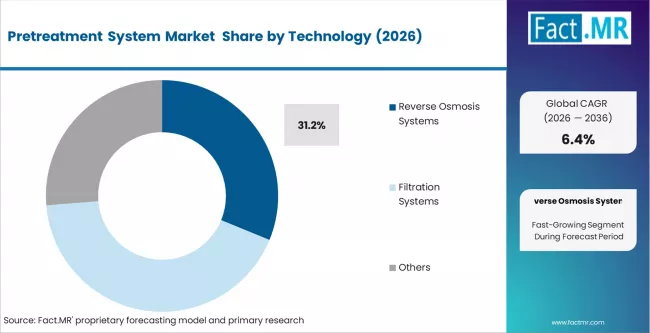
Pretreatment System Market Analysis By Technology | Source: Fact.MR
The Reverse Osmosis Systems segment is expected to lead the technology category with a 31.2% share in 2026. Reverse osmosis leads because it has become a central purification step in many high-demand industrial water applications. Even where RO is not the only pretreatment stage, investment around pretreatment trains increasingly converges on protecting and enabling membrane performance.
Pretreatment System Market Analysis by Application
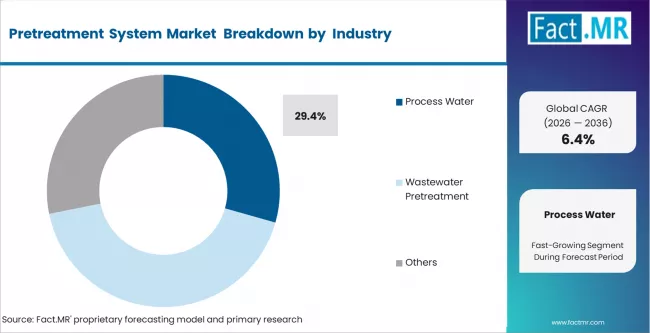
Pretreatment System Market Analysis By Application | Source: Fact.MR
The Process Water segment is expected to lead the application category with a 29.4% share in 2026. Process water leads because water quality directly affects production yield, contamination risk, and equipment life in sectors such as food, chemicals, and pharmaceuticals. That makes pretreatment an operational necessity over an environmental add-on.
Competitive Aligners for Market Players
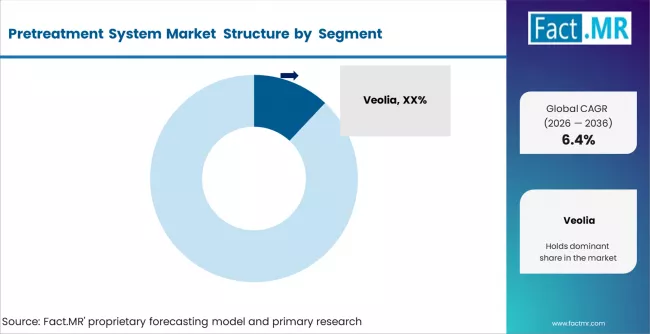
Pretreatment System Market Analysis By Company | Source: Fact.MR
The competitive structure of the pretreatment system market rewards suppliers that can move beyond hardware selling into water program ownership. Veolia, Ecolab Nalco Water, and SUEZ have each built business models where the pretreatment system sale is the entry point into a long-term water management relationship that includes chemistry, monitoring, maintenance, and optimization services. That model creates switching costs that pure equipment suppliers cannot match, because the customer relationship over time comes to depend on the service continuity, data ownership, and institutional knowledge the supplier has accumulated.
Technology differentiation in pretreatment is real but often overstated. Reverse osmosis membranes from leading manufacturers perform within narrow bands of each other, and filtration, ion exchange, and clarification are all mature technologies. What separates strong competitors is not the equipment specification but the engineering judgment that goes into system design: correctly sizing pretreatment capacity for the worst-case influent condition, selecting the right sequence of treatment steps, anticipating the interaction effects between technologies, and designing in the flexibility to adapt as influent quality changes over time. That kind of engineering quality is what prevents the pretreatment system from being the thing that causes a costly process upset five years after installation.
The digital monitoring layer is the competitive frontier attracting the most investment right now. Real-time feedwater quality monitoring, predictive fouling alerts, automated chemical dosing adjustments, and remote diagnostics are all becoming standard expectations in new project specifications, particularly from sophisticated industrial buyers in pharmaceuticals, semiconductors, and food and beverage. Suppliers who have integrated these capabilities into their standard offering are winning projects on capability, not just price. Those who have not are finding themselves competing on price alone, which in a capital-intensive, long-lifecycle market is a structurally weak position.
Key Players in Pretreatment System Market
- Veolia
- Ecolab Nalco Water
- SUEZ
- Xylem
- Evoqua Water Technologies
- Kurita Water Industries
- Pentair
- DuPont Water Solutions
- Pall Corporation
- Aquatech
Strategic Outlook by Fact.MR on Pretreatment System Market
Fact.MR expects pretreatment systems to post steady gains as industrial water risk, effluent compliance, and reuse priorities intensify. The best-positioned suppliers will be those that combine equipment, operating know-how, and longer-term service relationships. The digital layer will increasingly determine who wins new project awards, and the service relationship will determine who retains the customer. Both dimensions need investment, and suppliers that neglect either will find their competitive position eroding faster than the market growth rate would suggest.
Bibliography
- United States Environmental Protection Agency. (2025). National pretreatment program.
- United States Environmental Protection Agency. (2025). Pretreatment standards and requirements-applicability.
- United States Environmental Protection Agency. (2025). Industrial effluent guidelines.
- Ecolab Nalco Water. (n.d.). Water pretreatment system design and operation.
- Veolia Water Technologies. (n.d.). Water pretreatment.
- United States Environmental Protection Agency. (2025). Pretreatment roles and responsibilities-industrial users.
Segmentation
Scope of the Report
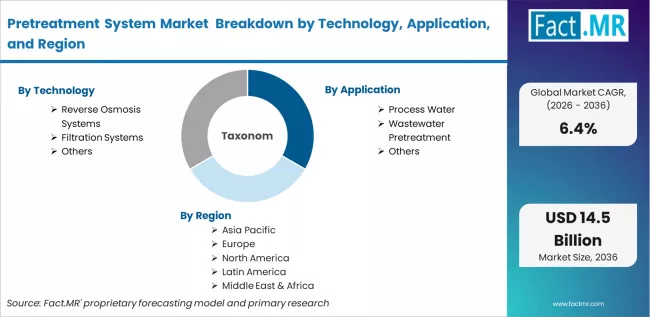
Pretreatment System Market Breakdown By Technology, Application, And Region | Source: Fact.MR
| Metric | Value |
|---|---|
| Market Value | USD 7.3 billion in 2025 to USD 14.5 billion by 2036 |
| CAGR | 6.4% from 2026 to 2036 |
| Base Year | 2025 |
| Forecast Period | 2026 to 2036 |
| Technology Segmentation | Filtration Systems, Reverse Osmosis Systems, Ion Exchange Systems, Clarifiers and Separators, Others |
| Application Segmentation | Boiler Feedwater, Process Water, Wastewater Pretreatment, Cooling Water, Others |
| End Use Industry Segmentation | Power Generation, Food and Beverage, Chemicals, Pharmaceuticals, Municipal and Utilities, Others |
| Regional Coverage | North America, Latin America, Europe, Asia Pacific, and Middle East & Africa |
Source: Fact.MR analysis. Updated Mar 16, 2026
Frequently Asked Questions
What is the projected size of the Pretreatment System Market by 2036?
What is the CAGR of the Pretreatment System Market from 2026 to 2036?
Which technology segment leads the Pretreatment System Market?
Which application segment dominates the Pretreatment System Market?
Which end use industry segment leads the Pretreatment System Market?
Who are the key companies in the Pretreatment System Market?
What is driving demand in the Pretreatment System Market?
Who worked on this report


Preview the report firsthand - request a free sample
Free SampleGet the brochure for pricing and purchase details
Download PDF