- Base Value(2025): 540 Mn
- Estimated Value(2026): 567 Mn
- Forecast Value (2036): 923.6 Mn
- CAGR (2026 - 2036): 5.0%
Profilometer Market Forecast and Outlook By Fact.MR
In 2025, the profilometer market was valued at USD 540 million. Based on Fact. MR analysis, demand for profilometers is estimated to grow to USD 567 million in 2026 and USD 923.6 million by 2036. FACT.MR projects a CAGR of 5.0% during the forecast period.
Between 2026 and 2036, the profilometer market is projected to create an absolute dollar opportunity of USD 356.6 million. This steady expansion reflects consistent demand from automotive powertrain and EV component quality control, semiconductor wafer inspection, and medical device surface verification programmes. Structural constraints include high capital cost of advanced non-contact systems limiting adoption among small and mid-sized manufacturers, and long instrument calibration certification cycles in regulated end uses.
Country growth reflects semiconductor investment, automotive surface quality standards, and expanding precision metrology programmes. China leads with a 7.0% CAGR driven by semiconductor fab expansion and EV component quality control. India follows at 6.7% supported by PLI-led manufacturing and semiconductor projects. Germany records 6.0% on automotive and medical device inspection demand. France grows 5.6% with aerospace manufacturing research. The United Kingdom posts 5.0% from photonics and semiconductor investment. The United States grows 4.7% on advanced semiconductor nodes. Brazil registers 4.0% driven by automotive component exports.
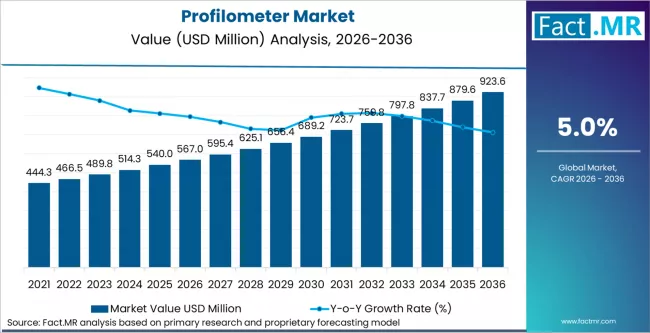
Profilometer Market Value Analysis | Source: Fact.MR
| Metric | Value |
|---|---|
| Estimated Value in 2026 | USD 567 million |
| Forecast Value in 2036 | USD 923.6 million |
| Forecast CAGR (2026 to 2036) | 5.0% |
Source: Fact.MR analysis. Updated Mar 17, 2026
Profilometer Market Definition
The profilometer market covers contact and non-contact instruments used to measure surface roughness, texture, and topography of components. These systems quantify parameters such as Ra, Rz, and Sa to verify surface quality against engineering specifications. They are used in automotive, semiconductor, aerospace, medical device, and materials processing manufacturing.
Market Inclusions
Includes global and regional revenue forecasts from 2026 to 2036 by equipment type, measurement dimension, and end use. Covers contact and non-contact systems, including 2D and 3D configurations across major industries and regions.
Market Exclusions
Excludes coordinate measuring machines, optical microscopes without roughness measurement capability, and non-profilometry interferometers. Also excludes calibration services, stylus consumables, and software-only surface analysis platforms without integrated hardware.
Research Methodology
- Primary Research
- Interviews with quality control engineers, metrology laboratory managers, semiconductor process engineers, automotive OEM supplier quality teams, and precision instrument distributors across Asia Pacific, Europe, and North America.
- Desk Research
- Sources include ISO 4287 and ISO 25178 surface texture standards, SEMI wafer metrology specifications, OEM annual reports, semiconductor capital equipment spending data, and automotive surface quality engineering publications from 2024 to 2025.
- Market Sizing and Forecasting
- A hybrid top-down and bottom-up model using manufacturing plant capital equipment budgets, instrument unit volumes by end use, average selling prices by equipment type and dimension, and replacement and upgrade cycle data.
- Data Validation and Update Cycle
- Outputs validated against OEM instrument revenue disclosures, semiconductor capital equipment spending indices, automotive quality programme investment data, and ISO metrology standard adoption timelines with annual forecast updates.
Summary of Profilometer Market
- Market Definition
- Profilometers are precision surface measurement instruments used to quantify texture, roughness, and topography on manufactured components across automotive, semiconductor, aerospace, and medical device production.
- Demand Drivers
- Semiconductor process node miniaturisation below 5 nm requires sub-nanometre surface roughness verification on wafers and photomasks, driving adoption of high-resolution non-contact optical profilometers in advanced fabs.
- Electric vehicle component surface quality standards for powertrain housings, battery cell casings, and motor laminations are increasing 3D profilometer procurement among Tier 1 automotive suppliers and OEM quality laboratories.
- ISO 25178 areal surface texture standard adoption in medical device manufacturing is mandating 3D profilometry qualification for implant and surgical instrument surface finish verification in FDA and CE-regulated production.
- Key Segments Analyzed
- By Equipment Type: Contact profilometers hold approximately 53% share in 2026 due to established reliability, high accuracy across diverse materials, and lower cost versus optical non-contact systems.
- By Dimension: 3D profilometers dominate at approximately 64% share in 2026, reflecting demand for comprehensive areal surface texture analysis and defect detection across semiconductor and automotive manufacturing.
- By End Use: Automotive leads at approximately 32% share in 2026, driven by precision surface inspection requirements for powertrain components, body panels, and electric vehicle parts.
- By Geography: Asia Pacific leads growth through semiconductor and automotive manufacturing expansion.
- Analyst Opinion at FACT.MR
- Shambhu Nath Jha, Principal Consultant at Fact.Mr, opines that CXOs will find the market’s 5.0% CAGR through 2036 underpinned by semiconductor fab capacity expansion and automotive EV quality programmes, with non-contact 3D optical systems commanding premium pricing and growing share through 2036.
- Strategic Implications
- Instrument manufacturers should invest in AI-assisted surface analysis and automated measurement routines to reduce operator dependency and increase throughput in semiconductor and automotive quality control.
- Distributors in China and India should provide on-site calibration, ISO compliance documentation, and application engineering support to accelerate adoption among new metrology users.
- Companies should develop modular non-contact profilometers configurable for both 2D and 3D measurement to address cost-sensitive manufacturers shifting from contact to optical systems.
- Methodology
- Market sizing used capital equipment budgets and profilometer unit volumes by end use, validated with OEM revenue data and semiconductor equipment spending indices.
- ISO 4287, ISO 25178, and SEMI wafer metrology standards supported analysis of surface measurement compliance demand.
- Forecasts incorporated semiconductor fab investments, EV quality programme timelines, medical device standards adoption, and interviews with metrology engineers and quality
Segmental Analysis
Profilometer Market Analysis by Equipment Type
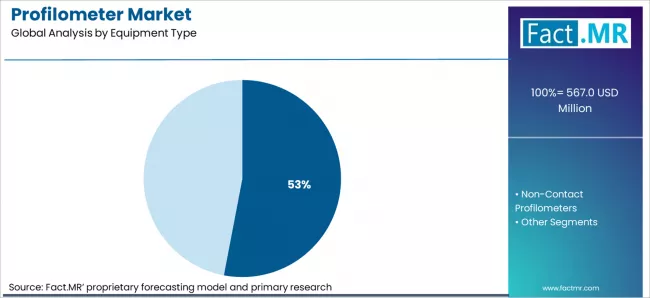
Profilometer Market Analysis By Equipment Type | Source: Fact.MR
Based on FACT.MR’s profilometer market report, contact profilometers are estimated to hold about 53% share in 2026. They remain widely used due to high measurement accuracy across metals and composites and significantly lower acquisition cost than optical systems.
- Mahr Federal Profilometer Platform Investment: In 2025, Mahr Federal launched the MarSurf XT 20 hybrid profilometer combining stylus and optical measurement for automotive and precision engineering labs. [5]
- Sensofar Non-Contact Technology Development: In 2024, Sensofar released the S neox Five Axis non-contact profilometer with confocal and interferometry modes for semiconductor and micro-optics inspection. [6]
- Non-Contact Adoption Acceleration Trend: The International Academy for Production Engineering reported in 2024 that non-contact profilometer adoption in semiconductor and EV battery manufacturing is growing faster than contact systems. [7]
Profilometer Market Analysis by Dimension
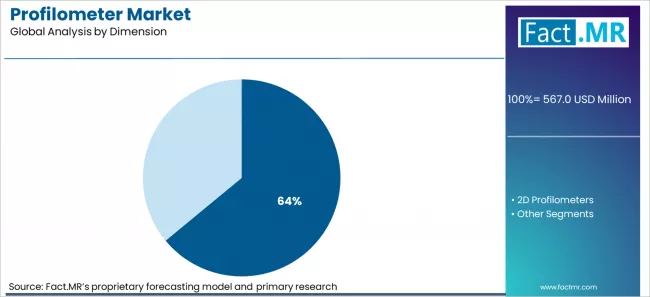
Profilometer Market Analysis By Dimension | Source: Fact.MR
Based on FACT.MR’s profilometer market report, 3D profilometers are projected to hold about 64% share in 2026. They provide full areal surface data, enabling detection of localized defects and complex surface patterns missed by 2D measurements.
- Zygo 3D Interferometer Platform Launch: In 2025, Zygo introduced the Nexview NX2 3D optical surface profiler using coherence scanning interferometry for semiconductor and precision component inspection. [8]
- KLA 3D Wafer Metrology Development: In 2024, KLA expanded its wafer surface metrology portfolio with 3D profilometry capabilities for EUV photomask flatness and roughness verification. [9]
- 3D Profilometry in Medical Devices Trend: Jenoptik reported in 2024 that 3D surface profiler sales to medical device manufacturers grew 18% year-on-year due to ISO 25178 implementation. [10]
Drivers, Restraints, and Opportunities
FACT.MR analysts observe that the profilometer market is closely linked to precision manufacturing investment in semiconductor, automotive, aerospace, and medical device industries. Valued at USD 540 million in 2025, demand is supported by stricter ISO surface standards and semiconductor process node advancement.
The market shows a divide between traditional 2D contact stylus systems and advanced non-contact 3D optical profilometers. Contact instruments lead by volume due to lower cost and material compatibility. Non-contact 3D systems command premium pricing and are gaining share in semiconductor and EV manufacturing where surface damage risk must be avoided.
- ISO 25178 Areal Texture Standard Adoption: ISO 25178 adoption has accelerated the shift from 2D profile instruments to 3D profilometers in automotive and medical device manufacturing. The European Automobile Manufacturers’ Association updated its quality guidelines in 2024 to reference ISO 25178 parameters for EV powertrain inspection. [2]
- Semiconductor Fab Expansion in Asia Pacific: Semiconductor capacity expansion continues to drive demand for optical profilometers used in wafer surface metrology. TSMC and Samsung have included surface metrology tools in equipment procurement for advanced semiconductor fabs. [3]
- Automotive EV Component Quality Requirements: EV manufacturing programmes are increasing the use of 3D surface measurement for powertrain and battery housing components. Volkswagen’s revised supplier quality standard in 2024 requires areal surface texture verification for EV component suppliers. [4]
Regional Analysis
The profilometer market is analysed across Asia Pacific, Europe, North America, Latin America, and Middle East and Africa, covering 40+ countries with demand profiles shaped by semiconductor manufacturing investment, automotive surface quality programmes, aerospace component metrology, and medical device production standards. The full report offers market attractiveness analysis based on manufacturing sector capital investment and precision metrology standard adoption timelines.
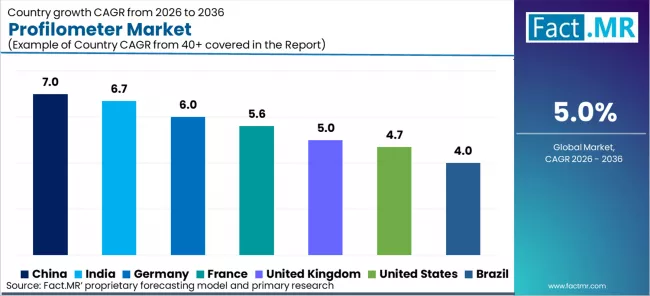
Profilometer Market Cagr Analysis By Country | Source: Fact.MR
| Country | CAGR (2026-2036) |
|---|---|
| China | 7.0% |
| India | 6.7% |
| Germany | 6.0% |
| France | 5.6% |
| United Kingdom | 5.0% |
| United States | 4.7% |
| Brazil | 4.0% |
Source: Fact.MR analysis. Updated Mar 17, 2026
Source: Fact.MR (FACT.MR) analysis, based on proprietary forecasting model and primary research
Asia Pacific Profilometer Market Analysis
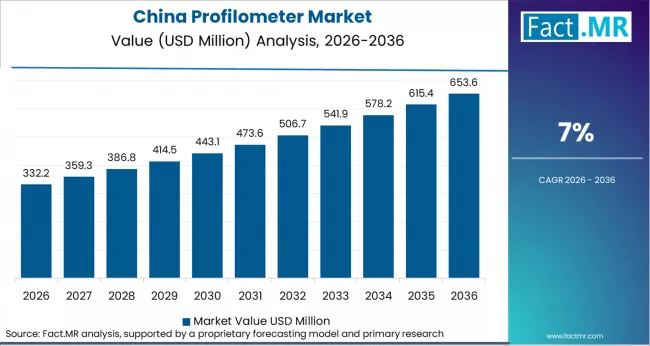
Profilometer Market Country Value Analysis | Source: Fact.MR
Asia Pacific is the fastest-growing profilometer market, supported by semiconductor fabrication expansion in China and rising precision manufacturing in India. Global metrology suppliers and regional distributors serve semiconductor fabs, EV component manufacturers, and general industrial users across the region.
- China: China is expected to register a 7.0% CAGR through 2036. Semiconductor localisation programmes and wafer fabrication expansion continue to increase surface metrology equipment procurement. EV manufacturers are also introducing ISO 25178-based surface inspection for battery and motor components, supporting adoption of 3D profilometers.
- India: Demand for profilometers in India is projected to grow at 6.7% CAGR through 2036. Tata Electronics’ Hosur semiconductor assembly and test facility, which began ramp-up in 2025 under its Apple supplier agreement, incorporated surface metrology equipment procurement including non-contact profilometers for chip package inspection in its quality laboratory setup. Semiconductor assembly projects and export-oriented automotive component manufacturing are increasing the use of ISO-compliant surface measurement systems across precision machining suppliers.
FACT.MR’s Asia Pacific analysis of the profilometer market covers China, Japan, South Korea, India, Australia and New Zealand, ASEAN, and Rest of South Asia and Pacific. Readers can find country CAGR forecasts, semiconductor fab metrology investment data, automotive quality programme timelines, and instrument supplier competitive positioning.
Europe Profilometer Market Analysis
Europe represents a high-value profilometer market supported by automotive engineering in Germany and aerospace manufacturing in France and the United Kingdom. Regional instrument manufacturers maintain strong positions through ISO-standard-aligned surface measurement technologies.
- Germany: Germany is projected to grow at a 6.0% CAGR through 2036. Automotive supplier quality upgrades and EV component inspection standards are increasing adoption of advanced surface metrology instruments.
- France: France is estimated to record a 5.6% CAGR through 2036. Aerospace manufacturing quality programmes and supplier inspection upgrades are supporting demand for non-contact 3D profilometers.
- United Kingdom: The United Kingdom is anticipated to expand at a 5.0% CAGR through 2036. Semiconductor, photonics, and precision engineering sectors are gradually increasing investment in advanced surface measurement technologies.
FACT.MR’s European analysis of the profilometer market covers Germany, France, the United Kingdom, Italy, Spain, Nordic countries, BENELUX, and Rest of Western Europe. Readers can find ISO 25178 standard adoption timelines, automotive OEM surface quality programme data, aerospace metrology investment trends, and country-level forecasts by equipment type and end use.
North America Profilometer Market Analysis
North America remains the largest revenue market for profilometers, supported by semiconductor capital equipment spending, aerospace quality programmes, and medical device manufacturing requirements.
- United States: The United States is expected to grow at a 4.7% CAGR through 2036. Semiconductor manufacturing expansion, supported by federal incentives, is increasing procurement of advanced wafer surface metrology tools.
FACT.MR’s North American analysis of the profilometer market covers the United States, Canada, and Mexico. Readers can find CHIPS Act semiconductor metrology investment data, FDA medical device surface standard impact analysis, aerospace quality programme procurement trends, and country-level forecasts by equipment type and dimension.
Latin America Profilometer Market Analysis
Latin America is an emerging profilometer market supported by automotive component manufacturing and growing precision engineering exports. Contact profilometers dominate procurement due to cost sensitivity.
- Brazil: Brazil is forecast to register a 4.0% CAGR through 2036. Automotive supplier quality requirements and aerospace component manufacturing programmes are gradually increasing demand for advanced surface inspection systems.
FACT.MR’s Latin American analysis of the profilometer market covers Brazil, Chile, Ecuador, and Rest of Latin America. Readers can find automotive supplier quality programme timelines, ISO standard adoption data, aerospace component metrology investment trends, and country-level profilometer demand forecasts.
Competitive Aligners for Market Players
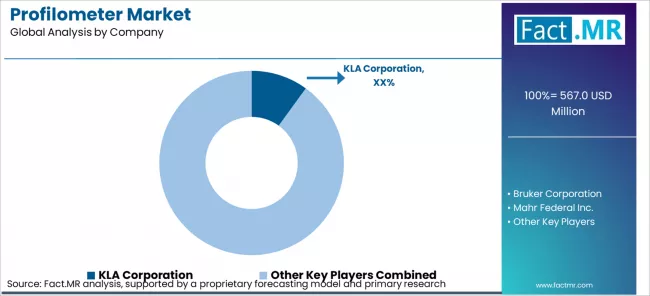
Profilometer Market Analysis By Company | Source: Fact.MR
The global profilometer market is moderately concentrated in high-precision non-contact and 3D segments and more fragmented in standard contact profilometer categories. KLA Corporation and Bruker Corporation hold the largest global positions in semiconductor-grade and advanced materials profilometry, competing primarily on measurement resolution, throughput, and integration with fab automation systems. Mitutoyo Corporation, Mahr Federal, and Jenoptik AG lead industrial profilometry through broad product portfolios covering both contact and non-contact instruments across automotive, aerospace, and general manufacturing quality control applications.
Structural competitive advantages belong to instrument makers with proprietary optical measurement technologies and ISO calibration traceability programmes that reduce qualification burden for regulated end users. Zygo Corporation’s coherence scanning interferometry platform and Sensofar Group’s confocal technology give them differentiated positions in semiconductor and optics markets where sub-nanometre resolution is a non-negotiable specification.
Alicona Imaging GmbH, acquired by Bruker, holds strong positions in focus variation 3D surface metrology for complex geometry components in automotive tooling and cutting tool inspection. Large semiconductor and automotive OEM customers manage supplier dependency through multi-instrument vendor qualification programmes that maintain two to three approved instrument suppliers per measurement category, limiting single-supplier pricing power in standard contact instrument segments. However, in advanced non-contact 3D profilometry, the qualification cost and process re-validation burden of switching instruments creates significant switching costs that sustain single-vendor relationships once an instrument platform is embedded in a high-volume production quality programme.
Key Players
- KLA Corporation
- Bruker Corporation
- Mahr Federal Inc.
- Zygo Corporation
- Mitutoyo Corporation
- Jenoptik AG
- Sensofar Group
- Alicona Imaging GmbH
Bibliography
[1] European Automobile Manufacturers’ Association (ACEA). (2024). Quality Management Recommendations Update: ISO 25178 Surface Texture Parameters for EV Powertrain Component Inspection. October 2024. acea.auto
[2] Samsung Electronics Co., Ltd. (2025). Press Release: Taylor, Texas Semiconductor Fab Phase 2 Expansion Announcement and Equipment Qualification Programme Timeline. January 2025. news.samsung.com
[3] Volkswagen AG. (2024). Supplier Quality Standard VW 01103 Part 2 Revision: 3D Areal Surface Texture Measurement Mandate for EV Platform Powertrain and Battery Housing Components. September 2024. volkswagen-group.com
[4] Mahr Federal Inc. (2025). Product Launch Release: MarSurf XT 20 Hybrid Contact and Non-Contact Profilometer Platform for Automotive and Precision Engineering Quality Laboratories. February 2025. mahr.com
[5] Sensofar Group. (2024). Product Launch: S neox Five Axis Non-Contact Profilometer with Confocal and Interferometry Measurement Modes for Semiconductor and Micro-Optics Applications. June 2024. sensofar.com
[6] International Academy for Production Engineering (CIRP). (2024). Surface Metrology Review: Non-Contact Profilometer Adoption Trends in Semiconductor and EV Battery Manufacturing. December 2024. cirp.net
[7] Zygo Corporation. (2025). Product Launch Release: Nexview NX2 3D Optical Surface Profiler with Enhanced Coherence Scanning Interferometry for Semiconductor and Precision Component Inspection. January 2025. zygo.com
[8] KLA Corporation. (2024). Product Portfolio Update: 3D Profilometry Capabilities for EUV Photomask Flatness and Surface Roughness Verification in Advanced Semiconductor Process Qualification. August 2024. kla.com
[9] Jenoptik AG. (2025). Annual Report 2024: Surface Profiler Sales Growth in Medical Device Segment and ISO 25178 Adoption at Orthopaedic and Cardiovascular Device Manufacturers. March 2025. jenoptik.com
This Report Addresses
- Strategic intelligence on ISO 25178 areal surface texture standard adoption, semiconductor fab profilometer procurement, automotive EV component quality programme requirements, and medical device surface characterisation regulation driving profilometer demand.
- Market forecast from USD 567 million in 2026 to USD 923.6 million by 2036 at 5.0% CAGR, segmented by equipment type, measurement dimension, end use, and region.
- Growth opportunity mapping across China semiconductor fab expansion, India PLI automotive metrology investment, Germany ISO 25178 automotive quality programme adoption, and U.S. CHIPS Act semiconductor surface metrology procurement.
- Country CAGR outlook for China 7.0%, India 6.7%, Germany 6.0%, France 5.6%, United Kingdom 5.0%, United States 4.7%, and Brazil 4.0%, with key manufacturing sector and standard adoption drivers per country.
- Competitive analysis of KLA, Bruker, Mitutoyo, Zygo, Jenoptik, Mahr Federal, Sensofar, and Alicona covering instrument portfolios, optical measurement technologies, ISO calibration programmes, and customer qualification relationships.
- Technology tracking including coherence scanning interferometry, confocal optical profiling, focus variation 3D surface measurement, AI-assisted surface defect detection, and inline automated profilometry systems.
- Standards analysis covering ISO 4287, ISO 25178, SEMI wafer surface metrology specifications, FDA medical device surface characterisation guidance, VDA automotive surface quality standards, and NADCAP aerospace surface inspection requirements.
- Report delivered in PDF, Excel datasets, PowerPoint summary, and dashboard formats supported by OEM capital equipment revenue data, semiconductor spending indices, and primary research interviews.
Segmentation
Scope of Report
| Metric | Value |
|---|---|
| Quantitative Units | USD 567 million (2026) to USD 923.6 million (2036), at a CAGR of 5.0% |
| Market Definition | Contact and non-contact precision instruments measuring surface roughness, texture, and topography for quality control in automotive, semiconductor, aerospace, and medical device manufacturing. |
| Equipment Type Segmentation | Contact Profilometers (53%), Non-Contact Profilometers |
| Dimension Segmentation | 3D Profilometers (64%), 2D Profilometers |
| End Use Segmentation | Automotive (32%), Chemical and Material Processing, Electronics and Semiconductors, Healthcare and Pharmaceuticals, Others |
| Application Coverage | Automotive powertrain and EV component inspection, semiconductor wafer surface measurement, aerospace component metrology, medical device implant surface verification, and precision tool surface quality control. |
| Regions Covered | Asia Pacific, Europe, North America, Latin America, Middle East and Africa |
| Countries Covered | China, Japan, South Korea, India, Australia and New Zealand, ASEAN, Rest of South Asia and Pacific, Germany, UK, France, Italy, Spain, Nordic, BENELUX, Rest of Western Europe, Russia, Poland, Hungary, Balkan and Baltic, USA, Canada, Mexico, Brazil, Chile, Ecuador, Rest of Latin America, Saudi Arabia, GCC, Turkey, South Africa, Rest of MEA |
| Key Companies Profiled | KLA Corporation, Bruker Corporation, Mahr Federal Inc., Zygo Corporation, Mitutoyo Corporation, Jenoptik AG, Sensofar Group, Alicona Imaging GmbH |
| Forecast Period | 2026 to 2036 |
| Approach | Hybrid top-down and bottom-up model using manufacturing capital equipment budgets, profilometer unit volumes by end use, average selling prices by equipment type and dimension, and interviews with metrology engineers and quality managers. |
Source: Fact.MR analysis. Updated Mar 17, 2026
Profilometer Market by Segments
-
By Equipment Type:
- Contact Profilometers
- Non-Contact Profilometers
-
By Dimension:
- 3D Profilometers
- 2D Profilometers
-
By End Use:
- Automotive
- Chemical and Material Processing
- Electronics and Semiconductors
- Healthcare and Pharmaceuticals
- Others
-
By Region:
- North America
- United States
- Canada
- Mexico
- Latin America
- Brazil
- Chile
- Ecuador
- Rest of Latin America
- Western Europe
- Germany
- United Kingdom
- France
- Italy
- Spain
- Nordic
- BENELUX
- Rest of Western Europe
- Eastern Europe
- Russia
- Poland
- Hungary
- Balkan and Baltic
- Rest of Eastern Europe
- East Asia
- China
- Japan
- South Korea
- South Asia and Pacific
- India
- ASEAN
- Australia and New Zealand
- Rest of South Asia and Pacific
- Middle East and Africa
- Kingdom of Saudi Arabia
- Other GCC Countries
- Turkey
- South Africa
- Other African Union
- Rest of Middle East and Africa
- North America
Frequently Asked Questions
How large is the profilometer market in 2025?
What will the market size be in 2026?
What is the projected market size by 2036?
What is the expected CAGR?
Which equipment type segment leads the market?
Which dimension segment dominates?
Which end use segment holds the largest share?
What are profilometers used for?
Which industries drive demand for profilometers?
Which technology trend is shaping the market?
What factors support long-term market growth?
Which country shows the fastest growth?
What is the primary restraint?
Who worked on this report


Preview the report firsthand - request a free sample
Free SampleGet the brochure for pricing and purchase details
Download PDF