- Estimated Value(2026): 1.5 Bn
- Forecast Value (2036): 12.6 Bn
- CAGR (2026 - 2036): 23.7%
Drone Land Surveying Market Forecast and Outlook By Fact.MR
- The drone land surveying market surpassed a value of USD 1.2 billion in 2025.
- Based on Fact.MR analysis, demand is estimated to grow to USD 1.5 billion in 2026 and USD 12.6 billion by 2036.
- Fact.MR projects a CAGR of 23.7% during the forecast period.
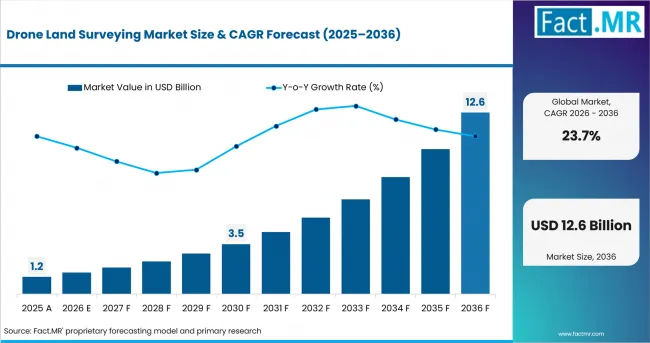
Drone Land Surveying Market Value Analysis | Source: Fact.MR
| Metric | Value |
|---|---|
| Estimated Value in 2026 | USD 1.5 billion |
| Forecast Value in 2036 | USD 12.6 billion |
| Forecast CAGR (2026 to 2036) | 23.7% CAGR |
Source: Fact.MR analysis. Updated Jun 5, 2026
Summary of Drone Land Surveying Market
- Demand Drivers
- Construction planning is the main demand base as contractors use aerial maps to shorten site checks and reduce manual visits.
- Energy corridor mapping creates repeat work as utilities need route checks for transmission lines and pipelines.
- Land record updating supports rural mapping as government programs use drone imagery to speed up property documentation.
- Key Segments Analyzed
- By Type: Topographic survey holds 24.8% share in 2026 because construction teams need elevation records before grading and site design.
- By End Use Industry: Construction accounts for 33.0% share in 2026 as projects need repeated site records from prework survey to completion checks.
- By Drone Platform: Multirotor drones capture 48.6% share in 2026 since short setup time and stable low-altitude imaging suit most survey sites.
- By Service Model: Third-party services hold 46.4% share in 2026 because project owners avoid pilot hiring and mapping software training costs.
- By Data Output: Orthomosaic maps represent 41.2% share in 2026 as survey teams need clear site views that can be measured and shared.
- By Project Size: Mid-size projects account for 39.5% share in 2026 since housing, roads, warehouses, and utility projects need professional survey output.
- Analyst Opinion at Fact.MR
- Shambhu Nath Jha, Principal Consultant at Fact.MR, opines, "CXOs will see drone land surveying shift from basic image capture to survey-grade data delivery. Construction sites need faster maps. Mining operators need volume data. Energy developers need route-level records. Suppliers will gain share through licensed pilots and mapping software skills. Proof of output accuracy will separate stronger service firms. Project owners should track flight permissions and trained pilot supply because both affect project timing."
- Strategic Implications
- Service providers should combine flight work with map processing so clients receive usable survey files.
- Drone firms should build construction and energy references because these sectors need repeat surveys across project phases.
- Software partners should improve the shift from aerial images to CAD-ready files because engineering staffs value usable outputs.
The market is set to generate an incremental revenue opportunity of USD 11.1 billion between 2026 and 2036. Market growth is rapid as construction and energy users shift survey work toward drone-based site mapping. Public land record updates support wider demand in developing regions. High software costs and pilot training needs limit faster in-house use among smaller contractors.
India is projected to record the leading CAGR at 27.9% through 2036, supported by public land mapping and highway work. China follows at 25.8% through 2036 as low-altitude aircraft regulation and construction planning support use. Saudi Arabia records 24.9% CAGR through 2036 with national infrastructure programs creating demand for corridor mapping and site progress checks. Germany advances at 23.6% through 2036 as engineering firms use drone survey data for redevelopment and utility mapping. The United States grows at 22.3% through 2036 as construction spending and Part 107 pilots support service supply. Japan expands at 21.8% through 2036 as drone registration rules and dense urban projects support survey work. The United Kingdom records 21.4% CAGR through 2036 as construction output and property survey work sustain aerial mapping demand.
Segmental Analysis
Drone Land Surveying Market Analysis by Type
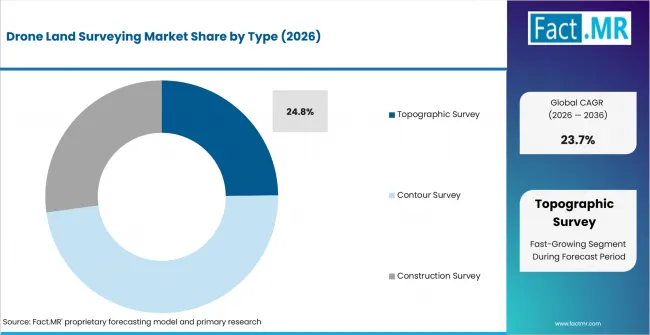
Drone Land Surveying Market Analysis By Type | Source: Fact.MR
Topographic survey is projected to account for 24.8% share in 2026 as construction teams need elevation records before grading and site design. The share reflects regular use in early project work and fewer barriers compared with legal boundary surveys.
- Topographic Survey Demand: Contractors use topographic survey flights to check slopes and earthwork needs before final project drawings.
- Boundary Survey Support: Surveyors use drone imagery to support field checks. Legal boundary confirmation still needs licensed ground validation.
- Construction Survey Use: Builders use repeat drone flights for layout checks across road and housing projects. Industrial projects use aerial records for site coordination.
Drone Land Surveying Market Analysis by End Use Industry
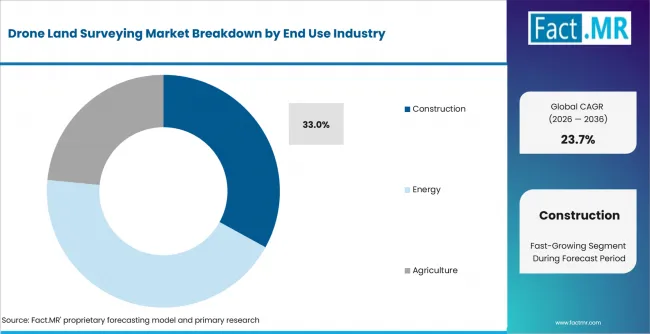
Drone Land Surveying Market Analysis By End Use Industry | Source: Fact.MR
Construction is expected to hold 33.0% share in 2026 as projects need repeat site records from prework survey to completion checks. The segment benefits from faster progress mapping and safer fieldwork on uneven sites.
- Construction Project Control: Drone construction monitoring supports earthwork checks and schedule tracking as site managers compare aerial maps with planned drawings.
- Energy Corridor Mapping: Utilities use aerial survey files to check route limits across solar sites and transmission lines. Pipeline rights of way use repeat route records.
- Agriculture Land Records: Farm users apply drone land maps for field boundaries and crop area measurement during land planning work.
Drone Land Surveying Market Analysis by Drone Platform
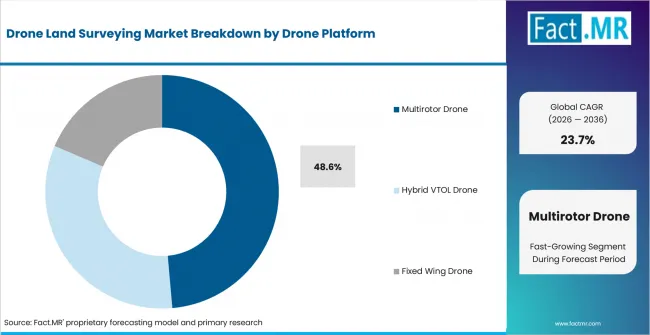
Drone Land Surveying Market Analysis By Drone Platform | Source: Fact.MR
Multirotor drones are estimated to hold 48.6% share in 2026 as most land survey jobs need vertical takeoff and controlled low-altitude imaging. The platform share is supported by short setup time and easy use on compact construction sites.
- Multirotor Site Access: Compact platforms reduce setup time on active construction sites and help survey teams collect repeat images from fixed points.
- Fixed Wing Use: Fixed wing drones serve long corridors and large mining areas as longer flight time improves coverage per mission.
- Hybrid VTOL Demand: Hybrid vertical takeoff drones support drone laser scanning jobs that need corridor coverage and controlled launch areas.
Drone Land Surveying Market Analysis by Service Model
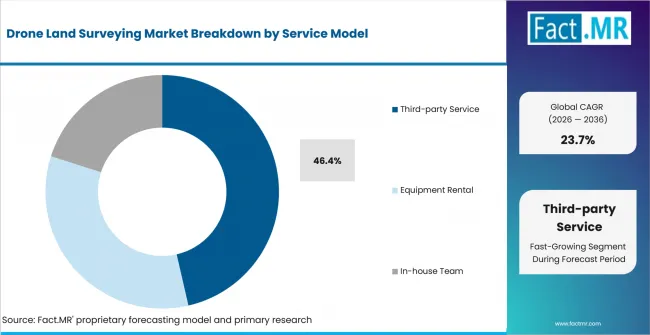
Drone Land Surveying Market Analysis By Service Model | Source: Fact.MR
Third-party services are projected to account for 46.4% share in 2026 as project owners avoid pilot hiring and software training costs. This model suits firms that need survey files only during planning or milestone checks.
- Service Provider Preference: Construction owners use drone as a service contracts to access licensed pilots and mapping files without owning a fleet.
- In-house Team Use: Large engineering firms keep internal pilots for repeat project work and better control of sensitive site data.
- Rental Demand: Equipment rental supports contractors that already have certified pilots but need extra drones for seasonal survey work.
Drone Land Surveying Market Analysis by Data Output
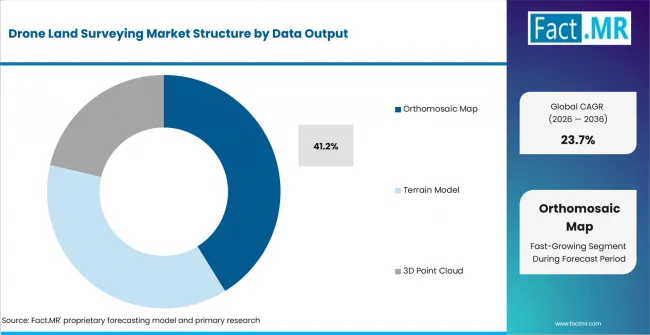
Drone Land Surveying Market Analysis By Data Output | Source: Fact.MR
Orthomosaic maps are expected to represent 41.2% share in 2026 as project owners need simple site views that can be measured and shared. This output is easier for construction staff to read than dense point cloud files.
- Orthomosaic Map Use: Surveyors use corrected aerial maps for site boundaries and progress checks that need clear visual records.
- Point Cloud Work: Mining and earthwork firms use 3D point clouds to measure stockpile volumes and terrain changes.
- Terrain Model Demand: Engineering firms use terrain models for early grading plans and drainage checks on large land parcels.
Drone Land Surveying Market Analysis by Project Size
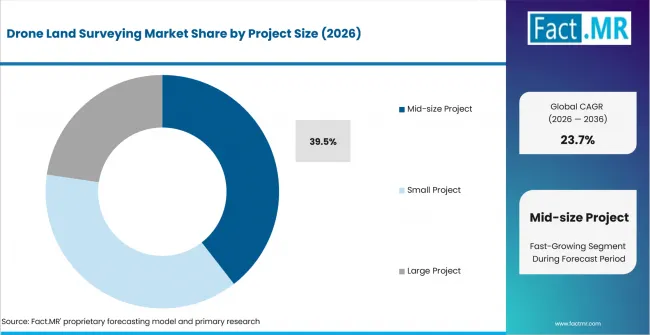
Drone Land Surveying Market Analysis By Project Size | Source: Fact.MR
Mid-size projects are anticipated to account for 39.5% share in 2026 as these sites need professional survey output without enterprise-level fleet systems. The share reflects steady use across housing and road projects. Warehouses and local utility work support repeat service demand.
- Mid-size Project Use: Developers use real estate drone services for site records and layout checks before civil work starts.
- Small Project Access: Small sites choose single-day survey services because lower costs suit local contractors and property owners.
- Large Project Work: Large projects use repeat flights and survey dashboards because long construction cycles need consistent records.
Drivers, Restraints, and Opportunities
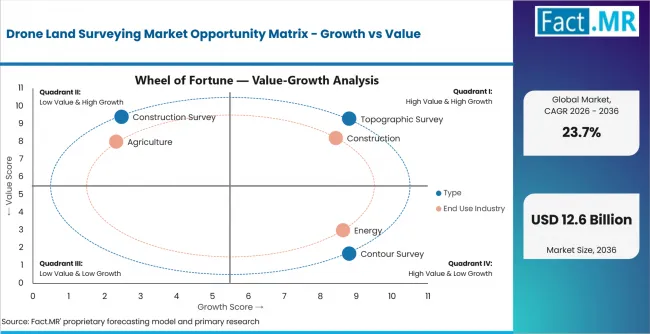
Drone Land Surveying Market Opportunity Matrix Growth Vs Value | Source: Fact.MR
The drone land surveying market expands as site owners replace slow manual checks with aerial mapping. Drone maps help with planning and progress records. The United States commercial small drone fleet is forecast at 1.089 million units in 2026 [1]. This fleet base supports service availability across construction and property projects. Service supply improves as certified pilots and mapping firms offer repeat survey packages.
Client use is rising as survey data connects with engineering workflows. Drone surveying services gain interest because outputs can move into design or progress review tools. High software cost and pilot training needs still limit in-house use for small contractors. Service providers can win projects through flight approval support and clean map delivery. Repeat pricing helps secure long projects.
- Construction Planning Driver: Builders use drone maps to check earthwork and site access before heavy equipment arrives.
- Pilot Skill Restraint: Smaller service firms face limits because survey clients expect certified pilots and clean map processing in one contract.
- Output Integration Opportunity: Mapping providers can increase contract value by linking aerial files with CAD workflows and project dashboards.
Regional Analysis
The drone land surveying market is assessed across North America, Europe, Asia Pacific, Latin America, and the Middle East and Africa, covering 40+ country-level demand by survey type, end use industry, drone platform, service model, data output, and project size. The full report includes market attractiveness analysis by region and country.
.webp "Top Country Growth Comparison — Drone Land Surveying Market CAGR (2026–2036)")
Top Country Growth Comparison — Drone Land Surveying Market CAGR (2026–2036) | Source: Fact.MR
| Country | CAGR (2026 to 2036) |
|---|---|
| India | 27.9% |
| China | 25.8% |
| Saudi Arabia | 24.9% |
| Germany | 23.6% |
| United States | 22.3% |
| Japan | 21.8% |
| United Kingdom | 21.4% |
Source: Fact.MR analysis. Updated Jun 5, 2026
Source: Fact.MR analysis, based on proprietary forecasting model and primary research
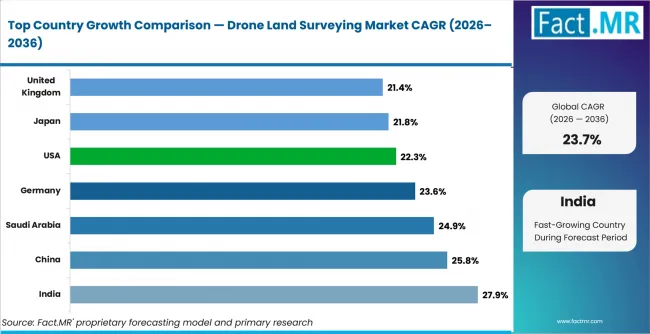
Drone Land Surveying Market CAGR Analysis By Country | Source: Fact.MR
Asia Pacific Drone Land Surveying Market Analysis
Asia Pacific records the fastest demand path for drone land surveying as public mapping and construction work create repeat survey needs. Drone rules are becoming clearer across major economies. Service suppliers are building local pilot networks. India and China shape regional demand because both markets combine infrastructure work with wider unmanned aircraft use.
- India: India is projected to record a 27.9% CAGR by 2036 as public land mapping and highway work create repeat drone survey needs. Under the SVAMITVA Scheme, 3.28 lakh villages had been surveyed using drones by February 2026 [3]. The program shows how public land records can support demand beyond private construction sites.
- China: China is expected to expand at 25.8% CAGR through 2036 as new rules improve operating clarity for civil drone services. CAAC released two mandatory national UAV standards in December 2025 [4]. These standards help service firms plan compliant mapping and construction work.
- Japan: Japan is forecast to grow at 21.8% CAGR from 2026 to 2036 as dense urban projects need precise survey outputs and strict airspace compliance. Drone registration rules keep commercial survey work linked with formal aircraft records and approved flight procedures. This supports professional survey providers that can manage documentation and mapping work for urban construction projects.
North America Drone Land Surveying Market Analysis
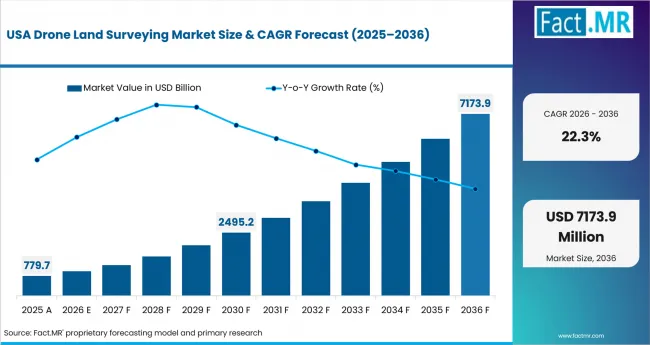
Drone Land Surveying Market Country Value Analysis | Source: Fact.MR
North America has a large service base for drone land surveying. Construction and energy companies use aerial maps to reduce site visits and improve project records. The United States remains the main demand center because Part 107 pilot supply and infrastructure spending support service use.
- United States: The United States is expected to expand at 22.3% CAGR through 2036 as construction owners and utilities use aerial records for site control. March 2026 construction spending stood at a seasonally adjusted annual rate of USD 2,185.5 billion [2]. This project base supports demand for construction survey flights and corridor mapping.
Europe Drone Land Surveying Market Analysis
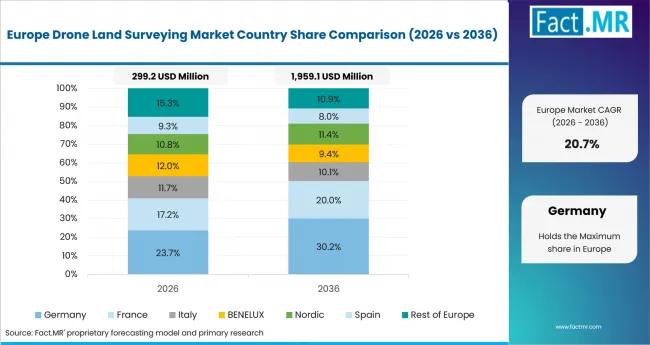
Drone Land Surveying Market Europe Country Market Share Analysis, 2026 & 2036 | Source: Fact.MR
Europe is an established market for drone land surveying because service providers work under strict airspace and data rules. Building renovation and road work create repeat demand. Utility mapping adds another service route for trained drone operators. Germany and the United Kingdom show different demand patterns because construction cycles and drone rules vary.
- Germany: Germany is expected to advance at 23.6% CAGR from 2026 to 2036 as engineering firms use drone survey outputs for redevelopment and utility projects. Eurostat reported Germany construction production down 2.5% year over year in June 2025 [6]. The softer construction cycle pushes service providers toward infrastructure and renovation survey work.
- United Kingdom: The United Kingdom is expected to post 21.4% CAGR by 2036 as property survey work and infrastructure planning keep aerial mapping in use. ONS reported total construction output grew 1.2% in Quarter 2 of 2025 [5]. This output gain supports short-term project checks and site mapping services.
Middle East Drone Land Surveying Market Analysis
Middle East demand is tied to infrastructure corridors and industrial zones. Energy projects create more route survey work. Saudi Arabia leads the regional opportunity as construction sites and public works need faster survey records. Drone service providers with local permits and survey software skills are better placed for repeat orders.
- Saudi Arabia: Saudi Arabia is projected to rise at 24.9% CAGR through 2036 as infrastructure and industrial projects need corridor mapping and site progress records. The Construction Cost Index increased by 1.0% in October 2025 compared with the same month one year earlier [7]. Cost pressure makes accurate site records more useful for contractors that need fewer rework cycles.
Competitive Aligners for Market Players
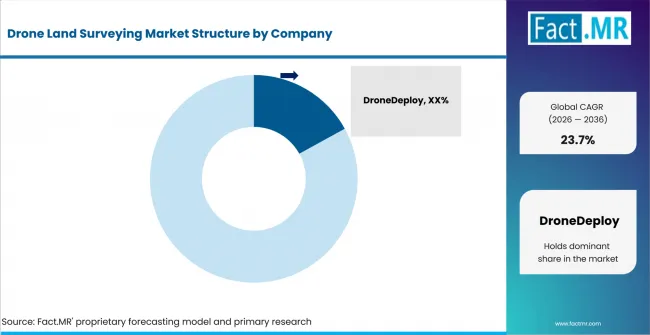
Drone Land Surveying Market Analysis By Company | Source: Fact.MR
Drone land surveying providers compete on pilot certification and output accuracy. Software handoff affects repeat work from construction firms. Construction firms prefer service providers that deliver maps and elevation files in usable formats. Firms with repeat flight plans and aerial inspection services experience can extend work beyond the first survey.
Mapping software capability separates suppliers. DroneDeploy and Pix4D support site data tools that reduce manual processing after flights. Propeller Aero and Firmatek serve survey users through mapping workflows. Service firms with industrial drone inspection methods can serve mining and utilities along with land survey work. Industrial assets add repeat aerial inspection revenue.
Application depth influences service provider selection. Firms offering topographic mapping and orthomosaic delivery can extend work into property planning and construction progress records. Energy-focused survey providers can use corridor mapping experience for transmission routes, solar sites and right-of-way records.
The next competitive layer will come from repeat contracts over single flights. Suppliers that combine licensed pilots with point cloud processing can serve civil infrastructure work. Drone bridge inspection experience strengthens their position in public works. Local presence is important in regulated countries because flight approval and trust affect project timing.
Key Players
- DroneDeploy
- Pix4D SA
- Propeller Aero
- Firmatek
- AUAV
- 3DroneMapping
- AERIUM Analytics
- Terra Drone Corporation
Bibliography
- [1] Federal Aviation Administration. (2025). Compendium to FAA Aerospace Forecast FY 2025–2045: Emerging aviation entrants: Unmanned aircraft systems and advanced air mobility. U.S. Department of Transportation.
- [2] U.S. Census Bureau. (2026, May 7). Monthly construction spending, March 2026 (CB26-75).
- [3] Press Information Bureau. (2026, February 17). India’s drone ecosystem: From policy to public service transformation. Government of India.
- [4] Civil Aviation Administration of China. (2025, December 24). CAAC releases two mandatory national standards for UAV.
- [5] Office for National Statistics. (2025, August 14). Construction output in Great Britain: June 2025, new orders and Construction Output Price Indices, April to June 2025.
- [6] Eurostat. (2025, August 21). Production in construction down by 0.8% in the euro area and by 0.5% in the EU.
- [7] General Authority for Statistics. (2025, November 23). GASTAT publishes the Construction Cost Index for October 2025.
This Report Addresses
- Strategic demand analysis for drone land surveying services across construction and energy projects. Agriculture, mining, oil and gas extraction and property development are covered globally.
- Market forecast from USD 1.5 billion in 2026 to USD 12.6 billion by 2036 at 23.7% CAGR, with segment-level analysis by survey type, end use industry, drone platform, service model, data output and project size.
- Opportunity mapping across India, China, Saudi Arabia, Germany, the United States, Japan and the United Kingdom based on construction activity and drone regulation.
- Segment analysis by type, end use industry, drone platform, service model, data output and project size with regional forecasts through 2036.
- Competitive analysis of DroneDeploy, Pix4D SA, Propeller Aero, Firmatek, AUAV, 3DroneMapping, AERIUM Analytics and Terra Drone Corporation.
- Regulatory impact analysis covering FAA drone fleet forecasts, Part 107 pilot supply, public land mapping programs, drone registration rules and UAV standards.
- Report delivery in PDF, Excel and presentation formats supported by provider portfolios, construction datasets, drone rule updates and survey service interviews.
Drone Land Surveying Market Definition
The drone land surveying market covers drone-based survey services used to create accurate land maps, site records, terrain models, and construction planning outputs. These services use multirotor, fixed wing, and hybrid VTOL drones to capture aerial data for construction, energy, agriculture, mining, oil and gas extraction, and property development projects.
Drone Land Surveying Market Inclusions
Covers global and regional market forecasts from 2026 to 2036 by survey type, end use industry, drone platform, service model, data output, and project size. Includes boundary survey, ALTA survey, topographic survey, construction survey, contour survey, and other drone-supported land survey formats across third-party services, in-house teams, and equipment rental models.
Drone Land Surveying Market Exclusions
Excludes general drone photography services not used for land surveying or site measurement. Omits recreational drone use, media filming, security surveillance, and inspection services that do not produce survey-ready land data. Excludes hardware-only drone sales unless tied directly to land surveying service delivery or rental revenue.
Drone Land Surveying Market Research Methodology
- Primary Research
- Interviews with drone surveying service providers, licensed pilots, construction project managers, civil engineering firms, mining operators, utility corridor planners, and drone software vendors across the United States, Germany, India, China, Saudi Arabia, Japan, and the United Kingdom.
- Desk Research
- Analysis of DroneDeploy, Pix4D SA, Propeller Aero, Firmatek, AUAV, 3DroneMapping, AERIUM Analytics, and Terra Drone Corporation service portfolios and public announcements. Supplemented by FAA drone fleet forecasts, construction spending releases, public land mapping programs, drone registration rules, UAV standards, and national construction activity datasets.
- Market-Sizing and Forecasting
- Hybrid model combining top-down drone services revenue estimates with bottom-up survey project volume projections by end use industry and project size. Average service pricing by survey type, drone platform, data output, and service model is assessed independently and aggregated across all major regions.
- Data Validation and Update Cycle
- Validated through drone service provider portfolios, mapping software workflows, construction project activity, public drone regulation updates, and survey service pricing checks. Updated annually with drone fleet forecasts, pilot certification trends, construction spending data, public mapping programs, and unmanned aircraft rule changes.
Segmentation
Scope of the Report
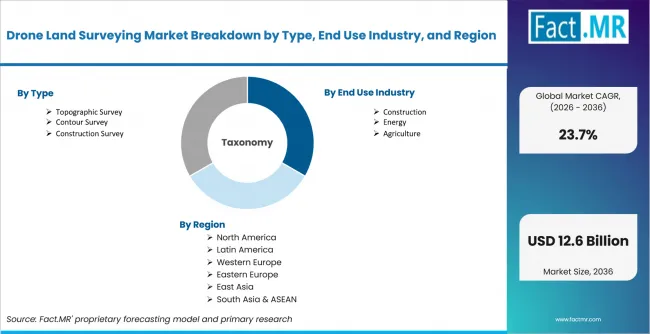
Drone Land Surveying Market Breakdown By Type, End Use Industry, And Region | Source: Fact.MR
| Attribute | Details |
|---|---|
| Quantitative Units | USD 1.5 billion (2026) to USD 12.6 billion (2036), at a CAGR of 23.7% |
| Market Definition | Drone-based land survey services used to create survey-ready maps and site records for construction, energy, agriculture, mining, oil and gas extraction, and property development projects. |
| Type Segmentation | Boundary Survey, ALTA Survey, Topographic Survey, Construction Survey, Contour Survey, Others |
| End Use Industry Segmentation | Construction, Energy, Agriculture, Mining, Oil and Gas Extraction, Others |
| Drone Platform Segmentation | Multirotor Drone, Fixed Wing Drone, Hybrid VTOL Drone |
| Service Model Segmentation | Third-party Service, In-house Team, Equipment Rental |
| Data Output Segmentation | Orthomosaic Map, 3D Point Cloud, Terrain Model, Contour Map |
| Project Size Segmentation | Small Project, Mid-size Project, Large Project |
| Regions Covered | North America, Latin America, Western Europe, Eastern Europe, East Asia, South Asia and Pacific, Middle East and Africa |
| Countries Covered | United States, Canada, Mexico, Germany, United Kingdom, France, Italy, Spain, China, Japan, South Korea, India, Australia, Saudi Arabia, GCC, Brazil |
| Key Companies Profiled | DroneDeploy, Pix4D SA, Propeller Aero, Firmatek, AUAV, 3DroneMapping, AERIUM Analytics, Terra Drone Corporation |
| Forecast Period | 2026 to 2036 |
| Approach | Hybrid top-down and bottom-up model using survey service pricing, drone fleet growth, construction project activity, and interviews with survey service providers. |
Source: Fact.MR analysis. Updated Jun 5, 2026
Drone Land Surveying Market by Segment
-
By Type
- Boundary Survey
- ALTA Survey
- Topographic Survey
- Construction Survey
- Contour Survey
- Others
-
By End Use Industry
- Construction
- Energy
- Agriculture
- Mining
- Oil and Gas Extraction
- Others
-
By Drone Platform
- Multirotor Drone
- Fixed Wing Drone
- Hybrid VTOL Drone
-
By Service Model
- Third-party Service
- In-house Team
- Equipment Rental
-
By Data Output
- Orthomosaic Map
- 3D Point Cloud
- Terrain Model
- Contour Map
-
By Project Size
- Small Project
- Mid-size Project
- Large Project
-
By Region
- North America
- United States
- Canada
- Mexico
- Western Europe
- Germany
- United Kingdom
- France
- Italy
- Spain
- Netherlands
- Nordic Countries
- BENELUX
- Rest of Western Europe
- Eastern Europe
- Poland
- Hungary
- Balkan and Baltic
- Rest of Eastern Europe
- East Asia
- China
- Japan
- South Korea
- South Asia and Pacific
- India
- ASEAN
- Australia and New Zealand
- Rest of South Asia and Pacific
- Middle East and Africa
- Kingdom of Saudi Arabia
- Other GCC Countries
- Turkey
- South Africa
- Rest of Middle East and Africa
Frequently Asked Questions
How large is the global drone land surveying market in 2025?
What will the drone land surveying market size be in 2026?
What is the projected drone land surveying market size by 2036?
What is the expected CAGR for the drone land surveying market from 2026 to 2036?
Which type segment leads the drone land surveying market?
Which end use industry holds the leading drone land surveying market share?
Which country shows the fastest growth in the drone land surveying market?
Who worked on this report


Preview the report firsthand - request a free sample
Free SampleGet the brochure for pricing and purchase details
Download PDF