- Market Value (2025): USD 2.2 Bn
- Estimated Value (2026): USD 2.4 Bn
- Forecast Value (2036): USD 6.5 Bn
- CAGR (2026-2036): 10.5%
What is the Protein Lubrication Fat Replacers Market forecast to be worth by 2036?
USD 2.4 billion in 2026 to USD 6.5 billion by 2036 at a 10.5% CAGR.
- The Protein Lubrication Fat Replacers Market reached USD 2.2 billion in 2025.
- Demand is projected to increase from USD 2.4 billion in 2026 to USD 6.5 billion by 2036.
- The market is forecast to record a 10.5% CAGR from 2026 to 2036.
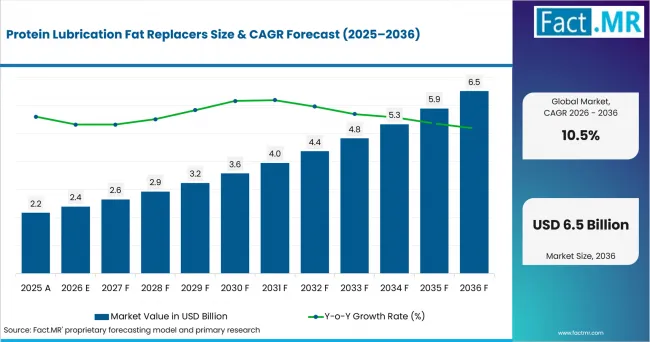
Protein Lubrication Fat Replacers Value Analysis | Source: Fact.MR
What are the defining numbers behind Protein Lubrication Fat Replacers Market growth?
USD 4.1104 billion absolute opportunity is expected between 2026 and 2036.
- Demand Drivers in the Market
- Dairy and dairy-alternative teams need proteins that restore smoothness after fat reduction. USDA NASS reported 213.524 million pounds of U.S. whey protein isolate output in 2025.
- Beverage teams need proteins that disperse well and add body without grit. Formulators test texture after mixing, chilling, and normal shelf life. A useful system should stay smooth without making the drink too thick.
- Sauce and dressing makers need proteins that support creaminess and stable emulsions. Protein must replace part of the sensory role normally supplied by fat. Teams therefore test coating feel and oil-water stability in the finished product.
- Bakery and nutrition-food teams need proteins that help products stay soft after fat reduction. They also check water holding and production handling. The final protein choice must support both processing and eating quality.
- Key Segments Analyzed
- By Protein Platform: Whey proteins are expected to hold 34.0% share in 2026.
- By Functional Role: Lubrication / creaminess is projected to account for 31.0% share in 2026.
- By Application: Dairy / alternatives are expected to capture 36.0% share in 2026.
- By Format: Powder concentrate is forecast to represent 29.0% share in 2026.
- Analyst Opinion at Fact.MR
- Shambhu Nath Jha, Principal Consultant at Fact.MR, states, “Fat reduction is becoming a formulation challenge centered on texture as much as nutrition. Food teams are evaluating creaminess, smoothness, emulsion stability, and process tolerance because higher protein use can create chalkiness or sensitivity to heat and pH. Whey and milk proteins remain important in dairy applications, while plant proteins and custom systems widen the options for formulators seeking familiar mouthfeel across reduced-fat foods and beverages.”
- Strategic Implications
- Dairy teams should compare whey, milk, and plant proteins at the same fat target. Heat and pH can change texture, so teams should test the full recipe. Plant proteins can suit dairy-free labels, while milk proteins fit conventional dairy foods.
- Application teams should measure viscosity and mouthfeel together. They should also test the product after heat treatment and storage. Sauce teams can check coating and emulsion hold, while beverage teams can check flow and smoothness.
- Ingredient blenders can use custom blends when one protein misses the texture target. The blend should remain easy to dose at plant scale. A second texture aid can help balance body and smoothness across several foods.
The USA and France are each forecast at 11.3% CAGR through 2036. China and Germany each record 11.1%, while Japan reaches 10.0%. Dairy activity, protein supply, food costs, and product reformulation shape demand in different ways.
How does the Protein Lubrication Fat Replacers Market break down by segment?
Whey proteins lead Protein Platform at 34.0%; Dairy / alternatives lead Application at 36.0%.
Which Protein Platform dominates?
Whey proteins are expected to hold 34.0% share in 2026.
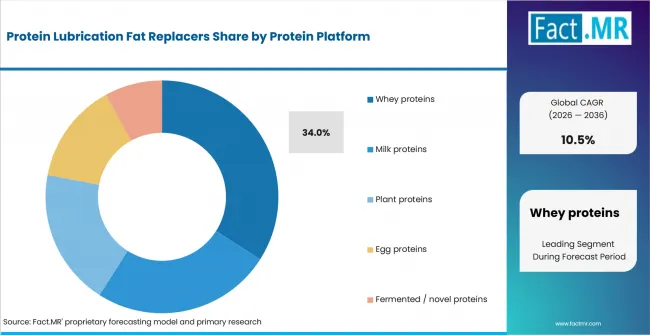
Protein Lubrication Fat Replacers Analysis By Protein Platform | Source: Fact.MR
Whey proteins fit many dairy processes and can add useful body. They also work in selected beverages and nutrition foods. Milk proteins offer another dairy route, while plant and egg proteins serve other product needs.
Whey must stay smooth after heat treatment and storage. Milk proteins can add more structure in dairy foods. Plant proteins suit dairy-free recipes but may need closer flavor and texture control. Egg, fermented, and novel proteins add further options.
What leads the Functional Role segment?
Lubrication / creaminess is projected to account for 31.0% share in 2026.
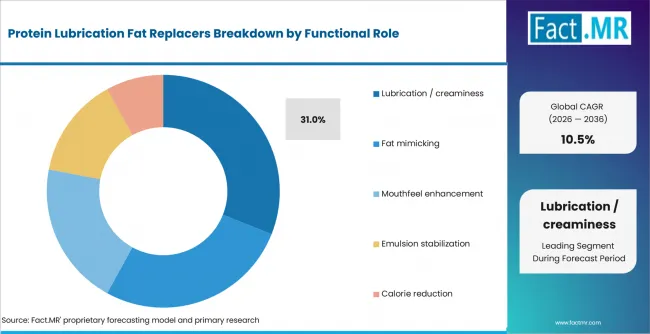
Protein Lubrication Fat Replacers Analysis By Functional Role | Source: Fact.MR
Lubrication / creaminess leads because fat reduction changes mouth coating and smoothness. Fat mimicking has a wider replacement role, while emulsion stability matters in sauces and drinks. The selected function still has to fit the final food.
Fat mimicking replaces part of the sensory effect of fat. Mouthfeel enhancement adds body and smoothness, while emulsion stability keeps oil and water evenly mixed. Food makers may need more than one function from the same protein system.
How does Application shape demand?
Dairy / alternatives are expected to capture 36.0% share in 2026.
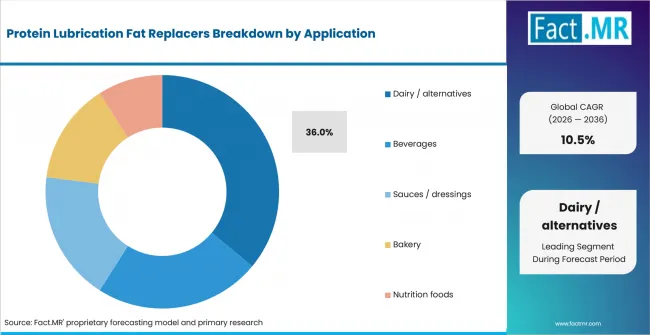
Protein Lubrication Fat Replacers Analysis By Application | Source: Fact.MR
Dairy / alternatives lead because creaminess strongly shapes yoghurt and dessert quality. Plant-based dairy alternatives widen the protein options for this application. Roquette launched NUTRALYS Pea 850F in February 2026 for cleaner-tasting plant protein formulations. Beverages, sauces, and bakery products create further texture needs.
Beverages need proteins that disperse cleanly and avoid a powdery finish. Sauces and dressings need stable emulsions with smooth coating. Bakery products need softness, while nutrition foods need balanced texture at higher protein levels.
What supports Powder Concentrate within Format?
Powder concentrate is forecast to represent 29.0% share in 2026.
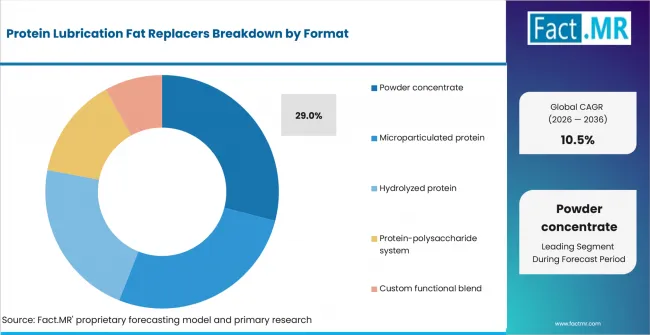
Protein Lubrication Fat Replacers Analysis By Format | Source: Fact.MR
Powder concentrate leads because it stores well and is easy to dose. Hydrolyzed proteins can support dispersion in selected recipes. Microparticulated proteins target a fat-like feel, while custom blends can combine several functions.
Microparticulated protein can create a more fat-like sensory effect. Hydrolyzed protein can help when faster dispersion is useful. Protein-polysaccharide systems and custom blends give formulators more ways to tune texture.
What is accelerating Protein Lubrication Fat Replacers Market adoption, and what is holding it back?
Fat-reduction formulation drives adoption; sensory and processing trade-offs restrain it.
Drivers Impact Analysis
| DRIVER | (~) % IMPACT ON CAGR | GEOGRAPHIC RELEVANCE | IMPACT TIMELINE |
|---|---|---|---|
| Reduced-fat reformulation with texture retention | +1.8% | North America, Europe, East Asia | Short term (<= 2 years) |
| Protein enrichment across dairy and beverages | +1.5% | Global | Medium term (2-4 years) |
| Plant-based dairy texture correction | +1.2% | North America, Europe, China | Medium term (2-4 years) |
| Foodservice and prepared-food creaminess needs | +0.9% | USA, Japan, China | Long term (>= 4 years) |
Opportunity Impact Analysis
| OPPORTUNITY | (~) % IMPACT ON CAGR | GEOGRAPHIC RELEVANCE | IMPACT TIMELINE |
|---|---|---|---|
| Microparticulated protein systems | +1.1% | USA, Germany, France | Medium term (2-4 years) |
| Low-fat dairy and cultured foods | +0.9% | USA, Germany, France, Japan | Short term (<= 2 years) |
| Plant protein sensory improvement | +0.8% | China, USA, Europe | Medium term (2-4 years) |
Restraints Impact Analysis
| RESTRAINT | (~) % IMPACT ON CAGR | GEOGRAPHIC RELEVANCE | IMPACT TIMELINE |
|---|---|---|---|
| Chalkiness or dryness at high protein load | -0.8% | Global | Short term (<= 2 years) |
| Heat and pH sensitivity | -0.6% | Dairy, beverages, sauces | Medium term (2-4 years) |
| Ingredient cost and reformulation burden | -0.5% | Global | Medium term (2-4 years) |
Which countries are scaling the Protein Lubrication Fat Replacers Market through 2036?
- The country comparison spans 1.3 percentage points across the five profiled markets.
- The USA and France share the upper displayed rate at 11.3% CAGR. Broad food recipe work and dairy work support both markets.
- China records 11.1% CAGR as milk and soybean output support both animal and plant protein routes.
- Germany also records 11.1% CAGR. Pulse supply and food recipe capacity support plant-protein use.
- Japan reaches 10.0% CAGR as food-price pressure raises the value of texture-efficient recipe changes.
- France combines an 11.3% CAGR with a large dairy base that supports whey and milk protein uses.
Similar CAGRs can still create different entry conditions. Protein supply, dairy structure, food prices, and local recipe needs vary by country. Adjacent fat-mimetic ingredients face similar mouthfeel tests in reduced-fat foods.
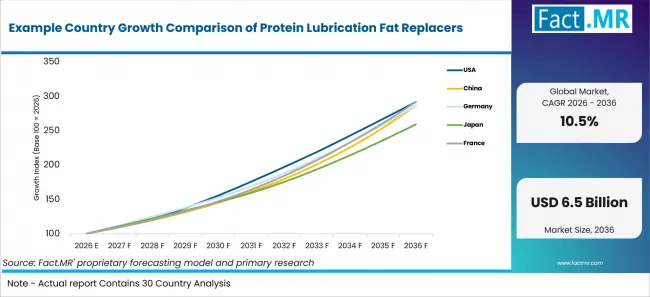
Example Country Growth Comparison Of Protein Lubrication Fat Replacers | Source: Fact.MR
| Country | CAGR (2026-2036) |
|---|---|
| USA | 11.3% |
| China | 11.1% |
| Germany | 11.1% |
| Japan | 10.0% |
| France | 11.3% |
What supports USA adoption?
11.3% CAGR, supported by broad food spending and reduced-fat reformulation.
USDA ERS reported U.S. food spending of USD 2.51 trillion in 2025. This scale gives food brands a broad base for formulation work. Protein systems can support dairy, beverages, sauces, and bakery products when they restore creaminess and remain easy to process.
How is China scaling demand?
11.1% CAGR, led by large milk and soybean supply bases.
China's National Bureau of Statistics reported 40.91 million tonnes of milk output in 2025. The food system supports both dairy and plant-based recipes. Milk proteins fit dairy foods, while plant proteins support dairy-free products with similar texture goals.
What supports Germany's adoption?
11.1% CAGR, backed by pulse availability and food formulation capability.
Destatis reported 139.1 thousand hectares of expected German field-pea area for 2025, up 7.6%. This supply base supports pea-derived ingredients. Plant proteins can serve dairy-free foods, while milk proteins fit conventional dairy products.
How does Japan perform?
10.0% CAGR, shaped by food-cost pressure and texture-focused recipe work.
Japan's Statistics Bureau reported a food CPI of 125.8 in 2025, up 6.8% from 2024. Higher food costs keep recipe efficiency important for product teams. Protein systems can support body and mouthfeel when the dose and process remain controlled.
How is France developing demand?
11.3% CAGR, driven by dairy processing and protein-based texture work.
Agreste reported that French cow-milk collection rose 1.2% year over year in April 2026. The dairy stream supports whey and milk proteins in cultured foods and desserts. Bakery and sauce applications also create demand for body after fat reduction.
Who leads the Protein Lubrication Fat Replacers Market?
Kerry, MicroLub, Arla Foods Ingredients, Roquette, Tate & Lyle, and Leprino Nutrition form a relevant provider set for protein and texture solutions. Across their portfolios, these companies offer dairy proteins, plant proteins, texturants, taste solutions, and formulation support. Supplier selection can vary with the food matrix, target protein level, desired texture, sensory profile, and processing conditions.
Kerry and Arla Foods Ingredients bring protein and dairy-application expertise, including solutions designed to manage taste, texture, and processing performance. Roquette supplies plant-protein ingredients through its NUTRALYS® portfolio.
Competitive differentiation is expected to extend beyond protein content to include sensory performance, texture stability, processing compatibility, and application support. In applications involving thermal processing or extended shelf life, formulators may also evaluate how protein and texture systems perform under relevant temperature, pH, and storage conditions. Sensory testing and process data can support comparisons between protein systems and help guide formulation from development toward commercial-scale production.
Which companies are the key providers?
Key companies include Kerry Group; MicroLub; Arla Foods Ingredients; Roquette; Tate & Lyle; and Leprino Nutrition.
- Kerry Group
- MicroLub
- Arla Foods Ingredients
- Roquette
- Tate & Lyle
- Leprino Nutrition
Bibliography
- U.S. Department of Agriculture, National Agricultural Statistics Service. (2026, April 24). Dairy products 2025 summary.
- Roquette. (2026, February 23). Launch of breakthrough clean-tasting pea protein isolate.
- Zeballos, E., & Sinclair, W. (2026, June 11). Total U.S. food spending reached $2.51 trillion in 2025. U.S. Department of Agriculture, Economic Research Service.
- National Bureau of Statistics of China. (2026, February 28). Statistical communiqué of the People’s Republic of China on the 2025 national economic and social development.
- Federal Statistical Office (Destatis). (2025, May 19). Acreage of important crops in Germany.
- Statistics Bureau of Japan. (2026, January 23). Japan 2025.
- Touati-Houari, N. (2026, June 12). Lait. Avril 2026 : la collecte de lait toujours en hausse sur un an. Agreste.
- Finn, A. (2025, May 28). How to offer better dairy with lactose-free options and reduced added sugar. Kerry.
This Report Answers
- The report explains where protein lubrication systems fit across whey and milk proteins. It also covers plant, egg, fermented, and novel proteins.
- Segment analysis identifies the leading Functional Role, Application, and Format. It explains the commercial reason behind each supplied share.
- Country analysis compares the USA, China, Germany, Japan, and France. It examines protein supply, dairy structure, food costs, and local formulation needs.
- Competitive analysis reviews the six profiled companies. It focuses on protein portfolios, sensory performance, process fit, and application support.
- Application analysis covers lubrication / creaminess and mouthfeel enhancement. It also considers emulsion stability and calorie reduction in food formulation.
What does the Protein Lubrication Fat Replacers Market cover?
The market covers whey and milk proteins used for fat-related texture functions. It also includes plant, egg, fermented, and novel proteins that support creaminess, body, lubrication, or mouthfeel.
The boundary is narrower than the wider fat-replacer category. Coverage focuses on systems where protein performs part of the sensory function. Proteins used only for nutrition fortification sit outside the defined market.
What is included in the scope?
Protein systems used in dairy and beverages are included when they provide lubrication or a fat-like feel. Sauces, bakery, and nutrition foods qualify under the same functional test.
Coverage includes broader fat-replacer systems when protein directly supports sensory replacement in the finished food. The scope includes nearby fat replacer and fat mimetic formulations when protein supplies creaminess or lubrication.
What is excluded from the scope?
Carbohydrate-only fat replacers and lipid-only mimetics fall outside the scope. Proteins used only for nutrition are also excluded.
The scope excludes starch, gum, fiber, oleogel, or emulsifier products without a functional protein component. It also excludes proteins used only for nutrition claims.
How Was the Analysis Built?
The analysis draws on 120+ sources, 35+ company portfolios, 25+ countries, and more than 20 industry interviews.
- Primary Research: Primary research includes discussions with manufacturers, service providers, technology developers, distributors, end users, and subject-matter experts. These conversations examine purchasing priorities, product adoption, operational challenges, approval requirements, competitive positioning, and the factors that influence wider market acceptance.
- Desk Research: Desk research covers government statistics, regulatory publications, company filings, trade data, technical studies, industry associations, standards, public policy, and other authoritative sources. Every source used in the analysis is documented in the bibliography.
- Market Sizing and Forecasting: Market estimates combine historical performance, demand indicators, pricing and volume trends, segment shares, company participation, country-level growth, adoption patterns, investment activity, and barriers to market expansion.
- Data Validation and Update Cycle: Findings are validated by comparing primary interviews with public data, company activity, regulatory changes, trade patterns, and industry developments. Regular updates review new product launches, capacity changes, partnerships, approvals, and shifts in commercial adoption.
What is the report’s scope and coverage?
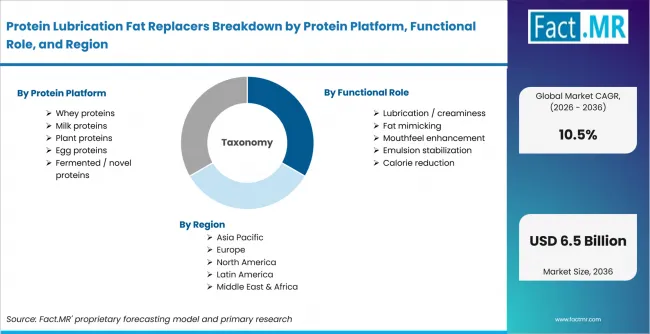
Protein Lubrication Fat Replacers Breakdown By Protein Platform, Functional Role, And Region | Source: Fact.MR
| Attribute | Details |
|---|---|
| Quantitative Units | USD billion |
| Market Definition | Protein-based ingredients and systems used to replace part of fat-related lubrication, creaminess, body, or mouthfeel in foods and beverages. |
| Protein Platform | Whey proteins; Milk proteins; Plant proteins; Egg proteins; Fermented / novel proteins |
| Functional Role | Lubrication / creaminess; Fat mimicking; Mouthfeel enhancement; Emulsion stabilization; Calorie reduction |
| Application | Dairy / alternatives; Beverages; Sauces / dressings; Bakery; Nutrition foods |
| Format | Powder concentrate; Microparticulated protein; Hydrolyzed protein; Protein-polysaccharide system; Custom functional blend |
| Regions Covered | North America; Latin America; Western Europe; Eastern Europe; East Asia; South Asia & Pacific; Middle East & Africa |
| Countries Covered | United States; China; Germany; Japan; France |
| Key Companies Profiled | Kerry Group; MicroLub; Arla Foods Ingredients; Roquette; Tate & Lyle; Leprino Nutrition |
| Forecast Period | 2026 to 2036 |
| Approach | Hybrid top-down and bottom-up assessment using food application demand, protein functionality, formulation intensity, country evidence, and provider portfolio review. |
How is the market segmented?
-
By Protein Platform
- Whey proteins
- Milk proteins
- Plant proteins
- Egg proteins
- Fermented / novel proteins
-
By Functional Role
- Lubrication / creaminess
- Fat mimicking
- Mouthfeel enhancement
- Emulsion stabilization
- Calorie reduction
-
By Application
- Dairy / alternatives
- Beverages
- Sauces / dressings
- Bakery
- Nutrition foods
-
By Format
- Powder concentrate
- Microparticulated protein
- Hydrolyzed protein
- Protein-polysaccharide system
- Custom functional blend
-
By Region
- North America
- Latin America
- Western Europe
- Eastern Europe
- East Asia
- South Asia & Pacific
- Middle East & Africa