- Market Value (2025): USD 1.8 Bn
- Estimated Value (2026): USD 1.9 Bn
- Forecast Value (2036): USD 4.3 Bn
- CAGR (2026-2036): 8.2%
What is the Real-Time Dewpoint Sensors Market forecast to be worth by 2036?
USD 1.9 billion in 2026 to USD 4.3 billion by 2036 at an 8.2% CAGR.
- The Real-Time Dewpoint Sensors Market reached USD 1.8 billion in 2025.
- As per Fact.MR analysis, demand is projected to increase from USD 1.9 billion in 2026 to USD 4.3 billion by 2036.
- The market is forecast to record an 8.2% CAGR from 2026 to 2036 as industrial facilities place continuous moisture measurement closer to critical processes.
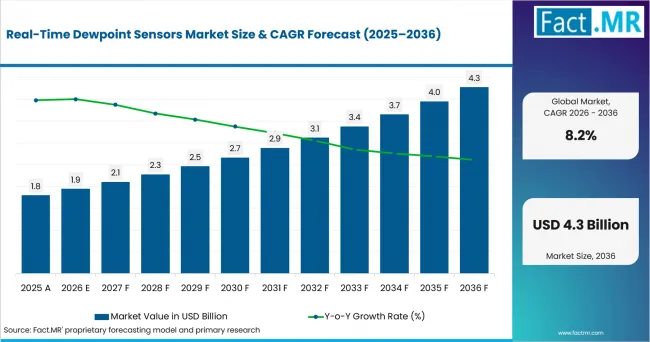
Real Time Dewpoint Sensors Market Value Analysis | Source: Fact.MR
What are the defining numbers behind Real-Time Dewpoint Sensors Market growth?
An absolute opportunity of USD 2.3 billion is expected between 2026 and 2036.
- Demand Drivers in the Market
- Compressed-air and energy-storage facilities need continuous dewpoint readings. In August 2026, the U.S. Energy Information Administration reported that at the end of 2025, utility-scale battery storage in operation totaled 43.6 GW. Battery production and dry rooms need regular moisture checks.
- Battery dry rooms use fast dewpoint readings to detect moisture before it affects battery materials or production.
- Semiconductor plants check moisture in clean dry air and special gases. Low moisture keeps production stable and reduces contamination risk.
- Pharmaceutical and food plants check moisture in compressed air and controlled areas. Records confirm that moisture stays within set limits.
- Key Segments Analyzed
- By Sensing Principle: Capacitive polymer is expected to hold a 29.0% share in 2026.
- By Dewpoint Range: Above -20°C Td accounts for 36.0% share in 2026 as it is widely used for air dryers and general plant air.
- By Response Class: <5 sec is expected to hold a 32.0% share in 2026.
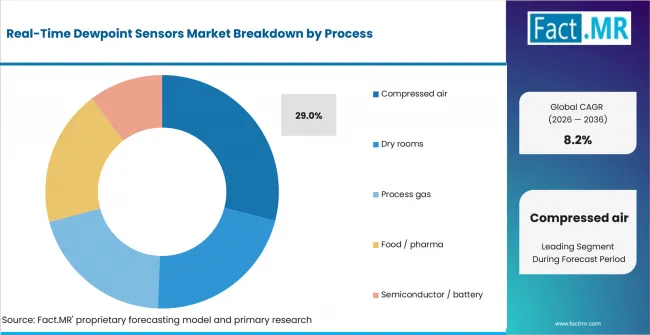
- By Process: Compressed air leads with a 29.0% share in 2026 since factories use dewpoint sensors to check moisture in air dryers.
- Analyst Opinion at Fact.MR
- Shambhu Nath Jha, Principal Consultant at Fact.MR, states, “Demand is growing for sensors that give fast and accurate readings in very dry conditions. Suppliers need reliable sensors with digital checks and easy replacement.”
- Strategic Implications
- Sensor makers can test response time under actual gas flow and pressure. Engineers can then compare how quickly sensors detect moisture changes.
- Dryer manufacturers can connect dewpoint readings with control and service systems. This reduces manual checks and finds dryer problems earlier.
- Battery and semiconductor plants can place sensors near sensitive production areas. Average room readings may miss small moisture changes near equipment.
- Calibration providers can offer regular service and quick sensor replacement. This keeps production lines monitored during maintenance.
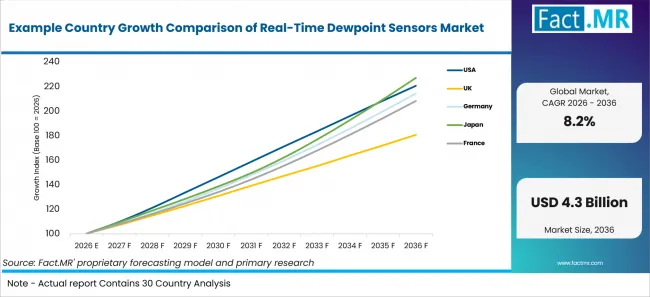
Japan is expected to grow at a CAGR of 8.5% till 2036, driven by investments in batteries and semiconductors. The USA is next with 8.2% spurred by growth in semiconductors and regulated manufacturing. Germany is anticipated to 7.9% CAGR while France holds 7.6% CAGR. The UK records 6.1% due to advanced manufacturing.
How does the Real-Time Dewpoint Sensors Market break down by segment?
Above -20°C Td leads Dewpoint Range at 36.0%; while <5 sec leads Response Class at 32.0% share in 2026.
Which Sensing Principle dominates?
Capacitive polymer is expected to hold 29.0% share in 2026.
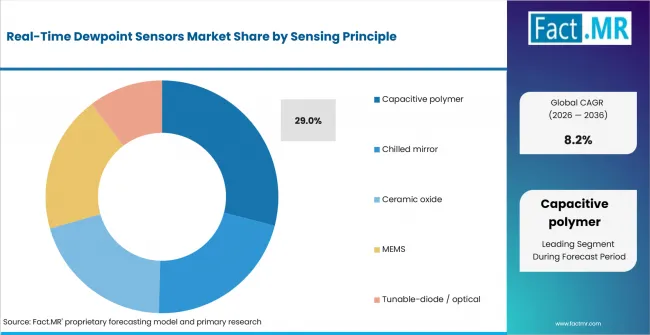
Real Time Dewpoint Sensors Market Analysis By Sensing Principle | Source: Fact.MR
Capacitive polymer sensors are small and continuously read moisture levels. They are used at dryer outlets, in dry rooms and in process equipment. Chilled-mirror sensors provide direct dewpoint readings . Ceramic oxide sensors are used for very dry gasses, where fast readings or small sensors are desired. Plants choose sensors based on range, speed, gas type, and maintenance.
What leads the Dewpoint Range segment?
Above -20°C Td is projected to account for 36.0% share in 2026.
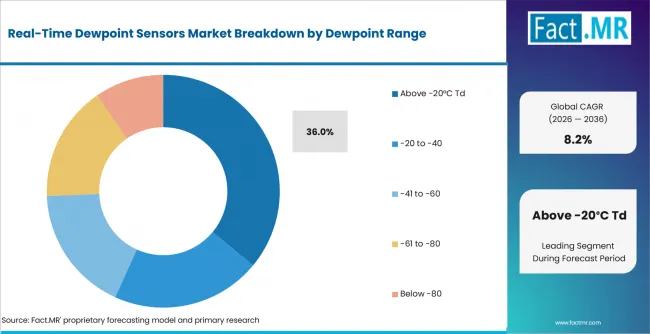
Real Time Dewpoint Sensors Market Analysis By Dewpoint Range | Source: Fact.MR
Above -20°C Td is widely used for refrigeration dryers and plant air. The -20 to -40°C and -41 to -60°C ranges are used for drier air. Lower ranges are used for adsorption dryers and sensitive production areas. The -61 to -80°C and below -80°C ranges are used in battery dry rooms, semiconductor equipment, and special gases. These areas need accurate readings and quick warnings when moisture changes.
How does Response Class shape demand?
<5 sec is anticipated to lead with 32.0% share in 2026.
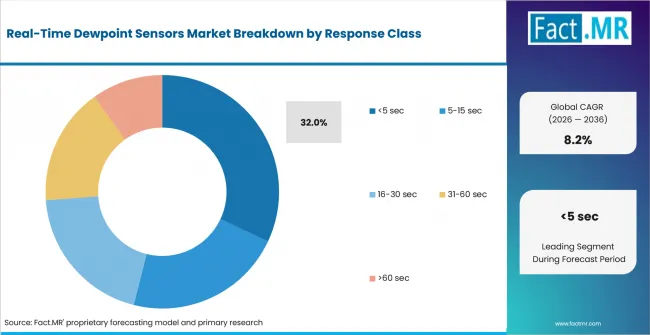
Real Time Dewpoint Sensors Market Analysis By Response Class | Source: Fact.MR
Fast readings are important with changing moisture levels. Fast responding (<5 second) sensors can give early warning of moisture changes near dryers, dry rooms and sensitive equipment. Medium-speed sensors are used for regular checks, while slower sensors are used where moisture levels stay stable.
What supports Compressed air within Process?
Compressed air is estimated to represent 29.0% share in 2026.
Real Time Dewpoint Sensors Market Analysis By Process | Source: Fact.MR
Compressed air is expected to remain the largest use area because plants check moisture after air dryers. Dewpoint sensors can track moisture levels and show if dryers are working properly. The U.S. Department of Commerce reported in June 2025 that Micron planned about USD 200 billion in U.S. semiconductor manufacturing and R&D investment.
What is accelerating Real-Time Dewpoint Sensors Market adoption, and what is holding it back?
More dry processes increase sensor use, while calibration and sensor choice can slow growth.
Drivers Impact Analysis
| DRIVER | (~) % IMPACT ON CAGR | GEOGRAPHIC RELEVANCE | IMPACT TIMELINE |
|---|---|---|---|
| Battery dry-room capacity and tighter moisture control | +1.7% | North America, Europe, East Asia | Medium term (2-4 years) |
| Semiconductor fab and specialty-gas monitoring | +1.5% | USA, Germany, Japan, France, UK | Medium term (2-4 years) |
| Compressed-air dryer monitoring and energy control | +1.2% | Global | Short term (<= 2 years) |
| Regulated pharmaceutical and food process monitoring | +0.8% | North America, Europe, Japan | Long term (>= 4 years) |
Opportunity Impact Analysis
| OPPORTUNITY | (~) % IMPACT ON CAGR | GEOGRAPHIC RELEVANCE | IMPACT TIMELINE |
|---|---|---|---|
| Ultra-dry transmitters for battery and semiconductor lines | +1.3% | USA, Germany, Japan, France | Medium term (2-4 years) |
| IO-Link and digital integration in dryer OEM systems | +0.9% | Europe, North America, Japan | Short term (<= 2 years) |
| Intrinsically safe dewpoint monitoring for gas processes | +0.7% | Global process industries | Long term (>= 4 years) |
Restraints Impact Analysis
| RESTRAINT | (~) % IMPACT ON CAGR | GEOGRAPHIC RELEVANCE | IMPACT TIMELINE |
|---|---|---|---|
| Calibration and contamination management in low-dewpoint service | -0.7% | Global | Short term (<= 2 years) |
| Slow recovery or drift under changing process conditions | -0.5% | Industrial manufacturing hubs | Medium term (2-4 years) |
| Application mismatch between sensor principles and gas conditions | -0.4% | Global | Long term (>= 4 years) |
Which countries are scaling the Real-Time Dewpoint Sensors Market through 2036?
- The displayed country comparison spans 2.4 percentage points from Japan at 8.5% to the UK at 6.1% through 2036.
- Japan stays 0.3 percentage point above the USA as battery and semiconductor projects expand ultra-dry process needs.
- The USA stays 0.3 percentage point above Germany as fabs and regulated manufacturing add moisture-monitoring points.
- Germany remains 0.3 percentage point above France through semiconductor and battery investment.
- France remains 1.5 percentage points above the UK as battery capacity expands dry-room measurement needs.
Country growth differs with the mix of compressed air, dry rooms, process gas, pharmaceuticals, batteries, and semiconductors. Full coverage spans North America, Latin America, Western Europe, Eastern Europe, East Asia, South Asia & Pacific, and Middle East & Africa.
Example Country Growth Comparison Of Real Time Dewpoint Sensors Market | Source: Fact.MR
| Country | CAGR (2026-2036) |
|---|---|
| Japan | 8.5% |
| United States | 8.2% |
| Germany | 7.9% |
| France | 7.6% |
| United Kingdom | 6.1% |
How is Japan developing demand?
Japan is anticipated to hold 8.5% CAGR through 2036.
Japan’s battery and semiconductor plants need strict moisture control during production. The Ministry of Economy, Trade and Industry reported in June 2026 that its revised Battery and Power Industry Strategy targets 150 GWh per year of domestic battery production capacity from 2030 to the mid-2030s.
What is driving adoption in the USA?
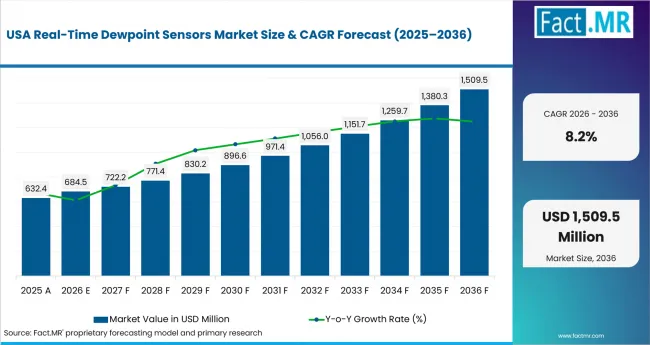
8.2% CAGR, supported by semiconductor and regulated manufacturing.
Real Time Dewpoint Sensors Market Country Value Analysis | Source: Fact.MR
U.S. semiconductor, pharmaceutical, and battery plants need regular moisture checks during production. The U.S. Food and Drug Administration reported in August 2025 that only 11% of manufacturers producing APIs used in FDA-approved products were based in the United States when it announced FDA PreCheck to support domestic pharmaceutical manufacturing.
What is supporting Germany’s adoption?
7.9% CAGR, supported by semiconductor and battery projects.
Germany’s semiconductor and battery plants need moisture checks in very dry gases and clean air. The Federal Ministry for Economic Affairs reported in February 2025 that Infineon planned about EUR 3.4 billion to expand semiconductor production in Dresden. These plants need controlled gas and air conditions during production.
How does France perform?
France lead 7.6% CAGR, driven by battery and manufacturing investment.
Battery production in France is increasing the need for moisture checks in dry rooms and process gases. The Ministry for Ecological Transition reported in December 2025 that Verkor's Dunkirk battery gigafactory represented EUR 1.5 billion of investment. Large battery plants need very low moisture levels during production.
What supports the United Kingdom’s growth?
6.1% CAGR, supported by manufacturing and regulated production.
Moisture sensors are used in compressed air, semiconductor production and controlled plants in UK factories. In July 2026, the Office for National Statistics said UK manufacturers had £452.0 billion in product sales in 2025. The demand for moisture checks in air dryers and production systems is driven by the country’s large manufacturing industry.
Who leads the Real-Time Dewpoint Sensors Market?
Vaisala supplies DRYCAP sensors for compressed air, battery dry rooms, semiconductor production, and pure gases. Its products include small probes, transmitters, and sensors for very dry conditions. They provide fast readings, digital connections, and calibration support for continuous moisture checks.
Michell Instruments, part of Process Sensing Technologies, supplies moisture transmitters and chilled-mirror dewpoint analyzers. In February 2025, the company launched the CD603 Condumax analyzer to measure water and hydrocarbon dewpoint in gases. It can provide continuous readings and is approved for use in hazardous areas.
CS Instruments supplies dewpoint and moisture sensors for compressed-air systems. Rotronic offers humidity and dewpoint sensors, while SUTO iTEC supplies dewpoint sensors for compressed air and industrial gases. Testo also supplies dewpoint transmitters for compressed-air and dry-air systems.
Which companies are the key providers?
Key companies include Vaisala; Michell Instruments; CS Instruments; Rotronic; SUTO iTEC; and Testo.
- Vaisala
- Michell Instruments
- CS Instruments
- Rotronic
- SUTO iTEC
- Testo
Bibliography
- U.S. Energy Information Administration. (2026, August 7). Battery storage capacity averaged 70% growth over the last three years.
- U.S. Department of Commerce. (2025, June 12). President Trump secures $200B investment from Micron Technology for memory chip manufacturing in the United States.
- Vaisala. (2026, March 5). Vaisala launches DMT153 dew point transmitter for ultra-dry processes.
- Ministry of Economy, Trade and Industry. (2026, June 2). “Battery Industry Strategy” revised as the “Battery and Power Industry Strategy.”
- U.S. Food and Drug Administration. (2025, August 7). FDA announces new FDA PreCheck program to boost U.S. drug manufacturing.
- Federal Ministry for Economic Affairs and Climate Action. (2025, February 20). Europäische Kommission genehmigt weiteres deutsches Chips-Act-Projekt: Infineon baut seine Chip-Produktion in Dresden aus [European Commission approves another German Chips Act project: Infineon expands its chip production in Dresden].
- Office for National Statistics. (2026, July 24). UK manufacturers’ sales by product: 2025.
- Process Sensing Technologies. (2025, February 28). Introducing the CD603 Condumax Dew-point Analyzer.
This Report Answers
- The report covers real-time dewpoint sensing by principle, range, response class, and process.
- Segment analysis explains why compressed air and ultra-dry manufacturing require different sensor performance.
- Country analysis compares Japan, the USA, Germany, France, and the UK using current official evidence.
- Competitive analysis reviews current providers across major dewpoint sensing approaches.
- Application analysis considers response, calibration, contamination resistance, connectivity, and range.
What does the Real-Time Dewpoint Sensors Market cover?
The Real-Time Dewpoint Sensors Market covers instruments that measure water-vapor dewpoint or frost point continuously in industrial gas and controlled environments. It includes inline transmitters, probes, analyzers, and OEM sensors used in compressed air, dry rooms, process gases, and high-purity production systems.
The assessment covers electronic moisture-sensing technologies and chilled optical surfaces used for reference-style dewpoint measurement. It spans moderate pressure dewpoints through ultra-dry ranges below -80 °C Td.
What is included in the scope?
The scope includes fixed and OEM transmitters used in compressed-air dryers, clean dry air, process gases, battery dry rooms, semiconductor plants, pharmaceutical utilities, and food production. Related food-grade dewpoint sensors show how moisture measurement moves into regulated production and clean-utility applications.
Covered principles include capacitive polymer, ceramic oxide, chilled mirror, MEMS, and optical sensing. The wider measurement stack also includes compressed air quality sensors where dewpoint is one of several plant-air quality parameters.
What is excluded from the scope?
The scope excludes laboratory hygrometers used only for occasional manual checks, weather-station calculations, and comfort sensors outside industrial process use. Adjacent safety monitoring such as gas detection equipment remains outside the market unless the instrument also performs dewpoint measurement.
How Was the Analysis Built?
The analysis draws on 120+ sources, 35+ company portfolios, 25+ countries, and more than 20 industry interviews.
- Primary Research: Primary research includes discussions with manufacturers, service providers, technology developers, distributors, end users, and subject-matter experts. These conversations examine purchasing priorities, product adoption, operational challenges, approval requirements, competitive positioning, and the factors that influence wider market acceptance.
- Desk Research: Desk research covers government statistics, regulatory publications, company filings, trade data, technical studies, industry associations, standards, public policy, and other authoritative sources. Every source used in the analysis is documented in the bibliography.
- Market Sizing and Forecasting: Market estimates combine historical performance, demand indicators, pricing and volume trends, segment shares, company participation, country-level growth, adoption patterns, investment activity, and barriers to market expansion.
- Data Validation and Update Cycle: Findings are validated by comparing primary interviews with public data, company activity, regulatory changes, trade patterns, and industry developments. Regular updates review new product launches, capacity changes, partnerships, approvals, and shifts in commercial adoption.
What is the report’s scope and coverage?
Real Time Dewpoint Sensors Market Breakdown By Sensing Principle, Dewpoint Range, And Region | Source: Fact.MR
| Attribute | Details |
|---|---|
| Quantitative Units | USD billion |
| Market Definition | Sensors, transmitters, and analyzers used for continuous or near-continuous measurement of dewpoint or frost point in compressed air, dry rooms, process gas, specialty gas, and controlled industrial environments. |
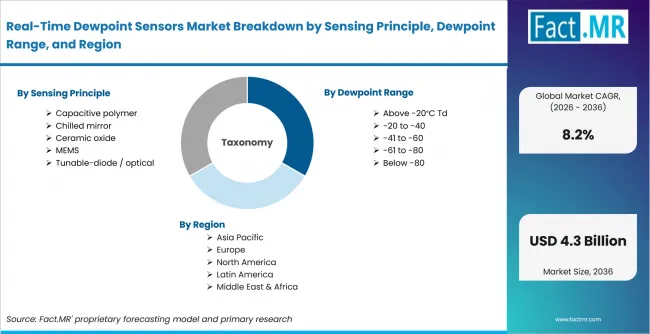
| Sensing Principle | Capacitive polymer; Chilled mirror; Ceramic oxide; MEMS; Tunable-diode / optical |
| Dewpoint Range | Above -20°C Td; -20 to -40; -41 to -60; -61 to -80; Below -80 |
| Response Class | <5 sec; 5-15 sec; 16-30 sec; 31-60 sec; >60 sec |
| Process | Compressed air; Dry rooms; Process gas; Food / pharma; Semiconductor / battery |
| Regions Covered | North America; Latin America; Western Europe; Eastern Europe; East Asia; South Asia & Pacific; Middle East & Africa |
| Countries Covered | United States; United Kingdom; Germany; Japan; France |
| Key Companies Profiled | Vaisala; Michell Instruments; CS Instruments; Rotronic; SUTO iTEC; Testo |
| Forecast Period | 2026 to 2036 |
| Approach | Hybrid top-down and bottom-up approach using industrial process demand, application intensity, installed measurement points, replacement cycles, country manufacturing indicators, and provider portfolio review. |
How is the market segmented?
-
By Sensing Principle:
- Capacitive polymer
- Chilled mirror
- Ceramic oxide
- MEMS
- Tunable-diode / optical
-
By Dewpoint Range:
- Above -20°C Td
- -20 to -40
- -41 to -60
- -61 to -80
- Below -80
-
By Response Class:
- <5 sec
- 5-15 sec
- 16-30 sec
- 31-60 sec
- >60 sec
-
By Process:
- Compressed air
- Dry rooms
- Process gas
- Food / pharma
- Semiconductor / battery
-
By Region:
- North America
- Latin America
- Western Europe
- Eastern Europe
- East Asia
- South Asia & Pacific
- Middle East & Africa