- Market Value (2025): USD 841.0 Mn
- Estimated Value (2026): USD 920.0 Mn
- Forecast Value (2036): USD 2259.2 Mn
- CAGR (2026-2036): 9.4%
What is the Compressed Air Quality Sensors Market forecast to be worth by 2036?
The Compressed Air Quality Sensors Market is projected to reach USD 2,259.2 million by 2036, from USD 920.0 million in 2026, at a 9.4% CAGR.
- The market stood at USD 841.0 million in 2025.
- Demand is valued at USD 920.0 million in 2026 and is forecast to reach USD 2259.2 million by 2036.
- Growth is projected at 9.4% CAGR from 2026 to 2036. Additional measurement points and replacement of stand-alone indicators with recorded alarms support instrument spending.
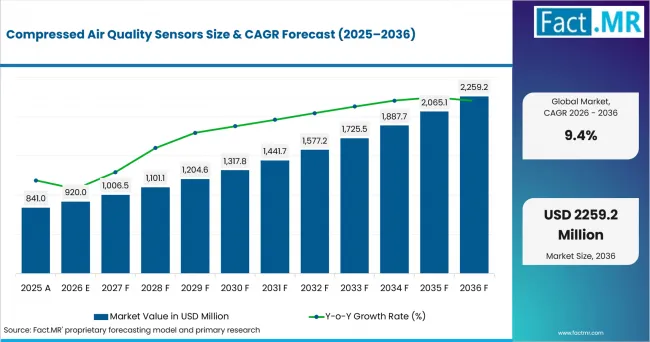
Compressed Air Quality Sensors Value Analysis | Source: Fact.MR
What are the defining numbers behind Compressed Air Quality Sensors Market growth?
The absolute opportunity between 2026 and 2036 is USD 1,339.2 million.
- Demand Drivers in the Market
- Food plants reassessing direct-contact air need measurements at vulnerable use points. FDA equipment rules require appropriate treatment of compressed air introduced into food or used to clean food-contact surfaces, giving quality teams a practical reason to specify monitoring alongside treatment equipment.
- Sterile pharmaceutical operations need gas specifications aligned with contamination risk. EU GMP Annex 1 addresses chemical, particulate and microbial quality, supporting purchases of appropriate physical instruments within a wider testing programme.
- Plants connecting dryer and filter alarms to maintenance systems can shorten the interval between a utility excursion and intervention. That creates demand for sensors compatible with machine monitoring workflows.
- Production expansions add branches and point-of-use treatment stages. Each new critical connection can require a measurement location even where the site retains its existing central compressor installation.
- Key Segments Analyzed
- Within Parameter, the Dewpoint segment holds a 29.0% share in 2026. Moisture readings help operators identify dryer deterioration before condensation threatens the process.
- The Inline fixed segment leads Sensor Format with 38.0% of 2026 revenue. Permanent installation captures operating changes that a scheduled spot check may miss.
- For Industry, 27.0% of 2026 revenue comes from the Food & beverage segment. Direct and indirect product-contact applications make utility excursions a product-quality issue.
- The leading Compliance segment is ISO 8573 monitoring, accounting for 42.0% in 2026. Separate purity classes provide a common structure for agreeing particulate, water and oil specifications.
- Analyst Opinion at Fact.MR
- Shambhu Nath Jha, Principal Consultant, Fact.MR“A compressed-air reading becomes useful when the sampling point, operating pressure and alarm response are understood. Suppliers that make those conditions repeatable can win repeat orders across a plant. A sensor with an attractive range but an unrepresentative sample leaves the buyer with the same uncertainty.”
- Strategic Implications
- Instrument suppliers should specify sample conditioning, pressure basis and calibration requirements with the sensor so integrators can reproduce its intended measurement conditions.
- Food and pharmaceutical buyers should map each instrument to the hazard it observes, then identify the tests still needed for contaminants outside its capability.
- System integrators should connect excursions to maintenance and quality decisions, including escalation rules and records within automation controls.
How does the Compressed Air Quality Sensors Market break down by segment?
The market is segmented by Parameter, Sensor Format, Industry, and Compliance.
Why does the Dewpoint segment lead Parameter?
The Dewpoint segment holds a 29.0% share of the Parameter category in 2026.
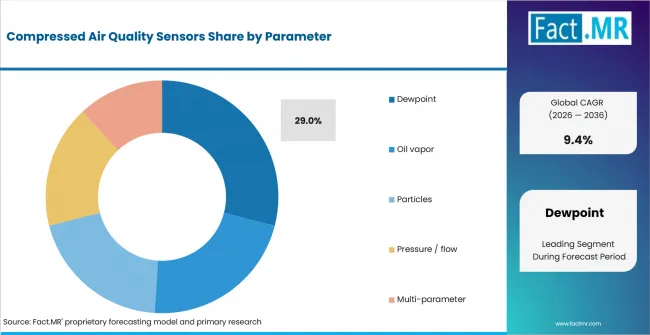
Compressed Air Quality Sensors Analysis By Parameter | Source: Fact.MR
Drying is a continuing operating duty, and changing dryer load can alter the moisture condition of the distribution system. Dewpoint measurement gives operators a direct variable for supervising that duty. The buying case is especially clear where condensation can disrupt a process or where dry-air specifications are tied to a downstream product requirement.
Pressure dewpoint and a measurement made after pressure reduction must be interpreted on the correct basis. Installation design also has to consider response time and the condition of the sample line. ISO 8573-1 treats water, particles and oil separately, so a satisfactory dewpoint reading does not establish compliance for the other contaminant classes.
Why does the Inline fixed segment lead Sensor Format?
The Inline fixed segment holds a 38.0% share of the Sensor Format category in 2026.
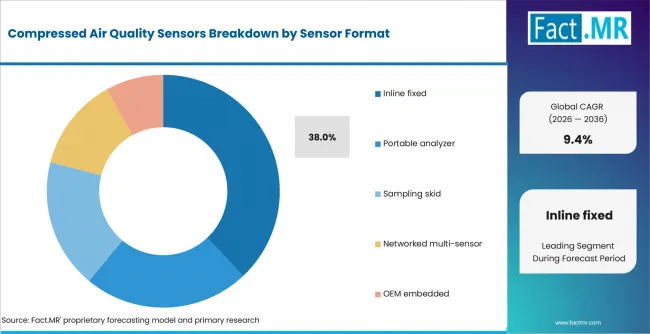
Compressed Air Quality Sensors Analysis By Sensor Format | Source: Fact.MR
A fixed device follows the system through start-up, production changes and dryer switching. Facilities operating continuously can use its trend to distinguish a recurring disturbance from a one-time reading. This makes the format attractive where an alarm needs to reach operators while the affected process is still running.
Portable analyzers remain useful for troubleshooting and selecting permanent monitoring locations. The two purchases can be complementary: a survey establishes where conditions vary, then fixed instrumentation watches the consequential points. Installation access, isolation valves and service arrangements influence whether a device can remain dependable over its operating life.
Why does the Food & beverage segment lead Industry?
The Food & beverage segment holds a 27.0% share of the Industry category in 2026.
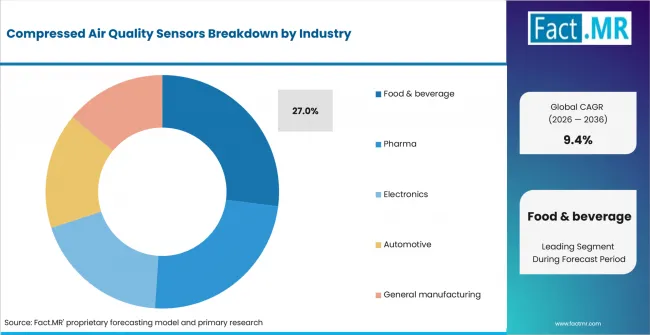
Compressed Air Quality Sensors Analysis By Industry | Source: Fact.MR
Food and beverage processors use compressed air around conveying, filling and cleaning operations, where contamination pathways depend on the specific connection. Buyers need to distinguish air that touches food or packaging surfaces from utility air serving isolated actuators. FDA requirements link treatment to preventing contamination rather than imposing one universal sensor configuration.
Projects involving food processing equipment can therefore generate demand for a site-specific combination of moisture, oil and particle instruments. The monitoring plan must match actual exposure. A large instrument package has limited value if its measurement point bypasses the pipework or filter whose condition the quality team needs to understand.
Why does the ISO 8573 monitoring segment lead Compliance?
The ISO 8573 monitoring segment holds a 42.0% share of the Compliance category in 2026.
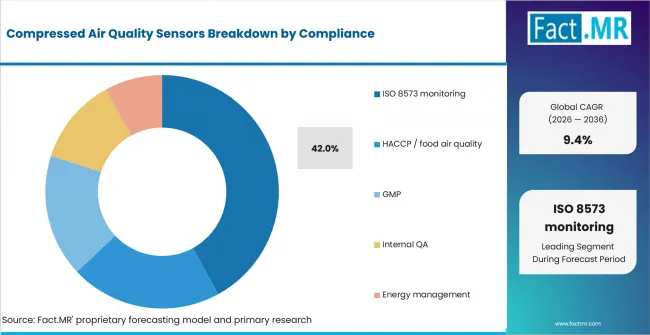
Compressed Air Quality Sensors Analysis By Compliance | Source: Fact.MR
ISO 8573-1 provides a recognised classification framework for compressed-air purity. Its separate contaminant categories help equipment buyers translate a process requirement into an agreed specification with a treatment supplier or testing provider. That common language supports instrument selection and comparison across facilities.
The standard does not turn every inline device into a complete certification system. Buyers still need suitable measurement methods, representative samples and a defined acceptance procedure. Multi-parameter packages can simplify installation, but the measurement capability of each channel and the treatment of oil vapor, aerosols or liquid must be established individually.
What is accelerating Compressed Air Quality Sensors Market adoption, and what is holding it back?
The transition from periodic checks to continuous supervision is strongest where a delayed response can create a costly production hold. Networked instruments can make utility conditions visible alongside production events in a smart factory. The useful result is a traceable relationship between an excursion, the affected process and the corrective action.
Calibration expense, sampling errors and uncertainty about alarm ownership can slow deployment. An installed sensor also cannot correct a poorly maintained dryer or filter. Buyers consequently need to budget for instrument care and treatment-system maintenance together, while avoiding an alarm threshold that causes repeated interventions without an established product-risk basis.
Drivers Impact Analysis
| Factor | (~) % Impact on CAGR | Geographic Relevance | Impact Timeline |
|---|---|---|---|
| Continuous surveillance of product-contact air | +0.8% | USA, UK, Germany | 2026 to 2031 |
| Pharmaceutical utility qualification | +0.6% | Switzerland, Germany, USA | 2026 to 2033 |
| Alarms linked to dryer maintenance | +0.5% | Global | 2027 to 2034 |
Source: Fact.MR analysis. Updated Sep 10, 2026
The estimates give greater weight to applications where an air-quality excursion can interrupt product release. Maintenance integration has a broader addressable base but depends on plants assigning responsibility for alarm response.
Opportunity Imact Analysis
| Factor | (~) % Impact on CAGR | Geographic Relevance | Impact Timeline |
|---|---|---|---|
| Monitoring at additional use points | +0.7% | Global | 2027 to 2036 |
| Portable surveys preceding fixed installation | +0.4% | UK, Japan, USA | 2026 to 2032 |
| Integrated sampling and multi-sensor packages | +0.5% | Germany, Switzerland, Japan | 2028 to 2036 |
Source: Fact.MR analysis. Updated Sep 10, 2026
Expansion is assessed through additional measurement locations and the conversion of survey findings into permanent installations. Multiple sensors in one package are treated as an integrated sale, avoiding a second allowance for the same hardware.
Restraints Impact Analysis
| Factor | (~) % Impact on CAGR | Geographic Relevance | Impact Timeline |
|---|---|---|---|
| Calibration downtime and service expense | -0.6% | Global | 2026 to 2036 |
| Unrepresentative samples and nuisance alarms | -0.5% | Global | 2026 to 2032 |
| Budget preference for periodic testing | -0.4% | Global | 2026 to 2031 |
Source: Fact.MR analysis. Updated Sep 10, 2026
The principal friction is the lifetime burden of keeping measurements trustworthy. Where periodic testing satisfies the operating requirement, permanent instruments must justify their additional installation and service cost.
Which countries are scaling the Compressed Air Quality Sensors Market through 2036?
- Germany: Engineered production networks support demand for instruments that connect air-quality signals to plant controls and maintenance routines.
- USA: Product-contact air in food processing creates a clear route from contamination assessment to point-of-use measurement purchases.
- UK: Compressed-air specialists can convert plant surveys into targeted monitoring projects supported by local service and calibration.
- Japan: Process-specific hygiene management favours carefully selected measurement locations within established manufacturing routines.
- Switzerland: Pharmaceutical utility qualification places emphasis on traceable measurements, controlled changes and inspection-ready records.
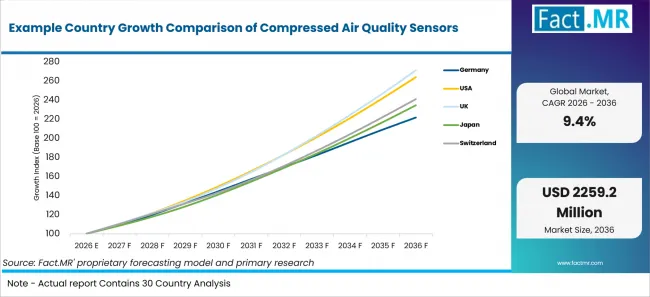
Example Country Growth Comparison Of Compressed Air Quality Sensors | Source: Fact.MR
Country CAGR (2026-2036)
| Country | CAGR (2026-2036) |
|---|---|
| Germany | 8.3% |
| USA | 10.2% |
| UK | 10.5% |
| Japan | 8.9% |
| Switzerland | 9.2% |
Source: Fact.MR analysis. Updated Sep 10, 2026
What is driving Germany's growth through 2036?
Germany is projected to record an 8.3% CAGR.
For pharmaceutical installations, EU GMP Annex 1 makes gas quality part of a broader contamination-control requirement. That gives instrument purchases a defined operating context: the plant must understand the gas specification, its use and the tests needed to maintain control.
The engineering opportunity extends to connecting moisture and contamination alarms with filter maintenance, dryer performance and production status. Suppliers can strengthen their position through dependable interfaces and local calibration support. A project that records a reading without a response procedure is less likely to expand across additional production areas.
What is driving USA's growth through 2036?
USA demand is forecast to grow at 10.2% CAGR.
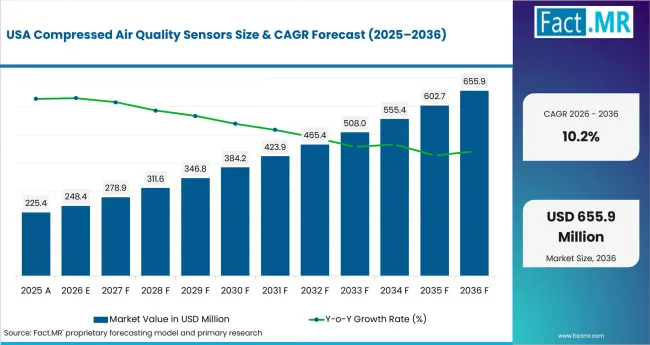
Compressed Air Quality Sensors Country Value Analysis | Source: Fact.MR
FDA's equipment and utensils provision explicitly addresses compressed air introduced into food and air used to clean food-contact surfaces. It creates a concrete compliance context for treatment and verification while leaving the appropriate monitoring configuration dependent on the operation.
Purchasing can therefore begin with a filling or conveying line and expand toward its upstream utility branches. For plants adding packaging automation, separating pneumatic actuation from product-exposure points helps direct instrumentation spending toward the connections with a meaningful contamination pathway.
What is driving UK's growth through 2036?
UK growth is projected at 10.5% CAGR.
The British Compressed Air Society provides technical guidance and access to equipment and service expertise across food processing, pharmaceuticals and other industries. This supports a practical procurement channel in which a specialist first diagnoses the air system and then recommends measurement and treatment changes.
Service-led projects are particularly relevant to existing plants with limited instrument access or inconsistent sampling arrangements. Portable assessment can identify whether a concern arises at the compressor room, a distribution branch or a point-of-use filter. Permanent sensors become easier to justify when that work establishes where an alarm will change an operating decision.
What is driving Japan's growth through 2036?
Japan is forecast to advance at 8.9% CAGR.
MHLW's HACCP implementation resources include manufacturing guidance for dairy, beverages, baked goods and other foods, reinforcing the importance of matching controls to the actual process. Air-quality instrumentation fits this approach when the hazard analysis identifies a relevant exposure route.
The commercial task is to integrate measurement without disturbing established production and cleaning routines. Compact installations, clear maintenance access and controlled sampling conditions can influence acceptance. Suppliers should connect the instrument specification to the factory's own air requirement rather than imply that HACCP prescribes the same ISO purity class for every food operation.
What is driving Switzerland's growth through 2036?
Switzerland is projected to grow at 9.2% CAGR.
Swissmedic issues establishment licences for medicinal-product activities following a successful inspection or other evaluation. This inspection context increases the commercial importance of traceable utility-control records and clear responsibility for changes to qualified equipment.
For pharmaceutical gas systems, suppliers can compete through calibration continuity, controlled replacement procedures and documentation that connects instrument performance to the intended measurement. Physical air-quality sensors remain one part of the control plan. Where microbiological testing is required, moisture, particle or oil readings do not replace that separate evidence.
Who Leads the Compressed Air Quality Sensors Market?
Key players in the Compressed Air Quality Sensors Market include CS Instruments, Vaisala, SUTO iTEC, BEKO Technologies, Parker Hannifin, and Michell Instruments.
Competition centres on the reliability of the complete measurement installation. Range, response time and drift matter alongside sample preparation, calibration turnaround and compatibility with plant data systems. Buyers evaluating a multi-parameter package need to understand which contaminant forms each channel detects and how the package is verified after servicing.
Permanent instruments and portable analyzers also create different service relationships. The former require continuity of monitoring and practical replacement procedures; the latter depend on reproducible field measurements across sites. Suppliers able to explain those operating differences can align the purchase with the user's testing plan without implying that one device establishes every aspect of air purity.
Which companies are the key providers?
The key providers are CS Instruments, Vaisala, SUTO iTEC, BEKO Technologies, Parker Hannifin, and Michell Instruments.
- CS Instruments
- Vaisala
- SUTO iTEC
- BEKO Technologies
- Parker Hannifin
- Michell Instruments
Bibliography
- U.S. Food and Drug Administration. (n.d.). 21 CFR 117.40: Equipment and utensils. Electronic Code of Federal Regulations.
- European Commission. (2022). EudraLex Volume 4, Annex 1: Manufacture of Sterile Medicinal Products. European Commission.
- International Organization for Standardization. (2010). ISO 8573-1: Compressed air, Part 1: Contaminants and purity classes. ISO.
- British Compressed Air Society. (n.d.). Your Industry. BCAS.
- Ministry of Health, Labour and Welfare. (n.d.). Reference information for HACCP implementation: Leaflets, manuals and videos. Government of Japan.
- Swissmedic. (2024). Licensing of medicinal and transplant products. Swiss Agency for Therapeutic Products.
This Report Answers
- How does demand develop from 2026 to 2036 across compressed-air measurement applications?
- Why do dewpoint instruments and inline fixed installations lead their categories?
- How do food, pharmaceutical and other industrial requirements affect sensor selection?
- What distinguishes the growth mechanisms in Germany, USA, UK, Japan and Switzerland?
- Which installation and service capabilities influence supplier selection?
What does the Compressed Air Quality Sensors Market cover?
The market covers commercial revenue from instruments and integrated measurement packages used to assess compressed-air quality and associated operating conditions. Buyers include plant utilities teams, quality departments, equipment manufacturers and specialist system integrators. Analysis distinguishes the measured parameter, instrument format, consuming industry and principal compliance or management purpose.
What is included in the scope?
Dewpoint, oil-vapor and particle instruments are included alongside multi-parameter equipment. Pressure and flow sensors are included when sold within the compressed-air monitoring applications defined here. Inline devices, portable analyzers, sampling skids, networked sensor assemblies and OEM-embedded formats are represented.
The revenue boundary includes instrumentation for food and beverage, pharmaceutical, electronics, automotive and general manufacturing use. Integrated sampling hardware belongs to the measurement package; the same sensing components are counted once when incorporated into a skid or networked assembly.
What is excluded from the scope?
Complete compressors, dryers, filters and distribution pipework are excluded except for the separately identifiable instrumentation component. General pressure or flow measurement outside compressed-air applications, ambient air-quality monitoring and medical breathing-gas delivery systems are outside the scope.
Independent laboratory testing, microbiological analysis and stand-alone certification services are excluded from sensor revenue. Monitoring results do not imply that every contaminant requirement has been tested, and treatment-equipment revenue is not added to instrument sales.
How Was the Analysis Built?
- Primary Research: Relevant respondent groups include compressed-air instrumentation engineers, calibration service managers, food-plant quality personnel, pharmaceutical utility specialists and system integrators. The research framework focuses on monitoring locations, alarm response, service intervals and the decision to install fixed equipment after a site survey.
- Desk Research: Technical and regulatory assessment draws on ISO purity classifications, FDA equipment provisions, EU sterile-manufacturing guidance, MHLW HACCP resources, Swissmedic licensing information and compressed-air industry guidance. These sources establish the operating context for instrument demand.
- Market Sizing and Forecasting: Demand is assessed through critical air-use points, instrumentation density, new installations, replacement cycles, package configuration and average equipment selling prices. Separate consideration of portable and fixed systems reflects their different purchase frequency and deployment patterns.
- Data Validation and Update Cycle: Validation checks parameter classification, bundled-system treatment, country growth assumptions and the consistency of replacement and new-installation revenue. Updates examine changes in relevant standards, product capability, calibration arrangements and plant monitoring practice.
Segmentation
What is the report's scope and coverage?
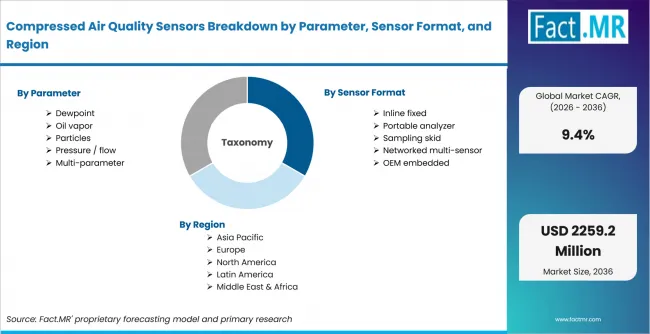
Compressed Air Quality Sensors Breakdown By Parameter, Sensor Format, And Region | Source: Fact.MR
| Attribute | Details |
|---|---|
| Quantitative Units | USD million |
| Market Definition | Sensors, analyzers and integrated packages measuring compressed-air quality and associated operating conditions in industrial applications. |
| Segments Covered | Parameter; Sensor Format; Industry; Compliance |
| Regions Covered | Global |
| Countries Covered | Germany; USA; UK; Japan; Switzerland |
| Key Companies | CS Instruments, Vaisala, SUTO iTEC, BEKO Technologies, Parker Hannifin, and Michell Instruments |
| Historical Period | 2021 to 2025 |
| Base Year | 2025 |
| Forecast Period | 2026 to 2036 |
| Market Value, 2026 | USD 920.0 million |
| Market Value, 2036 | USD 2,259.2 million |
| CAGR, 2026-2036 | 9.4% |
| Absolute Opportunity | USD 1,339.2 million |
| Approach | Application-level instrumentation demand, installation density, replacement cycles and package pricing, reconciled across parameter, format, industry and purpose. |
Source: Fact.MR analysis. Updated Sep 10, 2026
How is the market segmented?
-
By Parameter
- Dewpoint
- Oil vapor
- Particles
- Pressure / flow
- Multi-parameter
-
By Sensor Format
- Inline fixed
- Portable analyzer
- Sampling skid
- Networked multi-sensor
- OEM embedded
-
By Industry
- Food & beverage
- Pharma
- Electronics
- Automotive
- General manufacturing
-
By Compliance
- ISO 8573 monitoring
- HACCP / food air quality
- GMP
- Internal QA
- Energy management
Frequently Asked Questions
What is the Compressed Air Quality Sensors Market value in 2026?
At what CAGR is the market projected to grow?
What is the projected market value by 2036?
Which segment leads the Parameter category?
Which segment leads the Sensor Format category?
Which segment leads the Industry category?
Which segment leads the Compliance category?
What drives additional sensor purchases?
What can restrain adoption?
Which countries are analysed?
Which companies participate in the market?
Who worked on this report


Preview the report firsthand - request a free sample
Free SampleGet the brochure for pricing and purchase details
Download PDF