- Market Value (2025): USD 56.1 Mn
- Estimated Value (2026): USD 60.0 Mn
- Forecast Value (2036): USD 118.0 Mn
- CAGR (2026-2036): 7.0%
Refill-Compatible Dispensing Units Market Forecast and Outlook 2026 to 2036
The refill-compatible dispensing units market is projected to grow from USD 60.0 million in 2026 to USD 118.0 million by 2036. Demand for refill-compatible dispensing units is likely to grow at a CAGR of 7.0% over the forecast period.
Demand for refill-compatible dispensing units is rising as brands and retailers in home and personal care replace single-use bottles with durable dispensers that are topped up from pouches, cartridges, concentrates or in-store stations, in response to packaging rules and consumer pressure on plastic waste. Suppliers of refill-compatible dispensing units are offering reusable pumps, pouch-docking dispensers, cartridge systems, dilution dispensers and bulk refill stations designed for repeated use and easy cleaning. For example, on 12 August 2026, the EU Packaging and Packaging Waste Regulation began to apply, with many of its recyclability, reuse and refill obligations taking effect in later years.
Key Takeaways from the Refill-Compatible Dispensing Units Market
- Sales of refill-compatible dispensing units stood at USD 56.1 million in 2025
- Refill-Compatible Dispensing Units Market Value (2026): USD 60.0 million
- Refill-Compatible Dispensing Units Market Forecast Value (2036): USD 118.0 million
- Refill-Compatible Dispensing Units Market Forecast CAGR (2026-2036): 7.0%
- Leading Product Type: Pouch-compatible dispenser (28.3%)
- Key Market Participants: AptarGroup, Silgan Dispensing, Amcor, Albéa, Coster Group, Quadpack
- Key Growth Countries: Brazil, United Kingdom, United States, France, Japan
In October 2026, AptarGroup reported third-quarter sales of USD 1.02 billion, up 6%, with core sales up 5% and growth across its three segments, although these are company-wide figures and not specific to refill-compatible units. Demand for refill-compatible dispensing units is growing as dispensing specialists see steady consumer product demand and redesign pumps for reuse and recycling. Suppliers of refill-compatible dispensing units are launching mono-material and lockable refill-ready pumps.
Refill-Compatible Dispensing Units Market
| Metric | Value |
|---|---|
| Estimated Value in (2026) | USD 60.0 million |
| Forecast Value in (2036) | USD 118.0 million |
| Forecast CAGR (2026 to 2036) | 7.0% |
Source: Fact.MR analysis.
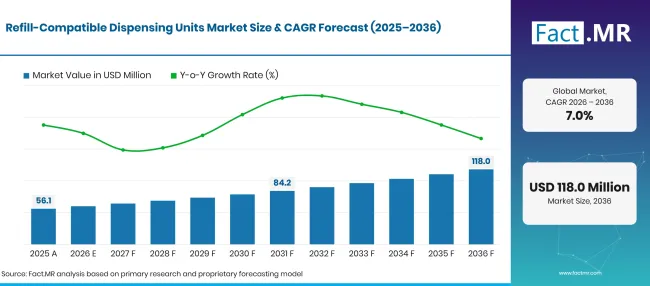
Refill Compatible Dispensing Units Forecast Global | Source: Fact.MR
Category
| Category | Segments |
|---|---|
| Product Type | Pouch-compatible dispenser, Refill cartridge system, Bulk refill station, Concentrate dilution dispenser, Reusable pump dispenser |
| Material | Bio-based plastics, Polypropylene, Glass, Aluminum, Recycled PET |
| Retail Channel | Supermarket, Professional and institutional, Specialty retail, Drugstore, E-commerce |
| Customer Segment | Sensitive and specialty, Professional, Premium, Family, Mass market |
| Country | Brazil; United Kingdom; United States; France; Japan |
Source: Fact.MR analysis.
Segmental Analysis
Why do pouch-compatible dispensers lead product demand in the Refill-Compatible Dispensing Units Market?
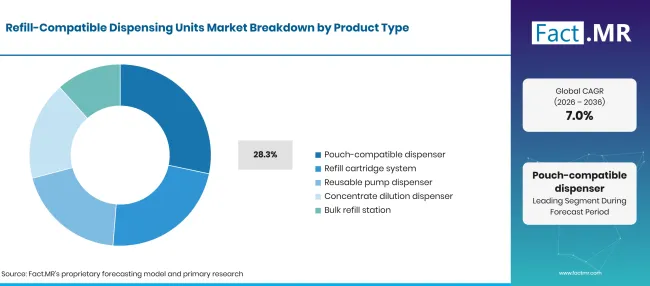
Refill Compatible Dispensing Units Breakdown Product Type | Source: Fact.MR
Pouch-compatible dispensers account for 28.3% of revenue in 2026, approximately USD 17.0 million, as consumers seek refill systems that reduce handling and simplify product replacement. Direct pouch connections can eliminate manual pouring and improve convenience. Packaging developers are refining docking mechanisms, leak-resistant seals and reusable holders to support repeated refilling across household and personal care applications.
How are bio-based plastics leading material demand in the Refill-Compatible Dispensing Units Market?
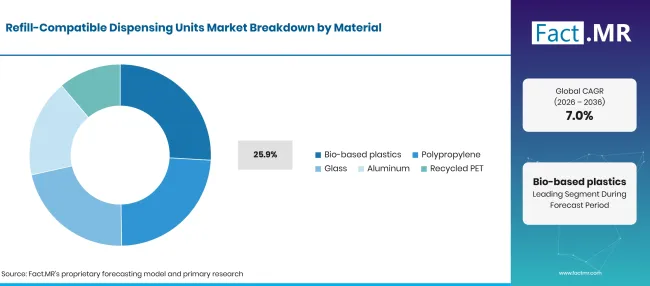
Refill Compatible Dispensing Units Breakdown Material | Source: Fact.MR
Bio-based plastics represent 25.9% of revenue in 2026, valued at approximately USD 15.5 million, reflecting interest in renewable materials for reusable dispensing equipment. Braskem's sugarcane-derived polyethylene offers processing characteristics comparable to conventional polyethylene. Packaging manufacturers can evaluate these resins for durable dispenser components, considering chemical resistance, mechanical strength, compatibility with refill products and long-term reuse performance.
Why do supermarkets lead retail demand in the Refill-Compatible Dispensing Units Market?
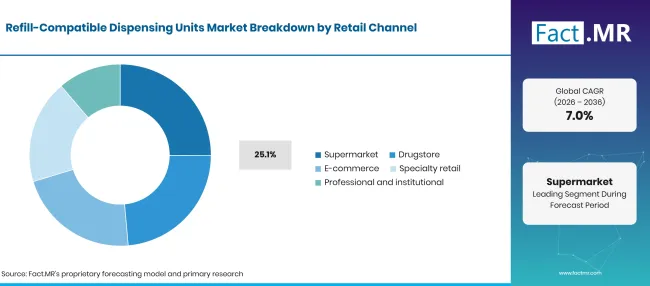
Refill Compatible Dispensing Units Breakdown Retail Channel | Source: Fact.MR
Supermarkets hold 25.1% of revenue in 2026, equivalent to approximately USD 15.1 million, benefiting from established household care distribution and frequent customer visits. Retailers can introduce reusable dispensers alongside compatible refill packs, making repeat purchases more convenient. In-store refill initiatives offer another purchasing model. Commercial success will depend on shelf placement, refill availability, competitive pricing and customer participation.
How are sensitive and specialty buyers leading demand in the Refill-Compatible Dispensing Units Market?
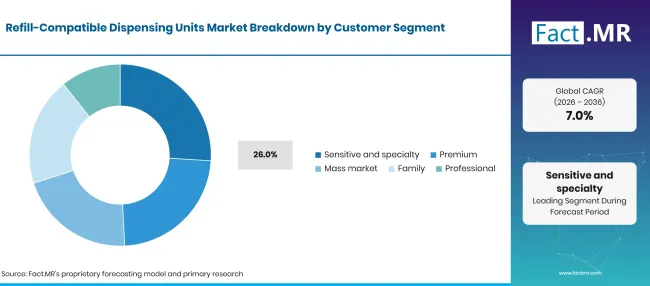
Refill Compatible Dispensing Units Breakdown Customer Segment | Source: Fact.MR
Sensitive and specialty buyers contribute 26.0% of revenue in 2026, approximately USD 15.6 million, reflecting interest in controlled dispensing for specialized skincare and household formulations. Refillable airless systems can protect sensitive products from environmental exposure during use. Manufacturers such as Aptar offer sealed dispensing technologies designed for product protection.
Refill-Compatible Dispensing Units Market-Drivers, Restraints & Trends
Drivers
Demand for refill-compatible dispensing units is rising as detergent and packaging laws formalize refill. For example, Regulation (EU) 2026/405 on detergents and surfactants, in force since 22 March 2026 and applying from 23 September 2029, sets labelling requirements for refill sales, including at refill stations, and Brazil's regulator Anvisa opened public consultations in January 2026 on repackaging and packaging reuse for cosmetics and perfumes.
Restraints
Demand for refill-compatible dispensing units is constrained by consumer inertia, hygiene and labeling concerns and the cost of durable hardware. For example, Brazil's Decree No. 12,688/2025 sets a 22% recycled-content target for plastic packaging from 2026 (January 2026 for large companies, July 2026 for smaller ones), which adds compliance cost for brands redesigning packaging systems. Such mandates may slow refill adoption where hardware changeover is costly.
Trend
Mono-Material and Recyclable Pumps Demand for all-plastic pumps without metal springs is rising because they can be recycled with the bottle at end of life. Suppliers are launching mono-material dispensing pumps. AptarGroup reported sales growth in all three segments in the third quarter of 2026, a company-wide result that is not specific to mono-material pumps.
Trend
Refill Promotions and Stations In May 2026, Natura launched its "Aqui Tem Refil Premiado" campaign in Brazil, timed to Recycling Day and running to 16 June, with refill buyers entering a prize draw and discounts of up to 70% on up to five refillable products per month. The campaign promotes refill packs rather than dispensers, but similar campaigns may support demand for refill-compatible dispensing units.
Refill-Compatible Dispensing Units Market Analysis by Key Country
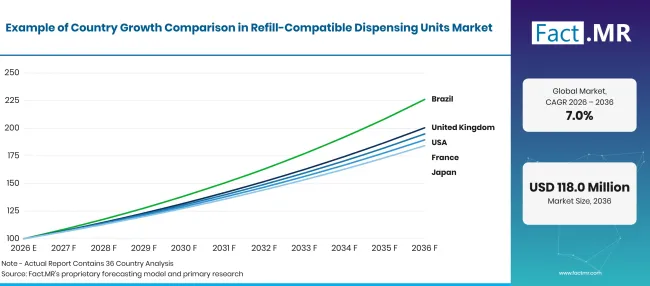
Refill Compatible Dispensing Units Growth Index | Source: Fact.MR
| Country | CAGR (2026-2036) |
|---|---|
| Brazil | 8.5% |
| United Kingdom | 7.2% |
| United States | 6.9% |
| France | 6.6% |
| Japan | 6.3% |
Source: Fact.MR analysis.
What is driving refill-compatible dispensing units demand in Brazil?
Demand for refill-compatible dispensing units in Brazil carries an 8.5% CAGR through 2036, the fastest among the five countries.
Established refill purchasing habits in beauty and household care provide opportunities for dispensers that accept flexible pouches. In October 2026, Unilever reported strong Home Care delivery in Brazil, including double-digit growth in Fabric Cleaning, although this is not specific to refill-compatible dispensing units. Brazil's plastic packaging reverse logistics decree also places greater emphasis on packaging recovery and recycled content. Local brands can develop refill systems around convenient pouch connections, durable dispensing mechanisms and affordable replacement packs.
How are packaging fees supporting refill-compatible dispensing units sales in the United Kingdom?
Sales of refill-compatible dispensing units in the United Kingdom are expected to advance at a 7.2% CAGR through 2036, with packaging waste costs influencing design decisions.
The government's extended producer responsibility framework requires qualifying producers to contribute toward household packaging disposal costs. This encourages brands to examine reusable containers and lighter refill formats, although actual savings depend on material and fee classifications. Supermarkets offer a route for starter kits and refill pouches. Packaging suppliers will focus on dispenser durability, refill compatibility and convenient household storage.
What is shaping refill-compatible dispensing units demand in the United States?
Demand for refill-compatible dispensing units in the United States is set to rise at a 6.9% CAGR through 2036 as online personal care brands seek packaging suitable for repeated use and parcel delivery.
Aptar provides dispensing pumps with locking mechanisms designed to reduce accidental activation during shipping. Such technologies create opportunities for reusable lotion, soap and cleaning product containers. Packaging developers are exploring secure closures and compatible refill formats. Brand purchasing decisions will depend on leakage prevention, dispensing accuracy, shipping durability and ease of consumer refilling.
How is legislation shaping refill-compatible dispensing units sales in France?
Sales of refill-compatible dispensing units in France are likely to expand at a 6.6% CAGR through 2036, supported by packaging reuse initiatives and cosmetics industry innovation.
France's anti-waste framework encourages businesses to examine reusable containers and unpackaged retail models. In 2025, Albéa developed refillable cosmetic packaging for Clarins and continued refining its TWIRL jar system. These developments create opportunities for durable dispensing components and replaceable product containers. French beauty manufacturers will assess refill hygiene, material quality, aesthetic design and convenient replacement mechanisms.
Why is growth slower for refill-compatible dispensing units in Japan?
Demand for refill-compatible dispensing units in Japan is forecast to increase at a 6.3% CAGR through 2036, the slowest among the five countries.
Refill pouches already have an established position in shampoo, detergent and personal care packaging, creating a mature replacement market. Kao promotes refill packs that allow consumers to continue using their original containers and dispensing components. Further opportunities will concentrate on improved pouch connections, premium dispenser designs and reduced handling during replacement. Manufacturers will prioritize reliable closures, ease of use and compatibility with existing refill packaging.
Competitive Landscape for Refill-Compatible Dispensing Units Market
Refill-compatible dispensing units compete on the connection between reusable containers, replacement packs and dispensing mechanisms. AptarGroup specializes in pumps, airless systems and refillable components designed for beauty and personal care products. Silgan Dispensing provides dispensing technologies for brands requiring controlled product delivery, while Amcor combines rigid containers with flexible refill pouches. Albéa and Quadpack address premium beauty packaging through replaceable containers and customized designs. Coster Group brings expertise in dispensing components for personal care and household applications.
A more practical approach to refill packaging is emerging as suppliers develop complete systems rather than individual bottles and pumps. In March 2026, Amcor showcased its AmPrima recycle-ready pouches for refilling rigid personal care containers. Its September announcement expanded the range of refill packaging formats available to beauty brands. Silgan Dispensing extended its ERA dispensing technology to airless packaging in February 2026, although that launch is not itself a refill system, while Aptar continued developing refillable systems for premium cosmetics. The EU Packaging and Packaging Waste Regulation began applying in August 2026, adding further consideration to packaging design and material selection.
Recent Developments
- In September 2026, Amcor expanded its refillable packaging portfolio, combining Mocha bottles, Wave dispensing pumps, and AmPrima refill pouches to provide compatible packaging systems for beauty and personal care products.
- In August 2026, Aptar Beauty collaborated with L’Occitane-en-Provence to develop a customized pump based on its Satine dispensing pump, featuring a screw-on neck finish and controlled dosing for the refillable hand care collection.
Key Players in Refill-Compatible Dispensing Units Market
Key companies operating in the market include AptarGroup, Silgan Dispensing, Amcor, Albéa, Coster Group, and Quadpack.
- AptarGroup
- Silgan Dispensing
- Amcor
- Albéa
- Coster Group
- Quadpack
Bibliography
- Amcor. (2026, September 8). Amcor versatility helps meet increasing refill demands.
- Aptar Beauty. (2026, August 26). Aptar Beauty creates custom pumps for L’Occitane-en-Provence's refillable hand care collection.
- AptarGroup, Inc. (2026, October 29). Aptar reports third quarter 2026 results. aptar.com
- European Commission. (2026, August 11). New EU packaging rules start to apply, including restrictions on PFAS in food-contact packaging.
- European Parliament & Council of the European Union. (2026, February 11). Regulation (EU) 2026/405 on detergents and surfactants, and repealing Regulation (EC) No 648/2004.
- Unilever PLC. (2026, October 28). Q3 2026 Trading Statement.
- Presidency of the Republic of Brazil. (2025, October 21). Decree No. 12,688 of October 21, 2025: Establishes the reverse logistics system for plastic packaging.
- Ministry of the Environment and Climate Change of Brazil. (2026). COMUNICADO LR-DGR/MMA No. 002/2026: Clarifications on Decree No. 12,688 of October 21, 2025.
- Ministry of the Environment and Climate Change of Brazil. (2026, September 16). Portaria GM/MMA No. 1,778: Establishment of the National Reverse Logistics System
- Aptar Beauty. (2026, September 23). Aptar Beauty launches BVLGARI’s first refillable travel spray with Nomad Refill.
- Aptar Beauty. (2025, January 27). Aptar Beauty introduces Nomad Refill, a game-changing purse spray.
- Brazilian Health Regulatory Agency (Anvisa). (2026, January 20). Public Consultations No. 1380 and No. 1381: repackaging and packaging reuse for cosmetics and perfumes
- Baker McKenzie. (2026, January 8). Brazil: implications of the new plastics decree.
- Silgan Dispensing. (2026, February 5). Silgan Dispensing extends the ERA dispensing system to airless packaging and expands its tube offering. silgandispensing.com
- Amcor. (2026). New products at Cosmoprof demonstrate Amcor’s versatility in beauty packaging
- Packaging Insights. (2025, March 17). Albéa Cosmetics and Fragrance equips Clarins with refillable skin care packaging.
- Exame. (2026, May 18). A melhor embalagem é a que você não joga fora: Natura oferece 70% de desconto nos refis
Segmentation
Scope of Report
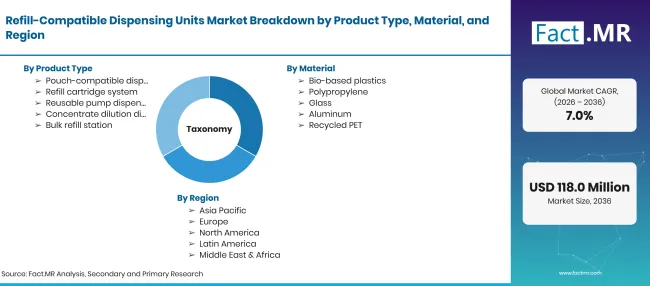
Refill Compatible Dispensing Units Taxonomy | Source: Fact.MR
| Items | Values |
|---|---|
| Quantitative Units (2026) | USD 60.0 Million |
| Product Type | Pouch-compatible dispenser, Refill cartridge system, Bulk refill station, Concentrate dilution dispenser, Reusable pump dispenser |
| Material | Bio-based plastics, Polypropylene, Glass, Aluminum, Recycled PET |
| Retail Channel | Supermarket, Professional and institutional, Specialty retail, Drugstore, E-commerce |
| Customer Segment | Sensitive and specialty, Professional, Premium, Family, Mass market |
| Regions Covered | North America, Latin America, Europe, East Asia, South Asia and Pacific, Middle East & Africa |
| Countries Covered | Brazil, United Kingdom, United States, France, Japan, and other countries |
| Key Companies Profiled | AptarGroup, Silgan Dispensing, Amcor, Albéa, Coster Group, Quadpack |
| Additional Attributes | Dollar revenue in the Refill-Compatible Dispensing Units Market is segmented by product type (pouch-compatible dispenser, refill cartridge system, bulk refill station, concentrate dilution dispenser, reusable pump dispenser), material, retail channel, customer segment and region. |
Source: Fact.MR analysis. Updated Nov 24, 2026
Refill-Compatible Dispensing Units Market by Segments
-
Product Type
- Pouch-compatible dispenser
- Refill cartridge system
- Bulk refill station
- Concentrate dilution dispenser
- Reusable pump dispenser
-
Material
- Bio-based plastics
- Polypropylene
- Glass
- Aluminum
- Recycled PET
-
Retail Channel
- Supermarket
- Professional and institutional
- Specialty retail
- Drugstore
- E-commerce
-
Customer Segment
- Sensitive and specialty
- Professional
- Premium
- Family
- Mass market
-
Region:
- North America
- United States
- Canada
- Europe
- Germany
- United Kingdom
- France
- Italy
- Spain
- Rest of Europe
- Asia Pacific
- China
- India
- Japan
- South Korea
- Australia
- Rest of Asia Pacific
- Latin America
- Brazil
- Mexico
- Argentina
- Rest of Latin America
- Middle East & Africa
- GCC Countries
- South Africa
- Rest of Middle East & Africa
- North America
Table of Contents
Key Takeaways
- Market Size and CAGR
- Top Growth Driver
- Fastest Growing Segment
- Leading Region
- Key Companies
- Emerging Opportunities