- Market Value (2025): USD 41.7 Mn
- Estimated Value (2026): USD 49.7 Mn
- Forecast Value (2036): USD 284.5 Mn
- CAGR (2026-2036): 19.1%
What is the Neuroarchitecture Advisory Services Market forecast to be worth by 2036?
USD 49.7 million in 2026 to USD 284.5 million by 2036 at a 19.1% CAGR.
- Neuroarchitecture advisory services demand came to USD 41.7 million in 2025, a small base built mostly on pilot workplace studies and wellness-led property briefs.
- Revenue will expand from USD 49.7 million in 2026 to USD 284.5 million by 2036 as neuroscience-informed reviews become a standard step in office, hospitality and healthcare design.
- A 19.1% CAGR reflects the low starting point and the shift of advisory budgets from one-off studies to repeat, portfolio-wide engagements.
| Year | Basis | Market Value (USD million) |
|---|---|---|
| 2025 | Actual | 41.7 |
| 2026 | Estimate | 49.7 |
| 2036 | Forecast | 284.5 |
| CAGR 2026 to 2036 | Forecast period | 19.1% |
Source: Fact.MR analysis. Updated Nov 13, 2026
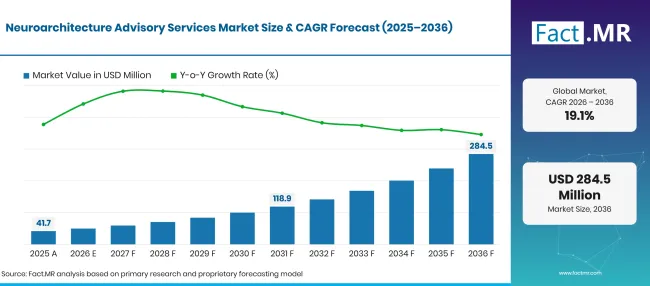
Neuroarchitecture Advisory Services Forecast Global 1 | Source: Fact.MR
What are the defining numbers behind Neuroarchitecture Advisory Services Market growth?
The 2026 to 2036 period adds USD 234.8 million in new value, with biophilic planning, employer contracts and hospitality partnerships carrying most of the gain.
Demand Drivers in the Market
- Mental health has become a facilities question for many employers and public bodies. The World Health Organization reported in September 2025 that over one billion people live with a mental disorder. Organizations that want to reduce stress in daily settings are turning to advisors who can link spatial design to how occupants feel and perform.
- Public health agencies now publish practical guidance on the built environment. The UK Health Security Agency notes that insulation and heating upgrades in low-income housing can reduce stress, and that shaded areas and parks can support emotional wellbeing. Guidance of this kind gives clients a credible reason to commission neuroscience-informed reviews.
- Nature-based design is gaining an evidence base that clients can cite. WHO Europe describes nature-based solutions as measures that benefit health and the environment together, including mental wellbeing and social cohesion, while warning that well-planned design is essential. That caution favors specialist consultants over generic landscaping input.
- Neuroinclusive design is entering policy discussion. A 2026 expert panel report for the UK Department for Work and Pensions recommends sensory-friendly design in national policy and building regulations, along with quiet break areas and lighting that marks key routes. Employers preparing for these expectations need advisors who can audit sensory load and wayfinding.
Key Segments Analyzed
- By Neuroarchitecture Service Scope: Biophilic Planning will lead with 30.2% share in 2026, since daylight, planting and natural materials are the most familiar entry point for clients new to neuroarchitecture.
- By Contract / Payment Model: Employer / Payer Contract will account for 27.8% of 2026 revenue, as employers prefer one agreement covering assessments across several sites.
- By Delivery Channel: Hospitality / Residential Partner will capture 28.5% in 2026, helped by developers who build wellness features into projects from the concept stage.
- By Service Beneficiary: Corporate Executives will represent 27.8% of 2026 value, given the weight companies place on focus and decision quality among senior staff.
Analyst Opinion at Fact.MR
Shambhu Nath Jha, Principal Consultant at Fact.MR, states, “Neuroarchitecture advice will win budget when it shows clients a measurable change in how people use a space, such as fewer complaints about noise or longer use of quiet rooms. Providers that combine biophilic planning, circadian lighting and sensory acoustics in one engagement will hold an advantage over single-topic consultants. Partnerships with hotel and residential developers will open the most projects, while employer contracts will give providers repeat revenue across office portfolios.”
Strategic Implications
- Advisory firms should package biophilic, lighting and acoustic assessments into one fixed-scope offer, since clients find a single report easier to approve than three separate studies.
- Architects and interior designers should bring neuroscience-informed reviewers in at briefing stage, when changes to daylight access and room layout cost the least.
- Employers and payers should tie advisory contracts to post-occupancy measures such as space use, noise complaints and staff survey results.
- Hotel and residential developers should treat circadian lighting and sensory comfort as marketable features and document them clearly in sales material.
South Korea leads the comparison at 22.5%, with a dense hospital network that gives healthcare design advisors a ready client base. China follows at 21.8%, only 0.7 points behind, as a large urban population raises demand for healthier homes and offices. The United States, at 21.4%, trails China by 0.4 points and benefits from employer interest in neuroinclusive workplaces. A wider 1.5-point gap separates it from Japan at 19.9%, where ageing drives design for older adults but budgets remain cautious. Germany closes the set at 18.7%, 1.2 points lower, with slower uptake tied to a conservative renovation cycle.
How does the Neuroarchitecture Advisory Services Market break down by segment?
Biophilic Planning will lead Neuroarchitecture Service Scope at 30.2%; Hospitality / Residential Partner will head Delivery Channel at 28.5%; Employer / Payer Contract and Corporate Executives will each hold 27.8% of their segments in 2026.
Which Neuroarchitecture Service Scope leads?
Biophilic Planning holds 30.2% of 2026 sales.
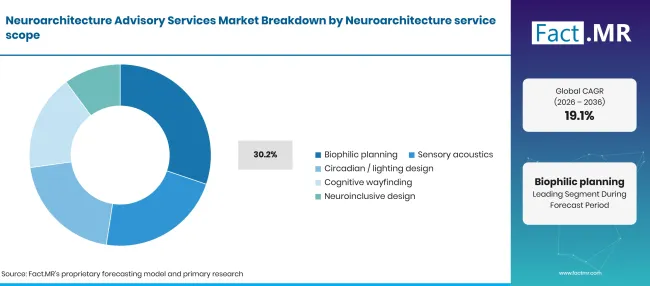
Neuroarchitecture Advisory Services Breakdown Neuroarchitecture Service Scope | Source: Fact.MR
| Neuroarchitecture Service Scope | Share (2026) |
|---|---|
| Biophilic Planning (Leading segment) | 30.2% |
| Other segments combined | 69.8%* |
| Total | 100.0% |
Source: Fact.MR analysis. Updated Nov 13, 2026
New clients usually ask first about daylight and planting. These changes are visible and easy to explain to boards and buyers. WHO notes that exposure to green spaces is widely associated with mental, physical and social health benefits. Advisors translate that evidence into planting plans, window strategies and material palettes that suit each building type. Circadian / Lighting Design, Cognitive Wayfinding, Neuroinclusive Design and Sensory Acoustics complete the service scope. Lighting work often draws on the same planning stage as lighting fixture selection, while acoustic advice frequently specifies finishes such as acoustic ceiling tiles. Neuroinclusive design is the newest scope and is gaining attention in workplaces and children’s healthcare.
What supports Employer / Payer Contract within Contract / Payment Model?
Employer / Payer Contract takes 27.8% of 2026 revenue.
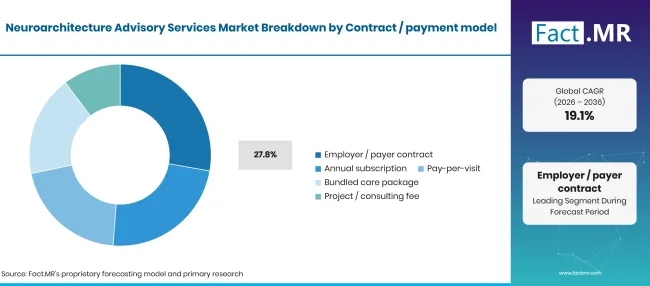
Neuroarchitecture Advisory Services Breakdown Contract Payment Model | Source: Fact.MR
| Contract / Payment Model | Share (2026) |
|---|---|
| Employer / Payer Contract (Leading segment) | 27.8% |
| Other segments combined | 72.2%* |
| Total | 100.0% |
Source: Fact.MR analysis. Updated Nov 13, 2026
Organizations with several offices want one agreement that sets fees, scope and reporting across the whole portfolio. Contracts often cover workstation layout and the choice of office furniture that supports posture and focus. Project / Consulting Fee, Bundled Care Package, Annual Subscription and Pay-per-visit cover other engagement styles. Project fees suit single developments, while subscriptions appeal to clients who want periodic reviews.
How does Delivery Channel shape demand?
Hospitality / Residential Partner accounts for 28.5% of 2026 value.
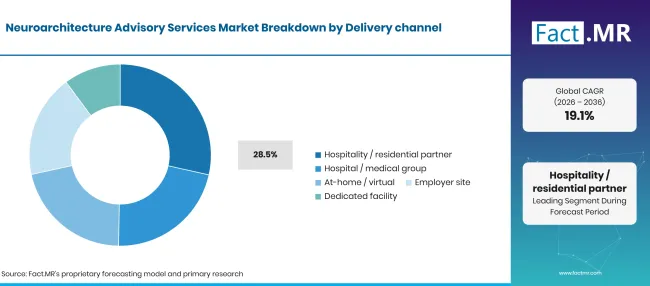
Neuroarchitecture Advisory Services Breakdown Delivery Channel | Source: Fact.MR
| Delivery Channel | Share (2026) |
|---|---|
| Hospitality / Residential Partner (Leading segment) | 28.5% |
| Other segments combined | 71.5%* |
| Total | 100.0% |
Source: Fact.MR analysis. Updated Nov 13, 2026
Hotel groups and residential developers decide on wellness features early, when site layout and facade design are still open. WHO guidance published in November 2025 names safe and inclusive planning, green spaces and access to community spaces as policy actions for mental health in urban and rural development. Developers use such guidance to justify spending on neuroscience-informed design. Advisors also review HVAC systems for thermal comfort and background noise in guest rooms. Employer Site, Hospital / Medical Group, Dedicated Facility and At-home / Virtual form the remaining channels. Hospital work centers on patient rooms and staff respite areas. Virtual reviews lower the cost of smaller jobs.
How does Service Beneficiary shape demand?
Corporate Executives represent 27.8% of 2026 demand.
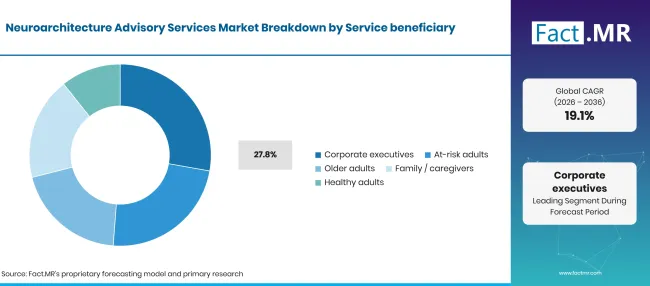
Neuroarchitecture Advisory Services Breakdown Service Beneficiary | Source: Fact.MR
| Service Beneficiary | Share (2026) |
|---|---|
| Corporate Executives (Leading segment) | 27.8% |
| Other segments combined | 72.2%* |
| Total | 100.0% |
Source: Fact.MR analysis. Updated Nov 13, 2026
Senior staff spend long hours on complex decisions, and companies want environments that protect concentration and reduce fatigue. Executive floors, boardrooms and focus rooms are often the first spaces reviewed. Lighting plans for these rooms frequently use light sensors to balance daylight and electric light. Family / Caregivers, Healthy Adults, At-risk Adults and Older Adults round out the beneficiary groups. Caregiver demand often arises from home adaptations for relatives with dementia or autism. Residential clients serving healthy adults often request natural finishes such as wood and laminate flooring to bring warmth into living spaces.
What is accelerating Neuroarchitecture Advisory Services Market adoption, and what is holding it back?
Public health guidance on green space, housing quality and sensory needs is giving clients firmer grounds to pay for neuroscience-informed design advice. Employers, developers and hospitals are the main buyers. Growth is limited by low awareness among conventional developers, high fees for specialist studies and a small pool of professionals trained in both neuroscience and architecture.
Drivers Impact Analysis
| DRIVER | (~) % IMPACT ON CAGR | GEOGRAPHIC RELEVANCE | IMPACT TIMELINE |
|---|---|---|---|
| Rising focus on mental wellbeing in workplaces and public buildings | +1.9% | Global | Short term (<=2 years) |
| Wider use of biophilic planning and nature-integrated design | +1.6% | North America, Western Europe, East Asia | Medium term (2-4 years) |
| Interest in circadian lighting and sensory comfort | +1.3% | Global | Medium term (2-4 years) |
| Demand for neuroinclusive environments and cognitive wayfinding | +1.0% | North America, Western Europe, East Asia | Long term (>=4 years) |
Source: Fact.MR analysis. Updated Nov 13, 2026
Opportunity Impact Analysis
| OPPORTUNITY | (~) % IMPACT ON CAGR | GEOGRAPHIC RELEVANCE | IMPACT TIMELINE |
|---|---|---|---|
| Partnerships with hotel and residential developers | +1.4% | Global | Medium term (2-4 years) |
| Biophilic and circadian lighting upgrades in commercial buildings | +1.2% | North America, Western Europe, East Asia | Short term (<=2 years) |
| Neuroinclusive design for hospitals and workplaces | +0.9% | North America, Western Europe, East Asia | Medium term (2-4 years) |
| Framework contracts with employers and institutional payers | +0.7% | Global | Long term (>=4 years) |
Source: Fact.MR analysis. Updated Nov 13, 2026
Restraints Impact Analysis
| RESTRAINT | (~) % IMPACT ON CAGR | GEOGRAPHIC RELEVANCE | IMPACT TIMELINE |
|---|---|---|---|
| Low awareness of neuroarchitecture among conventional developers | -0.7% | Global | Short term (<=2 years) |
| High fees for specialist studies and design changes | -0.5% | Global | Medium term (2-4 years) |
| Shortage of professionals with both neuroscience and architecture training | -0.3% | Global | Long term (>=4 years) |
Source: Fact.MR analysis. Updated Nov 13, 2026
Which countries are scaling the Neuroarchitecture Advisory Services Market through 2036?
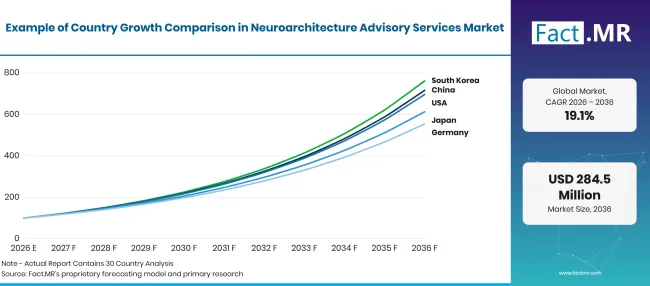
Neuroarchitecture Advisory Services Growth Index | Source: Fact.MR
| Country | CAGR (2026 to 2036) |
|---|---|
| South Korea | 22.5% |
| China | 21.8% |
| United States | 21.4% |
| Japan | 19.9% |
| Germany | 18.7% |
Source: Fact.MR analysis. Updated Nov 13, 2026
What supports South Korea’s adoption?
22.5% CAGR, backed by a dense hospital network and fast-moving workplace design.
Ministry of Health and Welfare data reported in July 2025 show Korea had 12.6 hospital beds per 1,000 people in 2023, almost three times the OECD average of 4.2. That large stock of clinical space gives advisors steady work on patient rooms, wards and staff areas.
How is China developing demand?
21.8% CAGR, driven by a large urban population seeking healthier homes and offices.
China’s urban resident population reached 953.80 million at the end of 2025, giving an urbanization rate of 67.89%, the National Bureau of Statistics reported. Dense city living raises interest in daylight, green views and quieter interiors.
What is supporting the United States’ adoption?
21.4% CAGR, helped by employer interest in neuroinclusive workplaces.
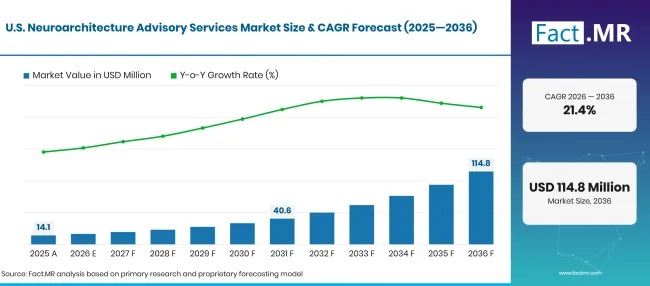
Neuroarchitecture Advisory Services Forecast Usa | Source: Fact.MR
CDC data published in April 2025 found that about 1 in 31 children aged 8 years had been identified with autism spectrum disorder in 2022. Schools and employers are responding with sensory-friendly layouts and quiet rooms. Large US employers are also funding workplace studies that link lighting and acoustics to focus.
What supports Japan’s adoption?
19.9% CAGR, reflecting design needs of an ageing population.
People aged 65 and over numbered 36.24 million on 1 October 2024, or 29.3% of Japan’s population, the Cabinet Office reported in its FY2025 ageing report. Residential and care operators seek advice on lighting, contrast and wayfinding for older residents. Budget caution keeps many projects small, which slows growth compared with South Korea and China.
How is Germany scaling demand?
18.7% CAGR, as renovation projects add wellbeing and accessibility reviews.
Destatis projects that by 2035 about one quarter of Germany’s population will be aged 67 or over, up from about one in five today. Housing companies and care providers are adapting existing buildings for older occupants, often with lighting and acoustic upgrades. A cautious renovation cycle and strict cost control keep uptake slower than in the Asian markets.
Who leads the Neuroarchitecture Advisory Services Market?
Competition splits into three groups. Large architecture practices such as Gensler, HOK and Perkins&Will compete on research depth and the ability to apply findings across global portfolios. HOK updated its HOK Forward 2025 publication on neuroinclusive workplaces in September 2025, adding sensory and physical response data from its own Seattle studio.
Perkins&Will published guidance in January 2026 on designing spaces for brain health, including tech-free zones and biophilic features such as natural light. Specialist consultancies form the second group: Terrapin Bright Green focuses on biophilic design and became a Core Partner of the 2026 Mind-Body-Space Global Symposium, while Atelier Ten offers lighting and healthy building services. The International WELL Building Institute shapes demand from a third position by setting the WELL standard that many clients use to frame their briefs. Through 2036, providers that can show measurable occupant outcomes will win repeat employer and developer contracts.
Which companies are the key providers?
Key companies in the Neuroarchitecture Advisory Services Market include Gensler, HOK, Perkins&Will, Terrapin Bright Green, Atelier Ten and International WELL Building Institute.
- Gensler
- HOK
- Perkins&Will
- Terrapin Bright Green
- Atelier Ten
- International WELL Building Institute
Bibliography
- Cabinet Office, Government of Japan. (2025, June). Annual Report on the Ageing Society [Summary] FY2025.
- Centers for Disease Control and Prevention. (2025, April 17). Prevalence and Early Identification of Autism Spectrum Disorder Among Children Aged 4 and 8 Years: Autism and Developmental Disabilities Monitoring Network, 16 Sites, United States, 2022.
- Department for Work and Pensions. (2026, October 2). Expert Academic Panel on Neurodiversity: Final Report and Recommendations.
- Federal Statistical Office of Germany. (2025, December 11). By 2035, one quarter of Germany’s population will be aged 67 or over.
- HOK. (2025, September 22). HOK Forward 2025: The Evolution of Neuroinclusive Workplaces.
- Korean Culture and Information Service. (2025, July 31). Number of outpatient visits, hospital beds leads OECD: report.
- National Bureau of Statistics of China. (2026, February 28). Statistical Communiqué of the People’s Republic of China on the 2025 National Economic and Social Development.
- Perkins&Will. (2026, January 14). Here’s how to stay connected while avoiding the cognitive damage of digital addiction.
- Terrapin Bright Green. (2026, January 21). Leveling Up in Design at The Mind-Body-Space Global Symposium.
- UK Health Security Agency. (2025, November 12). Changes to the built and natural environment to support mental health.
- World Health Organization. (2025, September 2). World mental health today: latest data.
- World Health Organization. (2025, September 4). Green spaces: sectoral solutions for air pollution and health.
- World Health Organization. (2025, November 24). Guidance on policy and strategic actions for mental health and the urban and rural development sector.
- World Health Organization Regional Office for Europe. (2025, May 22). Nature-based solutions and health.
This Report Answers
- How large will neuroarchitecture advisory revenue be in 2026 and 2036, and what growth rate links the two years?
- Which subsegment leads each segment, and why do clients choose it?
- How do public health guidance and neurodiversity policy shape client demand for design advice?
- Why do South Korea and China grow faster than Japan and Germany?
- Which architecture practices, specialist consultancies and standard setters compete for this work?
- What restraints, from awareness to skills supply, will slow adoption?
What does the Neuroarchitecture Advisory Services Market cover?
This market counts fees for advice that uses findings on human perception, attention and stress to guide how buildings and interiors are planned. Work ranges from short assessments of an existing office to full design support for a new hotel or hospital wing.
Values are measured as advisory revenue earned by providers, whatever the contract model or channel. Physical products installed as a result of the advice are not counted.
What is included in the scope?
Biophilic planning, sensory acoustic assessments, circadian lighting strategies, cognitive wayfinding reviews and neuroinclusive design services.
Engagements delivered through hospitality and residential partners, hospitals and medical groups, employer sites, dedicated facilities and at-home or virtual reviews.
Employer and payer contracts, annual subscriptions, pay-per-visit services, bundled care packages and project consulting fees tied to neuroarchitecture advice.
Post-occupancy evaluations that measure how occupants respond to design changes recommended by the advisor.
What is excluded from the scope?
Conventional architecture and interior design work that does not apply neuroscience-informed principles.
Lighting products, acoustic materials, furniture and building technologies sold on their own.
Clinical diagnosis, neurological treatment and general health screening without a built-environment advisory element.
General workplace consulting and wellness programs that do not address the physical environment.
How Was the Analysis Built?
The analysis draws on 120+ sources, 35+ company portfolios, 25+ countries, and more than 20 industry interviews.
- Primary Research: Primary research includes discussions with manufacturers, service providers, technology developers, distributors, end users, and subject-matter experts. These conversations examine purchasing priorities, product adoption, operational challenges, approval requirements, competitive positioning, and the factors that influence wider market acceptance.
- Desk Research: Desk research covers government statistics, regulatory publications, company filings, trade data, technical studies, industry associations, standards, public policy, and other authoritative sources. Every source used in the analysis is documented in the bibliography.
- Market Sizing and Forecasting: Market estimates combine historical performance, demand indicators, pricing and volume trends, segment shares, company participation, country-level growth, adoption patterns, investment activity, and barriers to market expansion.
- Data Validation and Update Cycle: Findings are validated by comparing primary interviews with public data, company activity, regulatory changes, trade patterns, and industry developments. Regular updates review new product launches, capacity changes, partnerships, approvals, and shifts in commercial adoption.
Segmentation
What is the report’s scope and coverage?
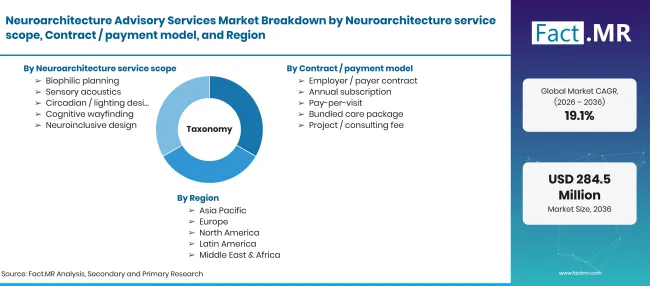
Neuroarchitecture Advisory Services Taxonomy | Source: Fact.MR
| Attribute | Details |
|---|---|
| Quantitative Units | USD million in 2026 to USD million by 2036 at CAGR |
| Market Definition | Advisory and consulting services that apply neuroscience-informed principles to the planning and design of built environments, covering biophilic planning, sensory acoustics, circadian lighting, cognitive wayfinding and neuroinclusive design. |
| Neuroarchitecture Service Scope | Biophilic Planning; Sensory Acoustics; Circadian / Lighting Design; Cognitive Wayfinding; Neuroinclusive Design |
| Contract / Payment Model | Employer / Payer Contract; Annual Subscription; Pay-per-visit; Bundled Care Package; Project / Consulting Fee |
| Delivery Channel | Hospitality / Residential Partner; Hospital / Medical Group; At-home / Virtual; Employer Site; Dedicated Facility |
| Service Beneficiary | Corporate Executives; At-risk Adults; Older Adults; Family / Caregivers; Healthy Adults |
| Regions Covered | North America; Latin America; Western Europe; Eastern Europe; East Asia; South Asia & Pacific; Middle East & Africa |
| Countries Covered | South Korea; China; United States; Japan; Germany |
| Companies Profiled | Gensler; HOK; Perkins&Will; Terrapin Bright Green; Atelier Ten; International WELL Building Institute |
| Forecast Period | 2026 to 2036 |
| Approach | Advisory revenue is tracked by service scope, contract model, delivery channel and beneficiary group, then checked against country demand conditions and provider activity. |
Source: Fact.MR analysis. Updated Nov 13, 2026
How is the market segmented?
-
By Neuroarchitecture Service Scope
- Biophilic Planning
- Sensory Acoustics
- Circadian / Lighting Design
- Cognitive Wayfinding
- Neuroinclusive Design
-
By Contract / Payment Model
- Employer / Payer Contract
- Annual Subscription
- Pay-per-visit
- Bundled Care Package
- Project / Consulting Fee
-
By Delivery Channel
- Hospitality / Residential Partner
- Hospital / Medical Group
- At-home / Virtual
- Employer Site
- Dedicated Facility
-
By Service Beneficiary
- Corporate Executives
- At-risk Adults
- Older Adults
- Family / Caregivers
- Healthy Adults
-
By Region
- North America
- Latin America
- Western Europe
- Eastern Europe
- East Asia
- South Asia & Pacific
- Middle East & Africa
Frequently Asked Questions
How large is the neuroarchitecture advisory services market in 2026?
What growth rate will the neuroarchitecture advisory services market record?
Which neuroarchitecture service scope leads?
Which contract / payment model leads?
Which delivery channel leads?
Which service beneficiary leads?
Which country will grow quickest?
Who are the main companies?
What holds the market back?
Who worked on this report


Preview the report firsthand - request a free sample
Free SampleGet the brochure for pricing and purchase details
Download PDF