Retail Store Replenishment Route Optimization Platforms Market
The Retail Store Replenishment Route Optimization Platforms Market is analyzed by platform function, including route optimization for store replenishment, along with deployment and retail format, forecast 2026 to 2036.
By Fact.MR Consumer Goods DeskLead analyst:
Ayush RajPublished :
15 min read
Fact-checked under the Fact.MR editorial process
Retail Store Replenishment Route Optimization Platforms Market Forecast and Outlook (2026 to 2036)
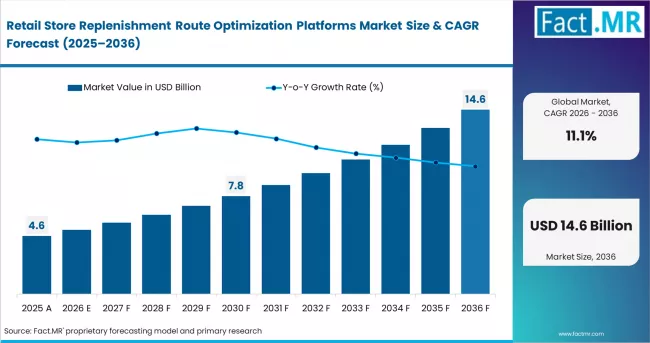
In 2025, the retail store replenishment route optimization platforms market was valued at USD 4.1 billion. Based on Fact.MR analysis, demand for retail store replenishment route optimization platforms is estimated to grow to USD 4.6 billion in 2026 and USD 13.2 billion by 2036. FACT.MR projects a CAGR of 11.1% during the forecast period.
Retail Store Replenishment Route Optimization Platforms Market Market Value Analysis | Source: Fact.MR
Metric
Value
Estimated Value in 2026
USD 4.6 billion
Forecast Value in 2036
USD 13.2 billion
Forecast CAGR (2026 to 2036)
11.1%
Source: Fact.MR analysis. Updated May 7, 2026
Summary of Retail Store Replenishment Route Optimization Platforms Market
Market Definition
The market covers cloud and on-premise route optimization platforms that plan and sequence merchandise replenishment routes across multi-store retail networks, integrating inventory, demand, and logistics data globally.
Demand Drivers
Persistent labour cost inflation in retail logistics is compelling grocery and convenience chains to deploy AI-powered route optimization platforms that reduce driver hours and fuel spend per replenishment cycle.
Rising consumer expectations for on-shelf product availability are forcing multi-format retailers to adopt real-time execution and tracking platforms that close the gap between demand sensing and physical replenishment.
Organized retail network expansion in India and Southeast Asia is generating high-volume platform adoption demand as new store clusters require structured route optimization to manage replenishment cost at scale.
Key Segments Analyzed
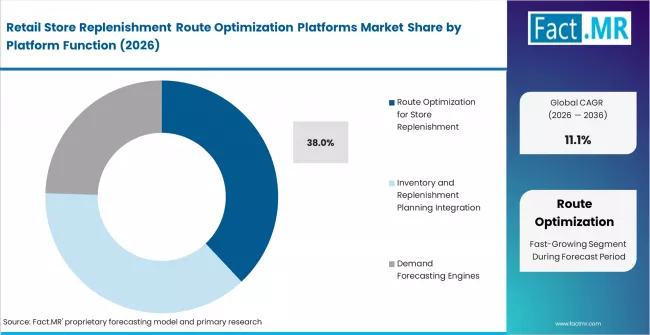
By Platform Function: Route optimization for store replenishment leads with 38% share in 2026, driven by its direct impact on delivery sequencing, multi-store routing efficiency, and transportation cost reduction across grocery and convenience formats.
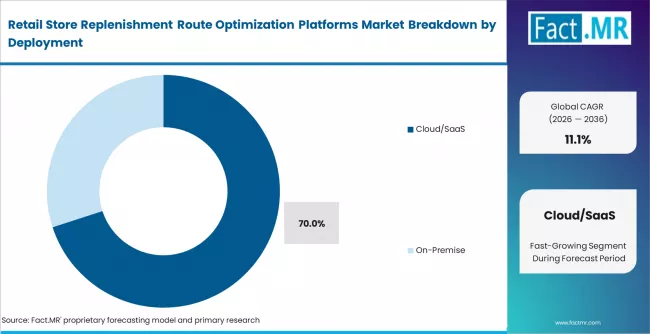
By Deployment: Cloud/SaaS platforms hold approximately 70% share in 2026, driven by lower upfront cost, faster deployment, and scalability across large multi-store retail networks.
By Retail Format: Supermarkets and hypermarkets lead with 40% share in 2026, driven by high replenishment frequency, large SKU volumes, and multi-location logistics complexity requiring platform-level route intelligence.
By Geography: India leads at 13.8% CAGR, driven by rapid organized retail expansion and strong platform ROI from baseline replenishment inefficiencies.
Analyst Opinion at FACT.MR
Shambhu Nath Jha, Principal Consultant at Fact.MR, opines, CXOs will find that retail chains integrating demand forecasting with live route optimization are consistently outperforming peers on in-stock availability and replenishment cost metrics. Vendors offering retail-specific, verticalized modules rather than generic logistics tools are securing stronger procurement preference and competitive advantage.
Strategic Implications
Invest in AI-powered demand sensing integrations that connect store-level inventory signals with dynamic route re-optimization to capture grocery and convenience chain enterprise procurement programmes.
Develop retail-format-specific SaaS modules for supermarket, convenience, and specialty chains to differentiate from generic logistics platforms in competitive enterprise sales cycles.
Build certified integration partnerships with SAP and Oracle ERP ecosystems to reduce implementation friction and accelerate mid-market retailer platform adoption across Europe and Asia Pacific.
Methodology
Market sizing uses platform vendor revenues and per-store subscription pricing benchmarks, validated with 2024-2025 retail supply chain technology investment data.
Analysis includes U.S. retail logistics technology adoption reports, EU supply chain digitization programme data, and India organized retail expansion statistics.
Forecasts incorporate cloud/SaaS penetration trends, AI adoption rates in retail logistics, and expert interviews with supply chain technology procurement specialists.
The market is projected to create USD 9.1 billion in absolute opportunity between 2026 and 2036. This represents a more than threefold expansion, reflecting transformational rather than incremental growth. Persistent labour cost inflation in logistics, rising consumer expectations for on-shelf availability, and AI-powered route intelligence are structural accelerants. Growth is moderated by high implementation complexity for mid-size retailers and fragmented legacy ERP integration requirements.
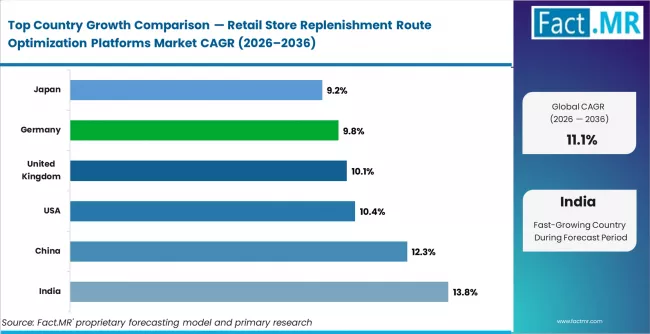
India leads with a CAGR of 13.8% through 2036, propelled by organized retail network expansion and high baseline route inefficiencies creating strong platform ROI. China follows at 12.3%, driven by dense urban store networks and retail technology mandates from domestic e-commerce leaders. The United States records 10.4%, supported by large multi-format retail chains accelerating SaaS platform adoption. The United Kingdom posts 10.1%, driven by advanced grocery replenishment systems modernisation. Germany records 9.8%, tied to supply chain automation investment by DACH region food retailers. Japan registers 9.2%, reflecting mature but continuously optimized store replenishment infrastructure.
Segmental Analysis
Retail Store Replenishment Route Optimization Platforms Market Analysis by Platform Function
Retail Store Replenishment Route Optimization Platforms Market Analysis By Platform Function | Source: Fact.MR
Route optimization for store replenishment holds 38% share in 2026. This function leads because it delivers the most direct and measurable cost reduction in multi-store retail logistics. Demand sequencing, delivery window compliance, and transport cost minimization are core operational pain points that this segment addresses. Large grocery and convenience chains prioritize it as the first platform capability deployed.
Blue Yonder Luminate Platform Expansion: Blue Yonder expanded its Luminate Supply Chain platform in Q1 2025 to include enhanced store replenishment route optimization modules with real-time traffic and demand signal integration. The expansion targeted large grocery retail clients across North America and Europe. [1]
Manhattan Associates Route Planning Innovation: Manhattan Associates launched an updated Active Omni replenishment routing feature in 2024, incorporating AI-driven route sequencing for multi-format retail networks. The feature was adopted by a major U.S. supermarket chain with over 1,200 stores. [2]
Cloud SaaS Adoption Acceleration: Gartner’s 2024 Supply Chain Technology Survey reported that 68% of grocery retailers planned to migrate replenishment planning to cloud-native platforms by 2026, up from 48% in 2022, driven by real-time execution demands. [3]
Retail Store Replenishment Route Optimization Platforms Market Analysis by Deployment
Retail Store Replenishment Route Optimization Platforms Market Analysis By Deployment | Source: Fact.MR
Cloud/SaaS platforms hold approximately 70% share in 2026. Cloud dominance reflects grocery and convenience retail chains’ preference for lower upfront capital deployment, faster go-live timelines, and seamless multi-location scalability. On-premise deployments persist among large retailers with proprietary data governance requirements and existing legacy ERP integration constraints.
SAP Integrated Cloud Replenishment Launch: SAP launched an integrated cloud-based store replenishment planning module within SAP S/4HANA in 2024, enabling connected route optimization for retail clients migrating from on-premise ERP. [4]
Descartes SaaS Route Management Expansion: Descartes Systems Group expanded its SaaS-based route management platform in 2025 to include retail-specific replenishment scheduling modules targeting European grocery and convenience chains. [5]
On-Premise Contraction Trend: IDC’s 2024 Retail Technology Investment Report noted that on-premise logistics platform new license revenue declined 14% in 2023 as cloud migration accelerated across large grocery retailers in North America and Europe.
Drivers, Restraints, and Opportunities
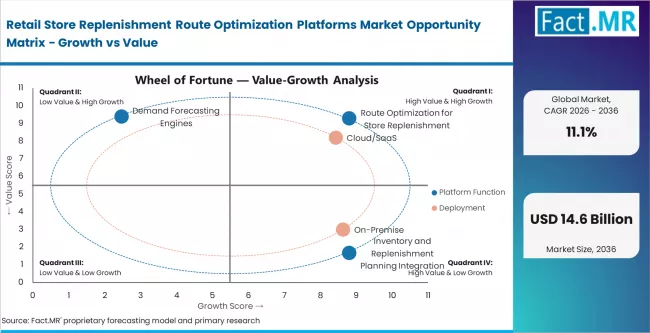
Retail Store Replenishment Route Optimization Platforms Market Opportunity Matrix Growth Vs Value | Source: Fact.MR
FACT.MR analysts observe that the retail store replenishment route optimization platforms market is moving from early adoption to mainstream deployment. Growth is driven by rising store counts and increasing labour costs. Manual route scheduling is becoming economically unviable. Platform adoption is now a cost-efficiency requirement.
The competitive gap is widening between AI-native cloud platforms and legacy on-premise systems. On-premise solutions are losing share. Retailers prefer scalability and real-time adaptability. Cloud vendors command 15–25% pricing premiums due to proven ROI. Mid-market retailers face adoption challenges due to cost and competitive pressure.
Labour Cost and Route Efficiency Pressure: Retail logistics labour costs rose 8–12% annually across the U.S. and EU between 2023 and 2025. Route optimization platforms reduce driver hours and fuel usage. Manhattan Associates reported an 18% cost reduction in a U.S. grocery case study. [6]
AI-Driven Demand Forecasting Integration: Integration of machine learning forecasting with route execution is a key differentiator. Blue Yonder Luminate platform combines demand signals with dynamic routing. This reduces safety stock and improves availability.
India Organized Retail Expansion Mandate: India added over 5,000 organized retail outlets between 2023 and 2025. Government policy is supporting digital logistics investment. Growth is accelerating adoption across emerging retail networks.
Regional Analysis
The retail store replenishment route optimization platforms market is assessed across North America, Europe, Asia Pacific, Latin America, and Middle East and Africa, covering 40+ countries segmented by retail format maturity, platform adoption stage, and supply chain digitization investment intensity. The full report offers market attractiveness analysis by region and country.
Top Country Growth Comparison Retail Store Replenishment Route Optimization Platforms Market Cagr (2026 2036) | Source: Fact.MR
Country
CAGR (2026 to 2036)
India
13.8%
China
12.3%
United States
10.4%
United Kingdom
10.1%
Germany
9.8%
Japan
9.2%
Source: Fact.MR analysis. Updated May 7, 2026
Source: Fact.MR (FACT.MR) analysis, based on proprietary forecasting model and primary research
Retail Store Replenishment Route Optimization Platforms Market Cagr Analysis By Country | Source: Fact.MR
Asia Pacific Retail Store Replenishment Route Optimization Platforms Market Analysis
Asia Pacific is the fastest-growing region and an innovation hub for replenishment platforms. India and China are driving retail network expansion and platform deployment. Blue Yonder, Oracle, and regional vendors are strengthening integration across large and mid-market retail chains. Government-led infrastructure and digitization initiatives are accelerating adoption.
India: Organized retail expansion supports 13.8% CAGR through 2036. Over 5,000 new grocery and convenience outlets increased replenishment complexity. National Retail Trade Policy 2024 prioritizes digital supply chain investment under ONDC-linked networks. Reliance Retail and DMart are expanding store networks across tier-2 and tier-3 cities. Platform adoption is driven by high baseline inefficiencies and fast ROI realization.
China: Platform-scale deployment supports 12.3% CAGR through 2036. Urban store density and hybrid retail models are increasing route optimization demand. JD.com expanded replenishment routing capabilities across 50+ cities in 2024. Government retail digitization guidance is accelerating AI-driven logistics integration. Adoption is driven by scale, infrastructure depth, and ecosystem maturity.
FACT.MR’s analysis of the retail store replenishment route optimization platforms market in Asia Pacific covers China, India, Japan, South Korea, ASEAN, and Australia and New Zealand. Readers can find regulatory drivers, retail network expansion data, and platform adoption forecasts by country and format.
Europe Retail Store Replenishment Route Optimization Platforms Market Analysis
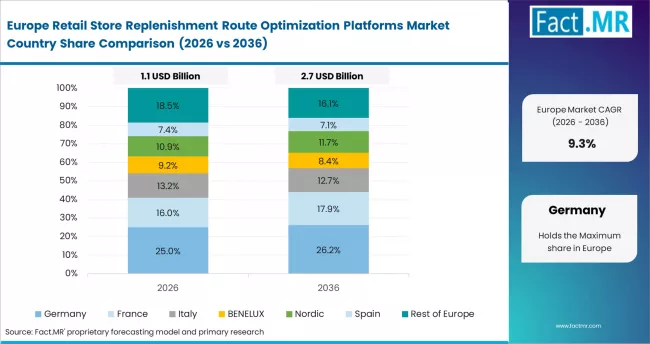
Retail Store Replenishment Route Optimization Platforms Market Europe Country Market Share Analysis, 2026 & 2036 | Source: Fact.MR
Europe is a compliance-driven and sustainability-focused market. Grocery retailers are aligning route optimization with emissions reduction and transport efficiency goals. Descartes Systems Group, SAP, and Trimble maintain strong regional presence.
United Kingdom: Consolidated grocery networks support 10.1% CAGR through 2036. Tesco, Sainsbury’s, and Asda are upgrading replenishment systems with AI-driven routing. Tesco’s efficiency programme targets reduction in distribution miles. Zero Emission Vehicle mandates are accelerating integration of EV fleets with routing platforms. Adoption is driven by sustainability targets and operational efficiency.
Germany: Strong logistics automation supports 9.8% CAGR through 2036. REWE Group and Edeka are investing in supply chain digitization linked to SAP S/4HANA migration. REWE committed €500 million to logistics upgrades. High transport costs and strict compliance standards reinforce platform ROI. Adoption is driven by automation and regulatory requirements.
FACT.MR’s analysis of the retail store replenishment route optimization platforms market in Europe covers Germany, France, the United Kingdom, Italy, Spain, Nordic countries, and BENELUX. Readers can find EU compliance drivers, supply chain digitization benchmarks, and country-level forecasts.
North America Retail Store Replenishment Route Optimization Platforms Market Analysis
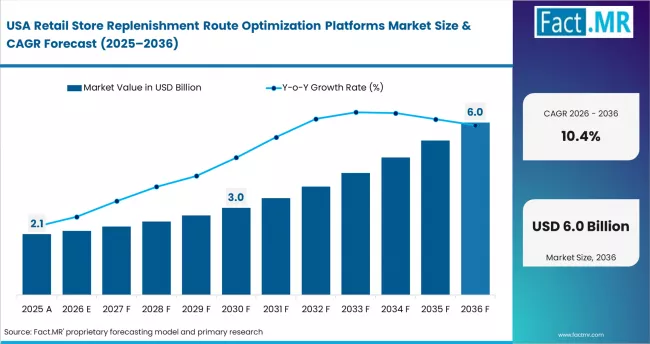
Retail Store Replenishment Route Optimization Platforms Market Country Value Analysis | Source: Fact.MR
North America represents the largest revenue base. The market is driven by large-scale grocery and convenience retail networks with mature procurement processes. Manhattan Associates, Blue Yonder, and Oracle dominate enterprise deployments.
United States: Large multi-format retail networks support 10.4% CAGR through 2036. Walmart, Kroger, and Albertsons operate thousands of stores requiring structured replenishment routing. Walmart committed USD 1.3 billion to supply chain upgrades. Federal logistics funding is supporting infrastructure and resilience. Adoption is driven by scale, investment capacity, and operational complexity.
FACT.MR’s analysis of the retail store replenishment route optimization platforms market in North America covers the United States, Canada, and Mexico. Readers can find enterprise procurement trends, platform vendor share data, and regional growth forecasts.
Competitive Aligners for Market Players
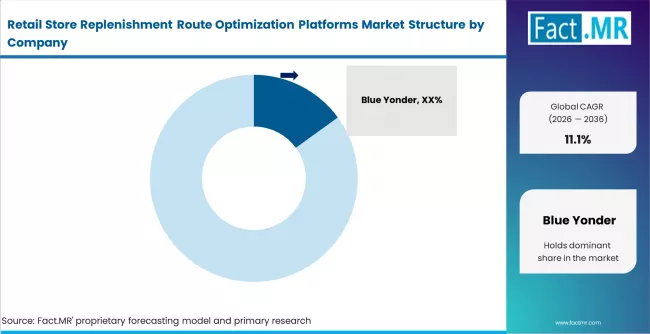
Retail Store Replenishment Route Optimization Platforms Market Analysis By Company | Source: Fact.MR
The retail store replenishment route optimization platforms market is moderately concentrated at the enterprise tier and fragmented in the mid-market. The top four vendors, Blue Yonder, Manhattan Associates, SAP, and Oracle, collectively serve the majority of large grocery and hypermarket chains globally. The primary competitive variable is depth of retail vertical integration: platforms that offer pre-built connectors to retail ERP systems, store-level POS data, and demand forecasting engines command significantly higher win rates in enterprise procurement.
Companies with structural advantages include Blue Yonder and Manhattan Associates, which have built proprietary retail-specific AI models trained on multi-year replenishment data from large grocery clients. SAP’s advantage is its embedded position within S/4HANA deployments, making its replenishment routing module a natural upgrade path for existing enterprise retail clients. Oracle’s retail cloud suite provides similar embedded advantage across Tier 1 grocery and department store accounts globally.
Buyer behaviour is shifting toward platform consolidation. Large grocery chains are reducing vendor sprawl by selecting integrated route optimization, demand forecasting, and inventory planning platforms from a single provider. Long-term SaaS contracts of three to five years are standard. This consolidation benefits large incumbent vendors and creates a procurement barrier for point-solution providers. Mid-market retailers face price sensitivity pressure, opening space for Descartes Systems Group, Omnitracs, and Trimble, which offer modular, lower-cost route optimization configurations.
Key Players
Blue Yonder
Manhattan Associates
SAP
Oracle
Descartes Systems Group
Omnitracs
Trimble
Walmart (Proprietary Platform)
Tesco (Proprietary Platform)
Carrefour (Proprietary Platform)
Bibliography
[1] Blue Yonder. 2025. Luminate Supply Chain Platform Expansion for Store Replenishment Routing. Scottsdale: Blue Yonder Group Inc.
[2] Manhattan Associates. 2024. Active Omni Replenishment Routing Feature Release. Atlanta: Manhattan Associates Inc.
[3] Gartner. 2024. Supply Chain Technology Survey: Cloud Adoption in Retail Replenishment. Stamford: Gartner Inc.
[4] SAP. 2024. S/4HANA Cloud-Based Store Replenishment Planning Module Launch. Walldorf: SAP SE.
[5] Descartes Systems Group. 2025. SaaS Route Management Platform Expansion for Retail Replenishment. Waterloo: Descartes Systems Group Inc.
[6] Manhattan Associates. 2024. Retail Grocery Route Optimization Case Study and Cost Reduction Analysis. Atlanta: Manhattan Associates Inc.
This Report Addresses
Strategic intelligence on retail store replenishment route optimization platform demand across grocery, convenience, specialty, and department store retail formats globally.
Market forecast from USD 4.6 billion in 2026 to USD 13.2 billion by 2036, at 11.1% CAGR, with absolute opportunity of USD 9.1 billion over the forecast period.
Opportunity mapping across India organized retail expansion, China retail digitization mandates, U.S. multi-format grocery chain platform investments, and EU transport compliance-driven adoption.
Segment analysis by platform function, deployment model, and retail format, covering route optimization, replenishment planning, demand forecasting, and real-time execution capabilities.
Regional outlook covering Asia Pacific high-growth adoption, North America enterprise platform consolidation, and Europe sustainability-driven route efficiency investment.
Competitive landscape of Blue Yonder, Manhattan Associates, SAP, Oracle, Descartes, Omnitracs, and Trimble covering platform differentiation, retail vertical integration depth, and contract structure.
Regulatory and policy analysis covering India National Retail Trade Policy 2024, U.S. Supply Chain Resilience Initiative, EU transport emission compliance requirements, and China retail digitization guidance.
Report delivery in PDF, Excel, and presentation formats supported by validated vendor revenue data, retail chain technology investment disclosures, and industry expert inputs.
Retail Store Replenishment Route Optimization Platforms Market Definition
The retail store replenishment route optimization platforms market covers software platforms that plan, sequence, and optimize delivery routes for replenishing merchandise across multi-store retail networks.
Retail Store Replenishment Route Optimization Platforms Market Inclusions
Covers global and regional forecasts from 2026 to 2036 by platform function, deployment model, and retail format. Includes cloud/SaaS and on-premise platforms used for route optimization, replenishment planning integration, demand forecasting, and real-time execution tracking across grocery, convenience, specialty, and department store retail channels.
Retail Store Replenishment Route Optimization Platforms Market Exclusions
Excludes general-purpose fleet management or last-mile delivery platforms not configured for store replenishment. Finished logistics hardware, warehouse management systems used independently of route planning, and pure inventory management software without routing capability are outside scope. Focus remains on platforms serving retail store replenishment routing and scheduling functions.
Retail Store Replenishment Route Optimization Platforms Market Research Methodology
Primary Research:Interviews with retail supply chain directors, platform vendors, logistics technology procurement leads, and store operations specialists across North America, Europe, and Asia Pacific.
Desk Research:Uses data from Blue Yonder, Manhattan Associates, SAP, and Oracle annual reports, Descartes Systems investor presentations, U.S. retail logistics association publications, and 2024-2025 supply chain technology adoption benchmarks.
Market-Sizing and Forecasting:Applies a hybrid model using platform vendor revenues, per-store SaaS subscription pricing benchmarks, retail format penetration rates by region, and deployment model adoption trends across grocery and convenience retail segments.
Data Validation and Update Cycle:Validated using vendor revenue disclosures, retail chain technology investment reports, and logistics platform deployment case studies. Supported by expert interviews with retail supply chain executives.
Market Breakdown
Segmentation
Scope of Report
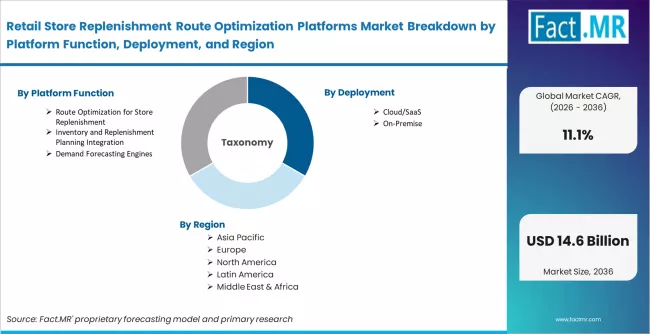
Retail Store Replenishment Route Optimization Platforms Market Breakdown By Platform Function, Deployment, And Region | Source: Fact.MR
Attribute
Details
Quantitative Units
USD 4.6 billion (2026) to USD 13.2 billion (2036), at a CAGR of 11.1%
Market Definition
Software platforms that plan, sequence, and optimize delivery routes for store replenishment across multi-store retail networks, integrating inventory, demand, and logistics data via cloud or on-premise deployment.
Platform Function Segmentation
Route Optimization for Store Replenishment, Inventory and Replenishment Planning Integration, Demand Forecasting Engines, Real-time Execution and Tracking
Deployment Segmentation
Cloud/SaaS, On-premise
Retail Format Segmentation
Supermarkets/Hypermarkets, Convenience Store Chains, Specialty Retail Chains, Department Stores
Application Coverage
Multi-store grocery replenishment route sequencing, convenience chain delivery optimization, specialty retail replenishment scheduling, and department store logistics coordination.
Regions Covered
North America, Europe, Asia Pacific, Latin America, Middle East and Africa
Countries Covered
USA, Canada, Mexico, Germany, UK, France, Italy, Spain, Nordic, BENELUX, China, Japan, South Korea, India, ASEAN, Australia and New Zealand, Brazil, Argentina, Saudi Arabia, GCC, Turkey, South Africa
Key Companies Profiled
Blue Yonder, Manhattan Associates, SAP, Oracle, Descartes Systems Group, Omnitracs, Trimble, Walmart, Tesco, Carrefour
Forecast Period
2026 to 2036
Approach
Hybrid top-down and bottom-up model using platform vendor revenues, per-store SaaS subscription pricing, retail format penetration rates by region, and primary interviews with retail supply chain executives.
Source: Fact.MR analysis. Updated May 7, 2026
Retail Store Replenishment Route Optimization Platforms Market by Segments
By Platform Function:
Route Optimization for Store Replenishment
Inventory and Replenishment Planning Integration
Demand Forecasting Engines
Real-time Execution and Tracking
By Deployment:
Cloud/SaaS
On-premise
By Retail Format:
Supermarkets/Hypermarkets
Convenience Store Chains
Specialty Retail Chains
Department Stores
By Region:
North America
United States
Canada
Mexico
Latin America
Brazil
Argentina
Rest of Latin America
Western Europe
Germany
United Kingdom
France
Italy
Spain
Nordic Countries
BENELUX
Rest of Western Europe
Eastern Europe
Russia
Poland
Rest of Eastern Europe
East Asia
China
Japan
South Korea
South Asia and Pacific
India
ASEAN
Australia and New Zealand
Rest of South Asia and Pacific
Middle East and Africa
Kingdom of Saudi Arabia
Other GCC Countries
Turkey
South Africa
Rest of Middle East and Africa
Questions Answered
Frequently Asked Questions
How large is the global retail store replenishment route optimization platforms market in 2025?
The global retail store replenishment route optimization platforms market was valued at USD 4.1 billion in 2025.
What will the market size be in 2026?
Based on Fact.MR analysis, demand for retail store replenishment route optimization platforms is estimated to grow to USD 4.6 billion in 2026.
What is the projected market size by 2036?
The market is projected to reach USD 13.2 billion by 2036, generating USD 9.1 billion in absolute dollar opportunity over the forecast period.
What is the expected CAGR from 2026 to 2036?
FACT.MR projects a CAGR of 11.1% for the global retail store replenishment route optimization platforms market during the 2026 to 2036 forecast period.
Which platform function segment is poised to lead the market?
Route optimization for store replenishment leads with approximately 38% share in 2026.
Which deployment model holds the largest share?
Cloud/SaaS platforms hold approximately 70% share in 2026.
Which country shows the fastest growth?
India leads at 13.8% CAGR through 2036, driven by rapid organized retail network expansion and high route inefficiency creating strong platform ROI.
What are retail store replenishment route optimization platforms used for?
They are used to plan, sequence, and optimize delivery routes for merchandise replenishment across multi-store retail networks, integrating inventory signals, demand forecasts, and logistics constraints to minimize cost and reduce out-of-stocks.
What drives demand in this market?
Labour cost inflation in retail logistics, rising consumer expectations for on-shelf availability, organized retail network expansion in India and Asia Pacific, and AI-powered route intelligence adoption across grocery and convenience chains drive growth.
Who are the key players in the market?
Major players include Blue Yonder, Manhattan Associates, SAP, Oracle, Descartes Systems Group, Omnitracs, and Trimble, alongside large retailers operating proprietary platforms including Walmart, Tesco, and Carrefour.
.webp "Top Country Growth Comparison Retail Store Replenishment Route Optimization Platforms Market Cagr (2026 2036)")