- Base Value(2025): 123.2 Bn
- Estimated Value(2026): 129.2 Bn
- Forecast Value (2036): 190.5 Bn
- CAGR (2026 - 2036): 4.1%
FMCG Logistics Market Forecast and Outlook 2026 to 2036
In 2025, the FMCG logistics market was valued at USD 123.2 billion. Based on Fact.MR analysis, demand for FMCG logistics services is estimated to grow to USD 129.2 billion in 2026 and USD 190.5 billion by 2036. Fact.MR projects a CAGR of 4.1% during the forecast period.
Vinay Dhanani, COO of Zepto states, “Companies with the ability to forecast closer to the consumption, better lead times, and the agility to update supply chain models and respond quickly to the change in demand will survive and will always have an advantage over competitors."
Growth rates vary significantly between emerging consumer markets and mature logistics systems. India leads with a 9.1% CAGR, supported by rapid expansion of modern retail, quick commerce platforms, and major investments in freight infrastructure. China follows at 6.4%, driven by FMCG demand growth in lower-tier cities and continued expansion of large fulfillment networks. Brazil grows at 5.3% as consumption spreads beyond traditional hubs. Germany posts 5.2%, benefiting from its role as a key European distribution center. The United States records 4.5% growth, mainly fueled by e-commerce grocery and last-mile delivery expansion, though labor shortages and urban delivery regulations moderate growth.
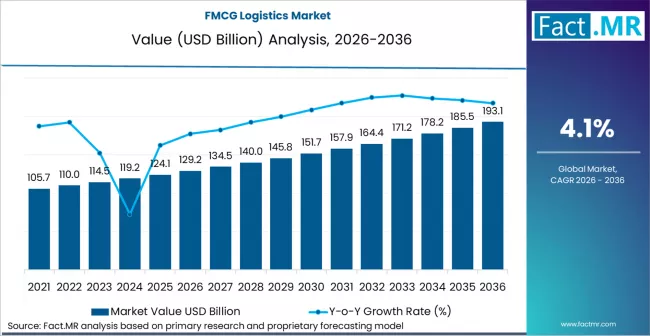
Fmcg Logistics Market Market Value Analysis | Source: Fact.MR
Market Definition
The FMCG logistics market includes transportation, warehousing, inventory management, cold chain services, and last-mile delivery used to move fast-moving consumer goods from factories to retailers and consumers. These goods include packaged foods, beverages, personal care products, and household essentials. Service providers range from third-party logistics companies and freight carriers to cold chain operators and e-commerce fulfillment specialists.
Market Inclusions
The report covers global and regional market size forecasts from 2026 to 2036, segmented by transportation mode and product category. It evaluates cold chain adoption, last-mile cost structures, modal shifts, warehouse automation, and competitive positioning of leading logistics providers.
Market Exclusions
The scope excludes logistics for pharmaceuticals, electronics, automotive parts, industrial goods, and bulk commodities. It also excludes fully in-house logistics operations and standalone reverse logistics activities not tied to forward FMCG distribution contracts.
Research Methodology
- Primary Research: Primary research involved structured interviews with FMCG supply chain and logistics directors at major consumer goods manufacturers, third-party logistics procurement managers at large retail chains, operations leads at cold chain and temperature-controlled distribution specialists, and digital freight platform providers serving the FMCG logistics segment across India, China, the United States, Germany, and Brazil.
- Desk Research: Desk research synthesized data from national transport ministry freight volume statistics, World Bank Logistics Performance Index reports, carrier annual reports and segment revenue disclosures from Deutsche Post DHL, UPS, FedEx, and Kuehne+Nagel, e-commerce FMCG market volume data from national retail trade associations, and FMCG manufacturer supply chain investment disclosures from investor presentations and sustainability reports.
- Market-Sizing and Forecasting: Market sizing employed a hybrid top-down and bottom-up approach, combining total FMCG market value estimates by country and product category with average logistics spend as a percentage of FMCG revenue by channel type, validated against third-party logistics revenue disclosures from major carriers and benchmarked against logistics cost intensity ratios published by FMCG industry associations in key markets.
- Data Validation and Update Cycle: Outputs were cross-validated against disclosed FMCG logistics segment revenues from Deutsche Post DHL Group, UPS Supply Chain Solutions, and Kuehne+Nagel's contract logistics division, reconciled semi-annually with quarterly carrier earnings disclosures, and updated annually with national retail trade volume statistics and new e-commerce FMCG platform expansion announcements in key markets.
Summary
-
Market Definition
- The FMCG logistics market covers the third-party transportation, warehousing, cold chain, and last-mile delivery services that move packaged food and beverages, personal care, and household care products through multi-tier distribution networks from manufacturers to retail stores and e-commerce consumers worldwide.
-
Demand Drivers
- India’s Pradhan Mantri Gati Shakti National Master Plan is accelerating multimodal infrastructure development, including freight corridors and logistics parks. These upgrades are reducing transit times and strengthening organized third party logistics networks in a market that was previously dominated by fragmented trucking operators.
- The rise of quick commerce platforms such as Blinkit, Zepto, Swiggy Instamart, Meituan, and JD Daojia is reshaping FMCG distribution. Manufacturers now require smaller, more frequent deliveries, dark store fulfillment, and real time inventory visibility. This shift increases logistics complexity and supports higher value service contracts.
- In Europe, the Fit for 55 decarbonisation framework is pushing logistics providers to invest in electric and alternative fuel trucks. Higher fleet costs are encouraging greater use of rail freight for medium and long haul FMCG transport where infrastructure allows.
-
Key Segments Analyzed
- By mode of transportation, railways account for 43.1% share due to their cost efficiency and ability to move large FMCG volumes across major markets such as China, India, and the United States.
- By product type, food and beverages hold 44.7% share, driven by high replenishment frequency and cold chain requirements.
- By geography, Asia Pacific contributes 42% of incremental growth, supported by India’s retail expansion and China’s rising FMCG demand beyond major cities.
-
Analyst Opinion at FACT.MR
- Shambhu Nath Jha, Principal Consultant at Fact.MR, opines, 'CXOs will find this report essential for understanding how the structural shift of FMCG distribution from weekly retail replenishment cycles toward daily and same-day e-commerce fulfilment is reshaping network design requirements, contract pricing structures, and technology investment priorities for both FMCG manufacturers and their logistics partners, and which modal, product, and geographic segments offer the highest revenue quality and contract durability through the forecast period.'
-
Strategic Implications / Executive Takeaways
- Third party logistics providers serving FMCG clients should expand integrated cold chain and ambient warehousing near major urban quick commerce hubs in India and China. Being within close proximity to dark store networks allows providers to support both traditional retail replenishment and same day fulfillment through a single contract, reducing complexity for manufacturers.
- FMCG companies operating across Europe should reassess rail freight for medium and long haul routes. Rising road transport compliance costs under EU decarbonisation rules are improving the cost competitiveness of rail, especially for corridors linking Central Europe with the UK, Nordic, and Eastern Europe markets.
- Logistics technology providers should integrate their digital freight platforms directly with leading retail chains’ inventory systems. Real time demand data can streamline replenishment cycles, reduce buffer stock, and improve overall supply chain efficiency.
-
Methodology
- Market size estimates were based on national FMCG retail values combined with logistics cost ratios, cross checked with revenue disclosures from major logistics companies.
- Modal analysis used official freight statistics from India, China, the United States, and the European Union.
- Product forecasts were validated using FMCG logistics cost data, cold chain investment figures, and retail trade association volume statistics.
Segmental Analysis
By Mode of Transportation
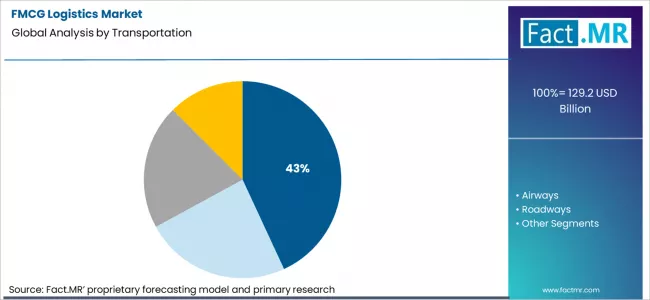
Fmcg Logistics Market Analysis By Transportation | Source: Fact.MR
Railways are expected to hold 43.1% share in 2026 due to cost efficiency for long haul, high volume FMCG movements across large markets such as China, India, and the United States. Dedicated freight corridors and intermodal services support reliable transit times for retail replenishment cycles.
- Indian Railways reported strong FMCG freight growth following corridor expansion. [2]
- DB Cargo expanded intermodal FMCG services across Europe. [5]
- Air freight volumes stabilized in 2023, remaining focused on premium and perishable FMCG segments. [6]
By Product Type
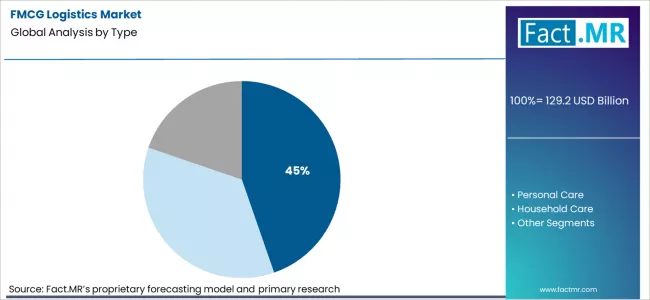
Fmcg Logistics Market Analysis By Type | Source: Fact.MR
Food and beverages are projected to hold 44.7% share in 2026. This segment drives the highest logistics demand due to frequent replenishment and cold chain requirements.
- DHL expanded cold chain capacity globally to serve FMCG clients. [1]
- Kuehne+Nagel enhanced digital monitoring for food safety compliance. [7]
- Personal care e commerce growth is increasing parcel based FMCG logistics demand. [8]
Drivers, Restraints, and Opportunities
The FMCG logistics market has grown into a USD 123.2 billion industry largely due to decades of globalized supply chains. Over time, manufacturers shifted complex distribution tasks to specialized third party logistics providers that could manage multi country networks more efficiently. Today, the market reflects two realities: stable long term contracts in developed economies and rapid expansion in emerging markets where organized logistics is replacing informal distribution systems.
A major challenge is balancing rising last mile delivery costs with strong pricing pressure from large FMCG clients. Traditional pallet based retail replenishment offers predictable volumes and lower costs. However, e commerce and quick commerce are shifting demand toward smaller, more frequent shipments that cost significantly more per unit. Providers with automated fulfillment and parcel capabilities are capturing higher margin growth, while those dependent on traditional retail volumes face margin pressure.
- India’s Dedicated Freight Corridors have reduced transit times and strengthened rail as a competitive option for FMCG freight, encouraging organized logistics expansion. [2]
- EU heavy duty vehicle CO2 standards are raising road freight costs and making rail and intermodal transport more attractive for long haul FMCG distribution. [3]
- China’s cross border e commerce boom is generating new FMCG export logistics demand, benefiting major logistics networks. [4]
Regional Analysis
The FMCG logistics market is analyzed across North America, Europe, Asia-Pacific, Latin America, and Middle East and Africa. Regional demand patterns reflect the maturity of modern retail trade infrastructure, e-commerce penetration in FMCG categories, cold chain network density, and multimodal freight connectivity between production and consumption centers. The full report offers detailed market attractiveness analysis comparing logistics infrastructure quality, regulatory environment, and competitive intensity by region.
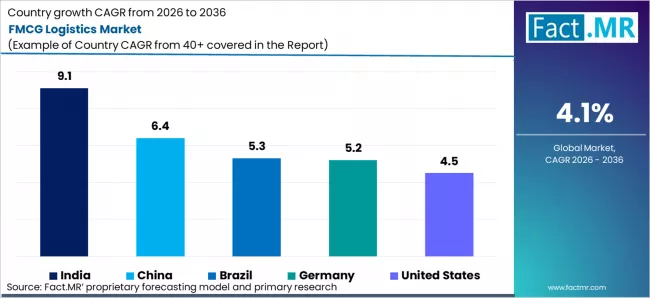
Fmcg Logistics Market Cagr Analysis By Country | Source: Fact.MR
| Country | CAGR% |
|---|---|
| India | 9.1% |
| China | 6.4% |
| Brazil | 5.3% |
| Germany | 5.2% |
| United States | 4.5% |
Source: Fact.MR analysis. Updated Feb 21, 2026
Source: Fact.MR (FACT.MR) analysis, based on proprietary forecasting model and primary research
North America FMCG Logistics Market Analysis
North America remains the global benchmark for e commerce driven FMCG logistics. The region benefits from advanced warehouse automation, dense same day and next day delivery networks, and strong parcel infrastructure led by Amazon, UPS, and FedEx. Traditional pallet based grocery replenishment is gradually giving way to higher value parcel and last mile fulfillment. Logistics providers are investing heavily in automation, robotics, and route optimization to maintain service levels while managing labor and fuel cost pressures.
- United States: Demand for FMCG logistics services in the United States is projected to rise at 4.5% CAGR through 2036. Growth is driven by e commerce grocery, personal care, and health product delivery, even as traditional store traffic softens. Regulatory factors such as electronic logging requirements continue to constrain driver capacity, supporting freight rate stability. Expanding last mile networks and fulfillment automation are reshaping cost structures and service models nationwide.
FACT.MR’s report includes detailed analysis of the North American market, with country level assessment covering the United States and Canada. It highlights e commerce fulfillment trends, freight rate cycles, and infrastructure investment patterns across the region.
Europe FMCG Logistics Market Analysis
Europe is increasingly shaped by sustainability regulations and freight decarbonisation policies. Road emission standards, low emission urban zones, and packaging responsibility rules are influencing logistics network design and modal choice. Rail and intermodal freight are gaining share as operators adjust to rising road transport costs. Major players such as DHL and Kuehne+Nagel leverage pan European networks and advanced compliance capabilities to serve complex FMCG supply chains.
- Germany: Demand for FMCG logistics services in Germany is projected to rise at 5.2% CAGR through 2036. Germany acts as the central hub of European distribution, linking Western production clusters to Eastern and Nordic retail markets. Strong rail infrastructure and environmental regulation are accelerating modal shift and electric vehicle adoption for urban FMCG delivery.
FACT.MR’s report provides country wise analysis across Germany, the United Kingdom, France, the Netherlands, and Nordic markets, covering sustainability impacts, rail road economics, and cold chain compliance trends.
Asia Pacific FMCG Logistics Market Analysis
Asia Pacific is the fastest growing FMCG logistics region, supported by rapid retail expansion, quick commerce growth, and infrastructure modernization. Organized third party logistics providers are expanding capacity as informal distribution systems are gradually replaced. Regional leaders such as Nippon Express, Cainiao Network, and Delhivery compete across premium, cross border, and high speed e commerce segments.
- India: Demand for FMCG logistics services in India is projected to rise at 9.1% CAGR through 2036. Growth is supported by the Gati Shakti infrastructure plan and rapid expansion of quick commerce platforms. National tax reforms and new freight corridors are improving distribution efficiency and encouraging network consolidation.
- China: Demand for FMCG logistics services in China is projected to rise at 6.4% CAGR through 2036. Mature infrastructure in major cities contrasts with growing demand in lower tier markets. Continued warehouse expansion and government logistics modernization policies are strengthening organized third party networks.
- Brazil: Demand for FMCG logistics services in Brazil is projected to rise at 5.3% CAGR through 2036. Expansion of organized retail and e commerce beyond major urban corridors is increasing structured logistics demand. Coastal shipping and last mile network growth are supporting distribution efficiency improvements.
FACT.MR’s report covers Asia Pacific markets including India, China, Japan, South Korea, Australia, and ASEAN countries, analyzing infrastructure investment, quick commerce growth, and cold chain expansion trends by country.
Competitive Aligners for Market Players
The global FMCG logistics market is moderately concentrated at the top tier, where major international providers such as Deutsche Post DHL, UPS, FedEx, Kuehne+Nagel, Maersk, DSV, Schenker, C.H. Robinson, Nippon Express, and Geodis together account for roughly 35 to 40 percent of total market revenue. Below this level, the industry becomes highly fragmented, with numerous regional and national operators competing on price, local coverage, or specialized handling capabilities. At the global contract logistics level, competition centers on network reach, technology integration, and cold chain strength, allowing FMCG companies to consolidate multi country distribution under fewer providers.
Competitive advantage increasingly depends on infrastructure depth and digital capability. Providers with established temperature controlled networks, integrated freight management platforms, and end to end ocean and inland solutions are better positioned to secure long term contracts.
Large FMCG manufacturers typically avoid reliance on a single logistics partner. Companies such as Procter and Gamble, Unilever, and Nestlé allocate volumes across multiple providers and review contracts annually, maintaining pricing discipline and limiting excessive supplier concentration despite the high capital intensity of the sector.
Key Players
- United Parcel Service, Inc.
- FedEx Corp
- Deutsche Post AG
- C.H. Robinson Worldwide Inc.
- Kuehne+Nagel International AG
- A.P. Moller - Maersk
- Schenker AG
- DSV Solutions
- Nippon Express Holdings, Inc.
- Landstar System Holdings, Inc.
Bibliography
- [1] Deutsche Post DHL Group, Annual Report 2023, March 2024.
- [2] Dedicated Freight Corridor Corporation of India Ltd / Ministry of Railways, Annual Report 2022-23, September 2023.
- [3] European Parliament and Council, Regulation (EU) 2019/1242 setting CO2 emission performance standards for new heavy-duty vehicles, Official Journal of the European Union, August 2019.
- [4] General Administration of Customs of the People's Republic of China, China Cross-Border E-Commerce Import and Export Data 2023, January 2024.
- [5] DB Cargo AG, Intermodal FMCG Services Expansion Press Release, October 2023.
- [6] International Air Transport Association (IATA), World Air Transport Statistics 2023, July 2023.
- [7] Kuehne+Nagel International AG, Annual Report 2023, February 2024.
This Report Addresses
- Market intelligence for strategic planning with analysis of FMCG logistics network evolution from traditional retail replenishment toward e-commerce, quick commerce, and cold chain-intensive distribution models across global markets.
- Market size and forecast showing global valuation of USD 129.2 billion in 2026 and projected USD 190.5 billion by 2036 at 4.1% CAGR.
- Growth opportunity mapping across cold chain FMCG logistics, quick commerce micro-fulfilment infrastructure, and intermodal rail-road FMCG freight in Dedicated Freight Corridor markets.
- Segment and regional forecasts covering all major countries with mode of transportation and product type breakdowns.
- Competition strategy assessment of leading third-party logistics providers including network breadth, cold chain infrastructure investment, digital platform capability, and FMCG client concentration analysis.
- Regulatory compliance tracking of EU road freight CO2 standards, India's Gati Shakti infrastructure programme milestones, China's Modern Logistics Development Plan targets, and urban low-emission zone requirements affecting FMCG last-mile delivery networks.
- Technology adoption analysis covering digital freight management platforms, AI-driven FMCG demand forecasting integration, cold chain IoT monitoring, and automated warehouse management system deployment by leading FMCG logistics providers.
- Report delivery in Excel, PowerPoint, and PDF formats with fully validated data, primary research evidence, and verified regulatory and company source documentation.
Segmentation
Scope of Report
| Items | Values |
|---|---|
| Quantitative Units | USD 129.2 billion (2026) to USD 190.5 billion (2036), at a CAGR of 4.1% |
| Market Definition | The FMCG logistics market encompasses the end-to-end transportation, warehousing, cold chain, last-mile delivery, and value-added logistics services used to move fast-moving consumer goods including food and beverages, personal care, and household care products from manufacturers through distribution networks to retail and e-commerce end points. |
| Mode of Transportation | Railways, Airways, Roadways, Seaways |
| Product Type | Food & Beverages, Personal Care, Household Care |
| Regions Covered | Asia Pacific, Europe, North America, Latin America, Middle East & Africa |
| Countries Covered | China, Japan, South Korea, Australia & New Zealand, India, ASEAN, Rest of Asia Pacific, Norway, Germany, United Kingdom, France, Spain, Netherlands, Nordics, Rest of Europe, United States, Canada, Mexico, Brazil, Chile, Ecuador, Rest of Latin America, Kingdom of Saudi Arabia, United Arab Emirates, South Africa, Turkey, Rest of Middle East & Africa |
| Key Companies Profiled | United Parcel Service Inc., FedEx Corp, Deutsche Post AG, C.H. Robinson Worldwide Inc., Kuehne+Nagel International AG, A.P. Moller - Maersk, Schenker AG, DSV Solutions, Nippon Express Holdings Inc., Landstar System Holdings Inc. |
| Forecast Period | 2026 to 2036 |
| Approach | Top-down and bottom-up market modeling validated through primary interviews with FMCG supply chain directors, third-party logistics procurement leads, cold chain network operators, and logistics technology providers, supported by national trade and transport ministry data, retail sector FMCG volume statistics, carrier disclosed revenue segments, and e-commerce logistics growth data from public company filings. |
Source: Fact.MR analysis. Updated Feb 21, 2026
FMCG Logistics Market by Segment
-
By Mode of Transportation :
- Railways
- Airways
- Roadways
- Seaways
-
By Product Type :
- Food & Beverages
- Personal Care
- Household Care
-
Region :
- Asia Pacific
- China
- Japan
- South Korea
- Australia & New Zealand
- India
- ASEAN
- Rest of Asia Pacific
- Europe
- Norway
- Germany
- United Kingdom
- France
- Spain
- Netherlands
- Nordics
- Rest of Europe
- North America
- United States
- Canada
- Mexico
- Latin America
- Brazil
- Chile
- Ecuador
- Rest of Latin America
- Middle East & Africa
- Kingdom of Saudi Arabia
- United Arab Emirates
- South Africa
- Turkey
- Rest of Middle East & Africa
- Asia Pacific
Frequently Asked Questions
How large is the FMCG logistics market in 2025?
What will the market size be in 2026?
What is the projected market size by 2036?
What is the expected CAGR for the forecast period 2026 to 2036?
Which Mode of Transportation segment holds the largest share?
Which Product Type segment dominates in 2026?
Which country shows the fastest CAGR?
What is the absolute dollar growth from 2026 to 2036?
How significant is the United States FMCG logistics market?
Who worked on this report


Preview the report firsthand - request a free sample
Free SampleGet the brochure for pricing and purchase details
Download PDF