- Market Value (2025): USD 119.9 Mn
- Estimated Value (2026): USD 132.0 Mn
- Forecast Value (2036): USD 345.0 Mn
- CAGR (2026-2036): 10.1%
What is the Reticle Pod Cleaners Market forecast to be worth by 2036?
USD 132.0 million in 2026 and USD 345.0 million by 2036, implying a 10.1% CAGR.
- The Reticle Pod Cleaners Market crossed a valuation of USD 119.9 million in 2025.
- Demand to increase from USD 132.0 million in 2026 to USD 345.0 million by 2036.
- The market is forecast to record a 10.1% CAGR from 2026 to 2036 and treats reticle reuse and contamination-control requirements as qualitative demand factors.
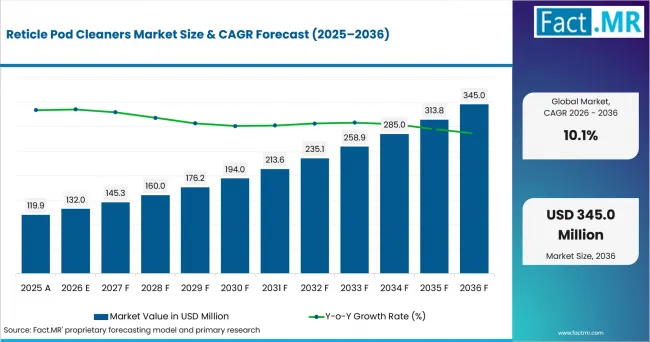
Reticle Pod Cleaners Market Value Analysis | Source: Fact.MR
What are the defining numbers behind Reticle Pod Cleaners Market growth?
USD 213.0 million absolute opportunity between 2026 and 2036.
- Demand Drivers in the Market
- Reticle-pod cleaning systems remove particulate, airborne molecular contamination and moisture from reticle pods to support production-ready return. Brooks Automation lists EUV pod cleaning systems within its reticle-management and lithography portfolio.
- Reticle-handling workflows use pod and reticle identification, transfer, inspection or qualification and usage tracking. Linking cleaner records to these workflows is treated in this report as an implementation practice rather than a SEMI requirement.
- SEMI reported in April 2026 that worldwide semiconductor manufacturing equipment sales increased 15.0% to USD 135.1 billion in 2025.
- Key Segments Analyzed
- By Cleaning Method: Dry CO2/plasma is expected to hold 38.0% share in 2026 because low-residue cleaning supports sensitive reticle-pod handling requirements.
- By Pod Type: Standard SMIF pods are projected to account for 42.0% share in 2026 as active supplier offerings support continued use across established reticle-handling environments.
- By Automation: Fully automated systems are anticipated to capture 56.0% share in 2026 since automated cleaning reduces manual handling and supports repeatable process control.
- By End User: Foundries are forecast to hold 47.0% share in 2026 as high-volume wafer operations require consistent reticle-pod cleanliness and controlled contamination management.
- Analyst Opinion at Fact.MR
- Shambhu Nath Jha, Principal Consultant at Fact.MR, states, "Reticle pod cleaners draw attention because a single carrier can touch several high-value lithography steps. Production acceptance is expected to depend on particle evidence and pod compatibility before peak throughput is discussed. Suppliers should combine cleaning repeatability, low carrier wear and clear service records."
- Strategic Implications
- NIST reported on January 3, 2025 that CHIPS for America awarded USD 285.0 million to establish and operate the SMART USA semiconductor digital-twin institute.
- Equipment providers should show cleaning recipes for SMIF pods, dual pods and advanced-node carriers during supplier qualification.
- Investors should separate direct pod-cleaner revenue from broader cleanroom automation and carrier storage exposure.
Taiwan leads at 11.97% CAGR through foundry scale and advanced semiconductor pilot-line investment. South Korea follows at 11.64% as memory strength and semiconductor exports support demand. Japan reaches 11.58% through next-generation semiconductor investment. The USA records 11.56% through fab and advanced-packaging funding. China posts 11.51% through integrated-circuit production scale, while Germany reaches 11.43% through Dresden semiconductor investment and EU funding support.
How does the Reticle Pod Cleaners Market break down by segment?
Dry CO2/plasma to lead Cleaning Method at 38.0% share in 2026 and Fully automated systems to lead Automation at 56.0% share in 2026.
Which Cleaning Method dominates?
Dry CO2/plasma is expected to account for 38.0% share in 2026.
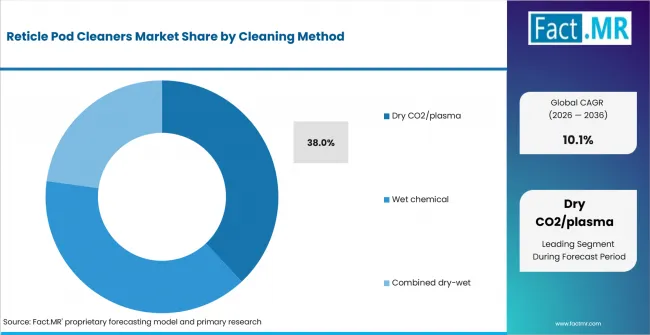
Reticle Pod Cleaners Market Analysis By Cleaning Method | Source: Fact.MR
Dry CO2/plasma leads the Cleaning Method segment as low-residue cleaning supports sensitive reticle-pod handling and contamination-control requirements. The approach helps fabs remove particles and other contaminants before pods return to storage, inspection or lithography workflows, supporting consistent carrier cleanliness during advanced semiconductor manufacturing operations.
What leads the Pod Type segment?
Standard SMIF pods are projected to hold 42.0% share in 2026.
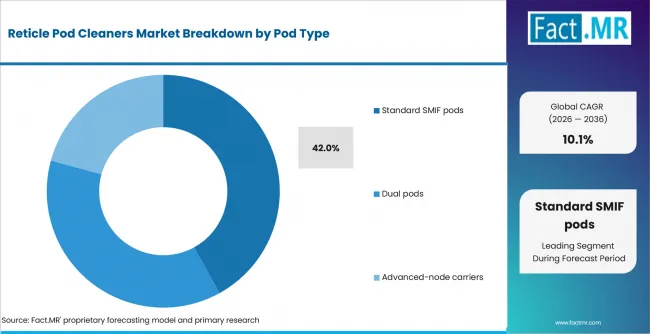
Reticle Pod Cleaners Market Analysis By Pod Type | Source: Fact.MR
Standard SMIF pods lead the Pod Type segment because they remain actively supported within established reticle-handling environments. Their continued use across semiconductor facilities sustains cleaning demand, while contamination control at pod sealing surfaces increases the importance of reliable cleaning, inspection and carrier-management procedures before production reuse.
How does Automation shape demand?
Fully automated systems are anticipated to lead with 56.0% share in 2026.
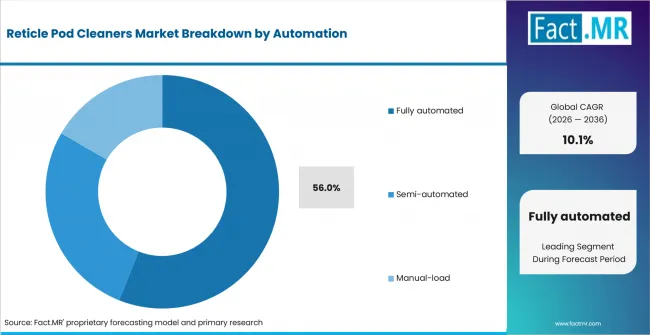
Reticle Pod Cleaners Market Analysis By Automation | Source: Fact.MR
Fully automated systems lead the Automation segment as fabs seek repeatable cleaning processes with lower manual handling. Automated workflows support consistent pod identification, transfer and process records while reducing operator intervention, making them well suited to advanced semiconductor environments where contamination control and reticle-carrier traceability are critical.
What supports Foundries within End User?
Foundries are forecast to represent 47.0% share in 2026.
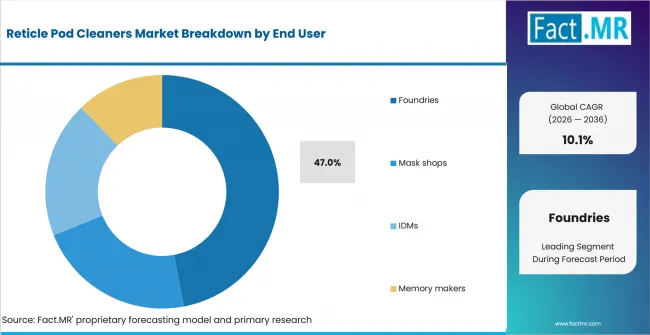
Reticle Pod Cleaners Market Analysis By End User | Source: Fact.MR
Foundries lead the End User segment because high-volume wafer production requires strict reticle-pod cleanliness before lithography exposure. Repeated movement between storage, inspection and production increases contamination-control requirements, supporting demand for reliable pod-cleaning systems that maintain carrier condition and help protect sensitive advanced-node manufacturing workflows.
What is accelerating Reticle Pod Cleaners Market adoption, and what is holding it back?
Reticle-carrier contamination control as the primary driver and qualification cost as the primary restraint.
Drivers Impact Analysis
| DRIVER | (~) % IMPACT ON CAGR | GEOGRAPHIC RELEVANCE | IMPACT TIMELINE |
|---|---|---|---|
| Foundry reticle reuse | +2.6% | Taiwan, USA, China | Short term (<= 2 years) |
| EUV and advanced-node handling | +2.2% | Taiwan, South Korea, Japan | Short term (<= 2 years) |
| Automation link to stockers | +1.8% | Leading fabs and mask shops | Medium term (2-4 years) |
| Particle and haze prevention | +1.5% | Global lithography sites | Medium term (2-4 years) |
| Service documentation needs | +1.0% | Advanced-node fabs | Long term (>= 4 years) |
- Foundry reticle reuse: Repeated reticle-pod movement between exposure, storage and inspection is treated as a demand factor.
- EUV and advanced-node handling: Entegris documents particle-transfer risk at EUV inner-pod sealing surfaces and engineering work to optimize pod geometry, design and materials.
- Automation link to stockers: SEMI E109 supports reticle-pod transfer, identification and verification within automated handling workflows.
Opportunity Impact Analysis
| OPPORTUNITY | (~) % IMPACT ON CAGR | GEOGRAPHIC RELEVANCE | IMPACT TIMELINE |
|---|---|---|---|
| Dry CO2/plasma recipe libraries | +1.4% | Taiwan, South Korea, Japan | Medium term (2-4 years) |
| Cleaner-stocker integration | +1.1% | Foundry clusters | Medium term (2-4 years) |
| Mask shop service contracts | +0.8% | USA, Japan, Germany | Long term (>= 4 years) |
| Advanced-node carrier upgrades | +0.6% | Taiwan and South Korea | Long term (>= 4 years) |
- Dry CO2/plasma recipe libraries: Brooks Automation states that carrier-cleaning processes use application-specific recipes tailored to contamination type, substrate materials and process requirements and that its specialists support fab qualification.
- Cleaner-stocker integration: The model treats links between cleaner status, carrier identity and automated storage or transfer data as an opportunity. Public SEMI evidence supports pod transfer and identity management but does not establish cleaner-stocker integration as a standard requirement.
- Mask shop service contracts: The model treats outsourced or recurring carrier-cleaning services as an opportunity for smaller fleets.
Restraints Impact Analysis
| RESTRAINT | (~) % IMPACT ON CAGR | GEOGRAPHIC RELEVANCE | IMPACT TIMELINE |
|---|---|---|---|
| Long qualification cycles | -1.2% | Advanced-node fabs | Short term (<= 2 years) |
| Carrier compatibility limits | -0.9% | EUV and SMIF users | Short term (<= 2 years) |
| Trade and service review | -0.7% | China, South Korea, USA | Medium term (2-4 years) |
| Small mask-shop budgets | -0.5% | Regional mask shops | Long term (>= 4 years) |
- Carrier compatibility limits: Supplier documentation confirms multiple reticle-carrier designs and materials, but the public sources reviewed do not establish that SMIF pods, dual pods and advanced-node carriers lack a common cleaning window.
- Small mask-shop budgets: The model treats capital constraints and lower throughput as factors supporting semi-automated systems.
Which countries are scaling Reticle Pod Cleaners Market fastest?
- The country comparison spans 0.54 percentage point and forms three practical growth bands across the forecast period.
- Taiwan remains 0.33 percentage point above South Korea through foundry scale and advanced semiconductor pilot-line investment.
- South Korea remains 0.06 percentage point above Japan as memory strength and semiconductor-export intensity support demand.
- Japan remains 0.02 percentage point above the USA through next-generation semiconductor investment.
- The USA remains 0.05 percentage point above China through fab and advanced-packaging investment.
- Germany closes the displayed range through Dresden semiconductor investment and EU funding support.
Comparable CAGRs can create different entry conditions due to foundry scale, reticle-handling requirements, advanced-node investment and local semiconductor infrastructure. Full report coverage includes North America, Latin America, Europe, East Asia, South Asia and Pacific, Middle East and Africa.
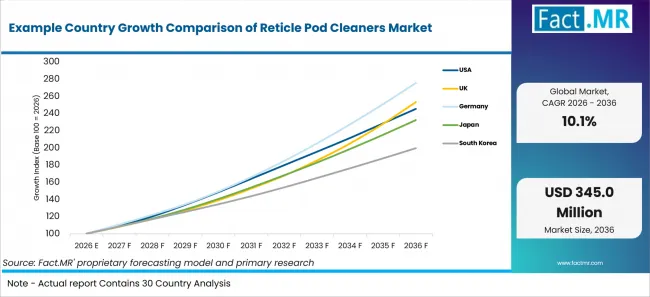
Example Country Growth Comparison Of Reticle Pod Cleaners Market | Source: Fact.MR
| Country | CAGR (2026-2036) |
|---|---|
| Taiwan | 11.97% |
| South Korea | 11.64% |
| Japan | 11.58% |
| USA | 11.56% |
| Germany | 11.43% |
What supports Taiwan adoption?
11.97% CAGR, with foundry scale and pilot-line investment treated as qualitative market context.
Taiwan’s growth is supported by semiconductor manufacturing depth and pilot-line investment. MOEA reported in February 2026 that the 12-inch advanced semiconductor pilot line represents an investment of NT$3.77 billion, forming part of a broader national infrastructure plan that also includes additional pilot lines and a metrology validation laboratory.
How is South Korea developing demand?
11.64% CAGR, with memory and semiconductor-export intensity treated as qualitative context.
South Korea’s growth reflects strong memory manufacturing and semiconductor export activity. MOTIR reported in January 2026 that semiconductor exports reached a record USD 173.4 billion in 2025, increasing 22.2% year over year. This export strength supports continued investment in advanced semiconductor operations and contamination-control requirements.
How does Japan perform?
11.58% CAGR, with next-generation semiconductor investment treated as qualitative context.
Japan’s growth is supported by next-generation semiconductor investment and domestic policy backing. METI said on November 21, 2025 that it intended to invest the JPY 100.0 billion allocated in the fiscal 2025 initial budget in Rapidus through the Information-technology Promotion Agency, Japan (IPA).
What supports USA adoption?
11.56% CAGR, with fab and advanced-packaging investment treated as qualitative context.
The USA’s growth is supported by semiconductor fab activity and advanced-packaging investment. NIST reported on January 16, 2025 that the U.S. Department of Commerce finalized USD 1.4 billion in NAPMP award funding to support advanced semiconductor packaging, including research, piloting, validation, and the transition of new technologies to U.S. manufacturing
What underpins Germany’s growth?
11.43% CAGR, with Dresden semiconductor investment and EU funding treated as qualitative context.
Germany’s growth is supported by semiconductor investment in Dresden and European funding support. The European Commission reported on February 20, 2025 that it approved up to EUR 920.0 million in German State aid to support Infineon’s EUR 3.5 billion semiconductor investment in Dresden, strengthening Europe’s security of supply, resilience, and technological autonomy in semiconductor technologies.
Who leads the Reticle Pod Cleaners Market?
Hugle Electronics Inc. and Brooks Automation show the clearest direct relevance, while STI Co., Ltd. strengthens the wider semiconductor-equipment landscape.
Hugle Electronics Inc. supports the competitive set as a profiled semiconductor-equipment provider. Brooks Automation adds automation and handling relevance. STI Co., Ltd. contributes further equipment capabilities, while DEVICE Co., Ltd. (DEVICEENG) broadens the supplier base. GSEC GmbH and Semiconductor Equipment Corporation extend the competitive field through their participation in the semiconductor-equipment ecosystem.
Which companies are profiled in this report?
Key providers include Hugle Electronics Inc., STI Co., Ltd., Brooks Automation, DEVICE Co., Ltd., GSEC GmbH, and Semiconductor Equipment Corporation.
- Hugle Electronics Inc.
- Brooks Automation
- STI Co., Ltd.
- DEVICE Co., Ltd. (DEVICEENG)
- GSEC GmbH
- Semiconductor Equipment Corporation
Bibliography
- Steinhagen, C. (2026, February 25). Particle quantification on EUV inner using adhesive and light-scattering tool [Conference presentation]. SPIE Advanced Lithography & Patterning 2026, San Jose, CA, United States.
- European Commission, Representation in Germany. (2025, February 20). Infineon-Halbleiterwerk in Dresden: Kommission genehmigt deutsche Beihilfe von 920 Millionen Euro für neue Megafabrik [Infineon semiconductor plant in Dresden: Commission approves German aid of €920 million for new megafab].
- Ministry of Economy, Trade and Industry. (2025, November 21). Press conference by Minister Akazawa (Excerpt).
- Ministry of Economic Affairs. (2026, February 11). MOEA breaks ground on Advanced Semiconductor R&D Center: Taiwan's first 12-inch pilot line to target AI, silicon photonics, and quantum technology.
- Ministry of Trade, Industry and Resources. (2026, January 2). Korea’s annual exports reach new highs in 2025.
- National Institute of Standards and Technology. (2025, January 3). Biden-Harris Administration awards Semiconductor Research Corporation Manufacturing Consortium Corporation $285M for new CHIPS Manufacturing USA Institute for Digital Twins, headquartered in North Carolina.
- National Institute of Standards and Technology. (2025, January 16). U.S. Department of Commerce announces $1.4 billion in final awards to support the next generation of U.S. semiconductor advanced packaging.
This Report Answers
- The report provides strategic intelligence on the reticle pod cleaners market across Cleaning Method and Pod Type choices that shape carrier release.
- Segment analysis identifies Dry CO2/plasma and Standard SMIF pods as the modeled share leaders within the 2026 market.
- Country outlook evaluates Taiwan and South Korea alongside Japan and the USA. China and Germany complete the growth comparison.
- Competitive analysis profiles Gudeng Precision and Brooks Automation alongside Entegris and Murata Machinery. Sinfonia Technology and Semiconductor Equipment Corporation complete the profiled company set.
- Automation assessment covers Fully automated and Semi-automated systems. Manual-load systems complete the automation view for smaller cleanroom settings.
What does the Reticle Pod Cleaners Market cover?
Reticle-pod cleaners remove particulate and other contamination from carriers used to store or transport reticles. Supplier materials reviewed identify particulate, airborne molecular contamination, moisture, particle, ion and organic-contamination control as relevant carrier-cleaning or inspection functions.
The reticle pod cleaners market covers equipment and services used for standard SMIF pods, dual pods and advanced-node carriers. Coverage includes dry CO2/plasma systems, wet chemical tools and combined dry-wet equipment. It also covers automation levels from manual-load systems to fully automated tools connected with reticle handling workflows.
What is included in the scope?
End User scope includes Foundries, Mask shops, IDMs and Memory makers. Carrier-cleaning activities tied to inspection and storage release are included within the report's market definition.
The scope includes Cleaning Method, Pod Type, Automation and End User. It covers pod-cleaning equipment and service routines used before storage, transfer or lithography exposure. Adjacent purge stockers and reticle handling interfaces are included only where they support pod-cleaner operation. Validation activity tied to particle removal and carrier compatibility is included.
What is excluded from the scope?
General photomask cleaning tools remain outside the scope unless the tool cleans the reticle carrier or pod.
The scope excludes wafer FOUP cleaners unless they are sold or configured for reticle pods. General cleanroom cleaning supplies and lithography scanners are excluded. Standalone mask inspection tools remain outside the scope unless their demand is directly tied to pod-cleaner release. Company revenue without a clear pod-cleaning connection is also excluded.
How Was the Analysis Built?
The analysis draws on 120+ sources, 35+ company portfolios, 25+ countries, and more than 20 industry interviews.
- Primary Research: Primary research includes discussions with manufacturers, service providers, technology developers, distributors, end users, procurement teams, and subject-matter experts. These conversations examine purchasing priorities, product adoption, operational challenges, approval requirements, competitive positioning, and the factors that influence wider market acceptance.
- Desk Research: Desk research covers government statistics, regulatory publications, company filings, trade data, technical studies, industry associations, standards, public policy, and other authoritative sources. Every source used in the analysis is documented in the bibliography.
- Market Sizing and Forecasting: Market estimates combine historical performance, demand indicators, pricing and volume trends, segment shares, company participation, country-level growth, adoption patterns, investment activity, and barriers to market expansion.
- Data Validation and Update Cycle: Findings are validated by comparing primary interviews with public data, company activity, regulatory changes, trade patterns, and industry developments. Regular updates review new product launches, capacity changes, partnerships, approvals, procurement trends, and shifts in commercial adoption.
What is the report’s scope and coverage?
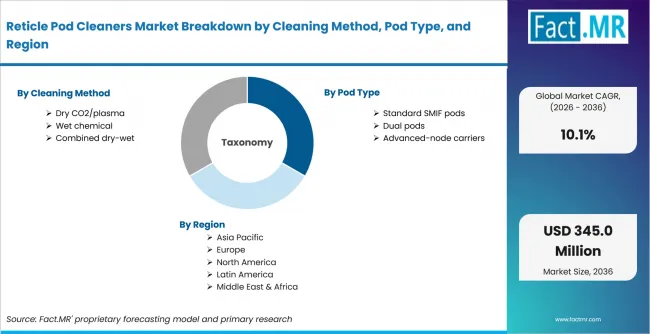
Reticle Pod Cleaners Market Breakdown By Cleaning Method, Pod Type, And Region | Source: Fact.MR
| Attribute | Details |
|---|---|
| Quantitative Units | USD million in 2026 to USD million by 2036 at CAGR |
| Market Definition | Equipment and service systems used to clean reticle pods and reticle carriers before storage, inspection, transport or lithography exposure |
| Cleaning Method | Dry CO2/plasma; Wet chemical; Combined dry-wet |
| Pod Type | Standard SMIF pods; Dual pods; Advanced-node carriers |
| Automation | Fully automated; Semi-automated; Manual-load |
| End User | Foundries; Mask shops; IDMs; Memory makers |
| Regions Covered | North America; Latin America; Europe; East Asia; South Asia and Pacific; Middle East and Africa |
| Countries Covered | Taiwan; South Korea; Japan; USA; China; Germany |
| Key Companies Profiled | Hugle Electronics Inc.; Brooks Automation; STI Co., Ltd.; DEVICE Co., Ltd. (DEVICEENG); GSEC GmbH; Semiconductor Equipment Corporation |
| Forecast Period | 2026 to 2036 |
| Approach | Hybrid top-down and bottom-up approach using semiconductor equipment demand; reticle handling practices; pod-cleaning requirements; automation adoption; end-user demand; company portfolio review; country growth patterns and contamination-control evidence |
How is the market segmented?
-
By Cleaning Method:
- Dry CO2/plasma
- Wet chemical
- Combined dry-wet
-
By Pod Type:
- Standard SMIF pods
- Dual pods
- Advanced-node carriers
-
By Automation:
- Fully automated
- Semi-automated
- Manual-load
-
By End User:
- Foundries
- Mask shops
- IDMs
- Memory makers
-
By Region:
- North America
- Latin America
- Europe
- East Asia
- South Asia and Oceania
- Middle East and Africa