AI Pods as a Service Market Size, Share, Growth and Forecast (2026 - 2036)

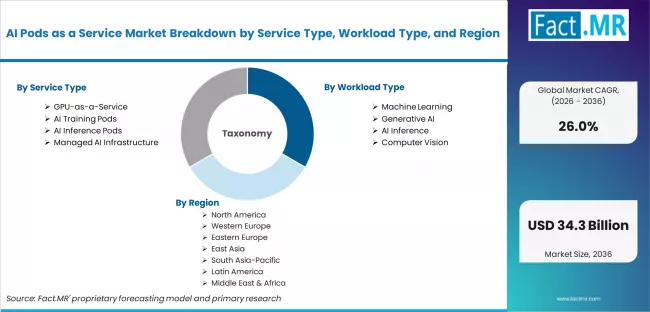
The AI Pods as a Service Market is segmented by Service Type, by Workload Type, by Pricing Model, by Deployment Architecture, by Application, by End-Use Industry, and by Region, with forecasts covering the period from 2026 to 2036.

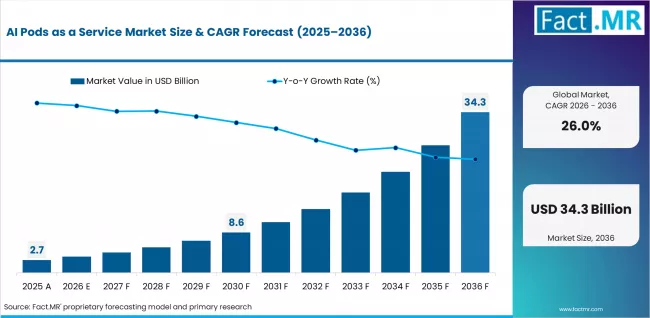
According to Fact.MR estimates, the AI Pods as a Service Market was valued at USD 2.7 billion in 2025 and is projected to reach USD 3.4 billion in 2026 and USD 34.3 billion by 2036, expanding at a CAGR of 26.0% during the forecast period. GPU-as-a-Service is expected to account for nearly 35.4% of the market share in 2026, driven by rising demand for scalable AI compute infrastructure and cloud-based GPU resources. Meanwhile, AI Agents & Copilots is anticipated to be the fastest-growing application segment, reaching approximately 22.8% share by 2036, supported by increasing adoption of generative AI, enterprise copilots, and autonomous AI-driven workflows.
AI Pods as a Service Market Overview, Growth Outlook, and Forecast by Fact.MR

  • In 2025, the AI Pods as a Service Market was valued at USD 2.7 billion.
  • Based on industry estimates, demand for AI Pods as a Service is projected to grow to USD 3.4 billion in 2026 and reach USD 34.3 billion by 2036.
  • The market is anticipated to expand at a CAGR of 26.0% during the forecast period.

Ai Pods As A Service Market Value Analysis

Summary of the AI Pods as a Service Market

  • Market Snapshot
    • In 2025, the size of the global AI Pods as a Service Market was valued at approximately USD 2.7 billion.
    • The market is projected to grow from USD 3.4 billion in 2026 to an estimated USD 34.3 billion by 2036.
    • The AI Pods as a Service Market is anticipated to expand at a CAGR of 26.0% during the forecast period.
    • The market is expected to create an absolute dollar opportunity of approximately USD 30.9 billion from 2026 to 2036.
    • GPU-as-a-Service is expected to hold a leading market position in 2026 under the service type segment, driven by rising enterprise demand for scalable GPU infrastructure, cloud-based AI compute resources, and growing generative AI workloads.
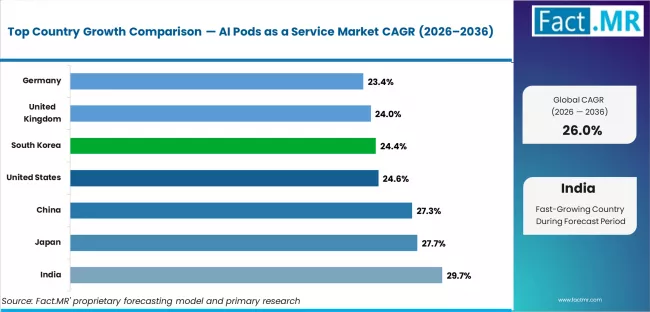
    • Key growth markets during the forecast period include India (29.7% CAGR), Japan (27.7% CAGR), and China (27.3% CAGR), supported by increasing hyperscale AI infrastructure investments, rapid enterprise AI adoption, and expanding deployment of large language model (LLM) and generative AI applications.
  • Demand and Growth Drivers
    • High demand for scalable and high-performance AI compute infrastructure from enterprises, AI start-ups, and cloud service providers will provide the driving force behind the growth of the AI Pods as a Service market.
    • Large scale adoption of generative AI, large language models (LLMs), and AI-powered enterprise applications is causing a significant increase in demand for GPU-intensive AI pod deployments.
    • Growing investment into hyperscale AI data centres and cloud-based AI infrastructure will support the growth of the AI Pods as a Service market through providing more flexible and lower cost access to advanced AI compute resources.
    • Increasingly enterprises are preferring pay-as-you-go AI services and on-demand access to GPU infrastructure, which will fuel the global adoption of AI Pods as a Service solutions.
    • Heightened deployment of AI agents, copilots, and autonomous AI systems across all industries is contributing to a substantial amount of demand for scalable AI inference and model hosting infrastructures.
    • Increase usage of AI orchestration platforms, MLOps frameworks, and Kubernetes-based AI infrastructures will increase deployment efficiencies, automate processes and improve workload-scalability for the overall AI Pods as a Service market.
  • Product and Segment View
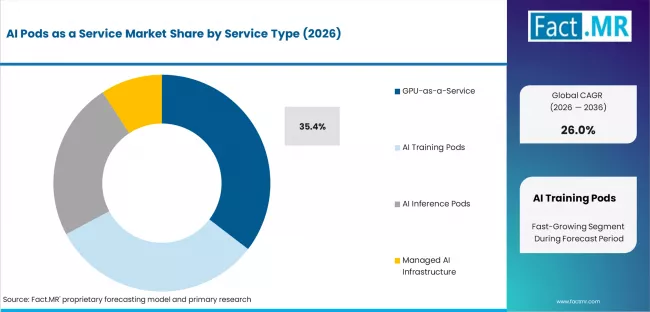
    • GPU-as-a-Service leads the service type segment with a 35.4% share in 2026, driven by increasing enterprise demand for scalable GPU compute infrastructure and flexible cloud-based AI deployment models.
    • AI Training Pods follow with a 31.8% share, supported by rising investments in large language model (LLM) training, foundation models, and hyperscale AI infrastructure.
    • Generative AI dominates the workload type segment with a 29.6% share in 2026, fueled by rapid adoption of text, image, and video generation applications across enterprises.
    • AI Inference accounts for a 27.9% share, driven by growing deployment of real-time AI applications, conversational AI systems, and recommendation engines.
    • Pay-as-you-go pricing models lead the pricing model segment with a 39.8% share, owing to strong demand for flexible and consumption-based AI infrastructure services.
  • Geography and Competitive Outlook
    • East Asia, South Asia & the Pacific are seen to be the areas with the largest market potential for AI Pods as a service, due to rapid investments in hyperscale infrastructure for Artificial Intelligence (AI), quick implementations of Enterprise AI, and increasing amounts of Generative AI and Large Language Model (LLM) software deployed throughout many industries, but specifically within India, China, Japan, and South Korea.
    • North America and Western Europe represent established markets as a result of the abundance of hyperscale cloud providers, an advanced ecosystem for AI infrastructure, and increased implementations of both AI training and inference workloads by companies and research facilities.
    • Some of the key players operating in the market include NVIDIA, CoreWeave, Together AI, Lambda, RunPod, Oracle, Google Cloud, Microsoft Azure, and Amazon Web Services among others.
  • Analyst Opinion
    • Shambhu Nath Jha, Principal Consultant at Fact.MR, says the AI Pods as a Service Market is demand for scalable AI compute infrastructure, rapid growth of generative AI workloads, and increased enterprise adoption of cloud AI platforms are driving substantial growth opportunities. “The rapid deployment of large language models (LLMs) and AI agents and the integration of enterprise copilots is contributing to growing demand for high-performance GPU infrastructure and AI training pods. The accelerated deployment of hyperscale AI datacenters, continued advances in distributed AI computing, and increased use of MLOps and AI orchestration platforms are helping to improve scalability, automation, and real-time AI processing across many industries

AI Pods as a Service Market— At a Glance

Attribute Details
Market Value 2025 USD 2.7 Billion
Market Value 2026 USD 3.4 Billion
Market Value 2036 USD 34.3 Billion
Absolute Dollar Opportunity USD 30.9 Billion
Total Growth 908.80%
CAGR 26.00%
Growth Multiple 10.1x
Key Demand Theme Rising demand for scalable GPU infrastructure, generative AI workloads, large language model (LLM) training, enterprise AI deployment, AI agents, and cloud-based AI compute services
Leading End User IT & Telecom
End User Share 34.20%
Leading Service Type GPU-as-a-Service
Service Type Share 35.40%
Leading Pricing Model Pay-as-you-go
Pricing Model Share 39.80%
Leading Deployment Architecture Centralized AI Pods
Deployment Architecture Share 60.80%
Leading Application AI Model Training
Application Share 33.40%
Key Growth Regions East Asia, South Asia & Pacific, North America
Key Companies NVIDIA, CoreWeave, Together AI, Lambda, RunPod, Oracle, Google Cloud, Microsoft Azure, Amazon Web Services
Segmentation by Service Type GPU-as-a-Service, AI Training Pods, AI Inference Pods, Managed AI Infrastructure
Segmentation by Workload Type Generative AI, Machine Learning, AI Inference, Computer Vision
Segmentation by Pricing Model Pay-as-you-go, Subscription-Based, Reserved Capacity, Enterprise Dedicated Contracts
Segmentation by Deployment Architecture Centralized AI Pods, Edge AI Pods, Distributed AI Pods
Segmentation by Application AI Model Training, AI Model Hosting, Autonomous AI Systems, AI Agents & Copilots, Enterprise AI Automation
Segmentation by End-Use Industry BFSI, Healthcare, IT & Telecom, Retail & E-commerce, Media & Entertainment
Segmentation by Region North America, Latin America, East Asia, South Asia & Pacific, Western Europe, Eastern Europe, Middle East & Africa

Key Growth Drivers, Constraints, and Opportunities
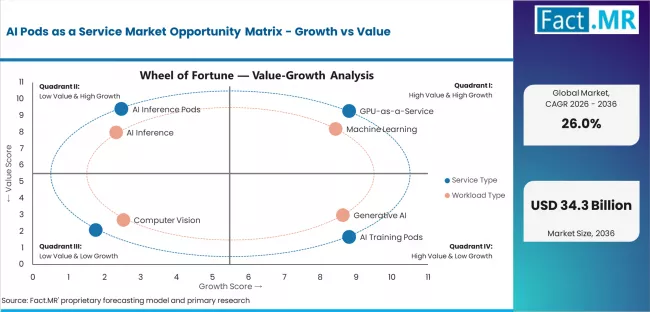
Ai Pods As A Service Market Opportunity Matrix Growth Vs Value

Key Factors Driving Growth

  • The increased use of Generative AI and Large Language Models alongside Enterprise AI is creating a much greater demand for both scalable AI compute infrastructure and GPU intensive AI Pod deployments.
  • Reliance of Enterprises on Cloud-based AI Infrastructure will continue to spur on the growth of AI Pods as a Service in the areas of AI Training, Inference and Model Hosting.
  • Expanding investment in Hyperscale AI Data Centres and GPU Cloud Infrastructure will provide momentum to the growth of the Market for AI Infrastructure, allowing for flexible, high-performance and on-demand AI compute environments.
  • The increased deployment of AI Agents, Enterprise Copilots, and Autonomous AI systems will lead to a strong demand for Low-Latency AI Inference Pods and Distributed AI Architectures.
Growth Driver Demand Impact Time Horizon Key Impact Area Fact.MR Insight
Rapid adoption of generative AI and large language models (LLMs) High Short–Long Term AI infrastructure expansion & GPU demand Increasing deployment of generative AI applications, enterprise copilots, and foundation models is significantly accelerating demand for scalable AI pod infrastructure and high-performance GPU clusters.
Rising enterprise demand for scalable cloud-based AI compute High Short–Mid Term Adoption acceleration & workload scalability Enterprises are increasingly adopting AI Pods as a Service solutions to access flexible, on-demand GPU infrastructure without large upfront investments in AI hardware and data centers.
Growing investments in hyperscale AI data centers and AI cloud infrastructure High Mid–Long Term Capacity expansion & market scalability Hyperscalers and AI-native cloud providers are rapidly expanding AI data center capacity and GPU deployments to support growing AI training and inference workloads globally.
Advancements in GPU architectures, distributed computing, and AI orchestration platforms Medium-High Mid–Long Term Product innovation & performance optimization Integration of advanced GPUs, Kubernetes-based orchestration, MLOps platforms, and distributed AI infrastructure is improving scalability, automation, and AI workload efficiency.
Increasing deployment of AI agents, copilots, and autonomous AI systems Medium-High Short–Long Term AI inference & enterprise automation Rising adoption of AI-powered assistants, autonomous workflows, and enterprise AI automation is driving strong demand for low-latency AI inference pods and managed AI hosting infrastructure.

Key Market Constraints

  • High capital costs of deploying high-performance GPU networks, for advanced-computing AI applications and large-scale computing facilities will limit access and thus potentially hinder growth opportunities for small businesses & new startups in the AI computing space.
  • The availability of GPUs and other semiconductor components has limited growth opportunities for existing legacy IT infrastructure and companies developing AI-based technologies that require greater quantities of high-performance computing resources (HPCs), and therefore, may also act as impediments to building a substantial infrastructure supporting advanced AI technologies.
  • Privacy and sovereignty regulations, as well as complex compliance requirements associated with enterprise AI workloads, will slow down the acceptance of AI-based systems by potential users across all industry sectors, especially heavily regulated industries like healthcare, banking and financial services (BFSI) and government.

Key Opportunity Areas

  • Rising use of generative AI, AI agents, and enterprise copilots is creating significant growth opportunities for providers of scalable AI training and inference infrastructure.
  • Expansion of AI cloud services and pay-as-you-go GPU infrastructure is driving enterprise adoption by startups, SMEs and large companies, and creating an environment where AI infrastructure models can be utilized more broadly throughout the enterprise.
  • Investments into sovereign AI Infrastructure and regional AI cloud ecosystems is creating new opportunities for localized AI pod deployments and expansion of domestic AI compute capacity.
  • Improvements in GPU Technology, AI orchestration platform, Kubernetes-based infrastructure, and MLOps Automation enable providers to offer AI Infrastructure Services that are faster, more efficient, more scalable, and more value-added.

Segment-wise Analysis of the AI Pods as a Service Market

  • GPU-as-a-Service accounts for 35.4% of the service type segment in 2026, driven by rising demand for scalable GPU infrastructure and cloud-based AI compute services.
  • Pay-as-you-go holds 39.8% of the pricing model segment in 2026, supported by increasing enterprise preference for flexible and consumption-based AI infrastructure.
  • Centralized AI Pods dominate the deployment architecture segment with a 60.8% share in 2026, owing to growing investments in hyperscale AI data centers and large-scale GPU clusters.
  • AI Model Training leads the application segment with a 33.4% share in 2026, fueled by increasing demand for foundation model and large language model (LLM) training workloads.

The report provides comprehensive market analysis by service type, workload type, pricing model, deployment architecture, application, end-use industry, and region.

Which Service Type Segment Topped the AI Pods as a Service Market?
Ai Pods As A Service Market Analysis By Service Type

The AI Pods as a Service Market share will be captured primarily by GPU-as-a-Service which is estimated to capture a 35.4% market share. The rise in enterprise demand for GPU infrastructure that is scalable, flexible, and cloud-based, as well as the rising demand for generative AI and LLM workloads, fuels its growth.

Which Pricing Model Segment Leads the Market?
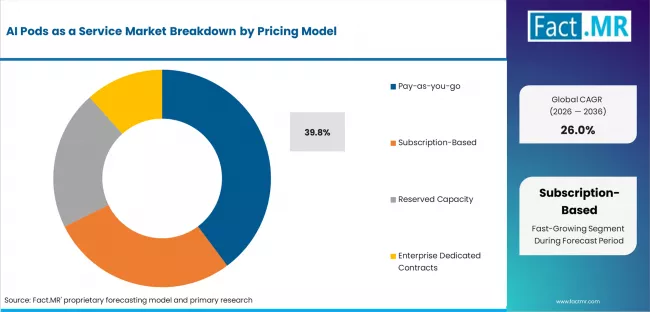
Ai Pods As A Service Market Analysis By Pricing Model

Pay-as-you-go leads the market share for the pricing model category, with 39.8% in 2026, driven by increasing corporate demand for scalable and pay-per-use AI infrastructure solutions that minimize capital investment requirements and facilitate AI implementation

Which Deployment Architecture Segment Holds the Largest Share in the Market?
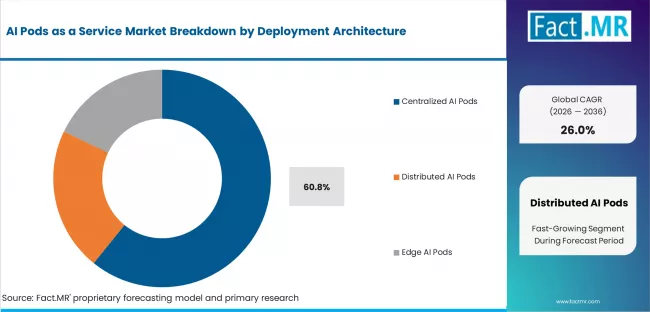
Ai Pods As A Service Market Analysis By Deployment Architecture

Centralized AI Pods are expected to account for the largest share of the market at 60.8% in 2026, driven mainly by the expansion of hyperscale AI data centers, centralized GPU clusters, and rising demand for large-scale infrastructure used for AI model training.

Which Application Segment Leads the Market?
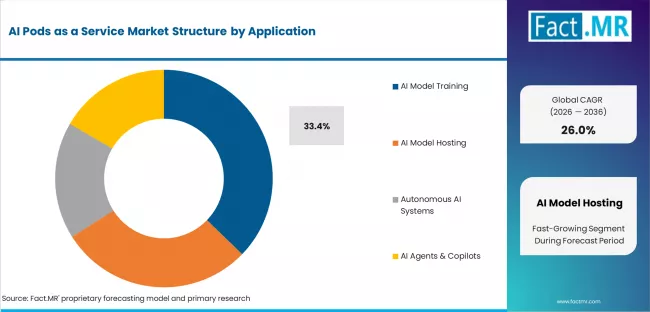
Ai Pods As A Service Market Analysis By Application

AI model training is expected to hold the largest share at 33.4% in 2026, supported by rising demand for foundation model development, large language model (LLM) training, and GPU-intensive AI workloads across enterprises and AI-native companies.

Which End-Use Industry Segment Leads the Market?
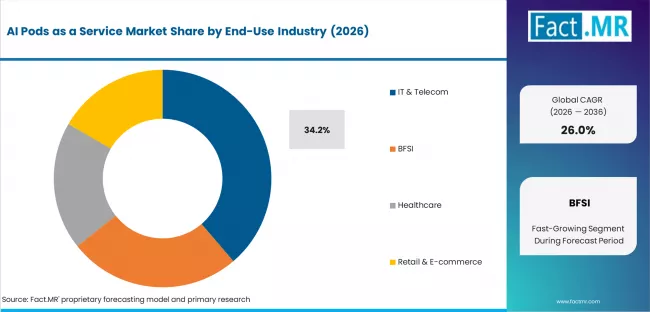
Ai Pods As A Service Market Analysis By End Use Industry

The IT & Telecom sector is projected to lead the market with a 34.2% share in 2026, driven by increasing investments in AI cloud infrastructure, enterprise AI deployment, hyperscale data centers, and AI-enabled network optimization solutions.

Regional Outlook Across Key Markets

  • The United States is expected to grow at 24.6%, supported by strong hyperscale cloud presence, advanced AI infrastructure, and expanding AI training and inference workloads.
  • Asia-Pacific is anticipated to be the fastest-growing region, with China growing at 27.3% due to rising AI cloud investments and sovereign AI initiatives, while Japan is projected at 27.7%, driven by advanced AI infrastructure adoption and enterprise automation. South Korea is expected to grow at 24.4%, supported by AI semiconductor leadership and hyperscale AI data center expansion.
  • Europe is witnessing steady growth, with Germany projected at 23.4%, driven by industrial AI adoption and enterprise automation. The United Kingdom is expected to grow at 24.0%, supported by increasing enterprise AI investments and cloud AI deployment.

Top Country Growth Comparison Ai Pods As A Service Market Cagr (2026 2036)

CAGR Table

Country CAGR (%)
India 29.7%
Japan 27.7%
China 27.3%
United States 24.6%
South Korea 24.4%
United Kingdom 24.0%
Germany 23.4%

Source: Fact.MR (FMR) analysis, based on proprietary forecasting model and primary research.
Ai Pods As A Service Market Cagr Analysis By Country

North America – The Hyperscale AI Infrastructure Hub

North America represents the most mature market for AI Pods as a Service, supported by a well-established hyperscale cloud infrastructure, advanced GPU ecosystems, and widespread enterprise adoption of AI. The region is a leader in generative AI deployment, AI model training, and investments in cloud-native AI infrastructure.

  • U.S.: Demand is projected to grow at 24.6% CAGR through 2036, driven by hyperscale AI data center expansion, enterprise AI adoption, and increasing deployment of large language models (LLMs) and AI inference workloads.
  • Canada: Expected to witness steady growth, supported by rising AI research investments, cloud infrastructure expansion, and increasing adoption of enterprise AI applications.

Europe – The Regulated Enterprise AI Market
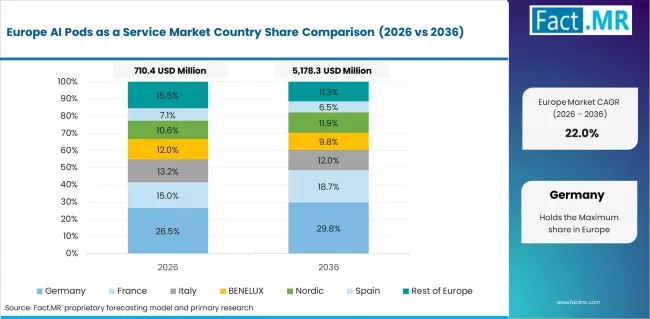
Ai Pods As A Service Market Europe Country Market Share Analysis, 2026 & 2036

The AI infrastructure market in Europe is primarily focused on compliance and places an emphasis on enterprise AI governance, as well as initiatives that promote sovereignty in AI and deploying AI systems to industry. There is also an emphasis on creating secure and scalable AI infrastructure environments that meet regulatory requirements.

  • Germany: Expected to grow at 23.4% CAGR, supported by industrial AI adoption, enterprise automation, and AI-driven manufacturing initiatives.
  • United Kingdom: Projected to expand at 24.0% CAGR, driven by increasing enterprise AI investments, AI cloud adoption, and development of AI innovation ecosystems.

Asia-Pacific – The High-Growth AI Infrastructure Engine
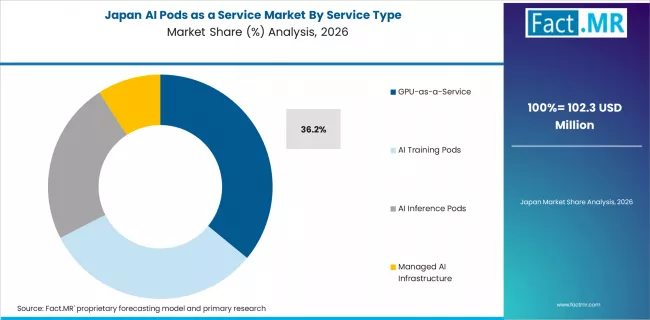
Ai Pods As A Service Market Japan Market Share Analysis By Service Type

Asia-Pacific is emerging as the fastest-growing region, driven by rapid digital transformation, rising investments in AI infrastructure, and the growing deployment of generative AI applications. Both governments and enterprises are increasingly investing in hyperscale AI data centers and sovereign AI ecosystems.

  • China: Expected to grow at 27.3% CAGR, supported by sovereign AI initiatives, expanding AI cloud infrastructure, and large-scale enterprise AI deployment.
  • Japan: Projected to grow at 27.7% CAGR, driven by advanced AI infrastructure adoption, semiconductor innovation, and enterprise automation demand.
  • India: Leading growth at 29.7% CAGR, fueled by hyperscale AI investments, startup ecosystem expansion, and rising demand for cloud-based AI compute services.
  • South Korea: Expected to grow at 24.4% CAGR, supported by AI semiconductor leadership and expansion of hyperscale AI infrastructure.

Latin America – The Emerging AI Cloud Adoption Market

Latin America is experiencing growing adoption of cloud-based AI infrastructure, supported by ongoing enterprise digitalization, expansion of the startup ecosystem, and increasing demand for scalable AI computing services.

  • Brazil: Expected to experience steady growth, supported by increasing enterprise AI deployment and growing investment in cloud infrastructure modernization.

Middle East & Africa – The Sovereign AI Infrastructure Zone

The Middle East & Africa is an emerging market for AI infrastructure, supported by sovereign AI initiatives, investments in smart city projects, and the expanding deployment of AI-driven digital transformation programs. The region is also focusing on building localized AI cloud infrastructure and strengthening regional AI computing capacity.

  • UAE / Saudi Arabia (KSA): Demand is projected to grow steadily, supported by sovereign AI programs, hyperscale data center investments, and national AI development strategies.

Fact.MR’s analysis of the AI Pods as a Service Market highlights strong regional growth momentum, with Asia-Pacific emerging as the fastest-growing region, while North America continues to lead in hyperscale AI infrastructure, enterprise AI deployment, and advanced GPU cloud ecosystems, driving the global transition toward scalable, cloud-native AI compute environments.

Competitive Benchmarking and Company Positioning

Leading Companies Shaping the AI Pods as a Service Market
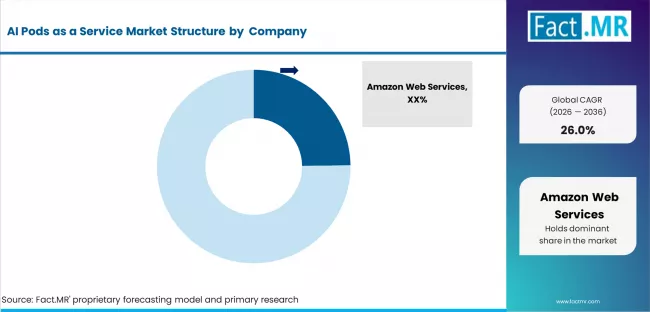
Ai Pods As A Service Market Analysis By Company

The market for AI Pods as a Service is being influenced by two key groups: hyperscale cloud providers and AI-centric GPU infrastructure providers. Four major players – Amazon Web Services, Microsoft Azure, Google Cloud, and NVIDIA – account for the vast majority of this market by virtue of their enormous AI infrastructure ecosystems, sophisticated GPU technology, and extensive use by businesses on an enterprise scale. When it comes to competing with one another in this marketplace, the primary factor will be access to GPUs, as well as how well workloads scale from one GPU to another, the ability to offer flexible pricing, the quality of networking services, and the ability to orchestrate AI.

Recent Industry Developments

  • Globant Introduces AI Pods for Enterprise AI Transformation (2025)
  • Globant introduced AI Pods, a modular AI infrastructure and services framework designed to accelerate enterprise AI adoption and deployment. The solution enables scalable AI model development, orchestration, and deployment across cloud environments, supporting enterprise generative AI, AI agents, and large language model (LLM) applications within the AI Pods as a Service ecosystem.
  • Meta Builds AI Infrastructure With NVIDIA (2025)
  • NVIDIA announced a strategic collaboration with Meta to expand hyperscale AI infrastructure using NVIDIA GPUs, networking technologies, and AI computing platforms. The partnership supports large-scale AI model training, inference workloads, and generative AI deployments, strengthening global AI pod infrastructure capacity.
  • CoreWeave and Meta Announce $21 Billion Expanded AI Infrastructure Agreement (2025)
  • CoreWeave announced a $21 billion expanded agreement with Meta to provide large-scale AI cloud infrastructure and GPU compute capacity. The partnership focuses on accelerating AI training and inference deployments through high-performance AI pod environments powered by advanced NVIDIA GPU infrastructure.
  • AWS Launches AI Factories for Enterprise AI Infrastructure Deployment (2025)
  • Amazon Web Services introduced AWS AI Factories, integrated AI infrastructure environments combining GPUs, AI accelerators, networking, storage, and orchestration capabilities for enterprise AI workloads. The platform supports scalable AI model training, inference, and generative AI deployment across cloud-native environments.
  • NVIDIA Launches Open Physical AI Data Factory Blueprint for Robotics and AI Agents (2025)
  • NVIDIA unveiled the Open Physical AI Data Factory Blueprint to accelerate AI training data generation for robotics, autonomous systems, and AI agents. The platform enhances AI infrastructure efficiency by enabling scalable synthetic data creation and high-performance AI workload processing within advanced AI compute ecosystems.

Leading Companies Shaping the AI Pods as a Service Market

  • NVIDIA
  • CoreWeave
  • Together AI
  • Lambda
  • RunPod
  • Oracle
  • Google Cloud
  • Microsoft Azure
  • Amazon Web Services

Sources and Research References

  • [1] Globant, “Globant Introduces AI Pods for Enterprise AI Transformation,” 2025.
  • [2] NVIDIA, “Meta Builds AI Infrastructure With NVIDIA,” 2025.
  • [3] CoreWeave, “CoreWeave and Meta Announce $21 Billion Expanded AI Infrastructure Agreement,” 2025.
  • [4] Amazon Web Services, “Introducing AWS AI Factories,” 2025.
  • [5] NVIDIA, “NVIDIA Announces Open Physical AI Data Factory Blueprint to Accelerate Robotics, Vision AI Agents and Autonomous Vehicle Development,” 2025.

AI Pods as a Service Market Definition

AI Pods as a Service Market refers to AI infrastructure as a service offering that offer cloud-based GPU-based AI infrastructure for training, inference, and deployment of AI workloads. It includes GPU as a Service, AI Training Pods, AI Inference Pods, and AI Infrastructure services with orchestration, MLOps, and distributed computing capabilities. AI pods cater to workloads involving generative AI, large language models (LLM), machine learning, computer vision, and autonomous AI workloads. It benefits enterprises, AI startups, and cloud service providers who are looking for efficient AI computing capabilities with flexibility in deployment, scalability, and faster AI model building capabilities.

AI Pods as a Service Market Inclusions

This report offers an in-depth analysis of the global market and its weeping implications from a regional/common perspective. Additional information will also be provided on the trends in the AI pod use, trend in pricing models, trend in adoption of AI pods, and trend in AI pods market expansion opportunity and competition among enterprise generative, cloud AI infrastructure, and large language model (LLM) deployments. Moreover, report will highlight the latest developments in GPU computing technology and distributed AI infrastructure, as well as the innovations in AI orchestration platforms, MLOps integration, and highly scalable cloud-based AI infrastructures.

AI Pods as a Service Market Exclusions

AI Pods as a Service Market excludes regular cloud computing and virtual machine solutions unless they have been designed explicitly to handle AI training and inference tasks. AI software and AI software as a service (SaaS) products, as well as AI models not coupled with an AI-specific compute platform, are also not included in the market analysis unless associated with AI pods as a service. Other products that are out of scope are consumer-oriented AI devices, edge consumer AI hardware, and data center offerings without GPU-assisted AI pods

AI Pods as a Service Market Research Methodology

  • Primary Research
    • AI infrastructure vendors, hyperscale clouds, GPU clouds, AI platform vendors, enterprise AI users, and technology experts from sectors like IT and telecommunication, BFSI, health care, and cloud computing were interviewed to get more information about AI compute requirements, GPU infrastructure deployment, pricing, AI pod as-a-service model deployment, and enterprise application of AI pods as-a-service.
  • Desk Research
    • Analyzing industry environments of secondary sources, in order to confirm market size, competitive environment, and trends in technology. Secondary sources included: company annual reports, investor presentations, product portfolios, cloud infrastructure reports, databases for AI industry, white papers, published research documents related to AI and cloud technologies, regulatory documents related to cloud computing and AI infrastructure.
  • Market-Sizing and Forecasting
    • The market sizing was obtained through a mix of bottom-up calculations (based on revenue, GPUs, cloud AI infrastructure investment, and adoption rate) and top-down calculations (based on generative AI growth, enterprise AI spend, growth of hyperscale data centers, and cloud AI adoption).
  • Data Validation and Update Cycle
    • Through triangulation with subject matter experts, market estimates and projections were validated and adapted to keep pace with technological changes, growth in demand for GPUs, corporate AI adoption rates, activity of large-scale data centres (Hyperscalers), legal developments, and global economic considerations that could have an impact on an overall AI Infrastructure market.

Scope of Analysis

Ai Pods As A Service Market Breakdown By Service Type, Workload Type, And Region


Parameter
Details
Quantitative Units USD 2.7 Billion (2025) to USD 34.3 Billion (2036), at a CAGR of 26.0%
Market Definition The AI Pods as a Service Market covers cloud-based AI infrastructure solutions providing scalable GPU-powered environments for AI training, inference, model hosting, and enterprise AI deployment. The market includes GPU-as-a-Service, AI training pods, AI inference pods, and managed AI infrastructure integrated with orchestration platforms, MLOps tools, and distributed AI computing technologies for workloads such as generative AI, large language models (LLMs), machine learning, and real-time AI applications.
Regions Covered North America, Europe, Asia-Pacific, Latin America, Middle East & Africa
Countries Covered USA, Canada, UK, Germany, China, Japan, India, South Korea, Brazil, UAE, Saudi Arabia, and 20+ countries
Key Companies NVIDIA, CoreWeave, Together AI, Lambda, RunPod, Oracle, Google Cloud, Microsoft Azure, Amazon Web Services
Forecast Period 2026 to 2036
Approach Hybrid demand-side and top-down methodology based on growth in generative AI adoption, hyperscale AI infrastructure investments, GPU cloud demand, enterprise AI deployment, AI inference workloads, and expansion of large language model (LLM) applications, validated through primary interviews with AI infrastructure providers, hyperscale cloud companies, GPU cloud operators, enterprise AI adopters, and technology experts across major regions.

Analysis by Service Type, Workload Type, Pricing Model, Deployment Architecture, Application, End-Use Industry, and Region

  • AI Pods as a Service Market by Service Type

    • GPU-as-a-Service
      • On-demand GPU rental
      • Dedicated GPU clusters
      • Multi-GPU pods
    • AI Training Pods
      • LLM training infrastructure
      • Deep learning training clusters
      • Distributed AI training pods
    • AI Inference Pods
      • Real-time inference
      • Serverless inference
      • Edge inference pods
    • Managed AI Infrastructure
      • Managed Kubernetes AI
      • MLOps platforms
      • AI orchestration services
  • AI Pods as a Service Market by Workload Type

    • Generative AI
      • Text generation
      • Image generation
      • Video generation
    • Machine Learning
      • Supervised learning
      • Reinforcement learning
      • Predictive analytics
    • AI Inference
      • LLM inference
      • Conversational AI
      • Recommendation systems
    • Computer Vision
      • Video analytics
      • Object detection
      • Medical imaging AI
  • AI Pods as a Service Market by Pricing Model

    • Pay-as-you-go
    • Subscription-Based
    • Reserved Capacity
    • Enterprise Dedicated Contracts
  • AI Pods as a Service Market by Deployment Architecture

    • Centralized AI Pods
    • Edge AI Pods
    • Distributed AI Pods
  • AI Pods as a Service Market by Application

    • AI Model Training
    • AI Model Hosting
    • Autonomous AI Systems
    • AI Agents & Copilots
    • Enterprise AI Automation
  • AI Pods as a Service Market by End-Use Industry

    • BFSI
      • Fraud detection
      • Risk analytics
      • AI banking assistants
    • Healthcare
      • Diagnostics AI
      • Medical imaging
      • Drug discovery
    • IT & Telecom
      • Network optimization
      • AI cloud services
      • Automation systems
    • Retail & E-commerce
      • Personalization engines
      • AI shopping assistants
      • Demand forecasting
    • Media & Entertainment
      • Content generation
      • AI video production
      • Gaming AI
  • AI Pods as a Service Market by Region

    • North America
      • USA
      • Canada
      • Mexico
    • Latin America
      • Brazil
      • Chile
      • Rest of LATAM
    • East Asia
      • China
      • Japan
      • South Korea
      • Taiwan
    • South Asia & Pacific
      • India
      • Singapore
      • Australia
      • ASEAN
    • Western Europe
      • Germany
      • France
      • U.K.
      • Italy
      • Spain
      • BENELUX
      • Nordic
      • Rest of Western Europe
    • Eastern Europe
      • Poland
      • Hungary
      • Czech Republic
      • Balkan & Baltics
      • Rest of Eastern Europe
    • Middle East and Africa
      • Kingdom of Saudi Arabia
      • United Arab Emirates
      • South Africa
      • Rest of Middle East and Africa

- Frequently Asked Questions -

How large is the demand for AI Pods as a Service in the global market in 2025?

Demand for the AI Pods as a Service Market is estimated to be valued at USD 2.7 billion in 2025, driven by increasing adoption of generative AI, large language models (LLMs), enterprise AI workloads, and scalable GPU cloud infrastructure.

What will be the market size of AI Pods as a Service by 2036?

The market size is projected to reach USD 34.3 billion by 2036, supported by rising demand for AI training, inference infrastructure, AI agents, and cloud-based AI compute services.

What is the expected demand growth between 2025 and 2036?

Demand is expected to grow at a CAGR of 26.0%, driven by increasing investments in hyperscale AI infrastructure, enterprise AI adoption, and expansion of generative AI applications.

Which service type segment is expected to dominate the market?

GPU-as-a-Service is expected to dominate, accounting for 35.4% share in 2026, due to rising enterprise demand for scalable GPU compute infrastructure and flexible AI cloud deployment.

Which regions are expected to drive growth in the market?

Asia-Pacific is expected to be the fastest-growing region, led by India, China, Japan, and South Korea, driven by rapid AI infrastructure investments and growing adoption of cloud-based AI compute services.

Who are the key companies operating in the AI Pods as a Service Market?

Key players include NVIDIA, CoreWeave, Together AI, Lambda, RunPod, Oracle, Google Cloud, Microsoft Azure, and Amazon Web Services.

Table of Content

  1. AI Pods as a Service Market – Executive Summary
  2. Market Overview
    • Market Definition & Introduction
    • Market Taxonomy & Research Scope
  3. Global AI Pods as a Service Market Demand (in Value or Size in US$ Mn) Analysis 2021-2025 and Forecast, 2026–2036
    • Historical Market Value (US$ Mn) Analysis, 2021-2025
    • Current and Future Market Value (US$ Mn) Projections, 2026–2036
      • Y-o-Y Growth Trend Analysis
      • Absolute $ Opportunity Analysis
  4. Market Background and Foundational Data Points
    • Installed Base of Systems in the Market
    • Technology / Solution Penetration Rate (%)
    • Industry-wise Risk & Criticality Index
    • Operational Intensity
    • Technology Mix Share
    • Preventive vs Predictive Maintenance Adoption
    • Downtime Cost Sensitivity
    • Edge vs Cloud AI Deployment Ratio
    • Compute Demand Growth Rate (AI Workloads)
    • Energy Consumption Efficiency Benchmarking
    • Data Localization & Compliance Impact Index
    • AI Workload Offloading Rate from Cloud to Edge
    • Subscription vs Pay-per-Use Adoption Mix
    • Vendor Lock-in Intensity Level
    • Hardware Standardization vs Customization Ratio
    • Start-up Ecosystem Analysis, 2021-2025
    • AI Pods as a Service Market Opportunity Assessment
      • Total Available Market (US$ Mn)
      • Serviceable Addressable Market (US$ Mn)
      • Serviceable Obtainable Market (US$ Mn)
    • Porter’s Five Forces and PESTEL Analysis
    • Investment Feasibility Analysis
    • Macro-Economic Factors & Forecast Factors - Relevance & Impact
    • Market Dynamics
      • Drivers
      • Restraints
      • Opportunity Analysis
    • Key Regulations & Certifications
  5. AI Pods as a Service Market Analysis 2021-2025 and Forecast 2026–2036, By Service Type
    • Introduction / Key Findings
    • Historical Market Size (US$ Mn) & Trend Analysis By Service Type, 2021-2025
    • Current and Future Market Size (US$ Mn) Analysis and Forecast By Service Type, 2026-2036
      • GPU-as-a-Service
        • On-demand GPU rental
        • Dedicated GPU clusters
        • Multi-GPU pods
      • AI Training Pods
        • LLM training infrastructure
        • Deep learning training clusters
        • Distributed AI training pods
      • AI Inference Pods
        • Real-time inference
        • Serverless inference
        • Edge inference pods
      • Managed AI Infrastructure
        • Managed Kubernetes AI
        • MLOps platforms
        • AI orchestration services
    • Market Attractiveness Analysis By Service Type
  6. AI Pods as a Service Market Analysis 2021-2025 and Forecast 2026–2036, By Workload Type
    • Introduction / Key Findings
    • Historical Market Size (US$ Mn) Trend Analysis By Workload Type, 2021-2025
    • Current and Future Market Size (US$ Mn) Analysis and Forecast By Workload Type, 2026-2036
      • Generative AI
        • Text generation
        • Image generation
        • Video generation
      • Machine Learning
        • Supervised learning
        • Reinforcement learning
        • Predictive analytics
      • AI Inference
        • LLM inference
        • Conversational AI
        • Recommendation systems
      • Computer Vision
        • Video analytics
        • Object detection
        • Medical imaging AI
    • Market Attractiveness Analysis By Workload Type
  7. AI Pods as a Service Market Analysis 2021-2025 and Forecast 2026–2036, By Pricing Model
    • Introduction / Key Findings
    • Historical Market Size (US$ Mn) Trend Analysis By Pricing Model, 2021-2025
    • Current and Future Market Size (US$ Mn) Analysis and Forecast By Pricing Model, 2026-2036
      • Pay-as-you-go
      • Subscription-Based
      • Reserved Capacity
      • Enterprise Dedicated Contracts
    • Market Attractiveness Analysis By Pricing Model
  8. AI Pods as a Service Market Analysis 2021-2025 and Forecast 2026–2036, By Deployment Architecture
    • Introduction / Key Findings
    • Historical Market Size (US$ Mn) Trend Analysis By Deployment Architecture, 2021-2025
    • Current and Future Market Size (US$ Mn) Analysis and Forecast By Deployment Architecture, 2026-2036
      • Centralized AI Pods
      • Edge AI Pods
      • Distributed AI Pods
    • Market Attractiveness Analysis By Deployment Architecture
  9. AI Pods as a Service Market Analysis 2021-2025 and Forecast 2026–2036, By Application
    • Introduction / Key Findings
    • Historical Market Size (US$ Mn) Trend Analysis By Application, 2021-2025
    • Current and Future Market Size (US$ Mn) Analysis and Forecast By Application, 2026-2036
      • AI Model Training
      • AI Model Hosting
      • Autonomous AI Systems
      • AI Agents & Copilots
      • Enterprise AI Automation
    • Market Attractiveness Analysis By Application
  10. AI Pods as a Service Market Analysis 2021-2025 and Forecast 2026–2036, By End-Use Industry
    • Introduction / Key Findings
    • Historical Market Size (US$ Mn) Trend Analysis By End-Use Industry, 2021-2025
    • Current and Future Market Size (US$ Mn) Analysis and Forecast By End-Use Industry, 2026-2036
      • BFSI
        • Fraud detection
        • Risk analytics
        • AI banking assistants
      • Healthcare
        • Diagnostics AI
        • Medical imaging
        • Drug discovery
      • IT & Telecom
        • Network optimization
        • AI cloud services
        • Automation systems
      • Retail & E-commerce
        • Personalization engines
        • AI shopping assistants
        • Demand forecasting
      • Media & Entertainment
        • Content generation
        • AI video production
        • Gaming AI
    • Market Attractiveness Analysis By End-Use Industry
  11. Global AI Pods as a Service Market Analysis and Forecast, by Region
    • Introduction / Key Findings
    • Historical Market Size (US$ Mn) Trend Analysis by Region, 2021-2025
    • Current and Future Market Size (US$ Mn) Analysis and Forecast by Region, 2026-2036
      • North America
      • Latin America
      • Western Europe
      • Eastern Europe
      • East Asia
      • South Asia & Pacific
      • Middle East & Africa
    • Market Attractiveness Analysis by Region
  12. North America AI Pods as a Service Market Analysis and Forecast
    • Introduction / Key Findings
    • Historical Market Size (US$ Mn) Trend Analysis by Market Taxonomy, 2021-2025
    • Current and Future Market Size (US$ Mn) Analysis & Forecast by Market Taxonomy, 2026-2036
    • By Country
      • United States
      • Canada
      • Mexico
    • By Taxonomy
    • Market Attractiveness Analysis By Country & Taxonomy
    • Market Trends
    • Key Market Participants – Intensity Mapping
    • Drivers and Restraints - Impact Analysis
  13. Latin America AI Pods as a Service Market Analysis and Forecast
    • Introduction / Key Findings
    • Historical Market Size (US$ Mn) Trend Analysis by Market Taxonomy, 2021-2025
    • Current and Future Market Size (US$ Mn) Analysis & Forecast by Market Taxonomy, 2026-2036
    • By Country
      • Brazil
      • Chile
      • Rest of LATAM
    • By Taxonomy
    • Market Attractiveness Analysis By Country & Taxonomy
    • Market Trends
    • Key Market Participants – Intensity Mapping
    • Drivers and Restraints - Impact Analysis
  14. Western Europe AI Pods as a Service Market Analysis and Forecast
    • Introduction / Key Findings
    • Historical Market Size (US$ Mn) Trend Analysis by Market Taxonomy, 2021-2025
    • Current and Future Market Size (US$ Mn) Analysis & Forecast by Market Taxonomy, 2026-2036
    • By Country
      • Germany
      • Italy
      • France
      • United Kingdom
      • Spain
      • BENELUX
      • Nordics
      • Rest of Western Europe
    • By Taxonomy
    • Market Attractiveness Analysis By Country & Taxonomy
    • Market Trends
    • Key Market Participants – Intensity Mapping
    • Drivers and Restraints - Impact Analysis
  15. Eastern Europe AI Pods as a Service Market Analysis and Forecast
    • Introduction / Key Findings
    • Historical Market Size (US$ Mn) Trend Analysis by Market Taxonomy, 2021-2025
    • Current and Future Market Size (US$ Mn) Analysis & Forecast by Market Taxonomy, 2026-2036
    • By Country
      • Russia
      • Hungary
      • Poland
      • Balkan & Baltics
      • Rest of Eastern Europe
    • By Taxonomy
    • Market Attractiveness Analysis By Country & Taxonomy
    • Market Trends
    • Key Market Participants – Intensity Mapping
    • Drivers and Restraints - Impact Analysis
  16. East Asia AI Pods as a Service Market Analysis and Forecast
    • Introduction / Key Findings
    • Historical Market Size (US$ Mn) Trend Analysis by Market Taxonomy, 2021-2025
    • Current and Future Market Size (US$ Mn) Analysis & Forecast by Market Taxonomy, 2026-2036
    • By Country
      • China
      • Japan
      • South Korea
    • By Taxonomy
    • Market Attractiveness Analysis By Country & Taxonomy
    • Market Trends
    • Key Market Participants – Intensity Mapping
    • Drivers and Restraints - Impact Analysis
  17. South Asia & Pacific AI Pods as a Service Market Analysis and Forecast
    • Introduction / Key Findings
    • Historical Market Size (US$ Mn) Trend Analysis by Market Taxonomy, 2021-2025
    • Current and Future Market Size (US$ Mn) Analysis & Forecast by Market Taxonomy, 2026-2036
    • By Country
      • India
      • ASEAN
      • Australia & New Zealand
      • Rest of South Asia & Pacific
    • By Taxonomy
    • Market Attractiveness Analysis By Country & Taxonomy
    • Market Trends
    • Key Market Participants – Intensity Mapping
    • Drivers and Restraints - Impact Analysis
  18. Middle East & Africa AI Pods as a Service Market Analysis and Forecast
    • Introduction / Key Findings
    • Historical Market Size (US$ Mn) Trend Analysis by Market Taxonomy, 2021-2025
    • Current and Future Market Size (US$ Mn) Analysis & Forecast by Market Taxonomy, 2026-2036
    • By Country
      • Kingdom of Saudi Arabia
      • Other GCC Countries
      • Turkiye
      • South Africa
      • Other African Union
    • By Taxonomy
    • Market Attractiveness Analysis By Country & Taxonomy
    • Market Trends
    • Key Market Participants – Intensity Mapping
    • Drivers and Restraints - Impact Analysis
  19. Country-level AI Pods as a Service Market Analysis and Forecast
    • Introduction
    • Market Value Proportion Analysis, By Key Countries
    • Global Vs. Country Growth Comparison
      • United States AI Pods as a Service Market Analysis
        • Market Size (US$ Mn) Analysis by Market Taxonomy, 2021–2036
        • By Service Type
        • By Workload Type
        • By Pricing Model
        • By Deployment Architecture
        • By Application
        • By End-Use Industry
        • Canada AI Pods as a Service Market Analysis
        • Mexico AI Pods as a Service Market Analysis
        • Brazil AI Pods as a Service Market Analysis
        • Chile AI Pods as a Service Market Analysis
        • Germany AI Pods as a Service Market Analysis
        • France AI Pods as a Service Market Analysis
        • Italy AI Pods as a Service Market Analysis
        • Spain AI Pods as a Service Market Analysis
        • United Kingdom AI Pods as a Service Market Analysis
        • BENELUX AI Pods as a Service Market Analysis
        • Nordics AI Pods as a Service Market Analysis
        • Poland AI Pods as a Service Market Analysis
        • Russia AI Pods as a Service Market Analysis
        • Hungary AI Pods as a Service Market Analysis
        • Balkan & Baltics AI Pods as a Service Market Analysis
        • China AI Pods as a Service Market Analysis
        • Japan AI Pods as a Service Market Analysis
        • South Korea AI Pods as a Service Market Analysis
        • India AI Pods as a Service Market Analysis
        • ASEAN AI Pods as a Service Market Analysis
        • ANZ AI Pods as a Service Market Analysis
        • KSA AI Pods as a Service Market Analysis
        • Other GCC Countries AI Pods as a Service Market Analysis
        • South Africa AI Pods as a Service Market Analysis
        • Turkiye AI Pods as a Service Market Analysis
    • AI Pods as a Service Market Structure Analysis
      • Market Analysis by Tier of Companies
      • Market Concentration
      • Market Share Analysis of Top Players
      • Market Space for New Brands and Dollar Opportunity
      • Market Presence Analysis
        • Regional Footprint of Players
        • Product Footprint by Players
    • AI Pods as a Service Competition Analysis
      • Competition Dashboard
      • Pricing Analysis by Competition
      • Competition Benchmarking
      • Competition Deep Dive
        • NVIDIA
          • Overview
          • Product Portfolio
          • Sales Footprint
          • Key Developments
          • SWOT Analysis
          • Strategy Overview
          • Key Financials
        • CoreWeave
        • Together AI
        • Lambda
        • RunPod
        • Oracle
        • Google Cloud
        • Microsoft Azure
        • Amazon Web Services
        • Other Prominent Players
    • Primary insights
    • Assumptions & Acronyms Used
    • Research Methodology & Data Sources

List Of Table

  • Table 1: Global Market Value (USD Mn) Forecast by Region, 2021 to 2036
  • Table 2: Global Market Value (USD Mn) Forecast by Service Type, 2021 to 2036
  • Table 3: Global Market Value (USD Mn) Forecast by Workload Type, 2021 to 2036
  • Table 4: Global Market Value (USD Mn) Forecast by Pricing Model, 2021 to 2036
  • Table 5: Global Market Value (USD Mn) Forecast by Deployment Architecture, 2021 to 2036
  • Table 6: Global Market Value (USD Mn) Forecast by Application, 2021 to 2036
  • Table 7: Global Market Value (USD Mn) Forecast by End-Use Industry, 2021 to 2036
  • Table 8: North America Market Value (USD Mn) Forecast by Country, 2021 to 2036
  • Table 9: North America Market Value (USD Mn) Forecast by Service Type, 2021 to 2036
  • Table 10: North America Market Value (USD Mn) Forecast by Workload Type, 2021 to 2036
  • Table 11: North America Market Value (USD Mn) Forecast by Pricing Model, 2021 to 2036
  • Table 12: North America Market Value (USD Mn) Forecast by Deployment Architecture, 2021 to 2036
  • Table 13: North America Market Value (USD Mn) Forecast by Application, 2021 to 2036
  • Table 14: North America Market Value (USD Mn) Forecast by End-Use Industry, 2021 to 2036
  • Table 15: Latin America Market Value (USD Mn) Forecast by Country, 2021 to 2036
  • Table 16: Latin America Market Value (USD Mn) Forecast by Service Type, 2021 to 2036
  • Table 17: Latin America Market Value (USD Mn) Forecast by Workload Type, 2021 to 2036
  • Table 18: Latin America Market Value (USD Mn) Forecast by Pricing Model, 2021 to 2036
  • Table 19: Latin America Market Value (USD Mn) Forecast by Deployment Architecture, 2021 to 2036
  • Table 20: Latin America Market Value (USD Mn) Forecast by Application, 2021 to 2036
  • Table 21: Latin America Market Value (USD Mn) Forecast by End-Use Industry, 2021 to 2036
  • Table 22: Western Europe Market Value (USD Mn) Forecast by Country, 2021 to 2036
  • Table 23: Western Europe Market Value (USD Mn) Forecast by Service Type, 2021 to 2036
  • Table 24: Western Europe Market Value (USD Mn) Forecast by Workload Type, 2021 to 2036
  • Table 25: Western Europe Market Value (USD Mn) Forecast by Pricing Model, 2021 to 2036
  • Table 26: Western Europe Market Value (USD Mn) Forecast by Deployment Architecture, 2021 to 2036
  • Table 27: Western Europe Market Value (USD Mn) Forecast by Application, 2021 to 2036
  • Table 28: Western Europe Market Value (USD Mn) Forecast by End-Use Industry, 2021 to 2036
  • Table 29: Eastern Europe Market Value (USD Mn) Forecast by Country, 2021 to 2036
  • Table 30: Eastern Europe Market Value (USD Mn) Forecast by Service Type, 2021 to 2036
  • Table 31: Eastern Europe Market Value (USD Mn) Forecast by Workload Type, 2021 to 2036
  • Table 32: Eastern Europe Market Value (USD Mn) Forecast by Pricing Model, 2021 to 2036
  • Table 33: Eastern Europe Market Value (USD Mn) Forecast by Deployment Architecture, 2021 to 2036
  • Table 34: Eastern Europe Market Value (USD Mn) Forecast by Application, 2021 to 2036
  • Table 35: Eastern Europe Market Value (USD Mn) Forecast by End-Use Industry, 2021 to 2036
  • Table 36: East Asia Market Value (USD Mn) Forecast by Country, 2021 to 2036
  • Table 37: East Asia Market Value (USD Mn) Forecast by Service Type, 2021 to 2036
  • Table 38: East Asia Market Value (USD Mn) Forecast by Workload Type, 2021 to 2036
  • Table 39: East Asia Market Value (USD Mn) Forecast by Pricing Model, 2021 to 2036
  • Table 40: East Asia Market Value (USD Mn) Forecast by Deployment Architecture, 2021 to 2036
  • Table 41: East Asia Market Value (USD Mn) Forecast by Application, 2021 to 2036
  • Table 42: East Asia Market Value (USD Mn) Forecast by End-Use Industry, 2021 to 2036
  • Table 43: South Asia and Pacific Market Value (USD Mn) Forecast by Country, 2021 to 2036
  • Table 44: South Asia and Pacific Market Value (USD Mn) Forecast by Service Type, 2021 to 2036
  • Table 45: South Asia and Pacific Market Value (USD Mn) Forecast by Workload Type, 2021 to 2036
  • Table 46: South Asia and Pacific Market Value (USD Mn) Forecast by Pricing Model, 2021 to 2036
  • Table 47: South Asia and Pacific Market Value (USD Mn) Forecast by Deployment Architecture, 2021 to 2036
  • Table 48: South Asia and Pacific Market Value (USD Mn) Forecast by Application, 2021 to 2036
  • Table 49: South Asia and Pacific Market Value (USD Mn) Forecast by End-Use Industry, 2021 to 2036
  • Table 50: Middle East & Africa Market Value (USD Mn) Forecast by Country, 2021 to 2036
  • Table 51: Middle East & Africa Market Value (USD Mn) Forecast by Service Type, 2021 to 2036
  • Table 52: Middle East & Africa Market Value (USD Mn) Forecast by Workload Type, 2021 to 2036
  • Table 53: Middle East & Africa Market Value (USD Mn) Forecast by Pricing Model, 2021 to 2036
  • Table 54: Middle East & Africa Market Value (USD Mn) Forecast by Deployment Architecture, 2021 to 2036
  • Table 55: Middle East & Africa Market Value (USD Mn) Forecast by Application, 2021 to 2036
  • Table 56: Middle East & Africa Market Value (USD Mn) Forecast by End-Use Industry, 2021 to 2036

List Of Figures

  • Figure 1: Global Market Cost Analysis
  • Figure 2: Global Market Value (USD Mn) Forecast 2021–2036
  • Figure 3: Global Market Value Share and BPS Analysis by Service Type, 2026 and 2036
  • Figure 4: Global Market Y-o-Y Growth Comparison by Service Type, 2026 to 2036
  • Figure 5: Global Market Attractiveness Analysis by Service Type
  • Figure 6: Global Market Value Share and BPS Analysis by Workload Type, 2026 and 2036
  • Figure 7: Global Market Y-o-Y Growth Comparison by Workload Type, 2026 to 2036
  • Figure 8: Global Market Attractiveness Analysis by Workload Type
  • Figure 9: Global Market Value Share and BPS Analysis by Pricing Model, 2026 and 2036
  • Figure 10: Global Market Y-o-Y Growth Comparison by Pricing Model, 2026 to 2036
  • Figure 11: Global Market Attractiveness Analysis by Pricing Model
  • Figure 12: Global Market Value Share and BPS Analysis by Deployment Architecture, 2026 and 2036
  • Figure 13: Global Market Y-o-Y Growth Comparison by Deployment Architecture, 2026 to 2036
  • Figure 14: Global Market Attractiveness Analysis by Deployment Architecture
  • Figure 15: Global Market Value Share and BPS Analysis by Application, 2026 and 2036
  • Figure 16: Global Market Y-o-Y Growth Comparison by Application, 2026 to 2036
  • Figure 17: Global Market Attractiveness Analysis by Application
  • Figure 18: Global Market Value Share and BPS Analysis by End-Use Industry, 2026 and 2036
  • Figure 19: Global Market Y-o-Y Growth Comparison by End-Use Industry, 2026 to 2036
  • Figure 20: Global Market Attractiveness Analysis by End-Use Industry
  • Figure 21: Global Market Value (USD Mn) Share and BPS Analysis by Region, 2026 and 2036
  • Figure 22: Global Market Y-o-Y Growth Comparison by Region, 2026 to 2036
  • Figure 23: Global Market Attractiveness Analysis by Region
  • Figure 24: North America Market Incremental $ Opportunity, 2026 to 2036
  • Figure 25: Latin America Market Incremental $ Opportunity, 2026 to 2036
  • Figure 26: Western Europe Market Incremental $ Opportunity, 2026 to 2036
  • Figure 27: Eastern Europe Market Incremental $ Opportunity, 2026 to 2036
  • Figure 28: East Asia Market Incremental $ Opportunity, 2026 to 2036
  • Figure 29: South Asia and Pacific Market Incremental $ Opportunity, 2026 to 2036
  • Figure 30: Middle East & Africa Market Incremental $ Opportunity, 2026 to 2036
  • Figure 31: North America Market Value Share and BPS Analysis by Country, 2026 and 2036
  • Figure 32: North America Market Value Share and BPS Analysis by Service Type, 2026 and 2036
  • Figure 33: North America Market Y-o-Y Growth Comparison by Service Type, 2026 to 2036
  • Figure 34: North America Market Attractiveness Analysis by Service Type
  • Figure 35: North America Market Value Share and BPS Analysis by Workload Type, 2026 and 2036
  • Figure 36: North America Market Y-o-Y Growth Comparison by Workload Type, 2026 to 2036
  • Figure 37: North America Market Attractiveness Analysis by Workload Type
  • Figure 38: North America Market Value Share and BPS Analysis by Pricing Model, 2026 and 2036
  • Figure 39: North America Market Y-o-Y Growth Comparison by Pricing Model, 2026 to 2036
  • Figure 40: North America Market Attractiveness Analysis by Pricing Model
  • Figure 41: North America Market Value Share and BPS Analysis by Deployment Architecture, 2026 and 2036
  • Figure 42: North America Market Y-o-Y Growth Comparison by Deployment Architecture, 2026 to 2036
  • Figure 43: North America Market Attractiveness Analysis by Deployment Architecture
  • Figure 44: North America Market Value Share and BPS Analysis by Application, 2026 and 2036
  • Figure 45: North America Market Y-o-Y Growth Comparison by Application, 2026 to 2036
  • Figure 46: North America Market Attractiveness Analysis by Application
  • Figure 47: North America Market Value Share and BPS Analysis by End-Use Industry, 2026 and 2036
  • Figure 48: North America Market Y-o-Y Growth Comparison by End-Use Industry, 2026 to 2036
  • Figure 49: North America Market Attractiveness Analysis by End-Use Industry
  • Figure 50: Latin America Market Value Share and BPS Analysis by Country, 2026 and 2036
  • Figure 51: Latin America Market Value Share and BPS Analysis by Service Type, 2026 and 2036
  • Figure 52: Latin America Market Y-o-Y Growth Comparison by Service Type, 2026 to 2036
  • Figure 53: Latin America Market Attractiveness Analysis by Service Type
  • Figure 54: Latin America Market Value Share and BPS Analysis by Workload Type, 2026 and 2036
  • Figure 55: Latin America Market Y-o-Y Growth Comparison by Workload Type, 2026 to 2036
  • Figure 56: Latin America Market Attractiveness Analysis by Workload Type
  • Figure 57: Latin America Market Value Share and BPS Analysis by Pricing Model, 2026 and 2036
  • Figure 58: Latin America Market Y-o-Y Growth Comparison by Pricing Model, 2026 to 2036
  • Figure 59: Latin America Market Attractiveness Analysis by Pricing Model
  • Figure 60: Latin America Market Value Share and BPS Analysis by Deployment Architecture, 2026 and 2036
  • Figure 61: Latin America Market Y-o-Y Growth Comparison by Deployment Architecture, 2026 to 2036
  • Figure 62: Latin America Market Attractiveness Analysis by Deployment Architecture
  • Figure 63: Latin America Market Value Share and BPS Analysis by Application, 2026 and 2036
  • Figure 64: Latin America Market Y-o-Y Growth Comparison by Application, 2026 to 2036
  • Figure 65: Latin America Market Attractiveness Analysis by Application
  • Figure 66: Latin America Market Value Share and BPS Analysis by End-Use Industry, 2026 and 2036
  • Figure 67: Latin America Market Y-o-Y Growth Comparison by End-Use Industry, 2026 to 2036
  • Figure 68: Latin America Market Attractiveness Analysis by End-Use Industry
  • Figure 69: Western Europe Market Value Share and BPS Analysis by Country, 2026 and 2036
  • Figure 70: Western Europe Market Value Share and BPS Analysis by Service Type, 2026 and 2036
  • Figure 71: Western Europe Market Y-o-Y Growth Comparison by Service Type, 2026 to 2036
  • Figure 72: Western Europe Market Attractiveness Analysis by Service Type
  • Figure 73: Western Europe Market Value Share and BPS Analysis by Workload Type, 2026 and 2036
  • Figure 74: Western Europe Market Y-o-Y Growth Comparison by Workload Type, 2026 to 2036
  • Figure 75: Western Europe Market Attractiveness Analysis by Workload Type
  • Figure 76: Western Europe Market Value Share and BPS Analysis by Pricing Model, 2026 and 2036
  • Figure 77: Western Europe Market Y-o-Y Growth Comparison by Pricing Model, 2026 to 2036
  • Figure 78: Western Europe Market Attractiveness Analysis by Pricing Model
  • Figure 79: Western Europe Market Value Share and BPS Analysis by Deployment Architecture, 2026 and 2036
  • Figure 80: Western Europe Market Y-o-Y Growth Comparison by Deployment Architecture, 2026 to 2036
  • Figure 81: Western Europe Market Attractiveness Analysis by Deployment Architecture
  • Figure 82: Western Europe Market Value Share and BPS Analysis by Application, 2026 and 2036
  • Figure 83: Western Europe Market Y-o-Y Growth Comparison by Application, 2026 to 2036
  • Figure 84: Western Europe Market Attractiveness Analysis by Application
  • Figure 85: Western Europe Market Value Share and BPS Analysis by End-Use Industry, 2026 and 2036
  • Figure 86: Western Europe Market Y-o-Y Growth Comparison by End-Use Industry, 2026 to 2036
  • Figure 87: Western Europe Market Attractiveness Analysis by End-Use Industry
  • Figure 88: Eastern Europe Market Value Share and BPS Analysis by Country, 2026 and 2036
  • Figure 89: Eastern Europe Market Value Share and BPS Analysis by Service Type, 2026 and 2036
  • Figure 90: Eastern Europe Market Y-o-Y Growth Comparison by Service Type, 2026 to 2036
  • Figure 91: Eastern Europe Market Attractiveness Analysis by Service Type
  • Figure 92: Eastern Europe Market Value Share and BPS Analysis by Workload Type, 2026 and 2036
  • Figure 93: Eastern Europe Market Y-o-Y Growth Comparison by Workload Type, 2026 to 2036
  • Figure 94: Eastern Europe Market Attractiveness Analysis by Workload Type
  • Figure 95: Eastern Europe Market Value Share and BPS Analysis by Pricing Model, 2026 and 2036
  • Figure 96: Eastern Europe Market Y-o-Y Growth Comparison by Pricing Model, 2026 to 2036
  • Figure 97: Eastern Europe Market Attractiveness Analysis by Pricing Model
  • Figure 98: Eastern Europe Market Value Share and BPS Analysis by Deployment Architecture, 2026 and 2036
  • Figure 99: Eastern Europe Market Y-o-Y Growth Comparison by Deployment Architecture, 2026 to 2036
  • Figure 100: Eastern Europe Market Attractiveness Analysis by Deployment Architecture
  • Figure 101: Eastern Europe Market Value Share and BPS Analysis by Application, 2026 and 2036
  • Figure 102: Eastern Europe Market Y-o-Y Growth Comparison by Application, 2026 to 2036
  • Figure 103: Eastern Europe Market Attractiveness Analysis by Application
  • Figure 104: Eastern Europe Market Value Share and BPS Analysis by End-Use Industry, 2026 and 2036
  • Figure 105: Eastern Europe Market Y-o-Y Growth Comparison by End-Use Industry, 2026 to 2036
  • Figure 106: Eastern Europe Market Attractiveness Analysis by End-Use Industry
  • Figure 107: East Asia Market Value Share and BPS Analysis by Country, 2026 and 2036
  • Figure 108: East Asia Market Value Share and BPS Analysis by Service Type, 2026 and 2036
  • Figure 109: East Asia Market Y-o-Y Growth Comparison by Service Type, 2026 to 2036
  • Figure 110: East Asia Market Attractiveness Analysis by Service Type
  • Figure 111: East Asia Market Value Share and BPS Analysis by Workload Type, 2026 and 2036
  • Figure 112: East Asia Market Y-o-Y Growth Comparison by Workload Type, 2026 to 2036
  • Figure 113: East Asia Market Attractiveness Analysis by Workload Type
  • Figure 114: East Asia Market Value Share and BPS Analysis by Pricing Model, 2026 and 2036
  • Figure 115: East Asia Market Y-o-Y Growth Comparison by Pricing Model, 2026 to 2036
  • Figure 116: East Asia Market Attractiveness Analysis by Pricing Model
  • Figure 117: East Asia Market Value Share and BPS Analysis by Deployment Architecture, 2026 and 2036
  • Figure 118: East Asia Market Y-o-Y Growth Comparison by Deployment Architecture, 2026 to 2036
  • Figure 119: East Asia Market Attractiveness Analysis by Deployment Architecture
  • Figure 120: East Asia Market Value Share and BPS Analysis by Application, 2026 and 2036
  • Figure 121: East Asia Market Y-o-Y Growth Comparison by Application, 2026 to 2036
  • Figure 122: East Asia Market Attractiveness Analysis by Application
  • Figure 123: East Asia Market Value Share and BPS Analysis by End-Use Industry, 2026 and 2036
  • Figure 124: East Asia Market Y-o-Y Growth Comparison by End-Use Industry, 2026 to 2036
  • Figure 125: East Asia Market Attractiveness Analysis by End-Use Industry
  • Figure 126: South Asia and Pacific Market Value Share and BPS Analysis by Country, 2026 and 2036
  • Figure 127: South Asia and Pacific Market Value Share and BPS Analysis by Service Type, 2026 and 2036
  • Figure 128: South Asia and Pacific Market Y-o-Y Growth Comparison by Service Type, 2026 to 2036
  • Figure 129: South Asia and Pacific Market Attractiveness Analysis by Service Type
  • Figure 130: South Asia and Pacific Market Value Share and BPS Analysis by Workload Type, 2026 and 2036
  • Figure 131: South Asia and Pacific Market Y-o-Y Growth Comparison by Workload Type, 2026 to 2036
  • Figure 132: South Asia and Pacific Market Attractiveness Analysis by Workload Type
  • Figure 133: South Asia and Pacific Market Value Share and BPS Analysis by Pricing Model, 2026 and 2036
  • Figure 134: South Asia and Pacific Market Y-o-Y Growth Comparison by Pricing Model, 2026 to 2036
  • Figure 135: South Asia and Pacific Market Attractiveness Analysis by Pricing Model
  • Figure 136: South Asia and Pacific Market Value Share and BPS Analysis by Deployment Architecture, 2026 and 2036
  • Figure 137: South Asia and Pacific Market Y-o-Y Growth Comparison by Deployment Architecture, 2026 to 2036
  • Figure 138: South Asia and Pacific Market Attractiveness Analysis by Deployment Architecture
  • Figure 139: South Asia and Pacific Market Value Share and BPS Analysis by Application, 2026 and 2036
  • Figure 140: South Asia and Pacific Market Y-o-Y Growth Comparison by Application, 2026 to 2036
  • Figure 141: South Asia and Pacific Market Attractiveness Analysis by Application
  • Figure 142: South Asia and Pacific Market Value Share and BPS Analysis by End-Use Industry, 2026 and 2036
  • Figure 143: South Asia and Pacific Market Y-o-Y Growth Comparison by End-Use Industry, 2026 to 2036
  • Figure 144: South Asia and Pacific Market Attractiveness Analysis by End-Use Industry
  • Figure 145: Middle East & Africa Market Value Share and BPS Analysis by Country, 2026 and 2036
  • Figure 146: Middle East & Africa Market Value Share and BPS Analysis by Service Type, 2026 and 2036
  • Figure 147: Middle East & Africa Market Y-o-Y Growth Comparison by Service Type, 2026 to 2036
  • Figure 148: Middle East & Africa Market Attractiveness Analysis by Service Type
  • Figure 149: Middle East & Africa Market Value Share and BPS Analysis by Workload Type, 2026 and 2036
  • Figure 150: Middle East & Africa Market Y-o-Y Growth Comparison by Workload Type, 2026 to 2036
  • Figure 151: Middle East & Africa Market Attractiveness Analysis by Workload Type
  • Figure 152: Middle East & Africa Market Value Share and BPS Analysis by Pricing Model, 2026 and 2036
  • Figure 153: Middle East & Africa Market Y-o-Y Growth Comparison by Pricing Model, 2026 to 2036
  • Figure 154: Middle East & Africa Market Attractiveness Analysis by Pricing Model
  • Figure 155: Middle East & Africa Market Value Share and BPS Analysis by Deployment Architecture, 2026 and 2036
  • Figure 156: Middle East & Africa Market Y-o-Y Growth Comparison by Deployment Architecture, 2026 to 2036
  • Figure 157: Middle East & Africa Market Attractiveness Analysis by Deployment Architecture
  • Figure 158: Middle East & Africa Market Value Share and BPS Analysis by Application, 2026 and 2036
  • Figure 159: Middle East & Africa Market Y-o-Y Growth Comparison by Application, 2026 to 2036
  • Figure 160: Middle East & Africa Market Attractiveness Analysis by Application
  • Figure 161: Middle East & Africa Market Value Share and BPS Analysis by End-Use Industry, 2026 and 2036
  • Figure 162: Middle East & Africa Market Y-o-Y Growth Comparison by End-Use Industry, 2026 to 2036
  • Figure 163: Middle East & Africa Market Attractiveness Analysis by End-Use Industry
  • Figure 164: Global Market – Tier Structure Analysis
  • Figure 165: Global Market – Company Share Analysis

AI Pods as a Service Market