Rutile Market Size, Share, Growth and Forecast (2026 - 2036)

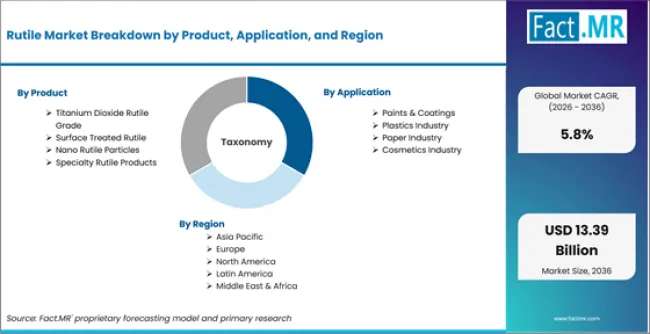
The Rutile Market is analyzed by product, including rutile grade titanium dioxide, surface treated and nano rutile, along with application, end use, and region, forecast 2026 to 2036.

Rutile Market Analysis and Forecast by Fact.MR

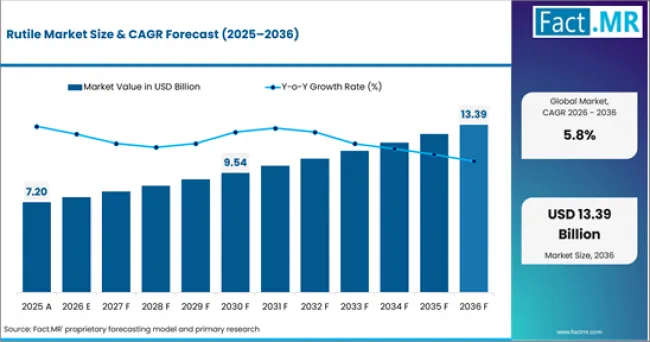
  • The Rutile Market is expected to grow from USD 7.6 billion in 2026 to USD 13.4 billion by 2036, at a 5.8% CAGR.
  •  driven by sustained demand for high-grade titanium dioxide pigment in paints and coatings, growing chloride-process capacity expansion in Asia, and tightening feedstock supply from mineral sands operations, with titanium dioxide rutile grade accounting for 42.9% of product share and paints and coatings contributing 64.3% of application demand as companies prioritize pigment performance, feedstock security, and compliance with environmental processing regulations.
Rutile Market Value Analysis

Summary of Rutile Market

  • Market Snapshot
    • In 2025, the global Rutile Market was valued at approximately USD 7.2 billion.
    • The market is estimated to reach USD 7.6 billion in 2026 and is projected to attain USD 13.4 billion by 2036.
    • The rutile market is likely to expand at a CAGR of 5.8% during the forecast period.
    • The market is anticipated to create an absolute dollar opportunity of USD 5.8 billion between 2026 and 2036.
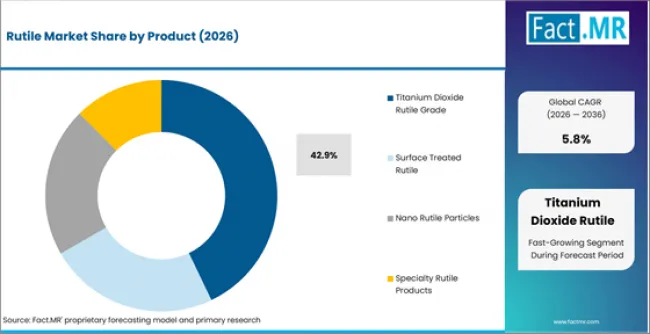
    • Titanium dioxide rutile grade accounts for 42.9% of product segment share in 2026.
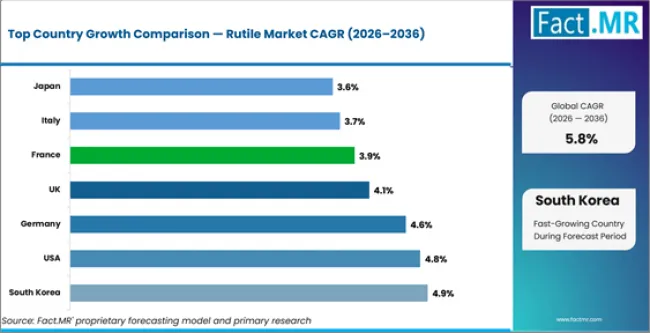
    • China (5.4%) and South Korea (4.9%) are the key growth markets during the forecast period.
  • Demand and Growth Drivers
    • Construction activity growth in Asia Pacific, the Middle East, and North America is sustaining demand for rutile-derived TiO2 pigment in architectural coatings, industrial paints, and protective finishes.
    • Chloride-process TiO2 production expansion is increasing demand for high-grade natural rutile and synthetic rutile feedstocks with low iron and chromium impurity levels.
    • Specialty applications in plastics, cosmetics, and paper are growing as formulators require higher-purity rutile grades for UV protection, opacity, and brightness improvement.
    • Mineral sands supply constraints from mine depletion and permitting delays are tightening feedstock availability and supporting rutile pricing above historical averages.
    • Welding electrode manufacturing continues to provide stable, cyclical demand for natural rutile as a flux coating material in construction and industrial welding.
  • Product and Segment View
    • Titanium dioxide rutile grade accounts for 42.9% of product share in 2026, driven by its position as the preferred feedstock for chloride-process TiO2 pigment production.
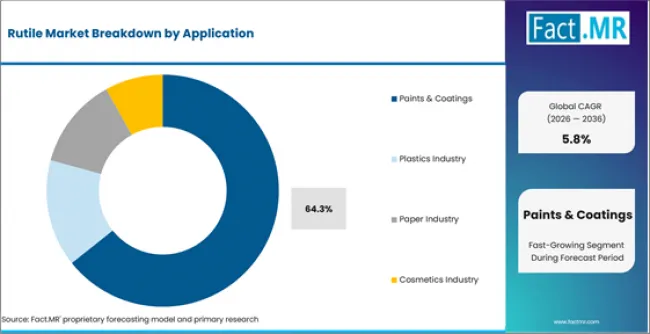
    • Paints and coatings account for 64.3% of application share in 2026, sustained by architectural and industrial coating demand for high-opacity, weather-resistant pigment systems.
    • Chloride process technology accounts for 52.4% of technology share in 2026, reflecting its growing dominance over sulfate-process production due to higher pigment quality and lower waste generation.
    • Key segmentation includes:
      • Product: Titanium Dioxide Rutile Grade, Surface Treated Rutile, Nano Rutile Particles, Specialty Rutile Products
      • Application: Paints and Coatings, Plastics, Paper, Cosmetics
      • End Use: Chemical Manufacturers, Paint Manufacturers, Plastic Manufacturers, Paper Manufacturers
      • Technology: Chloride Process, Sulfate Process, Surface Treatment, Nanotechnology Processing
    • These systems enable:
      • Production of high-opacity, UV-resistant titanium dioxide pigment for architectural and industrial coatings applications.
      • Feedstock supply for chloride-process TiO2 plants requiring 95%+ purity rutile or synthetic rutile input.
      • Specialty pigment and nanomaterial production for self-cleaning coatings, photocatalytic surfaces, and UV-protective cosmetic formulations.
  • Geography and Competitive Outlook
    • Asia Pacific drives consumption growth through China's expanding chloride-process TiO2 capacity and construction-driven demand across India and Southeast Asia.
    • North America maintains steady demand through replacement cycles in architectural coatings, automotive refinish, and industrial protective paints.
    • Europe is experiencing supply restructuring, with sulfate-process plant closures shifting pigment production toward chloride-route facilities requiring higher-grade rutile feedstock.
    • China (5.4%), South Korea (4.9%), UK (4.6%), Japan (4.3%), and USA (4.1%) are the fastest-growing country markets.
    • Key companies include Iluka Resources Limited, Tronox Holdings plc, The Chemours Company, Rio Tinto, Kenmare Resources, Base Resources, Kronos Worldwide, Venator Materials, LB Group (Lomon Billions), and Cristal (now part of Tronox).
  • Analyst Opinion
    • Shambhu Nath Jha, Principal Consultant at Fact.MR, says 'The rutile market is fundamentally a feedstock security story. As chloride-process TiO2 capacity expands in China and India, competition for high-grade natural rutile and synthetic rutile intensifies among pigment producers who cannot compromise on feedstock purity. Iluka's Balranald mine commissioning and Tronox's rationalization of lower-grade capacity both reflect a market that is consolidating around higher-specification output. Mineral sands depletion at legacy operations is constraining new supply, and producers with access to high-purity reserves are positioned to capture sustained pricing premiums as downstream pigment demand continues to grow.'

Key Growth Drivers, Constraints, and Opportunities
Rutile Market Opportunity Matrix Growth Vs Value

Key Factors Driving Growth

  • Chloride-process TiO2 capacity additions in China and India are increasing procurement pressure on high-grade natural rutile and synthetic rutile feedstocks with 95%+ titanium dioxide content.
  • Construction-led demand for architectural coatings across emerging markets is sustaining volume growth for rutile-derived pigments used in exterior paints, protective coatings, and industrial finishes.
  • Sulfate-process plant closures in Europe and rationalization of higher-cost capacity are shifting downstream pigment production toward chloride routes that require premium feedstock.

Key Market Constraints

  • Mine depletion at legacy mineral sands operations in Australia, Sierra Leone, and South Africa is constraining natural rutile supply growth and extending project development timelines for replacement deposits.
  • Permitting and environmental approval delays for new mineral sands mining operations are lengthening the gap between demand growth and supply response.
  • Price volatility in TiO2 pigment markets creates cyclical procurement behavior among pigment producers, leading to uneven rutile feedstock ordering patterns.

Key Opportunity Areas

  • New mineral sands projects, including Iluka's Balranald operation and Kenmare's Moma expansion, are adding high-grade rutile supply to a structurally undersupplied market.
  • Nano-rutile and surface-treated specialty grades for self-cleaning coatings, photocatalytic surfaces, and UV-protective cosmetics offer margin improvement over commodity pigment feedstock sales.
  • Synthetic rutile production expansion through ilmenite upgrading provides a supply pathway that is less constrained by natural deposit availability than direct mining.

Segment-wise Analysis of the Rutile Market

  • Titanium dioxide rutile grade accounts for 42.9% of product share in 2026, sustained by its position as the benchmark feedstock for chloride-process TiO2 pigment production.
  • Paints and coatings account for 64.3% of application share in 2026, driven by construction and industrial coating demand for high-opacity, weather-resistant pigment formulations.
  • Powder form rutile accounts for 67.9% of formulation share in 2026, reflecting the standard delivery format for pigment feedstock and welding electrode coating applications.

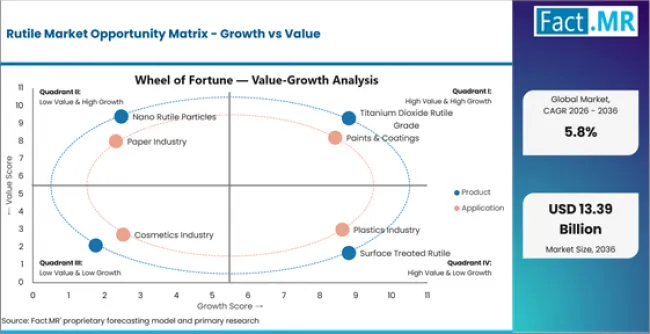
The rutile market is segmented by product type, application, end-use industry, technology, formulation, distribution channel, and region. By product type, the market covers titanium dioxide rutile grade, surface-treated rutile, nano rutile particles, and specialty rutile products. By application, coverage includes paints and coatings, plastics, paper, and cosmetics. TiO2 rutile grade dominates because of its essential role as chloride-process feedstock, while nano rutile is expected to grow faster in specialty coating and photocatalytic applications.

Which Product Segment Dominates the Rutile Market?
Rutile Market Analysis By Product

Titanium dioxide rutile grade accounts for 42.9% of total product segment value in 2026. This leadership reflects the grade's non-substitutable position as feedstock for chloride-process TiO2 pigment production, which increasingly dominates global pigment output. Chloride-process plants require rutile with 95%+ TiO2 content and strict impurity limits, creating a specification-driven procurement profile that locks in long-term supply agreements between mineral sands producers and pigment manufacturers.

Surface-treated rutile is gaining share in specialty applications where enhanced dispersibility and reduced photocatalytic activity are required for polymer and cosmetic formulations. Nano rutile particles remain a small but fast-growing segment, driven by photocatalytic coatings and advanced UV-protection applications.

Which Application Segment Dominates the Rutile Market?
Rutile Market Analysis By Application

Paints and coatings are expected to lead with 64.3% of total application segment value in 2026. Rutile-derived TiO2 pigment delivers the highest refractive index of any commercial white pigment, making it indispensable for opacity, brightness, and UV protection in architectural and industrial coating formulations. No commercial substitute can match rutile TiO2 on combined performance metrics in exterior and high-durability coatings.

Plastics represent the second-largest application, with rutile TiO2 used as a whitening and UV-stabilizing additive in polymer compounds. Paper industry applications consume significant volumes for opacity and brightness improvement, while cosmetics applications are growing through sunscreen and personal care formulations requiring high-purity, surface-treated rutile grades.

Which Product Trend is Shaping the Next Phase of Growth in the Rutile Market?

The shift from sulfate-process to chloride-process TiO2 production is fundamentally reshaping rutile demand. Chloride-process plants produce higher-purity pigment with lower waste generation but require premium rutile feedstock that sulfate plants can avoid by using lower-grade ilmenite. As environmental regulations and waste disposal costs make sulfate operations less viable in Europe and developed markets, chloride-process capacity is expanding primarily in China and India.

This transition has direct procurement implications. Every chloride-process plant commissioned creates incremental demand for 95%+ purity rutile feedstock that cannot be satisfied by lower-grade mineral sands concentrates. The competitive advantage shifts to mineral sands producers controlling high-grade reserves with favorable impurity profiles. Iluka, Tronox, and Rio Tinto are the primary beneficiaries of this structural shift, while synthetic rutile producers also gain from the tightening supply gap.

Regional Outlook Across Key Markets

  • China leads at 5.4% CAGR, driven by chloride-process TiO2 capacity expansion, construction-led coatings demand, and growing domestic pigment production that is increasingly sourcing premium rutile feedstock.
  • South Korea at 4.9% is expanding through high-performance coatings demand from automotive and electronics manufacturers requiring premium-grade TiO2 pigment systems.
  • Europe is restructuring supply, with Tronox's Botlek closure and Venator's sulfate line shutdown concentrating production in higher-quality chloride-route operations.

Top Country Growth Comparison Rutile Market Cagr (2026 2036)

Country CAGR (%)
China 5.4%
South Korea 4.9%
UK 4.6%
Japan 4.3%
USA 4.1%
Germany 3.9%
France 3.7%
Italy 3.5%

Source: Fact MR (FMR) analysis, based on proprietary forecasting model and primary research.
Rutile Market Cagr Analysis By Country

Market Outlook for Rutile in the United States
Rutile Market Country Value Analysis

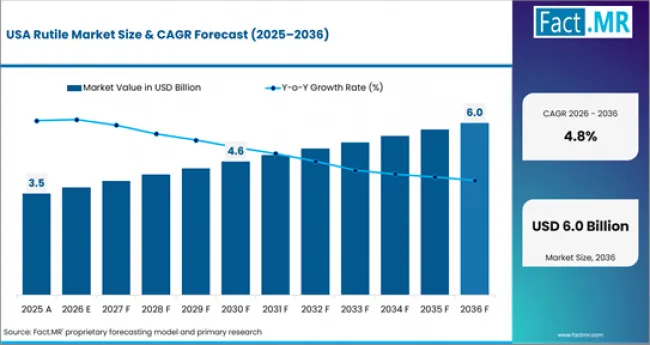
Replacement demand in architectural coatings, automotive refinish, and industrial protective paints sustains TiO2 pigment consumption and the associated rutile feedstock procurement. IRA provisions for infrastructure spending are supporting construction-linked demand, while domestic chloride-process producers maintain long-term supply agreements with mineral sands companies for high-grade rutile.

  • Infrastructure bill allocations are sustaining construction-linked demand for TiO2 pigment in architectural and protective coatings.
  • Reshoring of coatings manufacturing is reinforcing domestic pigment producer procurement commitments for high-grade natural and synthetic rutile.

China Rutile Market Growth Assessment

Domestic chloride-process TiO2 capacity is expanding rapidly as Chinese pigment producers invest in higher-quality production routes. This transition is pulling rutile feedstock procurement away from sulfate-grade ilmenite toward 95%+ purity natural and synthetic rutile, tightening competition for supply.

  • Technology self-sufficiency goals are driving investment in chloride-process capability that creates new demand for premium-grade rutile feedstock.
  • Construction and automotive coatings demand is absorbing growing domestic pigment output and reducing export dependency for finished TiO2.

South Korea Rutile Demand Trends
Rutile Market South Korea Market Share Analysis By Application

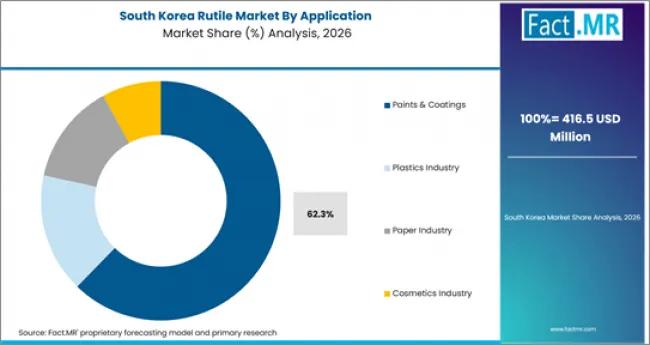
High-specification coatings for semiconductor cleanroom environments, automotive exterior finishes, and electronics display applications create premium-grade TiO2 pigment demand. South Korean pigment buyers prioritize feedstock purity and consistency, favoring long-term contracts with established mineral sands producers.

  • Semiconductor and display manufacturing require ultra-clean TiO2 pigment grades that trace back to high-purity rutile feedstock specifications.
  • Automotive OEM supply chains demand color consistency and weathering performance that depend on chloride-route pigment from premium rutile.

United Kingdom Rutile Market Growth Outlook

Post-Brexit regulatory independence is creating distinct coatings formulation specifications, while UK-based pigment and coatings producers maintain established rutile procurement relationships. Updated building regulations and energy performance targets are supporting coatings demand for commercial and institutional renovation projects.

  • Updated building regulations for energy performance are supporting demand for high-durability exterior coatings with rutile-derived TiO2 pigment.
  • Commercial and institutional renovation activity creates stable coatings consumption independent of new residential construction cycles.

Japan Rutile Market Demand Analysis
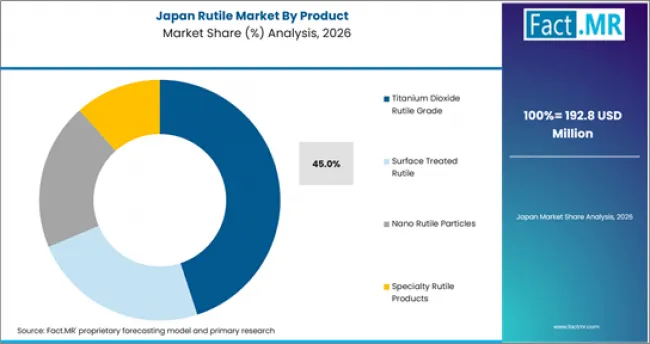
Rutile Market Japan Market Share Analysis By Product

PMDA-regulated pharmaceutical packaging and JIS-compliant industrial coatings create specification-intensive demand for high-purity rutile-derived TiO2 pigment. Strict quality requirements and long supplier qualification cycles favor established feedstock relationships with mineral sands producers who can document consistent purity over multi-year supply periods.

  • Automotive refinish and industrial maintenance coatings sustain cyclical rutile feedstock demand through domestic pigment producers.
  • Strict JIS compliance and long qualification cycles create supplier loyalty that concentrates procurement among certified, relationship-backed mineral sands companies.

Competitive Benchmarking and Company Positioning
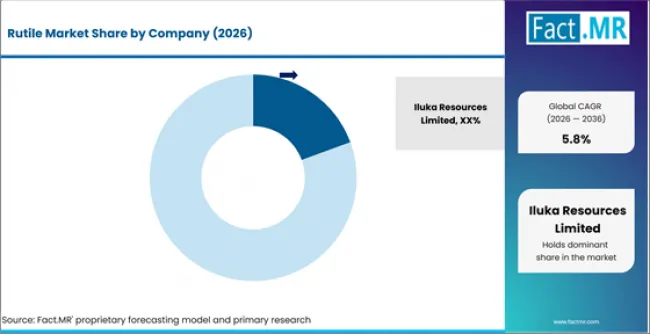
Rutile Market Analysis By Company

Rutile Market Analysis By Company

  • Iluka Resources Limited holds the largest market share at 19.4%, supported by its position as the leading global natural rutile and synthetic rutile producer with operations in Australia and established mineral sands reserves.
  • Tronox Holdings and The Chemours Company maintain integrated positions as both rutile feedstock producers and TiO2 pigment manufacturers, benefiting from vertical integration that secures internal supply.
  • Rio Tinto, Kenmare Resources, and Base Resources compete through mineral sands production at scale, with feedstock quality and reserve life as primary competitive differentiators.

The competitive landscape is shaped by mineral reserve access. Iluka's portfolio of Australian mineral sands assets, including the newly commissioned Balranald rutile and zircon mine, provides the broadest natural rutile supply base globally. The company's synthetic rutile production capability adds feedstock flexibility that pure-play miners cannot replicate.

Tronox and Chemours occupy unique dual positions as both feedstock producers and pigment manufacturers. Their vertical integration reduces exposure to spot-market rutile pricing volatility and provides captive demand for their mineral sands output. Tronox's closure of its 46,000 MT/year TiO2 plant in early 2026 reflects ongoing capacity rationalization to concentrate on higher-margin operations.

Competition at the mining level focuses on reserve quality, particularly TiO2 content, impurity profile, and remaining mine life. Producers controlling high-grade deposits with 95%+ rutile purity and low radioactive mineral contamination command pricing premiums. Long-term take-or-pay supply agreements between mineral sands producers and chloride-process pigment plants create multi-year revenue visibility.

Key Companies in the Rutile Market

  • Iluka Resources Limited, Tronox Holdings plc, and The Chemours Company lead the global rutile market through integrated mineral sands production and TiO2 pigment manufacturing capabilities.
  • Rio Tinto, Kenmare Resources, Base Resources, and Kronos Worldwide maintain strong positions through mineral reserves, feedstock supply agreements, and regional processing infrastructure.
  • Venator Materials, LB Group (Lomon Billions), and Cristal (now part of Tronox) compete through pigment production capacity and downstream customer relationships.

Recent Industry Developments

  • Iluka Resources, Mine Commissioning, Balranald Rutile and Zircon Mine (Late 2025)
    • Iluka Resources commenced production at its Balranald rutile and zircon mine in New South Wales, Australia. The mine adds significant high-grade natural rutile supply to a structurally undersupplied market and complements Iluka's existing Jacinth-Ambrosia and Cataby operations.
  • Tronox Holdings, Capacity Rationalization, TiO2 Plant Closure (January 2026)
    • Tronox announced permanent closure of its 46,000 metric ton per year TiO2 plant, consolidating production at higher-efficiency operations. The rationalization aligns with the company's strategy to concentrate output on chloride-process facilities that require premium rutile feedstock.
  • Iluka Resources, Supply Agreement, Take-or-Pay Contracts (2026)
    • Iluka secured minimum contracted revenue of USD 240 million through take-or-pay titanium dioxide product supply agreements for 2026, providing revenue visibility and underwriting production planning for its Australian mineral sands operations.
  • Tronox Holdings, Strategic Initiative, Rare Earth Elements Development (December 2025)
    • Tronox received coordinated letters of support from EFA and EXIM Bank for development of a rare earth elements supply chain, extending the company's mineral sands portfolio beyond traditional titanium dioxide and zircon products.

Leading Companies Shaping the Rutile Market

  • Iluka Resources Limited
  • Tronox Holdings plc
  • The Chemours Company
  • Rio Tinto
  • Kenmare Resources
  • Base Resources
  • Kronos Worldwide
  • Venator Materials
  • LB Group (Lomon Billions)
  • Cristal (Tronox)

Sources and Research References

  • Iluka Resources Limited. Annual reports, Balranald mine commissioning, and supply agreement updates.
  • Tronox Holdings plc. Capacity rationalization announcements and strategic initiative updates.
  • The Chemours Company. TiO2 pigment production and feedstock procurement updates.
  • U.S. Geological Survey. Mineral commodity summaries for titanium minerals and rutile.
  • Australian Securities Exchange (ASX). Iluka Resources quarterly reviews and annual reports.
  • Primary interviews with mineral sands producers, TiO2 pigment manufacturers, welding consumable producers, and commodity traders.

This bibliography is provided for reader reference and is not exhaustive. The full report contains the complete reference list and detailed citations.

Key Questions This Report Addresses

  • What is the current and future size of the Rutile Market?
  • How fast is the Rutile Market expected to grow between 2026 and 2036?
  • Which product type is likely to lead the market by 2026?
  • Which application segment is expected to account for the highest demand by 2026?
  • What factors are driving demand for rutile globally?
  • How is the shift from sulfate to chloride-process TiO2 production influencing the market?
  • Why is China emerging as the fastest-growing market?
  • How are mineral sands supply constraints affecting pricing and availability?
  • Which countries are projected to show the fastest growth through 2036?
  • What is driving market expansion in China, South Korea, and the UK?
  • Who are the key companies active in the Rutile Market?
  • How does Fact.MR estimate and validate the market forecast?

Rutile Market Definition

The rutile market covers the mining, processing, and industrial use of natural rutile and rutile-grade titanium dioxide products used as feedstock for TiO2 pigment production, welding electrode coatings, ceramics, and specialty applications. It includes titanium dioxide rutile grade, surface-treated rutile, nano rutile particles, and specialty rutile products across paints, coatings, plastics, paper, and cosmetics.

Rutile Market Inclusions

  • The scope covers global and regional market size and forecasts for 2026 to 2036 across product type, application, end-use industry, processing technology, formulation, distribution channel, and region.
  • It includes regional demand analysis based on TiO2 pigment production capacity, construction activity, automotive coatings output, and mineral sands production trends.
  • The report covers pricing and cost analysis across natural rutile, synthetic rutile, and value-added surface-treated grades.
  • It covers mineral processing technology trends, supply constraints, and the competitive landscape including mineral reserves, processing capacity, and long-term supply agreements.

Rutile Market Exclusions

  • The scope excludes ilmenite and leucoxene sold without further upgrading to rutile-grade specifications.
  • It excludes titanium sponge and titanium metal products used in aerospace and defense applications without TiO2 pigment involvement.
  • The report excludes finished TiO2 pigment products when sold as downstream manufactured goods rather than rutile feedstock.
  • It also excludes zircon, monazite, and other mineral sands by-products that are co-produced but not classified as rutile.

Rutile Market Research Methodology

  • The methodology combines secondary research, primary interviews, and forecast modelling.
  • It draws on 100+ secondary sources and benchmarks 40+ company mining and processing portfolios.
  • Market sizing covers 30+ countries through a demand-side model supported by top-down validation.
  • Key inputs include TiO2 pigment capacity, mineral sands production volumes, chloride vs. sulfate process splits, construction activity, and feedstock pricing.
  • The model cross-checks demand with mine production, synthetic rutile output, trade flows, and pigment plant utilization.
  • Primary validation includes 20+ interviews across mineral sands producers, TiO2 pigment manufacturers, welding consumable producers, and commodity traders.
  • Final estimates go through trade-flow validation, mine production reconciliation, and sensitivity testing.

Scope of Analysis

Rutile Market Breakdown By Product, Application, And Region

Parameter Details
Quantitative Units USD 7.6 billion to USD 13.4 billion, at a CAGR of 5.8%
Market Definition The Rutile Market covers mining, processing, and industrial use of natural rutile and rutile-grade titanium dioxide products used as TiO2 pigment feedstock, welding electrode coatings, ceramics, and specialty applications.
Regions Covered North America, Latin America, Europe, East Asia, South Asia and Pacific, Middle East and Africa
Countries Covered USA, UK, France, Germany, Italy, South Korea, Japan, China, 30 plus countries
Key Companies Iluka Resources Limited, Tronox Holdings plc, The Chemours Company, Rio Tinto, Kenmare Resources, Base Resources, Kronos Worldwide, Venator Materials, LB Group, Cristal (Tronox)
Forecast Period 2026 to 2036
Approach Hybrid demand-side and top-down methodology built on TiO2 pigment capacity, mineral sands production volumes, chloride vs. sulfate process splits, construction activity, feedstock pricing, trade-flow validation, and primary interviews across mineral sands producers, pigment manufacturers, and commodity traders

Rutile Market Segmentation

  • Rutile Market Segmented by Product:

    • Titanium Dioxide Rutile Grade
      • Chloride Process Rutile TiO2
        • High Brightness Rutile Pigments
        • Coating Grade Rutile Pigments
      • Sulfate Process Rutile TiO2
        • General Purpose Rutile Pigments
        • Low Oil Absorption Grades
    • Surface Treated Rutile
      • Alumina Treated Rutile
        • Weather Resistant Rutile Grades
        • Durability Enhanced Rutile Pigments
      • Silica Treated Rutile
        • Dispersible Rutile Grades
        • Anti-UV Rutile Pigments
    • Nano Rutile Particles
      • Ultrafine Rutile Grades
        • High Opacity Nano Rutile
        • Functional Nano Coatings
      • Engineered Nanostructures
        • Advanced Optical Rutile Materials
        • High Surface Area Rutile Systems
    • Specialty Rutile Products
      • Cosmetic Grade Rutile
        • UV Protection Rutile Formulations
        • Skin Safe Pigment Systems
      • Pharmaceutical Grade Rutile
        • Biocompatible Rutile Materials
        • Medical Coating Rutile Grades
  • Rutile Market Segmented by Application:

    • Paints & Coatings
      • Architectural Coatings
        • Exterior Wall Paints
        • Interior Decorative Paints
      • Industrial Coatings
        • Protective Metal Coatings
        • Marine Coating Systems
    • Plastics Industry
      • Engineering Plastics
        • Automotive Plastic Parts
        • Electrical Plastic Components
      • Packaging Plastics
        • Rigid Packaging Materials
        • Flexible Packaging Films
    • Paper Industry
      • Coated Paper Applications
        • Printing Paper Coatings
        • Specialty Paper Finishing
      • Paperboard Applications
        • Packaging Board Whitening
        • Carton Board Coatings
    • Cosmetics Industry
      • Sunscreen Formulations
        • UV Protection Creams
        • Dermal Protection Products
      • Personal Care Products
        • Pigmented Cosmetic Products
        • Skin Brightening Formulations
  • Rutile Market Segmented by End Use:

    • Chemical Manufacturers
      • Pigment Producers
        • Titanium Dioxide Manufacturers
        • Specialty Pigment Companies
      • Chemical Processing Plants
        • Industrial Chemical Blenders
        • Surface Treatment Companies
    • Paint Manufacturers
      • Decorative Paint Producers
        • Residential Paint Companies
        • Commercial Paint Producers
      • Industrial Paint Manufacturers
        • Marine Paint Producers
        • Automotive Coating Companies
    • Plastic Manufacturers
      • Polymer Processing Companies
        • Injection Molding Firms
        • Extrusion Processing Units
      • Plastic Product Manufacturers
        • Consumer Plastic Goods
        • Industrial Plastic Components
    • Paper Manufacturers
      • Printing Paper Mills
        • Coated Paper Producers
        • Specialty Paper Manufacturers
      • Packaging Paper Companies
        • Carton & Box Manufacturers
        • Paperboard Producers
  • Rutile Market Segmented by Technology:

    • Chloride Process Technology
      • High Purity Processing Systems
        • Gas Phase Reaction Systems
        • Advanced Chlorination Reactors
      • Energy Efficient Systems
        • Low Emission Production Units
        • Heat Recovery Processing Systems
    • Sulfate Process Technology
      • Acid Digestion Systems
        • Batch Processing Reactors
        • Continuous Sulfate Systems
      • Waste Management Systems
        • Effluent Treatment Units
        • Byproduct Recovery Systems
    • Surface Treatment Technology
      • Alumina Coating Systems
        • Chemical Surface Modification
        • Particle Stabilization Systems
      • Silica Coating Systems
        • Anti Agglomeration Technology
        • Dispersion Enhancement Systems
    • Nanotechnology Processing
      • Nano Milling Systems
        • Ultrafine Grinding Technology
        • Particle Size Reduction Systems
      • Nano Coating Systems
        • Functional Surface Engineering
        • High Reactivity Nanostructures
  • Rutile Market Segmented by Formulation:

    • Powder Form Rutile
      • Dry Pigment Formulations
        • Bulk Powder Pigment Systems
        • Micronized Rutile Powders
      • High Dispersion Powders
        • Easy Mix Pigment Systems
        • Instant Dispersion Grades
    • Liquid Dispersion Form
      • Aqueous Dispersion Systems
        • Water Based Pigment Slurries
        • Stable Suspension Systems
      • Solvent Dispersion Systems
        • Organic Medium Dispersions
        • High Stability Liquid Pigments
    • Coated Particle Formulations
      • Organic Coated Rutile
        • Surface Modified Pigment Particles
        • Performance Enhanced Coatings
      • Inorganic Coated Rutile
        • Alumina Encapsulated Pigments
        • Silica Encapsulated Pigments
    • Functional Composite Formulations
      • Hybrid Pigment Systems
        • Multi Layer Pigment Structures
        • Engineered Optical Pigments
      • Advanced Functional Additives
        • UV Blocking Composite Systems
        • Durability Enhanced Pigment Blends
  • Rutile Market Segmented by Distribution Channel:

    • Direct Industrial Sales
      • Manufacturer Direct Supply
        • Bulk Chemical Contracts
        • Long Term Supply Agreements
      • Enterprise Procurement Channels
        • Paint Industry Contracts
        • Plastic Industry Supply Deals
    • Chemical Distributors
      • Regional Distributors
        • Local Pigment Suppliers
        • Industrial Chemical Traders
      • Global Distribution Networks
        • International Chemical Exporters
        • Cross Border Supply Chains
    • Online Chemical Platforms
      • B2B Marketplaces
        • Industrial Material Portals
        • Digital Procurement Platforms
      • Manufacturer E Portals
        • Direct Ordering Systems
        • Subscription Supply Platforms
    • Third Party Trading Firms
      • Commodity Trading Companies
        • Pigment Brokerage Firms
        • Raw Material Trading Houses
      • Specialty Chemical Traders
        • High Purity Material Suppliers
        • Performance Chemical Brokers
  • Rutile Market by Region:

    • North America
      • USA
      • Canada
      • Mexico
    • Latin America
      • Brazil
      • Chile
      • Rest of Latin America
    • Western Europe
      • Germany
      • UK
      • Italy
      • Spain
      • France
      • Nordic
      • BENELUX
      • Rest of Western Europe
    • Eastern Europe
      • Russia
      • Poland
      • Hungary
      • Balkan & Baltic
      • Rest of Eastern Europe
    • East Asia
      • China
      • Japan
      • South Korea
    • South Asia and Pacific
      • India
      • ASEAN
      • Australia & New Zealand
      • Rest of South Asia and Pacific
    • Middle East & Africa
      • Kingdom of Saudi Arabia
      • Other GCC Countries
      • Turkiye
      • South Africa
      • Other African Union
      • Rest of Middle East & Africa

- Frequently Asked Questions -

How big is the rutile market in 2026?

The global rutile market is estimated to be valued at USD 7.6 billion in 2026.

What will be the size of rutile market in 2036?

The market size for the rutile market is projected to reach USD 13.4 billion by 2036.

How much will be the rutile market growth between 2026 and 2036?

The rutile market is expected to grow at a 5.8% CAGR between 2026 and 2036.

What are the key product types in the rutile market?

The key product types in rutile market are titanium dioxide rutile grade, surface treated rutile, nano rutile particles, specialty rutile products.

Which application segment is expected to contribute significant share in the rutile market in 2026?

In terms of application, paints & coatings segment is expected to command 64.3% share in the rutile market in 2026.

Table of Content

  1. Executive Summary
    • Global Market Outlook
    • Demand to side Trends
    • Supply to side Trends
    • Technology Roadmap Analysis
    • Analysis and Recommendations
  2. Market Overview
    • Market Coverage / Taxonomy
    • Market Definition / Scope / Limitations
  3. Research Methodology
    • Chapter Orientation
    • Analytical Lens and Working Hypotheses
      • Market Structure, Signals, and Trend Drivers
      • Benchmarking and Cross-market Comparability
      • Market Sizing, Forecasting, and Opportunity Mapping
    • Research Design and Evidence Framework
      • Desk Research Programme (Secondary Evidence)
        • Company Annual and Sustainability Reports
        • Peer-reviewed Journals and Academic Literature
        • Corporate Websites, Product Literature, and Technical Notes
        • Earnings Decks and Investor Briefings
        • Statutory Filings and Regulatory Disclosures
        • Technical White Papers and Standards Notes
        • Trade Journals, Industry Magazines, and Analyst Briefs
        • Conference Proceedings, Webinars, and Seminar Materials
        • Government Statistics Portals and Public Data Releases
        • Press Releases and Reputable Media Coverage
        • Specialist Newsletters and Curated Briefings
        • Sector Databases and Reference Repositories
        • Fact.MR Internal Proprietary Databases and Historical Market Datasets
        • Subscription Datasets and Paid Sources
        • Social Channels, Communities, and Digital Listening Inputs
        • Additional Desk Sources
      • Expert Input and Fieldwork (Primary Evidence)
        • Primary Modes
          • Qualitative Interviews and Expert Elicitation
          • Quantitative Surveys and Structured Data Capture
          • Blended Approach
        • Why Primary Evidence is Used
        • Field Techniques
          • Interviews
          • Surveys
          • Focus Groups
          • Observational and In-context Research
          • Social and Community Interactions
        • Stakeholder Universe Engaged
          • C-suite Leaders
          • Board Members
          • Presidents and Vice Presidents
          • R&D and Innovation Heads
          • Technical Specialists
          • Domain Subject-matter Experts
          • Scientists
          • Physicians and Other Healthcare Professionals
        • Governance, Ethics, and Data Stewardship
          • Research Ethics
          • Data Integrity and Handling
      • Tooling, Models, and Reference Databases
    • Data Engineering and Model Build
      • Data Acquisition and Ingestion
      • Cleaning, Normalisation, and Verification
      • Synthesis, Triangulation, and Analysis
    • Quality Assurance and Audit Trail
  4. Market Background
    • Market Dynamics
      • Drivers
      • Restraints
      • Opportunity
      • Trends
    • Scenario Forecast
      • Demand in Optimistic Scenario
      • Demand in Likely Scenario
      • Demand in Conservative Scenario
    • Opportunity Map Analysis
    • Product Life Cycle Analysis
    • Supply Chain Analysis
    • Investment Feasibility Matrix
    • Value Chain Analysis
    • PESTLE and Porter’s Analysis
    • Regulatory Landscape
    • Regional Parent Market Outlook
    • Production and Consumption Statistics
    • Import and Export Statistics
  5. Global Market Analysis 2021 to 2025 and Forecast, 2026 to 2036
    • Historical Market Size Value (USD Million) Analysis, 2021 to 2025
    • Current and Future Market Size Value (USD Million) Projections, 2026 to 2036
      • Y to o to Y Growth Trend Analysis
      • Absolute $ Opportunity Analysis
  6. Global Market Pricing Analysis 2021 to 2025 and Forecast 2026 to 2036
  7. Global Market Analysis 2021 to 2025 and Forecast 2026 to 2036, By Product
    • Introduction / Key Findings
    • Historical Market Size Value (USD Million) Analysis By Product, 2021 to 2025
    • Current and Future Market Size Value (USD Million) Analysis and Forecast By Product, 2026 to 2036
      • Titanium Dioxide Rutile Grade
        • Chloride Process Rutile TiO2
        • High Brightness Rutile Pigments
        • Coating Grade Rutile Pigments
        • Sulfate Process Rutile TiO2
        • General Purpose Rutile Pigments
        • Low Oil Absorption Grades
      • Surface Treated Rutile
        • Alumina Treated Rutile
        • Weather Resistant Rutile Grades
        • Durability Enhanced Rutile Pigments
        • Silica Treated Rutile
        • Dispersible Rutile Grades
      • Nano Rutile Particles
        • Ultrafine Rutile Grades
        • High Opacity Nano Rutile
        • Functional Nano Coatings
        • Engineered Nanostructures
        • Advanced Optical Rutile Materials
      • Specialty Rutile Products
        • Cosmetic Grade Rutile
        • UV Protection Rutile Formulations
        • Skin Safe Pigment Systems
        • Pharmaceutical Grade Rutile
        • Biocompatible Rutile Materials
    • Y to o to Y Growth Trend Analysis By Product, 2021 to 2025
    • Absolute $ Opportunity Analysis By Product, 2026 to 2036
  8. Global Market Analysis 2021 to 2025 and Forecast 2026 to 2036, By Application
    • Introduction / Key Findings
    • Historical Market Size Value (USD Million) Analysis By Application, 2021 to 2025
    • Current and Future Market Size Value (USD Million) Analysis and Forecast By Application, 2026 to 2036
      • Paints & Coatings
        • Architectural Coatings
        • Exterior Wall Paints
        • Interior Decorative Paints
        • Industrial Coatings
        • Protective Metal Coatings
        • Marine Coating Systems
      • Plastics Industry
        • Engineering Plastics
        • Automotive Plastic Parts
        • Electrical Plastic Components
        • Packaging Plastics
        • Rigid Packaging Materials
      • Paper Industry
        • Coated Paper Applications
        • Printing Paper Coatings
        • Specialty Paper Finishing
        • Paperboard Applications
        • Packaging Board Whitening
      • Cosmetics Industry
        • Sunscreen Formulations
        • UV Protection Creams
        • Dermal Protection Products
        • Personal Care Products
        • Pigmented Cosmetic Products
    • Y to o to Y Growth Trend Analysis By Application, 2021 to 2025
    • Absolute $ Opportunity Analysis By Application, 2026 to 2036
  9. Global Market Analysis 2021 to 2025 and Forecast 2026 to 2036, By End Use
    • Introduction / Key Findings
    • Historical Market Size Value (USD Million) Analysis By End Use, 2021 to 2025
    • Current and Future Market Size Value (USD Million) Analysis and Forecast By End Use, 2026 to 2036
      • Chemical Manufacturers
        • Pigment Producers
        • Titanium Dioxide Manufacturers
        • Specialty Pigment Companies
        • Chemical Processing Plants
        • Industrial Chemical Blenders
        • Surface Treatment Companies
      • Paint Manufacturers
        • Decorative Paint Producers
        • Residential Paint Companies
        • Commercial Paint Producers
        • Industrial Paint Manufacturers
        • Marine Paint Producers
      • Plastic Manufacturers
        • Polymer Processing Companies
        • Injection Molding Firms
        • Extrusion Processing Value (USD Million)s
        • Plastic Product Manufacturers
        • Consumer Plastic Goods
      • Paper Manufacturers
        • Printing Paper Mills
        • Coated Paper Producers
        • Specialty Paper Manufacturers
        • Packaging Paper Companies
        • Carton & Box Manufacturers
    • Y to o to Y Growth Trend Analysis By End Use, 2021 to 2025
    • Absolute $ Opportunity Analysis By End Use, 2026 to 2036
  10. Global Market Analysis 2021 to 2025 and Forecast 2026 to 2036, By Technology
    • Introduction / Key Findings
    • Historical Market Size Value (USD Million) Analysis By Technology, 2021 to 2025
    • Current and Future Market Size Value (USD Million) Analysis and Forecast By Technology, 2026 to 2036
      • Chloride Process Technology
        • High Purity Processing Systems
        • Gas Phase Reaction Systems
        • Advanced Chlorination Reactors
        • Energy Efficient Systems
        • Low Emission Production Value (USD Million)s
        • Heat Recovery Processing Systems
      • Sulfate Process Technology
        • Acid Digestion Systems
        • Batch Processing Reactors
        • Continuous Sulfate Systems
        • Waste Management Systems
        • Effluent Treatment Value (USD Million)s
      • Surface Treatment Technology
        • Alumina Coating Systems
        • Chemical Surface Modification
        • Particle Stabilization Systems
        • Silica Coating Systems
        • Anti Agglomeration Technology
      • Nanotechnology Processing
        • Nano Milling Systems
        • Ultrafine Grinding Technology
        • Particle Size Reduction Systems
        • Nano Coating Systems
        • Functional Surface Engineering
    • Y to o to Y Growth Trend Analysis By Technology, 2021 to 2025
    • Absolute $ Opportunity Analysis By Technology, 2026 to 2036
  11. Global Market Analysis 2021 to 2025 and Forecast 2026 to 2036, By Formulation
    • Introduction / Key Findings
    • Historical Market Size Value (USD Million) Analysis By Formulation, 2021 to 2025
    • Current and Future Market Size Value (USD Million) Analysis and Forecast By Formulation, 2026 to 2036
      • Powder Form Rutile
        • Dry Pigment Formulations
        • Bulk Powder Pigment Systems
        • Micronized Rutile Powders
        • High Dispersion Powders
        • Easy Mix Pigment Systems
        • Instant Dispersion Grades
      • Liquid Dispersion Form
        • Aqueous Dispersion Systems
        • Water Based Pigment Slurries
        • Stable Suspension Systems
        • Solvent Dispersion Systems
        • Organic Medium Dispersions
      • Coated Particle Formulations
        • Organic Coated Rutile
        • Surface Modified Pigment Particles
        • Performance Enhanced Coatings
        • Inorganic Coated Rutile
        • Alumina Encapsulated Pigments
      • Functional Composite Formulations
        • Hybrid Pigment Systems
        • Multi Layer Pigment Structures
        • Engineered Optical Pigments
        • Advanced Functional Additives
        • UV Blocking Composite Systems
    • Y to o to Y Growth Trend Analysis By Formulation, 2021 to 2025
    • Absolute $ Opportunity Analysis By Formulation, 2026 to 2036
  12. Global Market Analysis 2021 to 2025 and Forecast 2026 to 2036, By Distribution Channel
    • Introduction / Key Findings
    • Historical Market Size Value (USD Million) Analysis By Distribution Channel, 2021 to 2025
    • Current and Future Market Size Value (USD Million) Analysis and Forecast By Distribution Channel, 2026 to 2036
      • Direct Industrial Sales
        • Manufacturer Direct Supply
        • Bulk Chemical Contracts
        • Long Term Supply Agreements
        • Enterprise Procurement Channels
        • Paint Industry Contracts
        • Plastic Industry Supply Deals
      • Chemical Distributors
        • Regional Distributors
        • Local Pigment Suppliers
        • Industrial Chemical Traders
        • Global Distribution Networks
        • International Chemical Exporters
      • Online Chemical Platforms
        • B2B Marketplaces
        • Industrial Material Portals
        • Digital Procurement Platforms
        • Manufacturer E Portals
        • Direct Ordering Systems
      • Third Party Trading Firms
        • Commodity Trading Companies
        • Pigment Brokerage Firms
        • Raw Material Trading Houses
        • Specialty Chemical Traders
        • High Purity Material Suppliers
    • Y to o to Y Growth Trend Analysis By Distribution Channel, 2021 to 2025
    • Absolute $ Opportunity Analysis By Distribution Channel, 2026 to 2036
  13. Global Market Analysis 2021 to 2025 and Forecast 2026 to 2036, By Region
    • Introduction
    • Historical Market Size Value (USD Million) Analysis By Region, 2021 to 2025
    • Current Market Size Value (USD Million) Analysis and Forecast By Region, 2026 to 2036
      • North America
      • Latin America
      • Western Europe
      • Eastern Europe
      • East Asia
      • South Asia and Pacific
      • Middle East & Africa
    • Market Attractiveness Analysis By Region
  14. North America Market Analysis 2021 to 2025 and Forecast 2026 to 2036, By Country
    • Historical Market Size Value (USD Million) Trend Analysis By Market Taxonomy, 2021 to 2025
    • Market Size Value (USD Million) Forecast By Market Taxonomy, 2026 to 2036
      • By Country
        • USA
        • Canada
        • Mexico
      • By Product
      • By Application
      • By End Use
      • By Technology
      • By Formulation
      • By Distribution Channel
    • Market Attractiveness Analysis
      • By Country
      • By Product
      • By Application
      • By End Use
      • By Technology
      • By Formulation
      • By Distribution Channel
    • Key Takeaways
  15. Latin America Market Analysis 2021 to 2025 and Forecast 2026 to 2036, By Country
    • Historical Market Size Value (USD Million) Trend Analysis By Market Taxonomy, 2021 to 2025
    • Market Size Value (USD Million) Forecast By Market Taxonomy, 2026 to 2036
      • By Country
        • Brazil
        • Chile
        • Rest of Latin America
      • By Product
      • By Application
      • By End Use
      • By Technology
      • By Formulation
      • By Distribution Channel
    • Market Attractiveness Analysis
      • By Country
      • By Product
      • By Application
      • By End Use
      • By Technology
      • By Formulation
      • By Distribution Channel
    • Key Takeaways
  16. Western Europe Market Analysis 2021 to 2025 and Forecast 2026 to 2036, By Country
    • Historical Market Size Value (USD Million) Trend Analysis By Market Taxonomy, 2021 to 2025
    • Market Size Value (USD Million) Forecast By Market Taxonomy, 2026 to 2036
      • By Country
        • Germany
        • UK
        • Italy
        • Spain
        • France
        • Nordic
        • BENELUX
        • Rest of Western Europe
      • By Product
      • By Application
      • By End Use
      • By Technology
      • By Formulation
      • By Distribution Channel
    • Market Attractiveness Analysis
      • By Country
      • By Product
      • By Application
      • By End Use
      • By Technology
      • By Formulation
      • By Distribution Channel
    • Key Takeaways
  17. Eastern Europe Market Analysis 2021 to 2025 and Forecast 2026 to 2036, By Country
    • Historical Market Size Value (USD Million) Trend Analysis By Market Taxonomy, 2021 to 2025
    • Market Size Value (USD Million) Forecast By Market Taxonomy, 2026 to 2036
      • By Country
        • Russia
        • Poland
        • Hungary
        • Balkan & Baltic
        • Rest of Eastern Europe
      • By Product
      • By Application
      • By End Use
      • By Technology
      • By Formulation
      • By Distribution Channel
    • Market Attractiveness Analysis
      • By Country
      • By Product
      • By Application
      • By End Use
      • By Technology
      • By Formulation
      • By Distribution Channel
    • Key Takeaways
  18. East Asia Market Analysis 2021 to 2025 and Forecast 2026 to 2036, By Country
    • Historical Market Size Value (USD Million) Trend Analysis By Market Taxonomy, 2021 to 2025
    • Market Size Value (USD Million) Forecast By Market Taxonomy, 2026 to 2036
      • By Country
        • China
        • Japan
        • South Korea
      • By Product
      • By Application
      • By End Use
      • By Technology
      • By Formulation
      • By Distribution Channel
    • Market Attractiveness Analysis
      • By Country
      • By Product
      • By Application
      • By End Use
      • By Technology
      • By Formulation
      • By Distribution Channel
    • Key Takeaways
  19. South Asia and Pacific Market Analysis 2021 to 2025 and Forecast 2026 to 2036, By Country
    • Historical Market Size Value (USD Million) Trend Analysis By Market Taxonomy, 2021 to 2025
    • Market Size Value (USD Million) Forecast By Market Taxonomy, 2026 to 2036
      • By Country
        • India
        • ASEAN
        • Australia & New Zealand
        • Rest of South Asia and Pacific
      • By Product
      • By Application
      • By End Use
      • By Technology
      • By Formulation
      • By Distribution Channel
    • Market Attractiveness Analysis
      • By Country
      • By Product
      • By Application
      • By End Use
      • By Technology
      • By Formulation
      • By Distribution Channel
    • Key Takeaways
  20. Middle East & Africa Market Analysis 2021 to 2025 and Forecast 2026 to 2036, By Country
    • Historical Market Size Value (USD Million) Trend Analysis By Market Taxonomy, 2021 to 2025
    • Market Size Value (USD Million) Forecast By Market Taxonomy, 2026 to 2036
      • By Country
        • Kingdom of Saudi Arabia
        • Other GCC Countries
        • Turkiye
        • South Africa
        • Other African Union
        • Rest of Middle East & Africa
      • By Product
      • By Application
      • By End Use
      • By Technology
      • By Formulation
      • By Distribution Channel
    • Market Attractiveness Analysis
      • By Country
      • By Product
      • By Application
      • By End Use
      • By Technology
      • By Formulation
      • By Distribution Channel
    • Key Takeaways
  21. Key Countries Market Analysis
    • USA
      • Pricing Analysis
      • Market Share Analysis, 2025
        • By Product
        • By Application
        • By End Use
        • By Technology
        • By Formulation
        • By Distribution Channel
    • Canada
      • Pricing Analysis
      • Market Share Analysis, 2025
        • By Product
        • By Application
        • By End Use
        • By Technology
        • By Formulation
        • By Distribution Channel
    • Mexico
      • Pricing Analysis
      • Market Share Analysis, 2025
        • By Product
        • By Application
        • By End Use
        • By Technology
        • By Formulation
        • By Distribution Channel
    • Brazil
      • Pricing Analysis
      • Market Share Analysis, 2025
        • By Product
        • By Application
        • By End Use
        • By Technology
        • By Formulation
        • By Distribution Channel
    • Chile
      • Pricing Analysis
      • Market Share Analysis, 2025
        • By Product
        • By Application
        • By End Use
        • By Technology
        • By Formulation
        • By Distribution Channel
    • Germany
      • Pricing Analysis
      • Market Share Analysis, 2025
        • By Product
        • By Application
        • By End Use
        • By Technology
        • By Formulation
        • By Distribution Channel
    • UK
      • Pricing Analysis
      • Market Share Analysis, 2025
        • By Product
        • By Application
        • By End Use
        • By Technology
        • By Formulation
        • By Distribution Channel
    • Italy
      • Pricing Analysis
      • Market Share Analysis, 2025
        • By Product
        • By Application
        • By End Use
        • By Technology
        • By Formulation
        • By Distribution Channel
    • Spain
      • Pricing Analysis
      • Market Share Analysis, 2025
        • By Product
        • By Application
        • By End Use
        • By Technology
        • By Formulation
        • By Distribution Channel
    • France
      • Pricing Analysis
      • Market Share Analysis, 2025
        • By Product
        • By Application
        • By End Use
        • By Technology
        • By Formulation
        • By Distribution Channel
    • India
      • Pricing Analysis
      • Market Share Analysis, 2025
        • By Product
        • By Application
        • By End Use
        • By Technology
        • By Formulation
        • By Distribution Channel
    • ASEAN
      • Pricing Analysis
      • Market Share Analysis, 2025
        • By Product
        • By Application
        • By End Use
        • By Technology
        • By Formulation
        • By Distribution Channel
    • Australia & New Zealand
      • Pricing Analysis
      • Market Share Analysis, 2025
        • By Product
        • By Application
        • By End Use
        • By Technology
        • By Formulation
        • By Distribution Channel
    • China
      • Pricing Analysis
      • Market Share Analysis, 2025
        • By Product
        • By Application
        • By End Use
        • By Technology
        • By Formulation
        • By Distribution Channel
    • Japan
      • Pricing Analysis
      • Market Share Analysis, 2025
        • By Product
        • By Application
        • By End Use
        • By Technology
        • By Formulation
        • By Distribution Channel
    • South Korea
      • Pricing Analysis
      • Market Share Analysis, 2025
        • By Product
        • By Application
        • By End Use
        • By Technology
        • By Formulation
        • By Distribution Channel
    • Russia
      • Pricing Analysis
      • Market Share Analysis, 2025
        • By Product
        • By Application
        • By End Use
        • By Technology
        • By Formulation
        • By Distribution Channel
    • Poland
      • Pricing Analysis
      • Market Share Analysis, 2025
        • By Product
        • By Application
        • By End Use
        • By Technology
        • By Formulation
        • By Distribution Channel
    • Hungary
      • Pricing Analysis
      • Market Share Analysis, 2025
        • By Product
        • By Application
        • By End Use
        • By Technology
        • By Formulation
        • By Distribution Channel
    • Kingdom of Saudi Arabia
      • Pricing Analysis
      • Market Share Analysis, 2025
        • By Product
        • By Application
        • By End Use
        • By Technology
        • By Formulation
        • By Distribution Channel
    • Turkiye
      • Pricing Analysis
      • Market Share Analysis, 2025
        • By Product
        • By Application
        • By End Use
        • By Technology
        • By Formulation
        • By Distribution Channel
    • South Africa
      • Pricing Analysis
      • Market Share Analysis, 2025
        • By Product
        • By Application
        • By End Use
        • By Technology
        • By Formulation
        • By Distribution Channel
  22. Market Structure Analysis
    • Competition Dashboard
    • Competition Benchmarking
    • Market Share Analysis of Top Players
      • By Regional
      • By Product
      • By Application
      • By End Use
      • By Technology
      • By Formulation
      • By Distribution Channel
  23. Competition Analysis
    • Competition Deep Dive
      • Iluka Resources Limited
        • Overview
        • Product Portfolio
        • Profitability by Market Segments (Product/Age /Sales Channel/Region)
        • Sales Footprint
        • Strategy Overview
          • Marketing Strategy
          • Product Strategy
          • Channel Strategy
      • Tronox Holdings PLC
      • East Minerals
      • IREL (India) Limited
      • Rio Tinto
      • Kenmare Resources plc
      • Base Resources Limited
      • Indian Rare Earths Limited (IREL)
      • Sierra Rutile Limited
      • VV Mineral
      • Lomon Billions
      • TiZir Limited
      • Shanghai Jianghu Titanium White Co., Ltd.
      • Cristal Global (Now Tronox)
      • Zirco Products Ltd.
  24. Assumptions & Acronyms Used

List Of Table

  • Table 1: Global Market Value (USD Million) Forecast by Region, 2021 to 2036
  • Table 2: Global Market Value (USD Million) Forecast by Product, 2021 to 2036
  • Table 3: Global Market Value (USD Million) Forecast by Application, 2021 to 2036
  • Table 4: Global Market Value (USD Million) Forecast by End Use, 2021 to 2036
  • Table 5: Global Market Value (USD Million) Forecast by Technology, 2021 to 2036
  • Table 6: Global Market Value (USD Million) Forecast by Formulation, 2021 to 2036
  • Table 7: Global Market Value (USD Million) Forecast by Distribution Channel, 2021 to 2036
  • Table 8: North America Market Value (USD Million) Forecast by Country, 2021 to 2036
  • Table 9: North America Market Value (USD Million) Forecast by Product, 2021 to 2036
  • Table 10: North America Market Value (USD Million) Forecast by Application, 2021 to 2036
  • Table 11: North America Market Value (USD Million) Forecast by End Use, 2021 to 2036
  • Table 12: North America Market Value (USD Million) Forecast by Technology, 2021 to 2036
  • Table 13: North America Market Value (USD Million) Forecast by Formulation, 2021 to 2036
  • Table 14: North America Market Value (USD Million) Forecast by Distribution Channel, 2021 to 2036
  • Table 15: Latin America Market Value (USD Million) Forecast by Country, 2021 to 2036
  • Table 16: Latin America Market Value (USD Million) Forecast by Product, 2021 to 2036
  • Table 17: Latin America Market Value (USD Million) Forecast by Application, 2021 to 2036
  • Table 18: Latin America Market Value (USD Million) Forecast by End Use, 2021 to 2036
  • Table 19: Latin America Market Value (USD Million) Forecast by Technology, 2021 to 2036
  • Table 20: Latin America Market Value (USD Million) Forecast by Formulation, 2021 to 2036
  • Table 21: Latin America Market Value (USD Million) Forecast by Distribution Channel, 2021 to 2036
  • Table 22: Western Europe Market Value (USD Million) Forecast by Country, 2021 to 2036
  • Table 23: Western Europe Market Value (USD Million) Forecast by Product, 2021 to 2036
  • Table 24: Western Europe Market Value (USD Million) Forecast by Application, 2021 to 2036
  • Table 25: Western Europe Market Value (USD Million) Forecast by End Use, 2021 to 2036
  • Table 26: Western Europe Market Value (USD Million) Forecast by Technology, 2021 to 2036
  • Table 27: Western Europe Market Value (USD Million) Forecast by Formulation, 2021 to 2036
  • Table 28: Western Europe Market Value (USD Million) Forecast by Distribution Channel, 2021 to 2036
  • Table 29: Eastern Europe Market Value (USD Million) Forecast by Country, 2021 to 2036
  • Table 30: Eastern Europe Market Value (USD Million) Forecast by Product, 2021 to 2036
  • Table 31: Eastern Europe Market Value (USD Million) Forecast by Application, 2021 to 2036
  • Table 32: Eastern Europe Market Value (USD Million) Forecast by End Use, 2021 to 2036
  • Table 33: Eastern Europe Market Value (USD Million) Forecast by Technology, 2021 to 2036
  • Table 34: Eastern Europe Market Value (USD Million) Forecast by Formulation, 2021 to 2036
  • Table 35: Eastern Europe Market Value (USD Million) Forecast by Distribution Channel, 2021 to 2036
  • Table 36: East Asia Market Value (USD Million) Forecast by Country, 2021 to 2036
  • Table 37: East Asia Market Value (USD Million) Forecast by Product, 2021 to 2036
  • Table 38: East Asia Market Value (USD Million) Forecast by Application, 2021 to 2036
  • Table 39: East Asia Market Value (USD Million) Forecast by End Use, 2021 to 2036
  • Table 40: East Asia Market Value (USD Million) Forecast by Technology, 2021 to 2036
  • Table 41: East Asia Market Value (USD Million) Forecast by Formulation, 2021 to 2036
  • Table 42: East Asia Market Value (USD Million) Forecast by Distribution Channel, 2021 to 2036
  • Table 43: South Asia and Pacific Market Value (USD Million) Forecast by Country, 2021 to 2036
  • Table 44: South Asia and Pacific Market Value (USD Million) Forecast by Product, 2021 to 2036
  • Table 45: South Asia and Pacific Market Value (USD Million) Forecast by Application, 2021 to 2036
  • Table 46: South Asia and Pacific Market Value (USD Million) Forecast by End Use, 2021 to 2036
  • Table 47: South Asia and Pacific Market Value (USD Million) Forecast by Technology, 2021 to 2036
  • Table 48: South Asia and Pacific Market Value (USD Million) Forecast by Formulation, 2021 to 2036
  • Table 49: South Asia and Pacific Market Value (USD Million) Forecast by Distribution Channel, 2021 to 2036
  • Table 50: Middle East & Africa Market Value (USD Million) Forecast by Country, 2021 to 2036
  • Table 51: Middle East & Africa Market Value (USD Million) Forecast by Product, 2021 to 2036
  • Table 52: Middle East & Africa Market Value (USD Million) Forecast by Application, 2021 to 2036
  • Table 53: Middle East & Africa Market Value (USD Million) Forecast by End Use, 2021 to 2036
  • Table 54: Middle East & Africa Market Value (USD Million) Forecast by Technology, 2021 to 2036
  • Table 55: Middle East & Africa Market Value (USD Million) Forecast by Formulation, 2021 to 2036
  • Table 56: Middle East & Africa Market Value (USD Million) Forecast by Distribution Channel, 2021 to 2036

List Of Figures

  • Figure 1: Global Market Pricing Analysis
  • Figure 2: Global Market Value (USD Million) Forecast 2021 to 2036
  • Figure 3: Global Market Value Share and BPS Analysis by Product, 2026 and 2036
  • Figure 4: Global Market Y-o-Y Growth Comparison by Product, 2026 to 2036
  • Figure 5: Global Market Attractiveness Analysis by Product
  • Figure 6: Global Market Value Share and BPS Analysis by Application, 2026 and 2036
  • Figure 7: Global Market Y-o-Y Growth Comparison by Application, 2026 to 2036
  • Figure 8: Global Market Attractiveness Analysis by Application
  • Figure 9: Global Market Value Share and BPS Analysis by End Use, 2026 and 2036
  • Figure 10: Global Market Y-o-Y Growth Comparison by End Use, 2026 to 2036
  • Figure 11: Global Market Attractiveness Analysis by End Use
  • Figure 12: Global Market Value Share and BPS Analysis by Technology, 2026 and 2036
  • Figure 13: Global Market Y-o-Y Growth Comparison by Technology, 2026 to 2036
  • Figure 14: Global Market Attractiveness Analysis by Technology
  • Figure 15: Global Market Value Share and BPS Analysis by Formulation, 2026 and 2036
  • Figure 16: Global Market Y-o-Y Growth Comparison by Formulation, 2026 to 2036
  • Figure 17: Global Market Attractiveness Analysis by Formulation
  • Figure 18: Global Market Value Share and BPS Analysis by Distribution Channel, 2026 and 2036
  • Figure 19: Global Market Y-o-Y Growth Comparison by Distribution Channel, 2026 to 2036
  • Figure 20: Global Market Attractiveness Analysis by Distribution Channel
  • Figure 21: Global Market Value (USD Million) Share and BPS Analysis by Region, 2026 and 2036
  • Figure 22: Global Market Y-o-Y Growth Comparison by Region, 2026 to 2036
  • Figure 23: Global Market Attractiveness Analysis by Region
  • Figure 24: North America Market Incremental Dollar Opportunity, 2026 to 2036
  • Figure 25: Latin America Market Incremental Dollar Opportunity, 2026 to 2036
  • Figure 26: Western Europe Market Incremental Dollar Opportunity, 2026 to 2036
  • Figure 27: Eastern Europe Market Incremental Dollar Opportunity, 2026 to 2036
  • Figure 28: East Asia Market Incremental Dollar Opportunity, 2026 to 2036
  • Figure 29: South Asia and Pacific Market Incremental Dollar Opportunity, 2026 to 2036
  • Figure 30: Middle East & Africa Market Incremental Dollar Opportunity, 2026 to 2036
  • Figure 31: North America Market Value Share and BPS Analysis by Country, 2026 and 2036
  • Figure 32: North America Market Value Share and BPS Analysis by Product, 2026 and 2036
  • Figure 33: North America Market Y-o-Y Growth Comparison by Product, 2026 to 2036
  • Figure 34: North America Market Attractiveness Analysis by Product
  • Figure 35: North America Market Value Share and BPS Analysis by Application, 2026 and 2036
  • Figure 36: North America Market Y-o-Y Growth Comparison by Application, 2026 to 2036
  • Figure 37: North America Market Attractiveness Analysis by Application
  • Figure 38: North America Market Value Share and BPS Analysis by End Use, 2026 and 2036
  • Figure 39: North America Market Y-o-Y Growth Comparison by End Use, 2026 to 2036
  • Figure 40: North America Market Attractiveness Analysis by End Use
  • Figure 41: North America Market Value Share and BPS Analysis by Technology, 2026 and 2036
  • Figure 42: North America Market Y-o-Y Growth Comparison by Technology, 2026 to 2036
  • Figure 43: North America Market Attractiveness Analysis by Technology
  • Figure 44: North America Market Value Share and BPS Analysis by Formulation, 2026 and 2036
  • Figure 45: North America Market Y-o-Y Growth Comparison by Formulation, 2026 to 2036
  • Figure 46: North America Market Attractiveness Analysis by Formulation
  • Figure 47: North America Market Value Share and BPS Analysis by Distribution Channel, 2026 and 2036
  • Figure 48: North America Market Y-o-Y Growth Comparison by Distribution Channel, 2026 to 2036
  • Figure 49: North America Market Attractiveness Analysis by Distribution Channel
  • Figure 50: Latin America Market Value Share and BPS Analysis by Country, 2026 and 2036
  • Figure 51: Latin America Market Value Share and BPS Analysis by Product, 2026 and 2036
  • Figure 52: Latin America Market Y-o-Y Growth Comparison by Product, 2026 to 2036
  • Figure 53: Latin America Market Attractiveness Analysis by Product
  • Figure 54: Latin America Market Value Share and BPS Analysis by Application, 2026 and 2036
  • Figure 55: Latin America Market Y-o-Y Growth Comparison by Application, 2026 to 2036
  • Figure 56: Latin America Market Attractiveness Analysis by Application
  • Figure 57: Latin America Market Value Share and BPS Analysis by End Use, 2026 and 2036
  • Figure 58: Latin America Market Y-o-Y Growth Comparison by End Use, 2026 to 2036
  • Figure 59: Latin America Market Attractiveness Analysis by End Use
  • Figure 60: Latin America Market Value Share and BPS Analysis by Technology, 2026 and 2036
  • Figure 61: Latin America Market Y-o-Y Growth Comparison by Technology, 2026 to 2036
  • Figure 62: Latin America Market Attractiveness Analysis by Technology
  • Figure 63: Latin America Market Value Share and BPS Analysis by Formulation, 2026 and 2036
  • Figure 64: Latin America Market Y-o-Y Growth Comparison by Formulation, 2026 to 2036
  • Figure 65: Latin America Market Attractiveness Analysis by Formulation
  • Figure 66: Latin America Market Value Share and BPS Analysis by Distribution Channel, 2026 and 2036
  • Figure 67: Latin America Market Y-o-Y Growth Comparison by Distribution Channel, 2026 to 2036
  • Figure 68: Latin America Market Attractiveness Analysis by Distribution Channel
  • Figure 69: Western Europe Market Value Share and BPS Analysis by Country, 2026 and 2036
  • Figure 70: Western Europe Market Value Share and BPS Analysis by Product, 2026 and 2036
  • Figure 71: Western Europe Market Y-o-Y Growth Comparison by Product, 2026 to 2036
  • Figure 72: Western Europe Market Attractiveness Analysis by Product
  • Figure 73: Western Europe Market Value Share and BPS Analysis by Application, 2026 and 2036
  • Figure 74: Western Europe Market Y-o-Y Growth Comparison by Application, 2026 to 2036
  • Figure 75: Western Europe Market Attractiveness Analysis by Application
  • Figure 76: Western Europe Market Value Share and BPS Analysis by End Use, 2026 and 2036
  • Figure 77: Western Europe Market Y-o-Y Growth Comparison by End Use, 2026 to 2036
  • Figure 78: Western Europe Market Attractiveness Analysis by End Use
  • Figure 79: Western Europe Market Value Share and BPS Analysis by Technology, 2026 and 2036
  • Figure 80: Western Europe Market Y-o-Y Growth Comparison by Technology, 2026 to 2036
  • Figure 81: Western Europe Market Attractiveness Analysis by Technology
  • Figure 82: Western Europe Market Value Share and BPS Analysis by Formulation, 2026 and 2036
  • Figure 83: Western Europe Market Y-o-Y Growth Comparison by Formulation, 2026 to 2036
  • Figure 84: Western Europe Market Attractiveness Analysis by Formulation
  • Figure 85: Western Europe Market Value Share and BPS Analysis by Distribution Channel, 2026 and 2036
  • Figure 86: Western Europe Market Y-o-Y Growth Comparison by Distribution Channel, 2026 to 2036
  • Figure 87: Western Europe Market Attractiveness Analysis by Distribution Channel
  • Figure 88: Eastern Europe Market Value Share and BPS Analysis by Country, 2026 and 2036
  • Figure 89: Eastern Europe Market Value Share and BPS Analysis by Product, 2026 and 2036
  • Figure 90: Eastern Europe Market Y-o-Y Growth Comparison by Product, 2026 to 2036
  • Figure 91: Eastern Europe Market Attractiveness Analysis by Product
  • Figure 92: Eastern Europe Market Value Share and BPS Analysis by Application, 2026 and 2036
  • Figure 93: Eastern Europe Market Y-o-Y Growth Comparison by Application, 2026 to 2036
  • Figure 94: Eastern Europe Market Attractiveness Analysis by Application
  • Figure 95: Eastern Europe Market Value Share and BPS Analysis by End Use, 2026 and 2036
  • Figure 96: Eastern Europe Market Y-o-Y Growth Comparison by End Use, 2026 to 2036
  • Figure 97: Eastern Europe Market Attractiveness Analysis by End Use
  • Figure 98: Eastern Europe Market Value Share and BPS Analysis by Technology, 2026 and 2036
  • Figure 99: Eastern Europe Market Y-o-Y Growth Comparison by Technology, 2026 to 2036
  • Figure 100: Eastern Europe Market Attractiveness Analysis by Technology
  • Figure 101: Eastern Europe Market Value Share and BPS Analysis by Formulation, 2026 and 2036
  • Figure 102: Eastern Europe Market Y-o-Y Growth Comparison by Formulation, 2026 to 2036
  • Figure 103: Eastern Europe Market Attractiveness Analysis by Formulation
  • Figure 104: Eastern Europe Market Value Share and BPS Analysis by Distribution Channel, 2026 and 2036
  • Figure 105: Eastern Europe Market Y-o-Y Growth Comparison by Distribution Channel, 2026 to 2036
  • Figure 106: Eastern Europe Market Attractiveness Analysis by Distribution Channel
  • Figure 107: East Asia Market Value Share and BPS Analysis by Country, 2026 and 2036
  • Figure 108: East Asia Market Value Share and BPS Analysis by Product, 2026 and 2036
  • Figure 109: East Asia Market Y-o-Y Growth Comparison by Product, 2026 to 2036
  • Figure 110: East Asia Market Attractiveness Analysis by Product
  • Figure 111: East Asia Market Value Share and BPS Analysis by Application, 2026 and 2036
  • Figure 112: East Asia Market Y-o-Y Growth Comparison by Application, 2026 to 2036
  • Figure 113: East Asia Market Attractiveness Analysis by Application
  • Figure 114: East Asia Market Value Share and BPS Analysis by End Use, 2026 and 2036
  • Figure 115: East Asia Market Y-o-Y Growth Comparison by End Use, 2026 to 2036
  • Figure 116: East Asia Market Attractiveness Analysis by End Use
  • Figure 117: East Asia Market Value Share and BPS Analysis by Technology, 2026 and 2036
  • Figure 118: East Asia Market Y-o-Y Growth Comparison by Technology, 2026 to 2036
  • Figure 119: East Asia Market Attractiveness Analysis by Technology
  • Figure 120: East Asia Market Value Share and BPS Analysis by Formulation, 2026 and 2036
  • Figure 121: East Asia Market Y-o-Y Growth Comparison by Formulation, 2026 to 2036
  • Figure 122: East Asia Market Attractiveness Analysis by Formulation
  • Figure 123: East Asia Market Value Share and BPS Analysis by Distribution Channel, 2026 and 2036
  • Figure 124: East Asia Market Y-o-Y Growth Comparison by Distribution Channel, 2026 to 2036
  • Figure 125: East Asia Market Attractiveness Analysis by Distribution Channel
  • Figure 126: South Asia and Pacific Market Value Share and BPS Analysis by Country, 2026 and 2036
  • Figure 127: South Asia and Pacific Market Value Share and BPS Analysis by Product, 2026 and 2036
  • Figure 128: South Asia and Pacific Market Y-o-Y Growth Comparison by Product, 2026 to 2036
  • Figure 129: South Asia and Pacific Market Attractiveness Analysis by Product
  • Figure 130: South Asia and Pacific Market Value Share and BPS Analysis by Application, 2026 and 2036
  • Figure 131: South Asia and Pacific Market Y-o-Y Growth Comparison by Application, 2026 to 2036
  • Figure 132: South Asia and Pacific Market Attractiveness Analysis by Application
  • Figure 133: South Asia and Pacific Market Value Share and BPS Analysis by End Use, 2026 and 2036
  • Figure 134: South Asia and Pacific Market Y-o-Y Growth Comparison by End Use, 2026 to 2036
  • Figure 135: South Asia and Pacific Market Attractiveness Analysis by End Use
  • Figure 136: South Asia and Pacific Market Value Share and BPS Analysis by Technology, 2026 and 2036
  • Figure 137: South Asia and Pacific Market Y-o-Y Growth Comparison by Technology, 2026 to 2036
  • Figure 138: South Asia and Pacific Market Attractiveness Analysis by Technology
  • Figure 139: South Asia and Pacific Market Value Share and BPS Analysis by Formulation, 2026 and 2036
  • Figure 140: South Asia and Pacific Market Y-o-Y Growth Comparison by Formulation, 2026 to 2036
  • Figure 141: South Asia and Pacific Market Attractiveness Analysis by Formulation
  • Figure 142: South Asia and Pacific Market Value Share and BPS Analysis by Distribution Channel, 2026 and 2036
  • Figure 143: South Asia and Pacific Market Y-o-Y Growth Comparison by Distribution Channel, 2026 to 2036
  • Figure 144: South Asia and Pacific Market Attractiveness Analysis by Distribution Channel
  • Figure 145: Middle East & Africa Market Value Share and BPS Analysis by Country, 2026 and 2036
  • Figure 146: Middle East & Africa Market Value Share and BPS Analysis by Product, 2026 and 2036
  • Figure 147: Middle East & Africa Market Y-o-Y Growth Comparison by Product, 2026 to 2036
  • Figure 148: Middle East & Africa Market Attractiveness Analysis by Product
  • Figure 149: Middle East & Africa Market Value Share and BPS Analysis by Application, 2026 and 2036
  • Figure 150: Middle East & Africa Market Y-o-Y Growth Comparison by Application, 2026 to 2036
  • Figure 151: Middle East & Africa Market Attractiveness Analysis by Application
  • Figure 152: Middle East & Africa Market Value Share and BPS Analysis by End Use, 2026 and 2036
  • Figure 153: Middle East & Africa Market Y-o-Y Growth Comparison by End Use, 2026 to 2036
  • Figure 154: Middle East & Africa Market Attractiveness Analysis by End Use
  • Figure 155: Middle East & Africa Market Value Share and BPS Analysis by Technology, 2026 and 2036
  • Figure 156: Middle East & Africa Market Y-o-Y Growth Comparison by Technology, 2026 to 2036
  • Figure 157: Middle East & Africa Market Attractiveness Analysis by Technology
  • Figure 158: Middle East & Africa Market Value Share and BPS Analysis by Formulation, 2026 and 2036
  • Figure 159: Middle East & Africa Market Y-o-Y Growth Comparison by Formulation, 2026 to 2036
  • Figure 160: Middle East & Africa Market Attractiveness Analysis by Formulation
  • Figure 161: Middle East & Africa Market Value Share and BPS Analysis by Distribution Channel, 2026 and 2036
  • Figure 162: Middle East & Africa Market Y-o-Y Growth Comparison by Distribution Channel, 2026 to 2036
  • Figure 163: Middle East & Africa Market Attractiveness Analysis by Distribution Channel
  • Figure 164: Global Market - Tier Structure Analysis
  • Figure 165: Global Market - Company Share Analysis

Rutile Market

Buy Report Now