- Forecast Value (2036): 17.1 Bn
- CAGR (2036): 17.2%
What is the second-screen sports apps market forecast to be worth by 2036?
USD 3.5 billion in 2026 to USD 17.1 billion by 2036, at 17.2% CAGR.
- The second-screen sports apps market crossed a valuation of USD 3.0 billion in 2025.
- Demand is expected to increase from USD 3.5 billion in 2026 to USD 17.1 billion by 2036.
- The market is forecast to record 17.2% CAGR from 2026 to 2036 as fans use mobile apps for live stats and in-game participation while viewing sports on a primary screen.
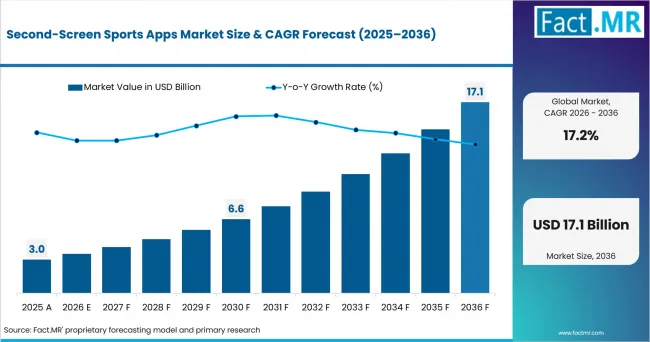
Second Screen Sports Apps Market Market Value Analysis | Source: Fact.MR
What are the defining numbers behind second-screen sports apps market growth?
USD 13.6 billion absolute opportunity by 2036, led by the United States and India.
- Demand Drivers in the Market
- Sports media product heads need mobile features that keep fans engaged during live viewing.
- Sportsbook teams need in-game interfaces that support live odds and quick decision flow.
- Fantasy product teams need player alerts that match live game moments.
- League digital teams need companion experiences that deepen official fan relationships.
- Key Segments Analyzed
- By App Type: Live Scores and Stats Apps are expected to hold 34.0% share in 2026 because fans first open second screens for real-time match context.
- By Feature Type: Real-Time Data and Alerts lead because score timing decides app trust. The share is projected at 39.0% in 2026.
- By Monetization Model: Advertising and Sponsorship are likely to account for 36.0% share in 2026 because live sports attention supports brand placement.
- By Sport Type: Football/Soccer leads with 31.0% share in 2026 because global match schedules create constant app engagement.
- By User Type: Mobile-First Fans are expected to hold 43.0% share in 2026 because they use apps throughout the live viewing window.
- By Geography: The United States is projected to record 19.5% CAGR through 2036 as media and sportsbook ecosystems converge.
- Analyst Opinion at Fact.MR
- Shambhu Nath Jha, Senior Analyst at Fact.MR, states, “Second-screen sports apps are becoming control panels for live fandom. We see fans using phones to understand the match, compare fantasy outcomes and react before the broadcast moves on. Providers that reduce timing gaps and simplify live context will gain stronger user retention.”
- Strategic Implications
- Broadcaster apps should synchronize mobile stats with connected TV viewing.
- Sportsbook apps should improve live odds clarity during active play.
- League apps can use official data to protect fan trust.
- Data providers should package feeds for low-latency mobile use.
Second-screen sports apps combine live match data with mobile engagement features. The strongest adoption case comes from fans who want context while the game is still live. The category connects with sports analytics because real-time data is the core reason users keep a companion app open during a match.
Apple introduced Apple Sports in 2024 as a free iPhone app for real-time scores and stats. [1] This shows how large consumer technology platforms are entering real-time sports utility apps. ESPN launched its enhanced app in 2025 with StreamCenter. The feature allows fans to synchronize live games on connected TV with stats and alerts on mobile devices. [2] This is a direct second-screen model because the phone becomes a matched companion to the main viewing screen.
DAZN launched ADI Predictstreet in 2026 for FIFA World Cup 2026. The free-to-play prediction experience is built inside the DAZN app. [3] This shows how prediction games are becoming part of live sports viewing.
The United States is projected to record 19.5% CAGR through 2036 as ESPN, DraftKings and FanDuel integrate live engagement into app ecosystems. India is expected to post 18.8% CAGR through 2036 as cricket viewing drives mobile companion use. The United Kingdom is likely to record 17.4% CAGR as football fans use apps for live scores and fantasy prompts. Germany is forecast to advance at 16.6% CAGR as Bundesliga-linked data products expand. Japan is set to record 16.0% CAGR as compact mobile-first viewing habits support app engagement.
How does the second-screen sports apps market break down by segment?
Live Scores and Stats Apps lead at 34.0%; Real-Time Data and Alerts lead at 39.0%.
Which app type dominates?
Live Scores and Stats Apps hold 34.0% share in 2026.
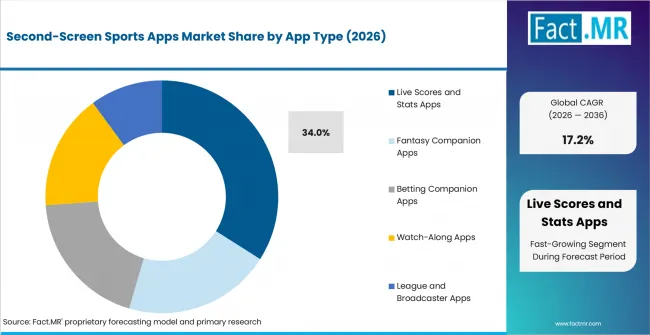
Second Screen Sports Apps Market Analysis By App Type | Source: Fact.MR
Live Scores and Stats Apps are expected to hold 34.0% share in 2026 because fans first use second screens for fast match context. The format supports score checks and player-level updates. It also helps viewers follow multiple fixtures during the same time window. The segment connects with edge analytics because low-latency processing improves the live update experience.
Which feature type dominates?
Real-Time Data and Alerts lead with 39.0% share in 2026.
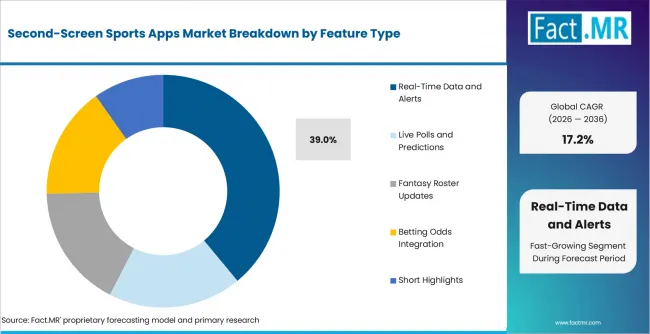
Second Screen Sports Apps Market Analysis By Feature Type | Source: Fact.MR
Real-Time Data and Alerts lead because second-screen users lose interest when updates lag behind the broadcast. The feature type is projected to capture 39.0% share in 2026. Apps use alerts to bring fans back during key moments. ESPN StreamCenter shows how synchronized stats can support mobile viewing alongside connected TV. Real-time alerts also help fantasy and betting users act quickly.
Which monetization model dominates?
Advertising and Sponsorship hold 36.0% share in 2026.
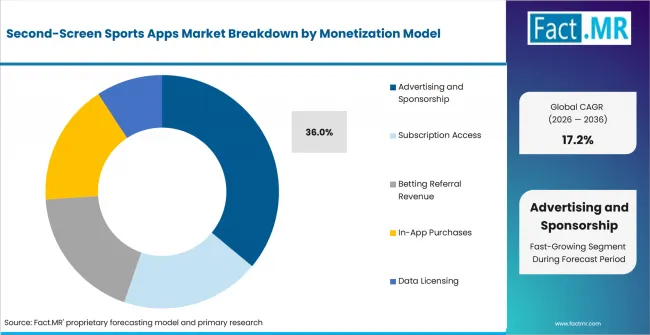
Second Screen Sports Apps Market Analysis By Monetization Model | Source: Fact.MR
Advertising and Sponsorship lead because live sports creates high-attention mobile moments. The monetization model is likely to account for 36.0% share in 2026. Sponsors value in-game prompts because they reach fans while emotion is high. Apps can place branded features around polls and prediction games.
Which sport type dominates?
Football/Soccer accounts for 31.0% share in 2026.
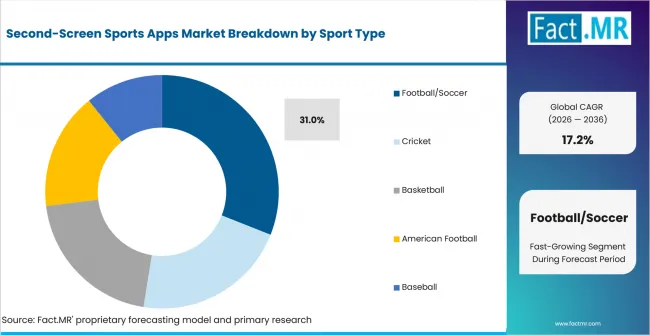
Second Screen Sports Apps Market Analysis By Sport Type | Source: Fact.MR
Football/Soccer leads because fixtures run across domestic leagues and global tournaments. The sport type is expected to hold 31.0% share in 2026. Fans use second screens for live tables and player events. DAZN’s World Cup prediction experience shows how football can support app-based participation. Cricket follows in mobile-first countries where ball-by-ball updates shape engagement.
Which user type dominates?
Mobile-First Fans hold 43.0% share in 2026.
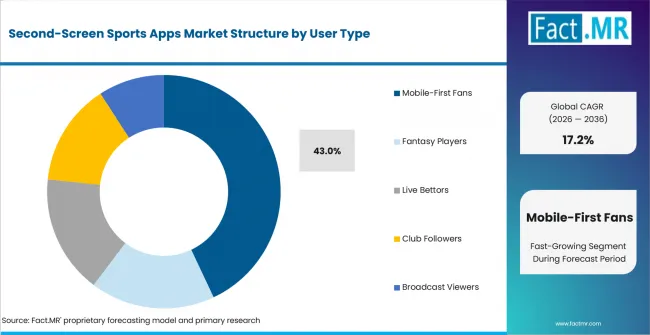
Second Screen Sports Apps Market Analysis By User Type | Source: Fact.MR
Mobile-First Fans lead because they keep phones active during live viewing. This group is expected to hold 43.0% share in 2026. They use apps for score checks, commentary and game alerts. The segment also responds to prediction games and fantasy prompts. Providers can use predictive analytics to personalize live content without crowding the app screen.
What is accelerating second-screen sports apps demand, and what is holding it back?
Synchronized viewing drives demand; notification fatigue restrains retention.
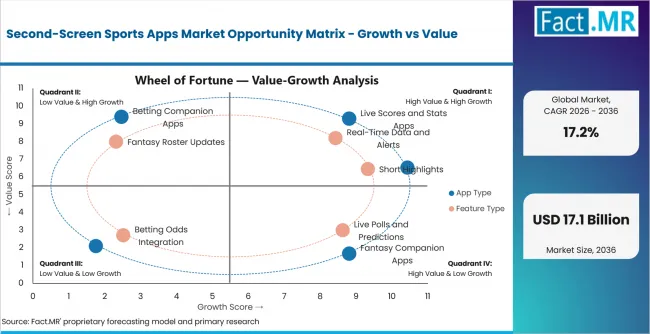
Second Screen Sports Apps Market Opportunity Matrix Growth Vs Value | Source: Fact.MR
Synchronized viewing is the main driver. Fans want mobile updates that match the live broadcast rather than spoil it. ESPN’s StreamCenter addresses this by matching the mobile app with the connected TV stream. [2]
Interactive prediction adds another driver. DAZN’s Predictstreet experience brings real-time participation and leaderboards into the DAZN app during FIFA World Cup 2026. [3] This shows how mobile games can sit beside live viewing.
Betting integrations support app engagement in regulated markets. ESPN and DraftKings announced a multi-year agreement in 2025 to integrate DraftKings entertainment products across ESPN’s ecosystem. [4] The agreement supports second-screen betting and fantasy use cases.
Social discovery is also influencing product design. FanDuel introduced Community Feed across sports in 2026 to help users discover and share picks in real time. [5] This gives betting apps a social layer during live events.
The main restraint is notification fatigue. Fans may disable alerts if apps push too many updates. Providers need sharper personalization before increasing message frequency.
Where do the biggest second-screen sports app opportunities sit?
Synchronized stats, live prediction and fantasy companion features.
- Synchronized Stats: Broadcasters can connect mobile data with live connected TV streams.
- Live Prediction: Media apps can use free-to-play games to increase session duration.
- Fantasy Companion: Fantasy platforms can deliver player alerts during live games.
Which countries are scaling second-screen sports apps fastest?
United States 19.5%, India 18.8%, United Kingdom 17.4%, Germany 16.6%, Japan 16.0%.
Based on regional analysis, the second-screen sports apps market is segmented into North America, Western Europe, Asia Pacific, Latin America, and Middle East and Africa.
.webp "Top Country Growth Comparison Second Screen Sports Apps Market Cagr (2026 2036)")
Top Country Growth Comparison Second Screen Sports Apps Market Cagr (2026 2036) | Source: Fact.MR
| Country | CAGR |
|---|---|
| United States | 19.5% |
| India | 18.8% |
| United Kingdom | 17.4% |
| Germany | 16.6% |
| Japan | 16.0% |
Source: Fact.MR analysis. Updated Jun 25, 2026
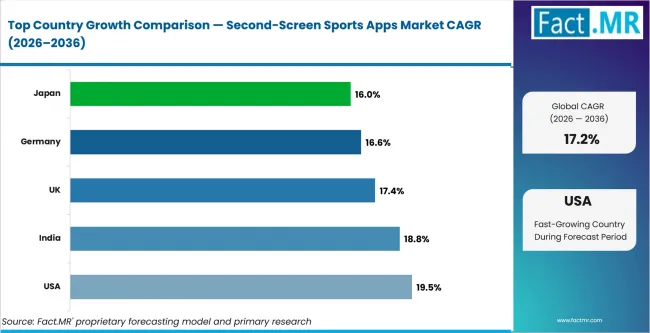
Second Screen Sports Apps Market Cagr Analysis By Country | Source: Fact.MR
What is powering the United States lead?
19.5% CAGR, driven by ESPN and DraftKings app integration.
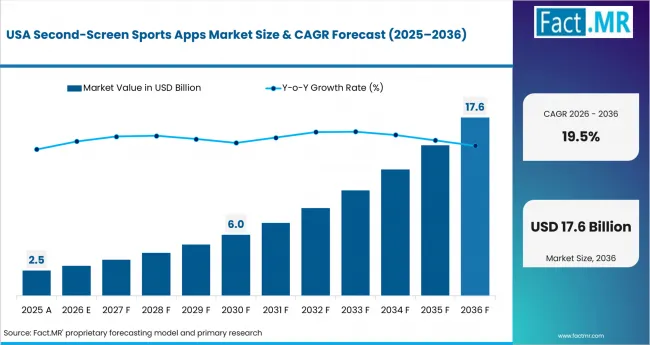
Second Screen Sports Apps Market Country Value Analysis | Source: Fact.MR
The United States is projected to record 19.5% CAGR through 2036 as media apps and sportsbook apps converge. ESPN StreamCenter supports synchronized viewing. DraftKings integration adds betting and fantasy use cases. Growth will favor apps that control live data and user identity.
How is India scaling second-screen sports app demand?
18.8% CAGR, supported by cricket viewing and mobile-first sports behavior.
India is expected to post 18.8% CAGR through 2036 as cricket fans use apps during live matches. Ball-by-ball updates suit second-screen use. Fantasy sports engagement also supports repeat app sessions. Growth will favor apps that combine live scores with personalized alerts.
What supports the United Kingdom outlook?
17.4% CAGR, backed by football viewing and betting companion use.
The United Kingdom is likely to record 17.4% CAGR from 2026 to 2036 as football fans use mobile apps while watching matches. Live scores and odds create strong second-screen behavior. Broadcaster apps can add match-linked alerts. Growth will favor providers that reduce lag between broadcast and mobile updates.
What underpins Germany’s growth?
16.6% CAGR, driven by Bundesliga data products and mobile match tracking.
Germany is forecast to advance at 16.6% CAGR through 2036 as football fans adopt app-based match tracking. Sportradar’s NBA fan engagement work shows how official data can power deeper mobile experiences. Similar data-led formats can support football engagement. Growth will favor official data partners with reliable feed delivery.
How is Japan scaling second-screen sports app adoption?
16.0% CAGR, supported by compact mobile viewing and real-time score behavior.
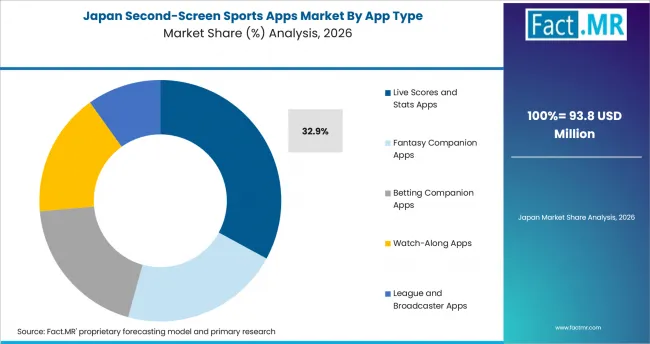
Second Screen Sports Apps Market Japan Market Share Analysis By App Type | Source: Fact.MR
Japan is set to record 16.0% CAGR by 2036 as fans use mobile apps around baseball and football viewing. Compact commutes and mobile-first habits support score checking. Sports media apps can use short alerts to increase repeat sessions. Growth will favor simple interfaces with fast data refresh.
Who leads the second-screen sports apps market?
ESPN and Apple Sports lead through real-time scores and companion app design.
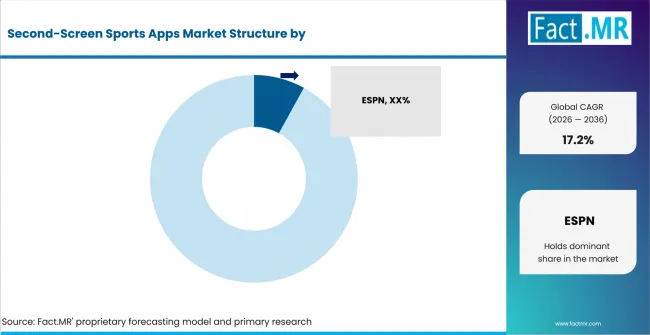
Second Screen Sports Apps Market Analysis By Company | Source: Fact.MR
Second-screen sports apps are supplied by media platforms, technology companies, sportsbooks and sports data providers. ESPN supports synchronized viewing through StreamCenter. Apple Sports supports fast scores and stats through an iPhone-first app.
DAZN competes through live sports streaming and prediction-led fan participation. DraftKings supports second-screen engagement through betting and fantasy products. FanDuel adds live betting and social discovery features. Sportradar supports partner apps through official sports data and fan engagement solutions.
Competition through 2036 will depend on timing accuracy and personalization quality. Apps that deliver late alerts will lose trust. The internet of things layer can support venue-linked engagement when fans are inside stadiums.
Which companies are the key providers?
ESPN and Apple Sports are key providers. DAZN and DraftKings are also profiled. FanDuel and Sportradar complete the company set.
- ESPN
- Apple Sports
- DAZN
- DraftKings
- FanDuel
- Sportradar
Bibliography
- [1] Apple. (2024, February 21). Introducing Apple Sports, a new app for sports fans. Apple Newsroom.
- [2] ESPN. (2025, August 21). ESPN launches new direct-to-consumer service, enhanced ESPN app. ESPN Press Room.
- [3] DAZN Group. (2026, June 18). Sports giant DAZN launches ADI Predictstreet free-to-play prediction market experience for FIFA World Cup 2026. DAZN Group.
- [4] ESPN. (2025, November 6). ESPN and DraftKings enter multi-year agreement. ESPN Press Room.
- [5] FanDuel. (2026, June 9). FanDuel debuts Community Feed across all sports just in time for World Cup. FanDuel.
- [6] Sportradar. (2024, October 22). Sportradar deepens official partnership with NBA with launch of innovative, value-add fan engagement solutions. Sportradar.
This Report Addresses
- Strategic intelligence on second-screen sports apps across app type and feature type.
- Segment analysis covering Live Scores and Stats Apps and Real-Time Data and Alerts.
- Regional outlook covering the United States, India, the United Kingdom, Germany and Japan.
- Competitive analysis of ESPN, Apple Sports, DAZN, DraftKings, FanDuel and Sportradar.
- Technology assessment covering real-time data, prediction games, alerts and app synchronization.
- Use case assessment covering live viewing, fantasy companion use and betting engagement.
- Primary interviews, provider checks and official source review support the forecast.
What does the second-screen sports apps market cover?
Mobile companion apps used while fans watch live sports on another screen.
The second-screen sports apps market covers apps that provide live scores and watch-along features during live sports viewing. It includes broadcaster apps and independent score apps. The scope connects with sports betting where in-game odds act as a second-screen engagement layer.
The market differs from ordinary sports news apps because timing is central to value. These apps need to update while the match is active. A delayed feed can reduce trust because users compare mobile updates with the live broadcast.
What is included in the scope?
Live stats apps and interactive watch-along products.
The scope includes score apps and broadcaster-controlled mobile experiences. It includes mobile ticketing only when venue entry data connects to live event engagement. It covers push alerts and synchronized mobile controls.
The scope includes league-owned apps and media-owned apps. It also includes data provider modules embedded inside partner apps. The market covers consumer-facing app interfaces and the backend data services needed for live updates.
What is excluded from the scope?
Sports apps without live companion engagement.
The scope excludes general sports news apps with no real-time match layer. It excludes video-only streaming services unless they include mobile companion features. It excludes ticketing apps that only manage entry. It excludes social media platforms unless the platform provides sports-specific second-screen products.
How was the analysis built?
100+ sources, 40+ company portfolios, 25+ countries, 20+ interviews.
- Primary Research: Primary research includes interviews with sports media product heads and app engagement directors. It includes input from sportsbook product teams and sports data providers.
- Desk Research: Desk research reviews app feature launches and official product sources. It covers broadcaster apps, score apps and smart ticketing connections where event access links with app engagement.
- Market-Sizing and Forecasting: Forecasting uses sports app audience growth and live engagement session patterns. Monetization through advertising, subscriptions and betting referrals supports the market assessment.
- Data Validation and Update Cycle: Forecasts are validated through provider checks and app feature tracking. League integrations and live event product updates help confirm market direction.
Segmentation
What is the report’s scope and coverage?
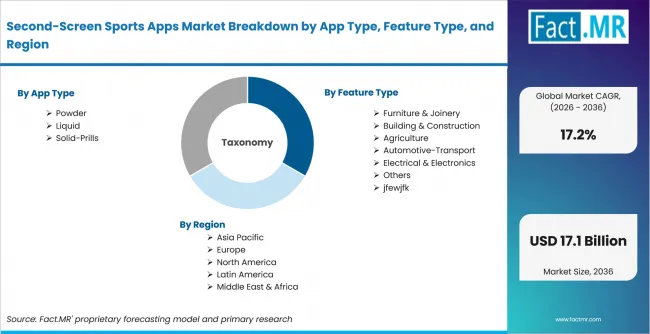
Second Screen Sports Apps Market Breakdown By App Type, Feature Type, And Region | Source: Fact.MR
| Attribute | Details |
|---|---|
| Quantitative Units | USD Billion in 2026 to USD Billion& by 2036 at CAGR |
| Market Definition | Mobile companion apps used while fans watch live sports on another screen |
| App Type | Live Scores and Stats Apps; Fantasy Companion Apps; Betting Companion Apps; Watch-Along Apps; League and Broadcaster Apps |
| Feature Type | Real-Time Data and Alerts; Live Polls and Predictions; Fantasy Roster Updates; Betting Odds Integration; Short Highlights |
| Monetization Model | Advertising and Sponsorship; Subscription Access; Betting Referral Revenue; In-App Purchases; Data Licensing |
| Sport Type | Football/Soccer; Cricket; Basketball; American Football; Baseball |
| User Type | Mobile-First Fans; Fantasy Players; Live Bettors; Club Followers; Broadcast Viewers |
| Regions Covered | North America; Western Europe; Asia Pacific; Latin America; Middle East and Africa |
| Countries Covered | United States; India; United Kingdom; Germany; Japan |
| Key Companies Profiled | ESPN; Apple Sports; DAZN; DraftKings; FanDuel; Sportradar |
| Forecast Period | 2026 to 2036 |
| Approach | Hybrid top-down and bottom-up approach using app feature rollouts, live sports viewing behavior, monetization models and provider validation |
Source: Fact.MR analysis. Updated Jun 25, 2026
How is the market segmented?
-
By App Type:
- Live Scores and Stats Apps
- Fantasy Companion Apps
- Betting Companion Apps
- Watch-Along Apps
- League and Broadcaster Apps
-
By Feature Type:
- Real-Time Data and Alerts
- Live Polls and Predictions
- Fantasy Roster Updates
- Betting Odds Integration
- Short Highlights
-
By Monetization Model:
- Advertising and Sponsorship
- Subscription Access
- Betting Referral Revenue
- In-App Purchases
- Data Licensing
-
By Sport Type:
- Football/Soccer
- Cricket
- Basketball
- American Football
- Baseball
-
By User Type:
- Mobile-First Fans
- Fantasy Players
- Live Bettors
- Club Followers
- Broadcast Viewers
-
Region:
- North America
- United States
- Canada
- Europe
- United Kingdom
- Germany
- France
- Spain
- Italy
- Asia Pacific
- India
- Japan
- South Korea
- Australia
- China
- Latin America
- Brazil
- Mexico
- Argentina
- Middle East & Africa
- Saudi Arabia
- UAE
- South Africa
- Qatar
- North America
Frequently Asked Questions
Which app type leads the Second-Screen Sports Apps Market?
Which feature type leads the Second-Screen Sports Apps Market?
Which monetization model leads the Second-Screen Sports Apps Market?
Which sport type leads the Second-Screen Sports Apps Market?
Which user type leads the Second-Screen Sports Apps Market?
Which country expands fastest in the Second-Screen Sports Apps Market?
How does India perform in the Second-Screen Sports Apps Market?
How does the United Kingdom perform in the Second-Screen Sports Apps Market?
How does Germany perform in the Second-Screen Sports Apps Market?
How does Japan perform in the Second-Screen Sports Apps Market?
What is the primary driver in the Second-Screen Sports Apps Market?
What is the main restraint in the Second-Screen Sports Apps Market?
Why are live score apps important in this market?
Why are prediction features gaining adoption?
Who worked on this report


Preview the report firsthand - request a free sample
Free SampleGet the brochure for pricing and purchase details
Download PDF