- Forecast Value (2036): 8.0 Bn
- CAGR (2036): 27.6%
What is the immersive sports viewing market forecast to be worth by 2036?
USD 0.7 billion in 2026 to USD 8.0 billion by 2036 at 27.6% CAGR.
- The immersive sports viewing market crossed a valuation of 0.5 billion in 2025.
- The market is estimated at USD 0.7 billion in 2026 and is projected to reach USD 8.0 billion by 2036. The market is forecast to expand at 27.6% CAGR during 2026 to 2036.
- Growth is supported by wider use of XR and spatial streaming technologies in professional sports broadcasting.
- Immersive sports viewing enables fans to experience sporting events through virtual environments, multi-angle interactive feeds and real-time digital overlays.
- The technology enhances engagement by allowing viewers to customize perspectives and interact with live content. Growing investments from broadcasters, telecom operators and sports leagues continue to accelerate adoption.
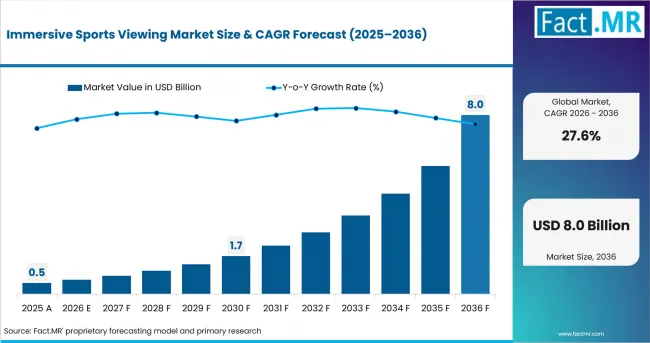
Immersive Sports Viewing Market Value Analysis | Source: Fact.MR
What are the defining numbers behind immersive sports viewing growth?
USD 7.3 billion absolute opportunity by 2036 led by the United States and Japan.
- Demand Drivers in the Market
- Sports broadcasters need differentiated fan experiences.
- Leagues seek deeper audience engagement and monetization.
- Telecom operators are expanding XR content ecosystems.
- Consumers increasingly demand interactive viewing experiences.
- Key Segments Analyzed
- By Technology Type: Virtual Reality Platforms are expected to hold 36.0% share in 2026 because they deliver the most immersive and interactive sports viewing experience available to consumers.
- By Viewing Platform: Home-Based Immersive Viewing is projected to account for 42.0% share in 2026 due to convenience, expanding XR device adoption and growing access to premium sports content.
- By Deployment Model: Cloud-Based Platforms are expected to hold 58.0% share in 2026 because they enable scalable real-time content delivery and efficient processing of immersive experiences.
- By End User: Sports Fans and Subscribers are projected to account for 61.0% share in 2026 as immersive technologies are primarily designed to enhance fan engagement and viewing satisfaction.
- By Revenue Model: Subscription Services are expected to hold 39.0% share in 2026 because recurring revenue models support continuous content development and platform expansion.
- By Geography: The United States is projected to record 29.3% CAGR through 2036 due to strong investment in immersive sports technologies by leagues, broadcasters.
The United States remains the leading market due to strong sports media investment and technology adoption. The United Kingdom benefits from immersive venue concepts and next-generation fan experiences. Saudi Arabia is emerging through esports districts and entertainment city developments. South Korea continues to advance through telecom-led XR deployments. Japan remains a major innovation hub supported by NTT's XR stadium technologies and advanced digital infrastructure.
How do the immersive sports viewing market break down by segment?
Virtual Reality Platforms lead at 36.0%; Sports Fans and Subscribers lead at 61.0%.
Which technology type dominates?
Virtual Reality Platforms hold 36.0% share in 2026.
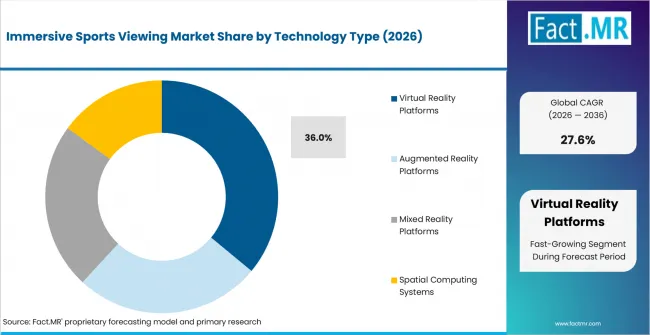
Immersive Sports Viewing Market Analysis By Technology Type | Source: Fact.MR
Virtual reality platforms lead because they provide fully immersive viewing experiences that replicate stadium environments. Fans can access multiple viewing angles and interactive features through VR headsets. Growing availability of consumer XR hardware supports adoption. Broadcasters are increasingly experimenting with VR-based premium sports experiences. Apple Vision Pro launched with MLS Season Pass support, enabling fans to watch live soccer in a spatial-computing environment with immersive viewing experiences and real-time statistics integration. [1]
Which viewing platform dominates?
Home-Based Immersive Viewing holds 42.0% share in 2026.
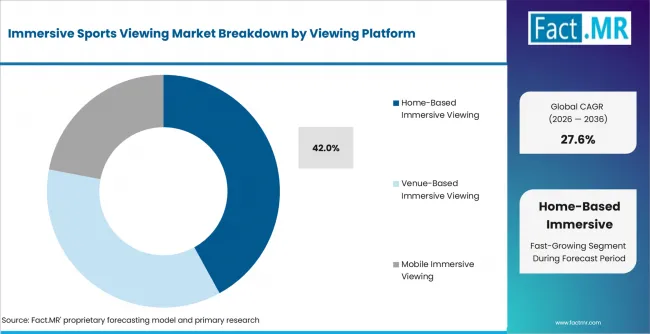
Immersive Sports Viewing Market Analysis By Viewing Platform | Source: Fact.MR
Home-based immersive viewing leads because consumers increasingly prefer premium experiences without attending events physically. Advances in headset technology and broadband infrastructure continue to improve accessibility. The segment benefits from convenience and expanding content availability. NBCUniversal announced that portions of the Paris 2024 Olympics would be available on Apple Vision Pro through immersive viewing experiences, including multiview and spatial video features. [2]
Which deployment model dominates?
Cloud-Based Platforms hold 58.0% share in 2026.
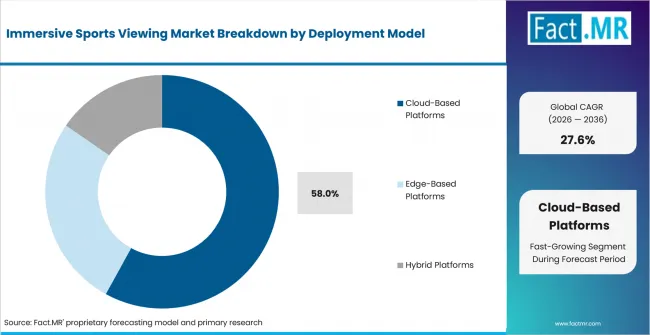
Immersive Sports Viewing Market Analysis By Deployment Model | Source: Fact.MR
Cloud-based platforms lead because immersive content requires substantial computing resources and scalable distribution. Cloud deployment improves accessibility and supports real-time content delivery across devices. Telecom operators and streaming providers continue to expand cloud-enabled XR services. The NFL partnered with Cosm to produce and distribute live NFL games in "Shared Reality" at Cosm's immersive venues in Los Angeles and Dallas. Using 87-foot-diameter 12K+ LED domes, the experience combines live game action with immersive visuals to replicate an in-stadium atmosphere for fans watching Thursday Night Football, Sunday Night Football, Monday Night Football, and select FOX broadcasts. [3]
Which end user dominates?
Sports Fans and Subscribers hold 61.0% share in 2026.
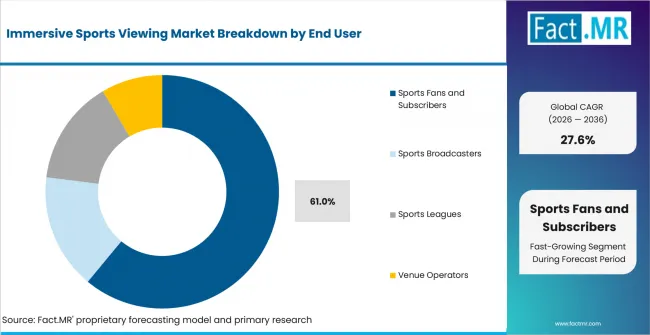
Immersive Sports Viewing Market Analysis By End User | Source: Fact.MR
Sports fans and subscribers account for the largest share because immersive experiences are primarily designed to improve audience engagement. Fans increasingly seek personalized viewing experiences and exclusive content features. The segment benefits from strong sports media consumption patterns. Cosm announced it will broadcast 40 FIFA World Cup 2026 matches across its Shared Reality venues in Los Angeles and Dallas, using massive dome displays and immersive production technology to recreate the feeling of attending matches in person. The initiative expands venue-based immersive sports viewing and highlights growing demand for large-scale experiential sports entertainment beyond traditional television broadcasts. [4]
Which revenue model dominates?
Subscription Services hold 39.0% share in 2026.
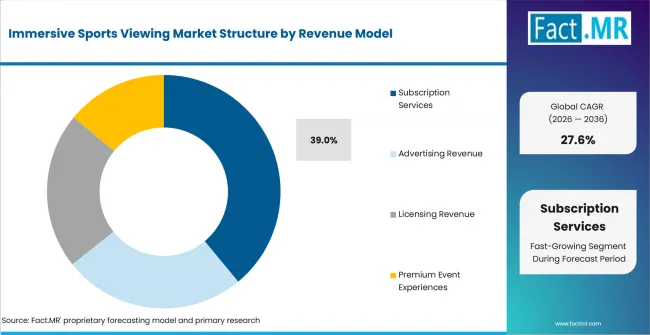
Immersive Sports Viewing Market Analysis By Revenue Model | Source: Fact.MR
Subscription services lead because immersive sports platforms increasingly use recurring revenue models. Subscribers gain access to premium content and enhanced viewing features. The model supports long-term customer retention and predictable revenue generation.
What is accelerating immersive sports viewing demand and what is holding it back?
XR technology adoption drives demand while hardware costs restrain growth.
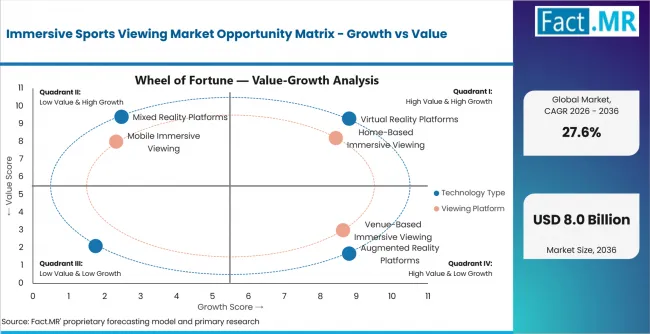
Immersive Sports Viewing Market Opportunity Matrix Growth Vs Value | Source: Fact.MR
The primary growth driver is increasing investment in immersive broadcasting technologies. Sports leagues, media companies and telecom providers are introducing new digital experiences that improve fan engagement. Advances in XR hardware and 5G connectivity continue to support adoption.
The main restraint is the cost of immersive viewing hardware. High-quality VR headsets and supporting equipment remain expensive for many consumers. Limited content availability in certain regions also slows adoption.
Where do the biggest immersive sports viewing opportunities sit?
XR stadium experiences, spatial streaming and telecom partnerships.
- XR Stadium Experiences:
- Sports venues are increasingly integrating immersive technologies to enhance fan engagement before, during and after events.
- Telecom-Led XR Platforms:
- Telecom operators can leverage 5G infrastructure to deliver immersive sports content at scale.
- Interactive Broadcasting:
- Broadcasters can create premium viewing packages featuring multiple camera angles and real-time data overlays.
Which countries are scaling immersive sports viewing adoption fastest?
United States 29.3%, United Kingdom 28.8%, Saudi Arabia 26.8%, Japan 27.9%, South Korea 27.2%
.webp "Top Country Growth Comparison Immersive Sports Viewing Market Cagr (2026 2036)")
Top Country Growth Comparison Immersive Sports Viewing Market Cagr (2026 2036) | Source: Fact.MR
Based on regional analysis, the immersive sports viewing market is segmented into North America, Western Europe, Asia Pacific, Latin America and Middle East & Africa.
| Country | CAGR |
|---|---|
| United States | 29.3% |
| United Kingdom | 28.8% |
| Saudi Arabia | 26.8% |
| South Korea | 27.2% |
| Japan | 27.9% |
Source: Fact.MR analysis. Updated Jun 23, 2026
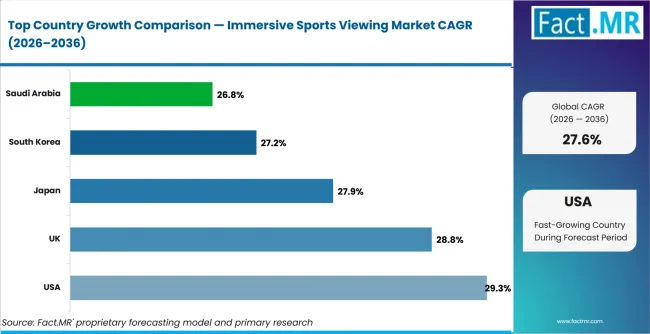
Immersive Sports Viewing Market Cagr Analysis By Country | Source: Fact.MR
What is powering the United States lead?
29.3% CAGR, supported by league investment and spatial sports media adoption.
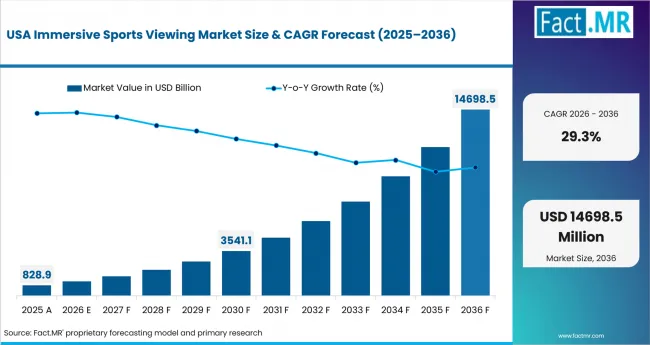
Immersive Sports Viewing Market Country Value Analysis | Source: Fact.MR
The United States is projected to record 29.3% CAGR by 2036 as sports broadcasters, technology companies and leagues invest heavily in immersive fan experiences. Professional sports organizations are increasingly adopting virtual reality and spatial streaming technologies to strengthen audience engagement. Strong consumer spending on digital entertainment and advanced XR ecosystems support market expansion.
How is the United Kingdom scaling immersive sports viewing demand?
28.8% CAGR, supported by venue-led immersive viewing and sports media experimentation
The United Kingdom is expected to post 28.8% CAGR as immersive sports venues and experiential viewing concepts gain popularity. Dedicated viewing destinations and next-generation sports entertainment formats continue to attract investment. Broadcasters are also expanding immersive content initiatives.
What underpins Saudi Arabia's growth?
28.8% CAGR, supported by entertainment districts and esports-led immersive venues.
Saudi Arabia is projected to register 26.8% CAGR as large-scale entertainment districts and esports developments integrate immersive technologies. Sports diversification initiatives and digital infrastructure investments are creating new opportunities for immersive viewing platforms. Demand is expected to remain strongest in premium entertainment environments.
How does South Korea perform?
27.2% CAGR, supported by telecom-led XR deployment and advanced 5G networks.
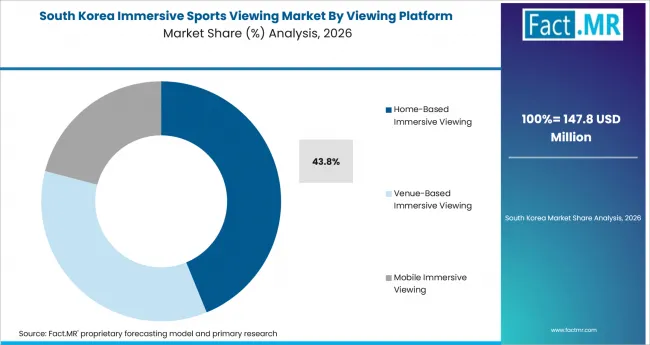
Immersive Sports Viewing Market South Korea Market Share Analysis By Viewing Platform | Source: Fact.MR
South Korea is expected to register 27.2% CAGR by 2036 due to strong telecom-led XR deployment strategies. Advanced 5G infrastructure and high digital adoption rates support immersive content consumption. Sports broadcasters and telecommunications providers continue to collaborate on next-generation viewing experiences.
Why is Japan important?
27.9% CAGR, supported by XR stadium technology and advanced digital infrastructure.
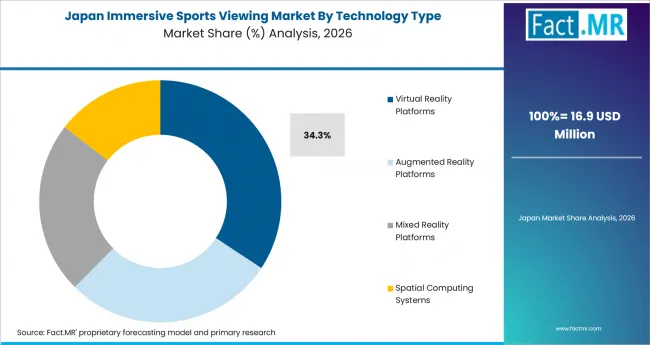
Immersive Sports Viewing Market Japan Market Share Analysis By Technology Type | Source: Fact.MR
Japan is forecast to advance at 27.9% CAGR through 2036 as NTT and other technology providers expand XR stadium technologies and immersive sports broadcasting solutions. Strong digital infrastructure and consumer acceptance of advanced technologies support adoption. The market benefits from continuous innovation in spatial computing and immersive entertainment.
Who leads the immersive sports viewing landscape?
Apple Inc., Meta, NTT, DAZN, Verizon and major sports broadcasters lead through XR ecosystems and immersive content platforms.
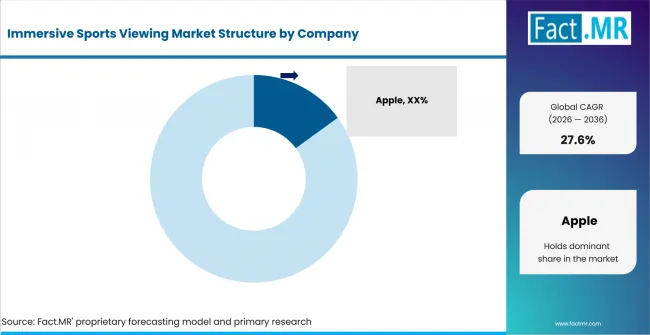
Immersive Sports Viewing Market Analysis By Company | Source: Fact.MR
The immersive sports viewing market remains highly innovation-driven with competition focused on content quality, user experience and technology integration. Companies are investing in virtual reality broadcasting, spatial computing and interactive streaming solutions to strengthen fan engagement.
Apple Inc. and Meta are advancing hardware ecosystems that support immersive content consumption. NTT continues to develop XR stadium technologies and next-generation sports experiences. DAZN and major sports broadcasters are expanding immersive streaming initiatives. Telecom operators such as Verizon are leveraging 5G infrastructure to support large-scale deployment.
Competition through 2036 will depend on content availability, platform interoperability and hardware accessibility. Providers that combine immersive technologies with premium sports rights and strong distribution networks will be better positioned to strengthen market share.
Which companies are the key players?
Apple Inc., Meta Platforms, NTT Group, DAZN, Verizon Communications, Qualcomm Incorporated, HTC Corporation
- Apple Inc.
- Meta Platforms
- NTT Group
- DAZN
- Verizon Communications
- Qualcomm Incorporated
- HTC Corporation
Bibliography
- [1] Dachman, J. (2024, February 2). Apple Vision Pro launches with new spatial app from PGA TOUR, compatible apps from MLB, MLS, NBA, and more. Sports Video Group.
- [2] NBCUniversal. (2024, March 20). Peacock unveils its viewing experience for Olympic Games Paris 2024.
- [3] Cosm. (2024, October 29). The NFL and Cosm partner to deliver select live NFL games in Shared Reality.
- [4] FOX Sports. (2026, May 8). FOX Sports teams up with Cosm, FIFA to deliver FIFA World Cup 2026™ in Shared Reality.
This Report Addresses
- Strategic intelligence on immersive sports viewing technologies and XR ecosystems.
- Segment analysis covering virtual reality platforms, immersive viewing solutions and subscription models.
- Regional outlook covering the United States, United Kingdom, Saudi Arabia, South Korea and Japan.
- Competitive analysis of Apple Inc., Meta, NTT, DAZN, Verizon and leading immersive technology providers.
- Technology assessment covering VR, AR, mixed reality and spatial computing platforms.
- Evaluation of immersive broadcasting, venue experiences and next-generation sports media ecosystems.
- Primary interviews, technology benchmarking and industry validation supporting market forecasts.
What does the immersive sports viewing market cover?
Digital technologies that enhance live sports consumption through immersive experiences.
The market covers virtual reality viewing and augmented reality overlays. It includes mixed reality sports experiences and immersive streaming platforms. The market focuses on technologies that transform how fans consume live and on-demand sports content.
What is included in the scope?
Immersive viewing hardware, software and digital content platforms.
The scope includes VR sports streaming platforms and XR content solutions. It covers immersive venue experiences and interactive broadcasting systems. It includes spatial computing applications designed for sports consumption.
What is excluded from the scope?
Traditional sports broadcasting and standard streaming services.
The scope excludes conventional television broadcasting without immersive features. It excludes general gaming experiences unrelated to sports viewing. It excludes non-sports virtual reality applications.
Segmentation
What is the report’s scope and coverage?
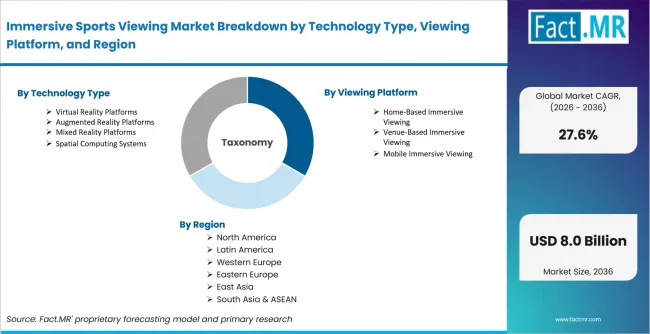
Immersive Sports Viewing Market Breakdown By Technology Type, Viewing Platform, And Region | Source: Fact.MR
| Attribute | Details |
|---|---|
| Quantitative Units | USD billion in 2026 to USD billion by 2036 |
| Market Definition | XR-enabled sports viewing technologies and immersive broadcasting platforms |
| Technology Type | Virtual Reality, Augmented Reality, Mixed Reality, Spatial Computing Platforms |
| Viewing Platform | Home-Based Viewing, Venue-Based Viewing, Mobile Immersive Viewing |
| Deployment Model | Cloud-Based, Edge-Based, Hybrid Platforms |
| End User | Sports Fans, Broadcasters, Sports Leagues, Venue Operators |
| Revenue Model | Subscription Services, Advertising, Licensing, Premium Experiences |
| Regions Covered | North America, Western Europe, Asia Pacific, Latin America, Middle East & Africa |
| Countries Covered | United States, United Kingdom, Saudi Arabia, South Korea, Japan |
| Key Companies Profiled |
Apple Inc., Meta Platforms, NTT Group, DAZN, Verizon Communications, Qualcomm Incorporated, HTC Corporation |
| Forecast Period | 2026 to 2036 |
| Approach | A hybrid top-down and bottom-up methodology is used to estimate market size by technology type, viewing platform, deployment model, end user and revenue model. Market estimates are benchmarked against XR hardware adoption. |
Source: Fact.MR analysis. Updated Jun 23, 2026
How is the market segmented?
-
By Technology Type
- Virtual Reality Platforms
- Augmented Reality Platforms
- Mixed Reality Platforms
- Spatial Computing Systems
-
By Viewing Platform
- Home-Based Immersive Viewing
- Venue-Based Immersive Viewing
- Mobile Immersive Viewing
-
By Deployment Model
- Cloud-Based Platforms
- Edge-Based Platforms
- Hybrid Platforms
-
By End User
- Sports Fans and Subscribers
- Sports Broadcasters
- Sports Leagues
- Venue Operators
-
By Revenue Model
- Subscription Services
- Advertising Revenue
- Licensing Revenue
- Premium Event Experiences
-
Region:
- North America
- United States
- Canada
- Europe
- United Kingdom
- Germany
- France
- Netherlands
- Spain
- Asia Pacific
- Australia
- Japan
- South Korea
- Singapore
- India
- Latin America
- Brazil
- Mexico
- Chile
- Middle East & Africa
- GCC Countries
- South Africa
- Israel
- North America
Frequently Asked Questions
Which technology type leads the market?
Which country expands fastest in the Immersive Sports Viewing Market?
What is the primary growth driver?
What is the main restraint?
Why are telecom operators important in this market?
Who worked on this report


Preview the report firsthand - request a free sample
Free SampleGet the brochure for pricing and purchase details
Download PDF