- Base Value(2025): 194.0 Bn
- Forecast Value (2035): 2101 Bn
- CAGR (2035): 29.1%
Senior Tech Services Market Outlook 2025 to 2035
Global senior tech services market is expected to reach USD 2,101 billion by 2035, up from USD 194 billion in 2025. During the forecast period 2025 to 2035, the industry is projected to expand at a CAGR of 26.9%.
The market of senior tech services can be motivated by the swiftly growing aging population, a rise in the independent living demand, and the development of AI, robotics, IoT, and wearable technologies that make life safe and more convenient. Growing awareness and use of digital health solutions by the elderly and their caregivers such as telehealth and remote monitoring also contribute to faster market growth. All these make technology a new attribute of the contemporary elderly care.
Quick Stats for Senior Tech Services Market
- Industry Value (2025): USD 194 Billion
- Projected Value (2035): USD 2,101 Billion
- Forecast CAGR (2025 to 2035): 26.9%
- Leading Segment (2025): Home Care and Assisted Living Services (39% Market Share)
- Fastest Growing Country (2025-2035): Germany (26.8% CAGR)
- Top Key Players: American Well, Ekso Bionics, Libify Technologies GmbH, Exordium Networks, GrandPad, and Invacare Corporation
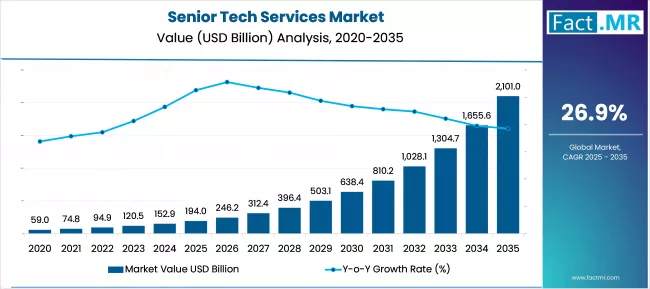
Senior Tech Services Market Market Value Analysis | Source: Fact.MR
What are the drivers of the senior tech services market?
The high rate of the aging population in the entire world is fueling the senior tech services market. With an ageing population, the number of seniors requiring solutions that allow them to have an independent, safe, and comfortable life is on the rise. This population change has presented a huge market to technologies that specifically address needs of older adults.
Another significant driver is technological progress, and AI, robotics, IoT, and wearable device innovations are changing the manner in which care is provided to the aged. Smart homes and health care trackers, as well as AI-based companions, are getting increasingly advanced and, therefore, convenient and real-time. The innovations make the care of seniors more efficient and more accessible.
The driving force of the market is also the greater awareness and uptake of digital health solutions by seniors and caregivers. Older adults are becoming more open to telehealth, wearables, and smart communication and caregivers are utilizing technology to manage and monitor remotely. Such a broad acceptance is facilitating the adoption of technology in the everyday care of the aging population.
What are the regional trends of the senior tech services market?
The senior tech services market is dominated by North America because the country has developed healthcare infrastructure and embraces AI and telehealth solutions. U.S. specifically contributes to growth by making substantial investment in assistive technologies and smart home technologies to support elderly people.
There is a high market growth in Europe, which is driven by the government efforts on elderly care and robotics and AI integration into assisted living homes. Such nations as Germany and the U.K. are at the forefront in coming up with innovative technologies in elder care.
Asia-Pacific is undergoing a rapid growth in which nations such as Japan and China are tackling ageing populations through smart elder care programs and AI-powered surveillance mechanisms. There is also an improving adoption in this region due to rising disposable incomes and rising tech literacy among seniors.
The Middle East and the Africa as well as Latin America are new markets with growing interest in senior care technologies as well as investments in healthcare infrastructure which are slowly increasing the market. Such areas are concerned with low-cost and flexible elderly care.
What are the challenges and restraining factors of the senior tech services market?
The major problem with senior tech services segment is the expensive price of the superior technologies, including artificial intelligence (AI)-enabled devices and robotic assistants. A large number of elderly people and care homes are unable to afford these solutions and can restrict their adoption widely. Constant repair and upgrades of these machines increase the total cost, which poses a hurdle to the smaller providers and individuals.
The digital illiteracy of a good number of the elderly prevents successful utilization of technology. The elderly might have a problem using smart devices, applications, or wearable gadgets, and this minimizes the advantages that the innovations hold. This has necessitated the companies to invest in easily accessible designs, training, and support system to enhance accessibility.
The market has a major limitation in the form of strict regulatory compliance and privacy of data. Senior tech services usually handle sensitive health and personal information and this information is required to comply with stringent laws in various countries. These legal requirements can make it challenging to navigate the legal requirements, thereby reducing growth of both new and existing players.
Country-Wise Insights
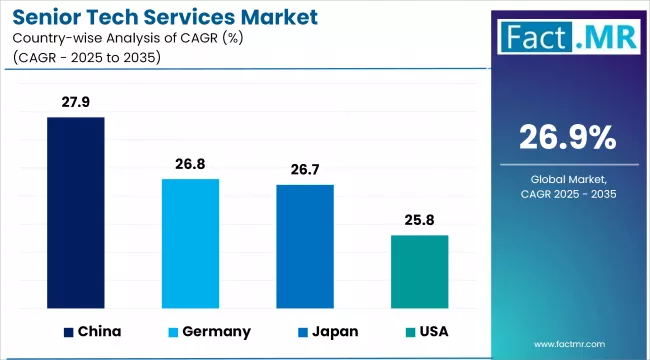
Senior Tech Services Market Cagr Analysis By Country | Source: Fact.MR
AI and smart eldercare technologies drive USA’s senior tech services market
The USA is experiencing an accelerated growth in the senior tech services market with AI-enabled monitoring, telehealth, and smart home devices taking a central role in the elderly care system. Smart fashionable health monitors, fall detection and AI-informed companions are becoming more common in independent and assisted living facilities. Federal and state programs are fueling smart home innovativeness, robotics and predictive health solutions that utilize IoT and are enhancing regulatory compliance and data security.
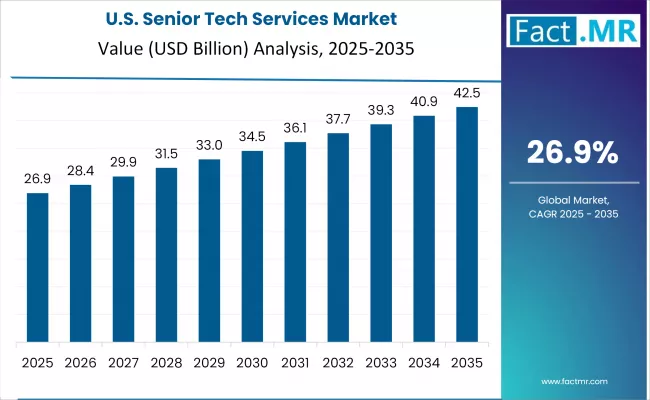
Senior Tech Services Market Country Value Analysis | Source: Fact.MR
The miniaturized and modular devices can easily be integrated in daily lives to enhance safety, independence and quality of life. The general direction is moving towards integrated, responsive eldercare systems integrating technology, health, and home automation, which support aging people in a proactive and personal way.
Smart eldercare and robotics drive Japan’s senior tech services market
The Japanese market in terms of senior tech services is rapidly expanding because of the ageing population and its need to have independent living. Robot assistants, wearable health gadgets, and AI-based surveillance systems are becoming widespread in homes and care homes to help people in their everyday tasks and enhance safety.
IoT-enabled smart home, assistive robotics, and predictive health technologies are all the topics of the research promoted by government initiatives and regional programs. Modular and miniaturized devices enable easy incorporation into the everyday life of the elderly, enabling them to be more mobile, communicative and medically supervised.
The market is automation and connectivity focused and focuses on the adaptive and technology-based solutions that fulfill the specific needs of the aging Japanese population that require independence and convenience and enhanced quality of life.
Connected and adaptive technologies transform elder care in Germany
The market of Germany senior tech services is fast growing with the country facing its increased aging population. At-Home technologies are becoming common in houses and community health centers to promote safety and autonomy through AI-enabled monitoring systems, wearable health technology, and smart homes. The government efforts encourage innovation of IoT based eldercare solutions, robotics and predictive health platforms.
Devices are user-friendly and modular, which allow easy inclusion to the daily routine, comforting mobility, communication and medical monitoring among the seniors. Market growth is being enhanced by growing digital literacy and the growth in the adoption of tech among older adults.
The general direction is on related, responsive and technology-solution-driven eldercare services to enhance the quality of life, facilitate independent living, and support the special requirements of the population of German elderly.
Category-Wise Analysis
Home care and assisted living services emerge as a leading segment in the senior tech services market
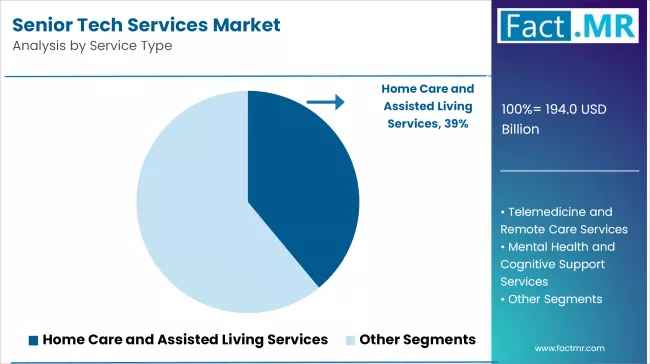
Senior Tech Services Market Analysis By Service Type | Source: Fact.MR
Home care and assisted living services are emerging as one of the most eminent in terms of senior tech service due to their ability to combine bespoke care along with technology-centered convenience. They tackle the major issues of aging populations including mobility, chronic diseases, medication compliance and social loneliness. It makes them especially attractive to the families that need support that can be trusted and to the elderly that want to keep their independence without losing the security.
The segment is also propelled by the increasing demand of the aging in place solutions wherein the elderly can be supported in their comfort zone with the help of integrated devices, remote monitoring, and telehealth.
Assistive Devices redefine independence in the senior tech services market
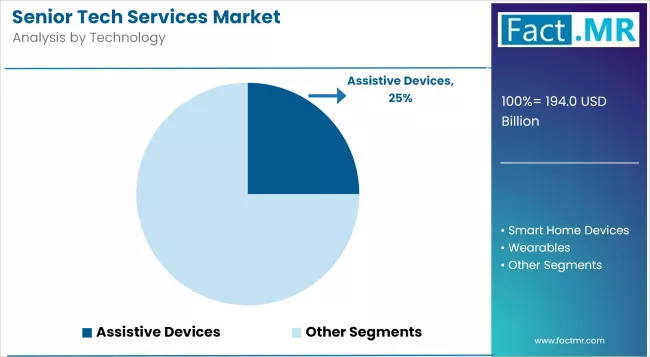
Senior Tech Services Market Analysis By Technology | Source: Fact.MR
Assisted living and home care are becoming one of the most outstanding in relation to senior tech service considering the possibility to integrate personalized care with technology-focused convenience. They address the key problems of aging such as mobility, chronic illnesses, adherence to medications and social loneliness. It predisposes them particularly to the families which require support that can be believed in and to the elderly who do not wish to lose the independence which the security offers them.
The segment is also driven by the growing need of the aging in place solutions whereby the elderly can be assisted in the comfort zone with the assistance of integrated devices, remote monitoring, and telehealth.
Independent seniors drive demand for autonomy-focused tech services
Independent seniors make one of the most dynamic user groups in the senior tech services market as they are keen on using tools that can expand their freedom and stay safe. The segment targets solutions that enable older adults to cope with their daily activities, health and social interactions with minimal dependency on care-givers. The desirability of the continuity of dignity, self-reliance, and lifestyle despite the arising age-related challenges is the root of the appeal.
This group has especially high levels of technology adoption when it comes to services including wearable health sensors, fall-detection devices, telehealth applications, and connected home assistants. These innovations do not have to position themselves as medical needs but as lifestyle additions, they provide convenience and assurance.
Subscription-Based models reshape accessibility in the senior tech services market
The sense of subscription-based models also increasingly, and becoming a leading business model in the market of senior tech services as its combination of affordability and continuity create a form of care enables it. They eliminate one of the greatest obstacles to seniors, which is the high initial cost, by providing flexibility in monthly or annual payments that provide stable access to the necessary services. It is a favorite among families operating with long-term care budgets and seniors who like certainty in spending.
It is convenient and personalized to be appealing. Elderly citizens are also able to subscribe to packages which encompass telehealth visits, wearable tracking, an emergency response system, or even digital literacy classes. These models are made affordable by bundled services, differentiated pricing and trial options and also promote the uptake of premium features by different income groups.
Competitive Analysis
The senior tech services market is also more competitive now and the players are looking at producing better service formats and integrated care solutions that enhance the whole user experience. The difference being offered by companies is in the form of holistic ecosystems of services offering home care support, assistive technologies, telehealth access, and digital engagement platforms. These holistic strategies improve the well-being of the seniors and also increase customer loyalty and expansive market coverage.
Businesses are adding new models to make a difference like personalized care subscription, AI tools in monitoring, and smart home integration. These strategies do not only deliver service quality improvement, but also meet the rising need of convenience, safety and independence in seniors.
In addition, firms are enhancing their visibility with partnerships with healthcare providers, insurance firms, and technology companies to enhance access and raise the adoption rates.
Key players in the senior tech services market are American Well, Ekso Bionics, Libify Technologies GmbH, Exordium Networks, GrandPad, Invacare Corporation, and others.
Recent Developments
- In August 2025, ONSCREEN, creator of Joy AI Companion for Seniors, announced that it is providing its soon-to-launch "Joy Calls" service for free to seniors in its home market.
- In August 2025, Vedaanta Senior Living, one of India’s most trusted and fast-growing senior living solution providers, has launched Vyom360, its proprietary in-house technology platform designed to enhance the quality of care.
Fact.MR has provided detailed information about the price points of key manufacturers of Senior Tech Services Market positioned across regions, sales growth, production capacity, and speculative technological expansion, in the recently published report.
Methodology and Industry Tracking Approach
The insights maintained in the Global Senior Tech Services Market Report 2025 are based on the survey conducted among more than 11,200 representatives of the interdependent industries of geriatric care, digital health applications, assistive technology, smart home solutions, telehealth platforms, insurance, regulatory compliance, and elder safety standards. The participants were healthcare executives, technology developers, senior care providers, insurance strategists, founding parties of start-ups, policy advisors and managers of retirement communities and assisted living facilities.
The study was conducted on the basis of the horizontal research design with structured questionnaires between the years October 2024 and August 2025. The methodology evaluated effectiveness, scalability and adoption of senior oriented technologies and services, with a special focus on integration with telemedicine platforms, AI-enabled health monitoring, secure data management, care-as-a-service model, and expansion of home care and assisted living ecosystems.
With Fact.MR monitoring consumer behavior, product efficacy, industry trends, and market opportunities since 2018, this report is becoming an authoritative source of information that stakeholders can rely on.
Segmentation
Segmentation of Senior Tech Services Market
-
By Service Type :
- Telemedicine and Remote Care Services
- Home Care and Assisted Living Services
- Mental Health and Cognitive Support Services
- Insurance and Financial Services
-
By Technology :
- Assistive Devices
- Wearables
- Robotics
- Smart Home Devices
- Communication Devices
-
By End-Users :
- Independent Seniors
- Assisted Living Residents
- Caregivers and Family Members
-
By Business Model :
- Subscription Based
- On-Demand Services
- B2B Partnerships
-
By Region :
- North America
- Latin America
- Western Europe
- Eastern Europe
- East Asia
- South Asia & Pacific
- Middle East & Africa
Frequently Asked Questions
What was the senior tech services market size reported by Fact.MR for 2025?
Who are the major players operating in the senior tech services market?
What is the estimated valuation of the senior tech services market in 2035?
What value CAGR did the senior tech services market exhibit over the last five years?
Who worked on this report


Preview the report firsthand - request a free sample
Free SampleGet the brochure for pricing and purchase details
Download PDF