- Base Value(2025): 41.6 Mn
- Forecast Value (2036): 57.8 Mn
- CAGR (2036): 3.4%
Silicone Radiopaque Vascular Ties Market Forecast and Outlook 2026 to 2036
In 2025, the global silicone radiopaque vascular ties market was valued at approximately USD 41.6 million. Based on Fact.MR analysis, demand for silicone radiopaque vascular ties is estimated to reach around USD 43.0 million in 2026 and expand to nearly USD 57.8 million by 2036, reflecting a CAGR of 3.4% during the forecast period. Market progression is closely tied to cardiovascular, neurosurgical, and complex general surgical procedures where vessel identification, temporary occlusion, and radiographic traceability are required.
The emphasis on leaving no residual foreign material aligns with evolving device philosophies, as highlighted by Tom Reidy, CEO and President of Ensite Vascular, who stated that“the concept was to develop, patent and obtain FDA market clearance of vascular closure devices that left absolutely nothing behind.” [1] Fact.MR analysis views this as indicative of broader surgical preference for atraumatic, removable, and imaging-compatible vascular control solutions.
The market is expected to add roughly USD 16.2 million in incremental value over the forecast window, reflecting steady compounding rather than rapid expansion. Early-period growth is supported by increasing cardiovascular and thoracic surgical volumes in emerging markets, while mid-period performance aligns with wider adoption of color-coded and radiopaque marking ties in neurosurgery and transplant procedures. In later years, value realization is shaped by tighter regulatory scrutiny, material standardization, and incremental innovation focused on handling precision and imaging clarity rather than unit volume growth.
China records the fastest growth at 4.6% CAGR, supported by rising surgical capacity and expansion of tertiary care hospitals. India follows at 4.3%, driven by growth in cardiovascular and general surgery procedures. Germany posts 3.9%, reflecting stable adoption in regulated hospital environments. Brazil grows at 3.6%, while the United States at 3.2% and the United Kingdom at 2.9% remain replacement-driven markets, constrained by mature surgical infrastructure and standardized procurement cycles.
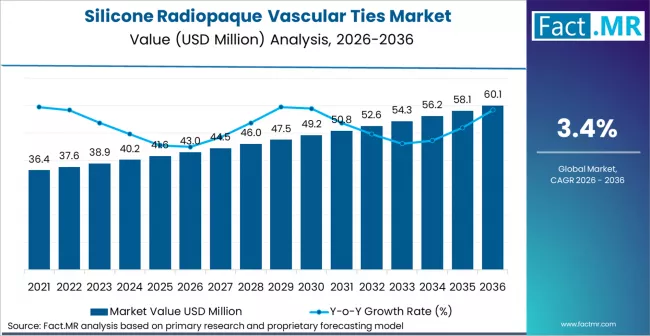
Silicone Radiopaque Vascular Ties Market Market Value Analysis | Source: Fact.MR
Silicone Radiopaque Vascular Ties Market
| Metric | Value |
|---|---|
| Market Value (2026) | USD 43.0 million |
| Forecast Value (2036) | USD 57.8 million |
| Forecast CAGR (2026-2036) | 3.4% |
Source: Fact.MR analysis. Updated Feb 26, 2026
Silicone Radiopaque Vascular Ties Market Definition
The silicone radiopaque vascular ties market covers implantable or intraoperative medical devices used to temporarily secure, identify, or occlude blood vessels during surgical procedures. These ties are manufactured from medical grade silicone and include radiopaque additives so they are visible under X ray or fluoroscopy. They are used in cardiovascular, general, and minimally invasive surgeries to aid vessel management and procedural accuracy. Device classification, material safety, and clinical use are regulated under medical device frameworks enforced by the US Food and Drug Administration and international health guidance bodies. [2]
Silicone Radiopaque Vascular Ties Market Inclusions
The report covers global and regional market size estimates in volume and value with a forecast from 2026 to 2036. Segmentation includes product form, size range, radiopacity level, and application across cardiovascular, general, and laparoscopic surgeries. End use coverage includes hospitals and surgical centers. Regional demand patterns and procurement trends for regulated surgical accessories are included.
Silicone Radiopaque Vascular Ties Market Exclusions
The scope excludes non radiopaque silicone ties, sutures, clips, staples, and permanent vascular implants. Catheters, guidewires, and other interventional devices are not included. Veterinary surgical products, research use only devices, prototype ties without regulatory clearance, and surgical services or procedure costs are outside the scope.
Silicone Radiopaque Vascular Ties Market Research Methodology
- Primary Research: Interviews were conducted with device manufacturers, surgeons, operating room staff, and hospital procurement teams.
- Desk Research: Regulatory classifications, safety notices, and device guidance issued by the US Food and Drug Administration and global medical device policy publications were reviewed.
- Market Sizing and Forecasting: Estimates were developed using surgical procedure volumes, device utilization rates, and hospital purchasing patterns.
- Data Validation and Update Cycle: Data was cross checked against regulatory approvals, hospital procurement disclosures, and manufacturer shipment information before updates were finalized.
Summary of Automotive Tappet Market
- Market definition
- The silicone radiopaque vascular ties market covers medical grade silicone ties with radiopaque properties used during surgical procedures to temporarily occlude, retract, or mark blood vessels under direct vision or imaging guidance.
- Demand drivers
- Rising cardiovascular, thoracic, and neurosurgical procedure volumes increase demand for vessel control tools that remain visible under fluoroscopy during complex operations.
- Hospital preference for removable and atraumatic surgical accessories supports use of silicone-based ties instead of permanent implants or metal clips.
- Regulatory focus on device traceability and material safety encourages procurement of FDA-cleared radiopaque ties that meet defined biocompatibility standards.
- Key Segments Analyzed
- Type: Occlusion ties account for the leading share, driven by routine use for temporary blood flow control during cardiovascular and thoracic surgeries.
- Application: Cardiovascular and thoracic surgery represents the largest application segment due to frequent vessel identification and retraction requirements.
- Geography: Asia Pacific shows the fastest growth, supported by expanding tertiary hospital infrastructure and increasing adoption of imaging-assisted surgery.
- Analyst opinion at Fact.MR
- Shambhu Nath Jha, Principal Consultant at Fact.MR, opines, ‘CXOs will find this report useful for understanding how radiopacity standards, material compliance, and surgeon handling preferences shape procurement decisions for vascular control accessories in regulated surgical environments.’
- Strategic implications / executive takeaways
- Manufacturers should prioritize consistent radiopacity performance and material documentation to align with hospital procurement criteria.
- Product portfolios should focus on occlusion and marking ties compatible with minimally invasive and image-guided procedures.
- Regional expansion strategies should align with hospital capacity growth in Asia Pacific rather than mature replacement-led markets.
- Methodology
- Market sizing is based on surgical procedure volumes, device utilization rates, and hospital purchasing behavior.
- Regulatory assumptions and device classification references were validated.
Segmental Analysis
Silicone Radiopaque Vascular Ties Market Analysis by Type
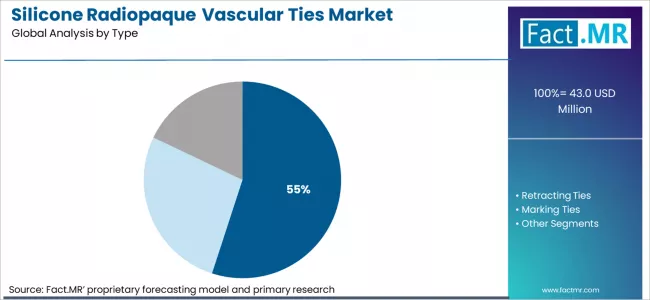
Silicone Radiopaque Vascular Ties Market Analysis By Type | Source: Fact.MR
Based on Fact.MR analysis, consumption of occlusion silicone radiopaque vascular ties is estimated to hold 55% share of the global silicone radiopaque vascular ties market. Fact.MR analysts note occlusion ties lead due to controlled vessel management, radiographic visibility, and compatibility with minimally invasive techniques. As per Fact.MR, this type addresses surgeon requirements for temporary vessel control, clear intraoperative identification under fluoroscopy, and atraumatic handling during complex cardiovascular and thoracic procedures performed in high acuity surgical settings worldwide today supporting repeatable outcomes and procedural efficiency across advanced hospital operating rooms globally.
- Device regulation: Vascular occlusion and retraction devices are regulated as surgical medical devices. [3]
- Imaging compatibility: Fact.MR analysts note radiopaque materials support visibility during image-guided surgery.
- Procedure control: Occlusion ties assist in temporary blood flow management.
Silicone Radiopaque Vascular Ties Market Analysis by Application
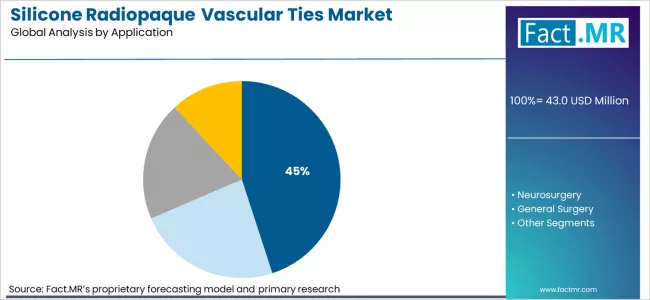
Silicone Radiopaque Vascular Ties Market Analysis By Application | Source: Fact.MR
Based on Fact.MR analysis, consumption of silicone radiopaque vascular ties in cardiovascular and thoracic surgery is estimated to hold 45% share of the global market. Fact.MR analysts note this application leads due to frequent need for vessel identification, retraction, and temporary occlusion during cardiac and thoracic procedures. As per Fact.MR, these applications address surgical requirements for precision, intraoperative visibility, and tissue protection during bypass grafting, valve repair, and aneurysm procedures conducted in specialized operating environments worldwide today supporting complex interventions and repeat imaging guidance across advanced cardiovascular care centers globally.
- Clinical oversight: Cardiovascular surgical procedures follow regulated clinical practice and device usage standards.
Procedure volume: Fact.MR analysts note cardiac surgeries generate consistent demand for vascular control tools. - Imaging reliance: Radiopaque ties support fluoroscopic and hybrid operating room workflows.
Silicone Radiopaque Vascular Ties Market Drivers, Restraints, And Opportunities
Fact.MR analysis indicates that the silicone radiopaque vascular ties market exists as a specialised medical device segment within interventional and surgical procedures where controlled vessel ligation, positioning, or identification is required. As per Fact.MR assessment, silicone radiopaque vascular ties are devices used to secure, retract, or mark blood vessels and soft tissue during surgical procedures, and their clinical use and safety profile are shaped by regulatory device classification and approval frameworks such as those governed by the U.S. Food and Drug Administration (FDA) for surgical accessories and implantable devices, which define requirements for design controls, material safety, and performance validation. Fact.MR analysts observe that the current market size is influenced by surgical procedure volumes, hospital adoption of advanced surgical accessories, and demand for radiopaque identification where fluoroscopic visualisation supports intraoperative workflows.
Fact.MR is of the opinion that current market dynamics reflect a transition toward multifunctional and performance-enhanced vascular ties that integrate improved material characteristics, radiopacity markers, and ease of deployment in minimally invasive surgical environments. Based on Fact.MR assessment, conventional non-radiopaque ties and sutures remain widely used because of lower cost and broad applicability, but demand grows in segments where radiopaque marking, secure soft tissue retraction, and compatibility with imaging workflows are specified. Advanced silicone radiopaque vascular ties typically carry higher per-unit pricing because of material technology, manufacturing controls, and regulatory validation requirements, meaning realised market value can increase even where shipment volume growth is moderate. Fact.MR analysis suggests that this combination of technological evolution and premium value placement will shape near-term market progression.
- Medical device regulatory frameworks: Fact.MR analysts note that compliance with U.S. FDA medical device requirements influences design, testing, and market entry planning for silicone radiopaque vascular ties intended for surgical use.
- Shift to performance-enhanced surgical accessories: Based on Fact.MR assessment, increasing adoption of radiopaque and advanced material surgical ties supports demand in minimally invasive, fluoroscopy-linked procedures where visualisation and secure retention matter.
- Asia Pacific surgical procedure growth: Fact.MR opines that expansion of hospital infrastructure, interventional surgery adoption, and investment in fluoroscopy-equipped operating rooms in China, India, and Southeast Asia support regional uptake of silicone radiopaque vascular ties across clinical applications.
Regional Analysis
Based on regional assessment, the silicone radiopaque vascular ties sector is analyzed across North America, Europe, East Asia, South Asia, and Latin America, spanning more than 40 countries. Regional performance varies according to surgical procedure volumes, adoption of advanced vascular devices, hospital infrastructure development, and regulatory standards governing implantable and disposable medical products.
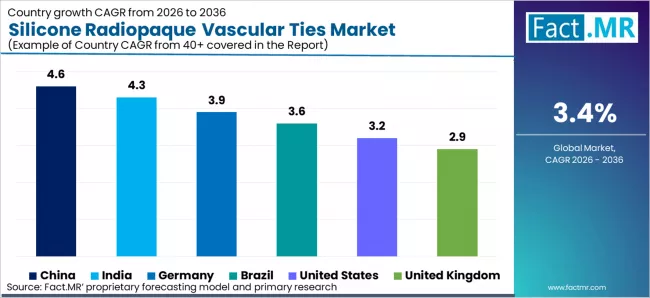
Silicone Radiopaque Vascular Ties Market Cagr Analysis By Country | Source: Fact.MR
| Country | CAGR |
|---|---|
| China | 4.6% |
| India | 4.3% |
| Germany | 3.9% |
| Brazil | 3.6% |
| United States | 3.2% |
| United Kingdom | 2.9% |
Source: Fact.MR analysis. Updated Feb 26, 2026
Source: Fact.MR analysis, based on proprietary forecasting models and primary research.
Outlook On Silicone Radiopaque Vascular Ties Demand in Asia Pacific
Asia Pacific shows measured demand for silicone radiopaque vascular ties supported by rising surgical volumes expansion of interventional procedures and hospital procurement. Usage reflects need for vessel identification secure ligation and visibility under imaging during procedures. China and India anchor regional consumption through tertiary hospitals and cardiac centers. Procurement emphasizes sterility traceability and compatibility with imaging systems. Growth remains steady reflecting replacement demand training adoption and incremental expansion of minimally invasive surgeries across public and private hospitals regionwide annually nationwide.
- China: Demand for silicone radiopaque vascular ties in China is projected to rise at 4.6% CAGR through 2036. Usage reflects expansion of interventional procedures and procurement by tertiary hospitals, as per Fact.MR.
- India: Demand for silicone radiopaque vascular ties in India is projected to rise at 4.3% CAGR through 2036. Adoption is supported by growing surgical volumes and hospital infrastructure development, according to Fact.MR.
Fact.MR’s analysis of the Silicone Radiopaque Vascular Ties Market in Asia Pacific consists of country-wise assessment that includes China and India. Readers can find surgical volume and hospital procurement insights.
Analysis On Silicone Radiopaque Vascular Ties Sales in Europe
Europe reflects regulated demand for silicone radiopaque vascular ties shaped by standardized surgical protocols reimbursement frameworks and device conformity requirements. Usage concentrates in operating theaters where imaging guided procedures require reliable vessel control. Germany and the United Kingdom contribute through hospital networks and specialized surgical centers. Procurement favors CE marked devices consistent sizing and documentation. Growth is gradual reflecting replacement cycles procedural volumes and compliance driven purchasing within public health systems and private clinics across Western Europe regionwide annually today.
- Germany: Demand for silicone radiopaque vascular ties in Germany is projected to rise at 3.9% CAGR through 2036. Usage reflects standardized surgical protocols and hospital based procurement, as per Fact.MR.
- United Kingdom: Demand for silicone radiopaque vascular ties in the United Kingdom is projected to rise at 2.9% CAGR through 2036. Adoption reflects steady surgical volumes within public healthcare facilities, according to Fact.MR.
Fact.MR’s analysis of the Silicone Radiopaque Vascular Ties Market in Europe consists of country-wise assessment that includes Germany and the United Kingdom. Readers can find regulatory and procurement insights.
Demand for Silicone Radiopaque Vascular Ties in North America
North America demonstrates stable demand for silicone radiopaque vascular ties supported by established surgical infrastructure and steady procedure volumes. Usage is linked to cardiovascular general and interventional surgeries requiring imaging visibility. The United States anchors regional consumption through hospitals and ambulatory surgery centers. Procurement emphasizes FDA clearance material consistency and supply reliability. Growth remains moderate reflecting replacement demand procedural mix stability and ongoing use within standardized operating room protocols nationwide across public and private care settings annually today regionwide broadly.
- United States: Demand for silicone radiopaque vascular ties in the United States is projected to rise at 3.2% CAGR through 2036. Usage reflects routine adoption across cardiovascular and general surgical procedures, as per Fact.MR.
Fact.MR’s analysis of the Silicone Radiopaque Vascular Ties Market in North America consists of country-wise assessment that includes the United States. Readers can find surgical procedure and procurement references.
Outlook On Silicone Radiopaque Vascular Ties Adoption In Latin America
Latin America shows emerging demand for silicone radiopaque vascular ties driven by gradual expansion of surgical services and hospital modernization. Usage centers on basic cardiovascular and general surgery procedures with imaging support. Brazil anchors regional consumption through tertiary hospitals and private clinics. Procurement remains price sensitive with reliance on imports. Growth is incremental reflecting procedure growth training uptake and replacement demand within urban healthcare facilities across major metropolitan areas regionwide annually today including public and private providers broadly nationwide systems.
- Brazil: Demand for silicone radiopaque vascular ties in Brazil is projected to rise at 3.6% CAGR through 2036. Adoption reflects gradual expansion of surgical capacity and hospital modernization, according to Fact.MR.
Fact.MR’s analysis of the Silicone Radiopaque Vascular Ties Market in Latin America consists of country-wise assessment that includes Brazil. Readers can find surgical capacity and hospital upgrade insights.
Competitive Landscape for Market Players
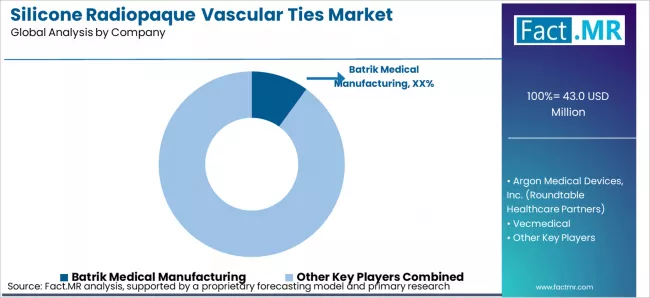
Silicone Radiopaque Vascular Ties Market Analysis By Company | Source: Fact.MR
As per Fact.MR analysis, the 2026 silicone radiopaque vascular ties market is defined by validated biocompatibility, radiopacity performance, and regulatory compliance, which determine competitive advantage. Batrik Medical Manufacturing and Argon Medical Devices, Inc. lead with high-precision, clinically validated ties that maintain visibility under fluoroscopy, which strengthens adoption in surgical and interventional procedures. Vecmedical and BOENMED focus on sterilized, high-durability materials with documented tensile strength, which improves procedural safety and reduces breakage risk. Surtex Instruments Ltd. and Medline Industries provide multi-length and multi-diameter options with verified performance, which enhances compatibility across diverse vascular applications.
B. Braun Melsungen AG and Teleflex Incorporated offer validated supply chain reliability and multi-region regulatory approvals, which supports hospital and surgical center adoption. Medtronic plc, Johnson & Johnson (Ethicon), and Stryker Corporation emphasize high-volume production with quality assurance, which ensures consistency for large-scale clinical programs. Boston Scientific, Terumo Corporation, Cardinal Health, Owens & Minor, Molnlycke Health Care, Zimmer Biomet, Smith & Nephew, Conmed, and Integra LifeSciences deliver validated performance in specialty procedures, which expands adoption in niche surgical segments. Across the market, validated material performance, radiopacity, and regulatory adherence form enduring competitive moats, reducing reliance on pricing or isolated product claims.
Recent Industry Development
- In July 2025, Teleflex completed its €760 million acquisition of BIOTRONIK’s Vascular Intervention business, expanding its coronary and peripheral portfolio and strengthening its global presence in the fast-growing cath lab market [4].
- In January 2025, Argon Medical acquired the SeQure and DraKon microcatheters from Guerbet, expanding its oncology portfolio into therapeutic delivery and strengthening its interventional radiology and vascular procedure offerings [5].
Key Players in Silicone Radiopaque Vascular Ties Market
- Batrik Medical Manufacturing
- Argon Medical Devices, Inc. (Roundtable Healthcare Partners)
- Vecmedical
- BOENMED
- Surtex Instruments Ltd.
- Medline Industries, LP
- B. Braun Melsungen AG
- Teleflex Incorporated
- Medtronic plc
- Johnson & Johnson (Ethicon)
- Stryker Corporation
- Boston Scientific Corporation
- Terumo Corporation
- Cardinal Health, Inc.
- Owens & Minor, Inc.
- Molnlycke Health Care AB
- Zimmer Biomet Holdings, Inc.
- Smith & Nephew plc
- Conmed Corporation
- Integra LifeSciences Holdings Corporation
Bibliography
- [1] Ensite Vascular, Inc. (2023). Vascular closure innovation and device design philosophy: Executive commentary by Tom Reidy, President and CEO. Ensite Vascular, Inc.
- [2] U.S. Food and Drug Administration. (2024). Medical devices: Regulatory overview and device classification. U.S. Department of Health and Human Services; World Health Organization. (2024). Medical devices: Health technology and safety guidance. World Health Organization.
- [3] U.S. Food and Drug Administration. (2024). Vascular occlusion devices: Regulatory requirements and clinical considerations. U.S. Department of Health and Human Services.
- [4] Teleflex Incorporated. (2025). Teleflex completes acquisition of BIOTRONIK’s vascular intervention business [Press release]. Teleflex Incorporated.
- [5] Argon Medical Devices, Inc. (2025). Argon Medical acquires SeQure and DraKon microcatheter portfolios from Guerbet [Corporate announcement]. Argon Medical Devices, Inc.
This Report Addresses
- Market intelligence to support strategic decision-making in the global silicone radiopaque vascular ties market, where procedural safety, intraoperative visibility, and material compliance shape purchasing behavior more than surgical volume growth alone
- Global market size assessment and 10-year revenue forecasts from 2026 to 2036, derived from surgical procedure volumes, device utilization rates, and hospital procurement patterns across regulated healthcare systems
- Growth opportunity mapping across vascular tie types including occlusion ties, retracting ties, and marking ties, highlighting differentiated demand linked to vessel control, identification, and imaging compatibility requirements
- Application-level analysis across cardiovascular and thoracic surgery, neurosurgery, general surgery, and other specialty procedures, connecting product usage to clinical precision, radiographic traceability, and atraumatic handling needs
- Competitive landscape assessment benchmarking manufacturers on biocompatibility, radiopacity performance, product consistency, regulatory approvals, and supply reliability in hospital and surgical center settings
- Technology and product roadmap tracking covering advances in radiopaque additives, color coding, handling ergonomics, and material standardization that improve intraoperative efficiency and imaging clarity
- Regulatory and compliance impact analysis addressing medical device classification, material safety, sterilization standards, and approval frameworks influencing product design and market access
- Regional and country-level growth analysis across Asia Pacific, Europe, North America, and Latin America, highlighting faster growth in China and India versus replacement-driven demand in mature Western markets
- Strategic implications for device manufacturers and hospital procurement teams focused on balancing premium performance features with standardized purchasing protocols and cost containment pressures
- Multi-format market report delivery in PDF, Excel datasets, PPT presentations, and interactive dashboards to support executives, clinical procurement leaders, product managers, and regulatory strategy teams
Segmentation
Scope of the Report
| Metric | Value |
|---|---|
| Quantitative Units | USD 43.0 million (2026) to USD 57.8 million (2036), CAGR 3.4% |
| Market Definition | The silicone radiopaque vascular ties market covers intraoperative or implantable devices used to temporarily secure, retract, or mark blood vessels during surgical procedures. Manufactured from medical-grade silicone with radiopaque additives, these ties ensure intraoperative visibility under X-ray or fluoroscopy. They are deployed in cardiovascular, thoracic, neurosurgical, and general surgeries to improve procedural accuracy and reduce residual foreign material. Device design, material compliance, and clinical safety follow regulatory frameworks enforced by the US FDA and international medical device authorities. |
| Type Segmentation | Occlusion Ties (Standard, Adjustable), Retracting Ties (Vessel Retraction Loops, Nerve Retraction Ties), Marking Ties (Radiopaque Markers, Color-Coded Marking Ties) |
| Application Segmentation | Cardiovascular & Thoracic Surgery (CABG, Valve Replacement/Repair, Aneurysm Repair, Congenital Heart Defects), Neurosurgery (Cerebrovascular Procedures, Tumor Resection, Aneurysm Clipping), General Surgery (Abdominal Surgery, Vascular Access, Organ Transplantation), Others (Urological, Gynecological, Orthopedic Surgery) |
| Regions Covered | Asia Pacific, Europe, North America, Latin America, Middle East & Africa |
| Countries Covered | China, India, Japan, South Korea, Indonesia, Australia & New Zealand, Germany, Italy, France, United Kingdom, Spain, Benelux, Nordics, Central & Eastern Europe, United States, Canada, Mexico, Brazil, Argentina, Chile, Kingdom of Saudi Arabia, United Arab Emirates, South Africa, Turkey |
| Key Companies Profiled | Batrik Medical Manufacturing, Argon Medical Devices, Vecmedical, BOENMED, Surtex Instruments Ltd., Medline Industries, B. Braun Melsungen AG, Teleflex Incorporated, Medtronic plc, Johnson & Johnson (Ethicon), Stryker Corporation, Boston Scientific Corporation, Terumo Corporation, Cardinal Health, Owens & Minor, Molnlycke Health Care, Zimmer Biomet, Smith & Nephew, Conmed, Integra LifeSciences |
| Forecast Period | 2026 to 2036 |
| Approach | Market sizing and forecasting based on surgical procedure volumes, device adoption rates, hospital procurement patterns, and regulatory clearance requirements. Data validated via interviews with manufacturers, surgeons, and hospital procurement staff, combined with FDA and international medical device guidance. |
Source: Fact.MR analysis. Updated Feb 26, 2026
Silicone Radiopaque Vascular Ties Market Analysis by Segments
-
Type:
- Occlusion Ties
- Standard Occlusion Ties
- Adjustable Occlusion Ties
- Retracting Ties
- Vessel Retraction Loops
- Nerve Retraction Ties
- Marking Ties
- Radiopaque Markers
- Color-Coded Marking Ties
- Occlusion Ties
-
Application:
- Cardiovascular & Thoracic Surgery
- Coronary Artery Bypass Grafting
- Valve Replacement/Repair
- Aneurysm Repair
- Congenital Heart Defect Correction
- Neurosurgery
- Cerebrovascular Procedures
- Tumor Resection
- Aneurysm Clipping
- General Surgery
- Abdominal Surgery
- Vascular Access
- Organ Transplantation
- Others
- Urological Surgery
- Gynecological Surgery
- Orthopedic Surgery
- Cardiovascular & Thoracic Surgery
-
Region
- Asia Pacific
- India
- China
- Japan
- South Korea
- Indonesia
- Australia & New Zealand
- ASEAN
- Rest of Asia Pacific
- Europe
- Germany
- Italy
- France
- United Kingdom
- Spain
- Benelux
- Nordics
- Central & Eastern Europe
- Rest of Europe
- North America
- United States
- Canada
- Mexico
- Latin America
- Brazil
- Argentina
- Chile
- Rest of Latin America
- Middle East & Africa
- Kingdom of Saudi Arabia
- United Arab Emirates
- South Africa
- Turkey
- Rest of Middle East & Africa
- Asia Pacific
Frequently Asked Questions
How large is the silicone radiopaque vascular ties market in 2026?
What will the market size be for silicone radiopaque vascular ties by 2036?
What is the expected CAGR of the silicone radiopaque vascular ties market?
How much incremental value is expected to be added over the forecast period?
What factors primarily govern purchasing decisions in this market?
Which type of silicone radiopaque vascular ties leads the market?
Why are occlusion ties preferred in surgical procedures?
Which application accounts for the largest share of demand?
Why does cardiovascular and thoracic surgery dominate usage?
What is supporting early-period market growth?
What trends influence mid-period market performance?
What shapes market value realization in the later years of the forecast?
Which country is projected to grow the fastest in this market?
What is the growth outlook for India in this market?
How does Germany perform in terms of market growth?
What is Brazil’s projected growth rate for silicone radiopaque vascular ties?
How fast is the market growing in the United States?
What is the growth outlook for the United Kingdom?
What limits rapid expansion of the silicone radiopaque vascular ties market?
What is the long-term outlook for the silicone radiopaque vascular ties market?
Who worked on this report


Preview the report firsthand - request a free sample
Free SampleGet the brochure for pricing and purchase details
Download PDF