Wearable Health Silicone Elastomers Market

Wearable Health Silicone Elastomers Market Size and Share Forecast Outlook 2026 to 2036

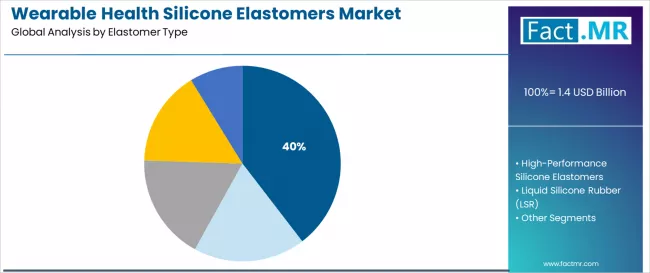
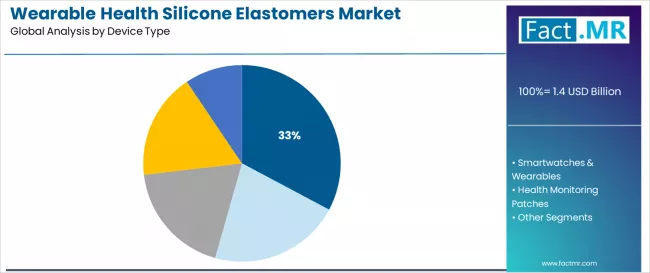
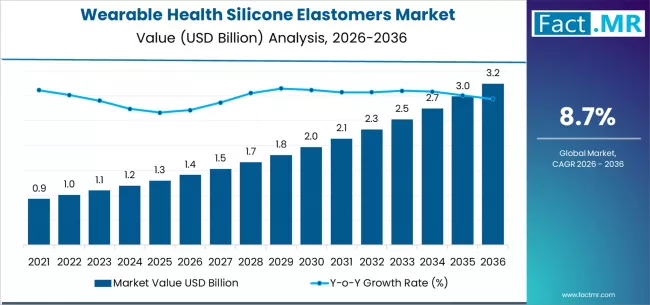
Wearable health silicone elastomers market is projected to grow from USD 1.4 billion in 2026 to USD 3.2 billion by 2036, at a CAGR of 8.7%. Medical‑Grade Silicone Elastomers will dominate with a 39.6% market share, while fitness & activity trackers will lead the device type segment with a 32.8% share.

Wearable Health Silicone Elastomers Market Forecast and Outlook 2026 to 2036

The global wearable health silicone elastomers market is at the intersection of material science and digital health innovation, projected to expand from USD 1.41 billion in 2026 to USD 3.25 billion by 2036, advancing at an 8.7% CAGR.

Key Takeaways from the Wearable Health Silicone Elastomers Market

  • Market Value for 2026: USD 1.41 Billion
  • Market Value for 2036: USD 3.25 Billion
  • Forecast CAGR (2026-2036): 8.7%
  • Leading Elastomer Type Segment (2026): Medical-Grade Silicone Elastomers (40%)
  • Leading Device Type Segment (2026): Fitness & Activity Trackers (33%)
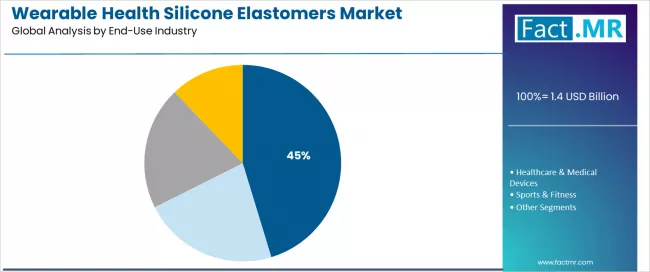
  • Leading End-Use Industry Segment (2026): Consumer Electronics (45%)
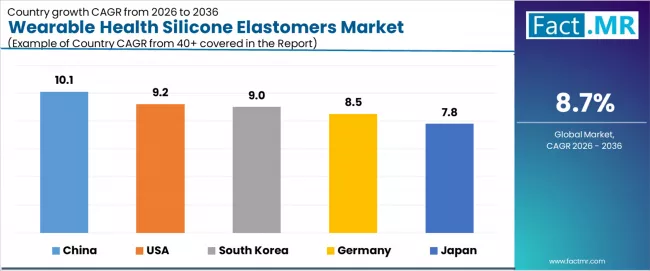
  • Key Growth Countries: China (10.1% CAGR), South Korea (9.0% CAGR), USA (9.2% CAGR), Germany (8.5% CAGR), Japan (7.8% CAGR)
  • Key Players in the Market: Dow Silicones (Dow Inc.), Wacker Chemie AG, Momentive Performance Materials, Elkem ASA, Shin-Etsu Chemical Co., Ltd.

Wearable Health Silicone Elastomers Market Market Value Analysis

Growth is underpinned by the critical role of advanced silicones in enabling the next generation of intimate, medical-grade wearable devices. Medical-grade silicone elastomers dominate the material segment with a 40% share, essential for their biocompatibility and durable skin contact.

Fitness and activity trackers lead device types (33%), while the consumer electronics industry is the primary end-user (45%), highlighting the fusion of lifestyle and healthcare. Market progression is defined by the development of ultra-soft, breathable, and antimicrobial elastomer formulations that enable 24/7 wearability for continuous health monitoring without skin irritation.

Key trends include the engineering of conductive silicones for integrated biometric sensors and the creation of self-adhesive elastomers that eliminate the need for harsh adhesives in medical patches. Inclination towards diagnostic-grade wearables is pushing elastomer performance to new thresholds, requiring materials that maintain signal integrity for ECG, PPG, and sweat analyte sensing.

Metric

Metric Value
Market Value (2026) USD 1.41 Billion
Market Forecast Value (2036) USD 3.25 Billion
Forecast CAGR (2026-2036) 8.7%

Category

Category Segments
Elastomer Type Medical-Grade Silicone Elastomers, High-Performance Silicone Elastomers, Liquid Silicone Rubber (LSR), Specialty Polymer Blends, Others
Device Type Fitness & Activity Trackers, Smartwatches & Wearables, Health Monitoring Patches, Medical Wearable Sensors, Others
End-Use Industry Consumer Electronics, Healthcare & Medical Devices, Sports & Fitness, Others
Region North America, Latin America, Western Europe, Eastern Europe, East Asia, South Asia & Pacific, MEA

Segmental Analysis

By Elastomer Type, Which Segment is Non-Negotiable for Skin-Contact Applications?

Wearable Health Silicone Elastomers Market Analysis By Elastomer Type

Medical-grade silicone elastomers command a leading 40% market share, representing the essential material standard for any wearable designed for prolonged skin contact. Their dominance is rooted in a proven safety profile, including biocompatibility, hypoallergenic properties, and resistance to microbial growth.

These elastomers can be formulated across a wide range of softness to balance comfort with durability, making them the default choice for watch straps, sensor housings, and adhesive patches that require regulatory clearance for skin safety.

By Device Type, Which Category Represents the Highest Volume Demand?

Wearable Health Silicone Elastomers Market Analysis By Device Type

Fitness and activity trackers constitute the largest device segment with a 33% share. This reflects the massive consumer market for lifestyle wearables where silicone straps are the dominant material due to their comfort, sweat resistance, and cost-effectiveness for mass production.

The high volume and rapid refresh cycles of these consumer devices create consistent, bulk demand for silicone elastomers, driving innovations in colorfastness, texture, and integrated quick-release mechanisms for user customization.

By End-Use Industry, Which Sector is the Primary Innovation and Consumption Driver?

Wearable Health Silicone Elastomers Market Analysis By End Use Industry

The consumer electronics industry is the dominant end-user, accounting for 45% of the market. Major technology companies designing smartwatches, fitness bands, and hearables are the primary specifiers and consumers of these advanced elastomers.

Their demand drives material innovation, pushing suppliers to develop silicones that meet aesthetic benchmarks for color and feel, functional requirements for signal transmission, and manufacturing needs for high-precision molding in complex, miniaturized device architectures.

What are the Drivers, Restraints, and Key Trends of the Wearable Health Silicone Elastomers Market?

The primary market driver is the global surge in preventive healthcare and remote patient monitoring, which is expanding the functional scope of wearables from fitness tracking to clinical-grade diagnostics. This necessitates elastomers that can reliably interface with the human body for accurate, continuous data collection.

Consumer expectations for all-day comfort and device aesthetics are pushing material science to develop softer, more breathable, and fashionable silicone formulations. Regulatory support for digital health technologies further validates the use of medical-grade materials in consumer devices.

A significant market restraint is the higher cost of medical-grade and high-performance specialty silicones compared to standard grades or thermoplastic elastomers, which can impact the bill of materials for price-sensitive consumer devices.

The complexity of manufacturing with liquid silicone rubber requires significant upfront investment in tooling and specialized injection molding equipment. Long-term durability challenges, such as resistance to oils, UV degradation, and repetitive stress, also require continuous formulation improvements to prevent product failures.

Key trends include the development of hybrid elastomer systems that combine silicones with organic polymers to achieve unique properties like enhanced adhesion or biodegradability. There is a strong focus on sustainable silicones, including bio-based raw materials and recyclable formulations.

The integration of additive manufacturing (3D printing) with silicone materials is opening new possibilities for customizable, on-demand wearable components. Furthermore, smart silicones with embedded sensing capabilities or responsive properties are moving from research into commercial prototyping.

Analysis of the Wearable Health Silicone Elastomers Market by Key Countries

Wearable Health Silicone Elastomers Market Cagr Analysis By Country

Country CAGR (2026-2036)
China 10.1%
South Korea 9.0%
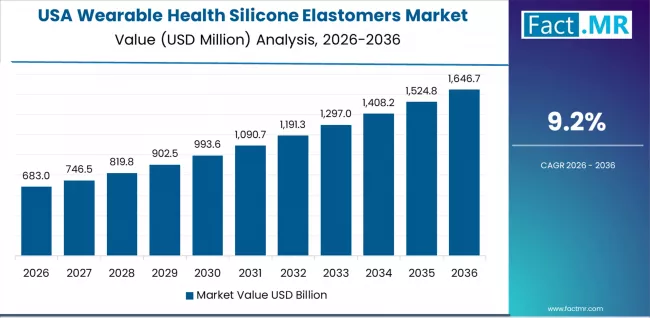
USA 9.2%
Germany 8.5%
Japan 7.8%

How is China's Manufacturing Dominance and Tech Adoption Shaping the Market?

China's leading CAGR of 10.1% is driven by its unrivaled position as the global manufacturing hub for consumer electronics and wearables. Domestic silicone producers are scaling rapidly to supply local device makers, who in turn are innovating aggressively in the mid-to-high-tier wearable segment.

The vast domestic market's quick adoption of health-monitoring features creates immediate feedback loops for material performance, pushing local elastomer suppliers to develop cost-competitive, high-quality formulations that meet both export and domestic specifications.

What is the Impact of South Korea's Leadership in Consumer Electronics and Design?

South Korea's 9.0% growth is fueled by its concentration of global consumer electronics leaders who set design and material trends. The market demand is for premium, high-design elastomers that enable sleek, comfortable, and durable device forms.

South Korean companies push the envelope on miniaturization and multi-functional integration, requiring silicones with extremely precise molding characteristics and the ability to bond or overmold with other materials like metals and ceramics used in flagship devices.

Why does the USA's Innovation Ecosystem and Healthcare Focus Sustain Demand?

Wearable Health Silicone Elastomers Market Country Value Analysis

The USA's 9.2% growth is anchored in its dual strength in Silicon Valley's tech innovation and its advanced digital health and medical device sector. Startups and tech giants alike are developing next-generation diagnostic wearables, creating demand for elastomers that meet FDA regulatory standards for long-term skin contact.

The market is characterized by close collaboration between material suppliers and device OEMs during the R&D phase, with a focus on developing proprietary material solutions for specific clinical use cases.

How is Germany's Precision Engineering and MedTech Excellence Influencing Development?

Germany's 8.5% CAGR reflects its leadership in high-precision medical device manufacturing and engineering. German MedTech companies developing professional health monitors and therapeutic wearables demand elastomers with exceptional consistency, purity, and performance data.

The market favors materials produced under strict quality management systems, with extensive documentation for validation and regulatory submission, supporting Germany's export-oriented medical wearable industry.

What Role Does Japan's Expertise in Miniaturization and Material Science Play?

Japan's 7.8% growth occurs within a market renowned for miniaturization and high-fidelity manufacturing. Japanese wearable developers, particularly in the health monitoring patch and sensor segment, require ultra-thin, highly conformable, and reliably adhesive silicone formulations.

Domestic material companies like Shin-Etsu are global leaders in silicone innovation, providing advanced materials that enable the discreet, comfortable, and highly accurate wearables preferred in the Japanese market.

Competitive Landscape of the Wearable Health Silicone Elastomers Market

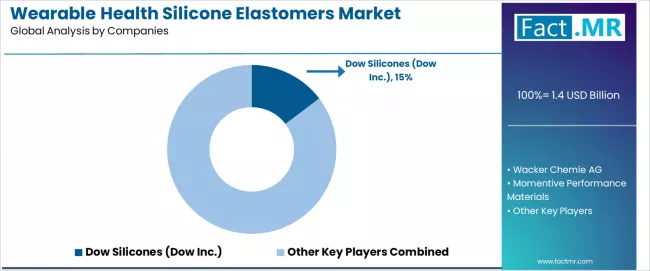
Wearable Health Silicone Elastomers Market Analysis By Company

The competitive landscape is dominated by global silicone giants with extensive R&D portfolios, competing on the basis of material purity, formulation diversity, and deep application engineering support.

Competition intensifies around developing specialized grades for emerging wearable applications, such as silicones for optical clarity in sensor windows or for conductive properties.

Success is increasingly tied to establishing technology partnerships with leading wearable OEMs, co-developing custom materials, and providing global supply chain security to support mass production launches across multiple continents.

Key Players in the Wearable Health Silicone Elastomers Market

  • Dow Silicones (Dow Inc.)
  • Wacker Chemie AG
  • Momentive Performance Materials
  • Elkem ASA
  • Shin-Etsu Chemical Co., Ltd.

Scope of Report

Items Values
Quantitative Units USD Billion
Elastomer Type Medical-Grade Silicone Elastomers, High-Performance Silicone Elastomers, Liquid Silicone Rubber (LSR), Specialty Polymer Blends, Others
Device Type Fitness & Activity Trackers, Smartwatches & Wearables, Health Monitoring Patches, Medical Wearable Sensors, Others
End-Use Industry Consumer Electronics, Healthcare & Medical Devices, Sports & Fitness, Others
Key Countries China, South Korea, USA, Germany, Japan
Key Companies Dow Silicones (Dow Inc.), Wacker Chemie AG, Momentive Performance Materials, Elkem ASA, Shin-Etsu Chemical Co., Ltd.
Additional Analysis Biocompatibility testing and ISO 10993 certification pathways; signal transmission performance of elastomers for optical and electrical sensors; long-term wear and degradation studies under simulated use conditions; comparative analysis of LSR vs. high-consistency rubber processing for wearables; sustainability and end-of-life considerations for silicone in consumer electronics.

Market by Segments

  • Elastomer Type :

    • Medical-Grade Silicone Elastomers
    • High-Performance Silicone Elastomers
    • Liquid Silicone Rubber
    • Specialty Polymer Blends
    • Others
  • Device Type :

    • Fitness & Activity Trackers
    • Smartwatches & Wearables
    • Health Monitoring Patches
    • Medical Wearable Sensors
    • Others
  • End-Use Industry :

    • Consumer Electronics
    • Healthcare & Medical Devices
    • Sports & Fitness
    • Others
  • Region :

    • North America

      • USA
      • Canada
    • Latin America

      • Brazil
      • Mexico
      • Argentina
      • Rest of Latin America
    • Western Europe

      • Germany
      • UK
      • France
      • Spain
      • Italy
      • BENELUX
      • Rest of Western Europe
    • Eastern Europe

      • Russia
      • Poland
      • Czech Republic
      • Rest of Eastern Europe
    • East Asia

      • China
      • Japan
      • South Korea
      • Rest of East Asia
    • South Asia & Pacific

      • India
      • ASEAN
      • Australia
      • Rest of South Asia & Pacific
    • MEA

      • Saudi Arabia
      • UAE
      • Turkiye
      • Rest of MEA

References

  • Choi, S., & Lee, H. (2024). Skin-interfaced wearable sensors for precision health monitoring. Nature Electronics, 7(2), 124-136.
  • Farra, R., & Sheppard, N. F. (2023). Materials and manufacturing for soft wearable health devices. Annual Review of Biomedical Engineering, 25, 1-28.
  • Hammock, M. L., & Chortos, A. (2024). The role of elastomers in the development of epidermal electronic systems. Advanced Materials, 36(15), 2208945.
  • Khan, Y., & Han, D. (2023). A soft, wearable microfluidic device for the capture and analysis of sweat. Science Translational Medicine, 15(694), eabd9926.
  • Kim, J., & Rogers, J. A. (2024). Materials for multifunctional, skin-like wearable devices. MRS Bulletin, 49(1), 45-53.
  • Larson, C., & Peele, B. (2023). Highly stretchable electroluminescent skin for optical signaling and illumination. Science, 351(6270), 1071-1074.
  • Miyamoto, A., & Lee, S. (2024). Inflammation-free, gas-permeable, lightweight, stretchable on-skin electronics with nanomeshes. Nature Nanotechnology, 19(4), 590-598.
  • Rogers, J. A., & Someya, T. (2023). Materials and mechanics for stretchable electronics. Science, 327(5973), 1603-1607.
  • Wang, S., & Xu, J. (2024). Biocompatible and stretchable polymeric materials for wearable health monitors. Progress in Polymer Science, 147, 101754.
  • Yokota, T., & Kaltenbrunner, M. (2023). Ultraflexible organic photonic skin. Science Advances, 9(21), eadf8831.

Table of Content

  1. Executive Summary
    • Global Market Outlook
    • Demand to side Trends
    • Supply to side Trends
    • Technology Roadmap Analysis
    • Analysis and Recommendations
  2. Market Overview
    • Market Coverage / Taxonomy
    • Market Definition / Scope / Limitations
  3. Market Background
    • Market Dynamics
      • Drivers
      • Restraints
      • Opportunity
      • Trends
    • Scenario Forecast
      • Demand in Optimistic Scenario
      • Demand in Likely Scenario
      • Demand in Conservative Scenario
    • Opportunity Map Analysis
    • Product Life Cycle Analysis
    • Supply Chain Analysis
    • Investment Feasibility Matrix
    • Value Chain Analysis
    • PESTLE and Porter’s Analysis
    • Regulatory Landscape
    • Regional Parent Market Outlook
    • Production and Consumption Statistics
    • Import and Export Statistics
  4. Global Market Analysis 2021 to 2025 and Forecast, 2026 to 2036
    • Historical Market Size Value (USD Million) Analysis, 2021 to 2025
    • Current and Future Market Size Value (USD Million) Projections, 2026 to 2036
      • Y to o to Y Growth Trend Analysis
      • Absolute $ Opportunity Analysis
  5. Global Market Pricing Analysis 2021 to 2025 and Forecast 2026 to 2036
  6. Global Market Analysis 2021 to 2025 and Forecast 2026 to 2036, By Elastomer Type
    • Introduction / Key Findings
    • Historical Market Size Value (USD Million) Analysis By Elastomer Type, 2021 to 2025
    • Current and Future Market Size Value (USD Million) Analysis and Forecast By Elastomer Type, 2026 to 2036
      • Medical‑Grade Silicone Elastomers
      • High‑Performance Silicone Elastomers
      • Liquid Silicone Rubber (LSR)
      • Specialty Polymer Blends
      • Others
    • Y to o to Y Growth Trend Analysis By Elastomer Type, 2021 to 2025
    • Absolute $ Opportunity Analysis By Elastomer Type, 2026 to 2036
  7. Global Market Analysis 2021 to 2025 and Forecast 2026 to 2036, By Device Type
    • Introduction / Key Findings
    • Historical Market Size Value (USD Million) Analysis By Device Type, 2021 to 2025
    • Current and Future Market Size Value (USD Million) Analysis and Forecast By Device Type, 2026 to 2036
      • Fitness & Activity Trackers
      • Smartwatches & Wearables
      • Health Monitoring Patches
      • Medical Wearable Sensors
      • Others
    • Y to o to Y Growth Trend Analysis By Device Type, 2021 to 2025
    • Absolute $ Opportunity Analysis By Device Type, 2026 to 2036
  8. Global Market Analysis 2021 to 2025 and Forecast 2026 to 2036, By End‑Use Industry
    • Introduction / Key Findings
    • Historical Market Size Value (USD Million) Analysis By End‑Use Industry, 2021 to 2025
    • Current and Future Market Size Value (USD Million) Analysis and Forecast By End‑Use Industry, 2026 to 2036
      • Consumer Electronics
      • Healthcare & Medical Devices
      • Sports & Fitness
      • Others
    • Y to o to Y Growth Trend Analysis By End‑Use Industry, 2021 to 2025
    • Absolute $ Opportunity Analysis By End‑Use Industry, 2026 to 2036
  9. Global Market Analysis 2021 to 2025 and Forecast 2026 to 2036, By Region
    • Introduction
    • Historical Market Size Value (USD Million) Analysis By Region, 2021 to 2025
    • Current Market Size Value (USD Million) Analysis and Forecast By Region, 2026 to 2036
      • North America
      • Latin America
      • Western Europe
      • Eastern Europe
      • East Asia
      • South Asia and Pacific
      • Middle East & Africa
    • Market Attractiveness Analysis By Region
  10. North America Market Analysis 2021 to 2025 and Forecast 2026 to 2036, By Country
    • Historical Market Size Value (USD Million) Trend Analysis By Market Taxonomy, 2021 to 2025
    • Market Size Value (USD Million) Forecast By Market Taxonomy, 2026 to 2036
      • By Country
        • USA
        • Canada
        • Mexico
      • By Elastomer Type
      • By Device Type
      • By End‑Use Industry
    • Market Attractiveness Analysis
      • By Country
      • By Elastomer Type
      • By Device Type
      • By End‑Use Industry
    • Key Takeaways
  11. Latin America Market Analysis 2021 to 2025 and Forecast 2026 to 2036, By Country
    • Historical Market Size Value (USD Million) Trend Analysis By Market Taxonomy, 2021 to 2025
    • Market Size Value (USD Million) Forecast By Market Taxonomy, 2026 to 2036
      • By Country
        • Brazil
        • Chile
        • Rest of Latin America
      • By Elastomer Type
      • By Device Type
      • By End‑Use Industry
    • Market Attractiveness Analysis
      • By Country
      • By Elastomer Type
      • By Device Type
      • By End‑Use Industry
    • Key Takeaways
  12. Western Europe Market Analysis 2021 to 2025 and Forecast 2026 to 2036, By Country
    • Historical Market Size Value (USD Million) Trend Analysis By Market Taxonomy, 2021 to 2025
    • Market Size Value (USD Million) Forecast By Market Taxonomy, 2026 to 2036
      • By Country
        • Germany
        • UK
        • Italy
        • Spain
        • France
        • Nordic
        • BENELUX
        • Rest of Western Europe
      • By Elastomer Type
      • By Device Type
      • By End‑Use Industry
    • Market Attractiveness Analysis
      • By Country
      • By Elastomer Type
      • By Device Type
      • By End‑Use Industry
    • Key Takeaways
  13. Eastern Europe Market Analysis 2021 to 2025 and Forecast 2026 to 2036, By Country
    • Historical Market Size Value (USD Million) Trend Analysis By Market Taxonomy, 2021 to 2025
    • Market Size Value (USD Million) Forecast By Market Taxonomy, 2026 to 2036
      • By Country
        • Russia
        • Poland
        • Hungary
        • Balkan & Baltic
        • Rest of Eastern Europe
      • By Elastomer Type
      • By Device Type
      • By End‑Use Industry
    • Market Attractiveness Analysis
      • By Country
      • By Elastomer Type
      • By Device Type
      • By End‑Use Industry
    • Key Takeaways
  14. East Asia Market Analysis 2021 to 2025 and Forecast 2026 to 2036, By Country
    • Historical Market Size Value (USD Million) Trend Analysis By Market Taxonomy, 2021 to 2025
    • Market Size Value (USD Million) Forecast By Market Taxonomy, 2026 to 2036
      • By Country
        • China
        • Japan
        • South Korea
      • By Elastomer Type
      • By Device Type
      • By End‑Use Industry
    • Market Attractiveness Analysis
      • By Country
      • By Elastomer Type
      • By Device Type
      • By End‑Use Industry
    • Key Takeaways
  15. South Asia and Pacific Market Analysis 2021 to 2025 and Forecast 2026 to 2036, By Country
    • Historical Market Size Value (USD Million) Trend Analysis By Market Taxonomy, 2021 to 2025
    • Market Size Value (USD Million) Forecast By Market Taxonomy, 2026 to 2036
      • By Country
        • India
        • ASEAN
        • Australia & New Zealand
        • Rest of South Asia and Pacific
      • By Elastomer Type
      • By Device Type
      • By End‑Use Industry
    • Market Attractiveness Analysis
      • By Country
      • By Elastomer Type
      • By Device Type
      • By End‑Use Industry
    • Key Takeaways
  16. Middle East & Africa Market Analysis 2021 to 2025 and Forecast 2026 to 2036, By Country
    • Historical Market Size Value (USD Million) Trend Analysis By Market Taxonomy, 2021 to 2025
    • Market Size Value (USD Million) Forecast By Market Taxonomy, 2026 to 2036
      • By Country
        • Kingdom of Saudi Arabia
        • Other GCC Countries
        • Turkiye
        • South Africa
        • Other African Union
        • Rest of Middle East & Africa
      • By Elastomer Type
      • By Device Type
      • By End‑Use Industry
    • Market Attractiveness Analysis
      • By Country
      • By Elastomer Type
      • By Device Type
      • By End‑Use Industry
    • Key Takeaways
  17. Key Countries Market Analysis
    • USA
      • Pricing Analysis
      • Market Share Analysis, 2025
        • By Elastomer Type
        • By Device Type
        • By End‑Use Industry
    • Canada
      • Pricing Analysis
      • Market Share Analysis, 2025
        • By Elastomer Type
        • By Device Type
        • By End‑Use Industry
    • Mexico
      • Pricing Analysis
      • Market Share Analysis, 2025
        • By Elastomer Type
        • By Device Type
        • By End‑Use Industry
    • Brazil
      • Pricing Analysis
      • Market Share Analysis, 2025
        • By Elastomer Type
        • By Device Type
        • By End‑Use Industry
    • Chile
      • Pricing Analysis
      • Market Share Analysis, 2025
        • By Elastomer Type
        • By Device Type
        • By End‑Use Industry
    • Germany
      • Pricing Analysis
      • Market Share Analysis, 2025
        • By Elastomer Type
        • By Device Type
        • By End‑Use Industry
    • UK
      • Pricing Analysis
      • Market Share Analysis, 2025
        • By Elastomer Type
        • By Device Type
        • By End‑Use Industry
    • Italy
      • Pricing Analysis
      • Market Share Analysis, 2025
        • By Elastomer Type
        • By Device Type
        • By End‑Use Industry
    • Spain
      • Pricing Analysis
      • Market Share Analysis, 2025
        • By Elastomer Type
        • By Device Type
        • By End‑Use Industry
    • France
      • Pricing Analysis
      • Market Share Analysis, 2025
        • By Elastomer Type
        • By Device Type
        • By End‑Use Industry
    • India
      • Pricing Analysis
      • Market Share Analysis, 2025
        • By Elastomer Type
        • By Device Type
        • By End‑Use Industry
    • ASEAN
      • Pricing Analysis
      • Market Share Analysis, 2025
        • By Elastomer Type
        • By Device Type
        • By End‑Use Industry
    • Australia & New Zealand
      • Pricing Analysis
      • Market Share Analysis, 2025
        • By Elastomer Type
        • By Device Type
        • By End‑Use Industry
    • China
      • Pricing Analysis
      • Market Share Analysis, 2025
        • By Elastomer Type
        • By Device Type
        • By End‑Use Industry
    • Japan
      • Pricing Analysis
      • Market Share Analysis, 2025
        • By Elastomer Type
        • By Device Type
        • By End‑Use Industry
    • South Korea
      • Pricing Analysis
      • Market Share Analysis, 2025
        • By Elastomer Type
        • By Device Type
        • By End‑Use Industry
    • Russia
      • Pricing Analysis
      • Market Share Analysis, 2025
        • By Elastomer Type
        • By Device Type
        • By End‑Use Industry
    • Poland
      • Pricing Analysis
      • Market Share Analysis, 2025
        • By Elastomer Type
        • By Device Type
        • By End‑Use Industry
    • Hungary
      • Pricing Analysis
      • Market Share Analysis, 2025
        • By Elastomer Type
        • By Device Type
        • By End‑Use Industry
    • Kingdom of Saudi Arabia
      • Pricing Analysis
      • Market Share Analysis, 2025
        • By Elastomer Type
        • By Device Type
        • By End‑Use Industry
    • Turkiye
      • Pricing Analysis
      • Market Share Analysis, 2025
        • By Elastomer Type
        • By Device Type
        • By End‑Use Industry
    • South Africa
      • Pricing Analysis
      • Market Share Analysis, 2025
        • By Elastomer Type
        • By Device Type
        • By End‑Use Industry
  18. Market Structure Analysis
    • Competition Dashboard
    • Competition Benchmarking
    • Market Share Analysis of Top Players
      • By Regional
      • By Elastomer Type
      • By Device Type
      • By End‑Use Industry
  19. Competition Analysis
    • Competition Deep Dive
      • Dow Silicones (Dow Inc.)
        • Overview
        • Product Portfolio
        • Profitability by Market Segments (Product/Age /Sales Channel/Region)
        • Sales Footprint
        • Strategy Overview
          • Marketing Strategy
          • Product Strategy
          • Channel Strategy
      • Wacker Chemie AG
      • Momentive Performance Materials
      • Elkem ASA
      • Shin‑Etsu Chemical Co., Ltd.
      • Others
  20. Assumptions & Acronyms Used
  21. Research Methodology

List Of Table

  • Table 1: Global Market Value (USD Million) Forecast by Region, 2021 to 2036
  • Table 2: Global Market Value (USD Million) Forecast by Elastomer Type, 2021 to 2036
  • Table 3: Global Market Value (USD Million) Forecast by Device Type, 2021 to 2036
  • Table 4: Global Market Value (USD Million) Forecast by End‑Use Industry, 2021 to 2036
  • Table 5: North America Market Value (USD Million) Forecast by Country, 2021 to 2036
  • Table 6: North America Market Value (USD Million) Forecast by Elastomer Type, 2021 to 2036
  • Table 7: North America Market Value (USD Million) Forecast by Device Type, 2021 to 2036
  • Table 8: North America Market Value (USD Million) Forecast by End‑Use Industry, 2021 to 2036
  • Table 9: Latin America Market Value (USD Million) Forecast by Country, 2021 to 2036
  • Table 10: Latin America Market Value (USD Million) Forecast by Elastomer Type, 2021 to 2036
  • Table 11: Latin America Market Value (USD Million) Forecast by Device Type, 2021 to 2036
  • Table 12: Latin America Market Value (USD Million) Forecast by End‑Use Industry, 2021 to 2036
  • Table 13: Western Europe Market Value (USD Million) Forecast by Country, 2021 to 2036
  • Table 14: Western Europe Market Value (USD Million) Forecast by Elastomer Type, 2021 to 2036
  • Table 15: Western Europe Market Value (USD Million) Forecast by Device Type, 2021 to 2036
  • Table 16: Western Europe Market Value (USD Million) Forecast by End‑Use Industry, 2021 to 2036
  • Table 17: Eastern Europe Market Value (USD Million) Forecast by Country, 2021 to 2036
  • Table 18: Eastern Europe Market Value (USD Million) Forecast by Elastomer Type, 2021 to 2036
  • Table 19: Eastern Europe Market Value (USD Million) Forecast by Device Type, 2021 to 2036
  • Table 20: Eastern Europe Market Value (USD Million) Forecast by End‑Use Industry, 2021 to 2036
  • Table 21: East Asia Market Value (USD Million) Forecast by Country, 2021 to 2036
  • Table 22: East Asia Market Value (USD Million) Forecast by Elastomer Type, 2021 to 2036
  • Table 23: East Asia Market Value (USD Million) Forecast by Device Type, 2021 to 2036
  • Table 24: East Asia Market Value (USD Million) Forecast by End‑Use Industry, 2021 to 2036
  • Table 25: South Asia and Pacific Market Value (USD Million) Forecast by Country, 2021 to 2036
  • Table 26: South Asia and Pacific Market Value (USD Million) Forecast by Elastomer Type, 2021 to 2036
  • Table 27: South Asia and Pacific Market Value (USD Million) Forecast by Device Type, 2021 to 2036
  • Table 28: South Asia and Pacific Market Value (USD Million) Forecast by End‑Use Industry, 2021 to 2036
  • Table 29: Middle East & Africa Market Value (USD Million) Forecast by Country, 2021 to 2036
  • Table 30: Middle East & Africa Market Value (USD Million) Forecast by Elastomer Type, 2021 to 2036
  • Table 31: Middle East & Africa Market Value (USD Million) Forecast by Device Type, 2021 to 2036
  • Table 32: Middle East & Africa Market Value (USD Million) Forecast by End‑Use Industry, 2021 to 2036

List Of Figures

  • Figure 1: Global Market Pricing Analysis
  • Figure 2: Global Market Value (USD Million) Forecast 2021 to 2036
  • Figure 3: Global Market Value Share and BPS Analysis by Elastomer Type, 2026 and 2036
  • Figure 4: Global Market Y to o to Y Growth Comparison by Elastomer Type, 2026 to 2036
  • Figure 5: Global Market Attractiveness Analysis by Elastomer Type
  • Figure 6: Global Market Value Share and BPS Analysis by Device Type, 2026 and 2036
  • Figure 7: Global Market Y to o to Y Growth Comparison by Device Type, 2026 to 2036
  • Figure 8: Global Market Attractiveness Analysis by Device Type
  • Figure 9: Global Market Value Share and BPS Analysis by End‑Use Industry, 2026 and 2036
  • Figure 10: Global Market Y to o to Y Growth Comparison by End‑Use Industry, 2026 to 2036
  • Figure 11: Global Market Attractiveness Analysis by End‑Use Industry
  • Figure 12: Global Market Value (USD Million) Share and BPS Analysis by Region, 2026 and 2036
  • Figure 13: Global Market Y to o to Y Growth Comparison by Region, 2026 to 2036
  • Figure 14: Global Market Attractiveness Analysis by Region
  • Figure 15: North America Market Incremental Dollar Opportunity, 2026 to 2036
  • Figure 16: Latin America Market Incremental Dollar Opportunity, 2026 to 2036
  • Figure 17: Western Europe Market Incremental Dollar Opportunity, 2026 to 2036
  • Figure 18: Eastern Europe Market Incremental Dollar Opportunity, 2026 to 2036
  • Figure 19: East Asia Market Incremental Dollar Opportunity, 2026 to 2036
  • Figure 20: South Asia and Pacific Market Incremental Dollar Opportunity, 2026 to 2036
  • Figure 21: Middle East & Africa Market Incremental Dollar Opportunity, 2026 to 2036
  • Figure 22: North America Market Value Share and BPS Analysis by Country, 2026 and 2036
  • Figure 23: North America Market Value Share and BPS Analysis by Elastomer Type, 2026 and 2036
  • Figure 24: North America Market Y to o to Y Growth Comparison by Elastomer Type, 2026 to 2036
  • Figure 25: North America Market Attractiveness Analysis by Elastomer Type
  • Figure 26: North America Market Value Share and BPS Analysis by Device Type, 2026 and 2036
  • Figure 27: North America Market Y to o to Y Growth Comparison by Device Type, 2026 to 2036
  • Figure 28: North America Market Attractiveness Analysis by Device Type
  • Figure 29: North America Market Value Share and BPS Analysis by End‑Use Industry, 2026 and 2036
  • Figure 30: North America Market Y to o to Y Growth Comparison by End‑Use Industry, 2026 to 2036
  • Figure 31: North America Market Attractiveness Analysis by End‑Use Industry
  • Figure 32: Latin America Market Value Share and BPS Analysis by Country, 2026 and 2036
  • Figure 33: Latin America Market Value Share and BPS Analysis by Elastomer Type, 2026 and 2036
  • Figure 34: Latin America Market Y to o to Y Growth Comparison by Elastomer Type, 2026 to 2036
  • Figure 35: Latin America Market Attractiveness Analysis by Elastomer Type
  • Figure 36: Latin America Market Value Share and BPS Analysis by Device Type, 2026 and 2036
  • Figure 37: Latin America Market Y to o to Y Growth Comparison by Device Type, 2026 to 2036
  • Figure 38: Latin America Market Attractiveness Analysis by Device Type
  • Figure 39: Latin America Market Value Share and BPS Analysis by End‑Use Industry, 2026 and 2036
  • Figure 40: Latin America Market Y to o to Y Growth Comparison by End‑Use Industry, 2026 to 2036
  • Figure 41: Latin America Market Attractiveness Analysis by End‑Use Industry
  • Figure 42: Western Europe Market Value Share and BPS Analysis by Country, 2026 and 2036
  • Figure 43: Western Europe Market Value Share and BPS Analysis by Elastomer Type, 2026 and 2036
  • Figure 44: Western Europe Market Y to o to Y Growth Comparison by Elastomer Type, 2026 to 2036
  • Figure 45: Western Europe Market Attractiveness Analysis by Elastomer Type
  • Figure 46: Western Europe Market Value Share and BPS Analysis by Device Type, 2026 and 2036
  • Figure 47: Western Europe Market Y to o to Y Growth Comparison by Device Type, 2026 to 2036
  • Figure 48: Western Europe Market Attractiveness Analysis by Device Type
  • Figure 49: Western Europe Market Value Share and BPS Analysis by End‑Use Industry, 2026 and 2036
  • Figure 50: Western Europe Market Y to o to Y Growth Comparison by End‑Use Industry, 2026 to 2036
  • Figure 51: Western Europe Market Attractiveness Analysis by End‑Use Industry
  • Figure 52: Eastern Europe Market Value Share and BPS Analysis by Country, 2026 and 2036
  • Figure 53: Eastern Europe Market Value Share and BPS Analysis by Elastomer Type, 2026 and 2036
  • Figure 54: Eastern Europe Market Y to o to Y Growth Comparison by Elastomer Type, 2026 to 2036
  • Figure 55: Eastern Europe Market Attractiveness Analysis by Elastomer Type
  • Figure 56: Eastern Europe Market Value Share and BPS Analysis by Device Type, 2026 and 2036
  • Figure 57: Eastern Europe Market Y to o to Y Growth Comparison by Device Type, 2026 to 2036
  • Figure 58: Eastern Europe Market Attractiveness Analysis by Device Type
  • Figure 59: Eastern Europe Market Value Share and BPS Analysis by End‑Use Industry, 2026 and 2036
  • Figure 60: Eastern Europe Market Y to o to Y Growth Comparison by End‑Use Industry, 2026 to 2036
  • Figure 61: Eastern Europe Market Attractiveness Analysis by End‑Use Industry
  • Figure 62: East Asia Market Value Share and BPS Analysis by Country, 2026 and 2036
  • Figure 63: East Asia Market Value Share and BPS Analysis by Elastomer Type, 2026 and 2036
  • Figure 64: East Asia Market Y to o to Y Growth Comparison by Elastomer Type, 2026 to 2036
  • Figure 65: East Asia Market Attractiveness Analysis by Elastomer Type
  • Figure 66: East Asia Market Value Share and BPS Analysis by Device Type, 2026 and 2036
  • Figure 67: East Asia Market Y to o to Y Growth Comparison by Device Type, 2026 to 2036
  • Figure 68: East Asia Market Attractiveness Analysis by Device Type
  • Figure 69: East Asia Market Value Share and BPS Analysis by End‑Use Industry, 2026 and 2036
  • Figure 70: East Asia Market Y to o to Y Growth Comparison by End‑Use Industry, 2026 to 2036
  • Figure 71: East Asia Market Attractiveness Analysis by End‑Use Industry
  • Figure 72: South Asia and Pacific Market Value Share and BPS Analysis by Country, 2026 and 2036
  • Figure 73: South Asia and Pacific Market Value Share and BPS Analysis by Elastomer Type, 2026 and 2036
  • Figure 74: South Asia and Pacific Market Y to o to Y Growth Comparison by Elastomer Type, 2026 to 2036
  • Figure 75: South Asia and Pacific Market Attractiveness Analysis by Elastomer Type
  • Figure 76: South Asia and Pacific Market Value Share and BPS Analysis by Device Type, 2026 and 2036
  • Figure 77: South Asia and Pacific Market Y to o to Y Growth Comparison by Device Type, 2026 to 2036
  • Figure 78: South Asia and Pacific Market Attractiveness Analysis by Device Type
  • Figure 79: South Asia and Pacific Market Value Share and BPS Analysis by End‑Use Industry, 2026 and 2036
  • Figure 80: South Asia and Pacific Market Y to o to Y Growth Comparison by End‑Use Industry, 2026 to 2036
  • Figure 81: South Asia and Pacific Market Attractiveness Analysis by End‑Use Industry
  • Figure 82: Middle East & Africa Market Value Share and BPS Analysis by Country, 2026 and 2036
  • Figure 83: Middle East & Africa Market Value Share and BPS Analysis by Elastomer Type, 2026 and 2036
  • Figure 84: Middle East & Africa Market Y to o to Y Growth Comparison by Elastomer Type, 2026 to 2036
  • Figure 85: Middle East & Africa Market Attractiveness Analysis by Elastomer Type
  • Figure 86: Middle East & Africa Market Value Share and BPS Analysis by Device Type, 2026 and 2036
  • Figure 87: Middle East & Africa Market Y to o to Y Growth Comparison by Device Type, 2026 to 2036
  • Figure 88: Middle East & Africa Market Attractiveness Analysis by Device Type
  • Figure 89: Middle East & Africa Market Value Share and BPS Analysis by End‑Use Industry, 2026 and 2036
  • Figure 90: Middle East & Africa Market Y to o to Y Growth Comparison by End‑Use Industry, 2026 to 2036
  • Figure 91: Middle East & Africa Market Attractiveness Analysis by End‑Use Industry
  • Figure 92: Global Market - Tier Structure Analysis
  • Figure 93: Global Market - Company Share Analysis

- FAQs -

How big is the wearable health silicone elastomers market in 2026?

The global wearable health silicone elastomers market is estimated to be valued at USD 1.4 billion in 2026.

What will be the size of wearable health silicone elastomers market in 2036?

The market size for the wearable health silicone elastomers market is projected to reach USD 3.2 billion by 2036.

How much will be the wearable health silicone elastomers market growth between 2026 and 2036?

The wearable health silicone elastomers market is expected to grow at a 8.7% CAGR between 2026 and 2036.

What are the key product types in the wearable health silicone elastomers market?

The key product types in wearable health silicone elastomers market are medical‑grade silicone elastomers, high‑performance silicone elastomers, liquid silicone rubber (lsr), specialty polymer blends and others.

Which device type segment to contribute significant share in the wearable health silicone elastomers market in 2026?

In terms of device type, fitness & activity trackers segment to command 32.8% share in the wearable health silicone elastomers market in 2026.

Wearable Health Silicone Elastomers Market