- Market Value (2025): USD 2.9 Bn
- Estimated Value (2026): USD 3.1 Bn
- Forecast Value (2036): USD 5.4 Bn
- CAGR (2026-2036): 5.7%
What is the Small Dog Harness Market forecast to be worth by 2036?
USD 3.1 billion in 2026 to USD 5.4 billion by 2036 at a 5.7% CAGR.
- The Small Dog Harness Market reached USD 2.9 billion in 2025.
- Demand is projected to increase from USD 3.1 billion in 2026 to USD 5.4 billion by 2036.
- The market is forecast to expand at a 5.7% CAGR from 2026 to 2036.
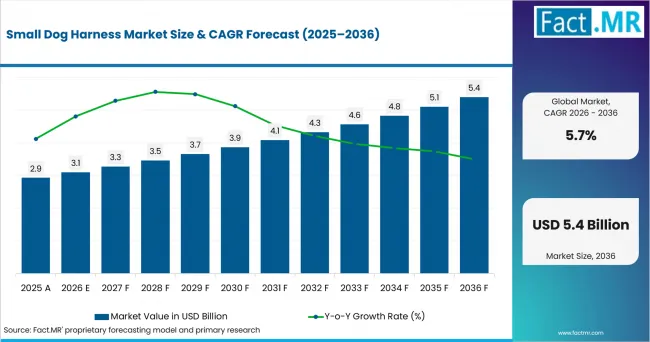
Small Dog Harness Market Value Analysis | Source: Fact.MR
What are the defining numbers behind Small Dog Harness Market growth?
An absolute opportunity of USD 2.3 billion is expected between 2026 and 2036.
- Demand Drivers in the Market
- Dog ownership provides the recurring consumer base for walking and restraint products. APPA reported 71 million U.S. dog-owning households in 2025, while UK Pet Food estimated 15.5 million dogs in UK homes in 2026. A larger active dog population increases replacement and first-purchase demand for harnesses used during daily walks and travel.
- Harnesses address a specific fit and pressure-distribution need in small dogs. American Kennel Club guidance notes that body harnesses are commonly used for small dogs and can reduce pressure on the throat compared with a collar when a dog pulls. This supports demand for lightweight, adjustable designs that spread load across the torso.
- Fit quality is becoming a product-selection criterion. AKC guidance emphasizes checking harness tightness, leg movement, chafing and escape risk. Small dogs vary materially in chest depth and body shape, so multi-point adjustment and ergonomic contouring can reduce returns while improving owner confidence in repeated use.
- The accessory market is shifting toward products that combine comfort with safety features. Ruffwear's current Front Range harness uses foam padding, four adjustment points, front and back leash attachments and reflective trim. These features illustrate how manufacturers compete through fit range, visibility and control rather than basic restraint alone.
- Channel access supports product discovery and replacement purchasing. Germany's ZZF/IVH data show online pet-market sales above EUR 1.5 billion in 2025, while specialty retail remains important for pet accessories. Harness buyers often need size comparison or fitting support, giving specialty stores a durable role even as online purchasing expands.
- Key Segments Analyzed
- Adjustable Harnesses account for 42.7% of Product in 2026 because multi-point sizing helps owners fit small dogs with different chest and neck proportions.
- Daily Walking holds 68.4% of Application in 2026 as harness use is most frequent during routine outdoor exercise and neighborhood walks.
- Individual Pet Owners represent 74.9% of End Use in 2026 because household buyers make the primary purchase and replacement decisions for companion-dog walking equipment.
- Ergonomic Fit Technology accounts for 57.2% of Technology in 2026 as small-dog harness selection depends heavily on secure body contouring without restricting movement.
- Lightweight Harness Systems hold 35.8% of Formulation in 2026 because lower-weight fabrics and mesh constructions suit smaller body sizes and routine wear.
- Pet Specialty Stores account for 63.5% of Distribution Channel in 2026 because buyers can compare sizes, construction and fit with category-specific retail support.
- Analyst Opinion at Fact.MR
- Shambhu Nath Jha, Principal Consultant at Fact.MR, states, “Small-dog harness demand is closely tied to fit confidence. Owners are more likely to replace or upgrade a harness when they see a clear improvement in adjustability, comfort or walking control. Suppliers that simplify sizing and demonstrate secure fit across small breeds can defend specialty-retail placement while building repeat demand through online channels.”
- Strategic Implications
- Brands should make chest-girth and fitting guidance central to product pages and packaging because sizing uncertainty can directly create returns or unsafe use.
- Manufacturers can differentiate adjustable products through low-profile buckles, padding placement and leash-attachment geometry rather than adding weight that undermines comfort for smaller dogs.
- Retailers should support try-on or measurement guidance for small breeds, where a narrow size error can change pressure distribution or escape risk.
- Online sellers should pair size charts with breed-independent body measurements and clear exchange policies to reduce friction when customers cannot test fit before purchase.
How does the Small Dog Harness Market break down by segment?
The market is segmented by Product, Application, End Use, Technology, Formulation and Distribution Channel.
Why do Adjustable Harnesses lead Product?
Adjustable Harnesses are projected to account for a 42.7% share in 2026.
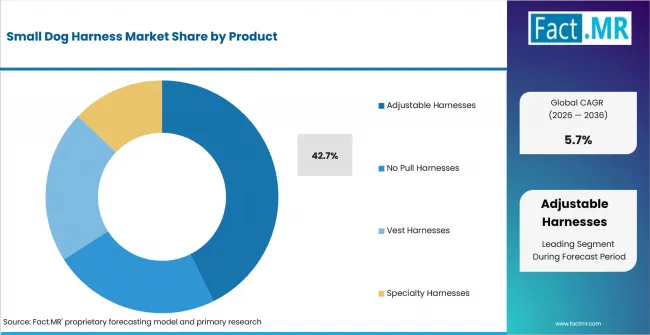
Small Dog Harness Market Analysis By Product | Source: Fact.MR
Adjustable designs lead because small dogs with similar body weight can have very different chest depth, neck width and shoulder shape. Multiple adjustment points allow the same product family to fit a broader range of dogs while helping owners maintain secure contact without excessive tightness.
Fit is especially important because a poorly fitted harness can rub, restrict movement or allow escape. AKC guidance on well-fitting harnesses reinforces the need to check movement and tightness. This demand for fit control sits alongside the related pet collar category, where restraint products are also selected around size and use case.
Why does Daily Walking lead Application?
Daily Walking is projected to account for a 68.4% share in 2026.
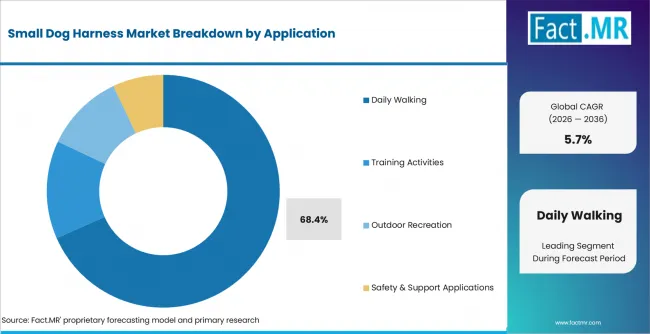
Small Dog Harness Market Analysis By Application | Source: Fact.MR
Daily walking leads because it creates the highest-frequency harness use. A harness used every day is repeatedly exposed to pulling, moisture, abrasion and fastening cycles, which raises the importance of comfort, washability and hardware durability.
Routine walking also makes harnesses part of the broader companion-animal accessory basket. The pet accessories market includes collars and harnesses among products shaped by pet ownership and spending on wellness and everyday care.
Why do Individual Pet Owners lead End Use?
Individual Pet Owners are projected to account for a 74.9% share in 2026.
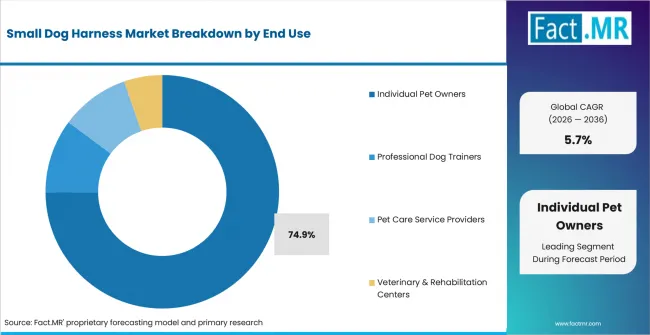
Small Dog Harness Market Analysis By End Use | Source: Fact.MR
Individual owners lead because they choose harnesses around their own dog’s size, behavior and walking routine. Purchase decisions are household-specific and may change as the dog grows, gains or loses weight, develops mobility needs or shifts from casual walks to training and travel.
Household pet spending also supports adjacent care purchases such as the pet grooming category. These recurring care routines keep owners engaged with specialty pet retail and service environments where harnesses are also discovered and replaced.
Why does Ergonomic Fit Technology lead Technology?
Ergonomic Fit Technology is projected to account for a 57.2% share in 2026.
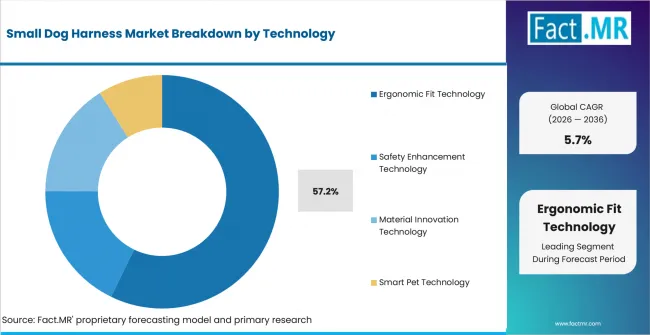
Small Dog Harness Market Analysis By Technology | Source: Fact.MR
Ergonomic fit leads because the harness must distribute force across the chest and torso without interfering with shoulder movement. This is more important for small dogs where a narrow strap or poorly placed edge can concentrate pressure over a smaller contact area.
Current product design reflects this requirement. Ruffwear uses multiple adjustment points, padded construction and separate chest and back leash attachments in its Front Range harness. The commercial value comes from combining secure fit with owner-friendly adjustment rather than relying on one fixed body shape.
Why do Lightweight Harness Systems lead Formulation?
Lightweight Harness Systems are projected to account for a 35.8% share in 2026.
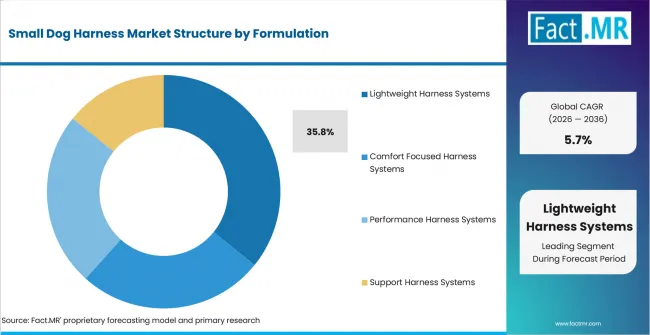
Small Dog Harness Market Analysis By Formulation | Source: Fact.MR
Lightweight systems lead because small dogs carry a greater accessory-weight burden relative to body mass. Mesh, thin webbing and low-profile hardware can reduce bulk during daily use while retaining sufficient load distribution for walking.
Lightweight design also matters during travel and outings, where owners may combine a harness with a dog carrier or other mobility accessory. Lower bulk helps the harness remain usable across walking and transport situations.
Why do Pet Specialty Stores lead Distribution Channel?
Pet Specialty Stores are projected to account for a 63.5% share in 2026.
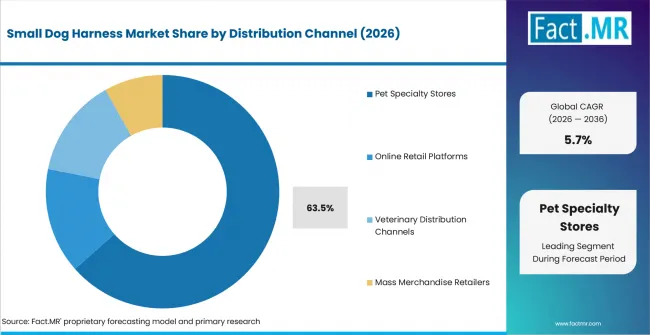
Small Dog Harness Market Analysis By Distribution Channel | Source: Fact.MR
Pet specialty stores lead because harnesses are fit-sensitive products. Buyers can compare strap geometry, fastening systems and size ranges in one category environment, while staff can help interpret chest measurements or demonstrate how a harness should sit on the dog.
Online channels are still expanding, especially for repeat purchases and known sizes. Smart or tracking-enabled variants can also connect the category with the pet wearables market as owners seek visibility and location functions alongside physical restraint.
What is accelerating Small Dog Harness Market adoption, and what is holding it back?
Adoption is supported by high dog ownership, routine walking, fit-focused product design and wider specialty and online availability. Growth is restrained by sizing errors, low-cost substitutes and the difficulty of balancing secure restraint with unrestricted movement across diverse small-dog body types.
Drivers Impact Analysis
| Factor | (~) % Impact on CAGR | Geographic Relevance | Impact Timeline |
|---|---|---|---|
| Growing small-dog ownership and routine walking demand | +1.3% | Global | Near term |
| Preference for harnesses that reduce neck pressure | +1.0% | USA; UK; Germany | Near term |
| Improved adjustment and ergonomic fit systems | +0.8% | Global | Mid term |
| Specialty retail and online category access | +0.6% | Germany; USA; UK | Mid term |
Source: Fact.MR analysis. Updated Aug 24, 2026
Opportunity Impact Analysis
| Factor | (~) % Impact on CAGR | Geographic Relevance | Impact Timeline |
|---|---|---|---|
| Reflective and safety-enhanced harnesses | +0.7% | Global | Mid term |
| Tracking-enabled and smart harness integration | +0.6% | USA; Germany; Japan | Mid term |
| Mobility-support and recovery configurations | +0.5% | USA; UK; Japan | Mid to long term |
| Lightweight recycled-material constructions | +0.4% | Germany; UK; Japan | Long term |
Source: Fact.MR analysis. Updated Aug 24, 2026
Restraints Impact Analysis
| Factor | (~) % Impact on CAGR | Geographic Relevance | Impact Timeline |
|---|---|---|---|
| Sizing errors and fit-related returns | -0.9% | Global | Near term |
| Low-cost collars and basic harness substitutes | -0.7% | Global | Near term |
| Chafing or restricted movement from poor fit | -0.6% | Global | Mid term |
| Price sensitivity in discretionary pet accessories | -0.4% | Brazil; USA; UK | Mid term |
Source: Fact.MR analysis. Updated Aug 24, 2026
Which countries are scaling the Small Dog Harness Market through 2036?
- Germany: Germany had 10.0 million dogs in 2025, while IVH notes a trend toward smaller dogs. Specialty retail remains important for pet accessories, supporting demand for size-specific harnesses and fitting guidance.
- Brazil: Brazil has a broad companion-animal base and a pet market that reached BRL 75.4 billion in 2024. Pet care and accessory spending supports harness demand among urban dog owners using products for walking and transport.
- USA: APPA reported 71 million dog-owning households in 2025. The scale of ownership supports a large replacement market for walking products, while owners increasingly compare functionality and value across specialty, mass and online channels.
- UK: UK Pet Food estimated 15.5 million dogs in UK homes in 2026. High dog ownership and regular walking create a recurring use case for secure, lightweight harnesses across urban and suburban households.
- Japan: Japan’s mature companion-animal market supports demand for compact, carefully fitted products, particularly where small dogs are kept in dense urban housing and walking equipment must combine low bulk with secure control.
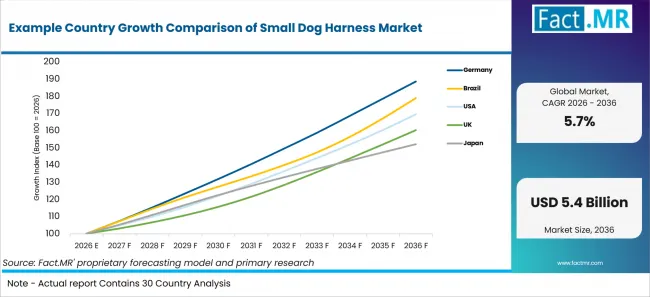
Example Country Growth Comparison Of Small Dog Harness Market | Source: Fact.MR
Country CAGR (2026-2036)
| Country | CAGR, 2026-2036 |
|---|---|
| Germany | 6.6% |
| Brazil | 6.0% |
| USA | 5.4% |
| UK | 4.8% |
| Japan | 4.3% |
Source: Fact.MR analysis. Updated Aug 24, 2026
What is driving Germany’s growth through 2036?
Germany is forecast to expand at a 6.6% CAGR from 2026 to 2036.
Germany combines a large dog population with an established pet-accessories retail base. IVH and ZZF counted 10.0 million dogs in 2025 and separately reported that smaller dogs remain popular. This supports demand for harnesses designed around compact body sizes, low weight and precise adjustment. Specialty retail is relevant because owners can compare fit before purchase, while online sales support repeat orders once size is known.
What is driving Brazil’s growth through 2036?
Brazil is forecast to expand at a 6.0% CAGR from 2026 to 2036.
Brazil’s pet sector reached BRL 75.4 billion in 2024 according to ABEMPET data based on Abinpet and sector sources. Pet care products are part of a broad household spending base, and the country has a large dog population. Urbanization and apartment living support compact-dog ownership, creating demand for everyday walking harnesses that combine affordability with secure fit.
What is driving USA’s growth through 2036?
USA is forecast to expand at a 5.4% CAGR from 2026 to 2036.
APPA reported that dog ownership expanded to 53% of U.S. households in 2025, equal to about 71 million households. This creates a broad installed base for first purchases and replacement harnesses. Product differentiation is moving toward fit, control and comfort, which supports adjustable and ergonomic designs while value-conscious buyers continue to compare channels.
What is driving UK’s growth through 2036?
UK is forecast to expand at a 4.8% CAGR from 2026 to 2036.
UK Pet Food estimated 15.5 million dogs in British households in 2026, with dog ownership particularly high among younger adults. Regular walking remains a common ownership routine, supporting demand for harnesses that are easy to put on, secure and comfortable over repeated use. Specialty and online channels both benefit from the large dog-owning base.
What is driving Japan’s growth through 2036?
Japan is forecast to expand at a 4.3% CAGR from 2026 to 2036.
Japan’s market is supported by established pet-care spending and a high share of small companion dogs suited to urban homes. Harness suppliers can gain through low-bulk construction, soft materials and accurate sizing. Demand also extends into travel and senior-dog support, where owners value restraint systems that are easier on the neck and can assist controlled movement.
Who Leads the Small Dog Harness Market?
Ruffwear, PSK Pet Mart, PetVogue, PetsUp, KITTYWOO, Pupteck, Matilor, Bingpet, Pawchie, Rabbitgoo, Kooltail and Dociote Direct are the key providers in the Small Dog Harness Market.
Ruffwear competes through technical outdoor-product positioning and detailed fit engineering. Its current harness portfolio uses multiple adjustment points, padded structures, reflective trim and alternative leash attachment locations, giving the brand a clear product architecture for everyday walking and higher-control applications.
PSK Pet Mart, PetVogue, PetsUp, KITTYWOO, Pupteck, Matilor, Bingpet, Pawchie, Rabbitgoo, Kooltail and Dociote Direct form the remainder of the supplied competitive set. Competition is shaped by size breadth, fastening security, fabric comfort, reflective detailing, online ratings and the ability to offer low-cost alternatives without compromising fit.
Specialty brands can defend higher price points through verified materials and sizing systems. Online-oriented brands compete more heavily on availability and product variety. Because harness fit varies by dog body shape, clear measurement instructions and exchange handling can influence conversion almost as much as visual design.
Which companies are the key providers?
Key companies profiled include Ruffwear; PSK Pet Mart; PetVogue; PetsUp; KITTYWOO; Pupteck; Matilor; Bingpet; Pawchie; Rabbitgoo; Kooltail; and Dociote Direct.
- Ruffwear
- PSK Pet Mart
- PetVogue
- PetsUp
- KITTYWOO
- Pupteck
- Matilor
- Bingpet
- Pawchie
- Rabbitgoo
- Kooltail
- Dociote Direct
Bibliography
- American Kennel Club. (2026). Dog Harnesses and Dog Collars: Which Is Right For Your Dog?
- American Kennel Club. (2026). The Importance of a Well-Fitting Dog Harness.
- American Pet Products Association. (2026). 2026 State of the Industry Report.
- American Pet Products Association. (2026). America’s Dog Owners Are Becoming Smarter Spenders.
- ABEMPET. (2026). Informações Gerais do Setor.
- Industrieverband Heimtierbedarf and ZZF. (2026). Heimtierpopulation in Deutschland 2025.
- Industrieverband Heimtierbedarf and ZZF. (2026). Der Deutsche Heimtiermarkt 2025.
- Ruffwear. (2026). Front Range Harness: Product Specifications.
- UK Pet Food. (2026). Pet Population Survey 2026.
- UK Pet Food. (2026). Annual Report 2026.
This Report Answers
- Which product formats account for the leading share of small-dog harness demand?
- How do walking, training, recreation and support applications differ in product requirements?
- Which buyer groups and channels influence harness selection and replacement?
- Which technologies and configurations are shaping fit, safety and comfort?
- How does competitive positioning differ between specialty brands and online-oriented suppliers?
What does the Small Dog Harness Market cover?
The market covers finished harnesses designed primarily for small dogs and sold for walking, training, outdoor recreation, travel, safety and support applications. Revenue is counted when a complete harness product is sold through the supplied retail and veterinary distribution channels.
What is included in the scope?
The scope includes adjustable, no-pull, vest and specialty harnesses, including the supplied subconfigurations.
It covers household pet owners, trainers, pet-care service providers and veterinary or rehabilitation users. Technology coverage includes ergonomic fit, safety enhancement, material innovation and smart-pet systems, while configuration coverage includes lightweight, comfort-focused, performance and support harness systems.
What is excluded from the scope?
The scope excludes standalone dog collars, leashes sold without a harness, pet clothing without a restraint function, carrier bags, crates and veterinary medical devices.
Harnesses for large dogs are excluded when they are not marketed or sized for the small-dog use case. Tracking devices sold separately are outside the market unless integrated into the harness product.
How Was the Analysis Built?
The analysis draws on more than 120 sources, over 35 company portfolios and more than 20 industry interviews across at least 25 countries.
- Primary Research: Interviews with harness brands, pet specialty retailers, e-commerce sellers, dog trainers, veterinary professionals and pet owners examine sizing, replacement behavior, channel selection and product-performance priorities.
- Desk Research: The review covers pet-population data, pet-industry spending, animal-welfare guidance, company product specifications, retail activity and country-level pet-market indicators. Sources used in the article are recorded in the bibliography.
- Market Sizing and Forecasting: Estimates combine small-dog ownership, harness replacement frequency, average selling prices, product mix, retail-channel mix and country-level adoption. Segment shares and country growth are applied within the supplied taxonomy.
- Data Validation and Update Cycle: Findings are cross-checked against company portfolios, pet-industry data and respondent feedback. Updates account for changes in dog ownership, product launches, retail-channel shifts and consumer spending behavior.
Segmentation
What is the report's scope and coverage?
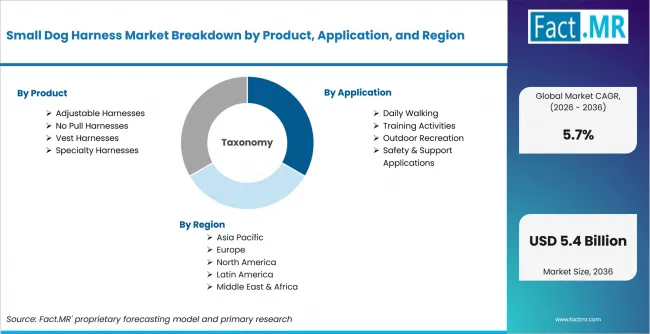
Small Dog Harness Market Breakdown By Product, Application, And Region | Source: Fact.MR
| Attribute | Details |
|---|---|
| Quantitative Units | USD billion |
| Market Definition | Finished harness systems designed primarily for small dogs across the supplied product and use-case categories |
| Segments Covered | Product; Application; End Use; Technology; Formulation; Distribution Channel |
| Regions Covered | North America; Latin America; Europe; East Asia; South Asia and Pacific; Middle East and Africa |
| Countries Covered | Germany; Brazil; USA; UK; Japan |
| Key Companies Profiled | Ruffwear; PSK Pet Mart; PetVogue; PetsUp; KITTYWOO; and others |
| Forecast Period | 2026 to 2036 |
| Base Year | 2026 |
| Market Value, 2026 | USD 3.1 billion |
| Market Value, 2036 | USD 5.4 billion |
| CAGR, 2026-2036 | 5.7% |
| Absolute Opportunity | USD 2.3 billion |
| Approach | Hybrid top-down and bottom-up approach using dog ownership, replacement frequency, average selling prices, segment mix, channel mix and country growth |
Source: Fact.MR analysis. Updated Aug 24, 2026
How is the market segmented?
-
By Product:
- Adjustable Harnesses
- Step In Adjustable Harnesses
- Overhead Adjustable Harnesses
- No Pull Harnesses
- Front Clip No Pull Harnesses
- Dual Clip No Pull Harnesses
- Vest Harnesses
- Soft Mesh Vest Harnesses
- Padded Vest Harnesses
- Specialty Harnesses
- Travel Harnesses
- Medical Support Harnesses
- Adjustable Harnesses
-
By Application:
- Daily Walking
- Urban Walking Applications
- Extended Walking Applications
- Training Activities
- Behavioral Training Applications
- Professional Training Applications
- Outdoor Recreation
- Adventure Applications
- Sports Applications
- Safety & Support Applications
- Travel Safety Applications
- Health Support Applications
- Daily Walking
-
By End Use:
- Individual Pet Owners
- Urban Pet Owners
- Suburban Pet Owners
- Professional Dog Trainers
- Independent Trainers
- Training Centers
- Pet Care Service Providers
- Dog Walking Companies
- Pet Boarding Facilities
- Veterinary & Rehabilitation Centers
- Veterinary Clinics
- Rehabilitation Facilities
- Individual Pet Owners
-
By Technology:
- Ergonomic Fit Technology
- Body Contour Design Systems
- Adjustment Mechanisms
- Safety Enhancement Technology
- Reflective Safety Systems
- Secure Fastening Systems
- Material Innovation Technology
- Performance Fabric Systems
- Reinforced Material Systems
- Smart Pet Technology
- Tracking Enabled Systems
- Monitoring Systems
- Ergonomic Fit Technology
-
By Formulation:
- Lightweight Harness Systems
- Mesh Based Configurations
- Minimalist Configurations
- Comfort Focused Harness Systems
- Padded Configurations
- Soft Touch Configurations
- Performance Harness Systems
- Training Configurations
- Outdoor Configurations
- Support Harness Systems
- Mobility Support Configurations
- Recovery Support Configurations
- Lightweight Harness Systems
-
By Distribution Channel:
- Pet Specialty Stores
- National Pet Retail Chains
- Independent Pet Stores
- Online Retail Platforms
- E Commerce Marketplaces
- Brand Owned Websites
- Veterinary Distribution Channels
- Veterinary Clinics
- Animal Hospitals
- Mass Merchandise Retailers
- Hypermarket Retailers
- Department Stores
- Pet Specialty Stores
Frequently Asked Questions
What is the Small Dog Harness Market value in 2026?
At what CAGR is the market projected to grow?
What is the projected market value by 2036?
Which Product leads the market?
Which Application leads the market?
Which End Use leads the market?
Which Technology leads the market?
Which Formulation leads the market?
Which Distribution Channel leads the market?
Which country records the highest listed CAGR?
Which companies are included in the market assessment?
Who worked on this report


Preview the report firsthand - request a free sample
Free SampleGet the brochure for pricing and purchase details
Download PDF