- Base Value(2025): 2.8 Bn
- Estimated Value(2026): 3.1 Bn
- Forecast Value (2036): 8.4 Bn
- CAGR (2026 - 2036): 10.5%
Smart Locks Market Forecast and Outlook 2026 to 2036
In 2025, the smart locks market was valued at USD 2.8 billion. Based on Fact.MR analysis, demand for smart locks is estimated to reach USD 3.1 billion in 2026 and USD 8.4 billion by 2036, reflecting a CAGR of 10.5% over the forecast period. Market growth is supported by rising smart home penetration, expanding multi-family residential construction, and increasing use of digital access control in commercial and institutional buildings.
The market adds approximately USD 5.6 billion in incremental value over the forecast window, indicating strong compounding driven by platform-led adoption rather than one-time device upgrades. Early-period growth is supported by Bluetooth and keypad-based smart locks in residential settings, particularly in urban housing and rental properties. Mid-period expansion aligns with wider deployment of Wi-Fi and biometric locks across offices, retail, and hospitality facilities. In later years, value growth is increasingly shaped by protocol standardization such as Thread Matter and deeper integration with building management and security systems, improving lifecycle value per installation.
India leads growth at 13.1% CAGR, supported by rapid urban housing development and smart home adoption. China follows at 12.8%, driven by large-scale residential and commercial digitization initiatives. The United States records 10.0%, reflecting steady uptake across residential, hospitality, and institutional applications. Germany and Canada each grow at 9.5%, shaped by security modernization in commercial and public buildings. The United Kingdom posts 9.1%, while Japan at 8.7% reflects a mature but steadily expanding smart access market constrained by longer technology evaluation and replacement cycles.
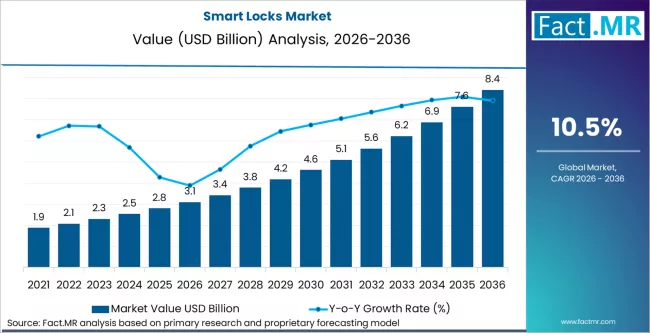
Smart Locks Market Market Value Analysis | Source: Fact.MR
Smart Locks Market
| Metric | Value |
|---|---|
| Market Value (2026) | USD 3.1 billion |
| Forecast Value (2036) | USD 8.4 billion |
| Forecast CAGR (2026–2036) | 10.5% |
Source: Fact.MR analysis. Updated Feb 23, 2026
Smart Locks Market Definition
The smart locks market covers electronically controlled locking devices that allow access to buildings without traditional mechanical keys. These locks operate using technologies such as keypads, biometric readers, wireless connectivity, or mobile applications. Smart locks enable remote access control, user authentication, and activity tracking for residential and commercial properties. Product safety, electronic compliance, and building access regulations are governed under consumer product and electronic equipment frameworks administered by the US Consumer Product Safety Commission and cybersecurity guidance issued by the National Institute of Standards and Technology.[1]
Smart Locks Market Inclusions
The report covers global and regional market size estimates in volume and value terms with a forecast period from 2026 to 2036. Segmentation includes lock type such as deadbolt and lever systems, authentication method including biometric and keypad entry, connectivity type, and end use across residential and commercial buildings. The scope also includes regional demand patterns, pricing benchmarks, and international trade flows for electronic access control devices.
Smart Locks Market Exclusions
The scope excludes traditional mechanical locks without electronic control features. Access control systems designed exclusively for large scale industrial security networks are not included. Surveillance cameras, alarm systems, and intercom devices sold separately are excluded. Installation services, building management software platforms, prototype locking systems without commercial release, and cybersecurity consulting services are also outside the scope.
Smart Locks Market Research Methodology
- Primary Research: Primary research involved interviews with smart lock manufacturers, electronic component suppliers, security integrators, property developers, and retail distributors.
- Desk Research: Desk research used consumer product safety regulations from the US Consumer Product Safety Commission and cybersecurity standards guidance from the National Institute of Standards and Technology, along with building construction statistics and company annual reports.
- Market Sizing and Forecasting: Market sizing applied a hybrid top down and bottom up model using residential and commercial construction data, smart home adoption rates, and device replacement cycles.
- Data Validation and Update Cycle: Outputs were cross checked against trade statistics, regulatory compliance records, retail sales disclosures, and publicly reported building completion data, with updates applied when verified public sources issue revisions.
Summary of Smart Locks Market
- Market Definition
The smart locks market includes electronically controlled locking devices that enable keyless entry using Bluetooth, Wi-Fi, keypad, or biometric authentication across residential, commercial, institutional, and hospitality properties. - Demand Drivers
Rising smart home penetration, growth in multi-family housing, and digital access control in offices and hotels support steady adoption.
Product safety, electronic compliance, and recall obligations are governed under consumer protection frameworks issued by the US Consumer Product Safety Commission [2], influencing design validation and market entry.
Cybersecurity expectations for connected devices are shaped by guidance from the National Institute of Standards and Technology [3], affecting encryption, authentication, and firmware update protocols. - Key Segments Analyzed
Bluetooth-enabled locks account for about 52% share due to lower power consumption, smartphone compatibility, and suitability for retrofit installations.
Deadbolt smart locks hold roughly 71% share, reflecting compatibility with standard door preparations and combined mechanical-electronic security strength.
Residential applications lead volume, while hospitality and institutional deployments drive higher-value installations through integration with property management systems. - Analyst Opinion at Fact.MR
Shambhu Nath Jha, Principal Consultant at Fact.MR, opines, ‘CXOs will find this report useful for evaluating how protocol standardization, biometric authentication reliability, and cybersecurity compliance are shaping procurement frameworks and platform integration strategies in the smart locks market.’ - Strategic Implications / Executive Takeaways
Manufacturers should prioritize secure firmware architecture and multi-protocol compatibility to align with evolving IoT standards.
Expansion in multi-family and rental housing supports recurring installation demand.
Integration with broader building management and access logging systems increases lifecycle value per deployment. - Methodology
Market sizing uses residential and commercial construction data, smart home penetration rates, and replacement cycles.
Validation references regulatory compliance records, trade statistics, and retail sales disclosures.
Forecasts apply reproducible top-down and bottom-up models grounded in verified public construction and consumer adoption data.
Segmental Analysis
Smart Locks Market Analysis by Authentication Method
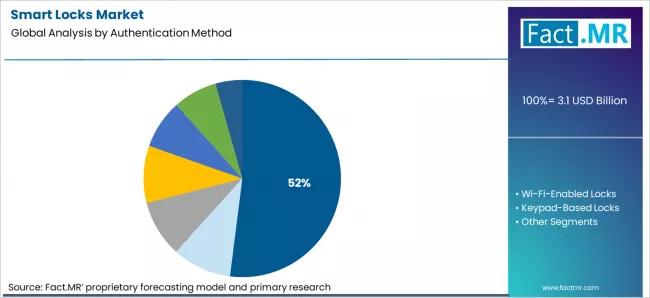
Smart Locks Market Analysis By Authentication Method | Source: Fact.MR
Based on Fact.MR analysis, consumption of Bluetooth-enabled smart locks is estimated to hold 52% share of the global smart locks market. Fact.MR analysts note Bluetooth locks lead due to low power consumption, smartphone compatibility, and offline operation without continuous internet connectivity. As per Fact.MR, this authentication method addresses user needs for proximity-based access, easier installation, and reduced cybersecurity exposure, supporting adoption in residential settings, rental properties, and small commercial premises where cost control, battery life, and local control remain important purchasing considerations globally today across varied housing types worldwide markets.
- Consumer protection: Smart home access devices are subject to consumer protection and data security guidance.
- Installation preference: Fact.MR analysts note Bluetooth locks are favored for retrofit installations.
- Power efficiency: Bluetooth operation supports longer battery replacement intervals.
Smart Locks Market Analysis by Lock Type
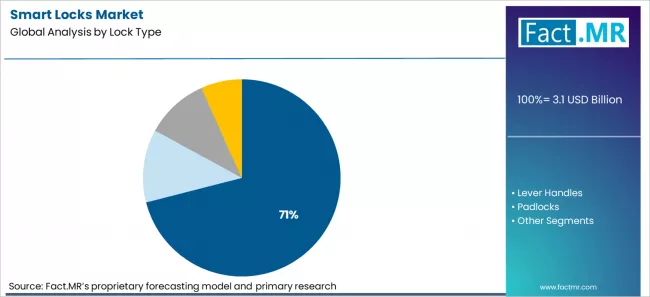
Smart Locks Market Analysis By Lock Type | Source: Fact.MR
Based on Fact.MR analysis, consumption of deadbolt smart locks is estimated to hold 71% share of the global smart locks market. Fact.MR analysts note deadbolts dominate because they provide strong mechanical security combined with electronic access control. As per Fact.MR, this lock type addresses homeowner and property manager requirements for durability, compatibility with existing doors, and compliance with residential security norms, supporting widespread use in single-family homes, apartments, and managed rental properties across urban and suburban markets worldwide today driven by replacement cycles and new construction activity in major regions.
- Security guidance: Residential access control and physical security practices are addressed within national cybersecurity and identity frameworks.
- Housing fit: Fact.MR analysts note deadbolts align with standard door preparations.
- Market continuity: Deadbolt formats support both smart and mechanical configurations.
Smart Locks Market Drivers, Restraints, And Opportunities
Fact.MR analysis indicates that the smart locks market exists as an electronic access control segment within residential, commercial, and hospitality security ecosystems, driven by growing emphasis on convenient, keyless entry and connected security solutions. As per Fact.MR assessment, smart locks integrate with home automation platforms and building management systems, and their performance and safety expectations intersect with regulatory standards such as the U.S. National Institute of Standards and Technology (NIST) guidelines for cybersecurity and IoT device integration, which inform best practices for secure cryptographic communication and device authentication in connected systems [4]. Fact.MR analysts observe that the current market scale is tied to the proliferation of smart home adoption, increased security awareness among building owners, and rising integration of IoT-enabled access technologies.
Fact.MR is of the opinion that current market dynamics reflect a transition toward more advanced smart lock solutions that merge wireless connectivity, biometric authentication, and remote management capabilities with traditional locking mechanisms. Based on Fact.MR assessment, conventional mechanical locks continue to dominate in lower-security or cost-sensitive segments due to familiarity and affordability, but demand for smart locks grows where connected security, remote control, and access logging features are specified. Advanced smart lock products that offer encrypted communication, mobile app integration, and multi-factor authentication generally carry higher per-unit pricing because of embedded electronics, firmware, and compliance requirements, meaning realised market value can increase even where shipment volumes grow at a measured pace. Fact.MR analysis suggests that this combination of technology advancement and differentiated pricing profiles will shape near-term market progression.
- Cybersecurity and IoT guidelines: Fact.MR analysts note that frameworks such as NIST cybersecurity guidelines influence smart lock design, authentication protocols, and secure communication expectations in smart home and commercial access control applications.
- Shift to connected access solutions: Based on Fact.MR assessment, growing adoption of wireless and mobile-integrated smart locks supports demand in residential and commercial properties seeking convenient access control and remote management.
- Asia Pacific smart home adoption: Fact.MR opines that rising penetration of smart home technologies and building automation in China, India, and Southeast Asia supports regional uptake of smart locks in both new construction and retrofit segments.
Regional Analysis
Based on regional assessment, the smart locks sector is analyzed across North America, Europe, East Asia, South Asia, and other key residential and commercial security markets, spanning more than 40 countries. Regional performance varies according to smart home adoption, penetration of connected security solutions, regulatory standards for access control, and growth in residential and commercial construction activity.
Smart Locks Market CAGR Analysis by Country (2026–2036)
| Country | CAGR |
|---|---|
| India | 13.1% |
| China | 12.8% |
| United States | 10.0% |
| Germany | 9.5% |
| Canada | 9.5% |
| United Kingdom | 9.1% |
| Japan | 8.7% |
Source: Fact.MR analysis. Updated Feb 23, 2026
Source: Fact.MR analysis, based on proprietary forecasting models and primary research.
Asia Pacific Smart Locks Market Analysis
Asia Pacific operates as a demand led smart locks region supported by rapid urban housing growth apartment construction and expanding ecommerce distribution. Adoption is shaped by residential security needs smartphone penetration and integration with home automation platforms. China India and Japan drive volume through new housing and retrofit installations. Procurement reflects consumer retail channels property developer specifications and rising use in rental housing. Growth reflects affordability improvements localization of electronics and wider acceptance of connected access across metropolitan residential.
China: Demand for smart locks in China is projected to rise at 12.8% CAGR through 2036. Adoption is supported by high urban apartment construction activity and strong consumer uptake of connected home devices, as per Fact.MR.
India: Demand for smart locks in India is projected to rise at 13.1% CAGR through 2036. Usage reflects rapid growth of urban housing projects and increasing penetration of app-enabled residential security systems, according to Fact.MR.
Japan: Demand for smart locks in Japan is projected to rise at 8.7% CAGR through 2036. Adoption reflects steady retrofit demand in residential buildings and integration with compact smart home ecosystems, as per Fact.MR.
Fact.MR’s analysis of the Smart Locks Market in Asia Pacific consists of country-wise assessment that includes China, India, and Japan. Readers can find housing trends, retail adoption patterns, and technology integration references.
Europe Smart Locks Market Analysis
Europe functions as a regulation aligned smart locks region influenced by data protection rules building standards and mature housing stock. Adoption is driven by retrofit demand landlord compliance and integration with access control in multifamily buildings. Germany and the United Kingdom anchor demand through residential upgrades and commercial offices. Procurement emphasizes certification privacy compliance and interoperability. Growth reflects steady replacement cycles public sector projects and acceptance of digital keys within apartments hotels and offices across urban markets in Europe today.
Germany: Demand for smart locks in Germany is projected to rise at 9.5% CAGR through 2036. Adoption is driven by retrofit installations in residential buildings and demand for certified access control systems, as per Fact.MR.
United Kingdom: Demand for smart locks in the United Kingdom is projected to rise at 9.1% CAGR through 2036. Usage reflects growing adoption across rental housing and commercial offices, according to Fact.MR.
Fact.MR’s analysis of the Smart Locks Market in Europe consists of country-wise assessment that includes Germany and the United Kingdom. Readers can find regulatory compliance trends and retrofit-driven demand insights.
North America Smart Locks Market Analysis
North America operates as a standards led smart locks region supported by single family housing multifamily developments and commercial adoption. Demand is shaped by security standards insurance considerations and integration with platforms. The United States and Canada drive installations across residential retrofit and new construction. Procurement favors certified devices dealer installation and subscription services. Growth reflects replacement cycles rising smart home penetration and deployment in rental properties offices and hospitality within metropolitan areas across major cities and suburbs nationwide today.
United States: Demand for smart locks in the United States is projected to rise at 10.0% CAGR through 2036. Adoption is supported by strong smart home penetration and residential retrofit installations, as per Fact.MR.
Canada: Demand for smart locks in Canada is projected to rise at 9.5% CAGR through 2036. Usage reflects adoption across urban housing and integration with residential security systems, according to Fact.MR.
Fact.MR’s analysis of the Smart Locks Market in North America consists of country-wise assessment that includes the United States and Canada. Readers can find housing trends, security standards, and consumer adoption references.
Competitive Landscape of Smart Locks Market
As per Fact.MR analysis, the 2026 smart locks market is defined by validated security performance, connectivity integration, and multi-region regulatory compliance, which determine competitive advantage. ASSA ABLOY AB (Yale, August Home) and Allegion plc (Schlage) lead with high-reliability digital locking systems and certified encryption standards, which strengthen adoption in residential and commercial segments globally. Spectrum Brands Holdings (Kwikset) and Samsung Electronics Co., Ltd. focus on validated wireless communication and mobile access, which improves user convenience and trust. Dormakaba Holding AG and Honeywell International emphasize multi-protocol interoperability and tamper-resistant designs, which enhances deployment in enterprise and multi-tenant facilities. UniKey Technologies, Goji Smart Locks, and Salto Systems provide cloud-connected and validated authentication systems, which increase remote management adoption. MIWA Lock Co., Godrej & Boyce, and Dessmann specialize in high-security mechanical-digital hybrid systems, which improves durability and regulatory compliance. Tenon, Guangdong Level Intelligence Lock, Locstar Technology, Adel Group, Gate (SESAME), and Nello offer regionally compliant smart locking solutions, which expand reach in Asia-Pacific and emerging markets. Across the market, validated security, integration with IoT and access management platforms, and adherence to multi-region standards create enduring competitive moats, reducing reliance on pricing or isolated feature claims.
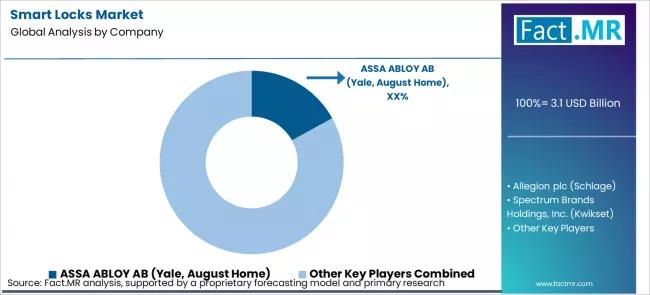
Smart Locks Market Analysis By Company | Source: Fact.MR
Recent Industry Developments
ASSA ABLOY (Jan 2026): Following its late-2024 acquisition of Level Lock, the group launched the Yale Luna Elite+ and Yale Cornelius, integrating advanced FaceScan and PalmScan biometrics. These models feature built-in video doorbells and are among the first to support the Matter and Aliro protocols for cross-platform smart home harmony. [5]
Allegion / Schlage (Jan 2026): Introduced on-device AI for the Schlage Sense series to detect suspicious access patterns without cloud reliance. Additionally, the firm launched Pin & Tumbler™ Studio, a direct-to-consumer innovation hub focusing on "invisible" smart locks and aesthetic-led hardware. [6]
Key Players in Smart Locks Market
- ASSA ABLOY AB (Yale, August Home)
- Allegion plc (Schlage)
- Spectrum Brands Holdings, Inc. (Kwikset)
- Samsung Electronics Co., Ltd.
- Dormakaba Holding AG
- Honeywell International Inc.
- UniKey Technologies Inc.
- Goji Smart Locks
- Salto Systems S.L.
- MIWA Lock Co.
- Godrej & Boyce Manufacturing Co., Ltd.
- Dessmann (Guangdong) Intelligent Lock Industry Co., Ltd.
- Tenon (Group) Co., Ltd.
- Guangdong Level Intelligence Lock Co., Ltd.
- Locstar Technology Co., Ltd.
- Adel Group
- Gate, Inc. (SESAME)
- Nello (Olsen AG)
Bibliographies
- [1] U.S. Consumer Product Safety Commission. (2024). Regulations, laws, and standards for consumer products. U.S. Consumer Product Safety Commission; National Institute of Standards and Technology. (2024). Cybersecurity Framework 2.0. NIST.
- [2] U.S. Consumer Product Safety Commission. (2024). Consumer product safety requirements for electronic and connected devices. U.S. Consumer Product Safety Commission.
- [3] National Institute of Standards and Technology. (2024). Cybersecurity Framework (CSF) for managing cybersecurity risk. U.S. Department of Commerce.
- [4] National Institute of Standards and Technology. (2024). Cybersecurity and Internet of Things (IoT) risk management guidance. U.S. Department of Commerce.
- [5] ASSA ABLOY AB. (2026). ASSA ABLOY introduces next-generation Yale smart locks with Matter and biometric authentication [Press release]. ASSA ABLOY.
- [6] Allegion plc. (2026). Allegion advances smart lock innovation with AI-enabled access control solutions [Press release]. Allegion plc.
This Report Addresses
- Market intelligence to support structured strategic decision making across residential, commercial, institutional, and hospitality access control ecosystems
- Market size estimation and ten year revenue forecasts from 2026 to 2036, supported by validated construction activity data, smart home penetration rates, retrofit cycles, and device adoption benchmarking
- Growth opportunity assessment across authentication methods, lock types, and communication protocols with emphasis on biometric reliability, Bluetooth and Wi-Fi adoption, and Thread Matter standardization
- Segment and regional revenue forecasts covering residential, commercial, institutional, and hospitality deployments across new construction and retrofit environments
- Competitive strategy assessment including encryption capability, firmware security architecture, multi-protocol interoperability, and alignment with smart building and property management platforms
- Technology evolution tracking covering biometric authentication advances, on-device processing, cloud integration, and integration with broader IoT and building automation ecosystems
- Regulatory and cybersecurity impact analysis covering consumer product safety compliance, electronic device standards, data protection expectations, and IoT security frameworks influencing product design and procurement
- Market report delivery in PDF, Excel, PowerPoint, and interactive dashboard formats for executive, technical, and operational decision support
Segmentation
Scope of the Report
| Metric | Value |
|---|---|
| Quantitative Units | USD 3.1 billion (2026) to USD 8.4 billion (2036), CAGR 10.5% |
| Market Definition | The smart locks market covers electronically controlled locking devices that enable keyless access to residential, commercial, and institutional buildings. These devices operate via Bluetooth, Wi-Fi, keypad entry, or biometric authentication and support remote access, user management, and activity logging. Product safety, electronic compliance, and cybersecurity adherence are regulated by US CPSC and NIST guidance. |
| Authentication Method Segmentation | Bluetooth-Enabled Locks, Wi-Fi-Enabled Locks, Keypad-Based Locks, Biometric Locks (Fingerprint, Facial, Iris Recognition) |
| Lock Type Segmentation | Deadbolts, Lever Handles, Padlocks, Mortise Locks |
| Communication Protocol Segmentation | Bluetooth, Wi-Fi, Z-Wave, Zigbee, Thread (Matter), Other Protocols |
| End-Use Application Segmentation | Residential (Single-Family Homes, Multi-Family Apartments/Condos), Commercial (Office Buildings, Retail Stores), Institutional (Educational, Government, Healthcare Facilities), Hospitality (Hotels, Short-Term Rentals), Other Applications |
| Regions Covered | Asia Pacific, Europe, North America, Latin America, Middle East & Africa |
| Countries Covered | India, China, Japan, South Korea, Indonesia, Australia & New Zealand, ASEAN, Rest of Asia Pacific, Germany, Italy, France, United Kingdom, Spain, Benelux, Nordics, Central & Eastern Europe, Rest of Europe, United States, Canada, Mexico, Brazil, Argentina, Chile, Rest of Latin America, Kingdom of Saudi Arabia, United Arab Emirates, South Africa, Turkey, Rest of Middle East & Africa |
| Key Companies Profiled | ASSA ABLOY AB (Yale, August Home), Allegion plc (Schlage), Spectrum Brands Holdings (Kwikset), Samsung Electronics Co., Ltd., Dormakaba Holding AG, Honeywell International Inc., UniKey Technologies Inc., Goji Smart Locks, Salto Systems S.L., MIWA Lock Co., Godrej & Boyce Manufacturing Co., Ltd., Dessmann (Guangdong) Intelligent Lock Industry Co., Ltd., Tenon (Group) Co., Ltd., Guangdong Level Intelligence Lock Co., Ltd., Locstar Technology Co., Ltd., Adel Group, Gate (SESAME), Nello (Olsen AG) |
| Forecast Period | 2026 to 2036 |
| Approach | Hybrid top-down and bottom-up modeling validated with primary interviews of manufacturers, security integrators, and property developers; cross-checked with construction statistics, retail adoption data, and regulatory compliance records. |
Source: Fact.MR analysis. Updated Feb 23, 2026
Smart Locks Market Analysis by Segments
-
Authentication Method :
- Bluetooth-Enabled Locks
- Wi-Fi-Enabled Locks
- Keypad-Based Locks
- Biometric Locks
- Fingerprint Recognition
- Facial Recognition
- Iris Recognition
-
Lock Type :
- Deadbolts
- Lever Handles
- Padlocks
- Mortise Locks
-
Communication Protocol :
- Bluetooth
- Wi-Fi
- Z-Wave
- Zigbee
- Thread (Matter)
- Other Protocols
-
End-Use Application :
- Residential
- Single-Family Homes
- Multi-Family Apartments/Condos
- Commercial
- Office Buildings
- Retail Stores
- Institutional
- Educational Facilities
- Government Buildings
- Healthcare Facilities
- Hospitality
- Hotels
- Short-Term Rentals
- Other Applications
- Residential
-
Region :
- Asia Pacific
- India
- China
- Japan
- South Korea
- Indonesia
- Australia & New Zealand
- ASEAN
- Rest of Asia Pacific
- Europe
- Germany
- Italy
- France
- United Kingdom
- Spain
- Benelux
- Nordics
- Central & Eastern Europe
- Rest of Europe
- North America
- United States
- Canada
- Mexico
- Latin America
- Brazil
- Argentina
- Chile
- Rest of Latin America
- Middle East & Africa
- Kingdom of Saudi Arabia
- United Arab Emirates
- South Africa
- Turkey
- Rest of Middle East & Africa
- Asia Pacific
Frequently Asked Questions
How large is the smart locks market expected to be in 2026?
What will the global smart locks market size be by 2036?
What is the expected CAGR of the smart locks market during 2026–2036?
How much incremental value will the smart locks market add over the forecast period?
What are the main structural drivers shaping demand for smart locks?
Which authentication method currently leads the smart locks market?
Why do Bluetooth-enabled smart locks account for the largest share?
Which lock type dominates smart lock installations globally?
What factors explain the dominance of deadbolt smart locks?
Which end-use application segment drives the highest adoption volume?
Which applications contribute higher-value smart lock deployments?
How significant is protocol standardization to future market growth?
Which country is expected to register the fastest growth in the smart locks market?
What is the projected growth rate of the smart locks market in China?
How does the smart locks market growth outlook compare in the United States?
What growth rates are expected in Germany and Canada?
How does the UK smart locks market perform relative to other mature markets?
What is the growth outlook for the smart locks market in Japan?
How important is residential construction to early-period market growth?
What should manufacturers prioritize to capture long-term growth in this market?
Who worked on this report


Preview the report firsthand - request a free sample
Free SampleGet the brochure for pricing and purchase details
Download PDF