Smart Dock Controllers Market Size, Share, Growth and Forecast (2026 - 2036)
The global Smart Dock Controllers Market is segmented by Product Type, Platform Compatibility, Connectivity Type, Application, Price Range, Distribution Channel, and Region, with forecasts covering the period from 2026 to 2036.
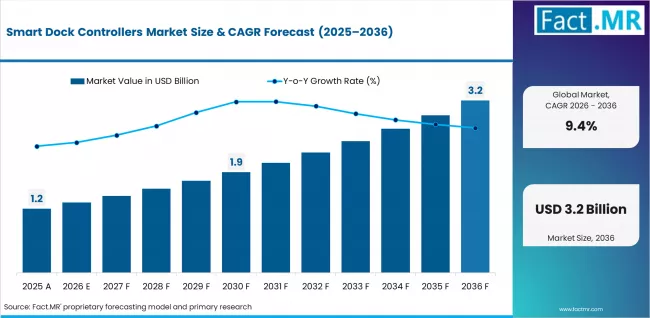
the smart dock controllers market is estimated to be USD 1.2 billion. The market is expected to grow to USD 1.3 billion in 2026 and up to USD 3.2 billion in 2036 with a CAGR of 9.4%.
Smart Dock Controllers Market Analysis and Forecast by Fact.MR
According to Fact.MR In 2025, the smart dock controllers market is estimated to be USD 1.2 billion. The market is expected to grow to USD 1.3 billion in 2026 and up to USD 3.2 billion in 2036 with a CAGR of 9.4%. Hardware-Based Smart Dock Controllers is expected to have almost half the share of the product type segment, whereas Gaming Console Docking is likely to be the most used application with 30.6% share.
Summary of Smart Dock Controllers Market
- Market Snapshot
- In 2025, the global Smart Dock Controllers Market was valued at approximately USD 1.2 billion.
- The market is estimated to reach USD 1.3 billion in 2026 and is projected to attain USD 3.2 billion by 2036.
- The Smart Dock Controllers Market is likely to expand at a CAGR of 9.4% during the forecast period.
- The market is anticipated to create an absolute dollar opportunity of USD 1.9 billion between 2026 and 2036.
- Hardware-Based Smart Dock Controllers account for 54.8% of market share in 2026.
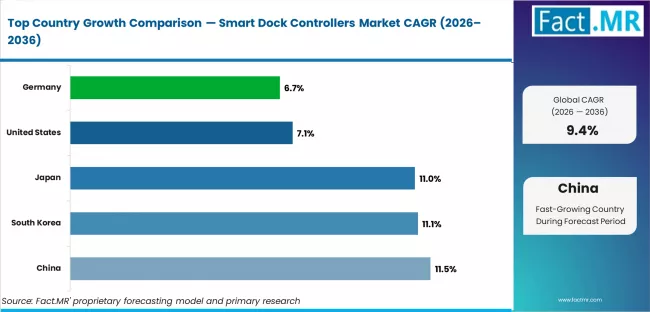
- China (11.5%) and South Korea (11.1%) are the key growth markets during the forecast period.
- Demand and Growth Drivers
- Increasing demands of smooth gaming systems, the interconnection of multiple devices, and the structured desk systems are pushing the usage of smart dock controllers among console, PC, and mobile gaming players.
- Current trend: The increasing popularity of esports, professional gaming, and creator streaming environments are putting pressure on the need to have low-latency connectivity and peripheral integration along with high-performance charging capabilities in docking systems.
- The growing infiltration of handheld gaming devices and hybrid consoles is favoring the need of portable smart docks that have display output, power delivery, and travel-friendly form factors.
- Some of these technological advances include: GaN fast charging, wireless connectivity, modular architecture, thermal cooling support, firmware optimization, and app-based management, which are enhancing the functionality and ease of use of products.
- The increase in the popularity of online retailing, direct to consumer sales channels, and gaming specialty stores are enhancing product availability and opening up the international market.
- Product and Segment View
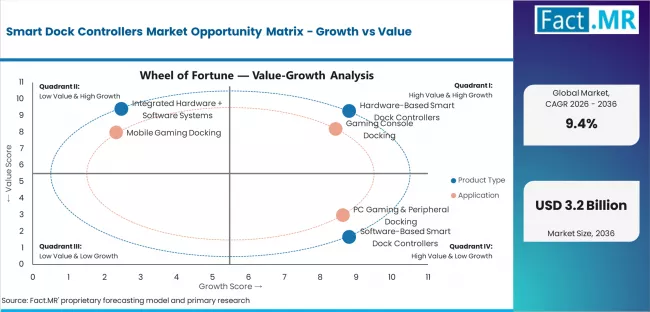
- Hardware-Based Smart Dock Controllers anticipated to hold the largest share of 54.8% by 2026, was the dominant segment attributed to its wide compatibility, cost effectiveness and large installed users base.
- Gaming Console Docking holds a share of 30.6% by 2026, the largest application segmented by mounting console ownership, increasing demand for console accessories replacement.
- Major segmentation is as follows:
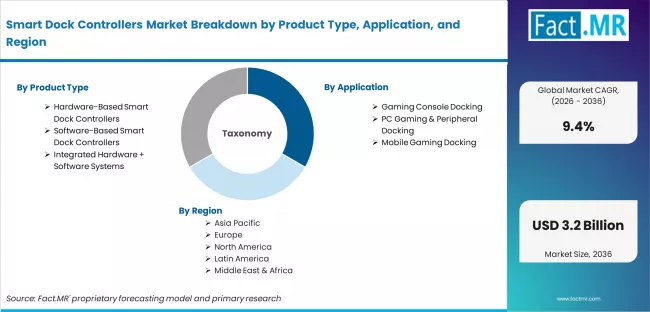
- Product Type: Hardware-Based, Software-Based, Integrated Hardware + Software Systems
- Application: Gaming Console Docking, PC Gaming and Peripheral Docking, Mobile Gaming Docking, VR / AR Gaming Docking, Streaming and Content Creator Docking
- Distribution Channel: Online Retailing, Offline Retail Stores, Direct-to-Consumer, Gaming Specialty Stores
- These systems enable:
- Spin-up charging and intelligent power management
- Multi-display output and multi-port peripherals access
- Multi-device dock seamlessly across gaming and creator ecosystems
- Geography and Competitive Outlook
- North America: North America is the most promising regional market because of the high gaming hardware purchasing behavior, good adoption of the console, well-developed infrastructure in esports, and the need to use high-quality gaming accessories.
- East Asia is the most rapidly expanding region with high numbers of gamers, robust consumer electronics production and the increasing popularity of handheld gaming and cross-platform docking solutions.
- Western Europe is experiencing predictable demand due to high-end PC gaming systems, creator economy, and increased uptake of performance-oriented accessories.
- China (11.5%), South Korea (11.1%), and Japan (11.0%) are the major growth markets, and the United States (7.1) and Germany (6.7) have steady growth.
- Nintendo, Sony, Microsoft, Genki, JSAUX, HORI, Nyko, PowerA, Skull & Co., Valve, ASUS, Razer, Corsair, and Elgato are some of the largest players in this market.
- Analyst Opinion
- Shambhu Nath Jha, Principal Consultant at Fact.MR, says “The Smart Dock Controllers Market is no longer defined only by basic charging docks. Growth is increasingly coming from handheld gaming ecosystems, creator workstations, and multi-platform setups, especially as users shift toward intelligent docking systems that offer fast charging, advanced connectivity, and seamless device integration.
Smart Dock Controllers Market — At a Glance
| Attribute | Details |
|---|---|
| Market Value 2025 | USD 1.2 billion |
| Market Value 2026 | USD 1.3 billion |
| Market Value 2036 | USD 3.2 billion |
| Absolute Dollar Opportunity | USD 1.9 billion |
| Total Growth | 146% |
| CAGR | 9.40% |
| Growth Multiple | 2.5x |
| Key Demand Theme | Rising demand for multi-device gaming setups, handheld gaming accessories, and premium connectivity solutions |
| Leading Application | Gaming Console Docking |
| Application Share | 30.60% |
| Leading Product Type | Hardware-Based Smart Dock Controllers |
| Product Type Share | 54.80% |
| Key Growth Regions | East Asia, North America, South Asia & Pacific |
| Key Companies | Nintendo, Sony, Microsoft, JSAUX, Genki, HORI, ASUS, Razer, Valve |
| Segmentation by Product Type | Hardware-Based Smart Dock Controllers, Software-Based Smart Dock Controllers, Integrated Hardware + Software Systems |
| Segmentation by Platform Compatibility | Microsoft Windows Compatible, Apple macOS Compatible, Android Compatible, iOS Compatible, Multi-Platform Compatible |
| Segmentation by Connectivity Type | Wired, Wireless, Hybrid |
| Segmentation by Application | Gaming Console Docking, PC Gaming & Peripheral Docking, Mobile Gaming Docking, VR / AR Gaming Docking, Streaming & Content Creator Docking |
| Segmentation by Price Range | Economy, Mid-Range, Premium |
| Segmentation by Distribution Channel | Online Retail, Offline Retail Stores, Direct-to-Consumer, Gaming Specialty Stores |
| Segmentation by Region | North America, Western Europe, Eastern Europe, East Asia, South Asia & Pacific, Latin America, Middle East & Africa |
Key Growth Drivers, Constraints, and Opportunities
Key Factors Driving Growth
- Rising demand beyond console gaming, especially across PC gaming, handheld devices, mobile gaming, creator workstations, and cross-platform setups.
- Growing adoption of premium accessories by esports players, streamers, and performance-focused gamers seeking organized multi-device environments.
- Expanding interest in smart dock controllers offering fast charging, display output, peripheral connectivity, and seamless device integration.
Key Market Constraints
- Platform compatibility restrictions and frequent hardware refresh cycles can limit long-term product relevance.
- Price pressure from low-cost imports affects competitiveness, particularly in entry-level segments.
- Dependence on console upgrade cycles and discretionary consumer spending can create uneven demand patterns.
Key Opportunity Areas
- Wider adoption in handheld gaming ecosystems, mobile gaming accessories, and creator workstation setups is expanding the addressable market.
- Software-enabled features such as firmware upgrades, app controls, RGB customization, and ecosystem subscriptions create recurring revenue potential.
- Demand for premium models with higher charging speeds, advanced connectivity, cooling systems, and multi-platform compatibility supports value growth.
| Growth Driver | Demand Impact | Time Horizon | Key Impact Area | Fact.MR Insight |
|---|---|---|---|---|
| Rising handheld gaming adoption and portable console ecosystems | High | Short-Mid Term | Adoption acceleration | Growth of handheld gaming devices increases demand for compact, high-performance docking solutions |
| Expansion of esports, streaming, and creator workstations | High | Mid Term | Market expansion | Professional gaming and creator setups drive premium dock demand with multi-port connectivity and display support |
| Advancements in GaN fast charging, USB-C, and HDMI technologies | Medium-High | Mid-Long Term | Product innovation | Higher charging efficiency and advanced connectivity improve value proposition and upgrade cycles |
| Growth of e-commerce and direct-to-consumer accessory channels | Medium | Short-Mid Term | Availability | Online channels expand global product reach, pricing transparency, and faster product launches |
| Capacity expansion by Asian electronics manufacturers | Medium | Short Term | Supply scalability | Large-scale manufacturing reduces cost pressure, improves supply security, and supports global market expansion |
Segment-wise Analysis of the Smart Dock Controllers Market
- Hardware-Based Smart Dock Controllers hold 54.8% of the product type segment in 2026, supported by lower upfront pricing, broad platform compatibility, and continued demand across console gaming, PC setups, and mainstream users.
- Gaming Console Docking represents 30.6% of the application segment in 2026, with strong installed console bases, replacement accessory demand, and demand for charging and display connectivity acting as primary growth drivers.
- Integrated Hardware + Software Systems are growing faster in percentage terms, with share projected to rise as users shift toward smart charging management, firmware optimization, app controls, RGB customization, and premium multi-device functionality.
The Smart Dock Controllers Market is divided based on the type of product, compatibility with the platform used, the type of connectivity, purpose, the price range, the distribution channel and the region. In terms of product, the market includes hardware-based, software-based, and integrated hardware + software. Coverage (by application) includes gaming console docking, PC gaming and peripheral docking, mobile gaming docking, VR / AR gaming docking, and streaming and content creator docking.
Which Product Type Segment Dominates the Smart Dock Controllers Market?
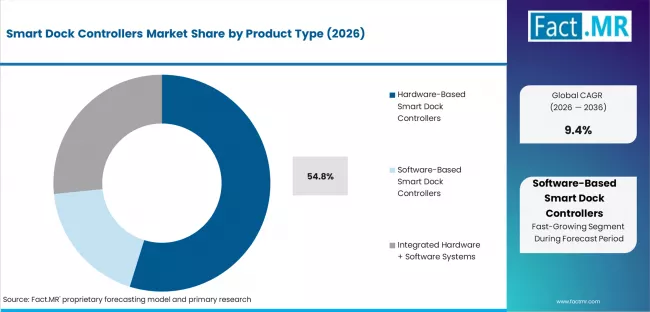
The Hardware-Based Smart Dock Controllers segment includes over half of the world Smart Dock Controllers sales and is projected to represent approximately 54.8% of the total market value in 2026. The primary factors supporting this leadership are a huge installed base of traditional docks, reduced upfront price, easy plug-and-play nature, and continued usage by mainstream gamers, console users, and PC users. Hardware-based models are still successful in the price-sensitive market where sophisticated software is not a necessity.
They are still massively used in console gaming stations, desktop gaming systems, handheld platforms, and mobile gaming platforms in which the primary factors of purchase are charging reliability, display output, and peripheral connectivity. Their cheap cost of ownership, wide compatibility and high retail presence remain in favor of high unit sales in the world.
Which Application Segment Dominates the Smart Dock Controllers Market?
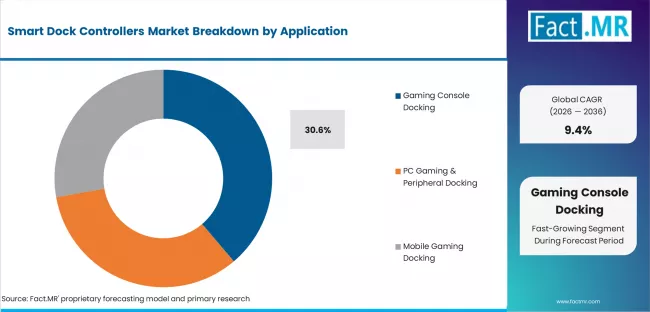
The Gaming Console Docking segment is expected to be the most valuable application category with an estimated 30.6% of market value in 2026. Segment leadership is supported by strong built-in console bases, frequent replacement of accessories and demand of structured charging and TV connectivity solutions.
Console docking products are still extensively utilized in controller charging, display output, cable management and the convenience of multiple devices. Near-term demand is likely to continue due to continued popularity of home consoles and upgrades to premium accessories.
Which Connectivity Type Segment Dominates the Smart Dock Controllers Market?
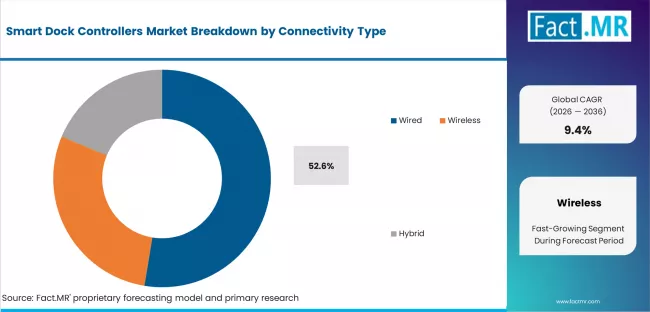
The Wired Connectivity segment is projected to hold around 52.6% of total market value in 2026, making it the dominant connectivity type. Leadership is supported by reliable charging, low-latency performance, stable display output, and universal compatibility across gaming and creator devices.
Wired smart dock controllers remain preferred among performance-focused users where uninterrupted connectivity and faster data transfer are key purchase considerations.
Which Price Range Segment Dominates the Smart Dock Controllers Market?
The Mid-Range segment is expected to account for nearly 46.3% of total market value in 2026, making it the largest price category. This segment benefits from balanced pricing, broad feature sets, and strong adoption among mainstream gamers.
Mid-range products typically offer fast charging, multiple ports, and strong compatibility without premium pricing, supporting higher unit demand.
Which Distribution Channel Segment Dominates the Smart Dock Controllers Market?
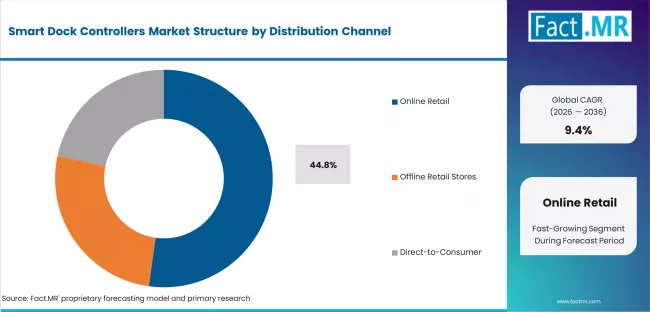
The Online Retail segment is projected to represent around 44.8% of total market value in 2026, emerging as the leading sales channel. Growth is driven by broad product availability, competitive pricing, direct brand access, and increasing consumer preference for digital purchasing.
Online channels also benefit from influencer marketing, product reviews, and rapid launch visibility for new smart dock controller products.
Regional Outlook Across Key Markets
- China leads growth at 11.5%, supported by rising domestic gaming demand, strong e-commerce penetration, handheld gaming expansion, and large-scale electronics manufacturing capabilities.
- North America shows stable growth, with the United States at 7.1% supported by high accessory spending, strong console installed base, and creator ecosystem demand, while Canada benefits from premium gaming hardware adoption and expanding esports participation.
- East Asia remains highly attractive, with Japan at 11.0% driven by established console gaming culture, premium hardware spending, and strong domestic gaming brands, while South Korea at 11.1% grows on advanced esports infrastructure, PC gaming demand, and preference for connected peripherals.
- European demand remains steady, with Germany at 6.7% supported by premium PC gaming peripherals, enthusiast users, and strong online retail penetration.
- South Asia & Pacific is emerging as a growth market, led by India and ASEAN countries due to rising smartphone gaming, expanding gaming communities, and increasing access to affordable accessories.
.webp)
CAGR Table
| Country | CAGR (%) |
|---|---|
| China | 11.5% |
| Japan | 11.0% |
| South Korea | 11.1% |
| Canada | 9.8% |
| United Kingdom | 7.2% |
| United States | 7.1% |
| Germany | 6.7% |
Source: Fact.MR (FMR) analysis, based on proprietary forecasting model and primary research.

Smart Dock Controllers Market Outlook in the United States
The United States Smart Dock Controllers Market Size is anticipated to witness a CAGR of 7.1% during the forecast period of 2022 to 2036. Demand is fueled by high gaming accessory expenditure, large console installed base, and growing creator workstation adoption. The market continues to be premium-led, replacement demand and ecosystem upgrades are the key elements of growth.
- Consoles and PC gaming penetration are high enough to sustain the need for recurring accessories.
- Premium docks and creator hubs continue to grow significantly.
- Well-developed retail networks and brand recognition within the category ensure that the demand remains strong.
Smart Dock Controllers Demand Trends in Canada
The Smart Dock Controllers Market in Canada is expected to witness growth at a steady pace during the period 2022-2036. Supported by the adoption of high-end gaming hardware, esports participation, and increase in the purchase of accessories online.
- Console gaming maintains a steady replacement market.
- Enthusiast consumers increasingly gravitating towards premium accessories.
- Advancement in e-commerce facilitates market accessibility.
United Kingdom Smart Dock Controllers Market Growth Outlook
The United Kingdom Smart Dock Controllers Market is expected to grow significantly by 2036. The growth in demand is being fueled by console gaming, creator economy growth, and a growing taste for high-end peripherals.
- Console ownership ensures a steady demand.
- New accessory opportunities are being created by makers’ setups
- Creator setups create new accessory ones.
- Premium product penetration is enhanced by the development of online stores.
Germany Smart Dock Controllers Market Demand Analysis
The Germany Smart Dock Controllers Market is estimated to grow at a CAGR of 6.7% through 2036. Demand is attributed to the robust PC gaming culture, high demand for premium peripherals, and passionate consumers.
- PC gaming still a massive source of demand.
- Higher average selling prices are supported by premium accessories.
- More advanced connectivity solutions are preferred by airheads.
China Smart Dock Controllers Market Growth Assessment
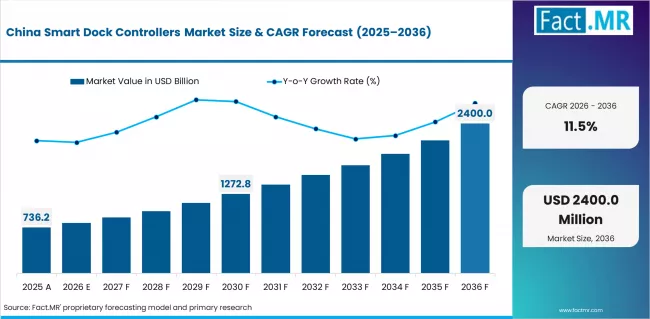
The China Smart Dock Controllers Market is projected to grow at a CAGR of 11.5% through 2036, making it a leading growth market. Growth is supported by rising gamer population, e-commerce scale, and manufacturing strength.
- Domestic gaming demand is the primary growth driver.
- Manufacturing scale supports pricing competitiveness.
- Handheld and mobile gaming widen demand potential.
India Smart Dock Controllers Market Opportunity Outlook
The India Smart Dock Controllers Market is projected to grow strongly through 2036. Demand is driven by smartphone gaming, expanding PC gaming communities, and rising demand for affordable accessories.
- Mobile gaming creates a large user base.
- PC gaming growth supports accessory adoption.
- Affordable products improve long-term penetration.
Competitive Benchmarking and Company Positioning
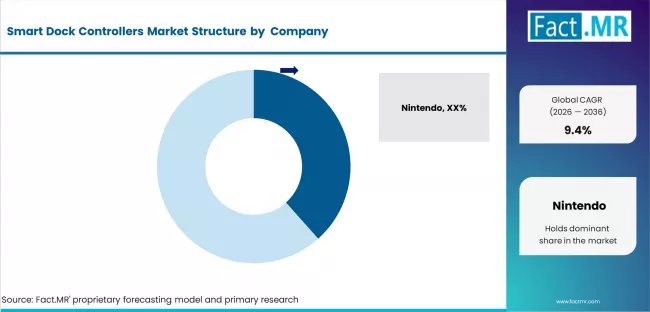
Smart Dock Controllers Market Analysis By Company
- Nintendo, Sony, Microsoft, and Valve manage to monopolize the global Smart Dock Controllers Market owing to the presence of official platform ecosystems, large gaming user base in the installed base and strong consumer trust on first-party accessory.
- Strong performers JSAUX, Genki, HORI, PowerA, and Skull & Co. in handheld gaming and value, and in multi-platform services, where competition is the greatest in pricing, portability, compatibility and features.
- ASUS, Razer, Corsair, and Elgato continue to excel in high-end gaming and creator-oriented docking products, with high-speed connectivity, display output, charging efficiency, and desktop integration as their differentiators.
The competition today is moderately fragmented between some console OEMs, specialist gaming accessory manufacturers, and premium PC hardware companies Nintendo, Sony, Microsoft and Valve are competing with each other on official compatibility, ecosystem integration, prominent retail visibility. These participants have the greatest opportunity to take advantage of hardware refresh cycles and recurring accessories replacement needs.
Below these leaders, JSAUX, Genki, HORI, PowerA and Skull&Co. hold a strong place in the world of handheld gaming, travel docks, and third party console peripherals. The pricetag: a slugfest on the same grounds: portability, openness, broader compatibility, and speedier product releases.
Key strategies are to increase handheld gaming portfolios, enhance multi-platform support, improve charging speed, and add scale in D2C and e-commerce channels. Companies that marry hardware innovation with compelling ecosystem positioning are likely to gain share over the long term.
Key Companies in the Smart Dock Controllers Market
- Key global companies leading the Smart Dock Controllers Market include:
- Nintendo, Sony, Microsoft, Valve are the big players worldwide in that sense, they have strong platform ecosystems, first party/offical accessory line-ups, large installed gaming user base that keeps recurring dock/charger accesory demand.
- JSAUX, Genki, HORI, PowerA and Skull & Co. are also prominent names that have been making a dent in the handheld gaming, console accessories as well as multi-platform dock categories with extensive product range, reasonable pricing and profound presence in the online retail scene.
- ASUS, Razer, Corsair, and Elgato remain fierce competitors in the premium gaming/creator-focused dock space, boasting high-end connectivity, power/charging capabilities, desktop integration, and brand loyalty within the enthusiast segment.
- Meanwhile, other specialist and regional brands continue to be heard from, their achievements in focused product introduction, price-point coverage, or niche depth in travel docks, creator hubs and handheld gaming adornments, making for competition in the scattered yet burgeoning market.
Recent Industry Developments
- Razer introduced the Razer USB 4 Dock, expanding its premium docking solutions portfolio with multi-port connectivity, high-speed data transfer, charging support, and multi-display functionality for gaming, productivity, and creator setups. [1]
- Nintendo announced the upcoming Nintendo Switch 2, creating a new upgrade cycle for official docks, charging stations, and compatible accessory ecosystems. [2]
- ASUS ROG introduced the ROG Bulwark Dock and 100W Gaming Charger Dock, expanding its gaming accessory portfolio with high-speed charging, HDMI output, and multi-device connectivity features. [3]
- JSAUX launched a two-in-one stand and docking station for ROG Ally X and other handheld gaming devices, combining ergonomic support with charging and connectivity functionality. [4]Razer introduced the Thunderbolt 5 Dock Chroma, expanding its premium smart dock portfolio with ultra-fast connectivity, multiple ports, and enhanced desktop integration. [5]
Leading Companies Shaping the Smart Dock Controllers Market
- Nintendo
- Sony
- Microsoft
- Genki
- JSAUX
- HORI
- Nyko
- PowerA
- Skull & Co.
- Valve
- ASUS
- Razer
- Corsair
- Elgato
Smart Dock Controllers Market by Segments
-
Smart Dock Controllers Market Segmented by Product Type:
- Hardware-Based Smart Dock Controllers
- Software-Based Smart Dock Controllers
- Integrated Hardware + Software Systems
-
Smart Dock Controllers Market Segmented by Platform Compatibility:
- Microsoft Windows Compatible
- Apple macOS Compatible
- Android Compatible
- iOS Compatible
- Multi-Platform Compatible
-
Smart Dock Controllers Market Segmented by Connectivity Type:
- Wired
- Wireless
- Hybrid
-
Smart Dock Controllers Market Segmented by Application:
- Gaming Console Docking
- PC Gaming & Peripheral Docking
- Mobile Gaming Docking
- VR / AR Gaming Docking
- Streaming & Content Creator Docking
-
Smart Dock Controllers Market Segmented by Price Range:
- Economy
- Mid-Range
- Premium
-
Smart Dock Controllers Market Segmented by Distribution Channel:
- Online Retail
- Offline Retail Stores
- Direct-to-Consumer
- Gaming Specialty Stores
-
Smart Dock Controllers Market by Region:
- North America
- USA
- Canada
- Mexico
- Latin America
- Brazil
- Chile
- Rest of Latin America
- Western Europe
- Germany
- UK
- Italy
- Spain
- France
- Nordic Countries
- BENELUX
- Rest of Western Europe
- Eastern Europe
- Russia
- Poland
- Hungary
- Balkan & Baltic Countries
- Rest of Eastern Europe
- East Asia
- China
- Japan
- South Korea
- South Asia & Pacific
- India
- ASEAN
- Australia & New Zealand
- Rest of South Asia & Pacific
- Middle East & Africa
- Kingdom of Saudi Arabia
- Other GCC Countries
- Türkiye
- South Africa
- Rest of Africa
- Rest of Middle East & Africa
- North America
Sources and Research References
- Razer introduced the Razer USB 4 Dock, expanding its premium docking solutions portfolio with multi-port connectivity, high-speed data transfer, charging support, and multi-display functionality for gaming, productivity, and creator setups. [1]
- Nintendo announced the upcoming Nintendo Switch 2, creating a new upgrade cycle for official docks, charging stations, and compatible accessory ecosystems. [2]
- ASUS ROG introduced the ROG Bulwark Dock and 100W Gaming Charger Dock, expanding its gaming accessory portfolio with high-speed charging, HDMI output, and multi-device connectivity features. [3]
- JSAUX launched a two-in-one stand and docking station for ROG Ally X and other handheld gaming devices, combining ergonomic support with charging and connectivity functionality. [4]
- Razer introduced the Thunderbolt 5 Dock Chroma, expanding its premium smart dock portfolio with ultra-fast connectivity, multiple ports, and enhanced desktop integration. [5]
This Report Answers
- What is the current and future size of the Smart Dock Controllers Market?
- How fast is the Smart Dock Controllers Market expected to grow between 2026 and 2036?
- Which product type is likely to lead the market by 2026?
- Which application segment is expected to account for the highest demand by 2026?
- What factors are driving global demand for smart dock controllers?
- How is the shift toward multifunction and connected docking systems influencing the market?
- Why is China emerging as one of the fastest-growing markets?
- How are handheld gaming devices, esports, and creator ecosystems supporting demand?
- Which countries are projected to show the fastest growth through 2036?
- What is driving market expansion in China, Japan, South Korea, and the United States?
- Who are the key companies active in the Smart Dock Controllers Market?
- How does Fact.MR estimate and validate the market forecast?
Smart Dock Controllers Market Definition
The Smart Dock Controllers Market encompasses smart docking devices that serve to offer charging, connectivity, display output and peripheral intertwining through gaming and digital entertainment systems whereby a smooth multi-device management is necessary. It encompasses hardware enabled, software-based and integrated systems found in gaming consoles, PC gaming, handheld devices, mobile gaming, VR/AR platforms and creator workstations.
Smart Dock Controllers Market Inclusions
- The scope includes global and regional market size and projections up to 2026 and 2036 by product type, platform compatibility, connectivity type, application, price range, distribution channel and region.
- It consists of regional demand research of key geographies through aspects like gaming hardware adoption, esports participation, handheld gaming development, creator economy development, and e-commerce penetration.
- The report encompasses pricing and cost analysis of economy, mid-range, and premium products, hardware components, chipsets, charging modules, cooling systems and software enabled features.
- It includes technology trends, market drivers and restraints, and competitive landscape, product portfolios, pricing strategies, geographic reach, ecosystem positioning, and channel expansion of the leading players.
Smart Dock Controllers Market Exclusions
- The scope does not encompass general-purpose laptop docks, office docking stations, USB hubs, wall chargers, passive stands and charging accessories that are not designed to be smart dock controllers.
- It does not cover software-only utilities, standalone mobile applications, RGB control software, firmware tools, and connectivity management platforms sold without dock hardware.
- The report does not consider enterprise workstation docks, industrial docking systems, automotive docking systems, marine docking systems or warehouse docking controllers that are not related to gaming or creator applications.
- It also does not cover informal unbranded products that have low market presence, rental/leasing services where no hardware is sold, and non-docking gaming accessories like regular cables, controller skins or desk organizers.
Smart Dock Controllers Market Methodology
- The research design is a mixture of secondary research, primary interview, and forecast modelling.
- It uses 110+ secondary sources, and compares 60+ company product portfolios.
- Market sizing is done across 25+ countries via a demand side model with top down validation.
- Some of the important inputs are the gamer population, console installed base, PC gaming penetration, and handheld device adoption, access to e-commerce, and consumer spending on accessories.
- The model balances demand and shipments, price trends, channel mix, and product introductions.
- Primary validation will involve 25 or more interviews with manufacturers, distributors, retailers, esports users, and content creators.
- Final estimates are subjected to trade-flow checks, online sales trend review and sensitivity testing.
Report Scope

| Parameter | Details |
|---|---|
| Quantitative Units | USD 1.3 billion to USD 3.2 billion, at a CAGR of 9.4% |
| Market Definition | The Smart Dock Controllers Market covers intelligent docking devices used for charging, connectivity, display output, and peripheral integration across gaming consoles, PCs, handheld devices, mobile gaming, VR/AR platforms, and creator workstations through hardware-based, software-enabled, and integrated formats. |
| Regions Covered | North America, Latin America, Europe, East Asia, South Asia & Pacific, Middle East & Africa |
| Countries Covered | USA, Canada, Mexico, UK, Germany, France, China, Japan, South Korea, India, Australia, Brazil, and 25+ countries |
| Key Companies | Nintendo, Sony, Microsoft, Genki, JSAUX, HORI, PowerA, Skull & Co., Valve, ASUS, Razer, Corsair, Elgato |
| Forecast Period | 2026 to 2036 |
| Approach | Hybrid demand-side and top-down methodology built on country-level gaming accessory demand, installed gamer base, product benchmarking, pricing analysis, shipment validation, e-commerce tracking, and primary interviews across manufacturers, distributors, retailers, esports users, and creators. |
- Frequently Asked Questions -
How big is the Smart Dock Controllers Market in 2025?
The global Smart Dock Controllers Market is estimated to be valued at USD 1.2 billion in 2025
What will be the size of the Smart Dock Controllers Market in 2036?
The market size for the Smart Dock Controllers Market is projected to reach USD 3.2 billion by 2036.
How much will the Smart Dock Controllers Market grow between 2026 and 2036?
The Smart Dock Controllers Market is expected to grow at a 9.4% CAGR between 2026 and 2036.
What are the key product types in the Smart Dock Controllers Market?
The key product types in the Smart Dock Controllers Market are Hardware-Based Smart Dock Controllers, Software-Based Smart Dock Controllers, and Integrated Hardware + Software Systems.
Which application segment will contribute significant share in the Smart Dock Controllers Market in 2026?
In terms of application, Gaming Console Docking is expected to account for 30.6% share in the Smart Dock Controllers Market in 2026.
Table of Content
- Smart Dock Controllers Market - Executive Summary
- Market Overview
- Market Definition and Introduction
- Market Taxonomy/ Research Scope
- Global Smart Dock Controllers Market Demand Analysis 2021-2025 and Forecast, 2026–2036
- Historical Market Volume Analysis, 2021-2025
- Current and Future Market Volume Forecast, 2026–2036
- Y-o-Y Growth Trend Analysis
- Global Smart Dock Controllers Market - Pricing Analysis
- Product Category and Country-Level Pricing Analysis
- Global Average Pricing Analysis Benchmark
- Factors Influencing Pricing
- Cost Structure Analysis: Elementary Deep Dive
- Competitive Pricing Strategies
- Price Trends and Forecasts
- Historical price trends
- Future price forecasts
- Global Smart Dock Controllers Market Demand Analysis 2021-2025 and Forecast, 2026–2036
- Historical Market Value Analysis, 2021-2025
- Current and Future Market Value Forecast, 2026–2036
- Y-o-Y Growth Trend Analysis
- Absolute $ Opportunity Analysis
- Market Background and Foundation Data
- Global Gaming Accessories Market Overview, 2025
- By Product Type
- By Connectivity Type
- By Application
- By Region
- Penetration of Smart Dock Controllers in Global Gaming Accessories Market, 2025
- Evolution of Smart Dock Controllers (Basic Docks → Multi-Port Docks → Smart Connected Systems)
- Stage 1: Basic Charging Docks and Passive Stands
- Stage 2: Multi-Port Display and Charging Docks
- Stage 3: High-Speed Console / PC Smart Docks
- Stage 4: AI-Enabled / App-Controlled Smart Dock Controllers
- Consumer Adoption and Usage Trends
- Share of Console vs PC vs Mobile Gaming Users
- Adoption of Wired vs Wireless Dock Controllers
- Consumer Preference for Multi-Device Docking Setups
- % of Gamers Using Premium Docking Accessories
- Gaming Ecosystem and Device Usage Trends
- Growth in Console Installed Base and Handheld Devices
- Rise in PC Gaming and Peripheral Expansion
- Expansion of Mobile Gaming and Cross-Platform Play
- Increasing Demand for Creator and Streaming Workstations
- Smart Dock Controllers Market Opportunity Assessment
- Total Available Market (US$ Bn)
- Serviceable Addressable Market (US$ Bn)
- Serviceable Obtainable Market (US$ Bn)
- Technology and Connectivity Landscape
- Penetration of Fast-Charging Dock Controllers
- USB-C / HDMI / Multi-Port Dock Adoption
- Growth in Cooling and RGB-Enabled Docks
- App Control and Firmware Integration Trends
- Retail and Distribution Foundation Analysis
- Share of Online vs Offline Sales
- Growth of Direct-to-Consumer Channels
- Importance of Gaming Specialty Retailers
- Seasonal Demand Trends by Channel
- Porter’s Five Forces and PESTEL Analysis
- Investment Feasibility Analysis
- Macro-Economic Factors
- Forecast Factors - Relevance & Impact
- Industry Value and Supply Chain Analysis
- List of Key Channel Partners
- Profit Margin & Operating Margin at Each Node of Supply Chain.
- Notes on Value Added at Each Node in the Value Chain
- Factors Influencing Value Chain
- Market Dynamics
- Drivers
- Restraints
- Opportunity Analysis
- Key Regulations & Certifications
- Global Gaming Accessories Market Overview, 2025
- Global Smart Dock Controllers Market Analysis 2021-2025 and Forecast 2026–2036, By Product Type
- Introduction / Key Findings
- Market Size & Volume Analysis by Market Taxonomy, 2021–2036
- Hardware-Based Smart Dock Controllers
- Software-Based Smart Dock Controllers
- Integrated Hardware + Software Systems
- Market Attractiveness Analysis by Product Type
- Global Smart Dock Controllers Market Analysis 2021-2025 and Forecast 2026–2036, By Platform Compatibility
- Introduction / Key Findings
- Market Size & Volume Analysis by Market Taxonomy, 2021–2036
- Microsoft Windows Compatible
- Apple macOS Compatible
- Android Compatible
- iOS Compatible
- Multi-Platform Compatible
- Market Attractiveness Analysis by Platform Compatibility
- Global Smart Dock Controllers Market Analysis 2021-2025 and Forecast 2026–2036, By Connectivity Type
- Introduction / Key Findings
- Market Size & Volume Analysis by Market Taxonomy, 2021–2036
- Wired
- Wireless
- Hybrid
- Market Attractiveness Analysis by Connectivity Type
- Global Smart Dock Controllers Market Analysis 2021-2025 and Forecast 2026–2036, By Application
- Introduction / Key Findings
- Market Size & Volume Analysis by Market Taxonomy, 2021–2036
- Gaming Console Docking
- PC Gaming & Peripheral Docking
- Mobile Gaming Docking
- VR / AR Gaming Docking
- Streaming & Content Creator Docking
- Market Attractiveness Analysis by Application
- Global Smart Dock Controllers Market Analysis 2021-2025 and Forecast 2026–2036, By Price Range
- Introduction / Key Findings
- Market Size & Volume Analysis by Market Taxonomy, 2021–2036
- Economy
- Mid-Range
- Premium
- Market Attractiveness Analysis by Price Range
- Global Smart Dock Controllers Market Analysis 2021-2025 and Forecast 2026–2036, By Distribution Channel
- Introduction / Key Findings
- Market Size & Volume Analysis by Market Taxonomy, 2021–2036
- Online Retail
- Offline Retail Stores
- Direct-to-Consumer
- Gaming Specialty Stores
- Market Attractiveness Analysis by Distribution Channel
- Global Smart Dock Controllers Market Analysis and Forecast, by Region
- Introduction / Key Findings
- Market Size & Volume Analysis by Market Taxonomy, 2021–2036
- North America
- Latin America
- Western Europe
- Eastern Europe
- East Asia
- South Asia & Pacific
- Middle East & Africa
- Market Attractiveness Analysis by Region
- North America Smart Dock Controllers Market Analysis and Forecast
- Market Size & Volume Analysis by Market Taxonomy, 2021–2036
- By Country
- United States
- Canada
- Mexico
- By Taxonomy
- By Product Type
- By Platform Compatibility
- By Connectivity Type
- By Application
- By Price Range
- By Sales Channel
- By Country
- Market Attractiveness Analysis by Country & Taxonomy
- Market Size & Volume Analysis by Market Taxonomy, 2021–2036
- Latin America Smart Dock Controllers Market Analysis and Forecast
- Market Size & Volume Analysis by Market Taxonomy, 2021–2036
- By Country
- Brazil
- Chile
- Rest of LATAM
- By Taxonomy
- By Product Type
- By Platform Compatibility
- By Connectivity Type
- By Application
- By Price Range
- By Sales Channel
- By Country
- Market Attractiveness Analysis by Country & Taxonomy
- Market Size & Volume Analysis by Market Taxonomy, 2021–2036
- Western Europe Smart Dock Controllers Market Analysis and Forecast
- Market Size & Volume Analysis by Market Taxonomy, 2021–2036
- By Country
- Germany
- Italy
- France
- United Kingdom
- Spain
- BENELUX
- Nordics
- Rest of Western Europe
- By Taxonomy
- By Product Type
- By Platform Compatibility
- By Connectivity Type
- By Application
- By Price Range
- By Sales Channel
- By Country
- Market Attractiveness Analysis by Country & Taxonomy
- Market Size & Volume Analysis by Market Taxonomy, 2021–2036
- Eastern Europe Smart Dock Controllers Market Analysis and Forecast
- Market Size & Volume Analysis by Market Taxonomy, 2021–2036
- By Country
- Russia
- Hungary
- Poland
- Balkan & Baltics
- Rest of Eastern Europe
- By Taxonomy
- By Product Type
- By Platform Compatibility
- By Connectivity Type
- By Application
- By Price Range
- By Sales Channel
- By Country
- Market Attractiveness Analysis by Country & Taxonomy
- Market Size & Volume Analysis by Market Taxonomy, 2021–2036
- East Asia Smart Dock Controllers Market Analysis and Forecast
- Market Size & Volume Analysis by Market Taxonomy, 2021–2036
- By Country
- China
- Japan
- South Korea
- By Taxonomy
- By Product Type
- By Platform Compatibility
- By Connectivity Type
- By Application
- By Price Range
- By Sales Channel
- By Country
- Market Attractiveness Analysis by Country & Taxonomy
- Market Size & Volume Analysis by Market Taxonomy, 2021–2036
- South Asia & Pacific Smart Dock Controllers Market Analysis and Forecast
- Market Size & Volume Analysis by Market Taxonomy, 2021–2036
- By Country
- India
- ASEAN
- Australia & New Zealand
- Rest of South Asia & Pacific
- By Taxonomy
- By Product Type
- By Platform Compatibility
- By Connectivity Type
- By Application
- By Price Range
- By Sales Channel
- By Country
- Market Attractiveness Analysis by Country & Taxonomy
- Market Size & Volume Analysis by Market Taxonomy, 2021–2036
- Middle East & Africa Smart Dock Controllers Market Analysis and Forecast
- Market Size & Volume Analysis by Market Taxonomy, 2021–2036
- By Country
- Kingdom of Saudi Arabia
- Other GCC Countries
- Turkiye
- South Africa
- Other African Union
- By Taxonomy
- By Product Type
- By Platform Compatibility
- By Connectivity Type
- By Application
- By Price Range
- By Sales Channel
- By Country
- Market Attractiveness Analysis by Country & Taxonomy
- Market Size & Volume Analysis by Market Taxonomy, 2021–2036
- Country-level Smart Dock Controllers Market Analysis and Forecast
- Introduction
- Market Value Proportion Analysis, By Key Countries
- Global Vs. Country Growth Comparison
- United States Smart Dock Controllers Market Analysis
- Market Size & Volume Analysis by Market Taxonomy, 2021–2036
- By Product Type
- By Platform Compatibility
- By Connectivity Type
- By Application
- By Price Range
- Market Size & Volume Analysis by Market Taxonomy, 2021–2036
- Introduction
- *Same Analysis will be providing for each of the countries mentioned below
- Canada Smart Dock Controllers Market Analysis
- Mexico Smart Dock Controllers Market Analysis
- Brazil Smart Dock Controllers Market Analysis
- Chile Smart Dock Controllers Market Analysis
- Germany Smart Dock Controllers Market Analysis
- France Smart Dock Controllers Market Analysis
- Italy Smart Dock Controllers Market Analysis
- Spain Smart Dock Controllers Market Analysis
- United Kingdom Smart Dock Controllers Market Analysis
- BENELUX Smart Dock Controllers Market Analysis
- Nordics Smart Dock Controllers Market Analysis
- Poland Smart Dock Controllers Market Analysis
- Russia Smart Dock Controllers Market Analysis
- Hungary Smart Dock Controllers Market Analysis
- Balkan & Baltics Smart Dock Controllers Market Analysis
- China Smart Dock Controllers Market Analysis
- Japan Smart Dock Controllers Market Analysis
- South Korea Smart Dock Controllers Market Analysis
- India Smart Dock Controllers Market Analysis
- ASEAN Smart Dock Controllers Market Analysis
- ANZ Smart Dock Controllers Market Analysis
- KSA Smart Dock Controllers Market Analysis
- Other GCC Countries Smart Dock Controllers Market Analysis
- South Africa Smart Dock Controllers Market Analysis
- Turkiye Smart Dock Controllers Market Analysis
- Smart Dock Controllers Market Structure Analysis
- Market Analysis by Tier of Companies
- Market Share Analysis of Top Players
- Market Space for New Brands and Dollar Opportunity
- Market Presence Analysis
- Regional Footprint of Players
- Product Footprint by Players
- Application Footprint by Players
- Smart Dock Controllers Competition Analysis
- Competition Dashboard
- Pricing Analysis by Competition
- Competition Benchmarking
- Competition Deep Dive
- Nintendo
- Overview
- Product Portfolio
- Sales Footprint
- Key Developments
- SWOT Analysis
- Strategy Overview
- Key Financials
- Sony
- Microsoft
- Genki
- JSAUX
- HORI
- Nyko
- PowerA
- Skull & Co.
- Valve
- ASUS
- Razer
- Corsair
- Elgato
- Other Prominent Players
- Nintendo
- Primary Insights
- Assumption & Acronyms Used
- Research Methodology & Data Sources
List Of Table
- Table 40: Latin America Market Volume (Units) Forecast by Price Range, 2021 to 2036
- Table 41: Latin America Market Value (USD Bn) Forecast by Distribution Channel, 2021 to 2036
- Table 42: Latin America Market Volume (Units) Forecast by Distribution Channel, 2021 to 2036
- Table 43: Western Europe Market Value (USD Bn) Forecast by Country, 2021 to 2036
- Table 44: Western Europe Market Volume (Units) Forecast by Country, 2021 to 2036
- Table 45: Western Europe Market Value (USD Bn) Forecast by Product Type, 2021 to 2036
- Table 46: Western Europe Market Volume (Units) Forecast by Product Type, 2021 to 2036
- Table 47: Western Europe Market Value (USD Bn) Forecast by Platform Compatibility, 2021 to 2036
- Table 48: Western Europe Market Volume (Units) Forecast by Platform Compatibility, 2021 to 2036
- Table 49: Western Europe Market Value (USD Bn) Forecast by Connectivity Type, 2021 to 2036
- Table 50: Western Europe Market Volume (Units) Forecast by Connectivity Type, 2021 to 2036
- Table 51: Western Europe Market Value (USD Bn) Forecast by Application, 2021 to 2036
- Table 52: Western Europe Market Volume (Units) Forecast by Application, 2021 to 2036
- Table 53: Western Europe Market Value (USD Bn) Forecast by Price Range, 2021 to 2036
- Table 54: Western Europe Market Volume (Units) Forecast by Price Range, 2021 to 2036
- Table 55: Western Europe Market Value (USD Bn) Forecast by Distribution Channel, 2021 to 2036
- Table 56: Western Europe Market Volume (Units) Forecast by Distribution Channel, 2021 to 2036
- Table 57: Eastern Europe Market Value (USD Bn) Forecast by Country, 2021 to 2036
- Table 58: Eastern Europe Market Volume (Units) Forecast by Country, 2021 to 2036
- Table 59: Eastern Europe Market Value (USD Bn) Forecast by Product Type, 2021 to 2036
- Table 60: Eastern Europe Market Volume (Units) Forecast by Product Type, 2021 to 2036
- Table 61: Eastern Europe Market Value (USD Bn) Forecast by Platform Compatibility, 2021 to 2036
- Table 62: Eastern Europe Market Volume (Units) Forecast by Platform Compatibility, 2021 to 2036
- Table 63: Eastern Europe Market Value (USD Bn) Forecast by Connectivity Type, 2021 to 2036
- Table 64: Eastern Europe Market Volume (Units) Forecast by Connectivity Type, 2021 to 2036
- Table 65: Eastern Europe Market Value (USD Bn) Forecast by Application, 2021 to 2036
- Table 66: Eastern Europe Market Volume (Units) Forecast by Application, 2021 to 2036
- Table 67: Eastern Europe Market Value (USD Bn) Forecast by Price Range, 2021 to 2036
- Table 68: Eastern Europe Market Volume (Units) Forecast by Price Range, 2021 to 2036
- Table 69: Eastern Europe Market Value (USD Bn) Forecast by Distribution Channel, 2021 to 2036
- Table 70: Eastern Europe Market Volume (Units) Forecast by Distribution Channel, 2021 to 2036
- Table 71: East Asia Market Value (USD Bn) Forecast by Country, 2021 to 2036
- Table 72: East Asia Market Volume (Units) Forecast by Country, 2021 to 2036
- Table 73: East Asia Market Value (USD Bn) Forecast by Product Type, 2021 to 2036
- Table 74: East Asia Market Volume (Units) Forecast by Product Type, 2021 to 2036
- Table 75: East Asia Market Value (USD Bn) Forecast by Platform Compatibility, 2021 to 2036
- Table 76: East Asia Market Volume (Units) Forecast by Platform Compatibility, 2021 to 2036
- Table 77: East Asia Market Value (USD Bn) Forecast by Connectivity Type, 2021 to 2036
- Table 78: East Asia Market Volume (Units) Forecast by Connectivity Type, 2021 to 2036
- Table 79: East Asia Market Value (USD Bn) Forecast by Application, 2021 to 2036
- Table 80: East Asia Market Volume (Units) Forecast by Application, 2021 to 2036
- Table 81: East Asia Market Value (USD Bn) Forecast by Price Range, 2021 to 2036
- Table 82: East Asia Market Volume (Units) Forecast by Price Range, 2021 to 2036
- Table 83: East Asia Market Value (USD Bn) Forecast by Distribution Channel, 2021 to 2036
- Table 84: East Asia Market Volume (Units) Forecast by Distribution Channel, 2021 to 2036
- Table 85: South Asia and Pacific Market Value (USD Bn) Forecast by Country, 2021 to 2036
- Table 86: South Asia and Pacific Market Volume (Units) Forecast by Country, 2021 to 2036
- Table 87: South Asia and Pacific Market Value (USD Bn) Forecast by Product Type, 2021 to 2036
- Table 88: South Asia and Pacific Market Volume (Units) Forecast by Product Type, 2021 to 2036
- Table 89: South Asia and Pacific Market Value (USD Bn) Forecast by Platform Compatibility, 2021 to 2036
- Table 90: South Asia and Pacific Market Volume (Units) Forecast by Platform Compatibility, 2021 to 2036
- Table 91: South Asia and Pacific Market Value (USD Bn) Forecast by Connectivity Type, 2021 to 2036
- Table 92: South Asia and Pacific Market Volume (Units) Forecast by Connectivity Type, 2021 to 2036
- Table 93: South Asia and Pacific Market Value (USD Bn) Forecast by Application, 2021 to 2036
- Table 94: South Asia and Pacific Market Volume (Units) Forecast by Application, 2021 to 2036
- Table 95: South Asia and Pacific Market Value (USD Bn) Forecast by Price Range, 2021 to 2036
- Table 96: South Asia and Pacific Market Volume (Units) Forecast by Price Range, 2021 to 2036
- Table 97: South Asia and Pacific Market Value (USD Bn) Forecast by Distribution Channel, 2021 to 2036
- Table 98: South Asia and Pacific Market Volume (Units) Forecast by Distribution Channel, 2021 to 2036
- Table 99: Middle East & Africa Market Value (USD Bn) Forecast by Country, 2021 to 2036
- Table 100: Middle East & Africa Market Volume (Units) Forecast by Country, 2021 to 2036
- Table 101: Middle East & Africa Market Value (USD Bn) Forecast by Product Type, 2021 to 2036
- Table 102: Middle East & Africa Market Volume (Units) Forecast by Product Type, 2021 to 2036
- Table 103: Middle East & Africa Market Value (USD Bn) Forecast by Platform Compatibility, 2021 to 2036
- Table 104: Middle East & Africa Market Volume (Units) Forecast by Platform Compatibility, 2021 to 2036
- Table 105: Middle East & Africa Market Value (USD Bn) Forecast by Connectivity Type, 2021 to 2036
- Table 106: Middle East & Africa Market Volume (Units) Forecast by Connectivity Type, 2021 to 2036
- Table 107: Middle East & Africa Market Value (USD Bn) Forecast by Application, 2021 to 2036
- Table 108: Middle East & Africa Market Volume (Units) Forecast by Application, 2021 to 2036
- Table 109: Middle East & Africa Market Value (USD Bn) Forecast by Price Range, 2021 to 2036
- Table 110: Middle East & Africa Market Volume (Units) Forecast by Price Range, 2021 to 2036
- Table 111: Middle East & Africa Market Value (USD Bn) Forecast by Distribution Channel, 2021 to 2036
- Table 112: Middle East & Africa Market Volume (Units) Forecast by Distribution Channel, 2021 to 2036
List Of Figures
- Figure 1: Global Market Volume (Units) Forecast 2021–2036
- Figure 2: Global Market Pricing Analysis
- Figure 3: Global Market Value (USD Bn) Forecast 2021–2036
- Figure 4: Global Market Value Share and BPS Analysis by Product Type, 2026 and 2036
- Figure 5: Global Market Y-o-Y Growth Comparison by Product Type, 2026–2036
- Figure 6: Global Market Attractiveness Analysis by Product Type
- Figure 7: Global Market Value Share and BPS Analysis by Platform Compatibility, 2026 and 2036
- Figure 8: Global Market Y-o-Y Growth Comparison by Platform Compatibility, 2026–2036
- Figure 9: Global Market Attractiveness Analysis by Platform Compatibility
- Figure 10: Global Market Value Share and BPS Analysis by Connectivity Type, 2026 and 2036
- Figure 11: Global Market Y-o-Y Growth Comparison by Connectivity Type, 2026–2036
- Figure 12: Global Market Attractiveness Analysis by Connectivity Type
- Figure 13: Global Market Value Share and BPS Analysis by Application, 2026 and 2036
- Figure 14: Global Market Y-o-Y Growth Comparison by Application, 2026–2036
- Figure 15: Global Market Attractiveness Analysis by Application
- Figure 16: Global Market Value Share and BPS Analysis by Price Range, 2026 and 2036
- Figure 17: Global Market Y-o-Y Growth Comparison by Price Range, 2026–2036
- Figure 18: Global Market Attractiveness Analysis by Price Range
- Figure 19: Global Market Value Share and BPS Analysis by Distribution Channel, 2026 and 2036
- Figure 20: Global Market Y-o-Y Growth Comparison by Distribution Channel, 2026–2036
- Figure 21: Global Market Attractiveness Analysis by Distribution Channel
- Figure 22: Global Market Value (USD Bn) Share and BPS Analysis by Region, 2026 and 2036
- Figure 23: Global Market Y-o-Y Growth Comparison by Region, 2026–2036
- Figure 24: Global Market Attractiveness Analysis by Region
- Figure 25: North America Market Incremental $ Opportunity, 2026–2036
- Figure 26: Latin America Market Incremental $ Opportunity, 2026–2036
- Figure 27: Western Europe Market Incremental $ Opportunity, 2026–2036
- Figure 28: Eastern Europe Market Incremental $ Opportunity, 2026–2036
- Figure 29: East Asia Market Incremental $ Opportunity, 2026–2036
- Figure 30: South Asia and Pacific Market Incremental $ Opportunity, 2026–2036
- Figure 31: Middle East & Africa Market Incremental $ Opportunity, 2026–2036
- Figure 32: North America Market Value Share and BPS Analysis by Country, 2026 and 2036
- Figure 33: North America Market Value Share and BPS Analysis by Product Type, 2026 and 2036
- Figure 34: North America Market Y-o-Y Growth Comparison by Product Type, 2026–2036
- Figure 35: North America Market Attractiveness Analysis by Product Type
- Figure 36: North America Market Value Share and BPS Analysis by Platform Compatibility, 2026 and 2036
- Figure 37: North America Market Y-o-Y Growth Comparison by Platform Compatibility, 2026–2036
- Figure 38: North America Market Attractiveness Analysis by Platform Compatibility
- Figure 39: North America Market Value Share and BPS Analysis by Connectivity Type, 2026 and 2036
- Figure 40: North America Market Y-o-Y Growth Comparison by Connectivity Type, 2026–2036
- Figure 41: North America Market Attractiveness Analysis by Connectivity Type
- Figure 42: North America Market Value Share and BPS Analysis by Application, 2026 and 2036
- Figure 43: North America Market Y-o-Y Growth Comparison by Application, 2026–2036
- Figure 44: North America Market Attractiveness Analysis by Application
- Figure 45: North America Market Value Share and BPS Analysis by Price Range, 2026 and 2036
- Figure 46: North America Market Y-o-Y Growth Comparison by Price Range, 2026–2036
- Figure 47: North America Market Attractiveness Analysis by Price Range
- Figure 48: North America Market Value Share and BPS Analysis by Distribution Channel, 2026 and 2036
- Figure 49: North America Market Y-o-Y Growth Comparison by Distribution Channel, 2026–2036
- Figure 50: North America Market Attractiveness Analysis by Distribution Channel
- Figure 51: Latin America Market Value Share and BPS Analysis by Country, 2026 and 2036
- Figure 52: Latin America Market Value Share and BPS Analysis by Product Type, 2026 and 2036
- Figure 53: Latin America Market Y-o-Y Growth Comparison by Product Type, 2026–2036
- Figure 54: Latin America Market Attractiveness Analysis by Product Type
- Figure 55: Latin America Market Value Share and BPS Analysis by Platform Compatibility, 2026 and 2036
- Figure 56: Latin America Market Y-o-Y Growth Comparison by Platform Compatibility, 2026–2036
- Figure 57: Latin America Market Attractiveness Analysis by Platform Compatibility
- Figure 58: Latin America Market Value Share and BPS Analysis by Connectivity Type, 2026 and 2036
- Figure 59: Latin America Market Y-o-Y Growth Comparison by Connectivity Type, 2026–2036
- Figure 60: Latin America Market Attractiveness Analysis by Connectivity Type
- Figure 61: Latin America Market Value Share and BPS Analysis by Application, 2026 and 2036
- Figure 62: Latin America Market Y-o-Y Growth Comparison by Application, 2026–2036
- Figure 63: Latin America Market Attractiveness Analysis by Application
- Figure 64: Latin America Market Value Share and BPS Analysis by Price Range, 2026 and 2036
- Figure 65: Latin America Market Y-o-Y Growth Comparison by Price Range, 2026–2036
- Figure 66: Latin America Market Attractiveness Analysis by Price Range
- Figure 67: Latin America Market Value Share and BPS Analysis by Distribution Channel, 2026 and 2036
- Figure 68: Latin America Market Y-o-Y Growth Comparison by Distribution Channel, 2026–2036
- Figure 69: Latin America Market Attractiveness Analysis by Distribution Channel
- Figure 70: Western Europe Market Value Share and BPS Analysis by Country, 2026 and 2036
- Figure 71: Western Europe Market Value Share and BPS Analysis by Product Type, 2026 and 2036
- Figure 72: Western Europe Market Y-o-Y Growth Comparison by Product Type, 2026–2036
- Figure 73: Western Europe Market Attractiveness Analysis by Product Type
- Figure 74: Western Europe Market Value Share and BPS Analysis by Platform Compatibility, 2026 and 2036
- Figure 75: Western Europe Market Y-o-Y Growth Comparison by Platform Compatibility, 2026–2036
- Figure 76: Western Europe Market Attractiveness Analysis by Platform Compatibility
- Figure 77: Western Europe Market Value Share and BPS Analysis by Connectivity Type, 2026 and 2036
- Figure 78: Western Europe Market Y-o-Y Growth Comparison by Connectivity Type, 2026–2036
- Figure 79: Western Europe Market Attractiveness Analysis by Connectivity Type
- Figure 80: Western Europe Market Value Share and BPS Analysis by Application, 2026 and 2036
- Figure 81: Western Europe Market Y-o-Y Growth Comparison by Application, 2026–2036
- Figure 82: Western Europe Market Attractiveness Analysis by Application
- Figure 83: Western Europe Market Value Share and BPS Analysis by Price Range, 2026 and 2036
- Figure 84: Western Europe Market Y-o-Y Growth Comparison by Price Range, 2026–2036
- Figure 85: Western Europe Market Attractiveness Analysis by Price Range
- Figure 86: Western Europe Market Value Share and BPS Analysis by Distribution Channel, 2026 and 2036
- Figure 87: Western Europe Market Y-o-Y Growth Comparison by Distribution Channel, 2026–2036
- Figure 88: Western Europe Market Attractiveness Analysis by Distribution Channel
- Figure 89: Eastern Europe Market Value Share and BPS Analysis by Country, 2026 and 2036
- Figure 90: Eastern Europe Market Value Share and BPS Analysis by Product Type, 2026 and 2036
- Figure 91: Eastern Europe Market Y-o-Y Growth Comparison by Product Type, 2026–2036
- Figure 92: Eastern Europe Market Attractiveness Analysis by Product Type
- Figure 93: Eastern Europe Market Value Share and BPS Analysis by Platform Compatibility, 2026 and 2036
- Figure 94: Eastern Europe Market Y-o-Y Growth Comparison by Platform Compatibility, 2026–2036
- Figure 95: Eastern Europe Market Attractiveness Analysis by Platform Compatibility
- Figure 96: Eastern Europe Market Value Share and BPS Analysis by Connectivity Type, 2026 and 2036
- Figure 97: Eastern Europe Market Y-o-Y Growth Comparison by Connectivity Type, 2026–2036
- Figure 98: Eastern Europe Market Attractiveness Analysis by Connectivity Type
- Figure 99: Eastern Europe Market Value Share and BPS Analysis by Application, 2026 and 2036
- Figure 100: Eastern Europe Market Y-o-Y Growth Comparison by Application, 2026–2036
- Figure 101: Eastern Europe Market Attractiveness Analysis by Application
- Figure 102: Eastern Europe Market Value Share and BPS Analysis by Price Range, 2026 and 2036
- Figure 103: Eastern Europe Market Y-o-Y Growth Comparison by Price Range, 2026–2036
- Figure 104: Eastern Europe Market Attractiveness Analysis by Price Range
- Figure 105: Eastern Europe Market Value Share and BPS Analysis by Distribution Channel, 2026 and 2036
- Figure 106: Eastern Europe Market Y-o-Y Growth Comparison by Distribution Channel, 2026–2036
- Figure 107: Eastern Europe Market Attractiveness Analysis by Distribution Channel
- Figure 108: East Asia Market Value Share and BPS Analysis by Country, 2026 and 2036
- Figure 109: East Asia Market Value Share and BPS Analysis by Product Type, 2026 and 2036
- Figure 110: East Asia Market Y-o-Y Growth Comparison by Product Type, 2026–2036
- Figure 111: East Asia Market Attractiveness Analysis by Product Type
- Figure 112: East Asia Market Value Share and BPS Analysis by Platform Compatibility, 2026 and 2036
- Figure 113: East Asia Market Y-o-Y Growth Comparison by Platform Compatibility, 2026–2036
- Figure 114: East Asia Market Attractiveness Analysis by Platform Compatibility
- Figure 115: East Asia Market Value Share and BPS Analysis by Connectivity Type, 2026 and 2036
- Figure 116: East Asia Market Y-o-Y Growth Comparison by Connectivity Type, 2026–2036
- Figure 117: East Asia Market Attractiveness Analysis by Connectivity Type
- Figure 118: East Asia Market Value Share and BPS Analysis by Application, 2026 and 2036
- Figure 119: East Asia Market Y-o-Y Growth Comparison by Application, 2026–2036
- Figure 120: East Asia Market Attractiveness Analysis by Application
- Figure 121: East Asia Market Value Share and BPS Analysis by Price Range, 2026 and 2036
- Figure 122: East Asia Market Y-o-Y Growth Comparison by Price Range, 2026–2036
- Figure 123: East Asia Market Attractiveness Analysis by Price Range
- Figure 124: East Asia Market Value Share and BPS Analysis by Distribution Channel, 2026 and 2036
- Figure 125: East Asia Market Y-o-Y Growth Comparison by Distribution Channel, 2026–2036
- Figure 126: East Asia Market Attractiveness Analysis by Distribution Channel
- Figure 127: South Asia and Pacific Market Value Share and BPS Analysis by Country, 2026 and 2036
- Figure 128: South Asia and Pacific Market Value Share and BPS Analysis by Product Type, 2026 and 2036
- Figure 129: South Asia and Pacific Market Y-o-Y Growth Comparison by Product Type, 2026–2036
- Figure 130: South Asia and Pacific Market Attractiveness Analysis by Product Type
- Figure 131: South Asia and Pacific Market Value Share and BPS Analysis by Platform Compatibility, 2026 and 2036
- Figure 132: South Asia and Pacific Market Y-o-Y Growth Comparison by Platform Compatibility, 2026–2036
- Figure 133: South Asia and Pacific Market Attractiveness Analysis by Platform Compatibility
- Figure 134: South Asia and Pacific Market Value Share and BPS Analysis by Connectivity Type, 2026 and 2036
- Figure 135: South Asia and Pacific Market Y-o-Y Growth Comparison by Connectivity Type, 2026–2036
- Figure 136: South Asia and Pacific Market Attractiveness Analysis by Connectivity Type
- Figure 137: South Asia and Pacific Market Value Share and BPS Analysis by Application, 2026 and 2036
- Figure 138: South Asia and Pacific Market Y-o-Y Growth Comparison by Application, 2026–2036
- Figure 139: South Asia and Pacific Market Attractiveness Analysis by Application
- Figure 140: South Asia and Pacific Market Value Share and BPS Analysis by Price Range, 2026 and 2036
- Figure 141: South Asia and Pacific Market Y-o-Y Growth Comparison by Price Range, 2026–2036
- Figure 142: South Asia and Pacific Market Attractiveness Analysis by Price Range
- Figure 143: South Asia and Pacific Market Value Share and BPS Analysis by Distribution Channel, 2026 and 2036
- Figure 144: South Asia and Pacific Market Y-o-Y Growth Comparison by Distribution Channel, 2026–2036
- Figure 145: South Asia and Pacific Market Attractiveness Analysis by Distribution Channel
- Figure 146: Middle East & Africa Market Value Share and BPS Analysis by Country, 2026 and 2036
- Figure 147: Middle East & Africa Market Value Share and BPS Analysis by Product Type, 2026 and 2036
- Figure 148: Middle East & Africa Market Y-o-Y Growth Comparison by Product Type, 2026–2036
- Figure 149: Middle East & Africa Market Attractiveness Analysis by Product Type
- Figure 150: Middle East & Africa Market Value Share and BPS Analysis by Platform Compatibility, 2026 and 2036
- Figure 151: Middle East & Africa Market Y-o-Y Growth Comparison by Platform Compatibility, 2026–2036
- Figure 152: Middle East & Africa Market Attractiveness Analysis by Platform Compatibility
- Figure 153: Middle East & Africa Market Value Share and BPS Analysis by Connectivity Type, 2026 and 2036
- Figure 154: Middle East & Africa Market Y-o-Y Growth Comparison by Connectivity Type, 2026–2036
- Figure 155: Middle East & Africa Market Attractiveness Analysis by Connectivity Type
- Figure 156: Middle East & Africa Market Value Share and BPS Analysis by Application, 2026 and 2036
- Figure 157: Middle East & Africa Market Y-o-Y Growth Comparison by Application, 2026–2036
- Figure 158: Middle East & Africa Market Attractiveness Analysis by Application
- Figure 159: Middle East & Africa Market Value Share and BPS Analysis by Price Range, 2026 and 2036
- Figure 160: Middle East & Africa Market Y-o-Y Growth Comparison by Price Range, 2026–2036
- Figure 161: Middle East & Africa Market Attractiveness Analysis by Price Range
- Figure 162: Middle East & Africa Market Value Share and BPS Analysis by Distribution Channel, 2026 and 2036
- Figure 163: Middle East & Africa Market Y-o-Y Growth Comparison by Distribution Channel, 2026–2036
- Figure 164: Middle East & Africa Market Attractiveness Analysis by Distribution Channel
- Figure 165: Global Market – Tier Structure Analysis
- Figure 166: Global Market – Company Share Analysis