Software Distribution Market (2026 - 2036)

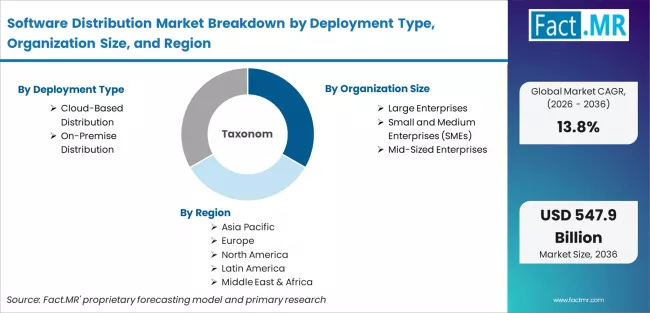
Software Distribution Market is segmented by Deployment Type (Cloud-Based Distribution and On-Premise Distribution), Organization Size (Small and Medium Enterprises (SMEs), Mid-Sized Enterprises, and Large Enterprises), Industry Vertical (IT & Telecom, BFSI, Healthcare, Retail, and Education) and Region. Forecast for 2026 to 2036.

Core Findings

    Software Distribution Market Forecast and Outlook By Fact.MR

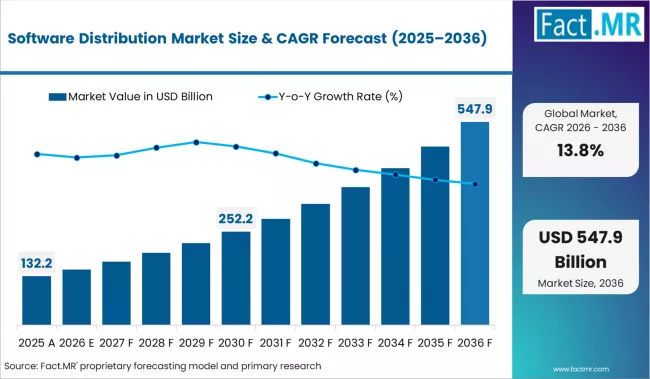
    In 2025, the software distribution market was valued at USD 132.1 billion. Based on Fact.MR analysis, demand for software distribution is estimated to grow to USD 150.4 billion in 2026 and USD 547.9 billion by 2036. FACT.MR projects a CAGR of 13.8% during the forecast period.

    The market is expected to generate USD 397.5 billion in incremental revenue during the forecast period, showing strong overall expansion. Growth is driven by increasing enterprise shift to cloud, wider adoption of SaaS subscriptions, and rising use of hyperscaler marketplaces for software purchases. Microsoft Cloud revenue reached USD 168.9 billion in FY2025, reflecting strong enterprise demand. However, some challenges remain. Moving legacy systems to the cloud is costly, especially in regulated sectors. Data laws in countries like Germany, France, and India require local deployment. Managing licences across multiple cloud platforms also increases complexity and costs.

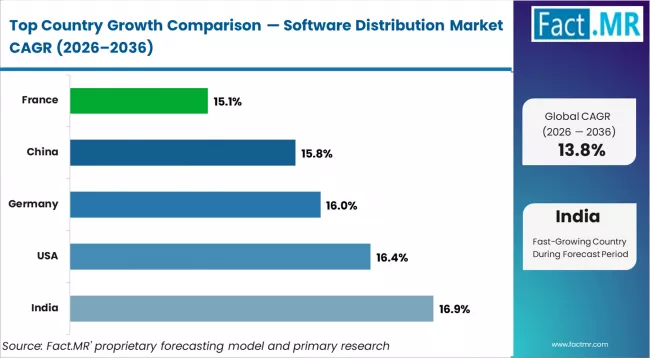
    India leads country-level growth at 16.9% CAGR through 2036, driven by the MeitY Cloud Services Policy's mandate for government agencies to adopt cloud-native software and the Digital India programme's push for SaaS adoption across public sector verticals. The USA follows at 16.4% CAGR, supported by hyperscaler marketplace growth AWS Marketplace serving over 42,000 products and Microsoft Azure Marketplace expanding commercial transactions and AI-native software procurement driven by Copilot, Gemini, and AWS Nova integrations. China grows at 15.8% CAGR, supported by Alibaba Cloud's domestic software distribution leadership and MIIT's cloud-first government procurement policy. Germany at 16.0% CAGR benefits from enterprise cloud ERP migration with SAP's cloud backlog growing 28% to EUR 14.81 billion in Q2 2024. France at 15.1% CAGR reflects public sector cloud software mandates and OVHcloud's government-certified cloud distribution expansion, generating new demand rather than replacement, with structural constraints from GDPR data residency requirements increasing multi-region distribution costs.
    Software Distribution Market Market Value Analysis

    Metric Value
    Estimated Value in 2026 USD 150.4 billion
    Forecast Value in 2036 USD 547.9 billion
    Forecast CAGR (2026 to 2036) 13.8%

    Software Distribution Market Definition

    The software distribution market includes platforms and channels used to deliver software to users. It covers SaaS, enterprise licences, open-source, and cloud-native tools. Distribution includes cloud marketplaces, digital downloads, on-premise portals, and MSP channels. It serves enterprise IT, government, healthcare, finance, and retail sectors.

    Software Distribution Market Inclusions

    Covers global and regional forecasts from 2026 to 2036. Includes SaaS platforms, cloud marketplaces, and licence management systems. Covers MSP distribution and subscription management tools. Applies across IT, BFSI, healthcare, retail, and education sectors.

    Software Distribution Market Exclusions

    Excludes hardware procurement platforms and IaaS services. Excludes custom software development and consumer app stores. Excludes cybersecurity hardware and telecom firmware updates. Focus is only on enterprise software distribution platforms.

    Software Distribution Market Research Methodology

    • Primary Research: Includes interviews with IT procurement managers, cloud architects, and SaaS leaders. Covers MSP directors and enterprise CIOs. Regions include North America, Europe, India, and Asia Pacific.
    • Desk Research: Uses data from Microsoft, SAP, AWS, and Google Cloud reports. Includes Gartner data and government policies. Covers EU and India cloud regulations.
    • Market Sizing and Forecasting: Uses hybrid top-down and bottom-up models. Based on subscription revenue and licence seat counts. Includes industry spending benchmarks and marketplace data.
    • Data Validation and Update Cycle: Validated using revenue data from Microsoft, AWS, Google Cloud, SAP, Oracle, and Salesforce. Supported by Gartner data and expert interviews.

    Summary Of Software Distribution Market

    • Market Definition
      • The software distribution market encompasses cloud and on-premise platforms, channels, and tools through which enterprise and public sector organisations procure, deliver, and manage licensed software, SaaS subscriptions, and cloud-native applications at scale.
    • Demand Drivers
      • Enterprise AI adoption is accelerating cloud software distribution, with Microsoft Azure revenue growing 33% in Q1 FY2025, boosting demand for cloud-based platforms
      • India’s MeitY Cloud Policy and Digital India programme are driving public sector SaaS adoption and long-term distribution demand
      • SAP’s cloud ERP shift, with backlog up 28% and revenue growth of 33%, is driving large-scale enterprise migration to cloud software
    • Key Segments Analyzed
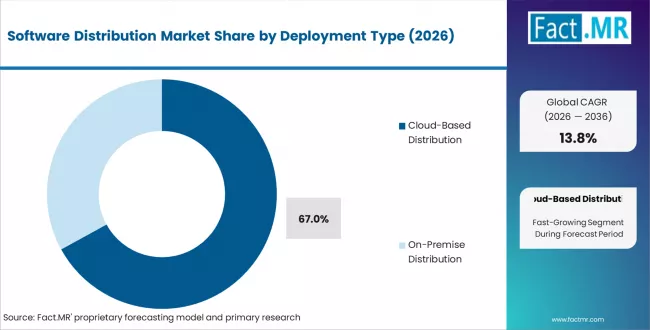
      • By Deployment Type: Cloud-based distribution holds ~67% share in 2025, driven by hyperscaler marketplaces and subscription models
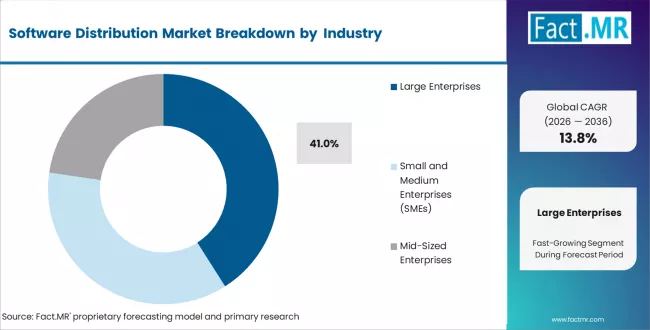
      • By Organization Size: Large enterprises account for ~41% share due to high-value multi-year contracts with major cloud vendors
      • By Geography: India leads growth at 16.9% CAGR through 2036, supported by government policies and expanding cloud infrastructure.
    • Analyst Opinion at FACT.MR
      • Shambhu Nath Jha, Principal Consultant at Fact.MR, opines that CXOs will find this report essential for understanding how AI-native software monetisation, hyperscaler marketplace consolidation, GDPR and DPDP-compliant cloud distribution infrastructure, and public sector cloud mandates in India and France are reshaping vendor economics and enterprise procurement strategy in the software distribution market through 2036.

    Segmental Analysis

    Software Distribution Market Analysis by Deployment Type
    Software Distribution Market Analysis By Deployment Type

    Cloud-based distribution holds 67% share in 2026. It dominates due to flexible pricing and easy access via marketplaces. Enterprises prefer cloud for scalability and lower IT overhead. Continuous updates and AI features add further value.

    • Microsoft Azure Cloud Distribution Growth: Microsoft Cloud revenue reached USD 168.9 billion in FY2025. Azure and cloud services grew strongly. Microsoft 365 adoption continues to expand. Azure Marketplace is a key enterprise distribution channel. Cloud reach spans both enterprise and consumer segments [1].
    • SAP Cloud ERP Distribution Acceleration: SAP cloud backlog grew 28% to EUR 14.81 billion in 2024. Cloud ERP revenue increased 33%. Migration to S/4HANA Cloud is accelerating. Cloud margins are improving after migration. This shows strong shift from on-premise models [2].
    • On-Premise Segment Structural Decline: Global IaaS spending reached USD 171.8 billion in 2024. AWS, Azure, and Google Cloud dominate the market. On-premise software demand is declining. Vendors are shifting focus to cloud revenue. Legacy models continue to contract [3].

    Software Distribution Market Analysis by Organization Size
    Software Distribution Market Analysis By Organization Size

    Large enterprises hold 41% share in 2026. They have high software budgets and long-term contracts. Procurement is done through multi-year agreements with major vendors. Complex cloud environments drive additional service revenue.

    • AWS Enterprise Agreement Expansion: AWS reported USD 29 billion revenue in Q1 2025. Large enterprises are using cloud credit programmes. Marketplace usage is increasing for software procurement. AWS is becoming a central distribution hub. Investment in AI infrastructure supports future growth [4].
    • Salesforce Large Enterprise CRM Distribution: Salesforce reported USD 37.9 billion revenue in FY2025. AI tools like Agentforce are driving adoption. Pricing models are evolving toward usage-based structures. Enterprise adoption is growing rapidly. Thousands of customers have already adopted AI solutions [5].
    • SME Cloud Distribution Growth via Marketplaces: SMEs are rapidly adopting cloud platforms. Azure startup customers grew significantly in 2024. AWS and Google Cloud are targeting SME markets. Growth is strong in India and Southeast Asia. This increases total market volume despite smaller deal sizes [6].

    Drivers, Restraints, and Opportunities
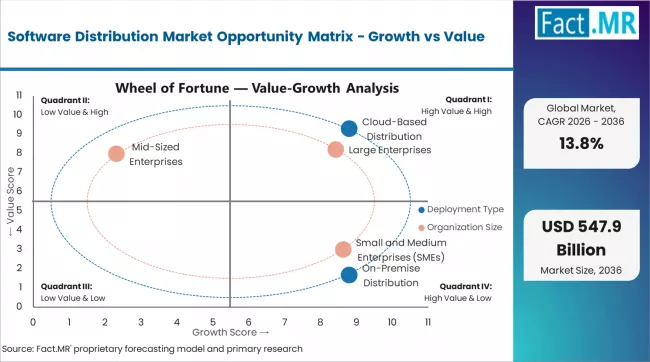
    Software Distribution Market Opportunity Matrix Growth Vs Value

    FACT.MR analysts note that the software distribution market has evolved in two phases. The first was the shift from physical media to digital downloads. The second is the ongoing cloud subscription transition. SaaS and cloud marketplaces are replacing perpetual licences.

    The market is shifting from on-premise to cloud economics. On-premise revenue is declining as enterprises move to cloud platforms. SAP and Microsoft are seeing reduced legacy licence revenue. Cloud models offer higher long-term value with lower upfront cost. AI add-ons like Microsoft 365 Copilot are increasing per-user revenue. This is setting new pricing benchmarks across enterprise software.

    • India Cloud Software Mandate: India’s MeitY Cloud Policy mandates cloud adoption for government agencies. AWS expanded its India region and compliance capabilities. Microsoft announced a new Azure region for 2026. These moves support public sector cloud adoption. This drives long-term demand and supports high growth in India.
    • Hyperscaler Marketplace Consolidation: AWS Marketplace hosts over 42,000 products and processes large enterprise transactions. Procurement is shifting to cloud credit programmes like AWS EDP and Azure MACC. This reduces reliance on traditional resellers. Google Cloud’s backlog reflects strong enterprise commitments. Hyperscalers are becoming primary distribution channels.
    • EU Data Sovereignty and GDPR Distribution Costs: EU regulations like GDPR and the Data Act increase compliance costs. Vendors must invest in local data infrastructure. SAP and Microsoft have implemented EU data boundary solutions. France and Germany enforce strict data rules. These costs favour large vendors over smaller players.

    Regional Analysis

    The software distribution market is analysed across North America, Europe, Asia Pacific, Latin America, and Middle East and Africa, covering 40+ country-level demand shaped by cloud adoption maturity, enterprise digital transformation investment, public sector cloud software mandates, and data sovereignty regulatory frameworks. The full report offers market attractiveness analysis based on cloud software subscription growth rates, hyperscaler marketplace transaction volumes, and public sector procurement programme timelines.

    Top Country Growth Comparison Software Distribution Market Cagr (2026 2036)

    Country CAGR (2026 to 2036)
    India 16.9%
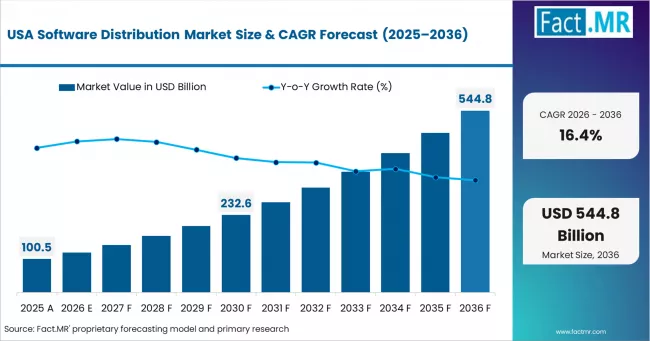
    USA 16.4%
    Germany 16.0%
    China 15.8%
    France 15.1%

    Source: Fact.MR (FACT.MR) analysis, based on proprietary forecasting model and primary research
    Software Distribution Market Cagr Analysis By Country

    Asia Pacific Software Distribution Market Analysis
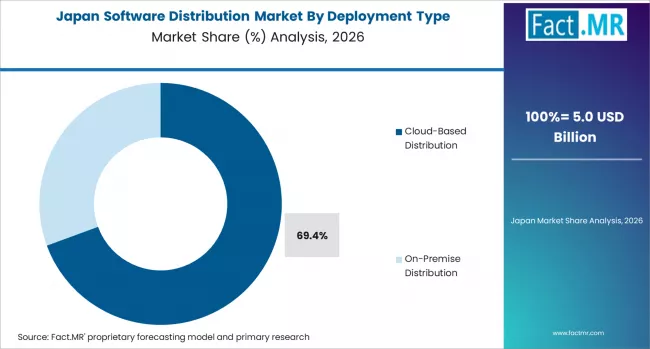
    Software Distribution Market Japan Market Share Analysis By Deployment Type

    Asia Pacific is the fastest-growing region, driven by cloud adoption and government policies. India and China lead growth, while Japan and South Korea support enterprise migration. Hyperscalers operate regional datacentres to meet data rules. Alibaba Cloud dominates China, while global players compete in ASEAN and India.

    • India: India is emerging as the fastest-growing market with a CAGR of 16.9% through 2036. Government cloud mandates are driving large-scale adoption. AWS and Microsoft are expanding local infrastructure. New datacentres support compliance and enterprise demand. The DPDP Act 2023 is increasing data compliance requirements. Domestic IT firms are also increasing cloud software usage.
    • China: China continues strong growth at a CAGR of 15.8% through 2036. Government policies are pushing cloud-first procurement. Domestic players like Alibaba Cloud and Huawei Cloud lead the market. Enterprise cloud adoption is rising under digital economy targets. AI-driven platforms are also expanding. Local compliance rules shape vendor participation.

    FACT.MR's Asia Pacific analysis includes India, China, Japan, South Korea, ASEAN, and Australia and New Zealand. It covers cloud adoption, AI trends, data compliance, and regional forecasts.

    Europe Software Distribution Market Analysis
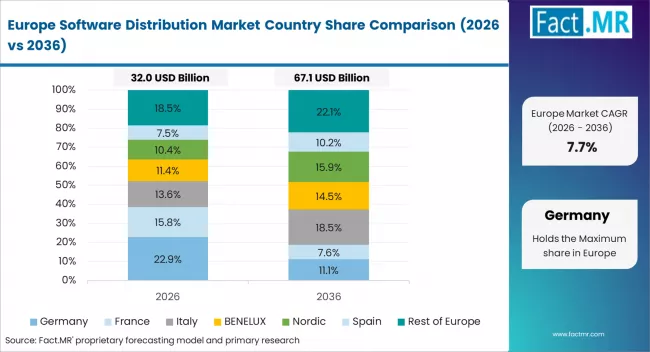
    Software Distribution Market Europe Country Market Share Analysis, 2026 & 2036

    Europe is a regulation-driven market shaped by GDPR and data sovereignty laws. Vendor selection depends on compliance and local infrastructure. SAP and Microsoft play major roles in enterprise cloud migration.

    • Germany: Germany is a key market with a CAGR of 16.0% through 2036. SAP leads cloud ERP adoption and migration. Government regulations enforce strict data handling rules. Demand is concentrated on compliant cloud platforms. Public sector adoption is driving growth. Multi-cloud procurement frameworks are expanding.
    • France: France is growing steadily at a CAGR of 15.1% through 2036. Government cloud programmes are increasing adoption. SecNumCloud certification is required for public sector use. OVHcloud and Microsoft are key providers. AI investment is supporting enterprise software demand. Local vendors are shifting to cloud-based distribution.

    FACT.MR's Europe analysis includes Germany, France, the UK, Italy, Spain, Nordic countries, and BENELUX. It covers GDPR impact, cloud migration, regulatory trends, and forecasts.

    North America Software Distribution Market Analysis
    Software Distribution Market Country Value Analysis

    North America is the largest revenue market, led by major cloud providers. Enterprise spending is high, supported by strong IT infrastructure. AI-driven software distribution is advancing rapidly in the region.

    • USA: The United States leads with a CAGR of 16.4% through 2036. Cloud adoption is expanding across enterprises. AWS and Microsoft dominate software distribution channels. Marketplace usage is increasing across industries. Government compliance frameworks like FedRAMP are shaping procurement. AI-based software models are gaining traction.

    FACT.MR's North America analysis includes the United States, Canada, and Mexico. It provides insights on AI adoption, marketplace trends, compliance impact, and forecasts.

    Competitive Aligners for Market Players
    Software Distribution Market Analysis By Company

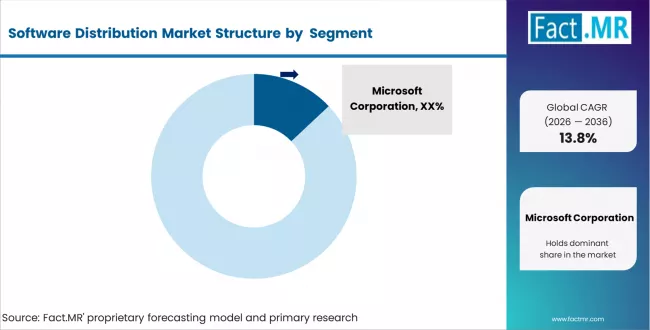
    The software distribution market is shaped by two main layers. At the top are hyperscalers like Amazon Web Services, Microsoft Azure, and Google Cloud, which control a large share of cloud infrastructure and increasingly act as the primary channels for enterprise software procurement. Below them is a wide base of SaaS vendors. While this layer is fragmented, revenue is gradually concentrating as enterprises prefer buying software through trusted cloud ecosystems. Major vendors like Microsoft, SAP, Oracle, and Salesforce dominate enterprise distribution, while IBM Red Hat and Adobe lead in specialised segments.

    Microsoft has a strong advantage because it combines cloud infrastructure, productivity tools, ERP systems, and developer platforms into a single ecosystem. This allows enterprises to manage most of their software needs under one agreement. AWS benefits from its early lead and vast marketplace, which makes it a common starting point for software discovery. SAP remains deeply embedded in enterprise operations, giving it strong pricing power.

    Large enterprises usually adopt a multi-cloud approach to reduce dependency, but switching platforms is still difficult once systems are integrated, giving established players a lasting advantage.

    Key Players

    • Microsoft Corporation
    • Amazon Web Services, Inc. (AWS)
    • Google LLC (Google Cloud)
    • SAP SE
    • Oracle Corporation
    • Salesforce, Inc.
    • IBM Corporation (Red Hat)
    • VMware, Inc. (Broadcom)
    • Adobe Inc.
    • ServiceNow, Inc.

    Scope of Report

    Software Distribution Market Breakdown By Deployment Type, Organization Size, And Region

    Attribute Details
    Quantitative Units USD 150.4 billion (2026) to USD 547.9 billion (2036), at a CAGR of 13.8%
    Market Definition Platforms, channels, and services through which enterprise and public sector organisations procure, deliver, and manage software licences, SaaS subscriptions, and cloud-native applications, including hyperscaler marketplaces, MSP distribution channels, and on-premise enterprise licence portals.
    Deployment Type Segmentation Cloud-Based Distribution, On-Premise Distribution
    Organization Size Segmentation Small and Medium Enterprises (SMEs), Mid-Sized Enterprises, Large Enterprises
    Industry Vertical Segmentation IT & Telecom, BFSI, Healthcare, Retail, Education
    Application Coverage Enterprise ERP cloud migration, public sector cloud software procurement, AI-native application distribution, BFSI compliance-grade cloud delivery, healthcare EHR platform deployment, and education SaaS institutional licensing.
    Regions Covered North America, Europe, Asia Pacific, Latin America, Middle East and Africa
    Countries Covered USA, Canada, Mexico, UK, Germany, France, Italy, Spain, Nordic, BENELUX, Japan, South Korea, China, India, ASEAN, Australia and New Zealand, Brazil, Argentina, Chile, Saudi Arabia, GCC, Turkey, South Africa, Rest of MEA
    Key Companies Profiled Microsoft, Amazon Web Services, Google Cloud, SAP SE, Oracle, Salesforce, IBM (Red Hat), VMware (Broadcom), Adobe, ServiceNow
    Forecast Period 2026 to 2036
    Approach Hybrid top-down and bottom-up model using cloud software subscription revenue by deployment type and organisation size, hyperscaler marketplace transaction data, enterprise licence seat counts, public sector cloud procurement programme valuations, and primary interviews with enterprise IT procurement directors and MSP channel managers.

    Software Distribution Market by Segments

    • By Deployment Type :

      • Cloud-Based Distribution
      • On-Premise Distribution
    • By Organization Size :

      • Small and Medium Enterprises (SMEs)
      • Mid-Sized Enterprises
      • Large Enterprises
    • By Industry Vertical :

      • IT & Telecom
      • BFSI (Banking, Financial Services, and Insurance)
      • Healthcare
      • Retail
      • Education
    • By Region :

      • North America
        • United States
        • Canada
        • Mexico
      • Latin America
        • Brazil
        • Mexico
        • Argentina
        • Chile
        • Rest of Latin America
      • Western Europe
        • Germany
        • United Kingdom
        • France
        • Italy
        • Spain
        • Nordic Countries
        • BENELUX
        • Rest of Western Europe
      • Eastern Europe
        • Russia
        • Poland
        • Hungary
        • Balkan and Baltic
        • Rest of Eastern Europe
      • East Asia
        • China
        • Japan
        • South Korea
      • South Asia and Pacific
        • India
        • ASEAN
        • Australia and New Zealand
        • Rest of South Asia and Pacific
      • Middle East and Africa
        • Kingdom of Saudi Arabia
        • Other GCC Countries
        • Turkey
        • South Africa
        • Rest of Middle East and Africa

    Bibliography

    • [1] Microsoft Corporation. Annual Report FY2025: Microsoft Cloud Revenue USD 168.9 Billion Growing 23%, Azure Revenue Growth 34%, Microsoft 365 Commercial Cloud Revenue Growth 15%, Consumer Subscribers 80.8 Million. July 2025.
    • [2] SAP SE. Q2 2024 Earnings Release: Current Cloud Backlog EUR 14.81 Billion Up 28%, Cloud Revenue Up 25%, Cloud ERP Suite Revenue Up 33%, Cloud Gross Profit Up 29%. July 2024.
    • [3] Gartner Inc. / CIO Dive. IaaS Market 2024: Global Cloud Infrastructure Services Spend USD 171.8 Billion Up 22.5%, AWS 38% Share, Azure 24%, Google Cloud 9%, Big Three Combined 70%+ Share. August 2025.
    • [4] Amazon Web Services Inc. Q1 FY2025 Earnings: AWS Revenue USD 29 Billion, AWS Marketplace 42,000+ Products Including 11,478 Infrastructure Software Solutions, Amazon AI Infrastructure Investment USD 100 Billion+ in 2025. April 2025.
    • [5] Salesforce Inc. Agentforce Platform Launch and FY2025 Earnings: Agentforce AI Software Platform Launch September 2024, USD 2 Per Conversation Pricing, 5,000+ Enterprise Customer Deals by Year-End, Full Year FY2025 Revenue USD 37.9 Billion. March 2025.
    • [6] Microsoft Corporation. Azure Customer Growth Data: Startup Customers Increased 23% From 157,000 to 193,000 in 2024, SME Cloud Software Distribution Expansion via Azure Marketplace Partner Programme. 2024.

    This Report Addresses

    • Strategic intelligence on India's MeitY Cloud Services Policy mandate, China MIIT cloud-first government procurement, EU Data Act software distribution obligations, US FedRAMP authorisation requirements, France SecNumCloud distribution certification, and Germany BfDI GDPR SaaS compliance enforcement shaping software distribution procurement through 2036.
    • Market forecast projecting growth from USD 150.4 billion in 2026 to USD 547.9 billion by 2036 at a 13.8% CAGR, segmented by deployment type, organisation size, industry vertical, and region.
    • Growth opportunity mapping across India's public sector cloud mandate pipeline, USA hyperscaler marketplace consolidation, Germany's SAP cloud ERP migration wave, France's SecNumCloud government distribution channel, and China's MLPS 2.0-driven domestic cloud software procurement expansion.
    • Country CAGR outlook highlighting India 16.9%, USA 16.4%, Germany 16.0%, China 15.8%, and France 15.1%, supported by hyperscaler revenue disclosures, public sector cloud procurement data, and enterprise cloud migration benchmarks.
    • Competitive landscape analysis covering Microsoft, AWS, Google Cloud, SAP, Oracle, Salesforce, IBM Red Hat, VMware, Adobe, and ServiceNow, focusing on marketplace consolidation strategies, AI software monetisation models, and cloud distribution platform economics.
    • Technology tracking including AI-native software distribution pricing models, usage-based SaaS monetisation, FedRAMP and SecNumCloud certified distribution platforms, open-source enterprise distribution via Red Hat OpenShift, and multi-cloud licence compliance management.
    • Regulatory analysis covering GDPR cloud SaaS data processing obligations, EU Data Act software sharing requirements, India DPDP Act 2023 cloud compliance, US FedRAMP cloud software authorisation, and China MLPS 2.0 enterprise software distribution certification standards.
    • Report deliverables include PDF report, Excel datasets, PowerPoint summary, and dashboards based on Microsoft SEC filings, SAP quarterly earnings, AWS Marketplace data, Gartner IaaS market reports, and primary research interviews with enterprise IT procurement directors.

    Table of Content

    1. Executive Summary
      • Global Market Outlook
      • Demand to side Trends
      • Supply to side Trends
      • Technology Roadmap Analysis
      • Analysis and Recommendations
    2. Market Overview
      • Market Coverage / Taxonomy
      • Market Definition / Scope / Limitations
    3. Research Methodology
      • Chapter Orientation
      • Analytical Lens and Working Hypotheses
        • Market Structure, Signals, and Trend Drivers
        • Benchmarking and Cross-market Comparability
        • Market Sizing, Forecasting, and Opportunity Mapping
      • Research Design and Evidence Framework
        • Desk Research Programme (Secondary Evidence)
          • Company Annual and Sustainability Reports
          • Peer-reviewed Journals and Academic Literature
          • Corporate Websites, Product Literature, and Technical Notes
          • Earnings Decks and Investor Briefings
          • Statutory Filings and Regulatory Disclosures
          • Technical White Papers and Standards Notes
          • Trade Journals, Industry Magazines, and Analyst Briefs
          • Conference Proceedings, Webinars, and Seminar Materials
          • Government Statistics Portals and Public Data Releases
          • Press Releases and Reputable Media Coverage
          • Specialist Newsletters and Curated Briefings
          • Sector Databases and Reference Repositories
          • Fact.MR Internal Proprietary Databases and Historical Market Datasets
          • Subscription Datasets and Paid Sources
          • Social Channels, Communities, and Digital Listening Inputs
          • Additional Desk Sources
        • Expert Input and Fieldwork (Primary Evidence)
          • Primary Modes
            • Qualitative Interviews and Expert Elicitation
            • Quantitative Surveys and Structured Data Capture
            • Blended Approach
          • Why Primary Evidence is Used
          • Field Techniques
            • Interviews
            • Surveys
            • Focus Groups
            • Observational and In-context Research
            • Social and Community Interactions
          • Stakeholder Universe Engaged
            • C-suite Leaders
            • Board Members
            • Presidents and Vice Presidents
            • R&D and Innovation Heads
            • Technical Specialists
            • Domain Subject-matter Experts
            • Scientists
            • Physicians and Other Healthcare Professionals
          • Governance, Ethics, and Data Stewardship
            • Research Ethics
            • Data Integrity and Handling
        • Tooling, Models, and Reference Databases
      • Data Engineering and Model Build
        • Data Acquisition and Ingestion
        • Cleaning, Normalisation, and Verification
        • Synthesis, Triangulation, and Analysis
      • Quality Assurance and Audit Trail
    4. Market Background
      • Market Dynamics
        • Drivers
        • Restraints
        • Opportunity
        • Trends
      • Scenario Forecast
        • Demand in Optimistic Scenario
        • Demand in Likely Scenario
        • Demand in Conservative Scenario
      • Opportunity Map Analysis
      • Product Life Cycle Analysis
      • Supply Chain Analysis
      • Investment Feasibility Matrix
      • Value Chain Analysis
      • PESTLE and Porter’s Analysis
      • Regulatory Landscape
      • Regional Parent Market Outlook
      • Production and Consumption Statistics
      • Import and Export Statistics
    5. Global Market Analysis 2021 to 2025 and Forecast, 2026 to 2036
      • Historical Market Size Value (USD Million) Analysis, 2021 to 2025
      • Current and Future Market Size Value (USD Million) Projections, 2026 to 2036
        • Y to o to Y Growth Trend Analysis
        • Absolute $ Opportunity Analysis
    6. Global Market Pricing Analysis 2021 to 2025 and Forecast 2026 to 2036
    7. Global Market Analysis 2021 to 2025 and Forecast 2026 to 2036, By Deployment Type
      • Introduction / Key Findings
      • Historical Market Size Value (USD Million) Analysis By Deployment Type, 2021 to 2025
      • Current and Future Market Size Value (USD Million) Analysis and Forecast By Deployment Type, 2026 to 2036
        • Cloud-Based Distribution
        • On-Premise Distribution
      • Y to o to Y Growth Trend Analysis By Deployment Type, 2021 to 2025
      • Absolute $ Opportunity Analysis By Deployment Type, 2026 to 2036
    8. Global Market Analysis 2021 to 2025 and Forecast 2026 to 2036, By Organization Size
      • Introduction / Key Findings
      • Historical Market Size Value (USD Million) Analysis By Organization Size, 2021 to 2025
      • Current and Future Market Size Value (USD Million) Analysis and Forecast By Organization Size, 2026 to 2036
        • Large Enterprises
        • Small and Medium Enterprises (SMEs)
        • Mid-Sized Enterprises
      • Y to o to Y Growth Trend Analysis By Organization Size, 2021 to 2025
      • Absolute $ Opportunity Analysis By Organization Size, 2026 to 2036
    9. Global Market Analysis 2021 to 2025 and Forecast 2026 to 2036, By Region
      • Introduction
      • Historical Market Size Value (USD Million) Analysis By Region, 2021 to 2025
      • Current Market Size Value (USD Million) Analysis and Forecast By Region, 2026 to 2036
        • North America
        • Latin America
        • Western Europe
        • Eastern Europe
        • East Asia
        • South Asia and Pacific
        • Middle East & Africa
      • Market Attractiveness Analysis By Region
    10. North America Market Analysis 2021 to 2025 and Forecast 2026 to 2036, By Country
      • Historical Market Size Value (USD Million) Trend Analysis By Market Taxonomy, 2021 to 2025
      • Market Size Value (USD Million) Forecast By Market Taxonomy, 2026 to 2036
        • By Country
          • USA
          • Canada
          • Mexico
        • By Deployment Type
        • By Organization Size
      • Market Attractiveness Analysis
        • By Country
        • By Deployment Type
        • By Organization Size
      • Key Takeaways
    11. Latin America Market Analysis 2021 to 2025 and Forecast 2026 to 2036, By Country
      • Historical Market Size Value (USD Million) Trend Analysis By Market Taxonomy, 2021 to 2025
      • Market Size Value (USD Million) Forecast By Market Taxonomy, 2026 to 2036
        • By Country
          • Brazil
          • Chile
          • Rest of Latin America
        • By Deployment Type
        • By Organization Size
      • Market Attractiveness Analysis
        • By Country
        • By Deployment Type
        • By Organization Size
      • Key Takeaways
    12. Western Europe Market Analysis 2021 to 2025 and Forecast 2026 to 2036, By Country
      • Historical Market Size Value (USD Million) Trend Analysis By Market Taxonomy, 2021 to 2025
      • Market Size Value (USD Million) Forecast By Market Taxonomy, 2026 to 2036
        • By Country
          • Germany
          • UK
          • Italy
          • Spain
          • France
          • Nordic
          • BENELUX
          • Rest of Western Europe
        • By Deployment Type
        • By Organization Size
      • Market Attractiveness Analysis
        • By Country
        • By Deployment Type
        • By Organization Size
      • Key Takeaways
    13. Eastern Europe Market Analysis 2021 to 2025 and Forecast 2026 to 2036, By Country
      • Historical Market Size Value (USD Million) Trend Analysis By Market Taxonomy, 2021 to 2025
      • Market Size Value (USD Million) Forecast By Market Taxonomy, 2026 to 2036
        • By Country
          • Russia
          • Poland
          • Hungary
          • Balkan & Baltic
          • Rest of Eastern Europe
        • By Deployment Type
        • By Organization Size
      • Market Attractiveness Analysis
        • By Country
        • By Deployment Type
        • By Organization Size
      • Key Takeaways
    14. East Asia Market Analysis 2021 to 2025 and Forecast 2026 to 2036, By Country
      • Historical Market Size Value (USD Million) Trend Analysis By Market Taxonomy, 2021 to 2025
      • Market Size Value (USD Million) Forecast By Market Taxonomy, 2026 to 2036
        • By Country
          • China
          • Japan
          • South Korea
        • By Deployment Type
        • By Organization Size
      • Market Attractiveness Analysis
        • By Country
        • By Deployment Type
        • By Organization Size
      • Key Takeaways
    15. South Asia and Pacific Market Analysis 2021 to 2025 and Forecast 2026 to 2036, By Country
      • Historical Market Size Value (USD Million) Trend Analysis By Market Taxonomy, 2021 to 2025
      • Market Size Value (USD Million) Forecast By Market Taxonomy, 2026 to 2036
        • By Country
          • India
          • ASEAN
          • Australia & New Zealand
          • Rest of South Asia and Pacific
        • By Deployment Type
        • By Organization Size
      • Market Attractiveness Analysis
        • By Country
        • By Deployment Type
        • By Organization Size
      • Key Takeaways
    16. Middle East & Africa Market Analysis 2021 to 2025 and Forecast 2026 to 2036, By Country
      • Historical Market Size Value (USD Million) Trend Analysis By Market Taxonomy, 2021 to 2025
      • Market Size Value (USD Million) Forecast By Market Taxonomy, 2026 to 2036
        • By Country
          • Kingdom of Saudi Arabia
          • Other GCC Countries
          • Turkiye
          • South Africa
          • Other African Union
          • Rest of Middle East & Africa
        • By Deployment Type
        • By Organization Size
      • Market Attractiveness Analysis
        • By Country
        • By Deployment Type
        • By Organization Size
      • Key Takeaways
    17. Key Countries Market Analysis
      • USA
        • Pricing Analysis
        • Market Share Analysis, 2025
          • By Deployment Type
          • By Organization Size
      • Canada
        • Pricing Analysis
        • Market Share Analysis, 2025
          • By Deployment Type
          • By Organization Size
      • Mexico
        • Pricing Analysis
        • Market Share Analysis, 2025
          • By Deployment Type
          • By Organization Size
      • Brazil
        • Pricing Analysis
        • Market Share Analysis, 2025
          • By Deployment Type
          • By Organization Size
      • Chile
        • Pricing Analysis
        • Market Share Analysis, 2025
          • By Deployment Type
          • By Organization Size
      • Germany
        • Pricing Analysis
        • Market Share Analysis, 2025
          • By Deployment Type
          • By Organization Size
      • UK
        • Pricing Analysis
        • Market Share Analysis, 2025
          • By Deployment Type
          • By Organization Size
      • Italy
        • Pricing Analysis
        • Market Share Analysis, 2025
          • By Deployment Type
          • By Organization Size
      • Spain
        • Pricing Analysis
        • Market Share Analysis, 2025
          • By Deployment Type
          • By Organization Size
      • France
        • Pricing Analysis
        • Market Share Analysis, 2025
          • By Deployment Type
          • By Organization Size
      • India
        • Pricing Analysis
        • Market Share Analysis, 2025
          • By Deployment Type
          • By Organization Size
      • ASEAN
        • Pricing Analysis
        • Market Share Analysis, 2025
          • By Deployment Type
          • By Organization Size
      • Australia & New Zealand
        • Pricing Analysis
        • Market Share Analysis, 2025
          • By Deployment Type
          • By Organization Size
      • China
        • Pricing Analysis
        • Market Share Analysis, 2025
          • By Deployment Type
          • By Organization Size
      • Japan
        • Pricing Analysis
        • Market Share Analysis, 2025
          • By Deployment Type
          • By Organization Size
      • South Korea
        • Pricing Analysis
        • Market Share Analysis, 2025
          • By Deployment Type
          • By Organization Size
      • Russia
        • Pricing Analysis
        • Market Share Analysis, 2025
          • By Deployment Type
          • By Organization Size
      • Poland
        • Pricing Analysis
        • Market Share Analysis, 2025
          • By Deployment Type
          • By Organization Size
      • Hungary
        • Pricing Analysis
        • Market Share Analysis, 2025
          • By Deployment Type
          • By Organization Size
      • Kingdom of Saudi Arabia
        • Pricing Analysis
        • Market Share Analysis, 2025
          • By Deployment Type
          • By Organization Size
      • Turkiye
        • Pricing Analysis
        • Market Share Analysis, 2025
          • By Deployment Type
          • By Organization Size
      • South Africa
        • Pricing Analysis
        • Market Share Analysis, 2025
          • By Deployment Type
          • By Organization Size
    18. Market Structure Analysis
      • Competition Dashboard
      • Competition Benchmarking
      • Market Share Analysis of Top Players
        • By Regional
        • By Deployment Type
        • By Organization Size
    19. Competition Analysis
      • Competition Deep Dive
        • Microsoft Corporation
          • Overview
          • Product Portfolio
          • Profitability by Market Segments (Product/Age /Sales Channel/Region)
          • Sales Footprint
          • Strategy Overview
            • Marketing Strategy
            • Product Strategy
            • Channel Strategy
        • Amazon Web Services, Inc. (AWS)
        • Google LLC (Google Cloud)
        • SAP SE
        • Oracle Corporation
        • Salesforce, Inc.
        • IBM Corporation (Red Hat)
        • VMware, Inc. (Broadcom)
        • Adobe Inc.
        • ServiceNow, Inc.
    20. Assumptions & Acronyms Used

    List Of Table

    • Table 1: Global Market Value (USD Million) Forecast by Region, 2021 to 2036
    • Table 2: Global Market Value (USD Million) Forecast by Deployment Type, 2021 to 2036
    • Table 3: Global Market Value (USD Million) Forecast by Organization Size, 2021 to 2036
    • Table 4: North America Market Value (USD Million) Forecast by Country, 2021 to 2036
    • Table 5: North America Market Value (USD Million) Forecast by Deployment Type, 2021 to 2036
    • Table 6: North America Market Value (USD Million) Forecast by Organization Size, 2021 to 2036
    • Table 7: Latin America Market Value (USD Million) Forecast by Country, 2021 to 2036
    • Table 8: Latin America Market Value (USD Million) Forecast by Deployment Type, 2021 to 2036
    • Table 9: Latin America Market Value (USD Million) Forecast by Organization Size, 2021 to 2036
    • Table 10: Western Europe Market Value (USD Million) Forecast by Country, 2021 to 2036
    • Table 11: Western Europe Market Value (USD Million) Forecast by Deployment Type, 2021 to 2036
    • Table 12: Western Europe Market Value (USD Million) Forecast by Organization Size, 2021 to 2036
    • Table 13: Eastern Europe Market Value (USD Million) Forecast by Country, 2021 to 2036
    • Table 14: Eastern Europe Market Value (USD Million) Forecast by Deployment Type, 2021 to 2036
    • Table 15: Eastern Europe Market Value (USD Million) Forecast by Organization Size, 2021 to 2036
    • Table 16: East Asia Market Value (USD Million) Forecast by Country, 2021 to 2036
    • Table 17: East Asia Market Value (USD Million) Forecast by Deployment Type, 2021 to 2036
    • Table 18: East Asia Market Value (USD Million) Forecast by Organization Size, 2021 to 2036
    • Table 19: South Asia and Pacific Market Value (USD Million) Forecast by Country, 2021 to 2036
    • Table 20: South Asia and Pacific Market Value (USD Million) Forecast by Deployment Type, 2021 to 2036
    • Table 21: South Asia and Pacific Market Value (USD Million) Forecast by Organization Size, 2021 to 2036
    • Table 22: Middle East & Africa Market Value (USD Million) Forecast by Country, 2021 to 2036
    • Table 23: Middle East & Africa Market Value (USD Million) Forecast by Deployment Type, 2021 to 2036
    • Table 24: Middle East & Africa Market Value (USD Million) Forecast by Organization Size, 2021 to 2036

    List Of Figures

    • Figure 1: Global Market Pricing Analysis
    • Figure 2: Global Market Value (USD Million) Forecast 2021 to 2036
    • Figure 3: Global Market Value Share and BPS Analysis by Deployment Type, 2026 and 2036
    • Figure 4: Global Market Y-o-Y Growth Comparison by Deployment Type, 2026 to 2036
    • Figure 5: Global Market Attractiveness Analysis by Deployment Type
    • Figure 6: Global Market Value Share and BPS Analysis by Organization Size, 2026 and 2036
    • Figure 7: Global Market Y-o-Y Growth Comparison by Organization Size, 2026 to 2036
    • Figure 8: Global Market Attractiveness Analysis by Organization Size
    • Figure 9: Global Market Value (USD Million) Share and BPS Analysis by Region, 2026 and 2036
    • Figure 10: Global Market Y-o-Y Growth Comparison by Region, 2026 to 2036
    • Figure 11: Global Market Attractiveness Analysis by Region
    • Figure 12: North America Market Incremental Dollar Opportunity, 2026 to 2036
    • Figure 13: Latin America Market Incremental Dollar Opportunity, 2026 to 2036
    • Figure 14: Western Europe Market Incremental Dollar Opportunity, 2026 to 2036
    • Figure 15: Eastern Europe Market Incremental Dollar Opportunity, 2026 to 2036
    • Figure 16: East Asia Market Incremental Dollar Opportunity, 2026 to 2036
    • Figure 17: South Asia and Pacific Market Incremental Dollar Opportunity, 2026 to 2036
    • Figure 18: Middle East & Africa Market Incremental Dollar Opportunity, 2026 to 2036
    • Figure 19: North America Market Value Share and BPS Analysis by Country, 2026 and 2036
    • Figure 20: North America Market Value Share and BPS Analysis by Deployment Type, 2026 and 2036
    • Figure 21: North America Market Y-o-Y Growth Comparison by Deployment Type, 2026 to 2036
    • Figure 22: North America Market Attractiveness Analysis by Deployment Type
    • Figure 23: North America Market Value Share and BPS Analysis by Organization Size, 2026 and 2036
    • Figure 24: North America Market Y-o-Y Growth Comparison by Organization Size, 2026 to 2036
    • Figure 25: North America Market Attractiveness Analysis by Organization Size
    • Figure 26: Latin America Market Value Share and BPS Analysis by Country, 2026 and 2036
    • Figure 27: Latin America Market Value Share and BPS Analysis by Deployment Type, 2026 and 2036
    • Figure 28: Latin America Market Y-o-Y Growth Comparison by Deployment Type, 2026 to 2036
    • Figure 29: Latin America Market Attractiveness Analysis by Deployment Type
    • Figure 30: Latin America Market Value Share and BPS Analysis by Organization Size, 2026 and 2036
    • Figure 31: Latin America Market Y-o-Y Growth Comparison by Organization Size, 2026 to 2036
    • Figure 32: Latin America Market Attractiveness Analysis by Organization Size
    • Figure 33: Western Europe Market Value Share and BPS Analysis by Country, 2026 and 2036
    • Figure 34: Western Europe Market Value Share and BPS Analysis by Deployment Type, 2026 and 2036
    • Figure 35: Western Europe Market Y-o-Y Growth Comparison by Deployment Type, 2026 to 2036
    • Figure 36: Western Europe Market Attractiveness Analysis by Deployment Type
    • Figure 37: Western Europe Market Value Share and BPS Analysis by Organization Size, 2026 and 2036
    • Figure 38: Western Europe Market Y-o-Y Growth Comparison by Organization Size, 2026 to 2036
    • Figure 39: Western Europe Market Attractiveness Analysis by Organization Size
    • Figure 40: Eastern Europe Market Value Share and BPS Analysis by Country, 2026 and 2036
    • Figure 41: Eastern Europe Market Value Share and BPS Analysis by Deployment Type, 2026 and 2036
    • Figure 42: Eastern Europe Market Y-o-Y Growth Comparison by Deployment Type, 2026 to 2036
    • Figure 43: Eastern Europe Market Attractiveness Analysis by Deployment Type
    • Figure 44: Eastern Europe Market Value Share and BPS Analysis by Organization Size, 2026 and 2036
    • Figure 45: Eastern Europe Market Y-o-Y Growth Comparison by Organization Size, 2026 to 2036
    • Figure 46: Eastern Europe Market Attractiveness Analysis by Organization Size
    • Figure 47: East Asia Market Value Share and BPS Analysis by Country, 2026 and 2036
    • Figure 48: East Asia Market Value Share and BPS Analysis by Deployment Type, 2026 and 2036
    • Figure 49: East Asia Market Y-o-Y Growth Comparison by Deployment Type, 2026 to 2036
    • Figure 50: East Asia Market Attractiveness Analysis by Deployment Type
    • Figure 51: East Asia Market Value Share and BPS Analysis by Organization Size, 2026 and 2036
    • Figure 52: East Asia Market Y-o-Y Growth Comparison by Organization Size, 2026 to 2036
    • Figure 53: East Asia Market Attractiveness Analysis by Organization Size
    • Figure 54: South Asia and Pacific Market Value Share and BPS Analysis by Country, 2026 and 2036
    • Figure 55: South Asia and Pacific Market Value Share and BPS Analysis by Deployment Type, 2026 and 2036
    • Figure 56: South Asia and Pacific Market Y-o-Y Growth Comparison by Deployment Type, 2026 to 2036
    • Figure 57: South Asia and Pacific Market Attractiveness Analysis by Deployment Type
    • Figure 58: South Asia and Pacific Market Value Share and BPS Analysis by Organization Size, 2026 and 2036
    • Figure 59: South Asia and Pacific Market Y-o-Y Growth Comparison by Organization Size, 2026 to 2036
    • Figure 60: South Asia and Pacific Market Attractiveness Analysis by Organization Size
    • Figure 61: Middle East & Africa Market Value Share and BPS Analysis by Country, 2026 and 2036
    • Figure 62: Middle East & Africa Market Value Share and BPS Analysis by Deployment Type, 2026 and 2036
    • Figure 63: Middle East & Africa Market Y-o-Y Growth Comparison by Deployment Type, 2026 to 2036
    • Figure 64: Middle East & Africa Market Attractiveness Analysis by Deployment Type
    • Figure 65: Middle East & Africa Market Value Share and BPS Analysis by Organization Size, 2026 and 2036
    • Figure 66: Middle East & Africa Market Y-o-Y Growth Comparison by Organization Size, 2026 to 2036
    • Figure 67: Middle East & Africa Market Attractiveness Analysis by Organization Size
    • Figure 68: Global Market - Tier Structure Analysis
    • Figure 69: Global Market - Company Share Analysis

    - Frequently Asked Questions -

    How large is the software distribution market in 2025?

    The global software distribution market was valued at USD 132.1 billion in 2025.

    What will the market size be in 2026?

    Based on Fact.MR analysis, the software distribution market is estimated to grow to USD 150.4 billion in 2026.

    What is the projected market size by 2036?

    The market is projected to reach USD 547.9 billion by 2036, generating USD 397.5 billion in absolute revenue opportunity over the forecast period from 2026 to 2036.

    What is the expected CAGR?

    The forecast CAGR from 2026 to 2036 is 13.8%.

    Which deployment type leads the software distribution market?

    Cloud-based distribution holds approximately 67% share in 2026.

    Which organisation size segment commands the largest share?

    Large enterprises account for approximately 41% share in 2026.

    Which country is projected to grow the fastest?

    India is projected to register the highest country-level CAGR at 16.9% through 2036.

    What is the expected growth rate for the USA?

    The USA is projected to register a CAGR of 16.4% through 2036.

    What is software distribution?

    It is the process of delivering and managing software through cloud platforms, marketplaces, or enterprise channels.

    What are hyperscaler marketplaces?

    They are cloud platforms like AWS and Azure where enterprises buy and deploy software.

    Why is cloud distribution growing?

    It offers flexibility, lower upfront cost, and easier software management.

    Who are the key players in this market?

    Major players include Microsoft, AWS, Google Cloud, SAP, Oracle, and Salesforce.

    What is SaaS in software distribution?

    SaaS is software delivered via subscription over the cloud instead of installed locally.

    How do enterprises buy software today?

    Most enterprises purchase software through cloud marketplaces and enterprise agreements.

    What is a multi-cloud strategy?

    It is the use of multiple cloud providers to reduce risk and improve flexibility.

    Software Distribution Market