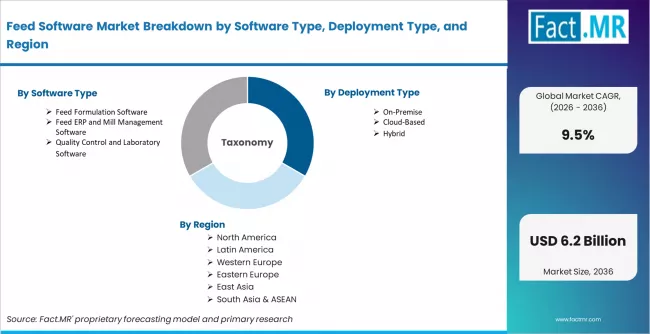
Feed Software Market Size, Share, Growth and Forecast (2026 - 2036)
The Feed Software Market is segmented by Software Type (Feed Formulation Software, Feed ERP and Mill Management Software, Quality Control and Laboratory Software, Procurement and Ingredient Management Software, Feed Sustainability and Footprint Software, and Others), Deployment Type (On-Premise, Cloud-Based, Hybrid, and Others), Feed Type (Livestock Feed, Poultry Feed, Aquafeed, Pet Food, Premix and Additives, and Others), Application (Formula Optimization, Production and Batch Control, Inventory and Procurement Management, Quality and Compliance Management, Costing and Margin Management, and Others), End Use (Feed Manufacturers, Premix Producers, Integrated Livestock Companies, Pet Food Producers, Aquafeed Producers, and Others), and Region. Forecast for 2026 to 2036.
Fact.MR analysis indicates that the feed software market is developing around formulation precision, raw-material control, and mill-wide operational visibility rather than basic digitization alone.
Feed Software Market Forecast and Outlook (2026 to 2036)
- The feed software market was valued at USD 1.9 billion in 2025.
- According to Fact.MR, demand is projected to reach USD 2.1 billion in 2026 and expand to USD 5.2 billion by 2036, reflecting a CAGR of 9.5% during the forecast period.
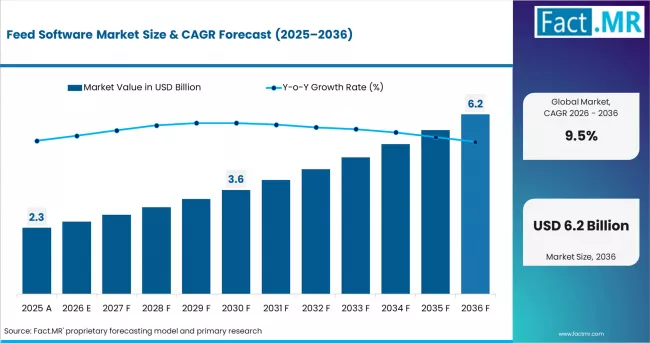
| Metric | Value |
|---|---|
| Estimated Value in 2026 | USD 2.1 billion |
| Forecast Value in 2036 | USD 5.2 billion |
| Forecast CAGR (2026 to 2036) | 9.5% |
Summary of Feed Software Market
- Market Definition
- The market includes software systems used to formulate feed, manage mill workflows, control quality, and optimize feed business operations.
- Demand Drivers
- Feed formulation software is being used to meet nutrition, cost, and regulatory targets with lower manual effort.
- Global feed production reached 1.4 billion metric tons in 2025, which increases the operational value of digital feed control.
- Feed manufacturers are increasingly connecting formulation, pricing, production, inventory, and shipping inside one software environment.
- Key Segments Analyzed
- By Software Type: Feed Formulation Software is estimated to lead with approximately 34% share in 2026, supported by its core role in least-cost and nutrition-balanced feed design.
- By Deployment Type: On-Premise is expected to hold approximately 39% share in 2026, driven by strong control needs in large feed mills.
- By Feed Type: Livestock Feed is projected to account for approximately 36% share in 2026, supported by broad industrial-feed demand.
- By Application: Formula Optimization is expected to contribute approximately 30% share in 2026, backed by direct cost and nutrition value.
- By Geography: India leads growth at 10.7% CAGR through 2036, supported by expanding feed-industry digitization.
- Analyst Opinion at FACT.MR
- Shambhu Nath Jha, Senior Analyst at Fact.MR, states, “this market as a formulation-intelligence and plant-control category rather than a niche nutrition software segment. Buyers are not only paying for recipe calculation. They are paying for tighter margins, better ingredient decisions, and stronger operational visibility.”
- Strategic Implications
- Invest in feed software platforms that connect formulation with inventory, purchasing, and production control.
- Build technical sales capability around raw-material variability, quality-linked optimization, and margin protection rather than software features alone.
- Position sustainability-linked feed software where producers want to manage both economic and environmental performance.
The market is expected to generate an absolute opportunity of USD 3.1 billion between 2026 and 2036, supported by increasing digitalization in feed production. Growth is being driven by rising formulation complexity, volatility in ingredient pricing and quality, stronger traceability requirements, and tighter integration between formulation, production, inventory, and sustainability workflows. Alltech reported global feed production reaching 1.44 billion metric tons in 2025, reinforcing the scale of operations that require digital control. Format Solutions highlights that centralized platforms can connect formulation, pricing, production, inventory, and shipping within a unified system.
India is projected to lead with a CAGR of 10.7% through 2036, driven by expanding compound-feed demand and stronger digitization across integrated animal production. China follows at 10.1%, supported by large-scale feed manufacturing and broader data-driven production control. The United States is expected to grow at 9.2%, underpinned by mature software adoption and continuing formulation, compliance, and margin-management needs. Germany records 8.8%, backed by structured feed quality and process control requirements. Brazil grows at 8.5%, supported by strong livestock feed demand and integrated production systems.
Segmental Analysis
Feed Software Market Analysis by Software Type
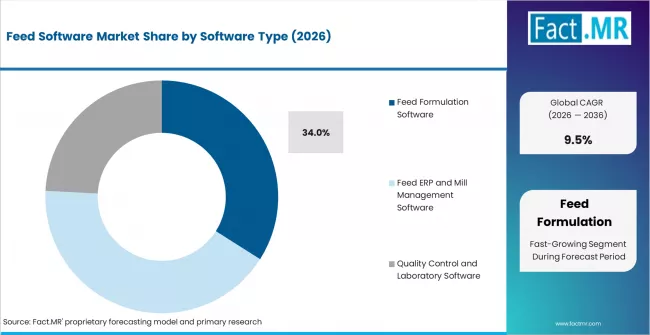
Feed Formulation Software is estimated to hold 34% share in 2026. It leads because feed manufacturers still begin software value capture with least-cost and nutrient-balanced formulation. Format Solutions states that formulation software helps manufacturers optimize recipes against nutritional targets, cost objectives, and regulatory standards. BESTMIX also positions formulation as a central system that keeps ingredient matrices up to date and helps deal with raw-material variability.
- Feed formulation software leads because it is the base decision layer for nutrition and cost control.
- Feed ERP and mill-management tools remain attractive where plants need stronger execution and inventory visibility.
- Quality-control software gains relevance where batch variation and compliance pressure are becoming more material.
Feed Software Market Analysis by Deployment Type
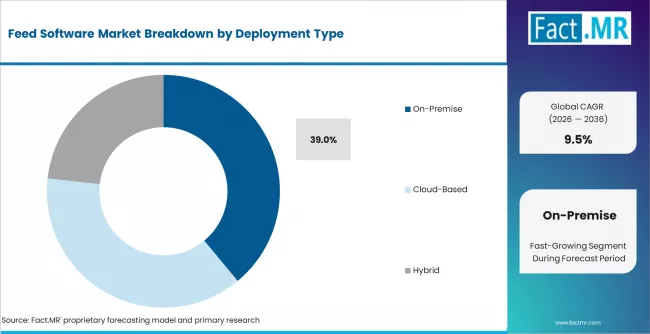
On-premise deployment continues to lead due to the need for direct system control and tight integration with plant-level infrastructure across feed manufacturing operations. This approach supports alignment with ERP, MES, and laboratory systems while enabling real-time production optimization. On-premise is expected to hold approximately 39% share in 2026. BESTMIX highlights advanced ERP and MES integration capabilities for batch-level optimization using real raw-material data, reinforcing the segment’s relevance.
- On-premise leads because many feed mills prioritize direct operational control and integration.
- Cloud-based deployment remains attractive where multi-site visibility and easier scaling matter more.
- Hybrid deployment gains relevance where companies want central data visibility with plant-level execution control.
Feed Software Market Analysis by Feed Type
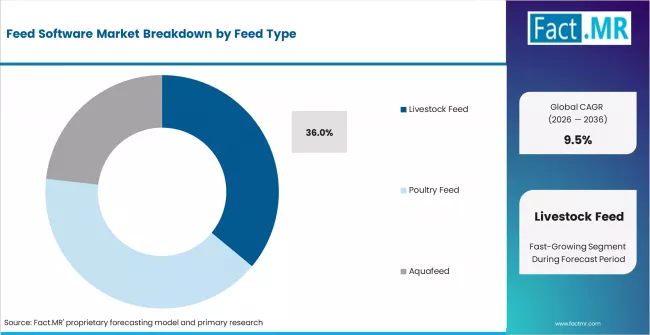
Livestock Feed is projected to account for approximately 36% share, as industrial-scale feed demand is still centered on large livestock and poultry production systems. Alltech’s 2026 Agri-Food Outlook confirms the very large global scale of compound feed production, while Format Solutions and BESTMIX both position their software around broad feed-manufacturing use cases. [4]
- Livestock feed leads because it represents the broadest industrial-feed manufacturing base.
- Premix and additives remain attractive where formulation accuracy and traceability are more demanding.
- Aquafeed gains relevance where fast-growing specialized feed systems need stronger digital control.
Feed Software Market Analysis by Application
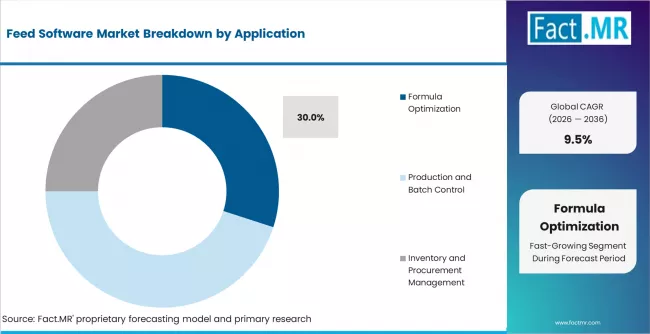
Formula Optimization is expected to contribute approximately 30% share in 2026, as feed software purchasing often starts with the need to improve formula economics while meeting nutritional constraints. Format Solutions explicitly frames precision formulation software around nutrition, compliance, and profitability, while BESTMIX emphasizes optimization using actual raw-material batch price and quality.
- Formula optimization leads because it delivers the clearest and fastest financial value in feed production.
- Production and batch control remain important where mills need more consistent execution.
- Costing and margin management gain relevance where feed producers face volatile ingredient markets.
Drivers, Restraints, and Opportunities
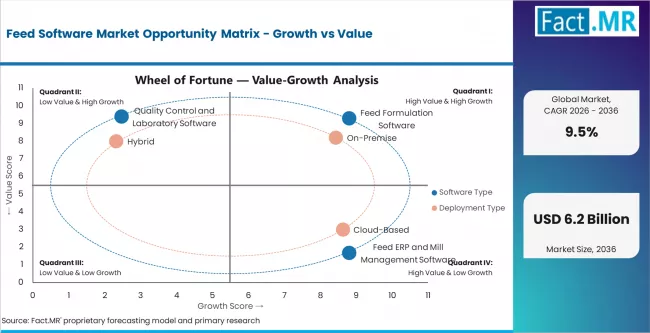
The market is being shaped by the need to make feed production more precise, more integrated, and more resilient to volatility. Structural demand is anchored in the fact that feed producers must manage shifting raw-material price, quality, and availability while still meeting performance and regulatory requirements. BESTMIX emphasizes real-time agility around ingredient variability, while Format Solutions frames formulation software around reduced manual errors and stronger compliance.
The main restraint is integration complexity and workflow change. Feed software delivers the most value when formulation, quality, procurement, and production data are connected, though that also raises implementation and change-management requirements. BESTMIX’s emphasis on ERP and MES integration reflects this reality.
- Sustainability-linked feed software remains the clearest opportunity where producers want to quantify environmental impact alongside cost and nutrition.
- Batch-level optimization creates stronger value where raw-material variability materially affects margins and quality.
- Unified formulation and ERP environments offer higher-value opportunity where feed companies want one digital operating layer across multiple sites. [1]
Regional Analysis
The market is assessed across North America, Europe, Asia Pacific, Latin America, and Middle East and Africa, covering 40+ countries with demand profiles shaped by feed-production scale, industrialization, vertical integration, and software-readiness across feed operations. The country growth rates below are model-based estimates.
.webp)
| Country | CAGR (2026 to 2036) |
|---|---|
| India | 10.7% |
| China | 10.1% |
| United States | 9.2% |
| Germany | 8.8% |
| Brazil | 8.5% |
North America Feed Software Market Analysis
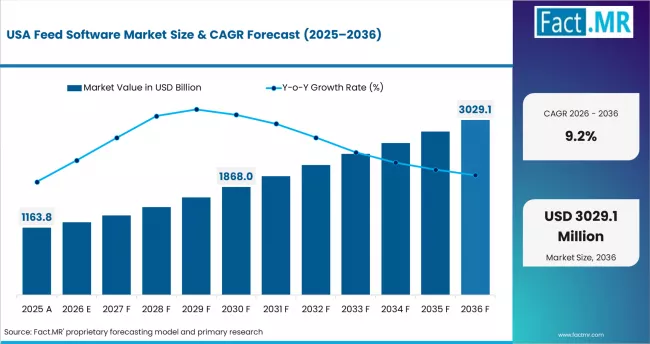
North America remains an important commercial region because it combines mature feed manufacturing, strong premix and pet food segments, and widespread adoption of integrated software platforms. Operators in this region increasingly rely on ERP, formulation, and plant-control systems to manage cost volatility, traceability, and production efficiency.
- United States: Mature software adoption and continued need for formulation accuracy and mill control support growth. The market is projected to expand at approximately 9.2% CAGR by 2036, driven by integrated feed-management platforms, real-time production monitoring, and tighter cost optimization across large-scale feed operations.
Europe Feed Software Market Analysis
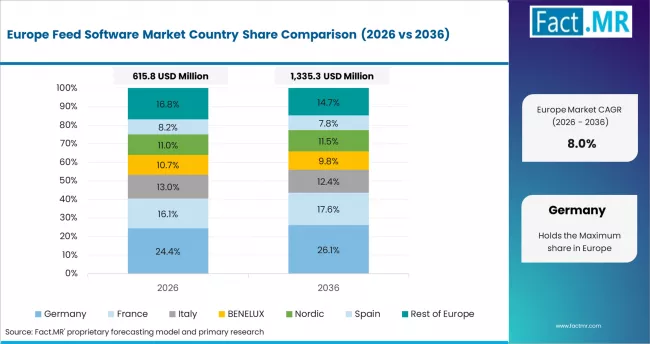
Europe remains a technically structured region where adoption is closely tied to formulation discipline, regulatory compliance, and process standardization. Feed manufacturers emphasize traceability, nutritional precision, and quality assurance, which increases the importance of advanced software systems.
- Germany: Germany plays a central role in Europe’s feed manufacturing ecosystem due to its strong industrial base and emphasis on process efficiency. The market is projected to grow at around 8.8% CAGR over the assessment period, supported by increasing use of formulation software, plant automation tools, and compliance-driven data management systems. Adoption is reinforced by the need for consistent product quality, regulatory adherence, and efficient resource utilization across integrated feed operations.
Asia Pacific and Latin America Feed Software Market Analysis
Asia Pacific offers the strongest long-term expansion potential because it combines large feed-production volumes, rapid industrialization, and increasing pressure to improve operational efficiency under volatile raw-material conditions. Software adoption is accelerating as producers shift from manual or fragmented systems toward integrated digital platforms. [2]
- India: Expanding feed production and increasing adoption of digital mill management support strong growth. The market is projected to grow at close to 10.7% CAGR through 2036, driven by modernization of feed mills, rising demand for formulation accuracy, and growing awareness of cost control through software-enabled operations.
- China: Large-scale feed manufacturing and tighter process-control requirements support continued expansion. The market is expected to grow at approximately 10.1% CAGR from 2026 to 2036, with strong uptake of integrated systems that manage formulation, inventory, and production workflows.
- Brazil: Strong livestock feed demand and vertically integrated production systems support steady growth. The market is projected to grow at around 8.5% CAGR by 2036, driven by increasing adoption of software tools to manage large-scale operations, optimize feed efficiency, and improve traceability.
Competitive Aligners for Market Players
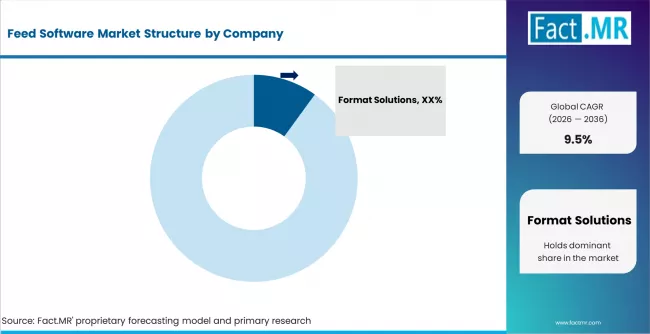
The market is moderately concentrated at the formulation, ERP, and integrated feed-workflow platform level, while broader deployment remains producer-controlled. Competitive strength comes from the ability to combine least-cost formulation, quality-linked optimization, ingredient control, and mill-wide visibility. Suppliers need more than a recipe engine claim. They need a clear explanation of how the platform improves margin, compliance, and execution in real feed plants. [3]
Competitive advantage is defined by formulation depth, workflow integration, raw-material data handling, sustainability linkage, and scalability across feed, premix, aquafeed, and pet food operations.
Key Players
- Format Solutions
- BESTMIX
- dsm-firmenich
- Trouw Nutrition
- Evonik
Bibliography
- [1] Format Solutions. Official formulation-software materials describing nutrition, compliance, profitability, and centralized formulation workflows.
- [2] Alltech. 2026 Agri-Food Outlook materials reporting global feed production of 1.44 billion metric tons in 2025.
- [3] Format Solutions. Official feed ERP materials describing integrated visibility across pricing, production, inventory, and shipping.
- [4] BESTMIX. Official industry materials describing integrated control across purchasing, R&D, formulation, production, and sales, including real-batch optimization and ERP/MES integration.
This Report Addresses
- Strategic intelligence on feed software demand across formulation, mill management, quality control, and sustainability-linked feed operations.
- Market forecast from USD 2.1 billion in 2026 to USD 5.2 billion by 2036 at a CAGR of 9.5%.
- Growth opportunity mapping across feed formulation engines, integrated ERP and mill-control software, batch-quality optimization, and sustainability-linked feed systems.
- Segment analysis by software type, deployment type, feed type, application, and end use.
- Regional outlook covering North America, Europe, Asia Pacific, Latin America, and Middle East and Africa.
- Competitive analysis of major participants serving feed formulation, ERP integration, mill operations, and digital nutrition workflows.
- Feed-manufacturing intelligence analysis covering raw-material variability, compliance, inventory visibility, and margin-focused optimization.
- Market interpretation built around larger feed volumes, stronger digital control needs, and broader integration of formulation with production and sustainability workflows.
Feed Software Market Definition
The market covers software platforms used to formulate feed, manage feed mill operations, control quality, optimize ingredient purchasing, and support traceability and sustainability across feed production workflows. It includes formulation engines, ERP and MES-linked systems, recipe management, specification control, and feed-specific decision-support tools.
Feed Software Market Inclusions
Covers global and regional forecasts from 2026 to 2036. Includes feed and pet food formulation software, feed ERP systems, mill and inventory management tools, quality-control software, sustainability and footprint-linked feed software, and integrated process software used across feed, premix, aquafeed, and pet food production.
Feed Software Market Exclusions
Excludes generic enterprise accounting tools without feed-specific workflow role, stand-alone livestock herd software where feed formulation or mill management is not the core product role, and general manufacturing software that is not materially positioned for feed production.
Feed Software Market Research Methodology
- Primary Research:Interviews with feed formulators, mill managers, premix specialists, procurement teams, nutritionists, quality managers, and feed-software providers.
- Desk Research:Uses current official materials from Format Solutions, BESTMIX, Alltech, and dsm-firmenich tied to formulation, ERP integration, raw-material variability, and sustainability-linked feed software [5]
- Market-Sizing and Forecasting:Hybrid model using global feed-production scale, adoption of feed formulation and ERP tools, ingredient-volatility management needs, and software-led workflow integration across feed manufacturing.
- Data Validation and Update Cycle:Validated using official product materials, feed-industry production references, and recurring checks on formulation, batch-quality optimization, and integrated feed-software development.
Scope of Report

| Attribute | Details |
|---|---|
| Quantitative Units | USD 2.1 billion (2026) to USD 5.2 billion (2036), at a CAGR of 9.5% |
| Market Definition | Software platforms used to formulate feed, manage feed mill operations, control quality, optimize ingredient purchasing, and support traceability and sustainability across feed production workflows |
| Software Type Segmentation | Feed Formulation Software, Feed ERP and Mill Management Software, Quality Control and Laboratory Software, Procurement and Ingredient Management Software, Feed Sustainability and Footprint Software, Others |
| Deployment Type Segmentation | On-Premise, Cloud-Based, Hybrid, Others |
| Feed Type Segmentation | Livestock Feed, Poultry Feed, Aquafeed, Pet Food, Premix and Additives, Others |
| Application Segmentation | Formula Optimization, Production and Batch Control, Inventory and Procurement Management, Quality and Compliance Management, Costing and Margin Management, Others |
| End Use Segmentation | Feed Manufacturers, Premix Producers, Integrated Livestock Companies, Pet Food Producers, Aquafeed Producers, Others |
| Regions Covered | North America, Europe, Asia Pacific, Latin America, Middle East and Africa |
| Countries Covered | United States, Germany, China, India, Brazil, Thailand, and 40+ countries |
| Forecast Period | 2026 to 2036 |
| Approach | Hybrid top-down and bottom-up model using feed-production scale, formulation software adoption, ingredient-volatility management needs, and primary interviews with nutrition, mill, and software stakeholders |
Feed Software Market by Segments
-
By Software Type:
- Feed Formulation Software
- Feed ERP and Mill Management Software
- Quality Control and Laboratory Software
- Procurement and Ingredient Management Software
- Feed Sustainability and Footprint Software
- Others
-
By Deployment Type:
- On-Premise
- Cloud-Based
- Hybrid
- Others
-
By Feed Type:
- Livestock Feed
- Poultry Feed
- Aquafeed
- Pet Food
- Premix and Additives
- Others
-
By Application:
- Formula Optimization
- Production and Batch Control
- Inventory and Procurement Management
- Quality and Compliance Management
- Costing and Margin Management
- Others
-
By End Use:
- Feed Manufacturers
- Premix Producers
- Integrated Livestock Companies
- Pet Food Producers
- Aquafeed Producers
- Others
-
By Region:
- North America
- United States
- Canada
- Mexico
- Latin America
- Brazil
- Argentina
- Chile
- Rest of Latin America
- Western Europe
- Germany
- France
- United Kingdom
- Italy
- Spain
- Nordic Countries
- BENELUX
- Rest of Western Europe
- Eastern Europe
- Russia
- Poland
- Hungary
- Balkan and Baltic
- Rest of Eastern Europe
- East Asia
- China
- Japan
- South Korea
- South Asia and Pacific
- India
- ASEAN
- Australia and New Zealand
- Rest of South Asia and Pacific
- Middle East and Africa
- Kingdom of Saudi Arabia
- Other GCC Countries
- Turkey
- South Africa
- Rest of Middle East and Africa
- North America
- Frequently Asked Questions -
How large is the global feed software market in 2025?
The global market was valued at USD 1.9 billion in 2025.
What will the market size be in 2026?
Demand is estimated to reach USD 2.1 billion in 2026.
What is the projected market size by 2036?
The market is projected to reach USD 5.2 billion by 2036, generating USD 3.1 billion in absolute opportunity over the forecast period.
What is the expected CAGR from 2026 to 2036?
Fact.MR projects a CAGR of 9.5% during the 2026 to 2036 period.
Which software type is poised to lead the market?
Feed Formulation Software is estimated to lead with approximately 34% share in 2026.
Which application segment holds the largest share?
Formula Optimization is expected to hold approximately 30% share in 2026.
Which country shows the fastest growth?
India is projected to lead growth at 10.7% CAGR through 2036.
What is driving demand for feed software?
Demand is being driven by rising formulation complexity, stronger raw-material variability management, broader mill integration, and growing need for feed-business visibility.
What is the key challenge in this market?
The main challenge is integrating formulation, quality, procurement, and production workflows well enough that software produces real mill-level value rather than isolated digital records.
Table of Content
- Executive Summary
- Global Market Outlook
- Demand to side Trends
- Supply to side Trends
- Technology Roadmap Analysis
- Analysis and Recommendations
- Market Overview
- Market Coverage / Taxonomy
- Market Definition / Scope / Limitations
- Research Methodology
- Chapter Orientation
- Analytical Lens and Working Hypotheses
- Market Structure, Signals, and Trend Drivers
- Benchmarking and Cross-market Comparability
- Market Sizing, Forecasting, and Opportunity Mapping
- Research Design and Evidence Framework
- Desk Research Programme (Secondary Evidence)
- Company Annual and Sustainability Reports
- Peer-reviewed Journals and Academic Literature
- Corporate Websites, Product Literature, and Technical Notes
- Earnings Decks and Investor Briefings
- Statutory Filings and Regulatory Disclosures
- Technical White Papers and Standards Notes
- Trade Journals, Industry Magazines, and Analyst Briefs
- Conference Proceedings, Webinars, and Seminar Materials
- Government Statistics Portals and Public Data Releases
- Press Releases and Reputable Media Coverage
- Specialist Newsletters and Curated Briefings
- Sector Databases and Reference Repositories
- Fact.MR Internal Proprietary Databases and Historical Market Datasets
- Subscription Datasets and Paid Sources
- Social Channels, Communities, and Digital Listening Inputs
- Additional Desk Sources
- Expert Input and Fieldwork (Primary Evidence)
- Primary Modes
- Qualitative Interviews and Expert Elicitation
- Quantitative Surveys and Structured Data Capture
- Blended Approach
- Why Primary Evidence is Used
- Field Techniques
- Interviews
- Surveys
- Focus Groups
- Observational and In-context Research
- Social and Community Interactions
- Stakeholder Universe Engaged
- C-suite Leaders
- Board Members
- Presidents and Vice Presidents
- R&D and Innovation Heads
- Technical Specialists
- Domain Subject-matter Experts
- Scientists
- Physicians and Other Healthcare Professionals
- Governance, Ethics, and Data Stewardship
- Research Ethics
- Data Integrity and Handling
- Primary Modes
- Tooling, Models, and Reference Databases
- Desk Research Programme (Secondary Evidence)
- Data Engineering and Model Build
- Data Acquisition and Ingestion
- Cleaning, Normalisation, and Verification
- Synthesis, Triangulation, and Analysis
- Quality Assurance and Audit Trail
- Market Background
- Market Dynamics
- Drivers
- Restraints
- Opportunity
- Trends
- Scenario Forecast
- Demand in Optimistic Scenario
- Demand in Likely Scenario
- Demand in Conservative Scenario
- Opportunity Map Analysis
- Product Life Cycle Analysis
- Supply Chain Analysis
- Investment Feasibility Matrix
- Value Chain Analysis
- PESTLE and Porter’s Analysis
- Regulatory Landscape
- Regional Parent Market Outlook
- Production and Consumption Statistics
- Import and Export Statistics
- Market Dynamics
- Global Market Analysis 2021 to 2025 and Forecast, 2026 to 2036
- Historical Market Size Value (USD Million) Analysis, 2021 to 2025
- Current and Future Market Size Value (USD Million) Projections, 2026 to 2036
- Y to o to Y Growth Trend Analysis
- Absolute $ Opportunity Analysis
- Global Market Pricing Analysis 2021 to 2025 and Forecast 2026 to 2036
- Global Market Analysis 2021 to 2025 and Forecast 2026 to 2036, By Software Type
- Introduction / Key Findings
- Historical Market Size Value (USD Million) Analysis By Software Type , 2021 to 2025
- Current and Future Market Size Value (USD Million) Analysis and Forecast By Software Type , 2026 to 2036
- Feed Formulation Software
- Feed ERP and Mill Management Software
- Quality Control and Laboratory Software
- Feed Formulation Software
- Y to o to Y Growth Trend Analysis By Software Type , 2021 to 2025
- Absolute $ Opportunity Analysis By Software Type , 2026 to 2036
- Global Market Analysis 2021 to 2025 and Forecast 2026 to 2036, By Deployment Type
- Introduction / Key Findings
- Historical Market Size Value (USD Million) Analysis By Deployment Type, 2021 to 2025
- Current and Future Market Size Value (USD Million) Analysis and Forecast By Deployment Type, 2026 to 2036
- On-Premise
- Cloud-Based
- Hybrid
- On-Premise
- Y to o to Y Growth Trend Analysis By Deployment Type, 2021 to 2025
- Absolute $ Opportunity Analysis By Deployment Type, 2026 to 2036
- Global Market Analysis 2021 to 2025 and Forecast 2026 to 2036, By Feed Type
- Introduction / Key Findings
- Historical Market Size Value (USD Million) Analysis By Feed Type, 2021 to 2025
- Current and Future Market Size Value (USD Million) Analysis and Forecast By Feed Type, 2026 to 2036
- Livestock Feed
- Poultry Feed
- Aquafeed
- Livestock Feed
- Y to o to Y Growth Trend Analysis By Feed Type, 2021 to 2025
- Absolute $ Opportunity Analysis By Feed Type, 2026 to 2036
- Global Market Analysis 2021 to 2025 and Forecast 2026 to 2036, By Application
- Introduction / Key Findings
- Historical Market Size Value (USD Million) Analysis By Application, 2021 to 2025
- Current and Future Market Size Value (USD Million) Analysis and Forecast By Application, 2026 to 2036
- Formula Optimization
- Production and Batch Control
- Inventory and Procurement Management
- Formula Optimization
- Y to o to Y Growth Trend Analysis By Application, 2021 to 2025
- Absolute $ Opportunity Analysis By Application, 2026 to 2036
- Global Market Analysis 2021 to 2025 and Forecast 2026 to 2036, By Region
- Introduction
- Historical Market Size Value (USD Million) Analysis By Region, 2021 to 2025
- Current Market Size Value (USD Million) Analysis and Forecast By Region, 2026 to 2036
- North America
- Latin America
- Western Europe
- Eastern Europe
- East Asia
- South Asia and Pacific
- Middle East & Africa
- Market Attractiveness Analysis By Region
- North America Market Analysis 2021 to 2025 and Forecast 2026 to 2036, By Country
- Historical Market Size Value (USD Million) Trend Analysis By Market Taxonomy, 2021 to 2025
- Market Size Value (USD Million) Forecast By Market Taxonomy, 2026 to 2036
- By Country
- USA
- Canada
- Mexico
- By Software Type
- By Deployment Type
- By Feed Type
- By Application
- By Country
- Market Attractiveness Analysis
- By Country
- By Software Type
- By Deployment Type
- By Feed Type
- By Application
- Key Takeaways
- Latin America Market Analysis 2021 to 2025 and Forecast 2026 to 2036, By Country
- Historical Market Size Value (USD Million) Trend Analysis By Market Taxonomy, 2021 to 2025
- Market Size Value (USD Million) Forecast By Market Taxonomy, 2026 to 2036
- By Country
- Brazil
- Chile
- Rest of Latin America
- By Software Type
- By Deployment Type
- By Feed Type
- By Application
- By Country
- Market Attractiveness Analysis
- By Country
- By Software Type
- By Deployment Type
- By Feed Type
- By Application
- Key Takeaways
- Western Europe Market Analysis 2021 to 2025 and Forecast 2026 to 2036, By Country
- Historical Market Size Value (USD Million) Trend Analysis By Market Taxonomy, 2021 to 2025
- Market Size Value (USD Million) Forecast By Market Taxonomy, 2026 to 2036
- By Country
- Germany
- UK
- Italy
- Spain
- France
- Nordic
- BENELUX
- Rest of Western Europe
- By Software Type
- By Deployment Type
- By Feed Type
- By Application
- By Country
- Market Attractiveness Analysis
- By Country
- By Software Type
- By Deployment Type
- By Feed Type
- By Application
- Key Takeaways
- Eastern Europe Market Analysis 2021 to 2025 and Forecast 2026 to 2036, By Country
- Historical Market Size Value (USD Million) Trend Analysis By Market Taxonomy, 2021 to 2025
- Market Size Value (USD Million) Forecast By Market Taxonomy, 2026 to 2036
- By Country
- Russia
- Poland
- Hungary
- Balkan & Baltic
- Rest of Eastern Europe
- By Software Type
- By Deployment Type
- By Feed Type
- By Application
- By Country
- Market Attractiveness Analysis
- By Country
- By Software Type
- By Deployment Type
- By Feed Type
- By Application
- Key Takeaways
- East Asia Market Analysis 2021 to 2025 and Forecast 2026 to 2036, By Country
- Historical Market Size Value (USD Million) Trend Analysis By Market Taxonomy, 2021 to 2025
- Market Size Value (USD Million) Forecast By Market Taxonomy, 2026 to 2036
- By Country
- China
- Japan
- South Korea
- By Software Type
- By Deployment Type
- By Feed Type
- By Application
- By Country
- Market Attractiveness Analysis
- By Country
- By Software Type
- By Deployment Type
- By Feed Type
- By Application
- Key Takeaways
- South Asia and Pacific Market Analysis 2021 to 2025 and Forecast 2026 to 2036, By Country
- Historical Market Size Value (USD Million) Trend Analysis By Market Taxonomy, 2021 to 2025
- Market Size Value (USD Million) Forecast By Market Taxonomy, 2026 to 2036
- By Country
- India
- ASEAN
- Australia & New Zealand
- Rest of South Asia and Pacific
- By Software Type
- By Deployment Type
- By Feed Type
- By Application
- By Country
- Market Attractiveness Analysis
- By Country
- By Software Type
- By Deployment Type
- By Feed Type
- By Application
- Key Takeaways
- Middle East & Africa Market Analysis 2021 to 2025 and Forecast 2026 to 2036, By Country
- Historical Market Size Value (USD Million) Trend Analysis By Market Taxonomy, 2021 to 2025
- Market Size Value (USD Million) Forecast By Market Taxonomy, 2026 to 2036
- By Country
- Kingdom of Saudi Arabia
- Other GCC Countries
- Turkiye
- South Africa
- Other African Union
- Rest of Middle East & Africa
- By Software Type
- By Deployment Type
- By Feed Type
- By Application
- By Country
- Market Attractiveness Analysis
- By Country
- By Software Type
- By Deployment Type
- By Feed Type
- By Application
- Key Takeaways
- Key Countries Market Analysis
- USA
- Pricing Analysis
- Market Share Analysis, 2025
- By Software Type
- By Deployment Type
- By Feed Type
- By Application
- Canada
- Pricing Analysis
- Market Share Analysis, 2025
- By Software Type
- By Deployment Type
- By Feed Type
- By Application
- Mexico
- Pricing Analysis
- Market Share Analysis, 2025
- By Software Type
- By Deployment Type
- By Feed Type
- By Application
- Brazil
- Pricing Analysis
- Market Share Analysis, 2025
- By Software Type
- By Deployment Type
- By Feed Type
- By Application
- Chile
- Pricing Analysis
- Market Share Analysis, 2025
- By Software Type
- By Deployment Type
- By Feed Type
- By Application
- Germany
- Pricing Analysis
- Market Share Analysis, 2025
- By Software Type
- By Deployment Type
- By Feed Type
- By Application
- UK
- Pricing Analysis
- Market Share Analysis, 2025
- By Software Type
- By Deployment Type
- By Feed Type
- By Application
- Italy
- Pricing Analysis
- Market Share Analysis, 2025
- By Software Type
- By Deployment Type
- By Feed Type
- By Application
- Spain
- Pricing Analysis
- Market Share Analysis, 2025
- By Software Type
- By Deployment Type
- By Feed Type
- By Application
- France
- Pricing Analysis
- Market Share Analysis, 2025
- By Software Type
- By Deployment Type
- By Feed Type
- By Application
- India
- Pricing Analysis
- Market Share Analysis, 2025
- By Software Type
- By Deployment Type
- By Feed Type
- By Application
- ASEAN
- Pricing Analysis
- Market Share Analysis, 2025
- By Software Type
- By Deployment Type
- By Feed Type
- By Application
- Australia & New Zealand
- Pricing Analysis
- Market Share Analysis, 2025
- By Software Type
- By Deployment Type
- By Feed Type
- By Application
- China
- Pricing Analysis
- Market Share Analysis, 2025
- By Software Type
- By Deployment Type
- By Feed Type
- By Application
- Japan
- Pricing Analysis
- Market Share Analysis, 2025
- By Software Type
- By Deployment Type
- By Feed Type
- By Application
- South Korea
- Pricing Analysis
- Market Share Analysis, 2025
- By Software Type
- By Deployment Type
- By Feed Type
- By Application
- Russia
- Pricing Analysis
- Market Share Analysis, 2025
- By Software Type
- By Deployment Type
- By Feed Type
- By Application
- Poland
- Pricing Analysis
- Market Share Analysis, 2025
- By Software Type
- By Deployment Type
- By Feed Type
- By Application
- Hungary
- Pricing Analysis
- Market Share Analysis, 2025
- By Software Type
- By Deployment Type
- By Feed Type
- By Application
- Kingdom of Saudi Arabia
- Pricing Analysis
- Market Share Analysis, 2025
- By Software Type
- By Deployment Type
- By Feed Type
- By Application
- Turkiye
- Pricing Analysis
- Market Share Analysis, 2025
- By Software Type
- By Deployment Type
- By Feed Type
- By Application
- South Africa
- Pricing Analysis
- Market Share Analysis, 2025
- By Software Type
- By Deployment Type
- By Feed Type
- By Application
- USA
- Market Structure Analysis
- Competition Dashboard
- Competition Benchmarking
- Market Share Analysis of Top Players
- By Regional
- By Software Type
- By Deployment Type
- By Feed Type
- By Application
- Competition Analysis
- Competition Deep Dive
- Format Solutions
- Overview
- Product Portfolio
- Profitability by Market Segments (Product/Age /Sales Channel/Region)
- Sales Footprint
- Strategy Overview
- Marketing Strategy
- Product Strategy
- Channel Strategy
- BESTMIX
- dsm-firmenich
- Trouw Nutrition
- Evonik
- Format Solutions
- Competition Deep Dive
- Assumptions & Acronyms Used
List Of Table
- Table 1: Global Market Value (USD Million) Forecast by Region, 2021 to 2036
- Table 2: Global Market Value (USD Million) Forecast by Software Type, 2021 to 2036
- Table 3: Global Market Value (USD Million) Forecast by Deployment Type, 2021 to 2036
- Table 4: Global Market Value (USD Million) Forecast by Feed Type, 2021 to 2036
- Table 5: Global Market Value (USD Million) Forecast by Application, 2021 to 2036
- Table 6: North America Market Value (USD Million) Forecast by Country, 2021 to 2036
- Table 7: North America Market Value (USD Million) Forecast by Software Type, 2021 to 2036
- Table 8: North America Market Value (USD Million) Forecast by Deployment Type, 2021 to 2036
- Table 9: North America Market Value (USD Million) Forecast by Feed Type, 2021 to 2036
- Table 10: North America Market Value (USD Million) Forecast by Application, 2021 to 2036
- Table 11: Latin America Market Value (USD Million) Forecast by Country, 2021 to 2036
- Table 12: Latin America Market Value (USD Million) Forecast by Software Type, 2021 to 2036
- Table 13: Latin America Market Value (USD Million) Forecast by Deployment Type, 2021 to 2036
- Table 14: Latin America Market Value (USD Million) Forecast by Feed Type, 2021 to 2036
- Table 15: Latin America Market Value (USD Million) Forecast by Application, 2021 to 2036
- Table 16: Western Europe Market Value (USD Million) Forecast by Country, 2021 to 2036
- Table 17: Western Europe Market Value (USD Million) Forecast by Software Type, 2021 to 2036
- Table 18: Western Europe Market Value (USD Million) Forecast by Deployment Type, 2021 to 2036
- Table 19: Western Europe Market Value (USD Million) Forecast by Feed Type, 2021 to 2036
- Table 20: Western Europe Market Value (USD Million) Forecast by Application, 2021 to 2036
- Table 21: Eastern Europe Market Value (USD Million) Forecast by Country, 2021 to 2036
- Table 22: Eastern Europe Market Value (USD Million) Forecast by Software Type, 2021 to 2036
- Table 23: Eastern Europe Market Value (USD Million) Forecast by Deployment Type, 2021 to 2036
- Table 24: Eastern Europe Market Value (USD Million) Forecast by Feed Type, 2021 to 2036
- Table 25: Eastern Europe Market Value (USD Million) Forecast by Application, 2021 to 2036
- Table 26: East Asia Market Value (USD Million) Forecast by Country, 2021 to 2036
- Table 27: East Asia Market Value (USD Million) Forecast by Software Type, 2021 to 2036
- Table 28: East Asia Market Value (USD Million) Forecast by Deployment Type, 2021 to 2036
- Table 29: East Asia Market Value (USD Million) Forecast by Feed Type, 2021 to 2036
- Table 30: East Asia Market Value (USD Million) Forecast by Application, 2021 to 2036
- Table 31: South Asia and Pacific Market Value (USD Million) Forecast by Country, 2021 to 2036
- Table 32: South Asia and Pacific Market Value (USD Million) Forecast by Software Type, 2021 to 2036
- Table 33: South Asia and Pacific Market Value (USD Million) Forecast by Deployment Type, 2021 to 2036
- Table 34: South Asia and Pacific Market Value (USD Million) Forecast by Feed Type, 2021 to 2036
- Table 35: South Asia and Pacific Market Value (USD Million) Forecast by Application, 2021 to 2036
- Table 36: Middle East & Africa Market Value (USD Million) Forecast by Country, 2021 to 2036
- Table 37: Middle East & Africa Market Value (USD Million) Forecast by Software Type, 2021 to 2036
- Table 38: Middle East & Africa Market Value (USD Million) Forecast by Deployment Type, 2021 to 2036
- Table 39: Middle East & Africa Market Value (USD Million) Forecast by Feed Type, 2021 to 2036
- Table 40: Middle East & Africa Market Value (USD Million) Forecast by Application, 2021 to 2036
List Of Figures
- Figure 1: Global Market Pricing Analysis
- Figure 2: Global Market Value (USD Million) Forecast 2021-2036
- Figure 3: Global Market Value Share and BPS Analysis by Software Type, 2026 and 2036
- Figure 4: Global Market Y-o-Y Growth Comparison by Software Type, 2026 to 2036
- Figure 5: Global Market Attractiveness Analysis by Software Type
- Figure 6: Global Market Value Share and BPS Analysis by Deployment Type, 2026 and 2036
- Figure 7: Global Market Y-o-Y Growth Comparison by Deployment Type, 2026 to 2036
- Figure 8: Global Market Attractiveness Analysis by Deployment Type
- Figure 9: Global Market Value Share and BPS Analysis by Feed Type, 2026 and 2036
- Figure 10: Global Market Y-o-Y Growth Comparison by Feed Type, 2026 to 2036
- Figure 11: Global Market Attractiveness Analysis by Feed Type
- Figure 12: Global Market Value Share and BPS Analysis by Application, 2026 and 2036
- Figure 13: Global Market Y-o-Y Growth Comparison by Application, 2026 to 2036
- Figure 14: Global Market Attractiveness Analysis by Application
- Figure 15: Global Market Value (USD Million) Share and BPS Analysis by Region, 2026 and 2036
- Figure 16: Global Market Y-o-Y Growth Comparison by Region, 2026 to 2036
- Figure 17: Global Market Attractiveness Analysis by Region
- Figure 18: North America Market Incremental Dollar Opportunity, 2026 to 2036
- Figure 19: Latin America Market Incremental Dollar Opportunity, 2026 to 2036
- Figure 20: Western Europe Market Incremental Dollar Opportunity, 2026 to 2036
- Figure 21: Eastern Europe Market Incremental Dollar Opportunity, 2026 to 2036
- Figure 22: East Asia Market Incremental Dollar Opportunity, 2026 to 2036
- Figure 23: South Asia and Pacific Market Incremental Dollar Opportunity, 2026 to 2036
- Figure 24: Middle East & Africa Market Incremental Dollar Opportunity, 2026 to 2036
- Figure 25: North America Market Value Share and BPS Analysis by Country, 2026 and 2036
- Figure 26: North America Market Value Share and BPS Analysis by Software Type, 2026 and 2036
- Figure 27: North America Market Y-o-Y Growth Comparison by Software Type, 2026 to 2036
- Figure 28: North America Market Attractiveness Analysis by Software Type
- Figure 29: North America Market Value Share and BPS Analysis by Deployment Type, 2026 and 2036
- Figure 30: North America Market Y-o-Y Growth Comparison by Deployment Type, 2026 to 2036
- Figure 31: North America Market Attractiveness Analysis by Deployment Type
- Figure 32: North America Market Value Share and BPS Analysis by Feed Type, 2026 and 2036
- Figure 33: North America Market Y-o-Y Growth Comparison by Feed Type, 2026 to 2036
- Figure 34: North America Market Attractiveness Analysis by Feed Type
- Figure 35: North America Market Value Share and BPS Analysis by Application, 2026 and 2036
- Figure 36: North America Market Y-o-Y Growth Comparison by Application, 2026 to 2036
- Figure 37: North America Market Attractiveness Analysis by Application
- Figure 38: Latin America Market Value Share and BPS Analysis by Country, 2026 and 2036
- Figure 39: Latin America Market Value Share and BPS Analysis by Software Type, 2026 and 2036
- Figure 40: Latin America Market Y-o-Y Growth Comparison by Software Type, 2026 to 2036
- Figure 41: Latin America Market Attractiveness Analysis by Software Type
- Figure 42: Latin America Market Value Share and BPS Analysis by Deployment Type, 2026 and 2036
- Figure 43: Latin America Market Y-o-Y Growth Comparison by Deployment Type, 2026 to 2036
- Figure 44: Latin America Market Attractiveness Analysis by Deployment Type
- Figure 45: Latin America Market Value Share and BPS Analysis by Feed Type, 2026 and 2036
- Figure 46: Latin America Market Y-o-Y Growth Comparison by Feed Type, 2026 to 2036
- Figure 47: Latin America Market Attractiveness Analysis by Feed Type
- Figure 48: Latin America Market Value Share and BPS Analysis by Application, 2026 and 2036
- Figure 49: Latin America Market Y-o-Y Growth Comparison by Application, 2026 to 2036
- Figure 50: Latin America Market Attractiveness Analysis by Application
- Figure 51: Western Europe Market Value Share and BPS Analysis by Country, 2026 and 2036
- Figure 52: Western Europe Market Value Share and BPS Analysis by Software Type, 2026 and 2036
- Figure 53: Western Europe Market Y-o-Y Growth Comparison by Software Type, 2026 to 2036
- Figure 54: Western Europe Market Attractiveness Analysis by Software Type
- Figure 55: Western Europe Market Value Share and BPS Analysis by Deployment Type, 2026 and 2036
- Figure 56: Western Europe Market Y-o-Y Growth Comparison by Deployment Type, 2026 to 2036
- Figure 57: Western Europe Market Attractiveness Analysis by Deployment Type
- Figure 58: Western Europe Market Value Share and BPS Analysis by Feed Type, 2026 and 2036
- Figure 59: Western Europe Market Y-o-Y Growth Comparison by Feed Type, 2026 to 2036
- Figure 60: Western Europe Market Attractiveness Analysis by Feed Type
- Figure 61: Western Europe Market Value Share and BPS Analysis by Application, 2026 and 2036
- Figure 62: Western Europe Market Y-o-Y Growth Comparison by Application, 2026 to 2036
- Figure 63: Western Europe Market Attractiveness Analysis by Application
- Figure 64: Eastern Europe Market Value Share and BPS Analysis by Country, 2026 and 2036
- Figure 65: Eastern Europe Market Value Share and BPS Analysis by Software Type, 2026 and 2036
- Figure 66: Eastern Europe Market Y-o-Y Growth Comparison by Software Type, 2026 to 2036
- Figure 67: Eastern Europe Market Attractiveness Analysis by Software Type
- Figure 68: Eastern Europe Market Value Share and BPS Analysis by Deployment Type, 2026 and 2036
- Figure 69: Eastern Europe Market Y-o-Y Growth Comparison by Deployment Type, 2026 to 2036
- Figure 70: Eastern Europe Market Attractiveness Analysis by Deployment Type
- Figure 71: Eastern Europe Market Value Share and BPS Analysis by Feed Type, 2026 and 2036
- Figure 72: Eastern Europe Market Y-o-Y Growth Comparison by Feed Type, 2026 to 2036
- Figure 73: Eastern Europe Market Attractiveness Analysis by Feed Type
- Figure 74: Eastern Europe Market Value Share and BPS Analysis by Application, 2026 and 2036
- Figure 75: Eastern Europe Market Y-o-Y Growth Comparison by Application, 2026 to 2036
- Figure 76: Eastern Europe Market Attractiveness Analysis by Application
- Figure 77: East Asia Market Value Share and BPS Analysis by Country, 2026 and 2036
- Figure 78: East Asia Market Value Share and BPS Analysis by Software Type, 2026 and 2036
- Figure 79: East Asia Market Y-o-Y Growth Comparison by Software Type, 2026 to 2036
- Figure 80: East Asia Market Attractiveness Analysis by Software Type
- Figure 81: East Asia Market Value Share and BPS Analysis by Deployment Type, 2026 and 2036
- Figure 82: East Asia Market Y-o-Y Growth Comparison by Deployment Type, 2026 to 2036
- Figure 83: East Asia Market Attractiveness Analysis by Deployment Type
- Figure 84: East Asia Market Value Share and BPS Analysis by Feed Type, 2026 and 2036
- Figure 85: East Asia Market Y-o-Y Growth Comparison by Feed Type, 2026 to 2036
- Figure 86: East Asia Market Attractiveness Analysis by Feed Type
- Figure 87: East Asia Market Value Share and BPS Analysis by Application, 2026 and 2036
- Figure 88: East Asia Market Y-o-Y Growth Comparison by Application, 2026 to 2036
- Figure 89: East Asia Market Attractiveness Analysis by Application
- Figure 90: South Asia and Pacific Market Value Share and BPS Analysis by Country, 2026 and 2036
- Figure 91: South Asia and Pacific Market Value Share and BPS Analysis by Software Type, 2026 and 2036
- Figure 92: South Asia and Pacific Market Y-o-Y Growth Comparison by Software Type, 2026 to 2036
- Figure 93: South Asia and Pacific Market Attractiveness Analysis by Software Type
- Figure 94: South Asia and Pacific Market Value Share and BPS Analysis by Deployment Type, 2026 and 2036
- Figure 95: South Asia and Pacific Market Y-o-Y Growth Comparison by Deployment Type, 2026 to 2036
- Figure 96: South Asia and Pacific Market Attractiveness Analysis by Deployment Type
- Figure 97: South Asia and Pacific Market Value Share and BPS Analysis by Feed Type, 2026 and 2036
- Figure 98: South Asia and Pacific Market Y-o-Y Growth Comparison by Feed Type, 2026 to 2036
- Figure 99: South Asia and Pacific Market Attractiveness Analysis by Feed Type
- Figure 100: South Asia and Pacific Market Value Share and BPS Analysis by Application, 2026 and 2036
- Figure 101: South Asia and Pacific Market Y-o-Y Growth Comparison by Application, 2026 to 2036
- Figure 102: South Asia and Pacific Market Attractiveness Analysis by Application
- Figure 103: Middle East & Africa Market Value Share and BPS Analysis by Country, 2026 and 2036
- Figure 104: Middle East & Africa Market Value Share and BPS Analysis by Software Type, 2026 and 2036
- Figure 105: Middle East & Africa Market Y-o-Y Growth Comparison by Software Type, 2026 to 2036
- Figure 106: Middle East & Africa Market Attractiveness Analysis by Software Type
- Figure 107: Middle East & Africa Market Value Share and BPS Analysis by Deployment Type, 2026 and 2036
- Figure 108: Middle East & Africa Market Y-o-Y Growth Comparison by Deployment Type, 2026 to 2036
- Figure 109: Middle East & Africa Market Attractiveness Analysis by Deployment Type
- Figure 110: Middle East & Africa Market Value Share and BPS Analysis by Feed Type, 2026 and 2036
- Figure 111: Middle East & Africa Market Y-o-Y Growth Comparison by Feed Type, 2026 to 2036
- Figure 112: Middle East & Africa Market Attractiveness Analysis by Feed Type
- Figure 113: Middle East & Africa Market Value Share and BPS Analysis by Application, 2026 and 2036
- Figure 114: Middle East & Africa Market Y-o-Y Growth Comparison by Application, 2026 to 2036
- Figure 115: Middle East & Africa Market Attractiveness Analysis by Application
- Figure 116: Global Market - Tier Structure Analysis
- Figure 117: Global Market - Company Share Analysis