- Base Value(2025): 12.4 Bn
- Estimated Value(2026): 14.1 Bn
- Forecast Value (2036): 57.3 Bn
- CAGR (2026 - 2036): 15%
Software Defined Security Market Size, Share and Forecast and Outlook By Fact.MR
In 2025, the software defined security market was valued at USD 12.4 billion. Fact MR analysis indicates demand for software defined security is expected to reach USD 14.1 billion in 2026 and USD 57.3 billion by 2036. FMR estimates the market will expand at a CAGR of 15% across the forecast period.
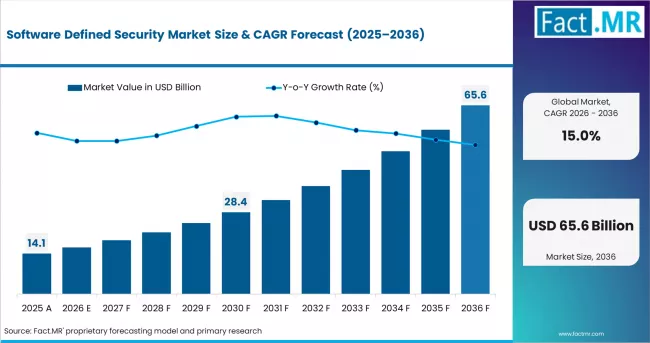
Software Defined Security Market Market Value Analysis | Source: Fact.MR
Software Defined Security Market
| Metric | Details |
|---|---|
| Industry Size (2026E) | USD 14.1 billion |
| Industry Value (2036F) | USD 57.3 billion |
| CAGR (2026 to 2036) | 15% |
Source: Fact.MR analysis. Updated May 6, 2026
Summary of Software Defined Security Market
- Market Definition
- The software defined security market refers to cybersecurity architectures where protection mechanisms are implemented through software-controlled policies rather than hardware appliances. Security orchestration, access control, threat monitoring, and micro-segmentation are centrally managed across cloud, hybrid, and virtualized IT environments. These platforms enable programmable protection layers aligned with dynamic infrastructure provisioning models used across modern enterprise digital ecosystems.
- Demand Drivers
- Increasing migration toward hybrid and multi-cloud environments requiring scalable and centrally managed policy enforcement frameworks.
- Rising adoption of zero trust security architectures supporting identity-based access control across distributed enterprise systems.
- Expansion of containerized workloads requiring micro-segmentation and software-driven network traffic inspection.
- Increasing demand for automated threat detection platforms reducing manual incident response workload across enterprise cybersecurity teams.
- Growing integration of AI-driven analytics enabling predictive threat intelligence and adaptive network defense mechanisms.
- Expansion of enterprise digital infrastructure increasing requirement for programmable network protection across distributed applications.
- Key Segments Analyzed
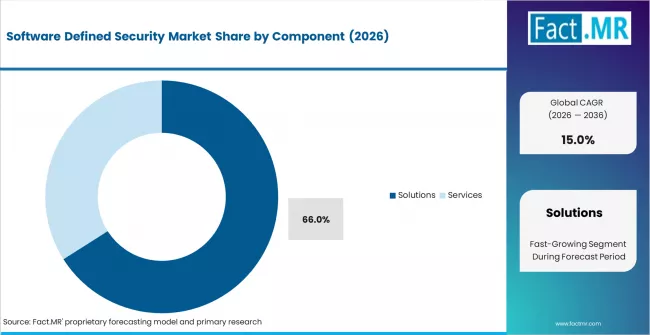
- Component: Solutions account for 66% share supported by increasing deployment of centralized policy orchestration platforms.
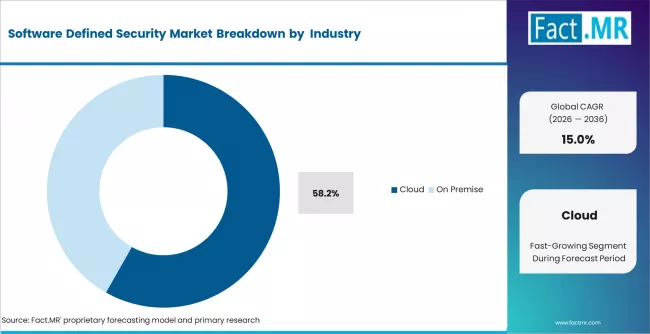
- Deployment Mode: Cloud deployment represents 58.2% share supported by migration of enterprise workloads toward cloud-native infrastructure.
- Security Type: Network security and cloud security demonstrate strong adoption due to expansion of virtualized enterprise environments.
- End Use: IT & telecom, BFSI, healthcare, and government sectors demonstrate strong adoption supported by high cybersecurity risk exposure.
- Geography: India and China demonstrate strongest growth supported by rapid expansion of cloud infrastructure ecosystems, while the USA and Germany reflect mature adoption of virtualized security frameworks.
- Analyst Opinion at Fact MR
- Sabyasachi Ghosh, Associate Vice President at Fact MR, states, "Software defined security reflects structural transformation of enterprise cybersecurity architecture from hardware-centric perimeter defense toward programmable protection layers embedded across hybrid infrastructure environments. Adoption is driven by zero trust frameworks and cloud-native application deployment requiring continuous policy enforcement across distributed digital workloads. Growth trajectory remains strongly aligned with virtualization, container orchestration, and automated threat response platforms supporting scalable enterprise cybersecurity management."
- Strategic Implications
- Expand integration capability supporting interoperability with multi-cloud infrastructure and container orchestration environments.
- Strengthen policy automation frameworks enabling dynamic enforcement of identity-based access control models.
- Improve threat analytics capability supporting real-time anomaly detection across distributed network environments.
- Expand micro-segmentation capability supporting workload-level isolation across hybrid infrastructure environments.
- Strengthen zero trust implementation frameworks supporting continuous authentication and authorization across enterprise networks.
- Improve compatibility with legacy security stacks supporting phased migration toward software-defined security architectures.
- Methodology
- Developed through primary interviews with cybersecurity solution providers, enterprise security architects, and cloud infrastructure operators.
- Supported by analysis of cybersecurity technical publications, regulatory frameworks, and vendor platform capability disclosures.
- Market estimation applied hybrid modeling combining vendor revenue benchmarking with enterprise cybersecurity spending analysis.
- Data validated through triangulation using threat intelligence publications, vendor documentation, and expert consultation inputs.
- Periodic updates incorporate developments in zero trust frameworks, cloud workload protection, and policy orchestration technologies influencing programmable cybersecurity demand.
A CAGR of 15%, with value increasing from USD 14.1 billion to USD 57.3 billion, indicates strong growth momentum driven by transition toward policy-based, virtualized security architectures across cloud and hybrid networks. Expansion is supported by zero-trust frameworks and automation needs, while moderated by interoperability complexity, migration costs, and evolving compliance requirements across jurisdictions.
India records the fastest growth at 17.2%, supported by increasing adoption of cloud-native security orchestration across enterprise IT environments. China follows at 16.5%, driven by expanding deployment of policy-based network protection frameworks across distributed infrastructure. The USA shows 14.2% growth, linked to integration of software-defined perimeter architectures in large-scale enterprise cybersecurity strategies. The United Kingdom at 13.9% and Germany at 13.6% represent mature markets where demand is largely replacement-driven due to established investment in virtualization-based security controls. A structural constraint across mature markets is interoperability requirements with legacy security stacks, which slows full transition to software-defined enforcement layers.
Segmental Analysis
Software Defined Security Market Analysis by Component
Software Defined Security Market Analysis By Component | Source: Fact.MR
- Market Overview: Solutions are projected to hold 66% share of the software defined security market in 2026. Demand concentration reflects increased deployment of programmable security platforms enabling centralized policy management, automated threat detection, and adaptive network protection across virtualized IT environments. Enterprises prioritize software-defined security solutions to improve visibility and enforce consistent protection policies across distributed infrastructure layers.
- Demand Drivers:
- Centralized Security Control: Software-defined security solutions enable unified policy enforcement across hybrid infrastructure environments including cloud, on-premise, and virtualized network architectures.
- Automation Capability: Security platforms incorporate automated threat detection and response mechanisms designed to reduce manual intervention across large-scale IT environments.
- Network Virtualization Compatibility: Software-defined frameworks integrate with virtual networks, enabling flexible deployment of security controls aligned with dynamic infrastructure provisioning models.
Software Defined Security Market Analysis by Deployment Mode
Software Defined Security Market Analysis By Deployment Mode | Source: Fact.MR
- Market Overview: Cloud deployment is estimated to account for 58.2% share in 2026, supported by increasing migration of enterprise workloads to cloud-based environments requiring scalable and centrally managed cybersecurity infrastructure. Cloud-based security deployment enables real-time monitoring and policy enforcement across distributed digital ecosystems.
- Demand Drivers:
- Scalability Requirements: Cloud-based security solutions support rapid scaling of protection capabilities aligned with fluctuating infrastructure demand across enterprise cloud environments.
- Remote Infrastructure Protection: Organizations deploy cloud security frameworks to maintain visibility across distributed applications accessed through remote and hybrid work environments.
- Integration Flexibility: Cloud deployment models enable integration with identity management systems, network monitoring tools, and application-level security frameworks across modern enterprise IT architectures.
Key Dynamics
Software Defined Security Market Drivers, Restraints, and Opportunities
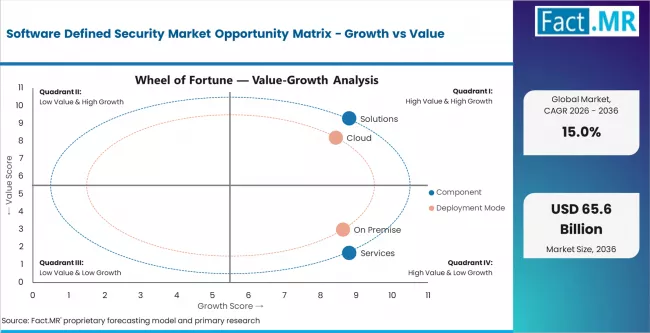
Software Defined Security Market Opportunity Matrix Growth Vs Value | Source: Fact.MR
Fact MR analysis indicates the market reflects a structurally high-growth cybersecurity architecture segment transitioning from perimeter-based hardware appliances toward policy-driven, programmable protection layers embedded across cloud, network, and application environments. Market size exists because enterprise IT infrastructure has shifted toward hybrid cloud, containerized workloads, and distributed edge systems where static firewalls cannot dynamically secure moving workloads. The current valuation reflects structural dependence on software-defined networking and virtualization frameworks that require centralized security orchestration capable of enforcing identity-based access control, micro-segmentation, and automated policy updates across complex digital ecosystems.
Current market dynamics show declining reliance on appliance-centric security stacks that create visibility gaps across multi-cloud environments, while software-defined micro-segmentation and zero-trust frameworks command higher per-unit contract pricing due to integration complexity and continuous monitoring requirements. Demand growth is concentrated in cloud-native enterprises, telecom infrastructure, and financial services, where cyber risk exposure expands alongside digital transformation investments. The market reflects a structural shift toward software-controlled security layers that increase value intensity per protected workload even as hardware footprint declines.
- Zero Trust Transition: Zero Trust Architecture principles and NIST SP 800-207 guidance are accelerating adoption of identity-centric access control models replacing perimeter-based network trust assumptions.
- Cloud Workload Expansion: North America leads adoption as enterprises migrate applications to multi-cloud and container environments requiring programmable security enforcement across distributed infrastructure layers.
- Policy Automation Shift: Software-defined micro-segmentation enables dynamic threat response and workload-level visibility, increasing contract value through continuous security orchestration rather than discrete hardware deployment cycles.
Regional Analysis
The software defined security market is assessed across Asia Pacific, Europe, and North America, segmented by country-level demand for virtualized security architecture, policy-driven network protection, cloud workload security, and software-based threat detection platforms. Geographic variation reflects enterprise cloud adoption, zero trust implementation, and increasing reliance on programmable security infrastructure. The full report offers market attractiveness analysis.
.webp "Top Country Growth Comparison Software Defined Security Market Cagr (2026 2036)")
Top Country Growth Comparison Software Defined Security Market Cagr (2026 2036) | Source: Fact.MR
CAGR Table
| Country | CAGR (2026–2036) |
|---|---|
| India | 17.2% |
| China | 16.5% |
| USA | 14.2% |
| UK | 13.9% |
| Germany | 13.6% |
Source: Fact.MR analysis. Updated May 6, 2026
Source: Fact MR analysis, based on proprietary forecasting model and primary research
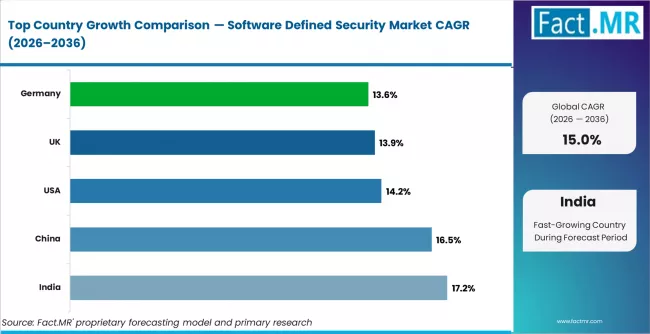
Software Defined Security Market Cagr Analysis By Country | Source: Fact.MR
Asia Pacific
Asia Pacific functions as the programmable cybersecurity deployment hub supported by rapid expansion of cloud-native applications and increasing enterprise adoption of software-based network protection frameworks. Tata Consultancy Services strengthens cloud security platform capability. Huawei Technologies Co., Ltd. expands software defined network protection portfolio. HCLTech supports virtualized security infrastructure integration expertise.
- India: India is projected to record 17.2% CAGR in software defined security through 2036. Digital India cybersecurity framework expansion (Ministry of Electronics and Information Technology, March 2023) supports adoption of virtualized security architecture. Tata Consultancy Services expanded cloud-native security platform capability (July 2023).
- China: China is expected to observe 16.5% CAGR in software defined security through 2036. Cybersecurity Law compliance framework update (Cyberspace Administration of China, January 2023) supports enterprise adoption of programmable network protection. Huawei Technologies Co., Ltd. expanded software defined security solution portfolio (May 2023).
North America
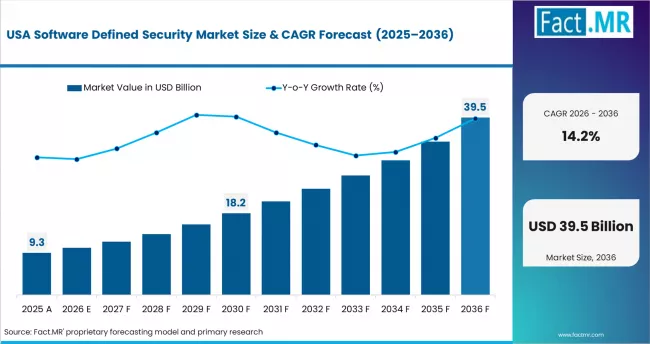
Software Defined Security Market Country Value Analysis | Source: Fact.MR
North America operates as the zero trust security commercialization center supported by strong enterprise investment in cloud workload protection and software-based network segmentation technologies. Palo Alto Networks strengthens software defined perimeter capability. Cisco Systems, Inc. expands cloud security orchestration portfolio depth. VMware, Inc. supports virtualized security architecture innovation.
- USA: The USA is anticipated to expand at 14.2% CAGR in software defined security through 2036. Federal Zero Trust Strategy implementation update (Office of Management and Budget, September 2023) supports programmable security adoption across enterprise networks. Palo Alto Networks expanded software defined protection platform capability (June 2023).
Europe
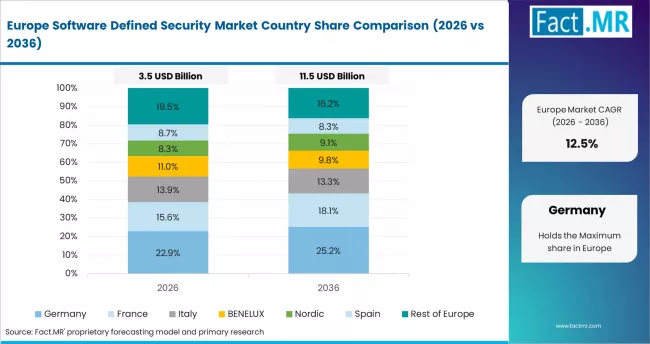
Software Defined Security Market Europe Country Market Share Analysis, 2026 & 2036 | Source: Fact.MR
Europe functions as the data protection compliance laboratory supported by strict regulatory frameworks and increasing enterprise investment in software-based security orchestration platforms. Atos SE strengthens cloud security infrastructure capability. BT Group plc expands managed virtual security services portfolio. Deutsche Telekom AG supports programmable network protection innovation.
- UK: The UK is forecast to grow at 13.9% CAGR in software defined security through 2036. UK Cyber Strategy implementation update (Department for Science, Innovation and Technology, February 2023) supports enterprise zero trust security adoption. BT Group plc expanded software defined network protection services (April 2023).
- Germany: Germany is projected to register 13.6% CAGR in software defined security through 2036. IT Security Act 2.0 compliance implementation update (Federal Office for Information Security, January 2023) supports programmable cybersecurity architecture adoption. Deutsche Telekom AG expanded virtualized security infrastructure capability (August 2023).
Fact MR's analysis of software defined security market in global regions consists of country-wise assessment that includes India, China, USA, UK, and Germany. Readers can find programmable cybersecurity adoption trends, cloud workload protection developments, regulatory compliance frameworks, and competitive platform innovation insights.
Competitive Landscape
What is the Competitive Structure of the Software Defined Security Market?
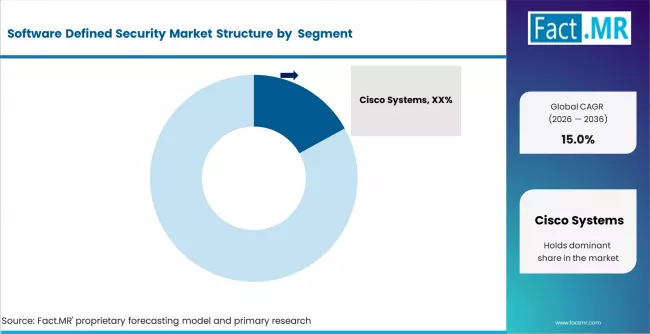
Software Defined Security Market Analysis By Company | Source: Fact.MR
The Software Defined Security Market demonstrates a moderately concentrated competitive structure, supported by established cybersecurity vendors with strong expertise in network virtualization, threat intelligence, and policy-driven security orchestration. Leading companies including Cisco Systems, Palo Alto Networks, Fortinet, Check Point Software, VMware, IBM, Juniper Networks, Hewlett Packard Enterprise, Symantec, and Intel Security collectively account for nearly 65–75% of global market share, particularly in virtualized firewall, micro-segmentation, and cloud workload protection solutions. Competitive positioning is primarily determined by threat detection accuracy, scalability of policy automation, integration with hybrid cloud environments, and real-time analytics capability across distributed networks. High technological complexity and continuous research investment create entry barriers, reinforcing the presence of established cybersecurity providers with advanced software-defined networking capabilities.
Structural advantages are observed among companies possessing integrated security ecosystems combining network security, endpoint protection, and cloud workload defense platforms. Cisco Systems and Palo Alto Networks benefit from large installed enterprise bases and long-term contracts supporting continuous software updates and threat intelligence integration. Buyers typically manage supplier dependency through multi-layered security architecture strategies and interoperability validation across multiple vendor platforms. Procurement decisions often consider policy automation flexibility, compatibility with existing IT infrastructure, and reliability of security orchestration performance. Pricing power remains relatively balanced, though suppliers retain moderate leverage where proprietary threat intelligence databases and platform integration capabilities create switching constraints for enterprises managing complex cybersecurity environments.
Key Players of the Software Defined Security Market
- Cisco Systems
- Palo Alto Networks
- Fortinet
- IBM
- VMware
- Check Point Software
- Intel Security
- Juniper Networks
- Hewlett Packard Enterprise
- Symantec
Bibliographies
- [1] Ministry of Electronics and Information Technology (India). (2023, March). Digital India cybersecurity framework expansion.
- [2] Cyberspace Administration of China. (2023, January). Cybersecurity Law compliance framework update.
- [3] Office of Management and Budget (USA). (2023, September). Federal Zero Trust Strategy implementation update.
- [4] Department for Science, Innovation and Technology (UK). (2023, February). UK Cyber Strategy implementation update.
- [5] Federal Office for Information Security (Germany). (2023, January). IT Security Act 2.0 compliance implementation update.
- [6] Tata Consultancy Services. (2023, July). Cloud-native security platform capability expansion.
- [7] Huawei Technologies Co., Ltd. (2023, May). Software defined security solution portfolio expansion.
- [8] Palo Alto Networks. (2023, June). Software defined protection platform capability expansion.
- [9] BT Group plc. (2023, April). Software defined network protection services expansion.
- [10] Deutsche Telekom AG. (2023, August). Virtualized security infrastructure capability expansion.
This Report Addresses
- Market size estimation and revenue forecasts from 2026 to 2036, supported by validated enterprise cybersecurity spending benchmarks and adoption indicators across virtualized and policy-driven security architectures.
- Growth opportunity mapping across software-defined security solutions and services enabling programmable protection layers across cloud, on-premise, and hybrid infrastructure environments.
- Segment and regional revenue forecasts covering network security, application security, endpoint security, cloud security, and data security deployed through centralized policy orchestration frameworks across enterprise IT ecosystems.
- Competition strategy assessment including benchmarking of threat detection accuracy, policy automation maturity, interoperability across multi-cloud environments, and scalability of software-defined micro-segmentation capabilities.
- Regulatory impact analysis covering zero trust architecture frameworks, data protection compliance requirements, and cybersecurity governance standards influencing adoption of programmable security enforcement layers.
- Market report delivery in PDF, Excel, PPT, and structured data formats designed for cybersecurity architects, CIOs, cloud infrastructure teams, managed security service providers, and enterprise IT risk management professionals.
- Supply chain vulnerability assessments identifying concentration risks in threat intelligence platforms, cloud security orchestration tools, virtualization infrastructure dependencies, and skilled cybersecurity workforce availability supporting software-defined security deployment.
Software Defined Security Market Definition
The software defined security market refers to cybersecurity architectures where protection functions are controlled through software rather than dedicated hardware appliances. Security policies, monitoring, access control, and threat response are centrally managed through programmable platforms, enabling scalable protection across cloud, virtualized networks, and distributed enterprise IT environments.
Software Defined Security Market Inclusions
The report covers global and regional market size evaluation and forecast outlook across the study period. It includes segmentation by component such as security software and services, deployment models including cloud and on-premise, applications across network, endpoint, and identity security, and end users including BFSI, telecom, healthcare, and government sectors.
Software Defined Security Market Exclusions
The scope excludes traditional hardware-centric security appliances such as standalone firewalls, routers, and physical intrusion detection systems without software orchestration capabilities. It does not include general IT infrastructure software lacking security functionality. Standalone cybersecurity consulting services without programmable security platforms are also excluded from the core analysis.
Software Defined Security Market Research Methodology
- Primary Research: Interviews were conducted with cybersecurity vendors, cloud infrastructure providers, enterprise IT managers, and network security architects involved in programmable security deployment.
- Desk Research: Public sources including cybersecurity journals, company product documentation, regulatory publications, and technology standards were reviewed to identify adoption patterns and architectural developments in software driven security frameworks.
- Market-Sizing and Forecasting: A hybrid approach combining bottom-up vendor revenue assessment and top-down evaluation of enterprise cybersecurity spending was applied to estimate market size and growth outlook.
- Data Validation and Update Cycle: Outputs were validated using multiple independent technical sources and expert consultations. Periodic updates reflect changes in cloud adoption, zero trust implementation, and network virtualization trends influencing programmable security demand.
Segmentation
Report Scope
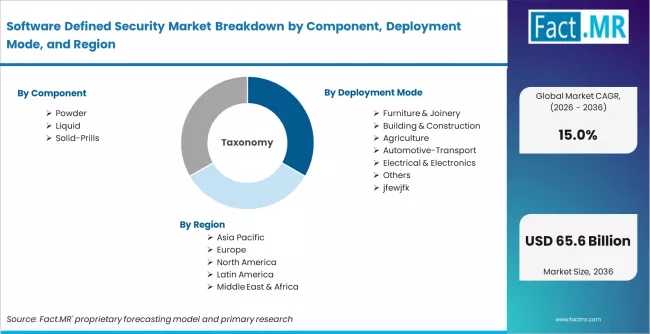
Software Defined Security Market Breakdown By Component, Deployment Mode, And Region | Source: Fact.MR
| Metric | Value |
|---|---|
| Quantitative Units | USD 14.1 billion (2026) to USD 57.3 billion (2036), at a CAGR of 15% |
| Market Definition | The software defined security market includes programmable and virtualized security architectures that enable centralized policy control, automated threat detection, and adaptive protection across distributed IT environments. These solutions leverage software-based controls to manage network, endpoint, application, and data security functions across cloud, on-premise, and hybrid infrastructure environments. |
| Component Segmentation | Solutions, Services |
| Deployment Mode Segmentation | Cloud, On-premise, Hybrid |
| Security Type Segmentation | Network security, Application security, Endpoint security, Cloud security, Data security |
| End Use Segmentation | IT & telecom, BFSI, Healthcare, Government, Manufacturing, Retail |
| Regions Covered | North America, Latin America, Europe, East Asia, South Asia, Oceania, Middle East and Africa |
| Countries Covered | United States, Canada, Mexico, Brazil, Argentina, Germany, France, United Kingdom, Italy, Spain, China, India, Japan, South Korea, Indonesia, Australia, and 40+ countries |
| Key Companies Profiled | Cisco Systems, Palo Alto Networks, Fortinet, IBM, VMware, Check Point Software, Intel Security, Juniper Networks, Hewlett Packard Enterprise, Symantec |
| Forecast Period | 2026 to 2036 |
| Approach | Hybrid top-down and bottom-up market estimation validated through primary interviews with cybersecurity solution providers, enterprise IT security architects, cloud infrastructure operators, and managed security service providers, supported by benchmarking of adoption patterns, threat landscape analysis, and evaluation of software-defined architecture integration across enterprise security environments |
Source: Fact.MR analysis. Updated May 6, 2026
Software Defined Security Market Key Segments
-
Component:
- Solutions
- Services
-
Deployment Mode:
- Cloud
- On Premise
- Hybrid
-
Security Type:
- Network Security
- Application Security
- Endpoint Security
- Cloud Security
- Data Security
-
End Use:
- IT and Telecom
- BFSI
- Healthcare
- Government
- Manufacturing
- Retail
-
Region:
- North America
- USA
- Canada
- Mexico
- Europe
- Germany
- UK
- France
- Italy
- Spain
- Nordic Countries
- BENELUX
- Rest of Europe
- Asia Pacific
- China
- Japan
- South Korea
- India
- Australia
- Rest of Asia Pacific
- Latin America
- Brazil
- Argentina
- Rest of Latin America
- Middle East and Africa
- Kingdom of Saudi Arabia
- United Arab Emirates
- South Africa
- Rest of Middle East and Africa
- Other Regions
- Oceania
- Central Asia
- Other Markets
- North America
Frequently Asked Questions
How large is the demand for Software Defined Security in the global market in 2026?
What will be the market size of Software Defined Security in the global market by 2036?
What is the expected demand growth for Software Defined Security in the global market between 2026 and 2036?
Which Component is poised to lead global demand by 2026?
What is Driving Software Defined Security Demand in India?
What is the India Growth Outlook in this Report?
What is Driving Software Defined Security Demand in China?
What is the China Growth Outlook in this Report?
What is Driving Software Defined Security Demand in the United States?
What is the United States Growth Outlook in this Report?
What is Driving Software Defined Security Demand in the United Kingdom?
What is the United Kingdom Growth Outlook in this Report?
What is Driving Software Defined Security Demand in Germany?
What is the Germany Growth Outlook in this Report?
Which Companies are Identified as Leading Participants in the Software Defined Security Market?
What is Software Defined Security and What is It Mainly Used For?
What does Software Defined Security Market Mean in this Report?
What is Included in the Scope of this Software Defined Security Market Report?
What is Excluded from the Scope of this Report?
What does Market Forecast Mean on this Page?
How is the Software Defined Security Market Forecast Developed in this Report?
What does Data Validation Approach Mean in this Report?
Who worked on this report


Preview the report firsthand - request a free sample
Free SampleGet the brochure for pricing and purchase details
Download PDF