Solid Body Moisturizers Market (2026 - 2036)
Solid Body Moisturizers Market Size and Share Forecast Outlook 2026 to 2036
Core Findings
Solid Body Moisturizers Market Forecast and Outlook 2026 to 2036
The solid body moisturizers market stands positioned for sustained growth, projected at USD 13.1 billion in 2026 and expanding to USD 22.3 billion by 2036, representing a CAGR of 5.5% across the evaluation period. While traditional liquid emulsions continue capturing volume leadership, solid delivery systems are establishing structural importance as brands pursue differentiated margin architectures aligned with waterless innovation, portability demands, and environmental accountability frameworks.
Key Takeaways from the Solid Body Moisturizers Market
- Solid Body Moisturizers Market Value (2026): USD 13.1 billion
- Solid Body Moisturizers Market Forecast Value (2036): USD 22.3 billion
- Solid Body Moisturizers Market Forecast CAGR (2026 to 2036): 5.5%
- Leading Product Type: Body Lotions (36.8%)
- Leading Market Players: Unilever, L'Oréal, Procter & Gamble, Johnson & Johnson, Beiersdorf, Shiseido Company, EltaMD Inc., The Avon Company, Clarins, Advantice Health LLC, Amorepacific, Estee Lauder, Ferndale Healthcare, Galderma Laboratories, Kao Corporation • Key Growth Regions: Asia Pacific, North America, Europe
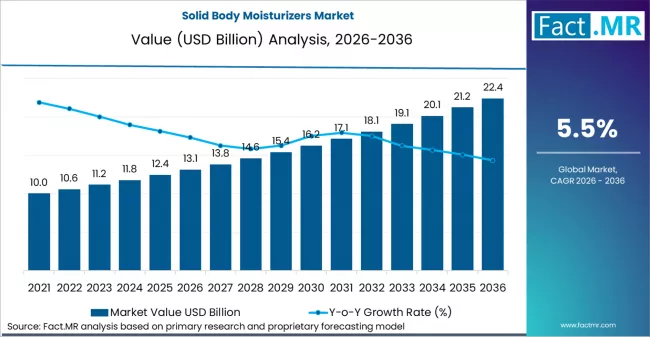
Solid moisturizer formats converge precision hydration technology, zero-water formulation efficiency, and elevated consumer positioning. These architectures enable concentrated actives, mess-free portability, and enhanced ingredient longevity particularly critical for barrier-repair compounds and climate-adaptive formulations. As body care transitions from indulgent routines to purposeful regimens, solid moisturizers are advancing beyond travel alternatives into core treatment platforms. Industry participants increasingly approach solid moisturizers as innovation vehicles rather than format extensions.
The category supports refillable ecosystems, reduces packaging burden, and addresses regulatory tightening around preservatives and micro plastics. This positions solid body moisturizers as structurally defensible assets within the broader personal care transformation underway globally.
Solid Body Moisturizers Market
| Metric | Value |
|---|---|
| Estimated Value in (2026E) | USD 13.1 billion |
| Forecast Value in (2036F) | USD 22.3 billion |
| Forecast CAGR (2026 to 2036) | 5.5% |
Category
| Category | Segments |
|---|---|
| Product Type | Body Lotions, Body Creams, Body Butters, Body Oils, Gel-based Moisturizers |
| Ingredient Type | Natural Ingredients, Organic Ingredients, Synthetic Ingredients, Herbal Ingredients |
| Skin Type | Dry Skin, Oily Skin, Normal Skin, Sensitive Skin, Combination Skin |
| Application | Daily Use, Therapeutic Use, Anti-aging, Hydrating, Sun Protection |
| Distribution Channel | Online Retailers, Supermarkets/Hypermarkets, Specialty Stores, Pharmacies/Drugstores, Direct Selling |
| Region | North America; Europe; Asia Pacific; Latin America; Middle East & Africa |
Segmental Analysis
By Product Type, What Drives Body Lotions to Dominate the Solid Body Moisturizers Market?
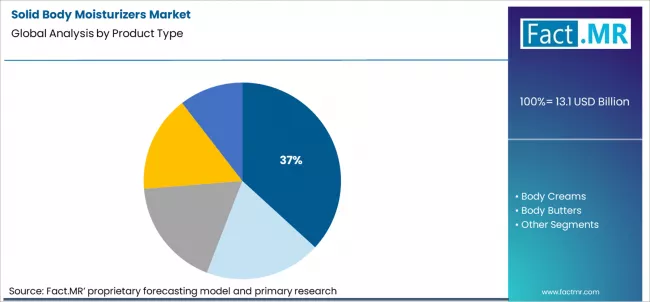
Body lotions represent 36.8% of the solid body moisturizers market, securing dominance through strategic alignment with consumer behavior patterns and formulation economics. Enterprise-level R&D documentation reveals that beauty corporations deliberately channel innovation investment toward lotion architectures because they offer the optimal balance between sensorial appeal, absorption efficiency, and scalable manufacturing infrastructure. Unlike heavier creams or specialty butters, lotions accommodate broader climate adaptability while maintaining cost structures compatible with mass-market penetration objectives. Portfolio analysis from multinational personal care groups demonstrates consistent prioritization of lotion formats when deploying solid delivery systems. This reflects empirical performance data showing lotions achieve superior daily-use compliance rates compared to specialized treatments. The format's lightweight texture profile addresses consumer fatigue with heavy body care routines, particularly among urban demographics managing humid environments and active lifestyles.
By Ingredient Type, Why Do Natural Ingredients Command Leadership in Solid Body Moisturizers?
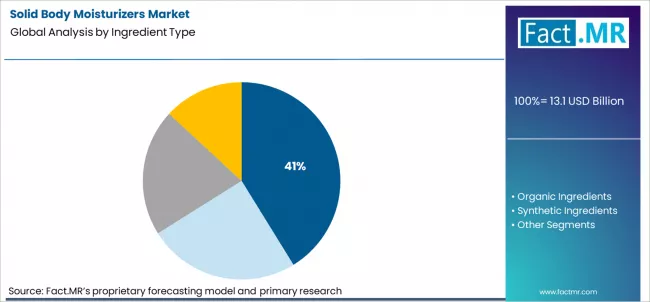
Natural ingredients account for 41.2% of the solid body moisturizers market as strategic imperatives of leading skincare enterprises converge with regulatory pressure and consumer demand shifts. Corporate sustainability disclosures and formulation roadmaps indicate that when brands allocate resources to solid formats, they prioritize botanical and naturally-derived systems to simplify regulatory navigation and strengthen clean-beauty positioning. Natural matrices enable waterless formulations that bypass preservative complexity while delivering marketing narratives aligned with wellness and environmental consciousness trends. Competitive behavior validates this dominance. Investor communications from global beauty conglomerates consistently emphasize ingredient transparency and biodegradability as core differentiators in body care portfolios. Natural ingredients support these objectives while reducing supply chain vulnerability to synthetic feedstock volatility. Formulation studies show botanical oils, plant waxes, and mineral-based actives provide inherent oxidative stability in solid formats, eliminating dependency on synthetic stabilizers that trigger consumer skepticism.
Market Dynamics
- Drivers: Growth in this market is being shaped by everyday consumer expectations rather than novelty appeal. Shoppers increasingly expect products to reduce waste without sacrificing performance, and solid formats naturally meet this need by cutting out excess packaging and water. Frequent travel and mobile lifestyles have made leak-proof, carry-friendly skincare a practical requirement rather than a bonus. At the same time, advances in formulation have made it possible to deliver potent ingredients such as ceramides and peptides in solid form without loss of effectiveness. This has allowed brands to reposition solid moisturizers as high-value treatment products, supporting premium pricing and stronger long-term investment.
- Restraints: The category still faces practical hurdles. Creating a solid moisturizer that spreads easily and absorbs well without feeling heavy requires advanced formulation work, which raises costs and slows product development. Some consumers remain unconvinced that solids can perform as well as liquids, especially in markets where traditional lotions are deeply ingrained in daily routines. Regulatory processes also add complexity, as waterless products are often held to the same safety expectations as liquids, increasing testing and approval timelines for new launches.
- Trend 1: Sensory-Led Solid Formats Brands are enhancing solid moisturizers with scent release, texture changes, and temperature-responsive elements to make application feel more indulgent and engaging, turning routine hydration into a sensory experience.
- Trend 2: Skin-Friendly Microbiome Care Product development is increasingly focused on supporting the skin’s natural balance, with solid formulas incorporating prebiotic and post biotic ingredients that remain stable and effective without water.
Analysis of the Solid Body Moisturizers Market by Key Country
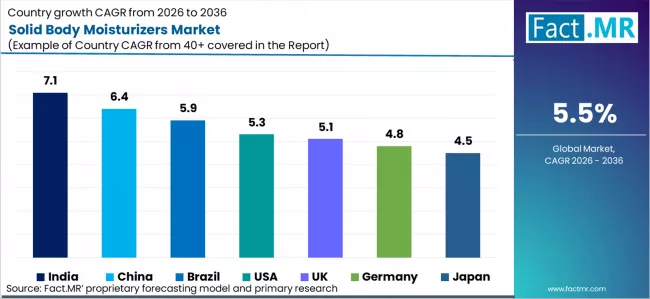
| Country | CAGR 2026 to 2036 |
|---|---|
| India | 7.1% |
| China | 6.4% |
| Brazil | 5.9% |
| USA | 5.3% |
| UK | 5.1% |
| Germany | 4.8% |
| Japan | 4.5% |
How is India emerging as a growth engine for solid body moisturizers?
India is projected to grow at a CAGR of 4.9% during 2026-2036, with momentum shaped by environmental and infrastructure realities rather than discretionary trends. High ambient temperatures, often exceeding 40°C, combined with limited climate-controlled warehousing and last-mile delivery, compromise the stability of liquid lotions, leading to separation and spoilage. Solid body moisturizers retain structural integrity under these conditions, reducing product loss and consumer dissatisfaction. Brands are responding by prioritizing solid formats within massive and premium portfolios aimed at urban consumers who value durability, portability, and consistent performance across daily use and travel scenarios.
Why is China accelerating solid moisturizer adoption through regulation-led concentration formats?
China is expected to expand at a CAGR of 5.3%, driven by regulatory tightening and rising ingredient literacy. The implementation of CSAR 2026 increases scrutiny on preservatives and stabilizers commonly used in liquid formulations. Solid moisturizers simplify compliance by eliminating water and reducing preservative dependence. At the same time, domestic C-Beauty brands are promoting concentrated bars as cleaner, more transparent solutions aligned with Gen Z expectations. This convergence of policy enforcement and consumer sophistication is structurally shifting demand toward zero-water solid formats across online and specialty retail channels.
What explains Germany’s disciplined transition toward solid body moisturizers?
Germany is forecast to grow at a CAGR of 4.5%, reflecting a compliance-driven and trust-oriented market. Net Zero 2045 commitments, coupled with strong consumer resistance to micro-plastics and synthetic emulsifiers, have forced established brands to re-engineer core moisturization products rather than rely on incremental launches. Solid-to-skin melting balms using natural-origin lipids meet both regulatory and sensorial expectations. Although development cycles are longer due to rigorous testing standards, adoption is structurally durable, anchored in brand credibility, regulatory alignment, and long-term consumer confidence.
How is the United States scaling solid body moisturizers through lifestyle alignment?
The United States market is growing at a CAGR of 3.7%, driven primarily by lifestyle convergence rather than regulation. Increased participation in gym culture, frequent domestic travel, and demand for spill-proof personal care solutions are normalizing solid formats. Major brands have expanded distribution beyond niche channels into mass and specialty retail, reframing solid moisturizers as everyday essentials rather than novelty items. This scale-led approach compresses adoption timelines, embedding solids into daily routines of convenience-focused consumers who prioritize portability, hygiene, and simplified skincare regimens.
Why is Brazil maintaining above-average momentum despite infrastructure constraints?
Brazil is advancing at a CAGR of 4.1%, supported by regulatory pressure and sustainability-led consumer behavior. Amendments to the National Solid Waste Policy increase compliance costs for plastic-intensive packaging, favoring solid moisturizers that reduce material volume and support refill systems. Local brands leverage biodiversity narratives through the use of native butters, aligning environmental responsibility with product efficacy. While distribution and storage challenges persist in humid regions, regulatory cost pressures and circular economy incentives continue to reinforce the economic case for solid formats.
How are fiscal instruments reshaping solid moisturizer adoption in the United Kingdom?
The UK is expected to grow at a CAGR of 3.3%, with adoption driven largely by fiscal mechanisms. Packaging Extended Producer Responsibility fees penalize heavy, water-based formats with higher disposal costs. Retailers and brands are responding by shifting toward naked or paper-wrapped solid moisturizers to reduce tax exposure. This cost-avoidance logic has accelerated assortment changes, embedding solid formats into mainstream shelves. As a result, solid moisturizers are increasingly positioned as financially efficient defaults rather than purely sustainability-led alternatives.
What defines Japan’s measured but innovation-led growth trajectory?
Japan is projected to expand at a CAGR of 2.9%, reflecting high performance expectations rather than weak demand. Cultural emphasis on freshness, precision, and enzymatic activation aligns with compact solid and serum-bar formats. Compliance with the Resource Circulation Act further reinforces interest in low-waste solutions. However, stringent sensorial and quality benchmarks slow mass rollout. Centralized R&D pipelines ensure that only highly refined solid systems reach consumers, supporting steady, credibility-driven growth focused on long-term value rather than rapid volume expansion.
Competitive Landscape
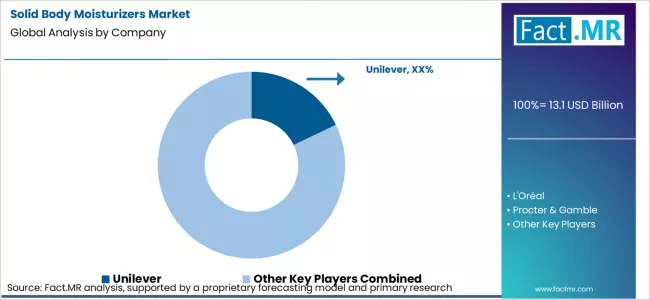
The solid body moisturizers market is shaped by a clear concentration of power among global personal care companies with deep formulation expertise, global manufacturing scale, and long-established consumer trust. Market leadership is anchored by Unilever, which has used its broad portfolio to normalize solid formats across price tiers. By extending solid innovation through widely recognized brands such as Dove and Vaseline, the company benefits from shelf priority, high trial rates, and the ability to scale sustainability-led narratives without repositioning risk.
L’Oréal and Procter & Gamble follow with more targeted strategies centered on scientific differentiation and digital acceleration. Both companies have formalized waterless and solid-format programs within their R&D pipelines, focusing on ingredient stability, clinical validation, and patent-backed delivery systems. These investments raise technical entry barriers and support premium pricing in a category that was once viewed as functional rather than treatment-led.
Beiersdorf applies a different logic, leaning on dermatological credibility and brand continuity. NIVEA’s transition into solid moisturizers reflects a portfolio protection strategy, where format innovation is used to retain loyal consumers while meeting evolving sustainability expectations. Johnson & Johnson adopts a trust-based approach, activating sensitive-skin and family-oriented credentials to appeal to risk-averse buyers seeking gentle, clinically familiar solutions. Luxury houses including Estée Lauder and Clarins operate in tightly controlled distribution environments, where solid formats support exclusivity through texture, rarity, and perceived craftsmanship. Competitive pressure is most intense in mass segments, while premium tiers remain protected by brand discipline and selective access.
Key Players in Solid Body Moisturizers Market
- Unilever
- L'Oréal
- Procter & Gamble
- Johnson & Johnson
- Beiersdorf
- Shiseido Company
- EltaMD, Inc
- THE AVON COMPANY
- Clarins
- Advantice Health, LLC
- Amorepacific
- Estee Lauder
- Ferndale Healthcare
- Galderma laboratories
- Kao Corporation
- Pharmaceutical Specialties, Inc
- Augustinus Bader
- Replenix
Bibliography
- International Organization for Standardization. 2023. Cosmetics and personal care products: Safety assessment and formulation standards for waterless body care delivery systems. ISO Technical Report.
- European Commission. 2022. Cosmetic products regulation: Preservative systems and microbiological safety in anhydrous formulations.
- International Federation of Societies of Cosmetic Chemists. 2024. Advances in solid body care formulation science and active encapsulation technologies.
- Journal of Cosmetic Science. 2024. Solid body moisturizer innovations: Stability, efficacy, and consumer acceptance studies.
- Personal Care Products Council. 2023. Sustainability trends in body care: Waterless formats and circular packaging systems.
Scope of Report
| Items | Values |
|---|---|
| Quantitative Units (2026) | USD 13.1 Billion |
| Product Type | Body Lotions, Body Creams, Body Butters, Body Oils, Gel-based Moisturizers |
| Ingredient Type | Natural Ingredients, Organic Ingredients, Synthetic Ingredients, Herbal Ingredients |
| Skin Type | Dry Skin, Oily Skin, Normal Skin, Sensitive Skin, Combination Skin |
| Application | Daily Use, Therapeutic Use, Anti-aging, Hydrating, Sun Protection |
| Distribution Channel | Online Retailers, Supermarkets/Hypermarkets, Specialty Stores, Pharmacies/Drugstores, Direct Selling |
| Regions Covered | North America, Europe, Asia Pacific, Latin America, Middle East & Africa |
| Countries Covered | U.S., Canada, Germany, Italy, UK, France, Japan, Australia, and other countries |
| Key Companies Profiled | L'Oréal, Procter & Gamble, Johnson & Johnson, Beiersdorf, Shiseido Company, EltaMD Inc., The Avon Company, Clarins, Advantice Health LLC, Amorepacific, Estee Lauder, Ferndale Healthcare, Galderma Laboratories, Kao Corporation |
| Additional Attributes | Dollar revenue in the solid body moisturizers market is segmented by product format, ingredient profile, distribution channel, end user, and region. Regional demand is driven by rising preference for waterless and spill-proof body care formats, increasing focus on long-lasting and high-performance moisturization, premiumization of daily body care routines, and expanding penetration of online, specialty beauty, and sustainable retail channels.. |
Solid Body Moisturizers Market by Segments
-
Product Type :
- Body Lotions
- Body Creams
- Body Butters
- Body Oils
- Gel-based Moisturizers
-
Ingredient Type :
- Natural Ingredients
- Organic Ingredients
- Synthetic Ingredients
- Herbal Ingredients
-
Skin Type :
- Dry Skin
- Oily Skin
- Normal Skin
- Sensitive Skin
- Combination Skin
-
Application :
- Daily Use
- Therapeutic Use
- Anti-aging
- Hydrating
- Sun Protection
-
Distribution Channel :
- Online Retailers
- Supermarkets/Hypermarkets
- Specialty Stores
- Pharmacies/Drugstores
- Direct Selling
-
Region :
- Asia Pacific
- Japan
- South Korea
- China
- Australia
- New Zealand
- Rest of Asia Pacific
- North America
- United States
- Canada
- Mexico
- Europe
- France
- Italy
- Spain
- Norway
- UK
- Rest of Europe
- Latin America
- Chile
- Peru
- Argentina
- Rest of Latin America
- Asia Pacific
Table of Content
- Executive Summary
- Global Market Outlook
- Demand to side Trends
- Supply to side Trends
- Technology Roadmap Analysis
- Analysis and Recommendations
- Market Overview
- Market Coverage / Taxonomy
- Market Definition / Scope / Limitations
- Research Methodology
- Chapter Orientation
- Analytical Lens and Working Hypotheses
- Market Structure, Signals, and Trend Drivers
- Benchmarking and Cross-market Comparability
- Market Sizing, Forecasting, and Opportunity Mapping
- Research Design and Evidence Framework
- Desk Research Programme (Secondary Evidence)
- Company Annual and Sustainability Reports
- Peer-reviewed Journals and Academic Literature
- Corporate Websites, Product Literature, and Technical Notes
- Earnings Decks and Investor Briefings
- Statutory Filings and Regulatory Disclosures
- Technical White Papers and Standards Notes
- Trade Journals, Industry Magazines, and Analyst Briefs
- Conference Proceedings, Webinars, and Seminar Materials
- Government Statistics Portals and Public Data Releases
- Press Releases and Reputable Media Coverage
- Specialist Newsletters and Curated Briefings
- Sector Databases and Reference Repositories
- FMR Internal Proprietary Databases and Historical Market Datasets
- Subscription Datasets and Paid Sources
- Social Channels, Communities, and Digital Listening Inputs
- Additional Desk Sources
- Expert Input and Fieldwork (Primary Evidence)
- Primary Modes
- Qualitative Interviews and Expert Elicitation
- Quantitative Surveys and Structured Data Capture
- Blended Approach
- Why Primary Evidence is Used
- Field Techniques
- Interviews
- Surveys
- Focus Groups
- Observational and In-context Research
- Social and Community Interactions
- Stakeholder Universe Engaged
- C-suite Leaders
- Board Members
- Presidents and Vice Presidents
- R&D and Innovation Heads
- Technical Specialists
- Domain Subject-matter Experts
- Scientists
- Physicians and Other Healthcare Professionals
- Governance, Ethics, and Data Stewardship
- Research Ethics
- Data Integrity and Handling
- Primary Modes
- Tooling, Models, and Reference Databases
- Desk Research Programme (Secondary Evidence)
- Data Engineering and Model Build
- Data Acquisition and Ingestion
- Cleaning, Normalisation, and Verification
- Synthesis, Triangulation, and Analysis
- Quality Assurance and Audit Trail
- Market Background
- Market Dynamics
- Drivers
- Restraints
- Opportunity
- Trends
- Scenario Forecast
- Demand in Optimistic Scenario
- Demand in Likely Scenario
- Demand in Conservative Scenario
- Opportunity Map Analysis
- Product Life Cycle Analysis
- Supply Chain Analysis
- Investment Feasibility Matrix
- Value Chain Analysis
- PESTLE and Porter’s Analysis
- Regulatory Landscape
- Regional Parent Market Outlook
- Production and Consumption Statistics
- Import and Export Statistics
- Market Dynamics
- Global Market Analysis 2021 to 2025 and Forecast, 2026 to 2036
- Historical Market Size Value (USD Million) Analysis, 2021 to 2025
- Current and Future Market Size Value (USD Million) Projections, 2026 to 2036
- Y to o to Y Growth Trend Analysis
- Absolute $ Opportunity Analysis
- Global Market Pricing Analysis 2021 to 2025 and Forecast 2026 to 2036
- Global Market Analysis 2021 to 2025 and Forecast 2026 to 2036, By Product Type
- Introduction / Key Findings
- Historical Market Size Value (USD Million) Analysis By Product Type, 2021 to 2025
- Current and Future Market Size Value (USD Million) Analysis and Forecast By Product Type, 2026 to 2036
- Body Lotions
- Body Creams
- Body Butters
- Body Oils
- Gel-based Moisturizers
- Body Lotions
- Y to o to Y Growth Trend Analysis By Product Type, 2021 to 2025
- Absolute $ Opportunity Analysis By Product Type, 2026 to 2036
- Global Market Analysis 2021 to 2025 and Forecast 2026 to 2036, By Ingredient Type
- Introduction / Key Findings
- Historical Market Size Value (USD Million) Analysis By Ingredient Type, 2021 to 2025
- Current and Future Market Size Value (USD Million) Analysis and Forecast By Ingredient Type, 2026 to 2036
- Natural Ingredients
- Organic Ingredients
- Synthetic Ingredients
- Herbal Ingredients
- Natural Ingredients
- Y to o to Y Growth Trend Analysis By Ingredient Type, 2021 to 2025
- Absolute $ Opportunity Analysis By Ingredient Type, 2026 to 2036
- Global Market Analysis 2021 to 2025 and Forecast 2026 to 2036, By Skin Type
- Introduction / Key Findings
- Historical Market Size Value (USD Million) Analysis By Skin Type, 2021 to 2025
- Current and Future Market Size Value (USD Million) Analysis and Forecast By Skin Type, 2026 to 2036
- Dry Skin
- Oily Skin
- Normal Skin
- Sensitive Skin
- Combination Skin
- Dry Skin
- Y to o to Y Growth Trend Analysis By Skin Type, 2021 to 2025
- Absolute $ Opportunity Analysis By Skin Type, 2026 to 2036
- Global Market Analysis 2021 to 2025 and Forecast 2026 to 2036, By Application
- Introduction / Key Findings
- Historical Market Size Value (USD Million) Analysis By Application, 2021 to 2025
- Current and Future Market Size Value (USD Million) Analysis and Forecast By Application, 2026 to 2036
- Daily Use
- Therapeutic Use
- Anti-aging
- Hydrating
- Sun Protection
- Daily Use
- Y to o to Y Growth Trend Analysis By Application, 2021 to 2025
- Absolute $ Opportunity Analysis By Application, 2026 to 2036
- Global Market Analysis 2021 to 2025 and Forecast 2026 to 2036, By Distribution Channel
- Introduction / Key Findings
- Historical Market Size Value (USD Million) Analysis By Distribution Channel, 2021 to 2025
- Current and Future Market Size Value (USD Million) Analysis and Forecast By Distribution Channel, 2026 to 2036
- Online Retailers
- Supermarkets/Hypermarkets
- Specialty Stores
- Pharmacies/Drugstores
- Direct Selling
- Online Retailers
- Y to o to Y Growth Trend Analysis By Distribution Channel, 2021 to 2025
- Absolute $ Opportunity Analysis By Distribution Channel, 2026 to 2036
- Global Market Analysis 2021 to 2025 and Forecast 2026 to 2036, By Region
- Introduction
- Historical Market Size Value (USD Million) Analysis By Region, 2021 to 2025
- Current Market Size Value (USD Million) Analysis and Forecast By Region, 2026 to 2036
- North America
- Latin America
- Western Europe
- Eastern Europe
- East Asia
- South Asia and Pacific
- Middle East & Africa
- Market Attractiveness Analysis By Region
- North America Market Analysis 2021 to 2025 and Forecast 2026 to 2036, By Country
- Historical Market Size Value (USD Million) Trend Analysis By Market Taxonomy, 2021 to 2025
- Market Size Value (USD Million) Forecast By Market Taxonomy, 2026 to 2036
- By Country
- USA
- Canada
- Mexico
- By Product Type
- By Ingredient Type
- By Skin Type
- By Application
- By Distribution Channel
- By Country
- Market Attractiveness Analysis
- By Country
- By Product Type
- By Ingredient Type
- By Skin Type
- By Application
- By Distribution Channel
- Key Takeaways
- Latin America Market Analysis 2021 to 2025 and Forecast 2026 to 2036, By Country
- Historical Market Size Value (USD Million) Trend Analysis By Market Taxonomy, 2021 to 2025
- Market Size Value (USD Million) Forecast By Market Taxonomy, 2026 to 2036
- By Country
- Brazil
- Chile
- Rest of Latin America
- By Product Type
- By Ingredient Type
- By Skin Type
- By Application
- By Distribution Channel
- By Country
- Market Attractiveness Analysis
- By Country
- By Product Type
- By Ingredient Type
- By Skin Type
- By Application
- By Distribution Channel
- Key Takeaways
- Western Europe Market Analysis 2021 to 2025 and Forecast 2026 to 2036, By Country
- Historical Market Size Value (USD Million) Trend Analysis By Market Taxonomy, 2021 to 2025
- Market Size Value (USD Million) Forecast By Market Taxonomy, 2026 to 2036
- By Country
- Germany
- UK
- Italy
- Spain
- France
- Nordic
- BENELUX
- Rest of Western Europe
- By Product Type
- By Ingredient Type
- By Skin Type
- By Application
- By Distribution Channel
- By Country
- Market Attractiveness Analysis
- By Country
- By Product Type
- By Ingredient Type
- By Skin Type
- By Application
- By Distribution Channel
- Key Takeaways
- Eastern Europe Market Analysis 2021 to 2025 and Forecast 2026 to 2036, By Country
- Historical Market Size Value (USD Million) Trend Analysis By Market Taxonomy, 2021 to 2025
- Market Size Value (USD Million) Forecast By Market Taxonomy, 2026 to 2036
- By Country
- Russia
- Poland
- Hungary
- Balkan & Baltic
- Rest of Eastern Europe
- By Product Type
- By Ingredient Type
- By Skin Type
- By Application
- By Distribution Channel
- By Country
- Market Attractiveness Analysis
- By Country
- By Product Type
- By Ingredient Type
- By Skin Type
- By Application
- By Distribution Channel
- Key Takeaways
- East Asia Market Analysis 2021 to 2025 and Forecast 2026 to 2036, By Country
- Historical Market Size Value (USD Million) Trend Analysis By Market Taxonomy, 2021 to 2025
- Market Size Value (USD Million) Forecast By Market Taxonomy, 2026 to 2036
- By Country
- China
- Japan
- South Korea
- By Product Type
- By Ingredient Type
- By Skin Type
- By Application
- By Distribution Channel
- By Country
- Market Attractiveness Analysis
- By Country
- By Product Type
- By Ingredient Type
- By Skin Type
- By Application
- By Distribution Channel
- Key Takeaways
- South Asia and Pacific Market Analysis 2021 to 2025 and Forecast 2026 to 2036, By Country
- Historical Market Size Value (USD Million) Trend Analysis By Market Taxonomy, 2021 to 2025
- Market Size Value (USD Million) Forecast By Market Taxonomy, 2026 to 2036
- By Country
- India
- ASEAN
- Australia & New Zealand
- Rest of South Asia and Pacific
- By Product Type
- By Ingredient Type
- By Skin Type
- By Application
- By Distribution Channel
- By Country
- Market Attractiveness Analysis
- By Country
- By Product Type
- By Ingredient Type
- By Skin Type
- By Application
- By Distribution Channel
- Key Takeaways
- Middle East & Africa Market Analysis 2021 to 2025 and Forecast 2026 to 2036, By Country
- Historical Market Size Value (USD Million) Trend Analysis By Market Taxonomy, 2021 to 2025
- Market Size Value (USD Million) Forecast By Market Taxonomy, 2026 to 2036
- By Country
- Kingdom of Saudi Arabia
- Other GCC Countries
- Turkiye
- South Africa
- Other African Union
- Rest of Middle East & Africa
- By Product Type
- By Ingredient Type
- By Skin Type
- By Application
- By Distribution Channel
- By Country
- Market Attractiveness Analysis
- By Country
- By Product Type
- By Ingredient Type
- By Skin Type
- By Application
- By Distribution Channel
- Key Takeaways
- Key Countries Market Analysis
- USA
- Pricing Analysis
- Market Share Analysis, 2025
- By Product Type
- By Ingredient Type
- By Skin Type
- By Application
- By Distribution Channel
- Canada
- Pricing Analysis
- Market Share Analysis, 2025
- By Product Type
- By Ingredient Type
- By Skin Type
- By Application
- By Distribution Channel
- Mexico
- Pricing Analysis
- Market Share Analysis, 2025
- By Product Type
- By Ingredient Type
- By Skin Type
- By Application
- By Distribution Channel
- Brazil
- Pricing Analysis
- Market Share Analysis, 2025
- By Product Type
- By Ingredient Type
- By Skin Type
- By Application
- By Distribution Channel
- Chile
- Pricing Analysis
- Market Share Analysis, 2025
- By Product Type
- By Ingredient Type
- By Skin Type
- By Application
- By Distribution Channel
- Germany
- Pricing Analysis
- Market Share Analysis, 2025
- By Product Type
- By Ingredient Type
- By Skin Type
- By Application
- By Distribution Channel
- UK
- Pricing Analysis
- Market Share Analysis, 2025
- By Product Type
- By Ingredient Type
- By Skin Type
- By Application
- By Distribution Channel
- Italy
- Pricing Analysis
- Market Share Analysis, 2025
- By Product Type
- By Ingredient Type
- By Skin Type
- By Application
- By Distribution Channel
- Spain
- Pricing Analysis
- Market Share Analysis, 2025
- By Product Type
- By Ingredient Type
- By Skin Type
- By Application
- By Distribution Channel
- France
- Pricing Analysis
- Market Share Analysis, 2025
- By Product Type
- By Ingredient Type
- By Skin Type
- By Application
- By Distribution Channel
- India
- Pricing Analysis
- Market Share Analysis, 2025
- By Product Type
- By Ingredient Type
- By Skin Type
- By Application
- By Distribution Channel
- ASEAN
- Pricing Analysis
- Market Share Analysis, 2025
- By Product Type
- By Ingredient Type
- By Skin Type
- By Application
- By Distribution Channel
- Australia & New Zealand
- Pricing Analysis
- Market Share Analysis, 2025
- By Product Type
- By Ingredient Type
- By Skin Type
- By Application
- By Distribution Channel
- China
- Pricing Analysis
- Market Share Analysis, 2025
- By Product Type
- By Ingredient Type
- By Skin Type
- By Application
- By Distribution Channel
- Japan
- Pricing Analysis
- Market Share Analysis, 2025
- By Product Type
- By Ingredient Type
- By Skin Type
- By Application
- By Distribution Channel
- South Korea
- Pricing Analysis
- Market Share Analysis, 2025
- By Product Type
- By Ingredient Type
- By Skin Type
- By Application
- By Distribution Channel
- Russia
- Pricing Analysis
- Market Share Analysis, 2025
- By Product Type
- By Ingredient Type
- By Skin Type
- By Application
- By Distribution Channel
- Poland
- Pricing Analysis
- Market Share Analysis, 2025
- By Product Type
- By Ingredient Type
- By Skin Type
- By Application
- By Distribution Channel
- Hungary
- Pricing Analysis
- Market Share Analysis, 2025
- By Product Type
- By Ingredient Type
- By Skin Type
- By Application
- By Distribution Channel
- Kingdom of Saudi Arabia
- Pricing Analysis
- Market Share Analysis, 2025
- By Product Type
- By Ingredient Type
- By Skin Type
- By Application
- By Distribution Channel
- Turkiye
- Pricing Analysis
- Market Share Analysis, 2025
- By Product Type
- By Ingredient Type
- By Skin Type
- By Application
- By Distribution Channel
- South Africa
- Pricing Analysis
- Market Share Analysis, 2025
- By Product Type
- By Ingredient Type
- By Skin Type
- By Application
- By Distribution Channel
- USA
- Market Structure Analysis
- Competition Dashboard
- Competition Benchmarking
- Market Share Analysis of Top Players
- By Regional
- By Product Type
- By Ingredient Type
- By Skin Type
- By Application
- By Distribution Channel
- Competition Analysis
- Competition Deep Dive
- Unilever
- Overview
- Product Portfolio
- Profitability by Market Segments (Product/Age /Sales Channel/Region)
- Sales Footprint
- Strategy Overview
- Marketing Strategy
- Product Strategy
- Channel Strategy
- L'Oréal
- Procter & Gamble
- Johnson & Johnson
- Beiersdorf
- Shiseido Company
- EltaMD, Inc
- THE AVON COMPANY
- Clarins
- Company
- Unilever
- L’Oréal Group
- Procter & Gamble
- Johnson & Johnson
- Beiersdorf AG
- Shiseido Co.
- Estée Lauder Companies
- Avon
- Coty / Calvin Klein Group
- Amway
- Unilever
- Competition Deep Dive
- Assumptions & Acronyms Used
List Of Table
- Table 1: Global Market Value (USD Million) Forecast by Region, 2021 to 2036
- Table 2: Global Market Value (USD Million) Forecast by Product Type, 2021 to 2036
- Table 3: Global Market Value (USD Million) Forecast by Ingredient Type, 2021 to 2036
- Table 4: Global Market Value (USD Million) Forecast by Skin Type, 2021 to 2036
- Table 5: Global Market Value (USD Million) Forecast by Application, 2021 to 2036
- Table 6: Global Market Value (USD Million) Forecast by Distribution Channel, 2021 to 2036
- Table 7: North America Market Value (USD Million) Forecast by Country, 2021 to 2036
- Table 8: North America Market Value (USD Million) Forecast by Product Type, 2021 to 2036
- Table 9: North America Market Value (USD Million) Forecast by Ingredient Type, 2021 to 2036
- Table 10: North America Market Value (USD Million) Forecast by Skin Type, 2021 to 2036
- Table 11: North America Market Value (USD Million) Forecast by Application, 2021 to 2036
- Table 12: North America Market Value (USD Million) Forecast by Distribution Channel, 2021 to 2036
- Table 13: Latin America Market Value (USD Million) Forecast by Country, 2021 to 2036
- Table 14: Latin America Market Value (USD Million) Forecast by Product Type, 2021 to 2036
- Table 15: Latin America Market Value (USD Million) Forecast by Ingredient Type, 2021 to 2036
- Table 16: Latin America Market Value (USD Million) Forecast by Skin Type, 2021 to 2036
- Table 17: Latin America Market Value (USD Million) Forecast by Application, 2021 to 2036
- Table 18: Latin America Market Value (USD Million) Forecast by Distribution Channel, 2021 to 2036
- Table 19: Western Europe Market Value (USD Million) Forecast by Country, 2021 to 2036
- Table 20: Western Europe Market Value (USD Million) Forecast by Product Type, 2021 to 2036
- Table 21: Western Europe Market Value (USD Million) Forecast by Ingredient Type, 2021 to 2036
- Table 22: Western Europe Market Value (USD Million) Forecast by Skin Type, 2021 to 2036
- Table 23: Western Europe Market Value (USD Million) Forecast by Application, 2021 to 2036
- Table 24: Western Europe Market Value (USD Million) Forecast by Distribution Channel, 2021 to 2036
- Table 25: Eastern Europe Market Value (USD Million) Forecast by Country, 2021 to 2036
- Table 26: Eastern Europe Market Value (USD Million) Forecast by Product Type, 2021 to 2036
- Table 27: Eastern Europe Market Value (USD Million) Forecast by Ingredient Type, 2021 to 2036
- Table 28: Eastern Europe Market Value (USD Million) Forecast by Skin Type, 2021 to 2036
- Table 29: Eastern Europe Market Value (USD Million) Forecast by Application, 2021 to 2036
- Table 30: Eastern Europe Market Value (USD Million) Forecast by Distribution Channel, 2021 to 2036
- Table 31: East Asia Market Value (USD Million) Forecast by Country, 2021 to 2036
- Table 32: East Asia Market Value (USD Million) Forecast by Product Type, 2021 to 2036
- Table 33: East Asia Market Value (USD Million) Forecast by Ingredient Type, 2021 to 2036
- Table 34: East Asia Market Value (USD Million) Forecast by Skin Type, 2021 to 2036
- Table 35: East Asia Market Value (USD Million) Forecast by Application, 2021 to 2036
- Table 36: East Asia Market Value (USD Million) Forecast by Distribution Channel, 2021 to 2036
- Table 37: South Asia and Pacific Market Value (USD Million) Forecast by Country, 2021 to 2036
- Table 38: South Asia and Pacific Market Value (USD Million) Forecast by Product Type, 2021 to 2036
- Table 39: South Asia and Pacific Market Value (USD Million) Forecast by Ingredient Type, 2021 to 2036
- Table 40: South Asia and Pacific Market Value (USD Million) Forecast by Skin Type, 2021 to 2036
- Table 41: South Asia and Pacific Market Value (USD Million) Forecast by Application, 2021 to 2036
- Table 42: South Asia and Pacific Market Value (USD Million) Forecast by Distribution Channel, 2021 to 2036
- Table 43: Middle East & Africa Market Value (USD Million) Forecast by Country, 2021 to 2036
- Table 44: Middle East & Africa Market Value (USD Million) Forecast by Product Type, 2021 to 2036
- Table 45: Middle East & Africa Market Value (USD Million) Forecast by Ingredient Type, 2021 to 2036
- Table 46: Middle East & Africa Market Value (USD Million) Forecast by Skin Type, 2021 to 2036
- Table 47: Middle East & Africa Market Value (USD Million) Forecast by Application, 2021 to 2036
- Table 48: Middle East & Africa Market Value (USD Million) Forecast by Distribution Channel, 2021 to 2036
List Of Figures
- Figure 1: Global Market Pricing Analysis
- Figure 2: Global Market Value (USD Million) Forecast 2021 to 2036
- Figure 3: Global Market Value Share and BPS Analysis by Product Type, 2026 and 2036
- Figure 4: Global Market Y to o to Y Growth Comparison by Product Type, 2026 to 2036
- Figure 5: Global Market Attractiveness Analysis by Product Type
- Figure 6: Global Market Value Share and BPS Analysis by Ingredient Type, 2026 and 2036
- Figure 7: Global Market Y to o to Y Growth Comparison by Ingredient Type, 2026 to 2036
- Figure 8: Global Market Attractiveness Analysis by Ingredient Type
- Figure 9: Global Market Value Share and BPS Analysis by Skin Type, 2026 and 2036
- Figure 10: Global Market Y to o to Y Growth Comparison by Skin Type, 2026 to 2036
- Figure 11: Global Market Attractiveness Analysis by Skin Type
- Figure 12: Global Market Value Share and BPS Analysis by Application, 2026 and 2036
- Figure 13: Global Market Y to o to Y Growth Comparison by Application, 2026 to 2036
- Figure 14: Global Market Attractiveness Analysis by Application
- Figure 15: Global Market Value Share and BPS Analysis by Distribution Channel, 2026 and 2036
- Figure 16: Global Market Y to o to Y Growth Comparison by Distribution Channel, 2026 to 2036
- Figure 17: Global Market Attractiveness Analysis by Distribution Channel
- Figure 18: Global Market Value (USD Million) Share and BPS Analysis by Region, 2026 and 2036
- Figure 19: Global Market Y to o to Y Growth Comparison by Region, 2026 to 2036
- Figure 20: Global Market Attractiveness Analysis by Region
- Figure 21: North America Market Incremental Dollar Opportunity, 2026 to 2036
- Figure 22: Latin America Market Incremental Dollar Opportunity, 2026 to 2036
- Figure 23: Western Europe Market Incremental Dollar Opportunity, 2026 to 2036
- Figure 24: Eastern Europe Market Incremental Dollar Opportunity, 2026 to 2036
- Figure 25: East Asia Market Incremental Dollar Opportunity, 2026 to 2036
- Figure 26: South Asia and Pacific Market Incremental Dollar Opportunity, 2026 to 2036
- Figure 27: Middle East & Africa Market Incremental Dollar Opportunity, 2026 to 2036
- Figure 28: North America Market Value Share and BPS Analysis by Country, 2026 and 2036
- Figure 29: North America Market Value Share and BPS Analysis by Product Type, 2026 and 2036
- Figure 30: North America Market Y to o to Y Growth Comparison by Product Type, 2026 to 2036
- Figure 31: North America Market Attractiveness Analysis by Product Type
- Figure 32: North America Market Value Share and BPS Analysis by Ingredient Type, 2026 and 2036
- Figure 33: North America Market Y to o to Y Growth Comparison by Ingredient Type, 2026 to 2036
- Figure 34: North America Market Attractiveness Analysis by Ingredient Type
- Figure 35: North America Market Value Share and BPS Analysis by Skin Type, 2026 and 2036
- Figure 36: North America Market Y to o to Y Growth Comparison by Skin Type, 2026 to 2036
- Figure 37: North America Market Attractiveness Analysis by Skin Type
- Figure 38: North America Market Value Share and BPS Analysis by Application, 2026 and 2036
- Figure 39: North America Market Y to o to Y Growth Comparison by Application, 2026 to 2036
- Figure 40: North America Market Attractiveness Analysis by Application
- Figure 41: North America Market Value Share and BPS Analysis by Distribution Channel, 2026 and 2036
- Figure 42: North America Market Y to o to Y Growth Comparison by Distribution Channel, 2026 to 2036
- Figure 43: North America Market Attractiveness Analysis by Distribution Channel
- Figure 44: Latin America Market Value Share and BPS Analysis by Country, 2026 and 2036
- Figure 45: Latin America Market Value Share and BPS Analysis by Product Type, 2026 and 2036
- Figure 46: Latin America Market Y to o to Y Growth Comparison by Product Type, 2026 to 2036
- Figure 47: Latin America Market Attractiveness Analysis by Product Type
- Figure 48: Latin America Market Value Share and BPS Analysis by Ingredient Type, 2026 and 2036
- Figure 49: Latin America Market Y to o to Y Growth Comparison by Ingredient Type, 2026 to 2036
- Figure 50: Latin America Market Attractiveness Analysis by Ingredient Type
- Figure 51: Latin America Market Value Share and BPS Analysis by Skin Type, 2026 and 2036
- Figure 52: Latin America Market Y to o to Y Growth Comparison by Skin Type, 2026 to 2036
- Figure 53: Latin America Market Attractiveness Analysis by Skin Type
- Figure 54: Latin America Market Value Share and BPS Analysis by Application, 2026 and 2036
- Figure 55: Latin America Market Y to o to Y Growth Comparison by Application, 2026 to 2036
- Figure 56: Latin America Market Attractiveness Analysis by Application
- Figure 57: Latin America Market Value Share and BPS Analysis by Distribution Channel, 2026 and 2036
- Figure 58: Latin America Market Y to o to Y Growth Comparison by Distribution Channel, 2026 to 2036
- Figure 59: Latin America Market Attractiveness Analysis by Distribution Channel
- Figure 60: Western Europe Market Value Share and BPS Analysis by Country, 2026 and 2036
- Figure 61: Western Europe Market Value Share and BPS Analysis by Product Type, 2026 and 2036
- Figure 62: Western Europe Market Y to o to Y Growth Comparison by Product Type, 2026 to 2036
- Figure 63: Western Europe Market Attractiveness Analysis by Product Type
- Figure 64: Western Europe Market Value Share and BPS Analysis by Ingredient Type, 2026 and 2036
- Figure 65: Western Europe Market Y to o to Y Growth Comparison by Ingredient Type, 2026 to 2036
- Figure 66: Western Europe Market Attractiveness Analysis by Ingredient Type
- Figure 67: Western Europe Market Value Share and BPS Analysis by Skin Type, 2026 and 2036
- Figure 68: Western Europe Market Y to o to Y Growth Comparison by Skin Type, 2026 to 2036
- Figure 69: Western Europe Market Attractiveness Analysis by Skin Type
- Figure 70: Western Europe Market Value Share and BPS Analysis by Application, 2026 and 2036
- Figure 71: Western Europe Market Y to o to Y Growth Comparison by Application, 2026 to 2036
- Figure 72: Western Europe Market Attractiveness Analysis by Application
- Figure 73: Western Europe Market Value Share and BPS Analysis by Distribution Channel, 2026 and 2036
- Figure 74: Western Europe Market Y to o to Y Growth Comparison by Distribution Channel, 2026 to 2036
- Figure 75: Western Europe Market Attractiveness Analysis by Distribution Channel
- Figure 76: Eastern Europe Market Value Share and BPS Analysis by Country, 2026 and 2036
- Figure 77: Eastern Europe Market Value Share and BPS Analysis by Product Type, 2026 and 2036
- Figure 78: Eastern Europe Market Y to o to Y Growth Comparison by Product Type, 2026 to 2036
- Figure 79: Eastern Europe Market Attractiveness Analysis by Product Type
- Figure 80: Eastern Europe Market Value Share and BPS Analysis by Ingredient Type, 2026 and 2036
- Figure 81: Eastern Europe Market Y to o to Y Growth Comparison by Ingredient Type, 2026 to 2036
- Figure 82: Eastern Europe Market Attractiveness Analysis by Ingredient Type
- Figure 83: Eastern Europe Market Value Share and BPS Analysis by Skin Type, 2026 and 2036
- Figure 84: Eastern Europe Market Y to o to Y Growth Comparison by Skin Type, 2026 to 2036
- Figure 85: Eastern Europe Market Attractiveness Analysis by Skin Type
- Figure 86: Eastern Europe Market Value Share and BPS Analysis by Application, 2026 and 2036
- Figure 87: Eastern Europe Market Y to o to Y Growth Comparison by Application, 2026 to 2036
- Figure 88: Eastern Europe Market Attractiveness Analysis by Application
- Figure 89: Eastern Europe Market Value Share and BPS Analysis by Distribution Channel, 2026 and 2036
- Figure 90: Eastern Europe Market Y to o to Y Growth Comparison by Distribution Channel, 2026 to 2036
- Figure 91: Eastern Europe Market Attractiveness Analysis by Distribution Channel
- Figure 92: East Asia Market Value Share and BPS Analysis by Country, 2026 and 2036
- Figure 93: East Asia Market Value Share and BPS Analysis by Product Type, 2026 and 2036
- Figure 94: East Asia Market Y to o to Y Growth Comparison by Product Type, 2026 to 2036
- Figure 95: East Asia Market Attractiveness Analysis by Product Type
- Figure 96: East Asia Market Value Share and BPS Analysis by Ingredient Type, 2026 and 2036
- Figure 97: East Asia Market Y to o to Y Growth Comparison by Ingredient Type, 2026 to 2036
- Figure 98: East Asia Market Attractiveness Analysis by Ingredient Type
- Figure 99: East Asia Market Value Share and BPS Analysis by Skin Type, 2026 and 2036
- Figure 100: East Asia Market Y to o to Y Growth Comparison by Skin Type, 2026 to 2036
- Figure 101: East Asia Market Attractiveness Analysis by Skin Type
- Figure 102: East Asia Market Value Share and BPS Analysis by Application, 2026 and 2036
- Figure 103: East Asia Market Y to o to Y Growth Comparison by Application, 2026 to 2036
- Figure 104: East Asia Market Attractiveness Analysis by Application
- Figure 105: East Asia Market Value Share and BPS Analysis by Distribution Channel, 2026 and 2036
- Figure 106: East Asia Market Y to o to Y Growth Comparison by Distribution Channel, 2026 to 2036
- Figure 107: East Asia Market Attractiveness Analysis by Distribution Channel
- Figure 108: South Asia and Pacific Market Value Share and BPS Analysis by Country, 2026 and 2036
- Figure 109: South Asia and Pacific Market Value Share and BPS Analysis by Product Type, 2026 and 2036
- Figure 110: South Asia and Pacific Market Y to o to Y Growth Comparison by Product Type, 2026 to 2036
- Figure 111: South Asia and Pacific Market Attractiveness Analysis by Product Type
- Figure 112: South Asia and Pacific Market Value Share and BPS Analysis by Ingredient Type, 2026 and 2036
- Figure 113: South Asia and Pacific Market Y to o to Y Growth Comparison by Ingredient Type, 2026 to 2036
- Figure 114: South Asia and Pacific Market Attractiveness Analysis by Ingredient Type
- Figure 115: South Asia and Pacific Market Value Share and BPS Analysis by Skin Type, 2026 and 2036
- Figure 116: South Asia and Pacific Market Y to o to Y Growth Comparison by Skin Type, 2026 to 2036
- Figure 117: South Asia and Pacific Market Attractiveness Analysis by Skin Type
- Figure 118: South Asia and Pacific Market Value Share and BPS Analysis by Application, 2026 and 2036
- Figure 119: South Asia and Pacific Market Y to o to Y Growth Comparison by Application, 2026 to 2036
- Figure 120: South Asia and Pacific Market Attractiveness Analysis by Application
- Figure 121: South Asia and Pacific Market Value Share and BPS Analysis by Distribution Channel, 2026 and 2036
- Figure 122: South Asia and Pacific Market Y to o to Y Growth Comparison by Distribution Channel, 2026 to 2036
- Figure 123: South Asia and Pacific Market Attractiveness Analysis by Distribution Channel
- Figure 124: Middle East & Africa Market Value Share and BPS Analysis by Country, 2026 and 2036
- Figure 125: Middle East & Africa Market Value Share and BPS Analysis by Product Type, 2026 and 2036
- Figure 126: Middle East & Africa Market Y to o to Y Growth Comparison by Product Type, 2026 to 2036
- Figure 127: Middle East & Africa Market Attractiveness Analysis by Product Type
- Figure 128: Middle East & Africa Market Value Share and BPS Analysis by Ingredient Type, 2026 and 2036
- Figure 129: Middle East & Africa Market Y to o to Y Growth Comparison by Ingredient Type, 2026 to 2036
- Figure 130: Middle East & Africa Market Attractiveness Analysis by Ingredient Type
- Figure 131: Middle East & Africa Market Value Share and BPS Analysis by Skin Type, 2026 and 2036
- Figure 132: Middle East & Africa Market Y to o to Y Growth Comparison by Skin Type, 2026 to 2036
- Figure 133: Middle East & Africa Market Attractiveness Analysis by Skin Type
- Figure 134: Middle East & Africa Market Value Share and BPS Analysis by Application, 2026 and 2036
- Figure 135: Middle East & Africa Market Y to o to Y Growth Comparison by Application, 2026 to 2036
- Figure 136: Middle East & Africa Market Attractiveness Analysis by Application
- Figure 137: Middle East & Africa Market Value Share and BPS Analysis by Distribution Channel, 2026 and 2036
- Figure 138: Middle East & Africa Market Y to o to Y Growth Comparison by Distribution Channel, 2026 to 2036
- Figure 139: Middle East & Africa Market Attractiveness Analysis by Distribution Channel
- Figure 140: Global Market - Tier Structure Analysis
- Figure 141: Global Market - Company Share Analysis
- Frequently Asked Questions -
How big is the solid body moisturizers market in 2026?
The global solid body moisturizers market is estimated to be valued at USD 13.1 billion in 2026.
What will be the size of solid body moisturizers market in 2036?
The market size for the solid body moisturizers market is projected to reach USD 22.4 billion by 2036.
How much will be the solid body moisturizers market growth between 2026 and 2036?
The solid body moisturizers market is expected to grow at a 5.5% CAGR between 2026 and 2036.
What are the key product types in the solid body moisturizers market?
The key product types in solid body moisturizers market are body lotions, body creams, body butters, body oils and gel-based moisturizers.
Which ingredient type segment to contribute significant share in the solid body moisturizers market in 2026?
In terms of ingredient type, natural ingredients segment to command 41.2% share in the solid body moisturizers market in 2026.