Solid Conditioner Bars Market (2026 - 2036)
Solid Conditioner Bars Market Size and Share Forecast Outlook 2026 to 2036
Core Findings
Solid Conditioner Bars Market Forecast and Outlook 2026 to 2036
The solid conditioner bars market is projected to be valued at USD 1.5 billion in 2026 and is expected to reach approximately USD 3.2 billion by 2036, expanding at a compound annual growth rate of 7.8% over the forecast period. This growth reflects a structural shift in hair care consumption, where demand for plastic-free packaging and clean-label formulations is moving decisively from niche eco-conscious consumers into mainstream and premium segments.
Key Takeaways from the Solid Conditioner Bars Market
- Solid Conditioner Bars Market Value (2026): USD 1.5 billion
- Solid Conditioner Bars Market Forecast Value (2036): USD 3.2 billion
- Solid Conditioner Bars Market Forecast CAGR (2026-2036): 7.8%
- Leading Product Type: Moisturizing Conditioner Bars (42.8%)
- Leading Market Participants: Ethique, Lush, HiBAR, The Earthling Co., EcoRoots, Beauty and the Bees, Friendly Soap, Plaine Products, Unwrapped Life, Lamazuna, Chagrin Valley Soap & Salve, Foamie, B.O.B Bars Over Bottles, The Solid Bar Company, Kind2, Bar None, Biovène Barcelona, Bali Secrets, Nourish Natural Soap, Viori
- Key Growth Regions: Europe, North America, Asia Pacific
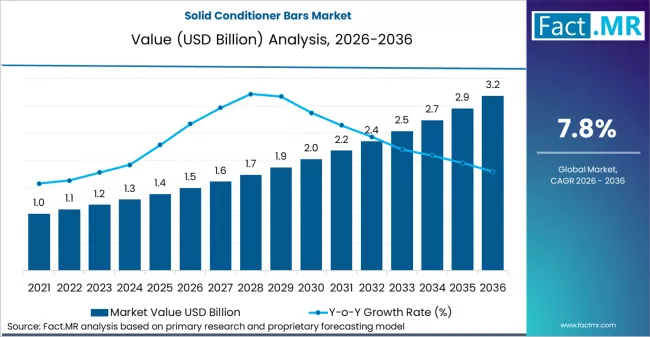
Consumer preference for waterless, low-waste formats has accelerated adoption across both personal and institutional channels, including hotels, salons, and professional care settings. This shift is reinforced by a wave of strategic product innovation, such as Groupe GM Cosmética Portugal’s launch of high-performance solid conditioners for hospitality use and L’Oréal’s sustainability-focused solid format innovations showcased at Viva Technology 2025. In parallel, emerging markets are becoming critical growth engines, evidenced by L’Oréal India’s expansion of premium and targeted solid hair treatments to meet rising demand for textured and curly hair solutions.
Strategic acquisitions and alliances are further strengthening market momentum. Unilever’s acquisition of Dr. Squatch integrates proven solid-format logistics into its global supply chain, while L’Oréal’s alliances with Kering and increased stake in Galderma signal long-term investment in premium, dermatological, and technology-led solid hair care platforms.
Solid Conditioner Bars Market
| Metric | Value |
|---|---|
| Estimated Value in (2026E) | USD 1.5 billion |
| Forecast Value in (2036F) | USD 3.2 billion |
| Forecast CAGR (2026 to 2036) | 7.8 % |
Category
| Category | Segments |
|---|---|
| Product Type | Moisturizing, Volumizing, Color-Protecting, Anti-Dandruff, And Other Variants |
| Application | Household, Salons & Spas, Hotels, And Other Uses |
| Ingredient type | Natural, Organic, Synthetic, And Other Formulations. |
| Distribution Channel | Online Stores, Supermarkets/Hypermarkets, Specialty Stores, And Others |
| Region | North America; Europe; Asia Pacific; Latin America; Middle East & Africa |
Segmental Analysis
How has the prioritization of hydration-centric performance requirements shaped the dominance of moisturizing conditioner bars in the solid hair care format?
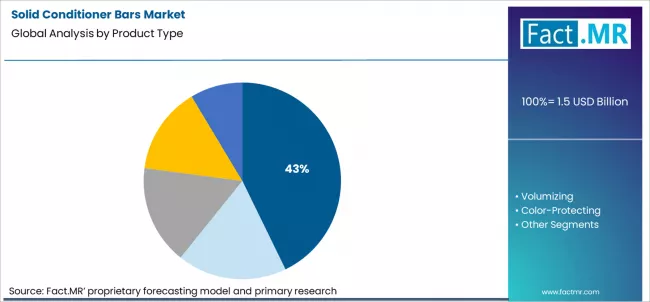
Moisturizing conditioner bars account for 42.8% of the solid conditioner bars market because large manufacturers have consistently positioned hydration as the primary functional role for solid hair care formats. Company disclosures and portfolio sequencing show that moisturizing variants are launched first when brands enter solid formats, reflecting their ability to address universal hair damage and dryness needs with minimal consumer education. Lipid-rich formulations perform reliably without water, supporting repeat use across households, hospitality, and professional channels, which stabilizes demand and accelerates scale.
How has the alignment of waterless formulation science with clean-label and sustainability mandates driven the dominance of natural ingredient-based solid conditioner bars?
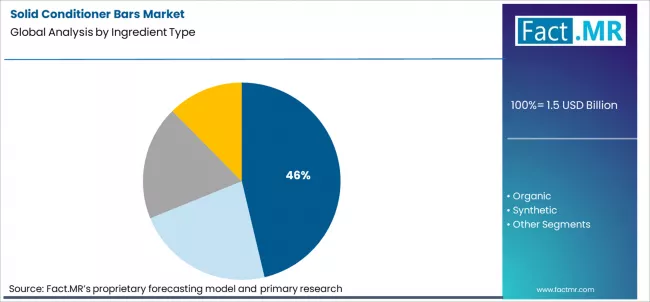
Natural ingredient formulations hold a 46.3% share of the market as solid conditioner bars have become a strategic platform for clean-label and plastic-free commitments. Corporate sustainability reports indicate that brands prioritize natural inputs in waterless formats to simplify regulatory compliance and reduce preservative reliance. Plant-based oils and biodegradable conditioning agents integrate effectively into solid bars, enabling brands to align formulation strategy with sustainability targets while maintaining performance consistency and long-term consumer trust.
Drivers, Restraints, and Key Trends in the Solid Conditioner Bars Market
Drivers
The market is being structurally accelerated by the convergence of logistics efficiency and sustainability compliance. Rising carbon-border adjustment mechanisms, freight volatility, and EU PPWR Regulation 2025/40 have materially increased the cost of shipping water-heavy formulations, pushing global FMCG players toward waterless conditioner formats that reduce shipping weight by up to 60-80% and improve margin resilience. This shift is reinforced by portfolio-level decisions, such as Unilever’s June 2025 acquisition of Dr. Squatch, which provides a proven blueprint for scaling anhydrous personal care logistics globally under its Growth Action Plan 2030. In parallel, advances in water-activated chemistry have enabled the integration of high-potency actives that historically degraded in liquid systems. P&G’s November 2025 launch of its Gemz platform, following more than a decade of R&D, validates solid conditioners as professional-grade delivery systems capable of meeting the performance expectations of high-spending, ingredient-literate consumers.
Restraints
Growth is moderated by regulatory and perception-led friction. The EU Regulation 2025/351 has introduced stricter purity and traceability requirements for plastic-free and recycled packaging materials, increasing compliance costs and slowing rollout timelines. L’Oréal’s 2025 sustainability disclosures highlight how multi-regional supply chain complexity delayed achievement of recyclability targets. Additionally, early market exposure to low-performance, wax-heavy bars created skepticism around efficacy and usability in mass segments, a perception that continues to slow adoption among time-constrained consumers who favor effortless application.
Key Trends
Innovation is moving beyond oil-and-wax formulations toward biotech-powered circularity, supported by targeted capital allocation such as L’Oréal’s €100 million Sustainable Innovation Accelerator focused on waterless actives and plastic-free systems. At the same time, consumer behavior is shifting toward ritual-based, minimalist hair care aligned with “slow living” values, while institutional demand is scaling rapidly through hospitality platforms, where professional-grade solid conditioner systems are being deployed to eliminate single-use amenity bottles at scale.
Analysis of the Solid Conditioner Bars Market by Key Country
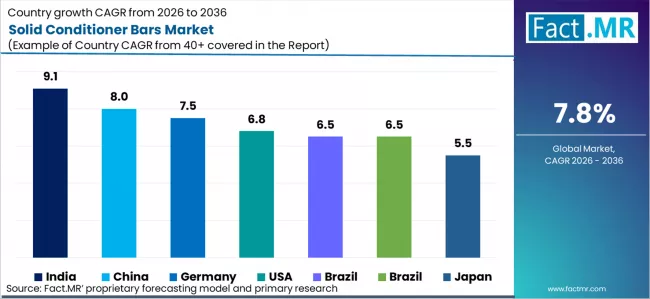
| Country | CAGR 2026 to 2036 |
|---|---|
| India | 9.1% |
| China | 8.0% |
| Germany | 7.5% |
| USA | 6.8% |
| Brazil | 6.5% |
| UK | 6.5% |
| Japan | 5.5% |
How is the professional salon ecosystem reshaping demand for solid conditioner bars in India?
India represents the fastest-growing market, expanding at a CAGR of 9.1%, driven by rapid growth in professional salon services and rising acceptance of clean beauty among urban consumers. Multinational brands are actively introducing salon-grade solid conditioners and repair treatments to capture premium demand from younger demographics seeking concentrated, performance-driven solutions. This momentum is reinforced by strategic focus from global professional divisions targeting damaged and textured hair. Growth is constrained by pronounced price sensitivity in rural and semi-urban markets, where the higher price-per-wash of solid bars competes unfavorably with low-cost liquid sachets.
How are green development policies and biotechnology investment accelerating solid conditioner innovation in China?
China’s market is growing at a CAGR of 8.0%, supported by the 14th Five-Year Plan for Green Development, which incentivizes biotechnology integration in industrial and consumer applications. Government-backed subsidies and OEM investments have enabled the use of bio-synthetic binders that improve sensory performance of solid conditioners. These advances address historical skepticism that solid formats are harsh or soap-like. However, premium perception in hair care remains closely tied to liquid textures, creating a behavioral restraint that brands must overcome through formulation science and education.
How are heritage brand preservation and EU chemical regulation shaping Germany’s solid conditioner strategy?
Germany is expanding at a CAGR of 7.5% as EU Omnibus regulations and national Net Zero mandates push legacy brands to re-engineer core formulations into compliant solid formats. Companies such as Beiersdorf are launching high natural-origin solid extensions to protect flagship brands while meeting regulatory deadlines. The principal constraint lies in formulation complexity, as maintaining sensory parity with heritage liquid products requires extensive R&D cycles, increasing cost and slowing portfolio conversion.
How is men’s grooming culture driving consolidation-led growth in solid conditioner bars in the U.S.?
The U.S. market is growing at a CAGR of 6.8%, driven by strong performance of men’s solid grooming brands built around masculinity, scent, and simplicity. Direct-to-consumer success has triggered acquisitions by large conglomerates seeking to scale solid-format logistics globally, as seen in Unilever’s strategic moves. However, shelf inertia in mass retail remains a constraint, with bottle-first legacy brands limiting physical visibility for premium solid conditioners despite rising consumer interest.
How are climate conditions and cultural hair rituals influencing solid conditioner adoption in Brazil?
Brazil is expanding at a CAGR of 6.5%, supported by high-frequency washing habits and persistent humidity-related frizz concerns. Brands are investing heavily in butter-rich solid conditioners formulated with local ingredients to provide portable, intensive conditioning. These products align with indulgent body and hair care rituals. Growth is moderated by storage and stability challenges in high-heat environments, requiring specialized packaging and handling solutions that add operational complexity.
How is packaging EPR reform driving de-packaged solid conditioner adoption in the UK?
The UK market is growing at a CAGR of 6.5% as Packaging Extended Producer Responsibility fees materially increase the cost of plastic-heavy liquid packaging. Brands are actively removing liquid formats in favor of mono-material or packaging-free solid bars to reduce tax exposure. This shift favors retailers with de-packaged models. However, data reporting and compliance requirements under the PackUK system create administrative burdens that slow adoption for smaller manufacturers.
How are circular economy mandates and precision standards shaping Japan’s solid conditioner market?
Japan’s market is expanding at a CAGR of 5.5%, driven by the Act on Promotion of Resource Circulation, which mandates recycled content and design-for-recyclability in hair care packaging. This has accelerated development of plastic-free and tablet-style conditioners aligned with METI standards. Adoption is constrained by supply chain scarcity of certified recycled materials and bio-synthetic binders, raising entry barriers and favoring established players with advanced sourcing capabilities.
Competitive Landscape for Solid Conditioner Bars Market
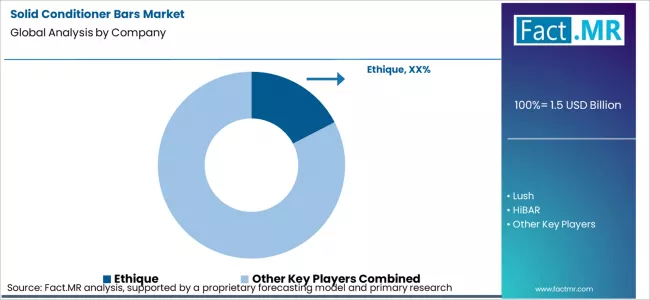
Until 2024, solid conditioner bars were treated by most global hair care players as sustainability-led extensions rather than core portfolio drivers. Adoption was largely confined to eco-conscious consumers and specialty retailers, with limited capital allocation and modest R&D intensity. Major FMCG and beauty groups prioritized liquid formats, using solid bars primarily to signal progress on plastic reduction targets rather than to drive scale or margin expansion. Portfolio decisions before 2024 show limited SKU breadth, minimal professional positioning, and cautious distribution expansion, reinforcing the view of solids as peripheral.
From 2026 onward, strategy is shifting decisively. Evidence from Unilever’s acquisition of Dr. Squatch, L’Oréal’s sustainability-led innovation accelerators, and the expansion of salon-grade solid treatments indicates that solid conditioners are being repositioned as high-efficiency platforms. The shift is driven by regulatory pressure on packaging, rising logistics costs, and advances in water-activated chemistry that allow performance parity with liquids. Solid conditioners now support higher concentration of actives, improved supply-chain economics, and refill-compatible architectures.
Key Players in Solid Conditioner Bars Market
- Ethique
- Lush
- HiBAR
- The Earthling Co.
- EcoRoots
- Beauty and the Bees
- Friendly Soap
- Plaine Products
- Unwrapped Life
- Lamazuna
- Chagrin Valley Soap & Salve
- Foamie
- B.O.B Bars Over Bottles
- The Solid Bar Company
- Kind2
- Bar None
- Biovène Barcelona
- Bali Secrets
- Nourish Natural Soap
- Viori
Bibliography
- International Organization for Standardization. 2023. Cosmetics and personal care products: Safety assessment, formulation standards, and quality requirements for solid and waterless hair care products. ISO Technical Report. International Organization for Standardization, Geneva.
- European Commission. 2025. Cosmetic Products Regulation and Packaging and Packaging Waste Regulation (EU) 2025/40: Ingredient safety, recyclability, and producer responsibility requirements. European Commission, Brussels.
- L’Oréal Group. 2025. Annual Report and Sustainability Progress Review: Innovation in solid formats, clean-label hair care, and professional product expansion. L’Oréal, Paris.
- Unilever PLC. 2025. Growth Action Plan 2030 and acquisition disclosures: Scaling waterless and solid personal care formats. Unilever Investor Relations, London.
- Personal Care Products Council. 2024. Solid and waterless hair care trends, formulation science, and sustainability compliance in global cosmetics. PCPC, Washington, DC.
Scope of Report
| Items | Values |
|---|---|
| Quantitative Units (2026) | USD 1.5 Billion |
| Product Type | Moisturizing, Volumizing, Color-Protecting, Anti-Dandruff, And Other Variants |
| Application | Household, Salons & Spas, Hotels, And Other Uses |
| Ingredient type | Natural, Organic, Synthetic, And Other Formulations. |
| Distribution Channel | Online Stores, Supermarkets/Hypermarkets, Specialty Stores, And Others |
| Regions Covered | North America, Europe, Asia Pacific, Latin America, Middle East & Africa |
| Countries Covered | USA, Canada, Germany, Italy, UK, France, Japan, Australia, and other countries |
| Key Companies Profiled | Ethique, Lush, HiBAR, The Earthling Co., EcoRoots, Beauty and the Bees, Friendly Soap, Plaine Products, Unwrapped Life, Lamazuna, Chagrin Valley Soap & Salve, Foamie, B.O.B Bars Over Bottles, The Solid Bar Company, Kind2, Bar None, Biovène Barcelona, Bali Secrets, Nourish Natural Soap, Viori |
| Additional Attributes | Dollar revenue is segmented by product type, ingredient type, application, distribution channel, and region. Regional demand trends are driven by sustainability regulations, rising preference for plastic-free and waterless hair care formats, premiumization of professional and household routines, and expanding adoption of digital and specialty retail channels. |
Solid Conditioner Bars Market by Segments
Product Type :
- Moisturizing
- Volumizing
- Color-Protecting
- Anti-Dandruff
Application :
- Household
- Salons & Spas
- Hotels
- Others
Ingredient Type :
- Natural
- Organic
- Synthetic
- Others
Distribution Channel :
- Online Stores
- Supermarkets/Hypermarkets
- Specialty Stores
Region :
- Asia Pacific
- Japan
- South Korea
- China
- Australia
- New Zealand
- Rest of Asia Pacific
- North America
- United States
- Canada
- Mexico
- Europe
- France
- Italy
- Spain
- Norway
- UK
- Rest of Europe
- Latin America
- Chile
- Peru
- Argentina
- Rest of Latin America
Table of Content
- Executive Summary
- Global Market Outlook
- Demand to side Trends
- Supply to side Trends
- Technology Roadmap Analysis
- Analysis and Recommendations
- Market Overview
- Market Coverage / Taxonomy
- Market Definition / Scope / Limitations
- Research Methodology
- Chapter Orientation
- Analytical Lens and Working Hypotheses
- Market Structure, Signals, and Trend Drivers
- Benchmarking and Cross-market Comparability
- Market Sizing, Forecasting, and Opportunity Mapping
- Research Design and Evidence Framework
- Desk Research Programme (Secondary Evidence)
- Company Annual and Sustainability Reports
- Peer-reviewed Journals and Academic Literature
- Corporate Websites, Product Literature, and Technical Notes
- Earnings Decks and Investor Briefings
- Statutory Filings and Regulatory Disclosures
- Technical White Papers and Standards Notes
- Trade Journals, Industry Magazines, and Analyst Briefs
- Conference Proceedings, Webinars, and Seminar Materials
- Government Statistics Portals and Public Data Releases
- Press Releases and Reputable Media Coverage
- Specialist Newsletters and Curated Briefings
- Sector Databases and Reference Repositories
- FMR Internal Proprietary Databases and Historical Market Datasets
- Subscription Datasets and Paid Sources
- Social Channels, Communities, and Digital Listening Inputs
- Additional Desk Sources
- Expert Input and Fieldwork (Primary Evidence)
- Primary Modes
- Qualitative Interviews and Expert Elicitation
- Quantitative Surveys and Structured Data Capture
- Blended Approach
- Why Primary Evidence is Used
- Field Techniques
- Interviews
- Surveys
- Focus Groups
- Observational and In-context Research
- Social and Community Interactions
- Stakeholder Universe Engaged
- C-suite Leaders
- Board Members
- Presidents and Vice Presidents
- R&D and Innovation Heads
- Technical Specialists
- Domain Subject-matter Experts
- Scientists
- Physicians and Other Healthcare Professionals
- Governance, Ethics, and Data Stewardship
- Research Ethics
- Data Integrity and Handling
- Primary Modes
- Tooling, Models, and Reference Databases
- Desk Research Programme (Secondary Evidence)
- Data Engineering and Model Build
- Data Acquisition and Ingestion
- Cleaning, Normalisation, and Verification
- Synthesis, Triangulation, and Analysis
- Quality Assurance and Audit Trail
- Market Background
- Market Dynamics
- Drivers
- Restraints
- Opportunity
- Trends
- Scenario Forecast
- Demand in Optimistic Scenario
- Demand in Likely Scenario
- Demand in Conservative Scenario
- Opportunity Map Analysis
- Product Life Cycle Analysis
- Supply Chain Analysis
- Investment Feasibility Matrix
- Value Chain Analysis
- PESTLE and Porter’s Analysis
- Regulatory Landscape
- Regional Parent Market Outlook
- Production and Consumption Statistics
- Import and Export Statistics
- Market Dynamics
- Global Market Analysis 2021 to 2025 and Forecast, 2026 to 2036
- Historical Market Size Value (USD Million) Analysis, 2021 to 2025
- Current and Future Market Size Value (USD Million) Projections, 2026 to 2036
- Y to o to Y Growth Trend Analysis
- Absolute $ Opportunity Analysis
- Global Market Pricing Analysis 2021 to 2025 and Forecast 2026 to 2036
- Global Market Analysis 2021 to 2025 and Forecast 2026 to 2036, By Product Type
- Introduction / Key Findings
- Historical Market Size Value (USD Million) Analysis By Product Type, 2021 to 2025
- Current and Future Market Size Value (USD Million) Analysis and Forecast By Product Type, 2026 to 2036
- Moisturizing
- Volumizing
- Color-Protecting
- Anti-Dandruff
- Others
- Moisturizing
- Y to o to Y Growth Trend Analysis By Product Type, 2021 to 2025
- Absolute $ Opportunity Analysis By Product Type, 2026 to 2036
- Global Market Analysis 2021 to 2025 and Forecast 2026 to 2036, By Application
- Introduction / Key Findings
- Historical Market Size Value (USD Million) Analysis By Application, 2021 to 2025
- Current and Future Market Size Value (USD Million) Analysis and Forecast By Application, 2026 to 2036
- Household
- Salons & Spas
- Hotels
- Others
- Household
- Y to o to Y Growth Trend Analysis By Application, 2021 to 2025
- Absolute $ Opportunity Analysis By Application, 2026 to 2036
- Global Market Analysis 2021 to 2025 and Forecast 2026 to 2036, By Distribution Channel
- Introduction / Key Findings
- Historical Market Size Value (USD Million) Analysis By Distribution Channel, 2021 to 2025
- Current and Future Market Size Value (USD Million) Analysis and Forecast By Distribution Channel, 2026 to 2036
- Online Stores
- Supermarkets/Hypermarkets
- Specialty Stores
- Others
- Online Stores
- Y to o to Y Growth Trend Analysis By Distribution Channel, 2021 to 2025
- Absolute $ Opportunity Analysis By Distribution Channel, 2026 to 2036
- Global Market Analysis 2021 to 2025 and Forecast 2026 to 2036, By Ingredient Type
- Introduction / Key Findings
- Historical Market Size Value (USD Million) Analysis By Ingredient Type, 2021 to 2025
- Current and Future Market Size Value (USD Million) Analysis and Forecast By Ingredient Type, 2026 to 2036
- Natural
- Organic
- Synthetic
- Others
- Natural
- Y to o to Y Growth Trend Analysis By Ingredient Type, 2021 to 2025
- Absolute $ Opportunity Analysis By Ingredient Type, 2026 to 2036
- Global Market Analysis 2021 to 2025 and Forecast 2026 to 2036, By Region
- Introduction
- Historical Market Size Value (USD Million) Analysis By Region, 2021 to 2025
- Current Market Size Value (USD Million) Analysis and Forecast By Region, 2026 to 2036
- North America
- Latin America
- Western Europe
- Eastern Europe
- East Asia
- South Asia and Pacific
- Middle East & Africa
- Market Attractiveness Analysis By Region
- North America Market Analysis 2021 to 2025 and Forecast 2026 to 2036, By Country
- Historical Market Size Value (USD Million) Trend Analysis By Market Taxonomy, 2021 to 2025
- Market Size Value (USD Million) Forecast By Market Taxonomy, 2026 to 2036
- By Country
- USA
- Canada
- Mexico
- By Product Type
- By Application
- By Distribution Channel
- By Ingredient Type
- By Country
- Market Attractiveness Analysis
- By Country
- By Product Type
- By Application
- By Distribution Channel
- By Ingredient Type
- Key Takeaways
- Latin America Market Analysis 2021 to 2025 and Forecast 2026 to 2036, By Country
- Historical Market Size Value (USD Million) Trend Analysis By Market Taxonomy, 2021 to 2025
- Market Size Value (USD Million) Forecast By Market Taxonomy, 2026 to 2036
- By Country
- Brazil
- Chile
- Rest of Latin America
- By Product Type
- By Application
- By Distribution Channel
- By Ingredient Type
- By Country
- Market Attractiveness Analysis
- By Country
- By Product Type
- By Application
- By Distribution Channel
- By Ingredient Type
- Key Takeaways
- Western Europe Market Analysis 2021 to 2025 and Forecast 2026 to 2036, By Country
- Historical Market Size Value (USD Million) Trend Analysis By Market Taxonomy, 2021 to 2025
- Market Size Value (USD Million) Forecast By Market Taxonomy, 2026 to 2036
- By Country
- Germany
- UK
- Italy
- Spain
- France
- Nordic
- BENELUX
- Rest of Western Europe
- By Product Type
- By Application
- By Distribution Channel
- By Ingredient Type
- By Country
- Market Attractiveness Analysis
- By Country
- By Product Type
- By Application
- By Distribution Channel
- By Ingredient Type
- Key Takeaways
- Eastern Europe Market Analysis 2021 to 2025 and Forecast 2026 to 2036, By Country
- Historical Market Size Value (USD Million) Trend Analysis By Market Taxonomy, 2021 to 2025
- Market Size Value (USD Million) Forecast By Market Taxonomy, 2026 to 2036
- By Country
- Russia
- Poland
- Hungary
- Balkan & Baltic
- Rest of Eastern Europe
- By Product Type
- By Application
- By Distribution Channel
- By Ingredient Type
- By Country
- Market Attractiveness Analysis
- By Country
- By Product Type
- By Application
- By Distribution Channel
- By Ingredient Type
- Key Takeaways
- East Asia Market Analysis 2021 to 2025 and Forecast 2026 to 2036, By Country
- Historical Market Size Value (USD Million) Trend Analysis By Market Taxonomy, 2021 to 2025
- Market Size Value (USD Million) Forecast By Market Taxonomy, 2026 to 2036
- By Country
- China
- Japan
- South Korea
- By Product Type
- By Application
- By Distribution Channel
- By Ingredient Type
- By Country
- Market Attractiveness Analysis
- By Country
- By Product Type
- By Application
- By Distribution Channel
- By Ingredient Type
- Key Takeaways
- South Asia and Pacific Market Analysis 2021 to 2025 and Forecast 2026 to 2036, By Country
- Historical Market Size Value (USD Million) Trend Analysis By Market Taxonomy, 2021 to 2025
- Market Size Value (USD Million) Forecast By Market Taxonomy, 2026 to 2036
- By Country
- India
- ASEAN
- Australia & New Zealand
- Rest of South Asia and Pacific
- By Product Type
- By Application
- By Distribution Channel
- By Ingredient Type
- By Country
- Market Attractiveness Analysis
- By Country
- By Product Type
- By Application
- By Distribution Channel
- By Ingredient Type
- Key Takeaways
- Middle East & Africa Market Analysis 2021 to 2025 and Forecast 2026 to 2036, By Country
- Historical Market Size Value (USD Million) Trend Analysis By Market Taxonomy, 2021 to 2025
- Market Size Value (USD Million) Forecast By Market Taxonomy, 2026 to 2036
- By Country
- Kingdom of Saudi Arabia
- Other GCC Countries
- Turkiye
- South Africa
- Other African Union
- Rest of Middle East & Africa
- By Product Type
- By Application
- By Distribution Channel
- By Ingredient Type
- By Country
- Market Attractiveness Analysis
- By Country
- By Product Type
- By Application
- By Distribution Channel
- By Ingredient Type
- Key Takeaways
- Key Countries Market Analysis
- USA
- Pricing Analysis
- Market Share Analysis, 2025
- By Product Type
- By Application
- By Distribution Channel
- By Ingredient Type
- Canada
- Pricing Analysis
- Market Share Analysis, 2025
- By Product Type
- By Application
- By Distribution Channel
- By Ingredient Type
- Mexico
- Pricing Analysis
- Market Share Analysis, 2025
- By Product Type
- By Application
- By Distribution Channel
- By Ingredient Type
- Brazil
- Pricing Analysis
- Market Share Analysis, 2025
- By Product Type
- By Application
- By Distribution Channel
- By Ingredient Type
- Chile
- Pricing Analysis
- Market Share Analysis, 2025
- By Product Type
- By Application
- By Distribution Channel
- By Ingredient Type
- Germany
- Pricing Analysis
- Market Share Analysis, 2025
- By Product Type
- By Application
- By Distribution Channel
- By Ingredient Type
- UK
- Pricing Analysis
- Market Share Analysis, 2025
- By Product Type
- By Application
- By Distribution Channel
- By Ingredient Type
- Italy
- Pricing Analysis
- Market Share Analysis, 2025
- By Product Type
- By Application
- By Distribution Channel
- By Ingredient Type
- Spain
- Pricing Analysis
- Market Share Analysis, 2025
- By Product Type
- By Application
- By Distribution Channel
- By Ingredient Type
- France
- Pricing Analysis
- Market Share Analysis, 2025
- By Product Type
- By Application
- By Distribution Channel
- By Ingredient Type
- India
- Pricing Analysis
- Market Share Analysis, 2025
- By Product Type
- By Application
- By Distribution Channel
- By Ingredient Type
- ASEAN
- Pricing Analysis
- Market Share Analysis, 2025
- By Product Type
- By Application
- By Distribution Channel
- By Ingredient Type
- Australia & New Zealand
- Pricing Analysis
- Market Share Analysis, 2025
- By Product Type
- By Application
- By Distribution Channel
- By Ingredient Type
- China
- Pricing Analysis
- Market Share Analysis, 2025
- By Product Type
- By Application
- By Distribution Channel
- By Ingredient Type
- Japan
- Pricing Analysis
- Market Share Analysis, 2025
- By Product Type
- By Application
- By Distribution Channel
- By Ingredient Type
- South Korea
- Pricing Analysis
- Market Share Analysis, 2025
- By Product Type
- By Application
- By Distribution Channel
- By Ingredient Type
- Russia
- Pricing Analysis
- Market Share Analysis, 2025
- By Product Type
- By Application
- By Distribution Channel
- By Ingredient Type
- Poland
- Pricing Analysis
- Market Share Analysis, 2025
- By Product Type
- By Application
- By Distribution Channel
- By Ingredient Type
- Hungary
- Pricing Analysis
- Market Share Analysis, 2025
- By Product Type
- By Application
- By Distribution Channel
- By Ingredient Type
- Kingdom of Saudi Arabia
- Pricing Analysis
- Market Share Analysis, 2025
- By Product Type
- By Application
- By Distribution Channel
- By Ingredient Type
- Turkiye
- Pricing Analysis
- Market Share Analysis, 2025
- By Product Type
- By Application
- By Distribution Channel
- By Ingredient Type
- South Africa
- Pricing Analysis
- Market Share Analysis, 2025
- By Product Type
- By Application
- By Distribution Channel
- By Ingredient Type
- USA
- Market Structure Analysis
- Competition Dashboard
- Competition Benchmarking
- Market Share Analysis of Top Players
- By Regional
- By Product Type
- By Application
- By Distribution Channel
- By Ingredient Type
- Competition Analysis
- Competition Deep Dive
- Ethique
- Overview
- Product Portfolio
- Profitability by Market Segments (Product/Age /Sales Channel/Region)
- Sales Footprint
- Strategy Overview
- Marketing Strategy
- Product Strategy
- Channel Strategy
- Lush
- HiBAR
- The Earthling Co.
- EcoRoots
- Beauty and the Bees
- Friendly Soap
- Plaine Products
- Unwrapped Life
- Lamazuna
- Chagrin Valley Soap & Salve
- Foamie
- B.O.B Bars Over Bottles
- The Solid Bar Company
- Kind2
- Bar None
- Biovène Barcelona
- Bali Secrets
- Nourish Natural Soap
- Viori
- Ethique
- Competition Deep Dive
- Assumptions & Acronyms Used
List Of Table
- Table 1: Global Market Value (USD Million) Forecast by Region, 2021 to 2036
- Table 2: Global Market Value (USD Million) Forecast by Product Type, 2021 to 2036
- Table 3: Global Market Value (USD Million) Forecast by Application, 2021 to 2036
- Table 4: Global Market Value (USD Million) Forecast by Distribution Channel, 2021 to 2036
- Table 5: Global Market Value (USD Million) Forecast by Ingredient Type, 2021 to 2036
- Table 6: North America Market Value (USD Million) Forecast by Country, 2021 to 2036
- Table 7: North America Market Value (USD Million) Forecast by Product Type, 2021 to 2036
- Table 8: North America Market Value (USD Million) Forecast by Application, 2021 to 2036
- Table 9: North America Market Value (USD Million) Forecast by Distribution Channel, 2021 to 2036
- Table 10: North America Market Value (USD Million) Forecast by Ingredient Type, 2021 to 2036
- Table 11: Latin America Market Value (USD Million) Forecast by Country, 2021 to 2036
- Table 12: Latin America Market Value (USD Million) Forecast by Product Type, 2021 to 2036
- Table 13: Latin America Market Value (USD Million) Forecast by Application, 2021 to 2036
- Table 14: Latin America Market Value (USD Million) Forecast by Distribution Channel, 2021 to 2036
- Table 15: Latin America Market Value (USD Million) Forecast by Ingredient Type, 2021 to 2036
- Table 16: Western Europe Market Value (USD Million) Forecast by Country, 2021 to 2036
- Table 17: Western Europe Market Value (USD Million) Forecast by Product Type, 2021 to 2036
- Table 18: Western Europe Market Value (USD Million) Forecast by Application, 2021 to 2036
- Table 19: Western Europe Market Value (USD Million) Forecast by Distribution Channel, 2021 to 2036
- Table 20: Western Europe Market Value (USD Million) Forecast by Ingredient Type, 2021 to 2036
- Table 21: Eastern Europe Market Value (USD Million) Forecast by Country, 2021 to 2036
- Table 22: Eastern Europe Market Value (USD Million) Forecast by Product Type, 2021 to 2036
- Table 23: Eastern Europe Market Value (USD Million) Forecast by Application, 2021 to 2036
- Table 24: Eastern Europe Market Value (USD Million) Forecast by Distribution Channel, 2021 to 2036
- Table 25: Eastern Europe Market Value (USD Million) Forecast by Ingredient Type, 2021 to 2036
- Table 26: East Asia Market Value (USD Million) Forecast by Country, 2021 to 2036
- Table 27: East Asia Market Value (USD Million) Forecast by Product Type, 2021 to 2036
- Table 28: East Asia Market Value (USD Million) Forecast by Application, 2021 to 2036
- Table 29: East Asia Market Value (USD Million) Forecast by Distribution Channel, 2021 to 2036
- Table 30: East Asia Market Value (USD Million) Forecast by Ingredient Type, 2021 to 2036
- Table 31: South Asia and Pacific Market Value (USD Million) Forecast by Country, 2021 to 2036
- Table 32: South Asia and Pacific Market Value (USD Million) Forecast by Product Type, 2021 to 2036
- Table 33: South Asia and Pacific Market Value (USD Million) Forecast by Application, 2021 to 2036
- Table 34: South Asia and Pacific Market Value (USD Million) Forecast by Distribution Channel, 2021 to 2036
- Table 35: South Asia and Pacific Market Value (USD Million) Forecast by Ingredient Type, 2021 to 2036
- Table 36: Middle East & Africa Market Value (USD Million) Forecast by Country, 2021 to 2036
- Table 37: Middle East & Africa Market Value (USD Million) Forecast by Product Type, 2021 to 2036
- Table 38: Middle East & Africa Market Value (USD Million) Forecast by Application, 2021 to 2036
- Table 39: Middle East & Africa Market Value (USD Million) Forecast by Distribution Channel, 2021 to 2036
- Table 40: Middle East & Africa Market Value (USD Million) Forecast by Ingredient Type, 2021 to 2036
List Of Figures
- Figure 1: Global Market Pricing Analysis
- Figure 2: Global Market Value (USD Million) Forecast 2021 to 2036
- Figure 3: Global Market Value Share and BPS Analysis by Product Type, 2026 and 2036
- Figure 4: Global Market Y to o to Y Growth Comparison by Product Type, 2026 to 2036
- Figure 5: Global Market Attractiveness Analysis by Product Type
- Figure 6: Global Market Value Share and BPS Analysis by Application, 2026 and 2036
- Figure 7: Global Market Y to o to Y Growth Comparison by Application, 2026 to 2036
- Figure 8: Global Market Attractiveness Analysis by Application
- Figure 9: Global Market Value Share and BPS Analysis by Distribution Channel, 2026 and 2036
- Figure 10: Global Market Y to o to Y Growth Comparison by Distribution Channel, 2026 to 2036
- Figure 11: Global Market Attractiveness Analysis by Distribution Channel
- Figure 12: Global Market Value Share and BPS Analysis by Ingredient Type, 2026 and 2036
- Figure 13: Global Market Y to o to Y Growth Comparison by Ingredient Type, 2026 to 2036
- Figure 14: Global Market Attractiveness Analysis by Ingredient Type
- Figure 15: Global Market Value (USD Million) Share and BPS Analysis by Region, 2026 and 2036
- Figure 16: Global Market Y to o to Y Growth Comparison by Region, 2026 to 2036
- Figure 17: Global Market Attractiveness Analysis by Region
- Figure 18: North America Market Incremental Dollar Opportunity, 2026 to 2036
- Figure 19: Latin America Market Incremental Dollar Opportunity, 2026 to 2036
- Figure 20: Western Europe Market Incremental Dollar Opportunity, 2026 to 2036
- Figure 21: Eastern Europe Market Incremental Dollar Opportunity, 2026 to 2036
- Figure 22: East Asia Market Incremental Dollar Opportunity, 2026 to 2036
- Figure 23: South Asia and Pacific Market Incremental Dollar Opportunity, 2026 to 2036
- Figure 24: Middle East & Africa Market Incremental Dollar Opportunity, 2026 to 2036
- Figure 25: North America Market Value Share and BPS Analysis by Country, 2026 and 2036
- Figure 26: North America Market Value Share and BPS Analysis by Product Type, 2026 and 2036
- Figure 27: North America Market Y to o to Y Growth Comparison by Product Type, 2026 to 2036
- Figure 28: North America Market Attractiveness Analysis by Product Type
- Figure 29: North America Market Value Share and BPS Analysis by Application, 2026 and 2036
- Figure 30: North America Market Y to o to Y Growth Comparison by Application, 2026 to 2036
- Figure 31: North America Market Attractiveness Analysis by Application
- Figure 32: North America Market Value Share and BPS Analysis by Distribution Channel, 2026 and 2036
- Figure 33: North America Market Y to o to Y Growth Comparison by Distribution Channel, 2026 to 2036
- Figure 34: North America Market Attractiveness Analysis by Distribution Channel
- Figure 35: North America Market Value Share and BPS Analysis by Ingredient Type, 2026 and 2036
- Figure 36: North America Market Y to o to Y Growth Comparison by Ingredient Type, 2026 to 2036
- Figure 37: North America Market Attractiveness Analysis by Ingredient Type
- Figure 38: Latin America Market Value Share and BPS Analysis by Country, 2026 and 2036
- Figure 39: Latin America Market Value Share and BPS Analysis by Product Type, 2026 and 2036
- Figure 40: Latin America Market Y to o to Y Growth Comparison by Product Type, 2026 to 2036
- Figure 41: Latin America Market Attractiveness Analysis by Product Type
- Figure 42: Latin America Market Value Share and BPS Analysis by Application, 2026 and 2036
- Figure 43: Latin America Market Y to o to Y Growth Comparison by Application, 2026 to 2036
- Figure 44: Latin America Market Attractiveness Analysis by Application
- Figure 45: Latin America Market Value Share and BPS Analysis by Distribution Channel, 2026 and 2036
- Figure 46: Latin America Market Y to o to Y Growth Comparison by Distribution Channel, 2026 to 2036
- Figure 47: Latin America Market Attractiveness Analysis by Distribution Channel
- Figure 48: Latin America Market Value Share and BPS Analysis by Ingredient Type, 2026 and 2036
- Figure 49: Latin America Market Y to o to Y Growth Comparison by Ingredient Type, 2026 to 2036
- Figure 50: Latin America Market Attractiveness Analysis by Ingredient Type
- Figure 51: Western Europe Market Value Share and BPS Analysis by Country, 2026 and 2036
- Figure 52: Western Europe Market Value Share and BPS Analysis by Product Type, 2026 and 2036
- Figure 53: Western Europe Market Y to o to Y Growth Comparison by Product Type, 2026 to 2036
- Figure 54: Western Europe Market Attractiveness Analysis by Product Type
- Figure 55: Western Europe Market Value Share and BPS Analysis by Application, 2026 and 2036
- Figure 56: Western Europe Market Y to o to Y Growth Comparison by Application, 2026 to 2036
- Figure 57: Western Europe Market Attractiveness Analysis by Application
- Figure 58: Western Europe Market Value Share and BPS Analysis by Distribution Channel, 2026 and 2036
- Figure 59: Western Europe Market Y to o to Y Growth Comparison by Distribution Channel, 2026 to 2036
- Figure 60: Western Europe Market Attractiveness Analysis by Distribution Channel
- Figure 61: Western Europe Market Value Share and BPS Analysis by Ingredient Type, 2026 and 2036
- Figure 62: Western Europe Market Y to o to Y Growth Comparison by Ingredient Type, 2026 to 2036
- Figure 63: Western Europe Market Attractiveness Analysis by Ingredient Type
- Figure 64: Eastern Europe Market Value Share and BPS Analysis by Country, 2026 and 2036
- Figure 65: Eastern Europe Market Value Share and BPS Analysis by Product Type, 2026 and 2036
- Figure 66: Eastern Europe Market Y to o to Y Growth Comparison by Product Type, 2026 to 2036
- Figure 67: Eastern Europe Market Attractiveness Analysis by Product Type
- Figure 68: Eastern Europe Market Value Share and BPS Analysis by Application, 2026 and 2036
- Figure 69: Eastern Europe Market Y to o to Y Growth Comparison by Application, 2026 to 2036
- Figure 70: Eastern Europe Market Attractiveness Analysis by Application
- Figure 71: Eastern Europe Market Value Share and BPS Analysis by Distribution Channel, 2026 and 2036
- Figure 72: Eastern Europe Market Y to o to Y Growth Comparison by Distribution Channel, 2026 to 2036
- Figure 73: Eastern Europe Market Attractiveness Analysis by Distribution Channel
- Figure 74: Eastern Europe Market Value Share and BPS Analysis by Ingredient Type, 2026 and 2036
- Figure 75: Eastern Europe Market Y to o to Y Growth Comparison by Ingredient Type, 2026 to 2036
- Figure 76: Eastern Europe Market Attractiveness Analysis by Ingredient Type
- Figure 77: East Asia Market Value Share and BPS Analysis by Country, 2026 and 2036
- Figure 78: East Asia Market Value Share and BPS Analysis by Product Type, 2026 and 2036
- Figure 79: East Asia Market Y to o to Y Growth Comparison by Product Type, 2026 to 2036
- Figure 80: East Asia Market Attractiveness Analysis by Product Type
- Figure 81: East Asia Market Value Share and BPS Analysis by Application, 2026 and 2036
- Figure 82: East Asia Market Y to o to Y Growth Comparison by Application, 2026 to 2036
- Figure 83: East Asia Market Attractiveness Analysis by Application
- Figure 84: East Asia Market Value Share and BPS Analysis by Distribution Channel, 2026 and 2036
- Figure 85: East Asia Market Y to o to Y Growth Comparison by Distribution Channel, 2026 to 2036
- Figure 86: East Asia Market Attractiveness Analysis by Distribution Channel
- Figure 87: East Asia Market Value Share and BPS Analysis by Ingredient Type, 2026 and 2036
- Figure 88: East Asia Market Y to o to Y Growth Comparison by Ingredient Type, 2026 to 2036
- Figure 89: East Asia Market Attractiveness Analysis by Ingredient Type
- Figure 90: South Asia and Pacific Market Value Share and BPS Analysis by Country, 2026 and 2036
- Figure 91: South Asia and Pacific Market Value Share and BPS Analysis by Product Type, 2026 and 2036
- Figure 92: South Asia and Pacific Market Y to o to Y Growth Comparison by Product Type, 2026 to 2036
- Figure 93: South Asia and Pacific Market Attractiveness Analysis by Product Type
- Figure 94: South Asia and Pacific Market Value Share and BPS Analysis by Application, 2026 and 2036
- Figure 95: South Asia and Pacific Market Y to o to Y Growth Comparison by Application, 2026 to 2036
- Figure 96: South Asia and Pacific Market Attractiveness Analysis by Application
- Figure 97: South Asia and Pacific Market Value Share and BPS Analysis by Distribution Channel, 2026 and 2036
- Figure 98: South Asia and Pacific Market Y to o to Y Growth Comparison by Distribution Channel, 2026 to 2036
- Figure 99: South Asia and Pacific Market Attractiveness Analysis by Distribution Channel
- Figure 100: South Asia and Pacific Market Value Share and BPS Analysis by Ingredient Type, 2026 and 2036
- Figure 101: South Asia and Pacific Market Y to o to Y Growth Comparison by Ingredient Type, 2026 to 2036
- Figure 102: South Asia and Pacific Market Attractiveness Analysis by Ingredient Type
- Figure 103: Middle East & Africa Market Value Share and BPS Analysis by Country, 2026 and 2036
- Figure 104: Middle East & Africa Market Value Share and BPS Analysis by Product Type, 2026 and 2036
- Figure 105: Middle East & Africa Market Y to o to Y Growth Comparison by Product Type, 2026 to 2036
- Figure 106: Middle East & Africa Market Attractiveness Analysis by Product Type
- Figure 107: Middle East & Africa Market Value Share and BPS Analysis by Application, 2026 and 2036
- Figure 108: Middle East & Africa Market Y to o to Y Growth Comparison by Application, 2026 to 2036
- Figure 109: Middle East & Africa Market Attractiveness Analysis by Application
- Figure 110: Middle East & Africa Market Value Share and BPS Analysis by Distribution Channel, 2026 and 2036
- Figure 111: Middle East & Africa Market Y to o to Y Growth Comparison by Distribution Channel, 2026 to 2036
- Figure 112: Middle East & Africa Market Attractiveness Analysis by Distribution Channel
- Figure 113: Middle East & Africa Market Value Share and BPS Analysis by Ingredient Type, 2026 and 2036
- Figure 114: Middle East & Africa Market Y to o to Y Growth Comparison by Ingredient Type, 2026 to 2036
- Figure 115: Middle East & Africa Market Attractiveness Analysis by Ingredient Type
- Figure 116: Global Market - Tier Structure Analysis
- Figure 117: Global Market - Company Share Analysis
- Frequently Asked Questions -
How big is the solid conditioner bars market in 2026?
The global solid conditioner bars market is estimated to be valued at USD 1.5 billion in 2026.
What will be the size of solid conditioner bars market in 2036?
The market size for the solid conditioner bars market is projected to reach USD 3.2 billion by 2036.
How much will be the solid conditioner bars market growth between 2026 and 2036?
The solid conditioner bars market is expected to grow at a 7.8% CAGR between 2026 and 2036.
What are the key product types in the solid conditioner bars market?
The key product types in solid conditioner bars market are moisturizing, volumizing, color-protecting, anti-dandruff and others.
Which application segment to contribute significant share in the solid conditioner bars market in 2026?
In terms of application, household segment to command 55.6% share in the solid conditioner bars market in 2026.