Solid Facial Sunscreens Market (2026 - 2036)

Solid Facial Sunscreens Market Size and Share Forecast Outlook 2026 to 2036

Core Findings

    Solid Facial Sunscreens Market Forecast and Outlook 2026 to 2036

    The solid facial sunscreens market is entering a phase of accelerated structural adoption, driven by the convergence of health awareness, lifestyle mobility, and format-led compliance. Global demand is projected to rise sharply from USD 12.4 billion in 2026 to approximately USD 28.3 billion by 2036, advancing at a CAGR of 8.6%. This expansion is closely tied to the rising incidence of skin malignancies and the normalization of daily, multi-time SPF reapplication as part of urban skincare routines. Solid formats resolve a long-standing execution gap in sun care by enabling effortless, precise use throughout the day, particularly in work, travel, and outdoor settings.

    Key Takeaways from the Solid Facial Sunscreens Market

    • Solid Facial Sunscreens Market Value (2026): USD 12.4 billion
    • Solid Facial Sunscreens Market Forecast Value (2036): USD 28.3 billion
    • Solid Facial Sunscreens Market Forecast CAGR (2026-2036): 8.6%
    • Leading Product Type: Mineral sunscreen sticks (34%)
    • Key Market Participants: L’Oréal S.A., Shiseido Company Ltd., Procter & Gamble Co., Beiersdorf AG, Unilever Plc, Estée Lauder Companies Inc., Johnson & Johnson, Coty Inc., Kao Corporation, Neutrogena, CeraVe, EltaMD, Beauty of Joseon, Isntree, Thank You Farmer, Minimalist, Dot & Key, The Derma Co, and Aqualogica.
    • Key Growth Regions: Asia Pacific, North America, Europe, Middle East and Africa
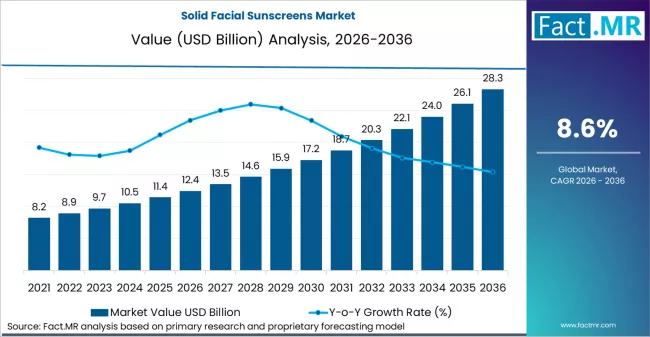
    Solid Facial Sunscreens Market Market Value Analysis

    The strategic relevance of the category lies in what industry leaders describe as the “mess-free protection” mandate. As highlighted during a 2025 global sun care summit, the sunscreen stick has evolved from a situational accessory into a daily facial essential because it removes friction from reapplication and reduces hygiene concerns. By eliminating greasy textures, white cast issues, and hand contact, solid sunscreens align with the realities of on-the-go consumption. This shift is reinforced by strong momentum in mineral-based, reef-safe sticks, reflecting consumer demand for sensitive-skin compatibility and environmental responsibility. Precision coverage for high-risk facial zones, TSA compliance, and preservative-free stability further position solid facial sunscreens as the most behaviorally aligned format for sustained UV protection.

    Solid Facial Sunscreens Market

    Metric Value
    Estimated Value in (2026E) USD 12.4 billion
    Forecast Value in (2036F) USD 28.3 billion
    Forecast CAGR (2026 to 2036) 8.6 %

    Category 

    Category Segments
    Product Type Mineral sunscreen sticks, Chemical sunscreen sticks, Hybrid (mineral + chemical) sunscreen sticks, Tinted sunscreen sticks
    SPF Level SPF 50+, SPF 30-50, SPF 15-30
    Skin Type Sensitive skin, Oily / acne-prone skin, Dry / normal skin
    Distribution Channel Online retail / e-commerce, Pharmacies & drug stores, Specialty beauty stores, Mass retail / supermarkets
    Region North America; Europe; Asia Pacific; Latin America; Middle East & Africa

    Segmental Analysis

    How is rising sensitivity awareness positioning mineral sunscreen sticks as the leading format in the Solid Facial Sunscreens Market?
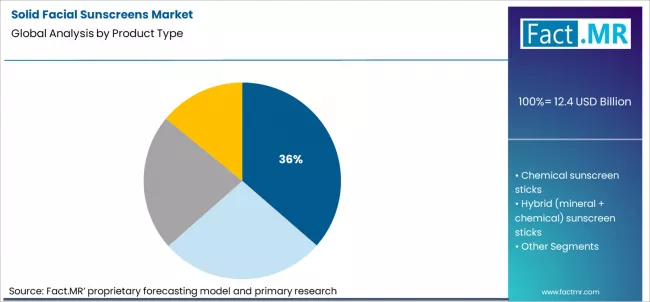
    Solid Facial Sunscreens Market Analysis By Product Type

    Mineral sunscreen sticks account for 36.4% of the Solid Facial Sunscreens Market because they directly address the growing demand for low-irritation, dermatologist-aligned sun protection. Regulatory scrutiny of chemical UV filters and heightened consumer concern around skin barrier disruption have shifted preference toward zinc oxide and titanium dioxide-based actives. Solid mineral sticks enable precise, localized application on high-risk facial zones without hand contact, reducing irritation risk and improving compliance. Their anhydrous structure also eliminates the need for preservatives commonly associated with stinging or redness, making mineral sticks the default choice for sensitive skin, post-procedure care, and daily urban SPF use.

    Why do SPF 50+ formulations dominate usage patterns in solid facial sunscreens?
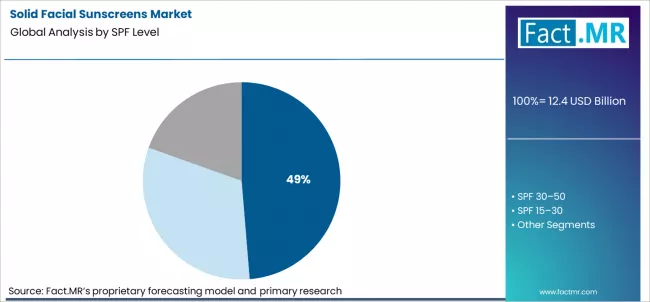
    Solid Facial Sunscreens Market Analysis By Spf Level

    SPF 50+ variants hold 48.7% share because reapplication behavior has become central to modern sun care routines. Dermatology guidance increasingly emphasizes consistent, high-level protection for incidental daily exposure rather than episodic beach use. Solid stick formats remove friction from reapplication by offering mess-free, makeup-compatible coverage throughout the day. High-SPF formulations align with this behavior by providing longer-lasting protection margins, especially for consumers exposed to pollution, blue light, and prolonged outdoor activity. The combination of portability, precision, and high efficacy has made SPF 50+ the standard benchmark for facial sunscreen sticks.

    What are the Drivers, Restraints, and Key Trends in the Solid Facial Sunscreens Market?

    • Drivers: A central driver shaping the solid facial sunscreens market is the normalization of reapplication culture in daily skincare. Rising awareness of cumulative UV damage, skin cancer risk, and photo aging has shifted sunscreen from occasional beach use to an everyday facial essential. Solid sticks remove key friction points associated with lotions and sprays by enabling precise, mess-free, no-touch application over makeup. This improves compliance and frequency of use. In parallel, the broader shift toward anhydrous beauty strengthens adoption, as waterless sticks offer greater UV filter stability, fewer preservatives, and superior portability for urban, travel-heavy lifestyles.
    • Restraints: Market expansion is constrained by formulation and perception challenges. Achieving uniform UV coverage in solid formats requires advanced dispersion of filters, particularly in mineral sticks where whitening risk remains a concern. This elevates R&D and testing costs. In addition, some consumers continue to associate higher SPF protection with traditional creams, creating a trust gap that brands must overcome through education and clinical validation, especially in mass-market and emerging regions.
    • Trend 1: Precision-First Facial Protection Solid sunscreens are increasingly positioned as targeted protection tools for high-risk facial zones such as the nose, eye contour, and hairline. This use-case expansion reframes sticks from secondary accessories into core daily SPF products.
    • Trend 2: Sensitive-Skin and Hybrid Formulation Expansion Innovation is accelerating around mineral and hybrid UV systems optimized for sensitive and acne-prone skin. Brands are prioritizing reef-safe filters, barrier-supporting additives, and makeup-compatible finishes to widen daily-use adoption.

    Analysis of the Solid Facial Sunscreens Market by Key Country
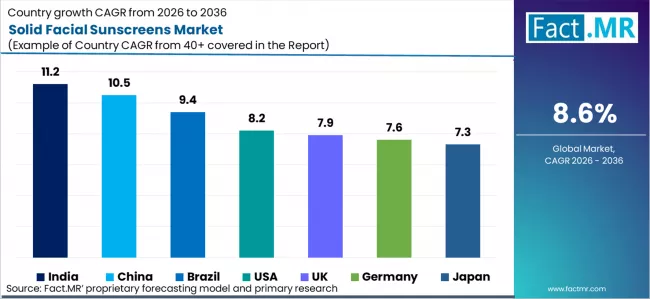
    Solid Facial Sunscreens Market Cagr Analysis By Country

    Country CAGR 2026 to 2036
    India 11.2%
    China 10.5%
    Brazil 9.4%
    USA 8.2%
    UK 7.9%
    Germany 7.6%
    Japan 7.3%

    Why is India emerging as the fastest-growing market for solid facial sunscreens globally?

    India is leading the Solid Facial Sunscreens Market with an estimated CAGR of 11.2%, making it the fastest-growing geography globally. This acceleration is structurally driven by climate stressors such as extreme humidity, prolonged heat exposure, and hard-water induced skin barrier disruption, all of which destabilize liquid SPF emulsions during daily commute and storage. Solid formats offer superior phase stability, sweat resistance, and matte sensoriality key attributes for Indian consumers. On the supply side, domestic dermo-cosmetic players like The Derma Co. and Minimalist are aggressively launching “clean-ical” solid SPF boosters that ensure active integrity even in high-heat transit. As a result, solid sticks are emerging as the most reliable facial UV vehicle for dense, urban, outdoor-centric lifestyles.

    How do regulatory changes explain the rapid adoption of solid facial sunscreens in China?

    China follows closely with a projected CAGR of 10.5% in solid facial sunscreens, driven primarily by regulatory and compliance-led demand shifts. The key inflection point is the 2025 NMPA labeling reform, particularly mandatory “spray-to-hand” warnings that complicate the usage and consumer perception of aerosol and liquid SPF formats. Solid sticks bypass this regulatory friction entirely while aligning with China’s growing emphasis on anti-pollution defense and barrier repair in urban environments. Global players such as Shiseido are capitalizing on this shift by repositioning solid SPF as “solid-state UV serums,” elevating them beyond sun care into functional skincare. This has enabled rapid penetration across Tier 1 and Tier 2 cities where regulatory clarity, convenience, and premium efficacy converge.

    What makes Brazil a high-growth but formulation-specific solid sunscreen market?

    Brazil is expanding at a robust CAGR of 9.4% in the solid facial sunscreen segment, with growth rooted more in formulation performance than portability. High humidity, widespread oily and acne-prone skin profiles, and shine-related discomfort have intensified demand for powder-to-cream solid SPF sticks offering dry-touch finishes. Unlike travel-driven markets, Brazilian consumers prioritize oil control and long-wear comfort. At the same time, amendments to the National Solid Waste Policy (PNRS 2025) are encouraging low-water, low-waste formats. This dual pressure has enabled brands like Natura to scale matte solid sunscreens optimized for tropical climates and sustainability compliance.

    Why is the United States seeing a strategic shift toward SPF 50+ facial sticks?

    The United States records a CAGR of 8.2% in the Solid Facial Sunscreens Market, reflecting a premium driven structural shift rather than regulatory pressure. Growth is fueled by strong consumer demand for TSA-compliant, mess-free, high-factor UV protection that integrates seamlessly into active, hybrid skincare routines. Solid SPF sticks particularly SPF 50+are increasingly replacing liquid primers as the primary facial base. L’Oréal’s dermatological beauty acceleration underscores this transition, highlighting how sun protection is becoming foundational rather than supplemental. In the U.S., solid sunscreens are positioned at the intersection of skincare, makeup, and wellness, appealing to consumers seeking multifunctional products that simplify routines without compromising efficacy or portability.

    How are sustainability taxes reshaping solid facial sunscreen adoption in the United Kingdom?

    The UK solid facial sunscreen category is growing at a CAGR of 7.9%, with momentum largely driven by environmental policy rather than climate or usage habits. The 2026 Packaging Extended Producer Responsibility (pEPR) framework imposes higher taxes on water-heavy, liquid-based packaging. In response, retailers such as Boots and No7 are accelerating a pivot toward naked or paper-encased solid SPF sticks to minimize tax liability. This has repositioned solid sunscreens as a retail compliance and margin-protection strategy, making sustainability-driven format shifts a central factor in category expansion.

    Why does Germany represent a regulation-led solid sunscreen market rather than a trend-driven one?

    Germany is advancing at a steady CAGR of 7.6% in solid facial sunscreens, with growth firmly anchored in regulatory alignment. EU Omnibus VII safety standards and Germany’s Net Zero 2045 mandate are actively discouraging liquid formulations that rely on microplastic emulsifiers and complex aqueous systems. As a result, solid-state mineral SPF formats are gaining institutional preference. Beiersdorf’s expansion of Thiamidol infused mineral SPF sticks reflects this shift toward eco-toxicologically compliant, reef-safe, and dermatologically precise solutions. In Germany, solid sunscreens are less about trend adoption and more about long-term regulatory compatibility, embedding them into the country’s dermo-pharmaceutical and pharmacy-led skincare ecosystem.

    How does cultural behavior influence solid facial sunscreen dominance in Japan?

    Japan rounds out the key markets with a CAGR of 7.3%, where adoption is culturally reinforced rather than regulation-led. A strong preference for no-touch reapplication, layered skincare routines, and compact portability favors solid SPF formats. The upcoming 2026 Resource Circulation Act further supports refillable and low-waste packaging. Shiseido’s serum-in-stick innovations integrating mineral i-shield and TripleLock Technology have elevated solid SPF into a prestige skincare hybrid. In Japan, solid sunscreens succeed by merging UV protection with advanced spot-prevention and anti-aging science.

    Competitive Landscape Evolution of the Solid Facial Sunscreens Market
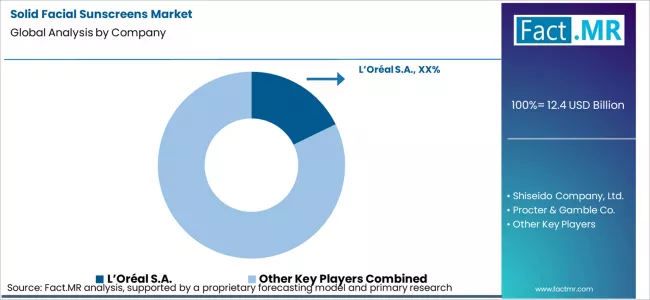
    Solid Facial Sunscreens Market Analysis By Company

    Competition in the solid facial sunscreens market has evolved from format experimentation to strategic category restructuring. In 2024, solid SPF sticks were largely positioned as secondary or situational products often framed around travel convenience, sports use, or quick reapplication. Liquids, creams, and lotions continued to dominate facial sun care portfolios, supported by long-standing consumer familiarity and broader shade or texture variations. During this phase, most brands treated solid sunscreens as adjunct SKUs, with limited R&D investment and messaging focused primarily on portability rather than performance leadership.

    In 2025, the competitive dynamic shifted materially. Solid facial sunscreens began moving into core facial protection architectures, driven by advances in solid-state UV filter dispersion, high-factor SPF stability, and sensorial refinement. Leading players most notably L’Oréal repositioned SPF 50+ sticks as multifunctional facial bases, capable of replacing primers and supporting daily dermatological routines. This marked a pivot from “on-the-go” utility to primary facial protection.

    Regulatory and operational pressures have further reinforced this transition. Rising costs tied to water-heavy formulations, stricter packaging compliance, and preservative scrutiny have improved the commercial attractiveness of solid formats. Concurrently, consumers are prioritizing mess-free application, targeted reapplication, and routine consolidation advantages structurally embedded in solid SPF systems. As a result, competition is increasingly defined by format mastery and clinical parity, rather than by SPF level alone.

    Recent Developments

    • In 2026, Shiseido launched its first unique sun care product developed via its AI-Powered VOYAGER platform. The focus is on optimizing the "sensory feel" of solid sticks, ensuring they provide a "Water-Based" cooling sensation despite being solid in the tube.
    • In 2025, L'Oréal integrated its patented Mexoryl 400 filter the first to effectively cover the long-UVA range (380-400nm) into solid stick formats within the La Roche-Posay Anthelios line. This moves solid sunscreens from "convenience tools" to "gold-standard protection.
    • In 2025, Kenvue (formerly J&J’s consumer health arm) is actively considering the divestment of non-core skin health brands (e.g., Clean & Clear) to double down on high-margin anchors like Neutrogena. This signals a move toward "Clinical Authority" where solid sunscreens are marketed as dermatological treatments rather than cosmetic add-ons.

    Key Players in Solid Facial Sunscreens Market

    • L’Oréal S.A.
    • Shiseido Company, Ltd.
    • Procter & Gamble Co.
    • Beiersdorf AG
    • Unilever Plc
    • Estée Lauder Companies Inc.
    • Johnson & Johnson
    • Coty Inc.
    • Kao Corporation
    • Neutrogena
    • CeraVe
    • Supergoop!
    • EltaMD
    • Beauty of Joseon
    • Isntree
    • Thank You Farmer
    • Minimalist
    • Dot & Key
    • The Derma Co
    • Aqualogica

    Scope of Report

    Items Values
    Quantitative Units (2026) USD 12.4 Billion
    Product Type Mineral sunscreen sticks, Chemical sunscreen sticks, Hybrid (mineral + chemical) sunscreen sticks, Tinted sunscreen sticks
    SPF Level SPF 50+, SPF 30-50, SPF 15-30
    Skin Type Sensitive skin, Oily / acne-prone skin, Dry / normal skin
    Distribution Channel Online retail / e-commerce, Pharmacies & drug stores, Specialty beauty stores, Mass retail / supermarkets
    Product Type Mineral sunscreen sticks, Chemical sunscreen sticks, Hybrid (mineral + chemical) sunscreen sticks, Tinted sunscreen sticks
    Regions Covered North America, Europe, Asia Pacific, Latin America, Middle East & Africa
    Countries Covered U.S., Canada, Germany, Italy, UK, France, Japan, Australia, and other countries
    Key Companies Profiled L’Oréal S.A., Shiseido Company Ltd., Procter & Gamble Co., Beiersdorf AG, Unilever Plc, Estée Lauder Companies Inc., Johnson & Johnson, Coty Inc., Kao Corporation, Neutrogena, CeraVe, EltaMD, Beauty of Joseon, Isntree, Thank You Farmer, Minimalist, Dot & Key, The Derma Co, and Aqualogica.
    Additional Attributes Dollar revenue in the solid facial sunscreens market is segmented by format type (stick, balm, hybrid), SPF level, filter system (mineral, hybrid), skin concern focus (oil control, pigmentation, sensitive skin), distribution channel, price tier, and region. Regional demand patterns are shaped by rising adoption of mess-free, TSA-compliant solid formats, increasing preference for high-SPF daily facial protection, regulatory and sustainability pressures on liquid formulations, premiumization of multifunctional sun care.

    Solid Facial Sunscreens Market by Segments 

    Product Type :

    • Mineral sunscreen sticks
    • Chemical sunscreen sticks
    • Hybrid (mineral + chemical) sunscreen sticks
    • Tinted sunscreen sticks

    SPF Level :

    • SPF 50+
    • SPF 30-50
    • SPF 15-30

    Skin Type :

    • Sensitive skin
    • Oily / acne-prone skin
    • Dry / normal skin

    Distribution Channel :

    • Online retail / e-commerce
    • Pharmacies & drug stores
    • Specialty beauty stores
    • Mass retail / supermarkets

    Region :

    • Asia Pacific
      • Japan
      • South Korea
      • China
      • Australia
      • New Zealand
      • Rest of Asia Pacific
    • North America
      • United States
      • Canada
      • Mexico
    • Europe
      • France
      • Italy
      • Spain
      • Norway
      • UK
      • Rest of Europe
    • Latin America
      • Chile
      • Peru
      • Argentina
      • Rest of Latin America

    Bibliography

    • European Commission. 2022. Cosmetic products regulation (EC) No 1223/2009: Sunscreen ingredient safety, labeling, and UV filter compliance requirements. Brussels: European Union.
    • International Organization for Standardization (ISO). 2023. Cosmetics and personal care products: Safety assessment, SPF testing, and formulation standards for solid and anhydrous sunscreen products. ISO Technical Report. Geneva: ISO.
    • International Federation of Societies of Cosmetic Chemists (IFSCC). 2024. Advances in solid-state UV filter dispersion, mineral sunscreen stabilization, and anhydrous sun care formulation science. IFSCC Monograph Series.
    • Journal of Cosmetic Dermatology. 2024. High-SPF solid sunscreen systems: Skin compatibility, barrier integrity, and reapplication efficacy. Journal of Cosmetic Dermatology 23(4): 1121-1136.
    • Mintel Group Ltd. 2025. Global sun care trends: Solid formats, high-SPF facial protection, and sustainability-driven innovation. London: Mintel.
    • Personal Care Products Council. 2023. Premium sun protection consumption and the rise of concentrated, waterless, and solid-format sunscreens. Washington, DC: PCPC.

    Table of Content

    1. Executive Summary
      • Global Market Outlook
      • Demand to side Trends
      • Supply to side Trends
      • Technology Roadmap Analysis
      • Analysis and Recommendations
    2. Market Overview
      • Market Coverage / Taxonomy
      • Market Definition / Scope / Limitations
    3. Research Methodology
      • Chapter Orientation
      • Analytical Lens and Working Hypotheses
        • Market Structure, Signals, and Trend Drivers
        • Benchmarking and Cross-market Comparability
        • Market Sizing, Forecasting, and Opportunity Mapping
      • Research Design and Evidence Framework
        • Desk Research Programme (Secondary Evidence)
          • Company Annual and Sustainability Reports
          • Peer-reviewed Journals and Academic Literature
          • Corporate Websites, Product Literature, and Technical Notes
          • Earnings Decks and Investor Briefings
          • Statutory Filings and Regulatory Disclosures
          • Technical White Papers and Standards Notes
          • Trade Journals, Industry Magazines, and Analyst Briefs
          • Conference Proceedings, Webinars, and Seminar Materials
          • Government Statistics Portals and Public Data Releases
          • Press Releases and Reputable Media Coverage
          • Specialist Newsletters and Curated Briefings
          • Sector Databases and Reference Repositories
          • FMR Internal Proprietary Databases and Historical Market Datasets
          • Subscription Datasets and Paid Sources
          • Social Channels, Communities, and Digital Listening Inputs
          • Additional Desk Sources
        • Expert Input and Fieldwork (Primary Evidence)
          • Primary Modes
            • Qualitative Interviews and Expert Elicitation
            • Quantitative Surveys and Structured Data Capture
            • Blended Approach
          • Why Primary Evidence is Used
          • Field Techniques
            • Interviews
            • Surveys
            • Presidents and Vice Presidents
            • R&D and Innovation Heads
            • Technical Specialists
            • Domain Subject-matter Experts
            • Scientists
            • Physicians and Other Healthcare Professionals
          • Governance, Ethics, and Data Stewardship
            • Research Ethics
            • Data Integrity and Handling
        • Tooling, Models, and Reference Databases
      • Data Engineering and Model Build
        • Data Acquisition and Ingestion
        • Cleaning, Normalisation, and Verification
        • Synthesis, Triangulation, and Analysis
      • Quality Assurance and Audit Trail
    4. Market Background
      • Market Dynamics
        • Drivers
        • Restraints
        • Opportunity
        • Trends
      • Scenario Forecast
        • Demand in Optimistic Scenario
        • Demand in Likely Scenario
        • Demand in Conservative Scenario
      • Opportunity Map Analysis
      • Product Life Cycle Analysis
      • Supply Chain Analysis
      • Investment Feasibility Matrix
      • Value Chain Analysis
      • PESTLE and Porter’s Analysis
      • Regulatory Landscape
      • Regional Parent Market Outlook
      • Production and Consumption Statistics
      • Import and Export Statistics
    5. Global Market Analysis 2021 to 2025 and Forecast, 2026 to 2036
      • Historical Market Size Value (USD Million) Analysis, 2021 to 2025
      • Current and Future Market Size Value (USD Million) Projections, 2026 to 2036
        • Y to o to Y Growth Trend Analysis
        • Absolute $ Opportunity Analysis
    6. Global Market Pricing Analysis 2021 to 2025 and Forecast 2026 to 2036
    7. Global Market Analysis 2021 to 2025 and Forecast 2026 to 2036, By Product Type
      • Introduction / Key Findings
      • Historical Market Size Value (USD Million) Analysis By Product Type, 2021 to 2025
      • Current and Future Market Size Value (USD Million) Analysis and Forecast By Product Type, 2026 to 2036
        • Mineral sunscreen sticks
        • Chemical sunscreen sticks
        • Hybrid (mineral + chemical) sunscreen sticks
        • Tinted sunscreen sticks
      • Y to o to Y Growth Trend Analysis By Product Type, 2021 to 2025
      • Absolute $ Opportunity Analysis By Product Type, 2026 to 2036
    8. Global Market Analysis 2021 to 2025 and Forecast 2026 to 2036, By SPF Level
      • Introduction / Key Findings
      • Historical Market Size Value (USD Million) Analysis By SPF Level, 2021 to 2025
      • Current and Future Market Size Value (USD Million) Analysis and Forecast By SPF Level, 2026 to 2036
        • SPF 50+
        • SPF 30-50
        • SPF 15-30
      • Y to o to Y Growth Trend Analysis By SPF Level, 2021 to 2025
      • Absolute $ Opportunity Analysis By SPF Level, 2026 to 2036
    9. Global Market Analysis 2021 to 2025 and Forecast 2026 to 2036, By Skin Type
      • Introduction / Key Findings
      • Historical Market Size Value (USD Million) Analysis By Skin Type, 2021 to 2025
      • Current and Future Market Size Value (USD Million) Analysis and Forecast By Skin Type, 2026 to 2036
        • Sensitive skin
        • Oily / acne-prone skin
        • Dry / normal skin
      • Y to o to Y Growth Trend Analysis By Skin Type, 2021 to 2025
      • Absolute $ Opportunity Analysis By Skin Type, 2026 to 2036
    10. Global Market Analysis 2021 to 2025 and Forecast 2026 to 2036, By Distribution Channel
      • Introduction / Key Findings
      • Historical Market Size Value (USD Million) Analysis By Distribution Channel, 2021 to 2025
      • Current and Future Market Size Value (USD Million) Analysis and Forecast By Distribution Channel, 2026 to 2036
        • Online retail / e-commerce
        • Pharmacies & drug stores
        • Specialty beauty stores
        • Mass retail / supermarkets
      • Y to o to Y Growth Trend Analysis By Distribution Channel, 2021 to 2025
      • Absolute $ Opportunity Analysis By Distribution Channel, 2026 to 2036
    11. Global Market Analysis 2021 to 2025 and Forecast 2026 to 2036, By Region
      • Introduction
      • Historical Market Size Value (USD Million) Analysis By Region, 2021 to 2025
      • Current Market Size Value (USD Million) Analysis and Forecast By Region, 2026 to 2036
        • North America
        • Latin America
        • Western Europe
        • Eastern Europe
        • East Asia
        • South Asia and Pacific
        • Middle East & Africa
      • Market Attractiveness Analysis By Region
    12. North America Market Analysis 2021 to 2025 and Forecast 2026 to 2036, By Country
      • Historical Market Size Value (USD Million) Trend Analysis By Market Taxonomy, 2021 to 2025
      • Market Size Value (USD Million) Forecast By Market Taxonomy, 2026 to 2036
        • By Country
          • USA
          • Canada
          • Mexico
        • By Product Type
        • By SPF Level
        • By Skin Type
        • By Distribution Channel
      • Market Attractiveness Analysis
        • By Country
        • By Product Type
        • By SPF Level
        • By Skin Type
        • By Distribution Channel
      • Key Takeaways
    13. Latin America Market Analysis 2021 to 2025 and Forecast 2026 to 2036, By Country
      • Historical Market Size Value (USD Million) Trend Analysis By Market Taxonomy, 2021 to 2025
      • Market Size Value (USD Million) Forecast By Market Taxonomy, 2026 to 2036
        • By Country
          • Brazil
          • Chile
          • Rest of Latin America
        • By Product Type
        • By SPF Level
        • By Skin Type
        • By Distribution Channel
      • Market Attractiveness Analysis
        • By Country
        • By Product Type
        • By SPF Level
        • By Skin Type
        • By Distribution Channel
      • Key Takeaways
    14. Western Europe Market Analysis 2021 to 2025 and Forecast 2026 to 2036, By Country
      • Historical Market Size Value (USD Million) Trend Analysis By Market Taxonomy, 2021 to 2025
      • Market Size Value (USD Million) Forecast By Market Taxonomy, 2026 to 2036
        • By Country
          • Germany
          • UK
          • Italy
          • Spain
          • France
          • Nordic
          • BENELUX
          • Rest of Western Europe
        • By Product Type
        • By SPF Level
        • By Skin Type
        • By Distribution Channel
      • Market Attractiveness Analysis
        • By Country
        • By Product Type
        • By SPF Level
        • By Skin Type
        • By Distribution Channel
      • Key Takeaways
    15. Eastern Europe Market Analysis 2021 to 2025 and Forecast 2026 to 2036, By Country
      • Historical Market Size Value (USD Million) Trend Analysis By Market Taxonomy, 2021 to 2025
      • Market Size Value (USD Million) Forecast By Market Taxonomy, 2026 to 2036
        • By Country
          • Russia
          • Poland
          • Hungary
          • Balkan & Baltic
          • Rest of Eastern Europe
        • By Product Type
        • By SPF Level
        • By Skin Type
        • By Distribution Channel
      • Market Attractiveness Analysis
        • By Country
        • By Product Type
        • By SPF Level
        • By Skin Type
        • By Distribution Channel
      • Key Takeaways
    16. East Asia Market Analysis 2021 to 2025 and Forecast 2026 to 2036, By Country
      • Historical Market Size Value (USD Million) Trend Analysis By Market Taxonomy, 2021 to 2025
      • Market Size Value (USD Million) Forecast By Market Taxonomy, 2026 to 2036
        • By Country
          • China
          • Japan
          • South Korea
        • By Product Type
        • By SPF Level
        • By Skin Type
        • By Distribution Channel
      • Market Attractiveness Analysis
        • By Country
        • By Product Type
        • By SPF Level
        • By Skin Type
        • By Distribution Channel
      • Key Takeaways
    17. South Asia and Pacific Market Analysis 2021 to 2025 and Forecast 2026 to 2036, By Country
      • Historical Market Size Value (USD Million) Trend Analysis By Market Taxonomy, 2021 to 2025
      • Market Size Value (USD Million) Forecast By Market Taxonomy, 2026 to 2036
        • By Country
          • India
          • ASEAN
          • Australia & New Zealand
          • Rest of South Asia and Pacific
        • By Product Type
        • By SPF Level
        • By Skin Type
        • By Distribution Channel
      • Market Attractiveness Analysis
        • By Country
        • By Product Type
        • By SPF Level
        • By Skin Type
        • By Distribution Channel
      • Key Takeaways
    18. Middle East & Africa Market Analysis 2021 to 2025 and Forecast 2026 to 2036, By Country
      • Historical Market Size Value (USD Million) Trend Analysis By Market Taxonomy, 2021 to 2025
      • Market Size Value (USD Million) Forecast By Market Taxonomy, 2026 to 2036
        • By Country
          • Kingdom of Saudi Arabia
          • Other GCC Countries
          • Turkiye
          • South Africa
          • Other African Union
          • Rest of Middle East & Africa
        • By Product Type
        • By SPF Level
        • By Skin Type
        • By Distribution Channel
      • Market Attractiveness Analysis
        • By Country
        • By Product Type
        • By SPF Level
        • By Skin Type
        • By Distribution Channel
      • Key Takeaways
    19. Key Countries Market Analysis
      • USA
        • Pricing Analysis
        • Market Share Analysis, 2025
          • By Product Type
          • By SPF Level
          • By Skin Type
          • By Distribution Channel
      • Canada
        • Pricing Analysis
        • Market Share Analysis, 2025
          • By Product Type
          • By SPF Level
          • By Skin Type
          • By Distribution Channel
      • Mexico
        • Pricing Analysis
        • Market Share Analysis, 2025
          • By Product Type
          • By SPF Level
          • By Skin Type
          • By Distribution Channel
      • Brazil
        • Pricing Analysis
        • Market Share Analysis, 2025
          • By Product Type
          • By SPF Level
          • By Skin Type
          • By Distribution Channel
      • Chile
        • Pricing Analysis
        • Market Share Analysis, 2025
          • By Product Type
          • By SPF Level
          • By Skin Type
          • By Distribution Channel
      • Germany
        • Pricing Analysis
        • Market Share Analysis, 2025
          • By Product Type
          • By SPF Level
          • By Skin Type
          • By Distribution Channel
      • UK
        • Pricing Analysis
        • Market Share Analysis, 2025
          • By Product Type
          • By SPF Level
          • By Skin Type
          • By Distribution Channel
      • Italy
        • Pricing Analysis
        • Market Share Analysis, 2025
          • By Product Type
          • By SPF Level
          • By Skin Type
          • By Distribution Channel
      • Spain
        • Pricing Analysis
        • Market Share Analysis, 2025
          • By Product Type
          • By SPF Level
          • By Skin Type
          • By Distribution Channel
      • France
        • Pricing Analysis
        • Market Share Analysis, 2025
          • By Product Type
          • By SPF Level
          • By Skin Type
          • By Distribution Channel
      • India
        • Pricing Analysis
        • Market Share Analysis, 2025
          • By Product Type
          • By SPF Level
          • By Skin Type
          • By Distribution Channel
      • ASEAN
        • Pricing Analysis
        • Market Share Analysis, 2025
          • By Product Type
          • By SPF Level
          • By Skin Type
          • By Distribution Channel
      • Australia & New Zealand
        • Pricing Analysis
        • Market Share Analysis, 2025
          • By Product Type
          • By SPF Level
          • By Skin Type
          • By Distribution Channel
      • China
        • Pricing Analysis
        • Market Share Analysis, 2025
          • By Product Type
          • By SPF Level
          • By Skin Type
          • By Distribution Channel
      • Japan
        • Pricing Analysis
        • Market Share Analysis, 2025
          • By Product Type
          • By SPF Level
          • By Skin Type
          • By Distribution Channel
      • South Korea
        • Pricing Analysis
        • Market Share Analysis, 2025
          • By Product Type
          • By SPF Level
          • By Skin Type
          • By Distribution Channel
      • Russia
        • Pricing Analysis
        • Market Share Analysis, 2025
          • By Product Type
          • By SPF Level
          • By Skin Type
          • By Distribution Channel
      • Poland
        • Pricing Analysis
        • Market Share Analysis, 2025
          • By Product Type
          • By SPF Level
          • By Skin Type
          • By Distribution Channel
      • Hungary
        • Pricing Analysis
        • Market Share Analysis, 2025
          • By Product Type
          • By SPF Level
          • By Skin Type
          • By Distribution Channel
      • Kingdom of Saudi Arabia
        • Pricing Analysis
        • Market Share Analysis, 2025
          • By Product Type
          • By SPF Level
          • By Skin Type
          • By Distribution Channel
      • Turkiye
        • Pricing Analysis
        • Market Share Analysis, 2025
          • By Product Type
          • By SPF Level
          • By Skin Type
          • By Distribution Channel
      • South Africa
        • Pricing Analysis
        • Market Share Analysis, 2025
          • By Product Type
          • By SPF Level
          • By Skin Type
          • By Distribution Channel
    20. Market Structure Analysis
      • Competition Dashboard
      • Competition Benchmarking
      • Market Share Analysis of Top Players
        • By Regional
        • By Product Type
        • By SPF Level
        • By Skin Type
        • By Distribution Channel
    21. Competition Analysis
      • Competition Deep Dive
        • L’Oréal S.A.
          • Overview
          • Product Portfolio
          • Profitability by Market Segments (Product/Age /Sales Channel/Region)
          • Sales Footprint
          • Strategy Overview
            • Marketing Strategy
            • Product Strategy
            • Channel Strategy
        • Shiseido Company, Ltd.
        • Procter & Gamble Co.
        • Beiersdorf AG
        • Unilever Plc
        • Estée Lauder Companies Inc.
        • Johnson & Johnson
        • Coty Inc.
        • Kao Corporation
        • Neutrogena
        • CeraVe
        • Supergoop!
        • EltaMD
        • Beauty of Joseon
        • Isntree
        • Thank You Farmer
    22. Assumptions & Acronyms Used

    List Of Table

    • Table 1: Global Market Value (USD Million) Forecast by Region, 2021 to 2036
    • Table 2: Global Market Value (USD Million) Forecast by Product Type, 2021 to 2036
    • Table 3: Global Market Value (USD Million) Forecast by SPF Level, 2021 to 2036
    • Table 4: Global Market Value (USD Million) Forecast by Skin Type, 2021 to 2036
    • Table 5: Global Market Value (USD Million) Forecast by Distribution Channel, 2021 to 2036
    • Table 6: North America Market Value (USD Million) Forecast by Country, 2021 to 2036
    • Table 7: North America Market Value (USD Million) Forecast by Product Type, 2021 to 2036
    • Table 8: North America Market Value (USD Million) Forecast by SPF Level, 2021 to 2036
    • Table 9: North America Market Value (USD Million) Forecast by Skin Type, 2021 to 2036
    • Table 10: North America Market Value (USD Million) Forecast by Distribution Channel, 2021 to 2036
    • Table 11: Latin America Market Value (USD Million) Forecast by Country, 2021 to 2036
    • Table 12: Latin America Market Value (USD Million) Forecast by Product Type, 2021 to 2036
    • Table 13: Latin America Market Value (USD Million) Forecast by SPF Level, 2021 to 2036
    • Table 14: Latin America Market Value (USD Million) Forecast by Skin Type, 2021 to 2036
    • Table 15: Latin America Market Value (USD Million) Forecast by Distribution Channel, 2021 to 2036
    • Table 16: Western Europe Market Value (USD Million) Forecast by Country, 2021 to 2036
    • Table 17: Western Europe Market Value (USD Million) Forecast by Product Type, 2021 to 2036
    • Table 18: Western Europe Market Value (USD Million) Forecast by SPF Level, 2021 to 2036
    • Table 19: Western Europe Market Value (USD Million) Forecast by Skin Type, 2021 to 2036
    • Table 20: Western Europe Market Value (USD Million) Forecast by Distribution Channel, 2021 to 2036
    • Table 21: Eastern Europe Market Value (USD Million) Forecast by Country, 2021 to 2036
    • Table 22: Eastern Europe Market Value (USD Million) Forecast by Product Type, 2021 to 2036
    • Table 23: Eastern Europe Market Value (USD Million) Forecast by SPF Level, 2021 to 2036
    • Table 24: Eastern Europe Market Value (USD Million) Forecast by Skin Type, 2021 to 2036
    • Table 25: Eastern Europe Market Value (USD Million) Forecast by Distribution Channel, 2021 to 2036
    • Table 26: East Asia Market Value (USD Million) Forecast by Country, 2021 to 2036
    • Table 27: East Asia Market Value (USD Million) Forecast by Product Type, 2021 to 2036
    • Table 28: East Asia Market Value (USD Million) Forecast by SPF Level, 2021 to 2036
    • Table 29: East Asia Market Value (USD Million) Forecast by Skin Type, 2021 to 2036
    • Table 30: East Asia Market Value (USD Million) Forecast by Distribution Channel, 2021 to 2036
    • Table 31: South Asia and Pacific Market Value (USD Million) Forecast by Country, 2021 to 2036
    • Table 32: South Asia and Pacific Market Value (USD Million) Forecast by Product Type, 2021 to 2036
    • Table 33: South Asia and Pacific Market Value (USD Million) Forecast by SPF Level, 2021 to 2036
    • Table 34: South Asia and Pacific Market Value (USD Million) Forecast by Skin Type, 2021 to 2036
    • Table 35: South Asia and Pacific Market Value (USD Million) Forecast by Distribution Channel, 2021 to 2036
    • Table 36: Middle East & Africa Market Value (USD Million) Forecast by Country, 2021 to 2036
    • Table 37: Middle East & Africa Market Value (USD Million) Forecast by Product Type, 2021 to 2036
    • Table 38: Middle East & Africa Market Value (USD Million) Forecast by SPF Level, 2021 to 2036
    • Table 39: Middle East & Africa Market Value (USD Million) Forecast by Skin Type, 2021 to 2036
    • Table 40: Middle East & Africa Market Value (USD Million) Forecast by Distribution Channel, 2021 to 2036

    List Of Figures

    • Figure 1: Global Market Pricing Analysis
    • Figure 2: Global Market Value (USD Million) Forecast 2021 to 2036
    • Figure 3: Global Market Value Share and BPS Analysis by Product Type, 2026 and 2036
    • Figure 4: Global Market Y to o to Y Growth Comparison by Product Type, 2026 to 2036
    • Figure 5: Global Market Attractiveness Analysis by Product Type
    • Figure 6: Global Market Value Share and BPS Analysis by SPF Level, 2026 and 2036
    • Figure 7: Global Market Y to o to Y Growth Comparison by SPF Level, 2026 to 2036
    • Figure 8: Global Market Attractiveness Analysis by SPF Level
    • Figure 9: Global Market Value Share and BPS Analysis by Skin Type, 2026 and 2036
    • Figure 10: Global Market Y to o to Y Growth Comparison by Skin Type, 2026 to 2036
    • Figure 11: Global Market Attractiveness Analysis by Skin Type
    • Figure 12: Global Market Value Share and BPS Analysis by Distribution Channel, 2026 and 2036
    • Figure 13: Global Market Y to o to Y Growth Comparison by Distribution Channel, 2026 to 2036
    • Figure 14: Global Market Attractiveness Analysis by Distribution Channel
    • Figure 15: Global Market Value (USD Million) Share and BPS Analysis by Region, 2026 and 2036
    • Figure 16: Global Market Y to o to Y Growth Comparison by Region, 2026 to 2036
    • Figure 17: Global Market Attractiveness Analysis by Region
    • Figure 18: North America Market Incremental Dollar Opportunity, 2026 to 2036
    • Figure 19: Latin America Market Incremental Dollar Opportunity, 2026 to 2036
    • Figure 20: Western Europe Market Incremental Dollar Opportunity, 2026 to 2036
    • Figure 21: Eastern Europe Market Incremental Dollar Opportunity, 2026 to 2036
    • Figure 22: East Asia Market Incremental Dollar Opportunity, 2026 to 2036
    • Figure 23: South Asia and Pacific Market Incremental Dollar Opportunity, 2026 to 2036
    • Figure 24: Middle East & Africa Market Incremental Dollar Opportunity, 2026 to 2036
    • Figure 25: North America Market Value Share and BPS Analysis by Country, 2026 and 2036
    • Figure 26: North America Market Value Share and BPS Analysis by Product Type, 2026 and 2036
    • Figure 27: North America Market Y to o to Y Growth Comparison by Product Type, 2026 to 2036
    • Figure 28: North America Market Attractiveness Analysis by Product Type
    • Figure 29: North America Market Value Share and BPS Analysis by SPF Level, 2026 and 2036
    • Figure 30: North America Market Y to o to Y Growth Comparison by SPF Level, 2026 to 2036
    • Figure 31: North America Market Attractiveness Analysis by SPF Level
    • Figure 32: North America Market Value Share and BPS Analysis by Skin Type, 2026 and 2036
    • Figure 33: North America Market Y to o to Y Growth Comparison by Skin Type, 2026 to 2036
    • Figure 34: North America Market Attractiveness Analysis by Skin Type
    • Figure 35: North America Market Value Share and BPS Analysis by Distribution Channel, 2026 and 2036
    • Figure 36: North America Market Y to o to Y Growth Comparison by Distribution Channel, 2026 to 2036
    • Figure 37: North America Market Attractiveness Analysis by Distribution Channel
    • Figure 38: Latin America Market Value Share and BPS Analysis by Country, 2026 and 2036
    • Figure 39: Latin America Market Value Share and BPS Analysis by Product Type, 2026 and 2036
    • Figure 40: Latin America Market Y to o to Y Growth Comparison by Product Type, 2026 to 2036
    • Figure 41: Latin America Market Attractiveness Analysis by Product Type
    • Figure 42: Latin America Market Value Share and BPS Analysis by SPF Level, 2026 and 2036
    • Figure 43: Latin America Market Y to o to Y Growth Comparison by SPF Level, 2026 to 2036
    • Figure 44: Latin America Market Attractiveness Analysis by SPF Level
    • Figure 45: Latin America Market Value Share and BPS Analysis by Skin Type, 2026 and 2036
    • Figure 46: Latin America Market Y to o to Y Growth Comparison by Skin Type, 2026 to 2036
    • Figure 47: Latin America Market Attractiveness Analysis by Skin Type
    • Figure 48: Latin America Market Value Share and BPS Analysis by Distribution Channel, 2026 and 2036
    • Figure 49: Latin America Market Y to o to Y Growth Comparison by Distribution Channel, 2026 to 2036
    • Figure 50: Latin America Market Attractiveness Analysis by Distribution Channel
    • Figure 51: Western Europe Market Value Share and BPS Analysis by Country, 2026 and 2036
    • Figure 52: Western Europe Market Value Share and BPS Analysis by Product Type, 2026 and 2036
    • Figure 53: Western Europe Market Y to o to Y Growth Comparison by Product Type, 2026 to 2036
    • Figure 54: Western Europe Market Attractiveness Analysis by Product Type
    • Figure 55: Western Europe Market Value Share and BPS Analysis by SPF Level, 2026 and 2036
    • Figure 56: Western Europe Market Y to o to Y Growth Comparison by SPF Level, 2026 to 2036
    • Figure 57: Western Europe Market Attractiveness Analysis by SPF Level
    • Figure 58: Western Europe Market Value Share and BPS Analysis by Skin Type, 2026 and 2036
    • Figure 59: Western Europe Market Y to o to Y Growth Comparison by Skin Type, 2026 to 2036
    • Figure 60: Western Europe Market Attractiveness Analysis by Skin Type
    • Figure 61: Western Europe Market Value Share and BPS Analysis by Distribution Channel, 2026 and 2036
    • Figure 62: Western Europe Market Y to o to Y Growth Comparison by Distribution Channel, 2026 to 2036
    • Figure 63: Western Europe Market Attractiveness Analysis by Distribution Channel
    • Figure 64: Eastern Europe Market Value Share and BPS Analysis by Country, 2026 and 2036
    • Figure 65: Eastern Europe Market Value Share and BPS Analysis by Product Type, 2026 and 2036
    • Figure 66: Eastern Europe Market Y to o to Y Growth Comparison by Product Type, 2026 to 2036
    • Figure 67: Eastern Europe Market Attractiveness Analysis by Product Type
    • Figure 68: Eastern Europe Market Value Share and BPS Analysis by SPF Level, 2026 and 2036
    • Figure 69: Eastern Europe Market Y to o to Y Growth Comparison by SPF Level, 2026 to 2036
    • Figure 70: Eastern Europe Market Attractiveness Analysis by SPF Level
    • Figure 71: Eastern Europe Market Value Share and BPS Analysis by Skin Type, 2026 and 2036
    • Figure 72: Eastern Europe Market Y to o to Y Growth Comparison by Skin Type, 2026 to 2036
    • Figure 73: Eastern Europe Market Attractiveness Analysis by Skin Type
    • Figure 74: Eastern Europe Market Value Share and BPS Analysis by Distribution Channel, 2026 and 2036
    • Figure 75: Eastern Europe Market Y to o to Y Growth Comparison by Distribution Channel, 2026 to 2036
    • Figure 76: Eastern Europe Market Attractiveness Analysis by Distribution Channel
    • Figure 77: East Asia Market Value Share and BPS Analysis by Country, 2026 and 2036
    • Figure 78: East Asia Market Value Share and BPS Analysis by Product Type, 2026 and 2036
    • Figure 79: East Asia Market Y to o to Y Growth Comparison by Product Type, 2026 to 2036
    • Figure 80: East Asia Market Attractiveness Analysis by Product Type
    • Figure 81: East Asia Market Value Share and BPS Analysis by SPF Level, 2026 and 2036
    • Figure 82: East Asia Market Y to o to Y Growth Comparison by SPF Level, 2026 to 2036
    • Figure 83: East Asia Market Attractiveness Analysis by SPF Level
    • Figure 84: East Asia Market Value Share and BPS Analysis by Skin Type, 2026 and 2036
    • Figure 85: East Asia Market Y to o to Y Growth Comparison by Skin Type, 2026 to 2036
    • Figure 86: East Asia Market Attractiveness Analysis by Skin Type
    • Figure 87: East Asia Market Value Share and BPS Analysis by Distribution Channel, 2026 and 2036
    • Figure 88: East Asia Market Y to o to Y Growth Comparison by Distribution Channel, 2026 to 2036
    • Figure 89: East Asia Market Attractiveness Analysis by Distribution Channel
    • Figure 90: South Asia and Pacific Market Value Share and BPS Analysis by Country, 2026 and 2036
    • Figure 91: South Asia and Pacific Market Value Share and BPS Analysis by Product Type, 2026 and 2036
    • Figure 92: South Asia and Pacific Market Y to o to Y Growth Comparison by Product Type, 2026 to 2036
    • Figure 93: South Asia and Pacific Market Attractiveness Analysis by Product Type
    • Figure 94: South Asia and Pacific Market Value Share and BPS Analysis by SPF Level, 2026 and 2036
    • Figure 95: South Asia and Pacific Market Y to o to Y Growth Comparison by SPF Level, 2026 to 2036
    • Figure 96: South Asia and Pacific Market Attractiveness Analysis by SPF Level
    • Figure 97: South Asia and Pacific Market Value Share and BPS Analysis by Skin Type, 2026 and 2036
    • Figure 98: South Asia and Pacific Market Y to o to Y Growth Comparison by Skin Type, 2026 to 2036
    • Figure 99: South Asia and Pacific Market Attractiveness Analysis by Skin Type
    • Figure 100: South Asia and Pacific Market Value Share and BPS Analysis by Distribution Channel, 2026 and 2036
    • Figure 101: South Asia and Pacific Market Y to o to Y Growth Comparison by Distribution Channel, 2026 to 2036
    • Figure 102: South Asia and Pacific Market Attractiveness Analysis by Distribution Channel
    • Figure 103: Middle East & Africa Market Value Share and BPS Analysis by Country, 2026 and 2036
    • Figure 104: Middle East & Africa Market Value Share and BPS Analysis by Product Type, 2026 and 2036
    • Figure 105: Middle East & Africa Market Y to o to Y Growth Comparison by Product Type, 2026 to 2036
    • Figure 106: Middle East & Africa Market Attractiveness Analysis by Product Type
    • Figure 107: Middle East & Africa Market Value Share and BPS Analysis by SPF Level, 2026 and 2036
    • Figure 108: Middle East & Africa Market Y to o to Y Growth Comparison by SPF Level, 2026 to 2036
    • Figure 109: Middle East & Africa Market Attractiveness Analysis by SPF Level
    • Figure 110: Middle East & Africa Market Value Share and BPS Analysis by Skin Type, 2026 and 2036
    • Figure 111: Middle East & Africa Market Y to o to Y Growth Comparison by Skin Type, 2026 to 2036
    • Figure 112: Middle East & Africa Market Attractiveness Analysis by Skin Type
    • Figure 113: Middle East & Africa Market Value Share and BPS Analysis by Distribution Channel, 2026 and 2036
    • Figure 114: Middle East & Africa Market Y to o to Y Growth Comparison by Distribution Channel, 2026 to 2036
    • Figure 115: Middle East & Africa Market Attractiveness Analysis by Distribution Channel
    • Figure 116: Global Market - Tier Structure Analysis
    • Figure 117: Global Market - Company Share Analysis

    - FAQs -

    How big is the solid facial sunscreens market in 2026?

    The global solid facial sunscreens market is estimated to be valued at USD 12.4 billion in 2026.

    What will be the size of solid facial sunscreens market in 2036?

    The market size for the solid facial sunscreens market is projected to reach USD 28.3 billion by 2036.

    How much will be the solid facial sunscreens market growth between 2026 and 2036?

    The solid facial sunscreens market is expected to grow at a 8.6% CAGR between 2026 and 2036.

    What are the key product types in the solid facial sunscreens market?

    The key product types in solid facial sunscreens market are mineral sunscreen sticks, chemical sunscreen sticks, hybrid (mineral + chemical) sunscreen sticks and tinted sunscreen sticks.

    Which spf level segment to contribute significant share in the solid facial sunscreens market in 2026?

    In terms of spf level, spf 50+ segment to command 48.7% share in the solid facial sunscreens market in 2026.

    Solid Facial Sunscreens Market