- Base Value(2025): 1.4 Bn
- Estimated Value(2026): 1.6 Bn
- Forecast Value (2036): 4.3 Bn
- CAGR (2026 - 2036): 10.4%
Speciality Kernel Peptides Market Forecast and Outlook By FACT.MR
In 2025, the speciality kernel peptides market was valued at USD 1.4 billion. Based on Fact.MR analysis, demand for speciality kernel peptides is estimated to grow to USD 1.6 billion in 2026 and USD 4.3 billion by 2036. FACT.MR projects a CAGR of 10.4% during the forecast period.
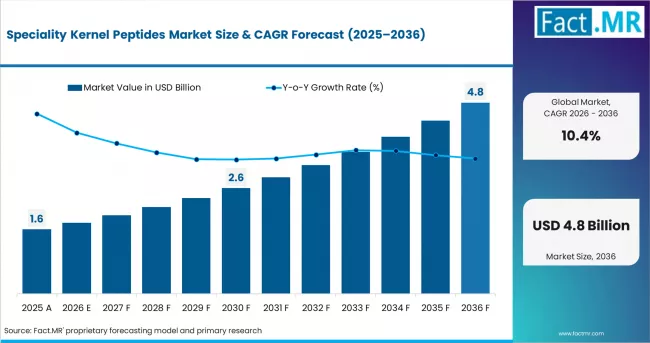
Speciality Kernel Peptides Market Value Analysis | Source: Fact.MR
Summary of Speciality Kernel Peptides Market
- Market Definition
- The market covers bioactive peptides from nut, seed, fruit, and cereal kernels. Supplies nutraceutical, cosmeceutical, functional food, and research applications.
- Demand Drivers
- FSSAI approvals in India are expanding access for plant peptide ingredients in nutraceuticals.
- K-Beauty brands are increasing demand for skin-active kernel peptides with validated bioactivity.
- EU compliance is driving demand for documented-purity peptide ingredients in supplements.
- Key Segments Analyzed
- By Source Type: Nut and seed kernels hold around 60% share in 2026, led by almond and walnut peptides.
- By Application: Nutraceuticals lead with about 42% share in 2026, driven by supplement demand.
- By Geography: India leads at 11.8% CAGR, supported by regulation and retail expansion.
- Analyst Opinion at FACT.MR
- Shambhu Nath Jha states that clinically validated and compliant peptide grades are outperforming commodity hydrolysates. Producers with documented bioactivity and approvals will capture premium margins.
- Strategic Implications
- Invest in bioactivity validation and FSSAI approvals for India market access.
- Develop clinically backed peptide grades for EU and K-Beauty applications.
- Build China sourcing partnerships for large-scale kernel supply.
- Methodology
- Market sizing uses producer revenues and volume data, validated with 2024–2025 benchmarks.
- Analysis includes FSSAI, ICMR 2024, and EU compliance data.
- Forecasts consider nutraceutical demand, cosmeceutical trends, and expert inputs.
| Metric | Value |
|---|---|
| Estimated Value in 2026 | USD 1.6 billion |
| Forecast Value in 2036 | USD 4.3 billion |
| Forecast CAGR (2026 to 2036) | 10.4% |
Source: Fact.MR analysis. Updated Apr 17, 2026
Between 2026 and 2036, the market is projected to generate USD 2.7 billion in absolute opportunity. Growth reflects strong structural expansion across key regions. Demand is rising in India’s organised nutraceutical retail, China’s kernel processing base, the United States clean-label segment, and South Korea’s K-Beauty ecosystem. Growth is constrained by amygdalin safety limits in apricot kernels, raw material price volatility, and lengthy approval timelines under FSSAI and EU regulations.
Procurement in nutraceutical and cosmeceutical segments is shifting toward validated ingredients. Buyers require documented bioactivity, clinical backing, and regulatory dossiers. Supplier bases are consolidating across supplement and cosmetic companies. Preference is shifting toward high-purity and application-specific peptide producers over undifferentiated hydrolysate suppliers.
India leads with an estimated CAGR of 11.8% through 2036, supported by rapid nutraceutical retail expansion and evolving FSSAI frameworks. China follows at 11.4%, driven by large-scale kernel processing and functional food exports. The United States records 10.7%, supported by strong demand for clean-label and plant-based ingredients. Germany registers 10.1%, backed by biotechnology integration and green chemistry standards. South Korea records 9.8%, driven by K-Beauty innovation and premium peptide-based formulations.
Segmental Analysis
Speciality Kernel Peptides Market Analysis by Source Type
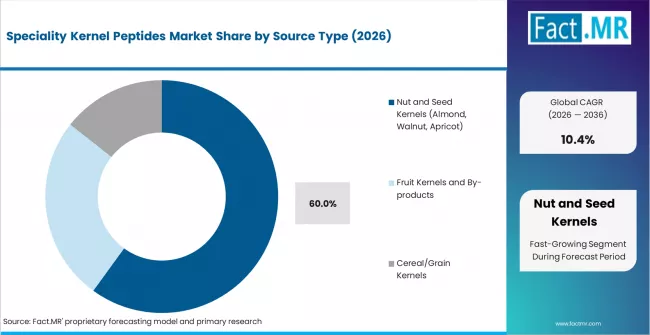
Speciality Kernel Peptides Market Analysis By Source Type | Source: Fact.MR
Based on Fact.MR, nut and seed kernels hold around 60% share in 2026. They dominate due to strong nutritional profiles and consumer familiarity. Almond and walnut peptides are widely accepted in formulations. Extensive bioactivity data supports use in skin, joint, and metabolic health. No other plant kernel offers similar versatility across applications.
- GELITA Vitafoods Showcase: GELITA AG showcased PeptENDURE and VERISOL at Vitafoods Europe 2024 in Geneva. The focus was on clinical validation standards. This sets benchmarks for all peptide suppliers, including plant-based alternatives. [1]
- Bachem Bubendorf Expansion: Bachem Holding AG opened Building K in Bubendorf in 2024. The expansion doubled production capacity. It introduced green chemistry and automation standards for peptide manufacturing. [2]
- Plant Peptide Adoption Trend: The global nutraceutical market reached about USD 591.1 billion in 2024. Growth is estimated at 7.6% CAGR. Plant-derived peptides are gaining share due to clean-label demand. Consumers prefer non-animal bioactive ingredients. [3]
Speciality Kernel Peptides Market Analysis by Application
Based on Fact.MR, nutraceuticals and dietary supplements hold around 42% share in 2026. Growth is driven by organised retail expansion in India and the United States. Consumers prefer clean-label and plant-based ingredients. Demand is strong for digestive, skin, and metabolic health solutions.
- GELITA SupplySide Showcase: GELITA AG presented its BE ACTIVE platform at SupplySide Global 2025. The focus was on clinically validated peptide ingredients. This sets procurement benchmarks for kernel peptide suppliers. [4]
- Bachem US Facility Expansion: Bachem Holding AG launched a new facility in the United States in September 2025. The site expands SPPS and LPPS production capacity. It supports nutraceutical and pharmaceutical demand. [5]
- Cosmeceutical Application Trend: South Korea’s K-Beauty sector expanded in 2024–2025. Demand increased for plant-based peptides in skincare. Applications include anti-aging and barrier repair products. Brands are shifting beyond collagen-based actives. [6]
Drivers, Restraints, and Opportunities
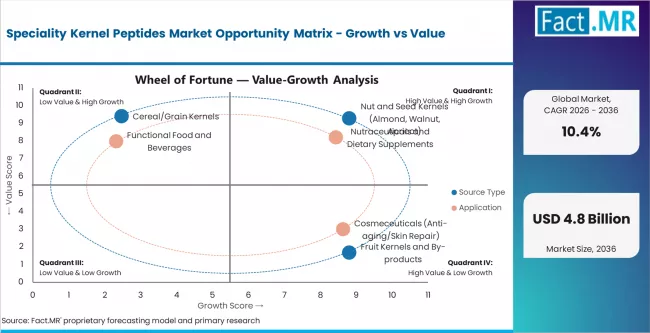
Speciality Kernel Peptides Market Opportunity Matrix Growth Vs Value | Source: Fact.MR
Fact.MR notes the market is multi-application and functional. It was valued at USD 1.4 billion in 2025. Demand is anchored in nutraceutical and cosmeceutical use. These applications are linked to health trends. This supports stable demand across cycles.
The market shows clear quality segmentation. Commodity hydrolysates face margin pressure from low-cost producers. Clinically validated peptide grades command 30–60% price premiums. This is driven by compliance and brand differentiation. High-quality grades support revenue growth despite moderate volume expansion.
- India FSSAI Botanical Framework: India introduced structured evaluation under FSSAI in 2024. The framework defines approval pathways for plant peptides. It expands access for compliant producers. This supports India’s 11.8% growth outlook. [7]
- EU Food Supplement Compliance: EU Directive 2002/46/EC requires EFSA safety assessment. This drives demand for documented peptide ingredients. European brands increased procurement in 2024–2025. Focus remains on compliant and traceable sourcing. [8]
- China Kernel Processing Expansion: China expanded kernel processing capacity through 2024. Almond and walnut exports increased. This supports low-cost hydrolysate supply globally. Domestic demand is also supported by nutrition policies.
Regional Analysis
The speciality kernel peptides market is assessed across Asia Pacific, Europe, North America, Latin America, and Middle East and Africa, covering 40+ countries with distinct demand profiles shaped by nutraceutical regulation maturity, cosmeceutical innovation depth, plant-based supplement retail infrastructure, and botanical novel ingredient approval frameworks. The full report offers market attractiveness analysis by region and country.
.webp "Top Country Growth Comparison Speciality Kernel Peptides Market Cagr (2026 2036)")
Top Country Growth Comparison Speciality Kernel Peptides Market Cagr (2026 2036) | Source: Fact.MR
| Country | CAGR (2026 to 2036) |
|---|---|
| India | 11.8% |
| China | 11.4% |
| United States | 10.7% |
| Germany | 10.1% |
| South Korea | 9.8% |
Source: Fact.MR analysis. Updated Apr 17, 2026
Source: Fact.MR (FACT.MR) analysis, based on proprietary forecasting model and primary research
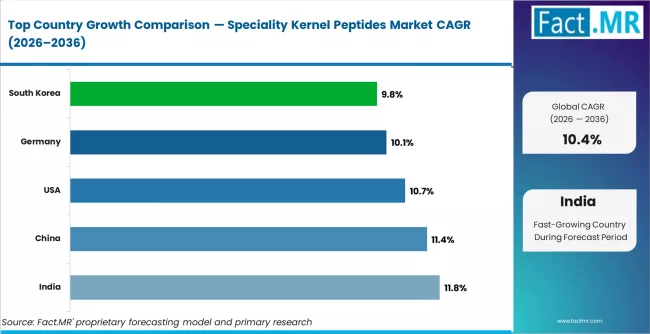
Speciality Kernel Peptides Market Cagr Analysis By Country | Source: Fact.MR
Asia Pacific Speciality Kernel Peptides Market Analysis
Asia Pacific is the highest-growth and largest volume region. Growth is driven by India’s FSSAI-regulated nutraceutical expansion and China’s processing infrastructure. The region shows a split between compliance-led demand in India and export-driven supply in China. GELITA AG and domestic producers serve different demand segments.
- India: India leads with a projected CAGR of 11.8% through 2036. FSSAI’s 2024 novel ingredient review created structured pathways under the Food Safety and Standards Act, 2006. This expanded the compliant kernel peptide market. India’s nutraceutical market reached about USD 5.6 billion in 2023 and continues to grow. Demand is rising for almond and plant-derived peptides through organised retail. ICMR dietary guidelines 2024 support plant protein and peptide inclusion. Companies including Glanbia India expanded certified peptide procurement in 2024. This follows stricter FSSAI licensing under Category 13.6.
- China: China is expected to grow at 11.4% CAGR through 2036. Growth is driven by large-scale kernel processing infrastructure. Almond, walnut, and apricot kernel processing supports supply. China acts as a low-cost hydrolysate base for global buyers. National nutrition policies support functional food innovation. Domestic brands expanded peptide use in 2024. Export-grade production is rising with HPLC standardisation and safety documentation.
FACT.MR covers China, India, Japan, South Korea, ASEAN, and ANZ. Includes FSSAI approvals, processing capacity, and forecasts.
North America Speciality Kernel Peptides Market Analysis
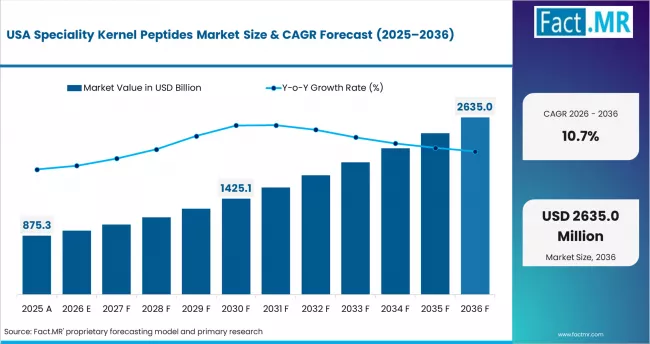
Speciality Kernel Peptides Market Country Value Analysis | Source: Fact.MR
North America is a premium and clean-label focused market. Demand is driven by U.S. supplement retail and clinical-grade standards. GELITA AG and Vital Proteins hold strong positions. Supply is supported by retail and direct-to-consumer channels.
- United States: The U.S. is projected to grow at 10.7% CAGR through 2036. FDA and FTC regulations in 2024 increased demand for clinically validated ingredients. Supplement sales reached USD 72.88 billion in 2024. Clean-label and plant-based categories are growing fast. Vital Proteins launched Collagen Sparkling Water in 2025. This reflects functional food and beverage convergence. It supports demand for peptide-based ingredients.
FACT.MR covers the U.S., Canada, and Mexico. Includes FDA regulation data and demand trends.
Europe Speciality Kernel Peptides Market Analysis
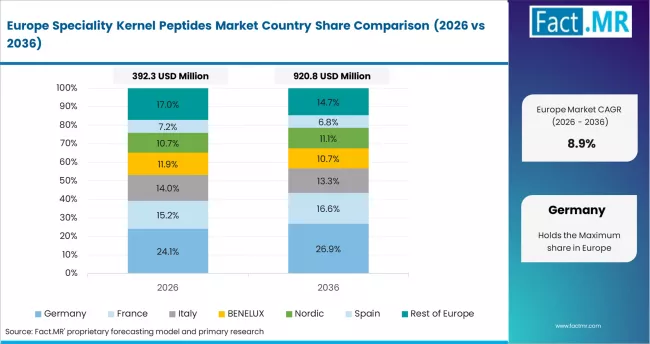
Speciality Kernel Peptides Market Europe Country Market Share Analysis, 2026 & 2036 | Source: Fact.MR
Europe is a regulation-driven and sustainability-focused market. EU directives and green chemistry rules define standards. GELITA AG and Bachem Holding AG lead supply. Demand is linked to compliance and premium positioning.
- Germany: Germany is forecast to grow at 10.1% CAGR through 2036. EU Directive 2002/46/EC requires EFSA safety assessment. This drives demand for compliant peptide ingredients. GELITA AG showcased products at Vitafoods Europe 2024 and CPHI 2025. This sets quality benchmarks. Green chemistry rules support clean-label demand.
- South Korea: South Korea is expected to grow at 9.8% CAGR through 2036. Growth is driven by K-Beauty cosmeceutical innovation. Brands are increasing plant peptide use in skincare. Applications include anti-aging and barrier repair. The Ministry of Food and Drug Safety updated standards in 2024. This supports approval of new peptide actives. The K-Beauty export market exceeds USD 10 billion. It drives demand for high-quality ingredients.
FACT.MR covers Germany, France, the UK, Italy, Spain, and Rest of Europe. Includes EU compliance data and sourcing trends.
Competitive Aligners for Market Players
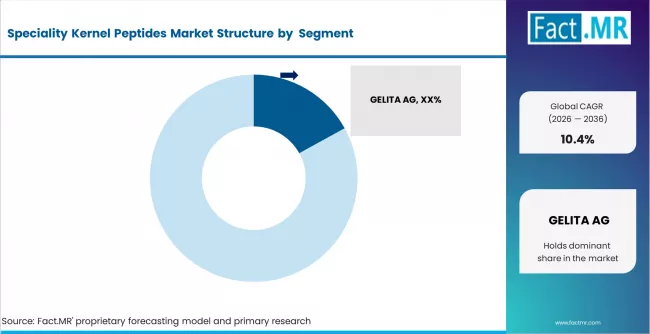
Speciality Kernel Peptides Market Analysis By Company | Source: Fact.MR
The speciality kernel peptides market shows a structured split between clinically validated premium suppliers and bulk hydrolysate producers. Competition is centred on purity validation, bioactivity documentation, and regulatory compliance. Suppliers with standardised peptide profiles and clinical backing are gaining share. Commodity producers remain active but face pricing pressure and limited differentiation.
GELITA AG and Bachem Holding AG define validation benchmarks through clinical-grade peptide production and documented efficacy standards. Their capabilities in process control, traceability, and regulatory alignment influence procurement expectations across nutraceutical and cosmeceutical segments. Kernel peptide producers are increasingly aligning with these standards to qualify for premium contracts.
Chinese manufacturers operate as large-scale supply bases for kernel hydrolysates, supported by integrated processing infrastructure and export-oriented production. Indian suppliers are transitioning toward compliance-led models under FSSAI frameworks, focusing on certified botanical peptide ingredients for organised nutraceutical retail. Cost competitiveness remains a factor, but quality certification is becoming critical for market access.
Procurement behaviour is shifting toward supplier consolidation. Nutraceutical and cosmeceutical brands prefer partners with validated bioactivity, safety dossiers, and consistent batch quality. Multi-year supply agreements and formulation-specific qualification processes are becoming standard. Buyers are reducing reliance on undifferentiated suppliers and prioritising partners with application-specific expertise. Competitive advantage is moving toward technical validation, regulatory readiness, and application-driven product development. Companies investing in clinical substantiation, HPLC standardization, and documented efficacy are better positioned to capture premium demand and sustain long-term contracts.
Key Players
- GELITA AG
- Nitta Gelatin Inc.
- PeptiDream Inc.
- Creative Peptides
- Bachem Holding AG
- Conscious Chemist
- Vital Proteins LLC
- Rousselot (Darling Ingredients)
- Glanbia Nutritionals
- Amicogen Inc.
- Gelnex
Bibliography
- [1] GELITA AG. (2024). Vitafoods Europe 2024 Product Showcase: PeptENDURE Bioactive Collagen Peptide for Endurance Performance and VERISOL Skin-Active Bioactive Collagen Peptides Nutraceutical and Cosmeceutical Portfolio Presentation. May 2024. gelita.com/en/knowledge
- [2] Bachem Holding AG. (2024). Annual Report 2024: Building K Large-Scale Peptide Manufacturing Facility Opened at Bubendorf, Switzerland — Capacity Expansion Applying Green Chemistry and Automation Technologies. March 2025. bachem.com/annual-report-2024
- [3] Springer Nature / Discover Food. (2025). Nutraceuticals Traditional Practices, Regulatory Guidelines, Opportunities and Challenges: Global Nutraceutical Market Valuation USD 591.1 Billion in 2024 and CAGR Data Including Plant-Derived Peptide Ingredient Demand. June 2025. link.springer.com/article/10.1007/s44187-025-00437-z
- [4] GELITA AG. (2025). GELITA Champions BE ACTIVE! at SupplySide Global 2025: Bioactive Collagen Peptides and Novel Delivery Format Innovations for Nutraceutical and Functional Food Applications Including Vital Proteins Collagen Sparkling Water Collaboration. October 2025. prnewswire.com/news-releases/gelita-champions-be-active
- [5] Market Research Future. (2025). Peptides Market 2035: Bachem AG New State-of-the-Art Manufacturing Facility in United States September 2025 for SPPS and LPPS Peptide Production Capacity Expansion Targeting North American Nutraceutical and Pharmaceutical Customers. marketresearchfuture.com/reports/peptides-market-56161
- [6] Vitafoods Insights / Nutrition Insight. (2025). GELITA CPHI 2025: Bridging the Gap Between Supplements and Pharma — Collagen Peptide Clinical Validation Standards and K-Beauty Cosmeceutical Skin Active Peptide Demand Trends. October 2025. nutritioninsight.com/news/gelita-cphi-2025-live-collagen-gelatin
- [7] Food Safety and Standards Authority of India (FSSAI). (2024). Novel Ingredient Approval Panel Review 2024: Botanical Plant Peptide Evaluation Pathways Under Food Safety and Standards Act 2006 for Nutraceutical and Health Supplement Category 13.6 Products. 2024. fssai.gov.in
- [8] European Parliament and Council of the European Union. (2002). Directive 2002/46/EC on Food Supplements: EFSA Novel Botanical Ingredient Safety Assessment Requirements and EU Food Supplement Compliance Framework Governing Plant Kernel Peptide Active Ingredient Supply to European Markets. June 2002. eur-lex.europa.eu/legal-content/EN/TXT/?uri=CELEX:32002L0046
This Report Addresses
- Strategic insights on speciality kernel peptide demand across nutraceuticals, cosmeceuticals, functional food, and bioactive ingredient applications.
- Market forecast from USD 1.6 billion in 2026 to USD 4.3 billion by 2036, at 10.4% CAGR.
- Opportunity mapping across India FSSAI expansion, China processing scale-up, U.S. clean-label demand, Germany green chemistry, and South Korea K-Beauty growth.
- Segment analysis by source type and application. Covers nut, seed, fruit, cereal kernels and key end uses.
- Regional outlook covering Asia Pacific demand growth, North America clean-label trends, and Europe regulation-driven adoption.
- Competitive landscape of GELITA AG, Bachem Holding AG, Vital Proteins, Nitta Gelatin, PeptiDream, Rousselot, and Glanbia Nutritionals.
- Regulatory analysis covering FSSAI 2024 framework, EU Directive 2002/46/EC, ICMR 2024, South Korea MFDS standards, and FDA requirements.
- Report delivery in PDF, Excel, and presentation formats supported by validated data and industry inputs.
Speciality Kernel Peptides Market Definition
The speciality kernel peptides market includes bioactive peptide ingredients derived through enzymatic or hydrolysis processing of nut, seed, fruit, and cereal kernels. Key sources include almonds, walnuts, apricot kernels, and grain-derived fractions.
Speciality Kernel Peptides Market Inclusions
Covers global and regional forecasts from 2026 to 2036 by source type and application. Includes nut, seed, fruit, and cereal kernel peptides. Covers nutraceutical, cosmeceutical, functional food, and research use. Includes standardised and non-standardised peptide formats.
Speciality Kernel Peptides Market Exclusions
Excludes whole kernels and unprocessed seed flour. Omits finished supplement and cosmetic products. Excludes animal and marine peptides. Focus remains on plant kernel-derived peptide supply.
Speciality Kernel Peptides Market Research Methodology
- Primary Research
- Interviews with peptide producers, formulators, ingredient buyers, and procurement specialists across key markets.
- Desk Research
- Uses data from GELITA AG and Bachem Holding AG reports, FSSAI approvals, EU directives, ICMR 2024 guidelines, and 2024–2025 trade data.
- Market-Sizing and Forecasting
- Applies a hybrid model using producer revenues and application-level volume estimates by source and end use.
- Data Validation and Update Cycle
- Validated using producer data, export statistics, and nutraceutical demand benchmarks. Supported by expert interviews.
Segmentation
Scope of Report
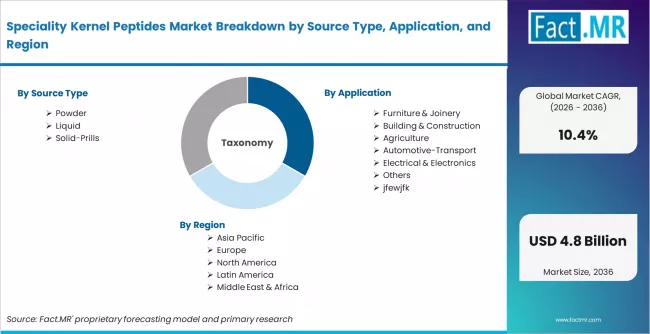
Speciality Kernel Peptides Market Breakdown By Source Type, Application, And Region | Source: Fact.MR
| Attribute | Details |
|---|---|
| Quantitative Units | USD 1.6 billion (2026) to USD 4.3 billion (2036), at a CAGR of 10.4% |
| Market Definition | Bioactive peptide fractions derived from enzymatic or hydrolysis processing of nut and seed, fruit, and cereal kernels, supplied in standardised and non-standardised formats for nutraceutical, cosmeceutical, functional food, and pharmaceutical research applications globally. |
| Source Type Segmentation | Nut and Seed Kernels (Almond, Walnut, Apricot), Fruit Kernels and By-products, Cereal/Grain Kernels |
| Application Segmentation | Nutraceuticals and Dietary Supplements, Cosmeceuticals (Anti-aging/Skin Repair), Functional Food and Beverages, Pharmaceutical Research |
| Application Coverage | FSSAI-compliant plant peptide nutraceutical supplement formulation, EU food supplement directive-aligned botanical active ingredient supply, K-Beauty cosmeceutical anti-aging and barrier-repair ingredient procurement, functional food and beverage bioactive peptide inclusion, and pharmaceutical research bioactive botanical peptide supply. |
| Regions Covered | North America, Europe, Asia Pacific, Latin America, Middle East and Africa |
| Countries Covered | USA, Canada, Mexico, Germany, UK, France, Italy, Spain, Nordic, BENELUX, China, Japan, South Korea, India, ASEAN, Australia and New Zealand, Brazil, Argentina, Chile, Saudi Arabia, GCC, Turkey, South Africa, Rest of MEA |
| Key Companies Profiled | GELITA AG, Nitta Gelatin Inc., PeptiDream Inc., Creative Peptides, Bachem Holding AG, Conscious Chemist, Vital Proteins LLC, Rousselot, Glanbia Nutritionals, Amicogen Inc., Gelnex |
| Forecast Period | 2026 to 2036 |
| Approach | Hybrid top-down and bottom-up model using kernel peptide producer revenues, ingredient production volumes by source type, average selling prices by purity and bioactivity grade, nutraceutical supplement procurement benchmarks, and primary interviews with nutraceutical formulators and cosmeceutical ingredient buyers. |
Source: Fact.MR analysis. Updated Apr 17, 2026
Speciality Kernel Peptides Market by Segments
-
By Source Type:
- Nut and Seed Kernels (Almond, Walnut, Apricot)
- Fruit Kernels and By-products
- Cereal/Grain Kernels
-
By Application:
- Nutraceuticals and Dietary Supplements
- Cosmeceuticals (Anti-aging/Skin Repair)
- Functional Food and Beverages
- Pharmaceutical Research
-
By Region:
- North America
- United States
- Canada
- Mexico
- Latin America
- Brazil
- Mexico
- Argentina
- Chile
- Rest of Latin America
- Western Europe
- Germany
- United Kingdom
- France
- Italy
- Spain
- Nordic Countries
- BENELUX
- Rest of Western Europe
- Eastern Europe
- Russia
- Poland
- Hungary
- Balkan and Baltic
- Rest of Eastern Europe
- East Asia
- China
- Japan
- South Korea
- South Asia and Pacific
- India
- ASEAN
- Australia and New Zealand
- Rest of South Asia and Pacific
- Middle East and Africa
- Kingdom of Saudi Arabia
- Other GCC Countries
- Turkey
- South Africa
- Rest of Middle East and Africa
- North America
Frequently Asked Questions
How large is the global speciality kernel peptides market in 2025?
What will the market size be in 2026?
What is the projected market size by 2036?
What is the expected CAGR from 2026 to 2036?
Which source type segment is poised to lead the market?
Which application segment holds the largest share?
Which country shows the fastest growth in the market?
What are speciality kernel peptides used for?
What drives demand in this market?
Who are the key players in the market?
Who worked on this report


Preview the report firsthand - request a free sample
Free SampleGet the brochure for pricing and purchase details
Download PDF