- Base Value(2025): 0.4 Bn
- Estimated Value(2026): 0.5 Bn
- Forecast Value (2036): 1.1 Bn
- CAGR (2026 - 2036): 9.8%
Koji Peptides Ingredients Market Forecast and Outlook By Fact.MR
In 2025, the koji peptides ingredients market was valued at USD 0.4 billion. Based on Fact.MR analysis, demand for koji peptides ingredients is estimated to grow to USD 0.5 billion in 2026 and USD 1.1 billion by 2036. FACT.MR projects a CAGR of 9.8% during the forecast period.
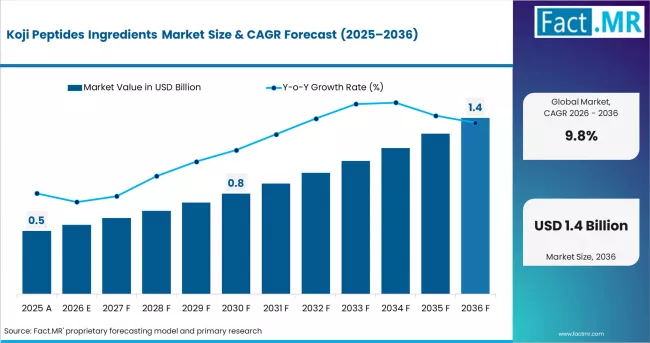
Koji Peptides Ingredients Market Market Value Analysis | Source: Fact.MR
| Metric | Value |
|---|---|
| Estimated Value in 2026 | USD 0.5 billion |
| Forecast Value in 2036 | USD 1.1 billion |
| Forecast CAGR (2026 to 2036) | 9.8% |
Source: Fact.MR analysis. Updated Apr 21, 2026
Summary of Koji Peptides Ingredients Market
- Market Definition
- Market covers koji-derived, non-koji, and enzymatic peptide ingredients for cosmetics, nutraceuticals, and pharma.
- Demand Drivers
- K-beauty innovation is increasing demand for certified peptide actives.
- Japan’s fermentation expertise supports premium peptide supply.
- EU kojic acid limits are shifting demand toward peptide alternatives.
- Key Segments Analyzed
- By Application: Cosmetics leads with 38% share in 2026.
- By Source: Koji-based peptides lead with 55% share in 2026.
- By Geography: South Korea leads with 10.8% CAGR.
- Analyst Opinion at FACT.MR
- Shambhu Nath Jha, Principal Consultant at Fact.MR, states that market leadership depends on fermentation traceability, certified bioactivity documentation, and alignment with K-beauty and premium cosmeceutical supply chains. Koji-heritage sourcing and application-specific grade validation support premium positioning.
- Strategic Implications
- Improve fermentation yield and certification for premium markets.
- Develop nutraceutical-grade peptides for Asia markets.
- Build direct OEM and formulator supply relationships.
- Methodology
- Based on shipment volumes and pricing benchmarks.
- Supported by METI, Bio Committee, BioE3, and company data.
- Forecasts include fermentation capacity and application demand trends.
The market is expected to create an absolute dollar opportunity of USD 0.6 billion between 2026 and 2036. Growth is supported by K-beauty cosmeceutical ingredient localisation and rising nutraceutical peptide demand in Japan and China. Expansion is constrained by limited fermentation capacity outside Japan and high purification costs. Regulatory scrutiny in EU cosmetics and supplements also limits scale-up.
Demand is shifting toward high-purity, application-specific peptide actives. Cosmetics and personal care remain the primary use case. Nutraceutical supplements are a growing segment. Synthetic peptides face qualification pressure in premium skincare. Koji-derived peptides command higher pricing due to traceability and bioactivity validation. Procurement requires certified performance and documented origin.
Country trends reflect regulation, biotechnology capability, and end-use demand. South Korea leads at 10.8% CAGR, supported by K-beauty innovation. Japan follows at 10.5%, driven by fermentation expertise and premium supply chains. China records 10.2%, backed by large-scale cosmetic and nutraceutical production. India posts 9.8%, supported by a growing enzyme and cosmeceutical base under BioE3. The United States records 9.4%, driven by clean-label demand but limited by fermentation infrastructure and regulatory timelines.
Segmental Analysis
Koji Peptides Ingredients Market Analysis by Application
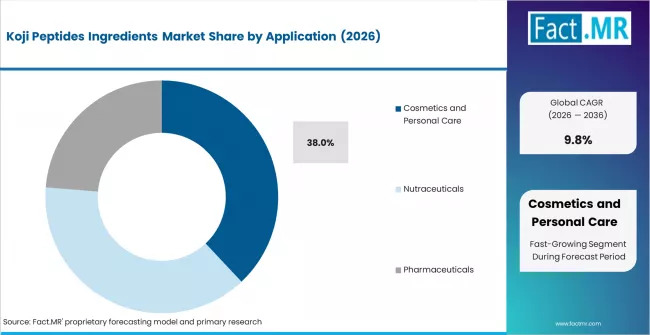
Koji Peptides Ingredients Market Analysis By Application | Source: Fact.MR
Based on FACT.MR analysis, cosmetics and personal care hold around 38% share in 2026. This segment leads due to strong use in K-beauty skincare, brightening serums, and anti-aging products. Koji peptides offer clean-label and fermentation-based positioning. Synthetic alternatives cannot match this heritage. This supports demand in South Korea and Japan.
- BASF Pepsensyal Launch: BASF launched Pepsensyal in October 2024. It is a synthetic tetrapeptide targeting early aging signs. This sets a benchmark for peptide performance. Koji peptides must match these standards in global supply chains. [1]
- Amano Enzyme Facility Expansion: Amano Enzyme expanded its U.S. facility in 2024–2025. This increases fermentation capacity. It supports peptide supply for cosmetic and nutraceutical markets. [2]
- Peptide Consumer Trend: Peptide demand surged in 2024. K-beauty brands increased multi-peptide serum launches. EU and UK kojic acid limits from April 2025 create new opportunities. Koji peptides act as alternatives in skin brightening. [3]
Koji Peptides Ingredients Market Analysis by Source
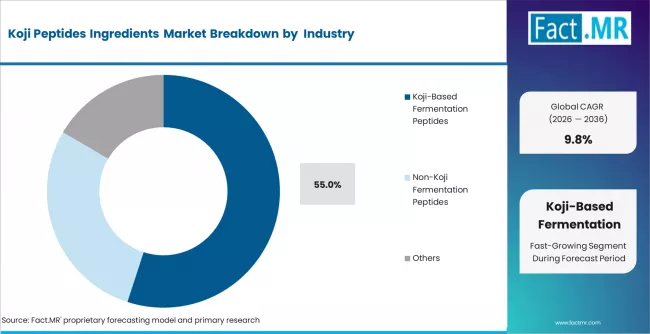
Koji Peptides Ingredients Market Analysis By Source | Source: Fact.MR
Koji-based peptides hold about 55% share in 2026. They lead due to fermentation heritage using Aspergillus oryzae. These peptides offer multi-functional benefits in one process. They support skin brightening, antioxidant, and barrier functions. Clean-label origin supports both cosmetic and nutraceutical demand.
- Novonesis Formation: Novozymes and Chr. Hansen merged in 2024 to form Novonesis. This expands fermentation ingredient supply. It strengthens peptide production capability. [4]
- DSM-Firmenich Enzyme Development: DSM-Firmenich launched Maxiren EVO in 2025. It reflects precision fermentation capability. This supports scalable peptide ingredient production. [5]
- Fermented Ingredient Trend: Fermented ingredients gained strong traction in 2024. They improve bioavailability and formulation performance. This trend supports adoption of koji peptides in premium skincare. [3]
Drivers, Restraints, and Opportunities
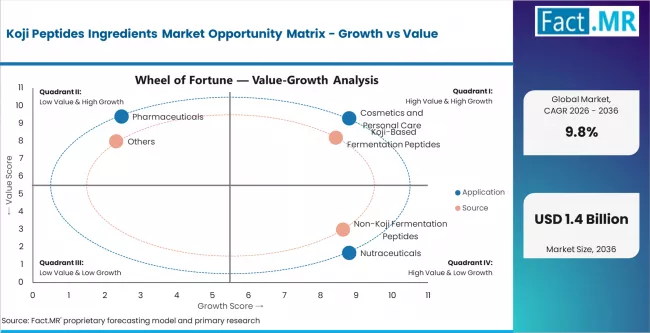
Koji Peptides Ingredients Market Opportunity Matrix Growth Vs Value | Source: Fact.MR
FACT.MR analysts observe a shift toward structured procurement. The market is limited by few qualified producers and high purification costs. Demand is supported by K-beauty in South Korea and premium cosmetics in Japan. Nutraceutical demand in China and India is also rising.
Synthetic peptides face qualification pressure in premium segments. Koji peptides cost 30–60% more than synthetic options. However, certified and traceable products command higher pricing.
- EU Kojic Acid Restriction Impact: EU and UK limits on kojic acid (1% cap from April 2025) are shifting formulations. This opens opportunities for peptide alternatives. [3]
- South Korea National Bio Committee: The committee formed in 2025 supports biotech innovation. It promotes fermentation ingredient use in K-beauty. This increases demand for certified peptide sourcing. [6]
- India BioE3 Policy Enzyme Manufacturing: India’s BioE3 policy (2024) supports enzyme production. It strengthens domestic fermentation capacity. This supports future peptide ingredient supply. [7]
Regional Analysis
The koji peptides ingredients market is assessed across Asia Pacific, North America, Europe, Latin America, and Middle East and Africa. Segmentation reflects koji fermentation capacity investment scale, cosmetic regulatory depth, and cosmeceutical and nutraceutical procurement maturity across 40+ countries. The full report provides market attractiveness analysis by region and country.
.webp "Top Country Growth Comparison Koji Peptides Ingredients Market Cagr (2026 2036)")
Top Country Growth Comparison Koji Peptides Ingredients Market Cagr (2026 2036) | Source: Fact.MR
| Country | CAGR (2026 to 2036) |
|---|---|
| South Korea | 10.8% |
| Japan | 10.5% |
| China | 10.2% |
| India | 9.8% |
| United States | 9.4% |
Source: Fact.MR analysis. Updated Apr 21, 2026
Source: Fact.MR (FACT.MR) analysis, based on proprietary forecasting model and primary research
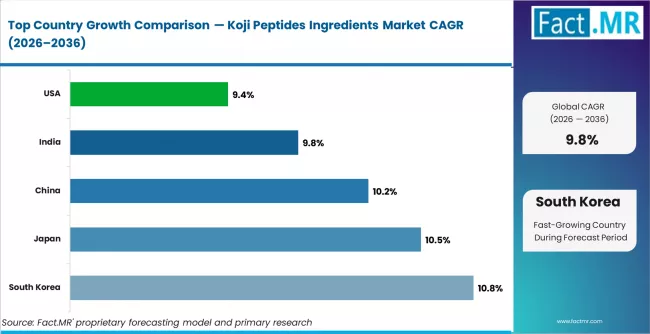
Koji Peptides Ingredients Market Cagr Analysis By Country | Source: Fact.MR
Asia Pacific Koji Peptides Ingredients Market Analysis
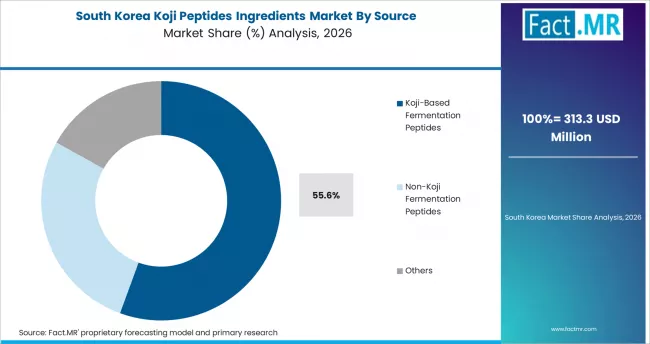
Koji Peptides Ingredients Market South Korea Market Share Analysis By Source | Source: Fact.MR
Asia Pacific is the global production hub and fastest-growing region for koji peptides ingredients. Japan leads with traditional Aspergillus oryzae fermentation expertise. South Korea drives premium cosmeceutical ingredient demand. China supports large-scale manufacturing. Amano Enzyme, Novonesis regional operations, and domestic producers shape competitive supply.
- South Korea: South Korea reflects technology-driven expansion at 10.8% CAGR through 2036. Growth is supported by K-beauty cosmeceutical investment and the National Bio Committee’s 2025 biotechnology coordination. Brands such as CosRX are driving multi-peptide serum demand. Global search peaks in 2024 increased procurement pressure for certified peptide actives. The country focuses on science-backed, biotech skincare, creating premium qualification standards for suppliers.
- Japan: Japan reflects heritage-driven premium positioning at 10.5% CAGR through 2036. Amano Enzyme remains a key supplier with deep fermentation expertise. Japan METI policies support domestic biotechnology capacity. Facility expansion in 2024–2025 reflects rising export demand. The regulatory model prioritises validated bioactivity and traditional evidence over rapid formulation cycles.
- China: China supports large-scale manufacturing-led growth at 10.2% CAGR through 2036. The cosmetic peptide segment has expanded rapidly under national regulation. Peptide approvals under the Cosmetic Supervision framework are increasing. This supports structured import and domestic fermentation scale-up. Demand is driven by both domestic consumption and export-oriented production.
- India: India shows manufacturing-driven expansion at 9.8% CAGR through 2036. The BioE3 policy (2024) supports fermentation R&D and capacity. Advanced Enzyme Technologies Ltd. is expanding its ingredient portfolio. Growing cosmeceutical demand and awareness of fermentation benefits support adoption. India presents a distinct pathway compared to China’s scale and Japan’s heritage model.
FACT.MR analysis covers China, Japan, South Korea, India, ASEAN, and Australia and New Zealand. It includes fermentation capacity data, cosmetic regulation trends, and country-level forecasts.
North America Koji Peptides Ingredients Market Analysis
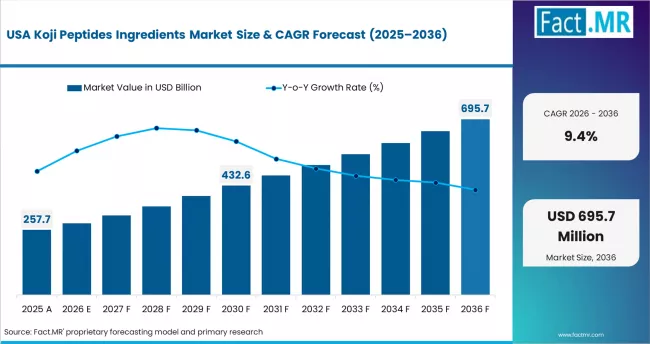
Koji Peptides Ingredients Market Country Value Analysis | Source: Fact.MR
North America reflects a clean-label and biotech-driven environment. The United States leads through supplement and cosmeceutical adoption with regulated sourcing frameworks. Amano Enzyme USA and other producers support regional supply. Canada contributes through clean technology initiatives.
- United States: The United States indicates biotech-led progression at 9.4% CAGR through 2036. Growth is supported by clean-label ingredient demand in supplements and skincare. FDA GRAS pathways are expanding for fermentation-derived ingredients. Amano Enzyme USA completed capacity expansion in 2025 to support regional demand.
FACT.MR analysis covers the United States, Canada, and Mexico. It includes FDA GRAS data, clean-label procurement trends, and forecasts.
Competitive Aligners for Market Players
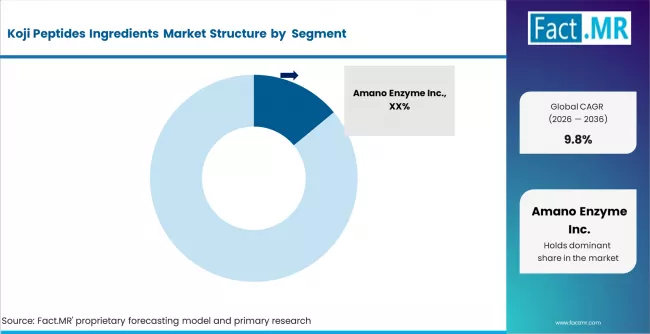
Koji Peptides Ingredients Market Analysis By Company | Source: Fact.MR
The koji peptides ingredients market shows a concentrated yet evolving competitive environment, where a limited number of fermentation-focused specialists operate alongside broader peptide and enzyme producers. Companies such as Amano Enzyme, DSM-Firmenich, Novonesis, and BASF play a central role in shaping supply, particularly in high-purity and application-specific peptide segments.
Market positioning is strongly influenced by depth of fermentation expertise, documentation capability, and alignment with cosmetic and nutraceutical regulatory standards. Suppliers with established koji fermentation heritage and the ability to demonstrate traceable production processes hold a distinct advantage, especially in premium skincare and supplement applications. These companies are able to meet increasingly stringent requirements around bioactivity validation, ingredient safety, and formulation consistency.
At the same time, competition is intensifying from synthetic peptide manufacturers and general fermentation players offering lower-cost alternatives. While these products provide scalability and pricing advantages, they often lack the natural positioning and heritage-driven appeal associated with koji-derived ingredients. This creates a clear divide between premium, certification-led offerings and cost-competitive substitutes. Strategic focus across leading participants includes expanding fermentation capacity, improving yield efficiency, and developing targeted peptide fractions for specific applications such as skin brightening and anti-aging. Partnerships with cosmetic formulators and nutraceutical brands are also becoming critical, as early-stage ingredient qualification often determines long-term supply relationships.
Key Players
- Amano Enzyme Inc.
- Novonesis Group (formerly Novozymes / Chr. Hansen)
- DSM-Firmenich AG
- Nagase and Co., Ltd.
- Advanced Enzyme Technologies Ltd.
- Creative Enzymes
- BASF SE Personal Care
- Creative Peptides
- Spec Chem Industry Inc.
- Seiwa Kasei Co., Ltd.
Bibliography
- [1] BASF. 2024. BASF launches Pepsensyal for advanced skin care applications. BASF Personal Care Press Release, October 2024.
- [2] Amano Enzyme. 2024–2025. Facility expansion at Elgin, Illinois manufacturing site. Company announcement and capacity expansion update.
- [3] European Commission. 2024–2025. Cosmetic ingredient regulatory updates and kojic acid restriction guidelines. Supplemented with consumer trend data from Google Trends and K-beauty product launches.
- [4] Novonesis. 2024. Merger of Novozymes and Chr. Hansen forming Novonesis. Corporate announcement, January 2024.
- [5] DSM-Firmenich. 2025. Launch of Maxiren EVO enzyme technology. Product release documentation, January 2025.
- [6] South Korea National Bio Committee. 2025. Biotechnology and fermentation strategy framework. Government policy publication.
- [7] India BioE3 Policy. 2024. Biotechnology for Economy, Environment, and Employment (BioE3) initiative. Government of India policy document.
This Report Addresses
- Strategic insights on demand across cosmeceutical skin brightening actives, K-beauty functional peptide ingredients, nutraceutical bioactive procurement, and pharmaceutical bioactive peptide applications.
- Market forecast from USD 0.5 billion in 2026 to USD 1.1 billion by 2036, at 9.8% CAGR.
- Opportunity mapping across South Korea K-beauty ingredient scale-up, Japan fermentation heritage supply, China cosmetic regulation-aligned peptide adoption, India BioE3 manufacturing, and U.S. clean-label ingredient channels.
- Segment analysis by application, source, and functionality. Covers koji fermentation, non-koji, and synthetic peptides across cosmetics, nutraceuticals, and pharmaceuticals.
- Regional outlook covering Asia Pacific fermentation production, North America biotech ingredient adoption, and Europe regulatory compliance-guided certified peptide procurement.
- Competitive analysis of Amano Enzyme, Novonesis Group, DSM-Firmenich, Nagase, Advanced Enzyme Technologies, and Creative Enzymes.
- Technology tracking on koji fermentation yield improvement, certified bioactivity documentation, precision fermentation for skin brightening actives, and EU and Japan regulatory compliance.
- Report delivery in PDF, Excel, and presentation formats with validated data sources and industry inputs.
Koji Peptides Ingredients Market Definition
The koji peptides ingredients market covers bioactive peptides produced via Aspergillus oryzae fermentation. Includes skin brightening, anti-aging, antioxidant, and multifunctional peptide actives.
Koji Peptides Ingredients Market Inclusions
Covers global and regional sizing from 2026 to 2036. Includes koji-based, non-koji, and synthetic peptides. Segmented by application, source, and functionality with pricing trends.
Koji Peptides Ingredients Market Exclusions
Excludes finished cosmetics and nutraceutical products. Omits non-peptide outputs like kojic acid unless co-derived. Excludes non-koji peptides. Focus remains on koji peptide supply.
Koji Peptides Ingredients Market Research Methodology
- Primary Research: Interviews with enzyme producers, cosmetic formulators, nutraceutical buyers, and K-beauty specialists.
- Desk Research: Uses Japan METI data, South Korea Bio Committee inputs, India BioE3 policy, BASF launches, and Amano Enzyme disclosures.
- Market Sizing and Forecasting: Hybrid model using shipment volumes, pricing, and application demand benchmarks.
- Data Validation and Update Cycle: Validated through producer revenues, trade data, and industry inputs. Updated regularly.
Segmentation
Scope of Report
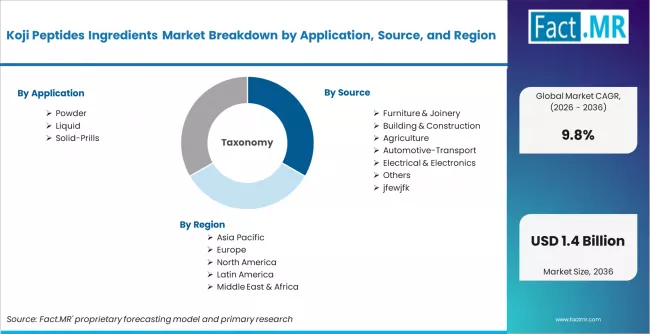
Koji Peptides Ingredients Market Breakdown By Application, Source, And Region | Source: Fact.MR
| Attribute | Details |
|---|---|
| Quantitative Units | USD 0.5 billion (2026) to USD 1.1 billion (2036), at a CAGR of 9.8% |
| Market Definition | Koji fermentation-derived bioactive peptide ingredients, non-koji fermentation actives, and enzymatic peptide fractions supplied as cosmeceutical skin brightening actives, anti-aging signal peptides, antioxidant fractions, and nutraceutical bioactive ingredients globally. |
| Application Segmentation | Cosmetics and Personal Care, Nutraceuticals, Pharmaceuticals |
| Source Segmentation | Koji-Based Fermentation Peptides, Non-Koji Fermentation Peptides, Synthetic and Enzymatically Derived Peptides |
| Functionality Segmentation | Skin Brightening and Enzymatic Actives, Anti-aging, Anti-oxidant, Anti-inflammatory, Multifunctional Bioactive Peptides |
| Application Coverage | K-beauty cosmeceutical skin brightening serum ingredient supply, Japanese premium cosmetics fermentation-heritage active sourcing, nutraceutical dietary supplement bioactive procurement, pharmaceutical research bioactive peptide supply, and clean-label functional food active ingredient procurement. |
| Regions Covered | North America, Europe, Asia Pacific, Latin America, Middle East and Africa |
| Countries Covered | USA, Canada, Mexico, Germany, UK, France, Italy, Spain, Nordic, BENELUX, Eastern Europe, China, Japan, South Korea, India, ASEAN, Australia and New Zealand, Brazil, Argentina, Chile, Saudi Arabia, GCC, Turkey, South Africa, Rest of MEA |
| Key Companies Profiled | Amano Enzyme Inc., Novonesis Group, DSM-Firmenich AG, Nagase and Co. Ltd., Advanced Enzyme Technologies Ltd., Creative Enzymes, BASF SE Personal Care |
| Forecast Period | 2026 to 2036 |
| Approach | Hybrid top-down and bottom-up model using koji peptide ingredient shipment volumes, fermentation-grade supply data, average selling prices by application and geography, and primary interviews with cosmeceutical ingredient procurement managers and koji fermentation producers. |
Source: Fact.MR analysis. Updated Apr 21, 2026
Koji Peptides Ingredients Market by Segments
-
By Application:
- Cosmetics and Personal Care
- Nutraceuticals
- Pharmaceuticals
-
By Source:
- Koji-Based Fermentation Peptides
- Non-Koji Fermentation Peptides
- Synthetic and Enzymatically Derived Peptides
-
By Functionality:
- Skin Brightening and Enzymatic Actives
- Anti-aging
- Anti-oxidant
- Anti-inflammatory
- Multifunctional Bioactive Peptides
-
By Region:
- North America
- United States
- Canada
- Mexico
- Latin America
- Brazil
- Mexico
- Argentina
- Chile
- Rest of Latin America
- Western Europe
- Germany
- United Kingdom
- France
- Italy
- Spain
- Nordic Countries
- BENELUX
- Rest of Western Europe
- Eastern Europe
- Russia
- Poland
- Hungary
- Balkan and Baltic
- Rest of Eastern Europe
- East Asia
- China
- Japan
- South Korea
- South Asia and Pacific
- India
- ASEAN
- Australia and New Zealand
- Rest of South Asia and Pacific
- Middle East and Africa
- Kingdom of Saudi Arabia
- Other GCC Countries
- Turkey
- South Africa
- Rest of Middle East and Africa
- North America
Frequently Asked Questions
How large is the koji peptides ingredients market in 2025?
What will the market size be in 2026?
What is the projected market size by 2036?
What is the expected CAGR of the koji peptides ingredients market?
Which application segment leads the market?
Which source segment dominates the market?
Which country shows the fastest growth?
Which functionality segment is poised to lead?
Who worked on this report


Preview the report firsthand - request a free sample
Free SampleGet the brochure for pricing and purchase details
Download PDF