- Estimated Value(2026): 0.8 Bn
- Forecast Value (2036): 4.0 Bn
- CAGR (2026 - 2036): 17.5%
What is the sports card grading market forecast to be worth by 2036?
USD 0.8 billion in 2026 to USD 4.0 billion by 2036 at 17.5% CAGR.
- The Sports Card Grading Market was valued at approximately USD 0.7 billion in 2025 and is estimated to reach USD 0.8 billion in 2026.
- Rising demand for authenticated collectibles and increasing investor participation are expected to drive the market to USD 4.0 billion by 2036 at 17.5% CAGR during 2026 to 2036.
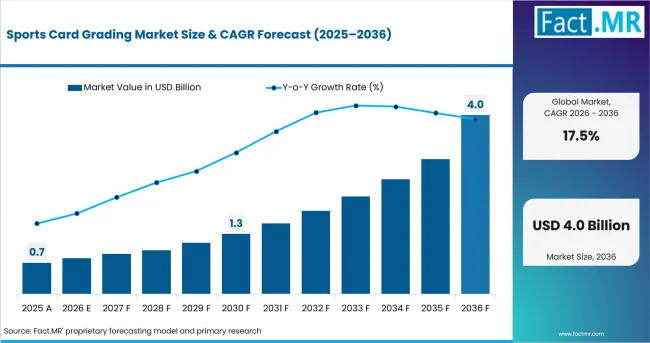
Sports Card Grading Market Value Analysis | Source: Fact.MR
What are the defining numbers behind sports card grading growth?
USD 3.2 billion absolute opportunity by 2036 led by the United States and Japan.
- Demand Drivers in the Market
- Collectors need standardized condition assessments for valuable cards.
- Investors increasingly view graded cards as alternative assets.
- Auction houses require trusted grading before premium sales.
- Online marketplaces benefit from certified authenticity and condition.
- Key Segments Analyzed
- By Grading Service Type: Standard Grading Services are expected to hold 43.0% share in 2026.
- By Card Type: Sports Trading Cards are projected to account for 62.0% share in 2026.
- By Customer Type: Individual Collectors are likely to hold 45.0% share in 2026.
- By Submission Type: Standard Submission Services are expected to account for 48.0% share in 2026.
- By End Use: Investment and Collection Preservation is projected to hold 41.0% share in 2026.
- By Geography: The United States is projected to record 18.4% CAGR through 2036.
- Analyst Opinion at Fact.MR
- Shambhu Nath Jha, Senior Analyst at Fact.MR, states, “Sports card grading is becoming an infrastructure layer for the collectibles investment ecosystem. As card values rise and investors enter the market, trusted grading standards become increasingly important. Providers that improve consistency, speed and technology integration will strengthen their market position.”
- Strategic Implications
- Grading companies should invest in AI-assisted assessment technologies.
- Auction platforms should integrate grading and verification services.
- Collectors should prioritize professionally graded assets for long-term value preservation.
- Marketplace operators should strengthen partnerships with grading providers.
Sports card grading services authenticate cards and assign standardized condition scores. These services improve transparency and increase confidence across auctions, private sales and online marketplaces. Growing participation from investors and rising demand for rare cards continue to support grading activity worldwide.
The United States is projected to remain a leading market due to its strong sports card ecosystem and concentration of grading providers. Japan is expected to benefit from strong demand for NPB cards and Pokémon crossover collecting. South Korea is emerging through expanding K-card culture and increasing collector participation. Saudi Arabia is witnessing growing interest from affluent collectors and alternative asset investors. The United Kingdom continues to gain momentum as football card collecting expands.
How does the sports card grading market break down by segment?
Standard Grading Services lead at 43.0%; Sports Trading Cards lead at 62.0%.
Which grading service type dominates?
Standard Grading Services hold 43.0% share in 2026.
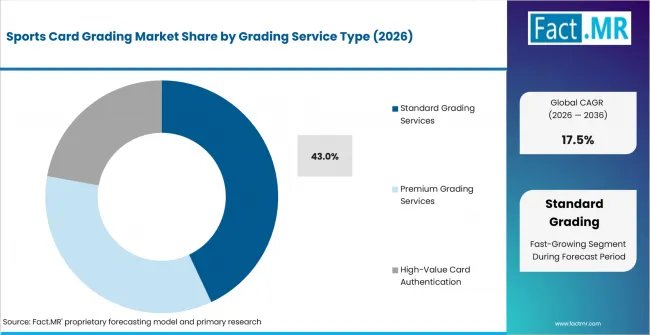
Sports Card Grading Market Analysis By Grading Service Type | Source: Fact.MR
Standard Grading Services are expected to hold 43.0% share in 2026 because they provide the most accessible entry point into professional card certification. Collectors use these services to verify authenticity, establish condition grades and improve market confidence before resale or long-term storage. The service remains popular among both casual collectors and experienced hobby participants due to its balance of affordability and credibility. eBay expanded its partnership with PSA by introducing a "Send to PSA Vault" option, allowing eligible trading cards purchased on eBay to be graded by PSA and transferred directly into PSA Vault storage. The enhanced integration creates an end-to-end workflow covering card purchase, authentication, grading, secure storage, and future consignment, further streamlining the sports card grading ecosystem. [1]
Which card type dominates?
Sports Trading Cards hold 62.0% share in 2026.
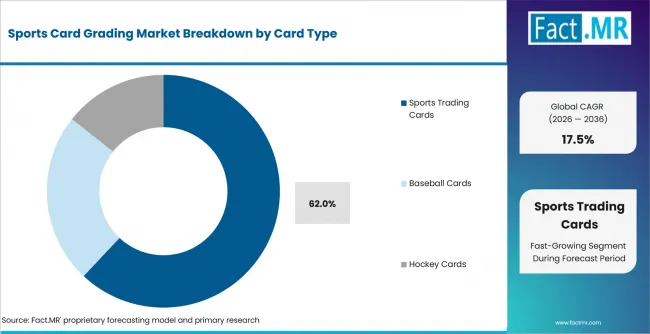
Sports Card Grading Market Analysis By Card Type | Source: Fact.MR
Sports Trading Cards are projected to account for 62.0% share in 2026 because they represent the largest and most liquid category within the grading industry. Cards linked to professional athletes continue to attract strong interest from collectors, investors and auction participants. Fanatics Collect and Sotheby's announced a partnership to auction premium trading cards and sports collectibles valued at more than $100,000. The collaboration brought professionally graded cards from services such as PSA into Sotheby's global auction ecosystem, increasing visibility and liquidity for high-value graded sports cards. [2]
Which customer type dominates?
Individual Collectors hold 45.0% share in 2026.
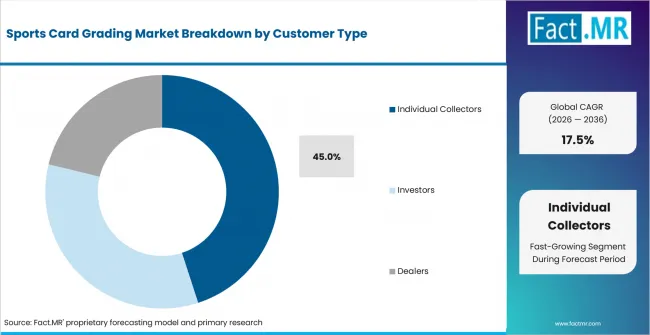
Sports Card Grading Market Analysis By Customer Type | Source: Fact.MR
Individual Collectors are expected to account for 45.0% share in 2026 because private ownership remains the foundation of the sports card market. Most grading submissions originate from collectors seeking to authenticate personal collections, preserve card condition and improve resale value. Professional grading provides reassurance regarding authenticity and creates a standardized framework for valuation. The segment benefits from increasing participation across both traditional and younger collector demographics. Fanatics launched Fanatics Collect, a new marketplace for trading cards and memorabilia with integrated grading and authentication partnerships including PSA, CGC, Beckett, SGC, and MBA. [3]
Which submission type dominates?
Standard Submission Services hold 48.0% share in 2026.
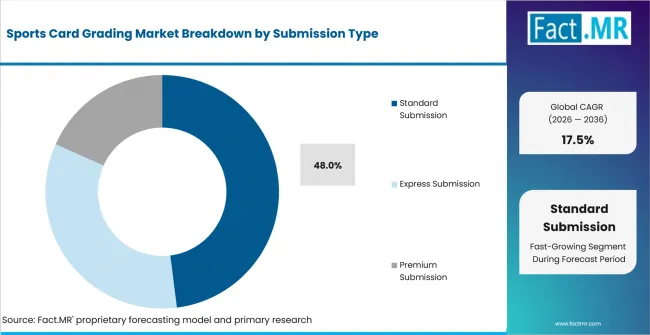
Sports Card Grading Market Analysis By Submission Type | Source: Fact.MR
Standard Submission Services are projected to hold 48.0% share in 2026 because most collectors prioritize affordability and value over accelerated turnaround times. The service category offers professional grading at lower costs than premium or express alternatives, making it suitable for routine submissions and larger grading batches. Collectors commonly use standard submissions for portfolio management, collection upgrades and resale preparation. The segment benefits from broad accessibility and predictable pricing structures.
Which end use dominates?
Investment and Collection Preservation holds 41.0% share in 2026.
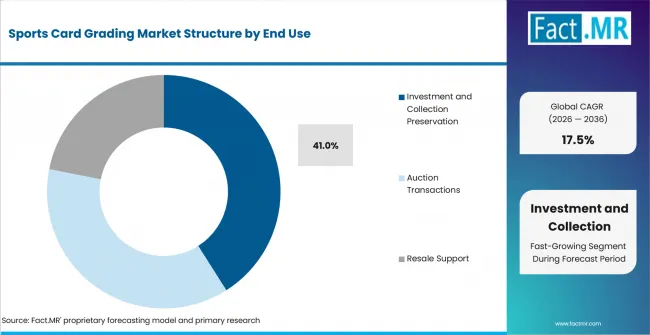
Sports Card Grading Market Analysis By End Use | Source: Fact.MR
Investment and Collection Preservation are expected to account for 41.0% share in 2026 as graded sports cards increasingly function as alternative assets. Collectors and investors use grading services to establish credibility, improve liquidity and support long-term value retention. Professionally graded cards often command higher prices because buyers can trust both authenticity and condition assessments. The segment benefits from growing interest in rare cards, athlete-linked collectibles and limited-edition releases.
What is accelerating sports card grading demand, and what is holding it back?
Rising card values and investment participation drive demand; grading backlogs restrain adoption.
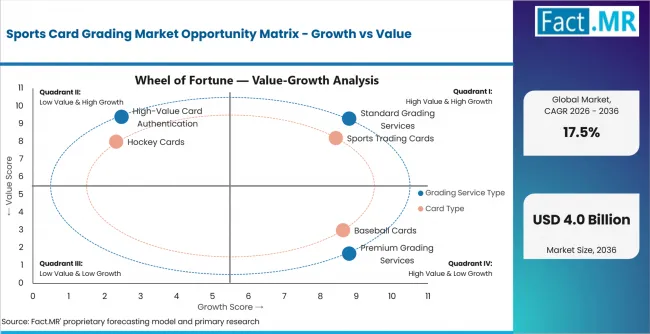
Sports Card Grading Market Opportunity Matrix Growth Vs Value | Source: Fact.MR
Increasing card values are the primary market driver. Collectors and investors require trusted grading services to establish authenticity and condition. Graded cards often command higher market values and stronger buyer confidence. Collectors Holdings announced strategic growth initiatives across grading and authentication services, showing how providers are adding capacity and service options as submissions rise. The initiative was designed to improve turnaround times and enhance accessibility to grading services for sports card collectors. [4]
The main restraint is grading turnaround time. Submission surges can create processing delays that affect collector experience. Providers must improve scalability and operational efficiency to meet growing demand.
Where do the biggest sports card grading opportunities sit?
AI grading, premium services and international expansion.
- AI-Assisted Grading: Automation can improve consistency and reduce processing times.
- Premium Authentication Services: High-value cards require enhanced verification and security.
- International Market Expansion: Growing collector communities in Asia and the Middle East create new opportunities.
Which countries are scaling sports card grading services fastest?
United States 18.4%, Saudi Arabia 18.0%, Japan 17.2%, South Korea 16.8%, United Kingdom 15.9%.
Based on regional analysis, the sports card grading market is segmented into North America, Western Europe, Asia Pacific, Latin America, and Middle East & Africa.
.webp "Top Country Growth Comparison Sports Card Grading Market Cagr (2026 2036)")
Top Country Growth Comparison Sports Card Grading Market Cagr (2026 2036) | Source: Fact.MR
| Country | CAGR |
|---|---|
| United States | 18.4% |
| Saudi Arabia | 18.0% |
| Japan | 17.2% |
| South Korea | 16.8% |
| United Kingdom | 15.9% |
Source: Fact.MR analysis. Updated Jun 24, 2026
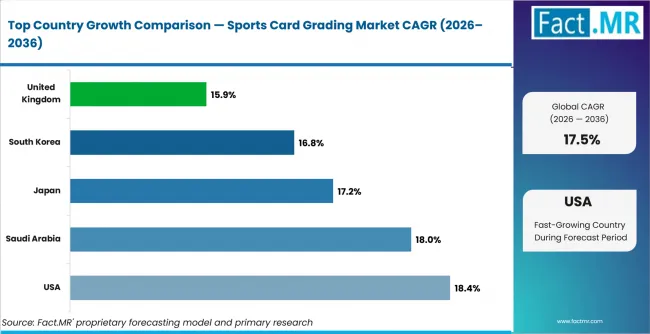
Sports Card Grading Market Cagr Analysis By Country | Source: Fact.MR
What is powering the United States lead?
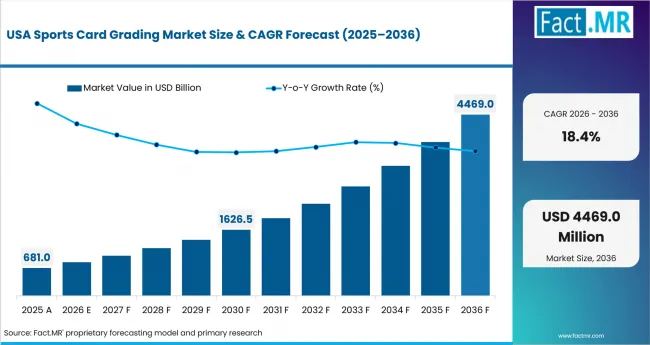
Sports Card Grading Market Country Value Analysis | Source: Fact.MR
The United States is projected to record 18.4% CAGR through 2036 as it remains the global center for sports card collecting, grading and auction activity. Major grading companies, card shows and auction platforms create a mature ecosystem that supports high grading volumes. Demand remains strongest for sports trading cards, baseball, basketball and football cards. Investor participation and record-breaking auction sales continue to increase grading submissions. The country benefits from strong collector awareness and established grading standards.
How is the United Kingdom scaling sports card grading demand?
The United Kingdom is expected to post 15.9% CAGR through 2036 as football card collecting gains popularity among collectors and investors. International card brands continue to expand visibility across the market. Growing awareness of grading services is improving confidence and transaction values. Auction activity and online marketplace participation are supporting market growth.
What underpins Saudi Arabia's growth?
Saudi Arabia is projected to register 18.0% CAGR through 2036 as affluent collectors increasingly diversify into graded sports cards and alternative assets. International sports investments and premium collectibles demand are supporting market expansion. Collectors are focusing on rare cards associated with globally recognized athletes. Professional grading services are becoming more important as transaction values rise.
How does South Korea perform?
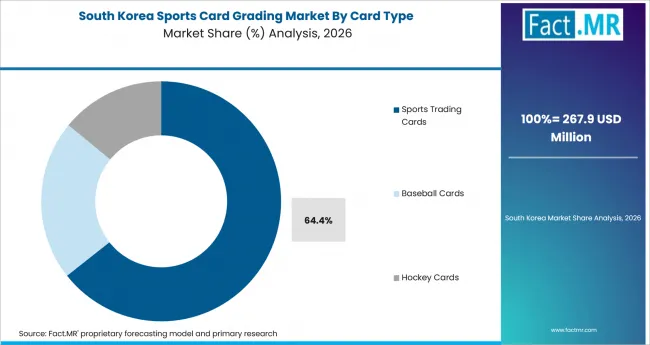
Sports Card Grading Market South Korea Market Share Analysis By Card Type | Source: Fact.MR
South Korea is expected to register 16.8% CAGR through 2036 due to the rapid development of K-card culture and growing sports collectibles participation. Baseball remains a key demand driver through strong interest in KBO players and international stars. Online communities and digital marketplaces continue to expand market accessibility. Demand for grading services is rising as collectors seek stronger value preservation.
Why is Japan important?
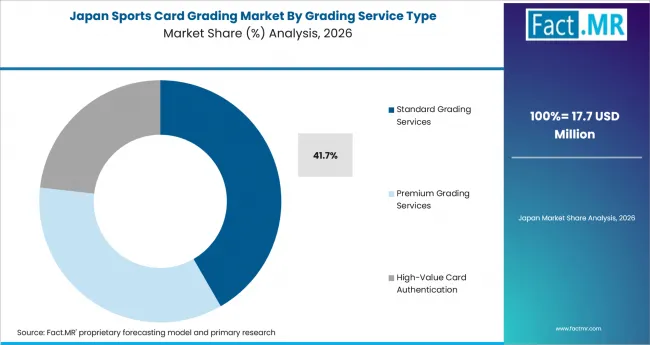
Sports Card Grading Market Japan Market Share Analysis By Grading Service Type | Source: Fact.MR
Japan is forecast to advance at 17.2% CAGR through 2036 as demand for NPB cards and Pokémon crossover collecting continues to expand. International interest in Japanese athletes has increased the value of graded cards. Collectors increasingly use grading services to preserve condition and improve resale opportunities. Strong domestic collecting culture and global demand support long-term market growth.
Who leads the sports card grading landscape?
PSA, Beckett Grading Services, CGC Cards, SGC and TAG lead through grading expertise and collector trust.
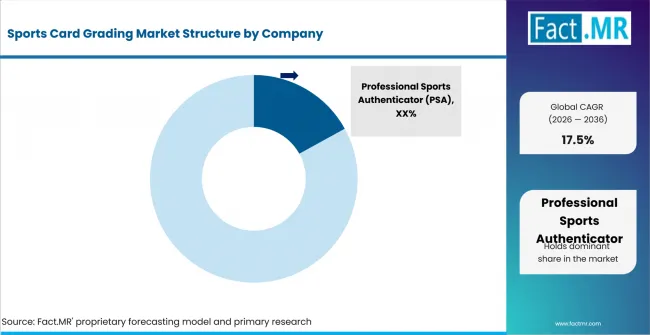
Sports Card Grading Market Analysis By Company | Source: Fact.MR
Sports card grading is characterized by reputation-driven competition where consistency and market acceptance remain the most important differentiators. Grading providers support collectors, investors and dealers by establishing standardized card conditions and authenticity verification. Rising card values continue to increase the importance of trusted grading services.
Professional Sports Authenticator (PSA) remains a leading provider through its extensive grading infrastructure and strong acceptance across auction markets. Beckett Grading Services maintains a significant presence through established grading standards and collector recognition. CGC Cards and SGC continue expanding through competitive service offerings and growing market adoption. TAG is introducing technology-focused grading solutions that emphasize transparency and automation.
Competition through 2036 will depend on grading consistency, turnaround times and technology integration. Providers that combine trusted grading standards with AI-assisted assessment and digital verification capabilities will be better positioned to strengthen market share. Partnerships with auction houses, marketplaces and collector communities will remain important growth strategies.
Which companies are the key players?
Professional Sports Authenticator (PSA), Beckett Grading Services (BGS), Certified Guaranty Company (CGC Cards), Sportscard Guaranty (SGC), TAG Grading, Fanatics Collect, and Arena Club
- Professional Sports Authenticator (PSA)
- Beckett Grading Services (BGS)
- Certified Guaranty Company (CGC Cards)
- Sportscard Guaranty (SGC)
- TAG Grading
- Fanatics Collect
- Arena Club
Bibliography
- [1] Sports Collectors Digest. (2025). eBay expands partnership with PSA, adds new services. Sports Collectors Digest.
- [2] Radnofsky, L. (2024, June 11). Fanatics, Sotheby’s and PWCC are reshaping the sports collectibles market. The Athletic.
- [3] Sportcal. (2024, March 28). Fanatics launches new collectibles marketplace. Sportcal.
- [4] Collectors Holdings, Inc. (2024, July 15). Collectors announces strategic growth initiatives across grading and authentication services. Collectors Holdings.
This Report Addresses
- Strategic intelligence on the sports card grading market across grading service types, card categories and customer groups.
- Market sizing and growth assessment across grading services, authentication solutions and certification activities.
- Segment analysis covering standard grading services, sports trading cards, individual collectors and investment preservation applications.
- Evaluation of grading demand trends across sports trading cards, baseball, basketball, football, soccer and multi-sport card categories.
- Regional outlook covering the United States, United Kingdom, Saudi Arabia, South Korea and Japan.
- Competitive assessment of PSA, Beckett Grading Services, CGC Cards, SGC, TAG Grading and emerging technology-enabled grading providers.
- Analysis of grading standards, authentication practices and certification methodologies across the collectibles ecosystem.
- Assessment of investment-driven demand, collector participation and auction market activity influencing grading volumes.
What does the sports card grading market cover?
Professional grading and authentication services for sports trading cards.
The sports card grading market covers services that verify authenticity and assess card condition using standardized grading scales. It includes grading, encapsulation and certification services. The market differs from sports card trading because the focus is verification and value preservation rather than card ownership.
What is included in the scope?
Card grading, authentication and certification services.
The scope includes card condition assessment and authenticity verification. It covers encapsulation and certification. It includes regrading and crossover grading services.
What is excluded from the scope?
Sports card manufacturing and card marketplace transactions.
The scope excludes card production and licensing activities. It excludes sports card retail sales and trading activity unless grading services are involved. It excludes memorabilia authentication services unrelated to trading cards.
How was the analysis built?
100+ sources, 40+ company portfolios, 25+ countries and industry interviews.
- Primary Research: Primary research includes interviews with grading providers, auction houses and collectors.
- Desk Research: Desk research reviews grading volumes, auction trends and collectibles market disclosures.
- Market-Sizing and Forecasting: Forecasting uses grading submissions, sports card transaction values and collector participation.
- Data Validation and Update Cycle: Forecasts are validated through grading company reviews and auction market benchmarking.
Segmentation
What is the report’s scope and coverage?
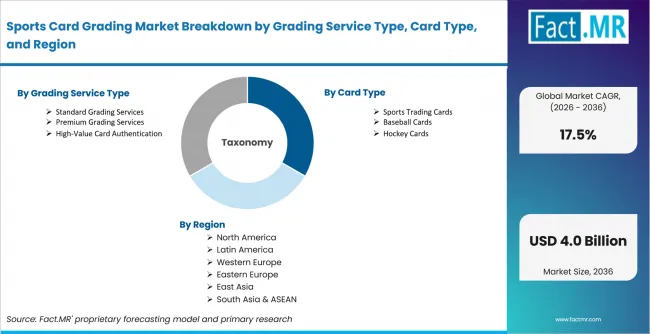
Sports Card Grading Market Breakdown By Grading Service Type, Card Type, And Region | Source: Fact.MR
| Attribute | Details |
|---|---|
| Quantitative Units | USD Billion in 2026 to USD Billion by 2036 |
| Market Definition | Professional grading, authentication and certification services for sports trading cards |
| Grading Service Type | Standard Grading, Premium Grading, High-Value Authentication, Regrading, Cross-Over Services |
| Card Type | Sports Trading Cards, Baseball Cards, Basketball Cards, Football Cards, Soccer Cards, Hockey Cards, Multi-Sport Cards |
| Customer Type | Individual Collectors, Investors, Dealers, Auction Houses, Trading Platforms |
| Submission Type | Standard Submission, Express Submission, Premium Submission, Bulk Submission |
| End Use | Investment Preservation, Collection Management, Auction Transactions, Resale Support, Insurance Documentation |
| Regions Covered | North America, Western Europe, Asia Pacific, Latin America, Middle East & Africa |
| Countries Covered | United States, United Kingdom, Saudi Arabia, South Korea, Japan |
| Key Companies Profiled | PSA, Beckett Grading Services, CGC Cards, SGC, TAG Grading |
| Forecast Period | 2026 to 2036 |
| Approach | Hybrid top-down and bottom-up approach using grading volumes, collector participation, auction activity and provider validation. |
Source: Fact.MR analysis. Updated Jun 24, 2026
How is the Market Segmented?
-
By Grading Service Type
- Standard Grading Services
- Premium Grading Services
- High-Value Card Authentication
- Regrading Services
- Cross-Over Grading Services
-
By Card Type
- Sports Trading Cards
- Baseball Cards
- Basketball Cards
- Football Cards
- Soccer Cards
- Hockey Cards
- Multi-Sport Cards
-
By Customer Type
- Individual Collectors
- Investors
- Dealers
- Auction Houses
- Trading Platforms
-
By Submission Type
- Standard Submission
- Express Submission
- Premium Submission
- Bulk Submission
-
By End Use
- Investment Preservation
- Collection Management
- Auction Transactions
- Resale Support
- Insurance Documentation
-
Region:
- North America
- United States
- Canada
- Europe
- United Kingdom
- Germany
- France
- Netherlands
- Spain
- Asia Pacific
- Australia
- Japan
- South Korea
- Singapore
- India
- Latin America
- Brazil
- Mexico
- Chile
- Middle East & Africa
- GCC Countries
- South Africa
- Israel
- North America
Frequently Asked Questions
Which grading service type leads the market?
Which card category generates the highest grading demand?
Why is card grading important?
Which country leads the Sports Card Grading Market?
What is driving sports card grading demand?
How is technology influencing grading services?
Who worked on this report


Preview the report firsthand - request a free sample
Free SampleGet the brochure for pricing and purchase details
Download PDF