- Base Value(2025): 425.8 Mn
- Estimated Value(2026): 452.2 Mn
- Forecast Value (2036): 825.2 Mn
- CAGR (2026 - 2036): 6.2%
Mono-Cardboard Shelf Trays Market Overview, Growth Outlook, and Forecast by Fact.MR
- In 2025, the mono-cardboard shelf trays market was valued at USD 425.8 million.
- Demand for mono-cardboard shelf tray solutions is projected to grow to USD 452.2 million in 2026 and reach USD 825.2 million by 2036.
- The market is expected to expand at a CAGR of 6.2% during the forecast period.
- The mono-cardboard shelf trays market is projected to create an absolute dollar opportunity of USD 373.0 million between 2026 and 2036.
- Increasing demand for sustainable retail packaging, growing substitution of plastic display packaging, growing organized retail, adoption of corrugated packaging options by food & beverage, pharmaceutical, consumer, personal care and electronics industry are driving the market.
- The growing investment in paperboard packaging technology, stringent sustainability regulations and increasing demand for lightweight shelf-display packaging solutions are projected to further boost the market growth during the forecast period.
- However, variations in raw materials cost, moisture sensitivity of paperboard packaging, increasing cost of logistics and competition from reusable plastic retail trays are some of the factors that may hamper market growth.
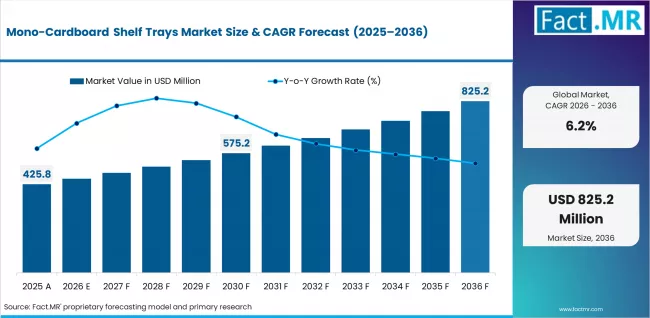
Mono Cardboard Shelf Trays Market Value Analysis | Source: Fact.MR
Summary of the Mono-Cardboard Shelf Trays Market
- Market Snapshot
- Global mono-cardboard shelf trays market revenue stood at USD 452.2 million in 2026 and is forecast to reach USD 825.2 million by 2036.
- At a 6.2% CAGR from 2026 to 2036, the market is set to expand to ~1.8x in value, creating an absolute dollar opportunity of USD 373.0 million.
- Growth is owing to increasing demand for sustainable retail ready packaging, increasing substitution of plastic display packaging and rapid growth of organized retail and e-commerce logistics worldwide.
- Growing environmental regulations and the higher adoption rate of recyclable corrugated and paperboard-based packaging solutions are positively influencing the market growth during the forecast period.
- Developments in light-weight corrugated tray designs, barrier-coated paperboard and tailored shelf-ready packaging solutions are positive influences in retailing and transport packaging applications in many industries.
- Demand and Growth Drivers
- Increasing demand for sustainable and recyclable solutions for retail packaging
- Growing substitution of plastic retail trays and display packaging
- Fast development of e-commerce and organized retail channels
- Growing demand for packaging from FMCG, food & beverage and pharma industries
- Increasing investment in corrugated packaging and in technologies for light-weight paperboard
- Need for packaging solutions that provide:
- Improved retail shelf visibility
- Lightweight and recyclable packaging
- Efficient transport and stacking performance
- Cost-effective retail-ready packaging
- Enhanced product merchandising
- Reduced environmental impact
- Product and Segment View
- Shelf-ready trays hold 29.1% of product share in 2026, emerging as the leading segment due to extensive usage across supermarkets, FMCG retail chains, and food & beverage merchandising applications.
- Corrugated cardboard accounts for 42.6% of material type share in 2026, positioning it as the dominant material segment owing to high durability, lightweight structure, and strong recyclability advantages.
- Coated trays represent 38.4% of coating type share in 2026, supported by increasing demand for enhanced printability, branding visibility, and retail display performance.
- Retail shelf packaging accounts for 37.2% of application share in 2026, reflecting rising adoption of shelf-ready packaging solutions across organized retail and supermarket channels.
- Food & Beverage accounts for 45.4% of end-use industry share in 2026, driven by increasing packaged food consumption, supermarket expansion, and demand for retail-ready display packaging solutions.
- Geography and Competitive Outlook
- Strong growth prospects exist across Asia Pacific, North America, and Europe owing to rising retail-ready packaging adoption, increasing sustainability regulations, and rapid expansion of e-commerce packaging demand.
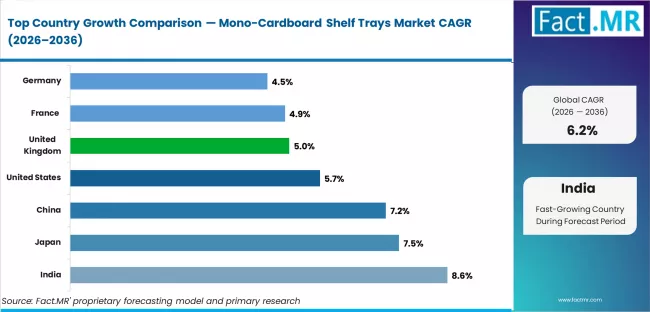
- Some of the major growth regions in the Mono-Cardboard Shelf Trays market include India (CAGR 8.6%), Japan (7.5%), China (7.2%), Brazil (7.1%), United States (5.7%), United Kingdom (5.0%), France (4.9%), and Germany (4.5%) throughout the forecast period.
- Rising investments in sustainable paperboard packaging solutions
- Expansion of organized retail and e-commerce logistics
- Increasing adoption of recyclable corrugated packaging materials
- Development of lightweight and barrier-coated tray technologies
- Regulatory restrictions on plastic-based retail packaging
- Key companies active in this market include International Paper, DS Smith, Smurfit Westrock, Graphic Packaging International, Mondi Group, Mayr-Melnhof Karton, Huhtamaki, Rengo Co., Ltd., Sonoco Products Company, Stora Enso, and others.
- Analyst Opinion
- Shambhu Nath Jha, Principal Consultant at Fact.MR, opines, “Leaders at the CXO level are expected to recognize that the future competitive advantage in the mono-cardboard shelf trays market will increasingly depend on developing sustainable, lightweight, and retail-ready paperboard packaging solutions capable of improving shelf visibility, logistics efficiency, and recyclability across food & beverage, FMCG, pharmaceutical, consumer goods, and e-commerce packaging applications.
Mono-Cardboard Shelf Trays Market — At a Glance
| Attribute | Details |
|---|---|
| Market Value 2025 | USD 425.8 Million |
| Market Value 2026 | USD 452.2 Million |
| Market Value 2036 | USD 825.2 Million |
| Absolute Dollar Opportunity | USD 373.0 Million |
| Total Growth | 82.50% |
| CAGR | 6.20% |
| Growth Multiple | 1.8x |
| Key Demand Theme | Rising demand for sustainable retail-ready packaging, increasing replacement of plastic display trays, expansion of organized retail and e-commerce logistics, growing adoption of recyclable corrugated packaging, and rising sustainability regulations for paper-based packaging solutions |
| Leading Product | Shelf-ready trays |
| Product Share | 29.10% |
| Leading Material Type | Corrugated cardboard |
| Material Type Share | 42.6% |
| Leading Coating Type | Coated trays |
| Coating Type Share | 38.4% |
| Leading Application | Retail shelf packaging |
| Application Share | 37.2% |
| Leading End-Use Industry | Food & Beverage |
| End-Use Industry Share | 45.4% |
| Key Growth Regions | Asia Pacific, North America, Europe |
| Key Companies | International Paper, DS Smith, Smurfit Westrock, Graphic Packaging International, Mondi Group, Mayr-Melnhof Karton, Huhtamaki, Rengo Co., Ltd., Sonoco Products Company, Stora Enso |
| Segmentation by Product | Shelf-ready trays, Retail display trays, Die-cut trays, Folding shelf trays, Stackable trays, Open-front display trays, Carry/display combo trays |
| Segmentation by Coating Type | Coated trays, Uncoated trays, Laminated trays, Barrier-coated trays |
| Segmentation by Material Type | Corrugated cardboard, Paperboard, Kraft board, Recycled fiberboard, Virgin fiberboard |
| Segmentation by Application | Retail shelf packaging, E-commerce packaging, Point-of-sale (POS) displays, Wholesale transport trays, Promotional display packaging |
| Segmentation by End-Use Industry | Food & Beverage, Pharmaceuticals, Personal Care & Cosmetics, Consumer Goods, Electronics |
| Segmentation by Region | North America, Latin America, East Asia, South Asia & Pacific, Western Europe, Eastern Europe, Middle East & Africa |
Key Growth Drivers, Constraints, and Opportunities
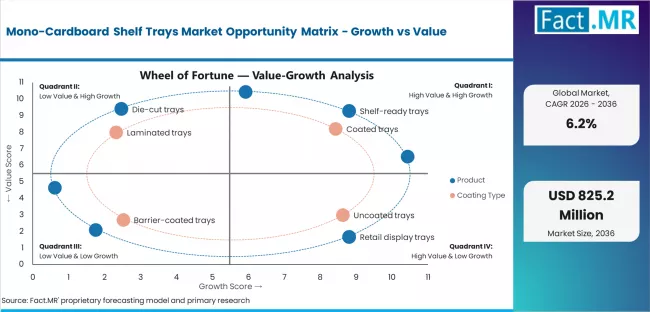
Mono Cardboard Shelf Trays Market Opportunity Matrix Growth Vs Value | Source: Fact.MR
Key Factors Driving Growth
- The adoption of mono- cardboard shelf trays among food & beverage, pharmaceutical, consumer goods and e-commerce sectors is on the rise owing to the increasing need for eco-friendly and recyclable retail ready packaging solutions.
- Growing substitution of plastic retail trays and display packaging owing to environmental policies, sustainability commitments and plastic reduction initiatives is boosting the market growth across the world.
- Surge in organized retail, supermarket chains, FMCG distribution and e-commerce logistics is boosting the demand for lightweight, stackable and shelf ready corrugated packaging.
| Growth Driver | Demand Impact | Time Horizon | Key Impact Area | Fact.MR Insight |
|---|---|---|---|---|
| Rising demand for sustainable and recyclable retail-ready packaging solutions | High | Short–Mid Term | Eco-friendly retail packaging & plastic tray replacement | Increasing sustainability regulations and growing retailer commitments toward recyclable packaging are accelerating adoption of corrugated and paperboard shelf tray solutions globally. |
| Rapid expansion of organized retail and e-commerce distribution networks | High | Short–Mid Term | Shelf-ready packaging & retail logistics efficiency | Growing supermarket penetration, FMCG distribution expansion, and e-commerce retail activities are increasing demand for lightweight and stackable shelf-ready cardboard tray packaging solutions. |
| Increasing replacement of plastic retail trays and display packaging | Medium-High | Mid–Long Term | Sustainable paperboard packaging & recyclable retail displays | Manufacturers and retailers are increasingly shifting toward recyclable corrugated and paperboard tray packaging to reduce environmental impact and comply with plastic reduction mandates. |
| Advancements in lightweight corrugated tray and barrier-coated packaging technologies | Medium-High | Mid–Long Term | High-performance retail-ready packaging & improved shelf presentation | Development of lightweight tray structures, moisture-resistant coatings, and high-quality printing technologies is improving packaging durability, branding visibility, and merchandising performance. |
| Growing adoption across food & beverage, FMCG, pharmaceuticals, and consumer goods industries | Medium-High | Mid–Long Term | Customized retail packaging & shelf merchandising solutions | Rising demand for efficient, visually appealing, and sustainable retail packaging formats is increasing adoption of mono-cardboard shelf trays across supermarkets, retail chains, and wholesale distribution channels. |
Key Market Constraints
- Sensitivity to moisture, and the potential for somewhat reduced durability versus plastic trays in some heavy-duty or wet storage applications, may limit the penetration of adoption in certain industrial packaging markets.
- Variations in the prices of raw materials for paperboard, corrugated cardboard and recycled fiber may affect the cost of production and the profit margins of packaging manufacturers.
- Increasing costs of transportation, logistics, and more pressure on packaging manufacturers to provide lightweight packaging that can also withstand the same level of structural performance for packaging, may cause operational challenges.
Key Opportunity Areas
- Increasing usage of recyclable paperboard packaging and the barrier coated cardboard tray technology are promising several remunerative opportunities for sustainable retail packaging manufacturers.
- Booster of e-commerce logistics and retail-ready packaging demand from developing regions is shedding positive lights on the growth prospects of the products for the lightweight corrugated shelf trays.
- Increasing investments in digital printing, customized retail display packaging and high visibility shelf ready tray solutions are expected to drive sustainable market growth in fast moving consumer goods (FMCG), food, pharmaceutical and consumer goods industries.
Segment-wise Analysis of the Mono-Cardboard Shelf Trays Market
- Shelf-ready trays account for 29.1% share of the product segment in 2026, driven by their widespread use across supermarkets, FMCG retail chains, food & beverage merchandising, and organized retail shelf-display applications.
- Corrugated cardboard holds 42.6% share of the material type segment in 2026, supported by its high durability, lightweight structure, strong recyclability advantages, and increasing adoption in retail-ready packaging and e-commerce logistics applications.
- Coated trays represent 38.4% share of the coating type segment in 2026, owing to growing demand for enhanced printability, branding visibility, moisture resistance, and improved retail display performance.
The Mono-Cardboard Shelf Trays Market is segmented by product, coating type, material type, application, end-use industry, and region.
Which Product Segment Topped the Mono-Cardboard Shelf Trays Market?
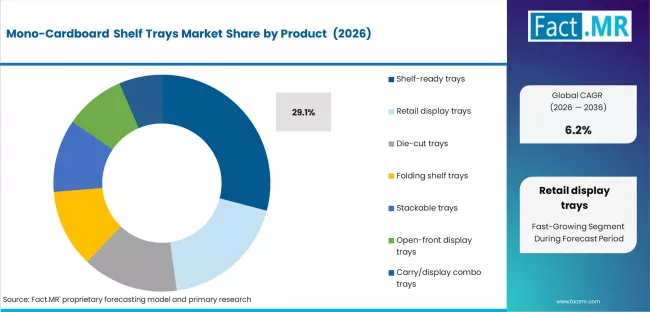
Mono Cardboard Shelf Trays Market Analysis By Product | Source: Fact.MR
Shelf-Ready trays are estimated to hold the largest market share of 29.1% in mono-cardboard shelf trays market by 2026. This is primarily due to increased demand for retail ready packaging in the sector of supermarkets, FMCG distribution, food and beverage merchandising, and organized retail. Shelf-ready trays offer better product visibility, efficient shelf replenishment, lighter transportation, and better retail merchandising performance, making them one of the most popular packaging formats for high-volume retail packaging applications.
Which Material Type Segment Accounts for the Highest Share in the Market?
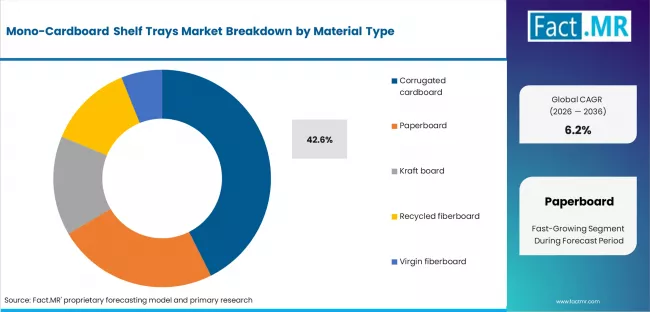
Mono Cardboard Shelf Trays Market Analysis By Material Type | Source: Fact.MR
The segment of corrugated cardboard is projected to hold the highest market share of 42.6% by the year 2026. This dominance is attributed to growing utilization of recyclable corrugated packaging, high structural strength, light weight nature, and increasing demand for sustainable retail ready packaging solutions. Manufacturers and retailers prefer corrugated cardboard for its cost efficiency, ability to print on, strength when stacking, and adherence to sustainability and recycling standards in both retail and e-commerce packaging applications.
Which Coating Type Segment Leads the Market?
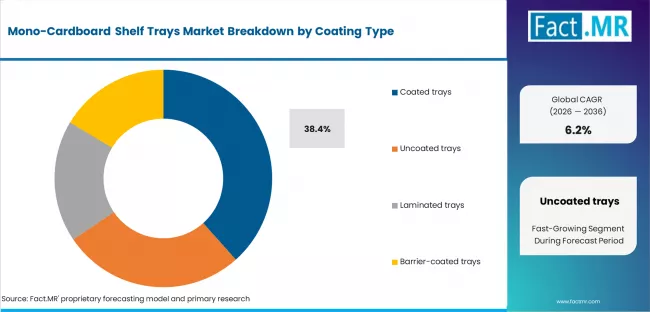
Mono Cardboard Shelf Trays Market Analysis By Coating Type | Source: Fact.MR
The Coated trays segment is anticipated to dominate the market with a share of 38.4% in 2026 owing to the rising demand for improved print quality, branding visibility, moisture resistance, and beautiful presentation at retail. Coated cardboard trays are widely adopted in food & beverage, consumer goods and retail merchandising as they enhance the shelf appeal and provide the ability to print high quality graphics for branded packaging.
Which Application Segment Holds the Largest Share in the Market?
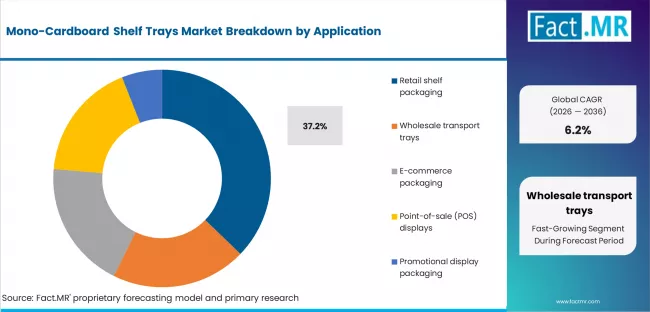
Mono Cardboard Shelf Trays Market Analysis By Application | Source: Fact.MR
It is expected that retail shelf packaging will come out on top as the application segment by 2026, owing to a 37.2% share of the market. Growth is attributed to the increasing expansion of supermarkets, growing adoption for the shelf-ready packaging systems, and increasing need for efficient solutions for retail merchandising in the fast moving consumer goods (FMCG) and food packaging industry. Retail shelf packaging enhances the store products accessibility, organization on the shelf and in-store work efficiency.
Which End-Use Industry Segment Holds the Largest Share in the Market?
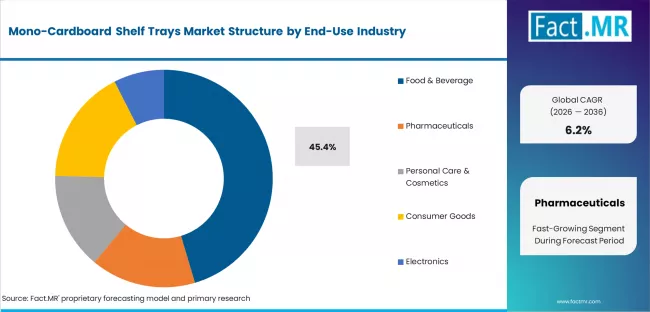
Mono Cardboard Shelf Trays Market Analysis By End Use Industry | Source: Fact.MR
The end-user industry segment of Food & Beverage is anticipated to continue dominating, accounting for a share of 45.4% by 2026. This growth is driven by rising consumption of packaged food, expansion of supermarket retailing, increasing demand for sustainable food packaging solutions and higher usage of recyclable retail display trays. Growing emphasis on sustainable packaging materials by food producers and retailers is also boosting global demand for corrugated and paperboard shelf-ready tray solutions worldwide.
Regional Outlook Across Key Markets
The geographies covered in this study include North America, Latin America, Western Europe, Eastern Europe, East Asia, South Asia & Pacific, and Middle East & Africa. Regional analysis includes assessment of retail-ready packaging adoption, demand for sustainable corrugated and paperboard shelf tray solutions, regulatory developments related to plastic packaging reduction, expansion of organized retail and e-commerce logistics infrastructure, and growth in recyclable paper-based retail packaging solutions across food & beverage, pharmaceuticals, personal care, consumer goods, and electronics industries.
.webp "Top Country Growth Comparison Mono Cardboard Shelf Trays Market Cagr (2026 2036)")
Top Country Growth Comparison Mono Cardboard Shelf Trays Market Cagr (2026 2036) | Source: Fact.MR
CAGR Table
| Country | CAGR (%) |
|---|---|
| India | 8.6% |
| Japan | 7.5% |
| China | 7.2% |
| France | 4.9% |
| United States | 5.7% |
| United Kingdom | 5.0% |
| Germany | 4.5% |
| Brazil | 7.1% |
Source: Fact.MR (FMR) analysis, based on proprietary forecasting model and primary research.
Mono Cardboard Shelf Trays Market Cagr Analysis By Country | Source: Fact.MR
North America Mono-Cardboard Shelf Trays Market
The mono-cardboard shelf trays market in North America is anticipated to account for a considerable share owing to the high demand for retail ready packaging, growing organized retail chains, strong e-commerce logistics infrastructure, and increased usage of recyclable corrugated packaging solutions. Packaging producers across the region are investing in more lightweight shelf-ready trays, sustainable paperboard packaging solutions, and innovative retail display options to address evolving consumer preferences and merchandising trends.
- U.S.: Demand for mono-cardboard shelf trays in the U.S. is projected to rise at 5.7% CAGR through 2036. Growth is driven by increasing retail-ready packaging adoption, expansion of e-commerce packaging demand, rising FMCG consumption, and growing preference for recyclable shelf-display packaging solutions.
- Canada: Market growth in Canada is supported by increasing demand for sustainable retail packaging, rising investments in corrugated packaging infrastructure, and growing adoption of recyclable display packaging solutions across food & beverage and consumer goods industries.
Europe Mono-Cardboard Shelf Trays Market
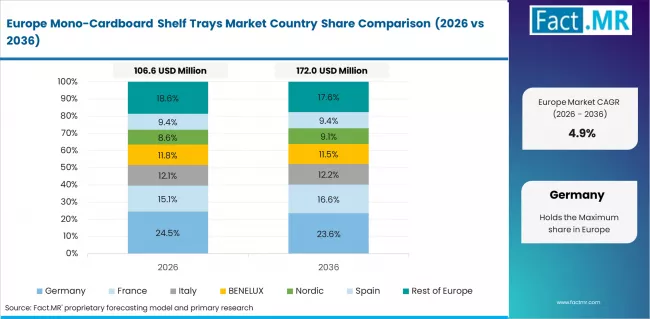
Mono Cardboard Shelf Trays Market Europe Country Market Share Analysis, 2026 & 2036 | Source: Fact.MR
The European region is considered as the major market for sustainable retail packaging solutions, with strict government policies and regulations on environmental protection, robust circular economy concept, and rising demand for recyclable paperboard packaging structures. Local producers are concentrating on lightweight corrugated tray solutions, barrier-coated packaging systems, and environmentally friendly shelf-ready packaging solutions.
- Germany: Demand for mono-cardboard shelf trays in Germany is projected to rise at 4.5% CAGR through 2036, driven by strong retail packaging demand, sustainable packaging regulations, and increasing use of recyclable transport and display trays across FMCG and industrial packaging sectors.
- U.K.: Mono-cardboard shelf tray demand in the U.K. is expected to grow at 5.0% CAGR through 2036 due to increasing supermarket retail expansion, rising demand for shelf-ready packaging, and growing replacement of plastic retail trays.
- France: Demand for mono-cardboard shelf trays in France is supported by rising sustainable packaging adoption, increasing food & beverage packaging demand, and growing investments in recyclable retail packaging technologies.
East Asia Mono-Cardboard Shelf Trays Market
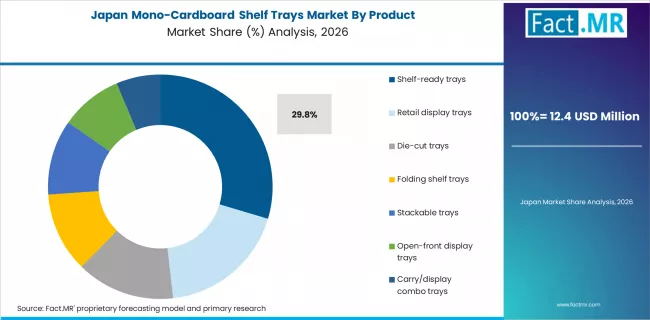
Mono Cardboard Shelf Trays Market Japan Market Share Analysis By Product | Source: Fact.MR
East Asia becomes the center of production and consumption of Mono-Cardboard Shelf Trays Market in the global market, due to the high capacity of corrugated packaging production, the demand for retail packaging on a large scale, and the fast-growing export-oriented industry of consumer goods. Manufacturers in the region are increasingly turning to lightweight paperboard packaging solutions, and sustainable retail-ready packaging solutions.
- China: Demand for mono-cardboard shelf trays in China is projected to rise at 7.2% CAGR through 2036, driven by rapid growth in retail packaging demand, expansion of e-commerce logistics, increasing FMCG production, and rising adoption of recyclable corrugated packaging materials.
- Japan: Mono-cardboard shelf tray demand in Japan is expected to grow at 7.5% CAGR through 2036 due to increasing demand for high-quality retail packaging, premium shelf-display solutions, and advanced sustainable paperboard packaging technologies.
- South Korea: Demand for mono-cardboard shelf trays in South Korea is forecast to expand steadily through 2036, supported by strong consumer electronics packaging demand, organized retail growth, and increasing sustainable packaging initiatives.
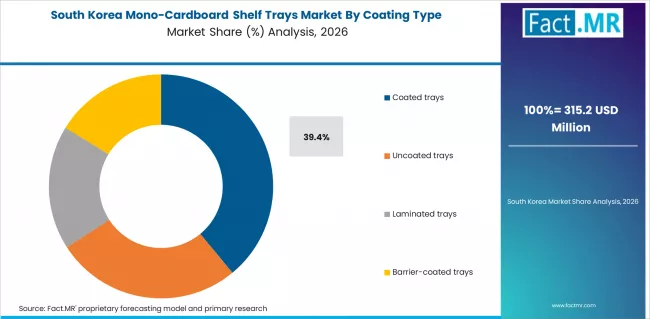
Mono Cardboard Shelf Trays Market South Korea Market Share Analysis By Coating Type | Source: Fact.MR
South Asia & Pacific Mono-Cardboard Shelf Trays Market
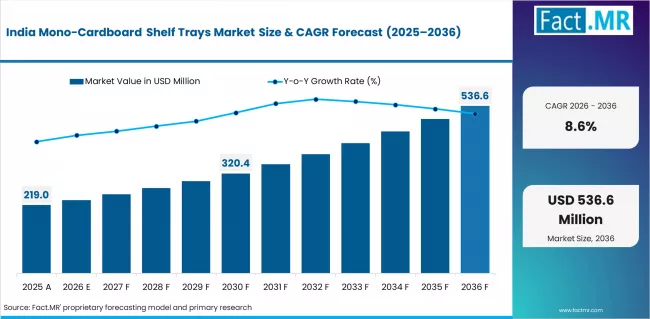
Mono Cardboard Shelf Trays Market Country Value Analysis | Source: Fact.MR
South Asia & Pacific is witnessing a high development in the mono-cardboard shelf trays market as a result of growing urbanization, organized retail formats, increasing production of FMCG, and escalating e-commerce logistic activities. Manufacturers are putting more and more investment into corrugated packaging production, and recyclable shelf ready trays solutions, as they respond to growing sustainability demands and retail packaging needs.
- India: Demand for mono-cardboard shelf trays in India is projected to rise at 8.6% CAGR through 2036, driven by rapid growth in retail and e-commerce sectors, increasing food & beverage packaging demand, rising sustainable packaging investments, and growing replacement of plastic-based retail display packaging formats.
Fact.MR’s analysis of the mono-cardboard shelf trays market consists of country-wise assessment across North America, Latin America, Europe, East Asia, South Asia & Pacific, and Middle East & Africa. Readers can find detailed insights on regional demand trends, sustainable paperboard packaging adoption, retail-ready packaging technologies, regulatory developments, competitive benchmarking, and long-term growth opportunities across major global markets.
Competitive Benchmarking and Company Positioning
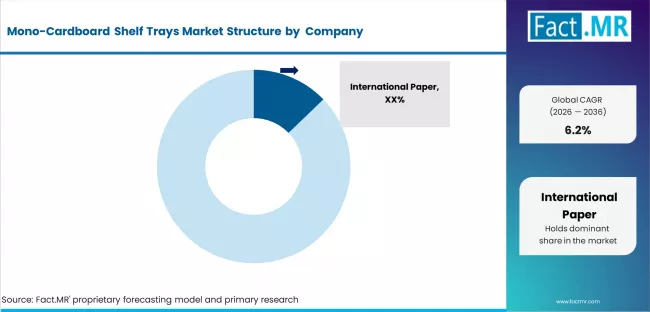
Mono Cardboard Shelf Trays Market Analysis By Company | Source: Fact.MR
Leading Companies Shaping the Mono-Cardboard Shelf Trays Market
The mono-cardboard shelf trays market is somewhat fragmented and comprises leading players like International Paper, DS Smith, Smurfit Westrock, Graphic Packaging International, Mondi Group, Mayr-Melnhof Karton, Huhtamaki, Rengo Co., Ltd., Sonoco Products Company, and Stora Enso. They compete in terms of their capacity for sustainable packaging, innovation in retail ready packaging, flexibility for customization, print quality, strength, light-weighting packaging abilities, and cost-effectiveness. Leading firms have a competitive edge by virtue of having an integrated corrugated packaging operation, superior die cutting and print technology, effective partnerships with FMCG companies and retailers, and extensive distribution channels across the world.
Companies are constantly working towards enhancing their presence in the market, improving their logistical efficiency, and ensuring greater sustainability by focusing on recyclable paperboard packaging, barrier coated tray technology, light-weighting, and retail display solutions.
Recent Industry Developments
- Graphic Packaging – PaperSeal® Pressed MAP Tray Portfolio Expansion (March 2025)
- Graphic Packaging International expanded its PaperSeal® sustainable food packaging portfolio with the launch of the Pressed MAP Tray designed to replace plastic food trays with recyclable paperboard packaging solutions. The innovation strengthens the company’s position in sustainable tray packaging, retail-ready packaging, and fiber-based food packaging applications across supermarkets and FMCG sectors. [1]
- International Paper – DS Smith Acquisition Completion (January 2025)
- International Paper completed its acquisition of DS Smith to strengthen its global corrugated packaging, retail-ready packaging, and sustainable paperboard packaging operations. The acquisition expands the company’s presence in shelf-ready packaging, recyclable corrugated tray solutions, and fiber-based retail packaging applications across North America and Europe. [2]
- Mondi Group – White Digital Printing Launch for Corrugated Packaging (September 2025)
- Mondi Group introduced white digital printing technology for corrugated packaging to improve branding visibility and retail packaging customization capabilities. The development supports high-quality shelf-ready packaging, retail display trays, and corrugated packaging solutions designed for food, consumer goods, and e-commerce retail applications. [3]
- Stora Enso – Oulu Consumer Board Line Operational Launch (March 2025)
- Stora Enso started operations at its new consumer board production line in Oulu, Finland, significantly increasing folding boxboard and coated kraft board production capacity. The investment strengthens the company’s sustainable paperboard packaging portfolio used across mono-cardboard shelf trays, retail-ready packaging, and food & beverage packaging applications. [4]
- Graphic Packaging – Waco Recycled Paperboard Facility Launch (October 2025)
- Graphic Packaging International launched its recycled paperboard manufacturing facility in Waco, Texas, to expand sustainable paperboard packaging production capacity. The facility supports growing demand for recyclable retail-ready packaging, corrugated display trays, and lightweight shelf-ready packaging solutions across food, beverage, and consumer goods industries. [5]
Leading Companies Shaping the Mono-Cardboard Shelf Trays Market
- International Paper
- DS Smith
- Smurfit Westrock
- Graphic Packaging International
- Mondi Group
- Mayr-Melnhof Karton
- Huhtamaki
- Rengo Co., Ltd.
- Sonoco Products Company
- Stora Enso
- TCPL Packaging Ltd.
- Kapco Packaging Company
Sources and Research References
- [1] Graphic Packaging International, “Graphic Packaging Adds PaperSeal® Pressed MAP Tray to Award-Winning Food Packaging Portfolio”, March 2025
- [2] International Paper, “International Paper Completes Acquisition of DS Smith”, January 2025
- [3] Mondi Group, “Mondi introduces white digital printing for corrugated packaging, unlocking new branding possibilities”, September 2025
- [4] Stora Enso, “Stora Enso's new consumer board line at the Oulu site in Finland has started operations”, March 2025
- [5] Graphic Packaging International, “Graphic Packaging's Waco Recycled Paperboard Facility Launches”, February 2025
Mono-Cardboard Shelf Trays Market Definition
Mono-cardboard shelf trays are a type of material that is used in the production of sustainable retail-ready packaging solutions where corrugated cardboard and paperboard derived from kraft board, recycled fiberboard, and virgin fiberboard are used. These trays are used for product display, shelf organization, transportation, stacking, and retail merchandising in organized retail stores and distribution channels. Mono-cardboard shelf trays such as shelf ready trays, retail display trays, die cut trays, folding shelf trays, stackable trays, open-front display trays, and carry/display combo trays are rapidly being embraced as a recyclable and lightweight solution to plastic-based retail packaging options.
The market caters to food & beverages, pharmaceutical, personal care & cosmetics, consumer goods, electronics, and e-commerce verticals and is driven by the increasing demand for sustainable packaging, the evolution of retail-ready packaging formats, rising supermarket penetration and growing utilization of recyclable corrugated packaging solutions worldwide.
Mono-Cardboard Shelf Trays Market Inclusions
The mono-cardboard shelf trays market report includes an evaluation of the world and regional market size until 2036. The report includes detailed segmentation for product, coating type, material type, application, end-use industry, and geography. The report provides in-depth analysis and coverage of sales revenue growth patterns, competitions, packaging materials innovations, price analysis, supply chain management, sustainability trends and regulations that may impact on the use of recyclable paper card packaging solutions.
Mono-Cardboard Shelf Trays Market Exclusions
This report excludes standard corrugated boxes, folding cartons and paperboard packaging products that are not intended for use in applications of shelf-ready display, retail merchandising or retail-ready packaging. The report does not cover plastic retail trays, reusable plastic crates, rigid plastic containers, protective transit packaging solutions or non-display transit packaging solutions. Also excluding are traditional shipping cartons, foodservice paper packaging, flexible packaging materials, molded pulp protective packaging goods and industrial bulk packaging types that are outside the scope of mono-cardboard shelf trays or retail display packaging solutions.
Mono-Cardboard Shelf Trays Market Research Methodology
- Primary Research
- Fact.MR conducted extensive primary interviews with corrugated packaging manufacturers, paperboard suppliers, retail-ready packaging converters, packaging distributors, retail merchandising specialists, sustainability consultants, and end-use industries including food & beverage, pharmaceuticals, personal care & cosmetics, consumer goods, electronics, and e-commerce to validate market trends, packaging demand patterns, and adoption rates.
- Desk Research
- The studies were based on company annual reports, sustainability reports, packaging industry documents, government regulations concerning reduction of plastic and use of recyclable packaging, trade journals, investor presentations, packaging association reports, and industry white papers in the fields of corrugated packaging, paperboard retail packaging and retail ready packaging.
- Market-Sizing and Forecasting
- Fact.MR’s approach involves an inherently holistic research methodology with a confluence of the bottom-up and top-down approaches to cover corrugated and paperboard packaging producers followed by analysis of retail ready packaging demand by end-use across regional and country markets.
- Data Validation and Update Cycle
- The market size estimations were validated through triangulation with findings based on primary interviews, company financials, regional demand for retail packaging, sustainability adoption trends, raw materials cost analysis, and historic data of the packaging industry. The projections are reviewed regularly in light of changes in environmental regulations, growth of retail space, growth in e-commerce logistics, innovations in paperboard packaging and advancements in sustainable corrugated packaging technology.
Segmentation
Scope of Analysis
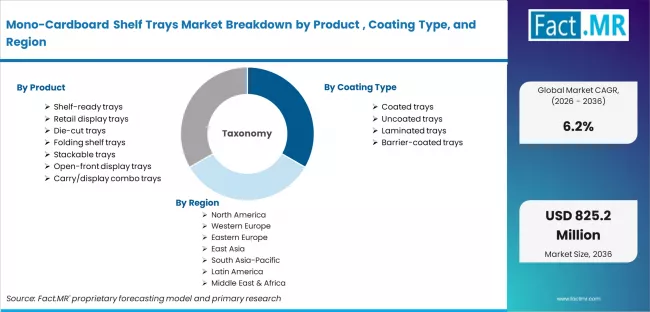
Mono Cardboard Shelf Trays Market Breakdown By Product , Coating Type, And Region | Source: Fact.MR
Parameter |
Details |
|---|---|
| Quantitative Units | USD 425.8 Million (2025) to USD 825.2 Million (2036), at a CAGR of 6.2% |
| Market Definition | The mono-cardboard shelf trays market covers paperboard and corrugated-based retail-ready packaging solutions designed for product display, shelf organization, transportation, and merchandising applications across retail and industrial supply chains. |
| Regions Covered | North America, Eastern Europe, Western Europe, East Asia, South Asia & Pacific, Latin America, Middle East & Africa |
| Countries Covered | USA, Canada, UK, Germany, France, China, Japan, India, South Korea, Brazil, Saudi Arabia, UAE, and 20+ countries |
| Key Companies | International Paper, DS Smith, Smurfit Westrock, Graphic Packaging International, Mondi Group, Mayr-Melnhof Karton, Huhtamaki, Rengo Co., Ltd., Sonoco Products Company, Stora Enso |
| Forecast Period | 2026 to 2036 |
| Approach | Hybrid demand-side and top-down methodology based on retail-ready packaging adoption, sustainable paperboard packaging demand, expansion of organized retail and e-commerce logistics, increasing replacement of plastic retail trays, and rising investments in recyclable corrugated packaging solutions, validated through primary interviews with corrugated packaging manufacturers, paperboard suppliers, retail packaging converters, FMCG companies, packaging distributors, retail merchandising specialists, and industry experts across key regional markets. |
Analysis by Product, Coating Type, Material Type, Application, End-Use Industry, and Region
-
Mono-Cardboard Shelf Trays Market by Product
- Shelf-ready trays
- Retail display trays
- Die-cut trays
- Folding shelf trays
- Stackable trays
- Open-front display trays
- Carry/display combo trays
-
Mono-Cardboard Shelf Trays Market by Coating Type
- Coated trays
- Uncoated trays
- Laminated trays
- Barrier-coated trays
-
Mono-Cardboard Shelf Trays Market by Material Type
- Corrugated cardboard
- Paperboard
- Kraft board
- Recycled fiberboard
- Virgin fiberboard
-
Mono-Cardboard Shelf Trays Market by Application
- Retail shelf packaging
- E-commerce packaging
- Point-of-sale (POS) displays
- Wholesale transport trays
- Promotional display packaging
-
Mono-Cardboard Shelf Trays Market by End-Use Industry
- Food & Beverage
- Snacks
- Bakery
- Frozen foods
- Ready-to-eat meals
- Beverages
- Pharmaceuticals
- OTC medicines
- Medical devices
- Healthcare products
- Personal Care & Cosmetics
- Skincare
- Makeup
- Toiletries
- Consumer Goods
- Household products
- FMCG packaging
- Electronics
- Accessories
- Small gadgets
- Food & Beverage
-
Mono-Cardboard Shelf Trays Market by Region
- North America
- USA
- Canada
- Mexico
- Latin America
- Brazil
- Chile
- Rest of LATAM
- East Asia
- China
- Japan
- South Korea
- Taiwan
- South Asia & Pacific
- India
- Singapore
- Australia
- ASEAN
- Western Europe
- Germany
- France
- U.K.
- Italy
- Spain
- BENELUX
- Nordic
- Rest of Western Europe
- Eastern Europe
- Poland
- Hungary
- Czech Republic
- Balkan & Baltics
- Rest of Eastern Europe
- Middle East and Africa
- Kingdom of Saudi Arabia
- United Arab Emirates
- South Africa
- Rest of Middle East and Africa
- North America
Frequently Asked Questions
How large is the demand for Mono-Cardboard Shelf Trays in the global market in 2025?
What will be the market size of the Mono-Cardboard Shelf Trays Market by 2036?
What is the expected demand growth for the Mono-Cardboard Shelf Trays Market between 2026 and 2036?
Which material type segment is expected to dominate the market?
How significant is the growth outlook for India in this market?
Which company is identified as a leading player in the Mono-Cardboard Shelf Trays Market?
Who worked on this report


Preview the report firsthand - request a free sample
Free SampleGet the brochure for pricing and purchase details
Download PDF