- Forecast Value (2036): 16.5 Bn
- CAGR (2036): 14.7%
What is the sports documentary production market forecast to be worth by 2036?
USD 4.2 billion in 2026 to USD 16.5 billion by 2036, at 14.7% CAGR.
- The sports documentary production market surpassed a valuation of USD 3.7 billion in 2025.
- Demand is expected to increase from USD 4.2 billion in 2026 to USD 16.5 billion by 2036.
- The market is forecast to record 14.7% CAGR from 2026 to 2036 as leagues and streaming platforms use documentary access to build fan attachment between live events.
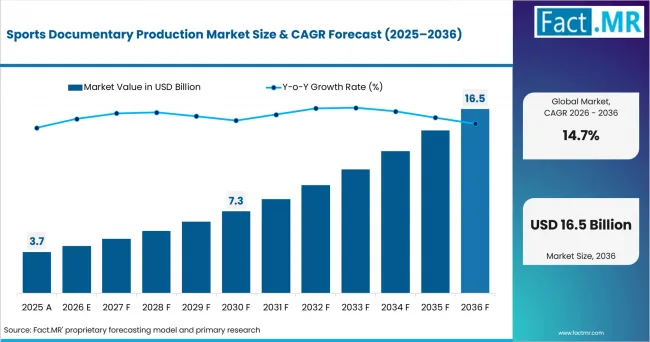
Sports Documentary Production Market Market Value Analysis | Source: Fact.MR
What are the defining numbers behind sports documentary production market growth?
USD 12.3 billion absolute opportunity by 2036, led by the United States and the United Kingdom.
- Demand Drivers in the Market
- Streaming commissioners need sports stories that extend engagement beyond live fixtures.
- League content heads need access projects that turn athletes into year-round fan assets.
- Production studios need repeatable series formats that lower development risk.
- Sports brands need documentaries that build emotional value around teams and athletes.
- Key Segments Analyzed
- By Format Type: Multi-Episode Docuseries are expected to hold 42.0% share in 2026 because recurring episodes create longer platform engagement.
- By Commissioning Platform: Streaming Platforms lead because they use sports stories to support subscriber retention. The share is projected at 47.0% in 2026.
- By Production Stage: Production and Filming Services are likely to account for 38.0% share in 2026 because access-led stories need field crews.
- By Sport Type: Football/Soccer leads with 29.0% share in 2026 because global fan bases support cross-border distribution.
- By Monetization Model: Streaming Originals and Licensing are expected to hold 44.0% share in 2026 because platforms pay for exclusive access-led content.
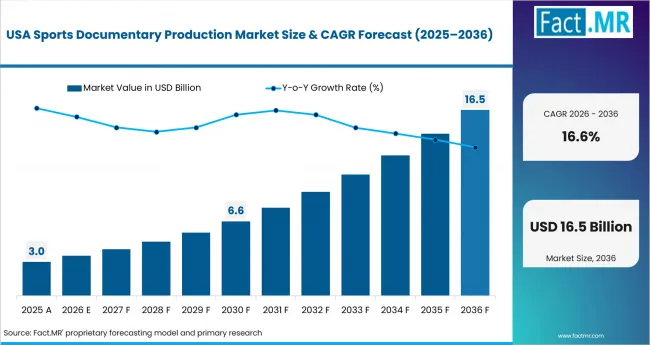
- By Geography: The United States is projected to record 16.6% CAGR through 2036 as streamer and league media activity expands.
- Analyst Opinion at Fact.MR
- Shambhu Nath Jha, Senior Analyst at Fact.MR, states, “Sports documentary production is becoming fan development infrastructure. We see platforms using access-led series to turn athletes into story assets. Production companies that can protect trust with leagues while delivering dramatic arcs will gain stronger access to premium commissions.”
- Strategic Implications
- Production studios should secure long-term access agreements before building series formats.
- Streamers should use release timing around live sports calendars.
- League media teams can package archives with current-season access.
- Post-production providers should invest in sports archival workflows.
Sports documentary production covers concept development, access negotiation, filming, post-production and platform delivery for unscripted sports stories. The category connects with streaming media because subscription platforms need sports stories that hold attention beyond live rights. The strongest adoption case comes from leagues that want new fans without adding more fixtures.
Netflix announced 2024 sports docuseries projects around Carlos Alcaraz and the Boston Red Sox. This shows how platforms are using season-long access and athlete-led narratives as recurring content formats.
ESPN Films announced a 2024 30 for 30 summer slate across ESPN and ESPN+. This supports the production market because sports documentary brands still hold value outside subscription-only streaming. Prime Video greenlit new sports documentaries in 2024 across women’s basketball and motorsport-led themes. This shows how premium platforms are expanding sports storytelling as part of broader sports media strategy.
The United States is projected to record 16.6% CAGR through 2036 as streaming platforms and league media arms commission more access-led projects. The United Kingdom is expected to post 15.8% CAGR through 2036 as production houses build global sports series. India is likely to record 15.2% CAGR as cricket and Olympic stories attract platform interest. Germany is forecast to advance at 14.1% CAGR as football and motorsport documentaries expand. Japan is set to record 13.6% CAGR as athlete stories support domestic and export-ready content.
How does the sports documentary production market break down by segment?
Multi-Episode Docuseries lead at 42.0%; Streaming Platforms lead at 47.0%.
Which format type dominates?
Multi-Episode Docuseries hold 42.0% share in 2026.
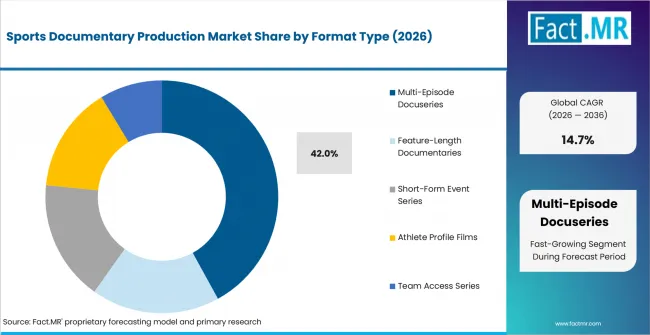
Sports Documentary Production Market Analysis By Format Type | Source: Fact.MR
Multi-Episode Docuseries are expected to hold 42.0% share in 2026 because sports stories gain value when fans follow a full season or athlete journey. The format supports character arcs and rivalry build-up. It also gives platforms more release flexibility than a single film. The segment connects with sports analytics because data-led storytelling helps explain performance without slowing the narrative.
Which commissioning platform dominates?
Streaming Platforms account for 47.0% share in 2026.
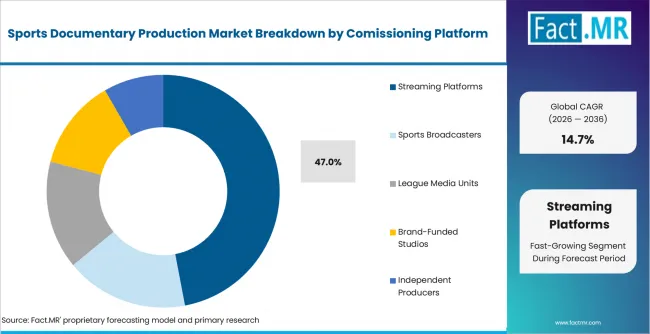
Sports Documentary Production Market Analysis By Comissioning Platform | Source: Fact.MR
Streaming Platforms lead because documentary series help platforms build sports audiences without buying every live right. The commissioning platform is projected to capture 47.0% share in 2026. Netflix, Prime Video and Apple TV+ use sports stories to create global viewing events. Broadcasters remain important when legacy documentary brands have strong audience trust. Streamers lead because bingeable series fit platform behavior.
Which production stage dominates?
Production and Filming Services hold 38.0% share in 2026.
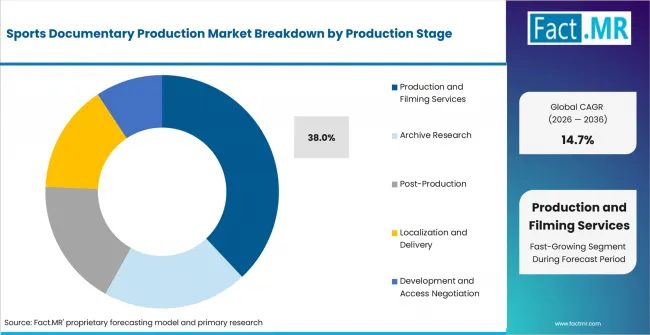
Sports Documentary Production Market Analysis By Production Stage | Source: Fact.MR
Production and Filming Services lead because access-led projects need crews embedded with teams or athletes. The stage is likely to account for 38.0% share in 2026. Field production requires travel planning and clearance management. Post-production is important but filming access determines what story can be built later. The video switchers layer supports multi-camera production when interviews and field setups require flexible capture.
Which sport type dominates?
Football/Soccer leads with 29.0% share in 2026.
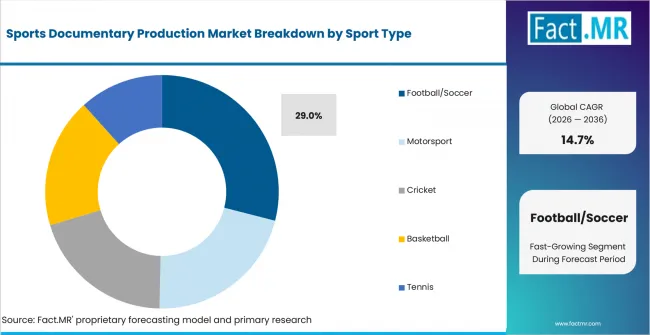
Sports Documentary Production Market Analysis By Sport Type | Source: Fact.MR
Football/Soccer leads because clubs and national teams have global fan bases. The sport type is expected to hold 29.0% share in 2026. Football documentaries can travel across languages when the story centers on identity and rivalry. Motorsport follows because racing teams offer strong behind-the-scenes drama. Basketball and tennis projects gain when individual athletes carry the story.
Which monetization model dominates?
Streaming Originals and Licensing hold 44.0% share in 2026.
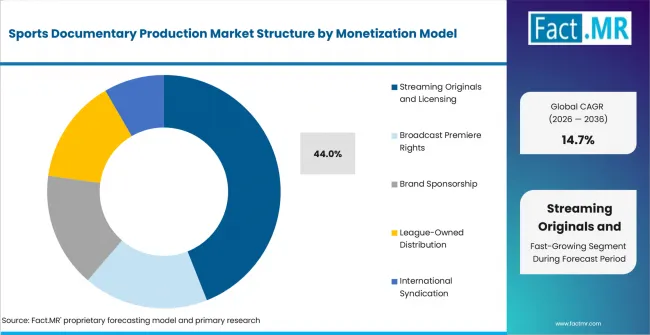
Sports Documentary Production Market Analysis By Monetization Model | Source: Fact.MR
Streaming Originals and Licensing lead because platforms use exclusive documentary access to strengthen viewing libraries. The model is expected to hold 44.0% share in 2026. Producers benefit when rights and distribution are agreed before filming starts. Broadcaster licensing remains useful for local sports stories. The media buying layer supports promotion when documentary releases are tied to event calendars.
What is accelerating sports documentary production demand, and what is holding it back?
Platform sports storytelling drives demand; access control restrains production timelines.
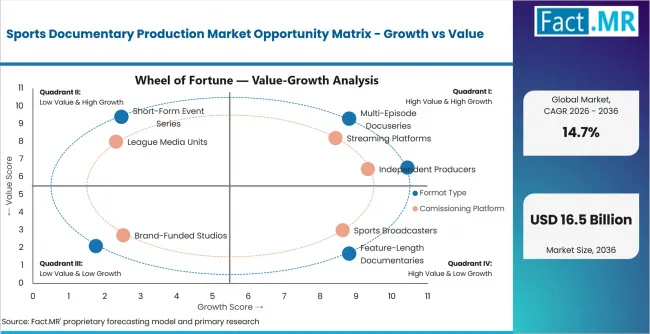
Sports Documentary Production Market Opportunity Matrix Growth Vs Value | Source: Fact.MR
Platform sports storytelling is the main driver. Netflix announced a documentary series about Rafael Nadal with Skydance Sports in 2024. This supports demand for athlete-led access projects with international appeal. League access adds another driver. Apple TV+ announced a documentary event around the 2024 World Series. This shows how rights holders can turn major sporting moments into premium documentary assets.
Short-form storytelling is creating another route. DAZN and NEO Studios announced Home Turf in 2025 as a docuseries tied to FIFA Club World Cup 2025. This supports smaller documentary formats that promote upcoming events. Production technology improves coverage quality. The 360-degree camera link is relevant because immersive cameras help crews capture training and venue scenes. Documentary producers can use lighter camera systems to film more intimate access moments.
The main restraint is access control. Teams and athletes may limit filming during sensitive periods. Producers must balance honesty with relationship management before a platform accepts the final cut.
Where do the biggest sports documentary production opportunities sit?
Athlete access, league archives and short-form event storytelling.
- Athlete Access: Producers can build global titles around athletes with strong cross-border appeal.
- League Archives: Rights holders can monetize old footage through new documentary formats.
- Event Storytelling: Platforms can use short-form projects to promote upcoming tournaments.
Which countries are scaling sports documentary production fastest?
United States 16.6%, United Kingdom 15.8%, India 15.2%, Germany 14.1%, Japan 13.6%.
Based on regional analysis, the sports documentary production market is segmented into North America, Western Europe, Asia Pacific, Latin America, and Middle East and Africa.
.webp "Top Country Growth Comparison Sports Documentary Production Market Cagr (2026 2036)")
Top Country Growth Comparison Sports Documentary Production Market Cagr (2026 2036) | Source: Fact.MR
| Country | CAGR |
|---|---|
| United States | 16.6% |
| United Kingdom | 15.8% |
| India | 15.2% |
| Germany | 14.1% |
| Japan | 13.6% |
Source: Fact.MR analysis. Updated Jun 25, 2026
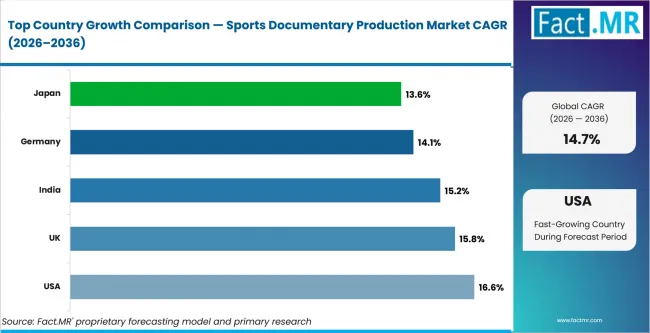
Sports Documentary Production Market Cagr Analysis By Country | Source: Fact.MR
What is powering the United States lead?
16.6% CAGR, driven by ESPN Films and league-backed access projects.
Sports Documentary Production Market Country Value Analysis | Source: Fact.MR
The United States is projected to record 16.6% CAGR by 2036 as streamers and sports networks expand documentary slates. ESPN Films keeps sports documentary brands active across broadcast and streaming. NFL, MLB and basketball stories offer strong archive depth. Growth will favor producers with league access and post-production scale.
How is the United Kingdom scaling sports documentary production demand?
15.8% CAGR, supported by Box to Box Films and global docuseries demand.
The United Kingdom is expected to post 15.8% CAGR through 2036 as production companies build export-ready sports series. Local producers have strong access-led storytelling experience. Football and motorsport create repeat commissions. Growth will favor studios with trusted athlete relationships.
What supports India’s outlook?
15.2% CAGR, driven by cricket stories and platform-led regional content.
India is likely to record 15.2% CAGR from 2026 to 2036 as cricket documentaries attract domestic and diaspora audiences. Platforms can build stories around players and national tournaments. Local production crews can support multilingual releases. Growth will favor producers with cricket access and regional editing capacity.
What underpins Germany’s growth?
14.1% CAGR, led by football clubs and motorsport heritage.
Germany is forecast to advance at 14.1% CAGR by 2036 as football clubs use documentary storytelling for fan engagement. Motorsport history adds another production lane. Broadcaster and streamer demand will support premium local stories. Growth will favor crews that can manage club access without disrupting team operations.
How is Japan scaling sports documentary production adoption?
13.6% CAGR, backed by athlete stories and international platform interest.
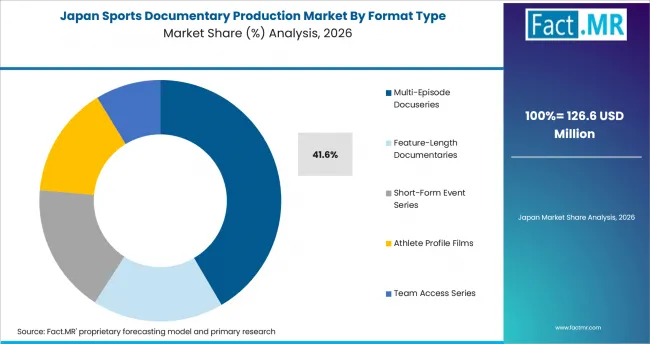
Sports Documentary Production Market Japan Market Share Analysis By Format Type | Source: Fact.MR
Japan is set to record 13.6% CAGR through 2036 as global platforms seek athlete-led stories with export value. Baseball and combat sports provide strong subject depth. Local crews can support culturally precise storytelling. Growth will favor producers that can balance domestic authenticity with global subtitles and distribution needs.
Who leads the sports documentary production market?
Netflix and ESPN Films lead through recurring sports documentary commissioning.
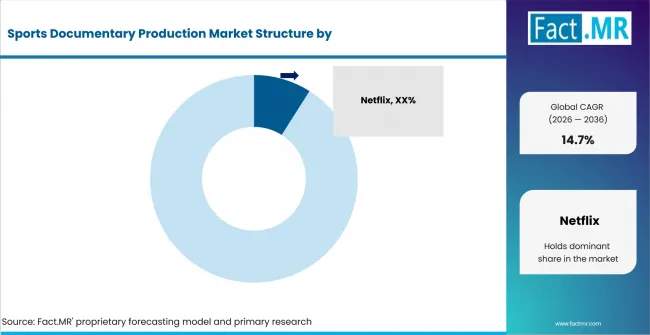
Sports Documentary Production Market Analysis By Company | Source: Fact.MR
Sports documentary production is shaped by platforms, sports media units and specialist producers. Netflix leads through global docuseries commissioning. ESPN Films remains a strong sports documentary brand through 30 for 30.
Prime Video supports sports documentaries that connect with its live sports strategy. Apple TV+ uses premium sports access to build event-led documentary programming. Skydance Sports works with major platforms on athlete-led projects. Box to Box Films is a specialist producer known for access-led sports series.
Competition through 2036 will depend on access trust and editorial control. Producers need athlete relationships and archive rights. Platforms need stories that keep fans engaged before the next live event. The content moderation layer matters because sports documentaries must manage sensitive footage and public reaction after release.
Which companies are the key providers?
Netflix and ESPN Films are key providers. Prime Video and Apple TV+ are also profiled. Skydance Sports and Box to Box Films complete the company set.
- Netflix
- ESPN Films
- Prime Video
- Apple TV+
- Skydance Sports
- Box to Box Films
Bibliography
- [1] Netflix. (2024, March 14). Alcaraz, the docuseries: An incredible journey through the eyes of Carlos Alcaraz arrives on Netflix. Netflix.
- [2] ESPN. (2024, May 14). ESPN Films announces upcoming 30 for 30 summer 2024 programming slate. ESPN Press Room.
- [3] Amazon MGM Studios. (2024, May 14). Prime Video greenlights four new sports documentaries at inaugural upfront presentation. Amazon MGM Studios.
- [4] Netflix. (2024, December 18). Netflix and Skydance Sports announce new docuseries on tennis icon Rafael Nadal. Netflix.
- [5] Apple TV+. (2024, October 22). Apple TV+ announces new Major League Baseball documentary event offering fans an immersive all-access view on the 2024 World Series. Apple TV+ Press.
- [6] DAZN Group. (2025, May 22). Home Turf premieres on DAZN. DAZN Group.
This Report Addresses
- Strategic intelligence on sports documentary production across format type and commissioning platform.
- Segment analysis covering Multi-Episode Docuseries and Streaming Platforms.
- Regional outlook covering the United States, the United Kingdom, India, Germany and Japan.
- Competitive analysis of Netflix, ESPN Films, Prime Video, Apple TV+, Skydance Sports and Box to Box Films.
- Production assessment covering access negotiation, field filming and post-production workflows.
- Use case assessment covering athlete profiles, team access and tournament-linked stories.
- Primary interviews, provider checks and official source review support the forecast.
What does the sports documentary production market cover?
Access-led non-fiction sports films and series for broadcast or streaming platforms.
The sports documentary production market covers documentary films, docuseries, short-form episodes and team access projects. It includes development, rights access, archival research, field production and post-production. The scope connects with enterprise video because production quality and distribution workflows now shape how sports stories reach digital audiences.
The market differs from live sports broadcasting because documentary value comes after events are shaped into story. Production teams need athlete access and editorial trust. Rights holders need brand control without weakening the emotional edge of the story.
What is included in the scope?
Documentary films, docuseries and short-form sports features.
The scope includes single-title documentaries and episodic access series. It includes drone filming when aerial footage supports stadium scenes or athlete training sequences. It covers interviews and platform delivery.
The scope includes streamer commissions and league-owned production projects. It covers athlete-led films and team-focused series. It also includes documentary work linked to upcoming tournaments or franchise launches.
What is excluded from the scope?
Live match production without documentary storytelling.
The scope excludes live event broadcasting unless documentary footage is produced from that content. It excludes ordinary highlight packages with no narrative production. It excludes sports news segments unless they are developed as long-form documentary projects. It excludes scripted sports films because those follow different commissioning and production economics.
How was the analysis built?
100+ sources, 40+ company portfolios, 25+ countries, 20+ interviews.
- Primary Research: Primary research includes interviews with documentary producers and sports media commissioners. It includes input from league content heads and post-production supervisors.
- Desk Research: Desk research reviews official platform announcements and sports documentary slates. It covers streamer commissions, rights-holder media units and video editing workflows.
- Market-Sizing and Forecasting: Forecasting uses platform commissioning activity and league content calendars. Production budgets and post-production service attachment support the market assessment.
- Data Validation and Update Cycle: Forecasts are validated through producer checks and platform release tracking. Rights-holder access announcements help confirm market direction.
Segmentation
What is the report’s scope and coverage?
Sports Documentary Production Market Breakdown By Format Type, Comissioning Platform, And Region | Source: Fact.MR
| Attribute | Details |
|---|---|
| Quantitative Units | USD Billion in 2026 to USD Billion by 2036 at CAGR |
| Market Definition | Production of access-led sports documentaries for streaming and broadcast distribution |
| Format Type | Multi-Episode Docuseries; Feature-Length Documentaries; Short-Form Event Series; Athlete Profile Films; Team Access Series |
| Commissioning Platform | Streaming Platforms; Sports Broadcasters; League Media Units; Brand-Funded Studios; Independent Producers |
| Production Stage | Development and Access Negotiation; Production and Filming Services; Archive Research; Post-Production; Localization and Delivery |
| Sport Type | Football/Soccer; Motorsport; Cricket; Basketball; Tennis |
| Monetization Model | Streaming Originals and Licensing; Broadcast Premiere Rights; Brand Sponsorship; League-Owned Distribution; International Syndication |
| Regions Covered | North America; Western Europe; Asia Pacific; Latin America; Middle East and Africa |
| Countries Covered | United States; United Kingdom; India; Germany; Japan |
| Key Companies Profiled | Netflix; ESPN Films; Prime Video; Apple TV+; Skydance Sports; Box to Box Films |
| Forecast Period | 2026 to 2036 |
| Approach | Hybrid top-down and bottom-up approach using platform commissions, production slates, rights access and provider validation |
Source: Fact.MR analysis. Updated Jun 25, 2026
How is the market segmented?
-
By Format Type:
- Multi-Episode Docuseries
- Feature-Length Documentaries
- Short-Form Event Series
- Athlete Profile Films
- Team Access Series
-
By Commissioning Platform:
- Streaming Platforms
- Sports Broadcasters
- League Media Units
- Brand-Funded Studios
- Independent Producers
-
By Production Stage:
- Development and Access Negotiation
- Production and Filming Services
- Archive Research
- Post-Production
- Localization and Delivery
-
By Sport Type:
- Football/Soccer
- Motorsport
- Cricket
- Basketball
- Tennis
-
By Monetization Model:
- Streaming Originals and Licensing
- Broadcast Premiere Rights
- Brand Sponsorship
- League-Owned Distribution
- International Syndication
-
Region:
- North America
- United States
- Canada
- Europe
- United Kingdom
- Germany
- France
- Spain
- Italy
- Asia Pacific
- India
- Japan
- South Korea
- Australia
- China
- Latin America
- Brazil
- Mexico
- Argentina
- Middle East & Africa
- Saudi Arabia
- UAE
- South Africa
- Qatar
- North America
Frequently Asked Questions
Which format type leads the Sports Documentary Production Market?
Which commissioning platform leads the Sports Documentary Production Market?
Which production stage leads the Sports Documentary Production Market?
Which sport type leads the Sports Documentary Production Market?
Which monetization model leads the Sports Documentary Production Market?
Which country expands fastest in the Sports Documentary Production Market?
How does the United Kingdom perform in the Sports Documentary Production Market?
How does India perform in the Sports Documentary Production Market?
How does Germany perform in the Sports Documentary Production Market?
How does Japan perform in the Sports Documentary Production Market?
What is the primary driver in the Sports Documentary Production Market?
What is the main restraint in the Sports Documentary Production Market?
Why are docuseries important in this market?
Why do streaming platforms lead commissioning?
Who worked on this report


Preview the report firsthand - request a free sample
Free SampleGet the brochure for pricing and purchase details
Download PDF