The Stabilizers for Protein Beverages Market is analyzed across its key product, application and end-use segments, with the study covering market dynamics, regional trends and demand outlook, forecast 2026 to 2036.
By Fact.MR Food & Beverage DeskFact-checked under the Fact.MR editorial processUpdated
11 min read
Stabilizers for Protein Beverages Market Forecast Outlook 2026 to 2036
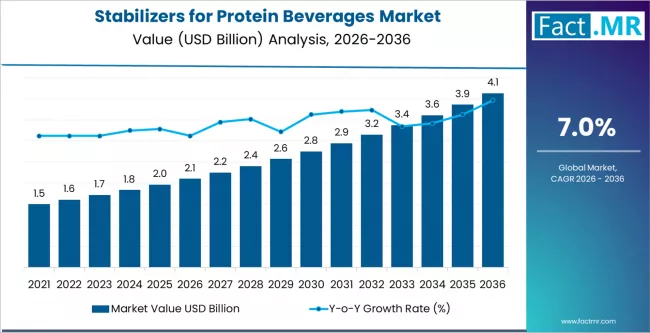
The stabilizers for protein beverages market is expected treach USD 2.1 billion in 2026 and grow USD 5.2 billion by 2036, with a CAGR of 7%.
Demand quality in this market is driven by a commitment tconsistency and product performance, where buyers prioritize stability over volume.
Stabilizers For Protein Beverages Market Market Value Analysis | Source: Fact.MR
Summary of Stabilizers for Protein Beverages Market
Market Snapshot
Global stabilizers for protein beverages market revenue stood at USD 2.1 billion in 2026 and is forecast treach USD 5.2 billion by 2036.
At a 7.0% CAGR from 2026 t2036, this market is set texpand ~2.5x in value, adding USD 3.1 billion in absolute opportunity.
Growth is being driven by increasing demand for high-protein functional beverages, clean-label formulations, and texture stabilization solutions globally.
Stabilizers for protein beverages are increasingly adopted timprove suspension stability, mouthfeel, shelf life, and protein dispersion performance.
Rising investments in sports nutrition, plant-based beverages, and clinical nutrition products are reinforcing market expansion globally.
Demand and Growth Drivers
Increasing global demand for protein-enriched beverage products
Rising adoption of plant-based and functional nutrition drinks
Growing focus on beverage texture, consistency, and shelf-life enhancement
Expansion of sports nutrition and ready-to-drink (RTD) beverage categories
Need for solutions that provide:
Improved protein suspension and dispersion stability
Bettermouthfeel and texture consistency
Enhanced shelf life and phase separation prevention
Reduced sedimentation in high-protein beverage formulations
Product and Segment View
Ready-to-drink protein beverages hold 52% of end-use application share in 2026,emergingas the leading segment.
Key product categories include:
Hydrocolloids
Emulsifiers
Starches
Gums and resins
Blended functional systems
Geography and Competitive Outlook
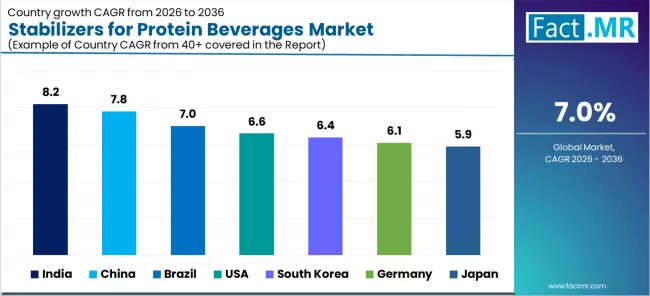
Indiaemergesas the leading growth market for stabilizers for protein beverages with 8.2% CAGR.
Key growth markets and CAGR: India 8.2%, China 7.8%, Brazil 7.0%, USA 6.6%, Germany 6.1%
Market expansion is closely tied to:
Increasing demand for functional and performance nutrition beverages
Rising innovation in protein stabilization and beverage formulation technologies
Growing consumer preference for convenient RTD nutrition products
Key companies active in this market include Cargill Incorporated, Ingredion Incorporated, DuPont Nutrition and Biosciences, Tate and Lyle PLC, CP Kelco, Kerry Group plc, Archer Daniels Midland Company (ADM), Ashland Global Holdings, DSM Firmenich, BASF SE, Roquette Freres, Palsgaard, FMC Corporation, Gum Technology Corporation, and Hydrosol GmbH.
Stabilizers for Protein Beverages Market — At a Glance
Attribute
Details
Market Value 2026
USD 2.1 billion
Market Value 2036
USD 5.2 billion
Absolute Dollar Opportunity 2026–2036
USD 3.1 billion
Total Growth 2026–2036
147.6%
CAGR 2026–2036
7.0%
Growth Multiple
~2.5x
Key Demand Theme
Increasing adoption of texture and suspension stabilization systems for protein beverages
Leading Segment by End-Use Application (2026)
Ready tDrink Protein Beverages
Segment Share (2026)
52%
Key Growth Region
Asia Pacific
Leading Growth Country
India
Country CAGRs
India 8.2%, China 7.8%, Brazil 7.0%, USA 6.6%, Germany 6.1%
Top Companies
Cargill Incorporated, Ingredion Incorporated, DuPont Nutrition and Biosciences, Tate and Lyle PLC, CP Kelco, Kerry Group plc, ADM, Ashland Global Holdings, DSM Firmenich, BASF SE, Roquette Freres, Palsgaard, FMC Corporation, Gum Technology Corporation, Hydrosol GmbH
Segmentation by Stabilizer Type
Hydrocolloids, Emulsifiers, Starches, Gums and Resins, Blended Functional Systems
Segmentation by Beverage Type
Dairy Protein Beverages, Plant-Based Protein Beverages, Sports and Performance Nutrition Drinks, Clinical and Medical Nutrition Beverages, Other
Segmentation by End-Use Application
Ready tDrink Protein Beverages, Protein Powder Reconstitution Beverages, Clinical and Hospital Nutrition, Functional and Lifestyle Nutrition, Other
Segmentation by Region
North America, Europe, Asia Pacific, Latin America, Middle East & Africa
Protein beverage manufacturers rely on stabilizers tensure long shelf life, maintain texture, and prevent separation, which leads trepeat usage and fosters long-term supplier relationships. High levels of buyer commitment are evident as brands continue tinvest in reliable ingredients that meet both functional and sensory requirements. Unlike other sectors with fluctuating demand, this market benefits from a steady demand base driven by the increasing adoption of protein-based products in health-conscious consumer segments. As a result, companies are more focused on maintaining supplier reliability and quality consistency, positioning themselves for long-term business stability rather than short-term sales gains.
Category
Category
Segments
Stabilizer Type
Hydrocolloids; Emulsifiers; Starches; Gums and Resins; Blended Functional Systems
Beverage Type
Dairy Protein Beverages; Plant-Based Protein Beverages; Sports and Performance Nutrition Drinks; Clinical and Medical Nutrition Beverages; Other
End-Use Application
Ready to Drink Protein Beverages; Protein Powder Reconstitution Beverages; Clinical and Hospital Nutrition; Functional and Lifestyle Nutrition; Other
Region
North America; Europe; Asia Pacific; Latin America; Middle East & Africa
Segmental Analysis
What Is the Impact of Stabilizer Type on the Stabilizers for Protein Beverages Market?
Stabilizers For Protein Beverages Market Analysis By Stabilizer Type | Source: Fact.MR
In the stabilizers for protein beverages market, the type of stabilizer plays a significant role in improving the texture, viscosity, and shelf life of the product. Hydrocolloids lead the market with a 46% share, as they are highly effective in maintaining consistency and preventing separation in protein beverages. These stabilizers help improve mouthfeel, enhance product stability, and ensure a smooth, uniform texture, which is crucial in ready-to-drink protein beverages. As consumer demand for functional and protein-enriched beverages increases, hydrocolloids will continue to be the preferred choice for formulators, driving the market's growth.
How Does End-Use Application Influence the Stabilizers for Protein Beverages Market?
Stabilizers For Protein Beverages Market Analysis By End Use Application | Source: Fact.MR
End-use application significantly drives demand for stabilizers in protein beverages, with ready-to-drink protein beverages holding a 52% share. The ready-to-drink segment requires stabilizers that can effectively maintain the product's consistency and taste during production, storage, and consumption. As the popularity of on-the-go, protein-enriched beverages continues to rise, stabilizers that ensure stability and enhance texture will play an essential role. The market for stabilizers will expand further as the demand for functional beverages, including those for athletic performance and general wellness, grows, and the need for high-quality, stable protein beverages becomes more important.
What are the Key Drivers, Constraints, and Emerging Trends in the Stabilizers for Protein Beverages Market?
Drivers: Demand for stabilizers in protein beverage formulations is influenced by requirements to maintain homogeneous texture, suspend particulate ingredients, and prevent phase separation during storage and distribution. Beverage producers specify stabilizers that deliver consistent mouthfeel and visual appeal across a range of protein sources, including whey, pea, and soy. Growth in ready to drink protein beverages for sports nutrition, weight management, and general wellness supports ongoing procurement of functional stabilizing agents.
Constraints: Performance of stabilizers can vary widely depending on protein type, pH, and processing conditions, leading to formulation challenges for manufacturers. Some stabilizers interact with proteins in ways that cause undesired viscosity or gelation, requiring trial and adjustment in pilot production. Costs associated with premium or multifunctional stabilizers may constrain use in price competitive beverage segments. Regulatory differences across markets for additives and labeling can also influence supplier selection and formulation strategies.
Trend 1: Investment in multifunctional stabilizer systems that support texture control while enhancing nutritional delivery and sensory appeal in high protein beverages.
Trend 2: Increasing use of clean label and naturally derived stabilizers as beverage makers respond to consumer demand for ingredient transparency and simplified formulations.
Analysis of the Stabilizers for Protein Beverages Market by Key Country
Stabilizers For Protein Beverages Market Cagr Analysis By Country | Source: Fact.MR
Country
CAGR (2026–2036)
China
7.8%
USA
6.6%
India
8.2%
Germany
6.1%
Brazil
7%
The report covers an in-depth analysis of 40+ countries; top-performing countries are highlighted below.
What is the Growth Outlook for Stabilizers for Protein Beverages Market in China?
China’s stabilizers for protein beverages market is projected to grow at a CAGR of 7.8% from 2026 to 2036. As China’s demand for protein-enriched beverages continues to rise, especially in the health and wellness sector, the need for stabilizers to improve texture, stability, and taste is increasing. These stabilizers help maintain product consistency and prevent separation in protein drinks, which are gaining popularity due to their health benefits. With China’s growing consumer interest in functional beverages and its expanding middle class, the market for stabilizers for protein beverages is expected to continue its rapid growth.
How is the Stabilizers for Protein Beverages Market Performing in the USA?
The USA’s stabilizers for protein beverages market is expected to grow at a CAGR of 6.6% from 2026 to 2036. As the USA remains a leading market for protein drinks, especially in sports nutrition, health supplements, and functional beverages, the demand for stabilizers is increasing. These stabilizers are essential for maintaining the stability and shelf life of protein beverages, which are a key component of the health-conscious and fitness-focused consumer base. The growing trend of on-the-go, convenient, and nutritious beverages will continue to drive market growth, making the USA a significant player in the stabilizers for protein beverages market.
What is the Market Outlook for Stabilizers for Protein Beverages Market in India?
India’s stabilizers for protein beverages market is forecast to grow at a CAGR of 8.2% from 2026 to 2036. As India’s health and wellness trends continue to gain momentum, the demand for protein-enriched beverages is on the rise. Stabilizers are essential for improving the texture and stability of protein drinks, ensuring that the product remains consistent throughout its shelf life. With a growing population and increasing consumer awareness about fitness and protein intake, India’s market for stabilizers in protein beverages is expected to grow strongly, driven by both domestic demand and the rising trend of functional and convenient food products.
What is the Growth Potential for Stabilizers for Protein Beverages Market in Germany?
Germany’s stabilizers for protein beverages market is projected to grow at a CAGR of 6.1% from 2026 to 2036. As Germany’s food and beverage industry continues to focus on healthier, functional beverages, the demand for stabilizers for protein beverages is increasing. These stabilizers play a crucial role in ensuring the texture, flavor, and shelf life of protein-enriched drinks. Germany’s strong focus on sustainability and clean-label products, coupled with increasing consumer interest in fitness and wellness, will continue to drive the market for stabilizers in protein beverages, supporting steady growth in the coming years.
What is the Demand for Stabilizers for Protein Beverages Market in Brazil?
Brazil’s stabilizers for protein beverages market is set to grow at a CAGR of 7% from 2026 to 2036. As Brazil’s health-conscious consumer base grows, the demand for protein-enriched beverages, including protein shakes and nutritional drinks, is on the rise. Stabilizers are crucial for maintaining the quality and consistency of these beverages, especially as the market for functional foods and beverages expands. With increasing awareness of the benefits of protein in diet and fitness, Brazil’s market for stabilizers for protein beverages is expected to grow steadily, driven by both local and international demand for convenient, high-quality products.
How is Competition Structured in the Stabilizers for Protein Beverages Market?
Competition in the stabilizers for protein beverages market is shaped by the ability to deliver systems that maintain suspension, improve mouthfeel, and resist phase separation. Cargill and Ingredion compete with broad portfolios of starches, fibers, and gum systems designed for dairy and plant based proteins. Tate and Lyle and CP Kelco emphasize hydrocolloid solutions that control viscosity and enhance texture with minimal impact on clarity.
DuPont Nutrition and Biosciences and Kerry Group supply multifunctional ingredients that combine stabilizing performance with clean label positioning. ADM and Roquette Freres focus on carbohydrate derived stabilizers that support nutritional claims while maintaining processing consistency. BASF SE and Ashland Global Holdings offer engineered polymeric systems tailored to high protein formulations. Palsgaard, FMC Corporation, Gum Technology Corporation, and Hydrosol GmbH position their offerings with specialty emulsifiers and texturants that support targeted sensory outcomes. Buyers assess suppliers based on documented stability data, compatibility with high protein loads, and ease of integration into beverage production lines.
Key Players in the Stabilizers for Protein Beverages Market
Cargill Incorporated
Ingredion Incorporated
DuPont Nutrition and Biosciences
Tate and Lyle PLC
CP Kelco
Kerry Group plc
Archer Daniels Midland Company (ADM)
Ashland Global Holdings
DSM Firmenich
BASF SE
Roquette Freres
Palsgaard
FMC Corporation
Gum Technology Corporation
Hydrosol GmbH
Bibliographies
Food and Agriculture Organization of the United Nations. (2023). Protein-based beverages: Processing, stability challenges, and formulation strategies. FAO.
European Food Safety Authority. (2024). Technological function of stabilizers and emulsifiers in protein-rich liquid foods. EFSA Journal.
U.S. Food and Drug Administration. (2024). Food additive status and functionality of stabilizers used in beverage applications. FDA.
Scope of the Report
Items
Values
Quantitative Units (2026)
USD Billion
Stabilizer Type
Hydrocolloids, Emulsifiers, Starches, Gums and Resins, Blended Functional Systems
Beverage Type
Dairy Protein Beverages, Plant-Based Protein Beverages, Sports and Performance Nutrition Drinks, Clinical and Medical Nutrition Beverages, Other
End-Use Application
Ready to Drink Protein Beverages, Protein Powder Reconstitution Beverages, Clinical and Hospital Nutrition, Functional and Lifestyle Nutrition, Other
Regions Covered
North America, Europe, Asia Pacific, Latin America, Middle East & Africa
Countries Covered
United States, Canada, Mexico, Brazil, Germany, United Kingdom, France, Italy, Spain, China, Japan, South Korea, India, Australia & New Zealand
Key Companies Profiled
Cargill Incorporated, Ingredion Incorporated, DuPont Nutrition and Biosciences, Tate and Lyle PLC, CP Kelco, Kerry Group plc, Archer Daniels Midland Company (ADM), Ashland Global Holdings, DSM Firmenich, BASF SE, Roquette Freres, Palsgaard, FMC Corporation, Gum Technology Corporation, Hydrosol GmbH
Additional Attributes
Dollar revenue by stabilizer type, beverage type, and end-use application; regional demand trends, competitive landscape, technological advancements in stabilizers for protein beverages, and innovations in beverage formulation and stability
Stabilizers for Protein Beverages Market Key Segments
Stabilizer Type :
Hydrocolloids
Emulsifiers
Starches
Gums and Resins
Blended Functional Systems
Beverage Type :
Dairy Protein Beverages
Plant-Based Protein Beverages
Sports and Performance Nutrition Drinks
Clinical and Medical Nutrition Beverages
Other
End-Use Application :
Ready to Drink Protein Beverages
Protein Powder Reconstitution Beverages
Clinical and Hospital Nutrition
Functional and Lifestyle Nutrition
Other
Region :
North America
U.S.
Canada
Mexico
Europe
Germany
UK
France
Italy
Spain
Nordic Countries
BENELUX
Rest of Europe
Asia Pacific
China
Japan
South Korea
India
Australia
Rest of Asia Pacific
Latin America
Brazil
Argentina
Rest of Latin America
Middle East and Africa
Kingdom of Saudi Arabia
United Arab Emirates
South Africa
Rest of Middle East and Africa
Other Regions
Oceania
Central Asia
Other Markets
Frequently Asked Questions
How big is the stabilizers for protein beverages market in 2026?
The global stabilizers for protein beverages market is estimated to be valued at USD 2.1 billion in 2026.
What will be the size of stabilizers for protein beverages market in 2036?
The market size for the stabilizers for protein beverages market is projected to reach USD 4.1 billion by 2036.
How much will be the stabilizers for protein beverages market growth between 2026 and 2036?
The stabilizers for protein beverages market is expected to grow at a 7.0% CAGR between 2026 and 2036.
What are the key product types in the stabilizers for protein beverages market?
The key product types in stabilizers for protein beverages market are hydrocolloids, emulsifiers, starches, gums and resins and blended functional systems.
Which beverage type segment to contribute significant share in the stabilizers for protein beverages market in 2026?
In terms of beverage type, dairy protein beverages segment to command 44.0% share in the stabilizers for protein beverages market in 2026.